pity UK taxpayers in decades, centuries and millennia to come.

 When the party’s over … the financial spectre at the end of nuclear power http://www.theecologist.org/News/news_analysis/2985577/when_the_partys_over_the_financial_spectre_at_the_end_of_nuclear_power.html Dr Ian Fairlie 1st October 2015
There are two rules about the end costs of nuclear power, writes Ian Fairlie. It’s far more than you ever knew. And whatever sum of money was ever set aside, it’s nowhere near enough. Germany understands this. That’s why it refused to let E.ON spin off its nuclear liabilities into a hands-off company. But the UK, it seems, has lost the ability to learn from its nuclear mistakes.
Nuclear power has a wide spectrum of disadvantages.
One is that when reactors are shut down for good, a host of financial liabilities continue with no income flow from the sale of nuclear electricity to pay for them.
And enormous new liabilities for decommissioning and final disposal commence at the same time.

This became crystal-clear in April when the German energy giant E.ON proposed to spin off its remaining nuclear activities1 into a separate company, Uniper, in an attempt to protect the parent company from the multiple nuclear liabilities from the impending shutdowns of its nuclear reactors: Germany is phasing out all nuclear power by 2022. Continue reading →
October 3, 2015
Posted by Christina Macpherson |
business and costs, politics, Reference, UK |
Leave a comment

 Nuclear reactors are closing and we are counting http://www.beyondnuclear.org/the-nuclear-retreat/2015/9/30/nuclear-reactors-are-closing-and-we-are-counting.html The United Bank of Switzerland (UBS), the second largest bank in the world, headlined that “Nuke Retirements are coming” in its September 24, 2015 global financial research issue of US Electric Utilities and IPPs. The international investment giant projects “a growing capitulation in the nuclear sector as the prospects for protracted downturn remains front and center.”
UBS forecasts, “We see both ETR (Entergy) and EXC (Exelon) as substantially exposed to this thesis: it has specifically emerged in recent days that not just ETR’s Fitzpatrick but also the Pilgrim unit could well be shut in lieu of investing to improve profile up to NRC levels. Further, we see EXC as highlighting this nuclear retirement thesis further with not just its Ginna plant in NY and Oyster Creek (NJ) plants poised to retire in 2019, but also now its Three Mile Island unit is at risk beyond known the ongoing saga in Illinois over support for Quad Cities, Clinton, and even Byron.”
UBS admits that its forecast “could well underestimate total retirements” as actual retirements might prove more aggressive particularly for the other single unit nuclear power stations. With Exelon’s two unit Quad Cities nuclear power plant in Illinois still posting losses, UBS sees the nuclear power corporation’s “plans to retire the plant as entirely credible (and seemingly committed to investors) should Illinois fail to produce a sufficiently attractive scheme” in spite of the fact that 50% of its nuclear assets are clustered in the state.
There is even more good news to be found in this particular UBS forecast where, “In turn, if retirements move forward as contemplated, we see a real corresponding uplift to the renewable industry as this becomes the growing source of ‘plugging’ for any further holes in meeting prospective carbon targets.” The UBS assessment undermines the pro-nuclear industry’s most prevalent false argument that “No Nukes” means more coal. It clearly doesn’t.
You can keep pace with these anticipated nuclear power plant closures and more by periodically visiting our website’s “Reactors are closing” page.
October 3, 2015
Posted by Christina Macpherson |
business and costs, USA |
Leave a comment
 The Bank of England governor has given a stark warning that climate change poses a huge risk to global stability.
At a gathering of leading insurers at Lloyd’s of London, Mark Carney pointed out the rapid increase in weather-related catastrophes and the jump in both the physical and financial costs.
He said the challenges currently posed by climate change “pale in significance compared with what might come”……http://www.bbc.com/news/business-34396961
October 2, 2015
Posted by Christina Macpherson |
business and costs, UK |
Leave a comment
 Pilgrim Nuclear Power Plant In Massachusetts May Close Down, Clean Technica, September 27th, 2015 by James Ayre Owing to a probable lack of funds for necessary repairs and safety improvements, the Pilgrim Nuclear Power Station will possibly be shut down at some point in the near future, according to the officials involved.
The multimillion dollar safety improvements and repairs in question are federally required actions if the project is to remain open — following the recent downgrading of the facility’s safety rating by the Nuclear Regulatory Commission. The 43-year-old facility is now ranked as one of the least safe nuclear plants in the US.
If the corporation finds that the cost of making the improvements of the plant exceed the value of the plant, the corporation may decide to shut the plant down,” stated David Noyes, the director of regulatory and performance improvement at the facility. “No business decision has been made about Pilgrim. We’re looking at specific conditions, and analyzing weaknesses associated with the plant. As of right now, we don’t know the costs.”
It could ended up being the case, though, that the regulatory commission simply decides to shut down the plant regardless of actions taken to address its issues. The regulatory commission currently rates the facility’s level of risk as “low to moderate.”
As the facility currently provides roughly 12.5% of Massachusetts’ electricity, this is all of course not to be taken lightly. But neither is the fact that the facility is only 35 miles from the mega population center of Boston. Roughly 5 million people currently reside within a 50-mile radius around the facility.
This is a point made recently by Governor Charlie Baker in a letter to Entergy (the operating company) officials, urging officials to “make certain that the plant meets the highest safety standards.”
Interestingly, he also noted that that the company “has failed to take appropriate corrective actions to address the causes of several unplanned shutdowns dating back to 2013.”……….
A couple of final points worth making here are: 1) the basic design of the facility is the same as that of the Fukushima station that is continuing to cause problems in Japan, and 2) Entergy has, as a result, spent some funds in the years since to try and address perhaps latent weaknesses in the design — the company claims to have spent around $70 million on these actions since 2011.
State officials in Massachusetts have yet to comment on what actions would/will be taken to make up for the electricity generation shortfall in the state if the plant closes.
In any case, it is interesting to see that this generation of nuclear power plants is getting to the point where repairs/improvements are too expensive to be worth the life extension. In other words, I think we’re likely to see a gradual decline in nuclear power in the US in the coming decade or so. http://cleantechnica.com/2015/09/27/pilgrim-nuclear-power-plant-massachusetts-may-close/
September 28, 2015
Posted by Christina Macpherson |
business and costs, USA |
Leave a comment
 Russia offers nuclear expertise to Malaysia Star.com. 25 Sept 15 KUALA LUMPUR: Russia will extend its expertise if Malaysia decides to develop its own nuclear programme.
Russian Minister of Economic Development Alexei Ulyukayev, who said this, added that his country was well-placed to build and support a national nuclear industry.
“We will propose a very sophisticated and complex construction of a local nuclear programme. We can construct nuclear power generation stations………http://www.thestar.com.my/News/Nation/2015/09/25/Russia-offers-nuclear-expertise-to-Msia/
September 26, 2015
Posted by Christina Macpherson |
Malaysia, marketing, Russia |
Leave a comment
 Investors shun UK’s £24bn Hinkley Point nuclear project, FT.com , Christopher Adams , 24 Sept 15
Delays and cost overruns that have dogged two nuclear reactors being built in France and Finland have deterred investors from joining a £24bn project to build a plant at Hinkley Point.
French utility EDF is in advanced talks with two Chinese partners — China General Nuclear Corporation and China National Nuclear Corporation — over their final shares of construction spending and roles in the building of up to three nuclear plants in the UK. An agreement could be reached this year.
But Jean-Bernard Levy, EDF chief executive, told Les Echos, the French financial daily newspaper, that it had been unable to secure the support of other investors after persistent problems with the proposed European pressurised reactor design………http://www.ft.com/cms/s/0/67001140-6208-11e5-9846-de406ccb37f2.html#axzz3mgxe3MV2
September 25, 2015
Posted by Christina Macpherson |
business and costs, politics, UK |
Leave a comment
 Only China wants to invest in Britain’s new £2bn Hinkley Point nuclear plant because no one else thinks it will work, EDF admits Investors put off by problems facing nuclear reactors under construction in France and Finland Geert De Clercq Wednesday 23 September 2015 Delays and cost overruns at two nuclear reactors under construction in France and Finland have made potential investors wary of joining a consortium led by France’s EDF for a similar project in Britain, EDF’s chief executive has admitted…….http://www.independent.co.uk/news/business/only-china-wants-to-invest-in-britains-new-2bn-hinkley-point-nuclear-plant-because-no-one-else-10513752.html
September 25, 2015
Posted by Christina Macpherson |
business and costs, politics, UK |
Leave a comment

 Shifting focus: Owner of world’s largest nuclear fleet looks to renewable energy, Fierce Energy September 24, 2015 By William Pentland EDF, the state-controlled electric utility company based in Paris, France, is pinning its hopes for growth on renewable energy investments, including investments in markets outside of Europe. “By 2030, we want to have a significant presence in three to five countries outside of Europe, notably in solar and wind,” said Jean-Bernard Levy, chief executive officer of Electricite de France SA (EDF), in an interview with the French financial daily newspaper,Les Echos.
EDF owns and operates the world’s largest fleet of nuclear reactors. Currently, 95 percent of the French utility’s generating assets are located in either France, Britain or Italy. Levy said EDF would ramp up investments in renewable energy in these markets.
“Our objective is to double our European and French renewables fleet by 2030 from 28 to more than 50 gigawatts,” Levy said.
This strategy departs markedly from the strategy articulated by Levy’s predecessor, Henri Proglio.
While speaking at the Eurelectric conference in June 2014, Poglio said that the European Union needed to assert greater “control” over the pace of renewable energy growth………http://www.fierceenergy.com/story/shifting-focus-owner-worlds-largest-nuclear-fleet-looks-renewable-energy/2015-09-24
September 25, 2015
Posted by Christina Macpherson |
business and costs, France |
Leave a comment
WT, By – Associated Press – Thursday, September 24, 2015 BRATTLEBORO, Vt. (AP) – The company that owns the Vermont Yankee nuclear power plant has dropped its fight against the state’s 30-day written notice requirement.
Entergy Nuclear said Wednesday it is withdrawing its license amendment request to the Nuclear Regulatory Commission to eliminate a requirement that it notify the state when it plans to make withdrawals from the Vermont Yankee decommissioning trust fund…..
The Shumlin administration says the advance notice is necessary for a meaningful review of trust fund spending.
Officials say the state may ask for hearings each time Entergy asks for money from the fund. http://www.washingtontimes.com/news/2015/sep/24/entergy-nuclear-withdraws-license-amendment-reques/
September 25, 2015
Posted by Christina Macpherson |
business and costs, politics, USA |
Leave a comment
 Costs cited in possible closure of Pilgrim nuclear plant, Cape Cod Times, Christine Legere @chrislegereCCT 20 Sep 15 Entergy Corp. will announce some time this winter whether it will move forward with costly repairs and upgrades to the beleaguered Pilgrim Nuclear Power Station or simply decide the 43-year-old plant is no longer a moneymaker and close it down.
The Nuclear Regulatory Commission downgraded Pilgrim to the bottom of the performance list for the nation’s 99 operating reactors two weeks ago, based on the frequency of forced shutdowns and equipment failures there since 2013.
The so-called Column 4 category is just one step above mandatory shutdown by federal regulators. Only two other reactors in the country are in that performance category, both at Arkansas Nuclear I and both owned by Entergy.
Spokeswoman Lauren Burm said Entergy is now faced with a big decision. “If the corporation finds the cost of making improvements exceeds the value of the plant, it may consider shutting Pilgrim down,” Burm said.
Burm also noted the challenges of the current energy market. “The wholesale market has dropped and natural gas is hard to compete with,” she said.
Entergy must produce a performance improvement plan for federal regulators within six months, but a decision on Entergy’s future should be made long before then.
David Noyes, Pilgrim’s director of regulatory and performance improvement, said the scope of required work — along with cost figures he anticipates will be in the millions — is nearly ready for review by Entergy’s corporate leaders.
“They will work out the business models in terms of profitability,” Noyes said. Whether the plant continues to be financially viable will then be determined.
Costs will include necessary equipment, experts to monitor and analyze plant data, and workers to make required changes and upgrades, since the 600 current employees of the plant are needed for day-to-day operation.
Entergy just recently spent $70 million on Pilgrim, on equipment and additional staff, during its April refueling, yet the plant has been forced to power down twice since then.
Entergy must also pay the NRC for inspections, which have been frequent due to the plant’s performance.
Neil Sheehan, spokesman for the NRC, said last year’s inspections cost the company $1.8 million. Inspectors spent 6,500 hours at the plant, at a rate of $279 per hour.
The frequency of inspections will increase, Sheehan said, now that Pilgrim has been downgraded.
Meanwhile state Sen. Daniel Wolf, a Democrat from Harwich and longtime Pilgrim critic, has filed two bills that would add about $58 million to Entergy’s yearly expenses. The bills are expected to be considered this fall, Wolf said.
The first would impose a $10,000 annual charge for each spent fuel bundle that remains in pools at nuclear plants. Pilgrim has more than 3,000 bundles in its pool, making the charge $33 million. Wolf’s second bill would institute a requirement that $25 million be paid annually by nuclear plants into a decommissioning fund, so enough money would be available to cover closure.
“If those bills were to pass, that would be part of our evaluation of future viability,” Noyes said.
Wolf said he would like to see Pilgrim shut down. “This is a nuclear plant that federal officials have designated as a Category 4, a low to moderate safety risk; that’s just not acceptable,” Wolf said…….
Entergy closed Vermont Yankee, a boiling-water reactor similar to Pilgrim, in 2014, saying it was no longer economically viable. The corporation has secured federal approval to keep the Vermont plant in SafStor, which means fuel is removed from the reactor and stored in the spent fuel pools, but the reactor itself and all its components can remain onsite for 60 years.
Earlier this month, Entergy informed its investors that it will decide before the end of this calendar year whether to close the New York-based FitzPatrick Nuclear Power Plant, also similar to Pilgrim in size and type. “The decision will be based on the market,” Burm said……http://www.capecodtimes.com/article/20150920/NEWS/150929946
September 21, 2015
Posted by Christina Macpherson |
business and costs, USA |
Leave a comment
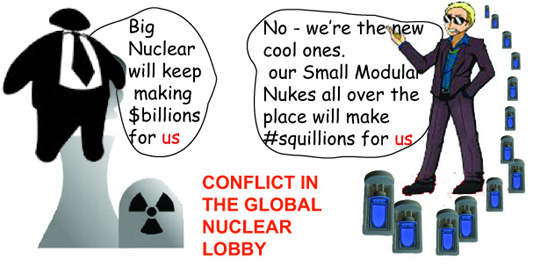
 UK’s most aggressive nuclear lobby is pushing for Small Modular Nuclear Reactors and Thorium Reactors. They’ve even got themselves classed as a Charity!!! So, is the veiled co-operation between the old Big nuclear camp, and the new geewhiz Little nuclear camp now wearing thin in Britain?
Pro-nuclear environmentalists in call to scrap Hinkley C plans
Three leading experts urge government to end nuclear project saying delays will create panicked scramble back to fossil fuels, Guardian, Terry Macalister, 19 Sept 15 Three leading environmentalists who broke ranks to give their support to a new generation of nuclear plants have now urged the government to scrap plans for Hinkley Point C.
The call comes as George Osborne and Amber Rudd, the secretary of state for energy and climate change, head off to China, where they will discuss Beijing’s proposed investment in the new nuclear plant in Somerset.
George Monbiot, Mark Lynas and Chris Goodall say the soaring cost and delays to the Hinkley project leave ministers with no option but to pour the estimated £24.5bn worth of investment into other low-carbon technologies
“Hinkley C bears all the distinguishing features of a white elephant: overpriced, overcomplicated and overdue. The delay that was announced recently should be the final straw. The government should kill the project,” they write in a comment piece for the Guardian.
“The new delay should not surprise anyone who’s aware of the technological issues,” said Tony Roulstone, who runs the masters programme in nuclear engineering at Cambridge University. He argues that the plan for Hinkley C is like “building a cathedral within a cathedral”. It is, he concludes, “unconstructable”………
EDF, the French energy group, promoting Hinkley, has already won a generous financial aid package from the government through its “contract for difference” mechanism but has yet to sign the definitive deal it needs with Beijing investors.
This is expected to happen when the Chinese premier visits the UK next month, leaving EDF in a position to finally give the green light to the first nuclear plant to be built in the UK for 20 years.
But the energy company and its French engineering partner, Areva, have been beset by problems, leaving a growing number of former supporters from the world of energy and the City to question the viability of the whole project…….http://www.theguardian.com/environment/2015/sep/18/nuclear-environmentalists-scrap-hinkley-c-plans
September 19, 2015
Posted by Christina Macpherson |
business and costs, politics, UK |
Leave a comment
Ending subsidies, that amount to almost a quarter of the sale price in some cases, would hugely reduce carbon emissions, new research reveals
Coal subsidies are costing US and Australian taxpayers billions of dollars a year, according to a new report.
The research examined the subsidies given to coal production in the US’s largest coal field, the Powder River Basin, and found they totalled $2.9bn (£1.9bn) a year. This equates to $8 per tonne, almost 25% of the sale price.
Ending the subsidies would lead to cuts in coal use equivalent to shutting up to 32 coal-fired power stations, the researchers found, leading to a large reduction in carbon emissions.
The report also analysed Australia’s exporting of coal for power stations in Asia and found these came to $1.3bn a year, or $4 a tonne. Ending these subsidies would cut demand by up to 7%, a smaller impact than in the US because coal users could buy supplies from other countries.
“The fossil fuel industry has gamed energy market consumers, with numerous subsidies evident over the long term,” said Tim Buckley, at the Institute forEnergy Economics and Financial Analysis, who worked on the report. “Any discussion of cost competitiveness of renewable energy and energy efficiency needs to take into account the decades of extensive subsidies evident for the coal industry and that, in many cases, remain in place today.”
Luke Sussams, senior researcher at Carbon Tracker Initiative, also part of the research team, said: “Policy makers concerned about climate change and a level playing field in energy markets should look to take coordinated action to remove the distortions to production these subsidies create.”
The subsidies given to coal companies included tax breaks, cheap leases, government-funded infrastructure including railways and ports and allowing inadequate funding of clean-up operation after mining ends.
The G20 nations pledged to end fossil fuel subsidies in 2009, but little action has been taken. However, falling oil and coal prices in the last year have seen some countries starting to reduce subsidies.
A recent study by the International Monetary Fund (IMF) took into account not just direct subsidies but also the cost to nations of the damage caused by air pollution and global warming. It estimated coal, oil and gas were being subsidised by $5.3trn a year, more than the total health spending of all the world’s governments. Much of the cost is due to the illness and death caused by air pollution.
“Eliminating coal subsidies in the Powder River Basin and throughout the world, is an obvious, no-regrets climate strategy,” said Doug Koplow, of Earth Track and another member of the research team.
The new report, called Assessing Thermal Coal Production Subsidies, was produced by the Carbon Tracker Initiative, Energy Transition Advisors, the Institute for Energy Economics and Financial Analysis and Earth Track.
September 18, 2015
Posted by Christina Macpherson |
AUSTRALIA, business and costs, climate change, politics, USA |
Leave a comment
How Charles Koch Prevents Clean Energy Businesses From Succeeding, TruthOut 02 September 2015 By Matthew Kasper, Republic Report | News Analysis Last week, President Obama correctly singled out the Koch brothers – Charles and David – and the Koch-funded network for standing in the way of America’s clean energy Continue reading →
September 18, 2015
Posted by Christina Macpherson |
business and costs, climate change, politics, USA |
Leave a comment
 Entergy’s FitzPatrick Reactor May Be Next Nuclear Casualty, Power, 09/14/2015 | Sonal Patel Entergy’s 850-MW James A. FitzPatrick nuclear plant located near Oswego, N.Y., may be the next reactor doomed to close on profitability woes. Entergy’s CEO Leo Denault told attendees at the Barclays CEO EnergyPower Conference on Sept. 10 that the company will need to decide by the end of this year whether to go forward with plans to refuel the FitzPatrick plant in Fall 2016.
The single-unit 1975-built reactor is one of six merchant nuclear plants that Entergy operates in the Northeast. Competition from low-cost gas and subsidized wind power has undercut power prices, making it difficult for FitzPatrick to make money (see POWER‘s latest story on how Exelon is dealing with similar issues)………Entergy in December 2014 shuttered its Vermont Yankee Nuclear Power Plant because it was unprofitable. The Louisiana-based company acknowledged that the FitzPatrick plant, which gained the Nuclear Regulatory Commission’s green light to run until 2034, has been flailing financially for two years now. However, the company is determined to continue operating its two Indian Point units in New York despite strong opposition by New York Gov. Andrew Cuomo and environmental advocacy groups, Denault said, because its a “primary source of value earnings and … cash flow.” http://www.powermag.com/entergys-fitzpatrick-reactor-may-be-next-nuclear-casualty/
September 16, 2015
Posted by Christina Macpherson |
business and costs, USA |
Leave a comment
 FIVE REASONS NOT TO BUILD HINKLEY [Excellent graphs] Bloomberg Finance http://about.bnef.com/landing-pages/five-reasons-build-hinkley/ The endgame for the UK’s new reactor project at Hinkley Point is nearing. A Chinese state visit to the UK in October may be the make-or-break point for the project to get the go-ahead. As that moment approaches, we give five reasons not to build the plant. This is an excerpt from our EU Power Weekly, which is available to our BNEF EMEA and BNEF All clients.
Last week, French energy giant EDF announced delays to two key new reactor projects. Firstly, Flamanville 3 in France will only come online in 2018, six years behind the initial plan and three times over budget. Also, Hinkley Point C in the UK will not be completed by 2023 due to delays in reaching a final investment decision. This adds to the uncertainty around the 3.2GW reactor project. Here are five reasons not to build Hinkley.
- It is extremely difficult to build
Hinkley C uses Areva’s troubled EPR (European Pressurised Reactor) technology. All current EPR plants under construction are suffering from severe delays, and there is are substantial concerns about the integrity of some of the reactor vessels.
- It is very expensive
Carrying an all-in financing cost of GBP 24.5bn, Hinkley Point C is the most expensive new reactor project around. On a GW basis, it is even more expensive than fellow EPR projects Flamanville and Olkiluoto, which are both multiple times over budget. (good graph)
- It may not be necessary
- In our view, UK power consumption is in long-term decline. Combined with continued growth of wind and solar capacity and interconnectors to the European mainland, the remaining market might be too small for a mammoth plant such as Hinkley to make sense.
GB annual power consumption and renewable output, 2015-2030 (TWh)
-
- Hinkley won’t play nice with wind and solar
Also, Hinkley might not help to integrate variable wind and solar. Firstly, the massive 3.2GW plant will not help relieve increasingly apparent constraints in the distribution grid. Secondly, it might not be flexible enough to respond to fluctuations in solar and wind output: in sunny and windy days, Hinkley would need to reduce its output significantly, a feature it is not designed for. Other technologies such as small gas-fired peakers might be better suited — read more about them here, or deploying small, more flexible modular reactors (SMRs) that should be available for commercial deployment by 2022-24.
- It is a cost for future generations
Hinkley will be costly to decommission, even if these costs will only arise in the second half of this century. The decommissioning cost of San Onofre, a 2.3 GW nuclear plant in California, is estimated at $4.4bn (an unusually high cost given its location, other small reactors decommissioning costs are closer to $1bn). For comparison: cleaning up one MW of San Onofre costs as much as a MW of onshore wind. (Also on decommissioning: the German government is trying to ensure German utilities are held liable for the cost of cleaning up their old reactors).
September 14, 2015
Posted by Christina Macpherson |
business and costs, UK |
Leave a comment







 US and Australian taxpayers pay billions a year to fund coal – report, http://www.theguardian.com/environment/2015/sep/16/us-australian-taxpayers-pay-billions-fund-coal