Japan keen to sell nuclear reactors to Kazakhstan
 Japan to construct nuclear power plant in Kazakhstan, Tengri News, 27 Oct 15
For more information see:http://en.tengrinews.kz/politics_sub/Japan-to-construct-nuclear-power-plant-in-Kazakhstan-262718/
Use of the Tengrinews English materials must be accompanied by a hyperlink to en.Tengrinews.kz
October 23 Tengrinews.kz reported, citing the country’s Vice Minister of Energy Bakhytzhan Dzhaksaliyev, that Kazakhstan was to decide within the following 2-3 years on the location and strategic partner for its first nuclear power station.
January 23,2015 Tengrinews.kz reported that Kazakhstan had started talks with Toshiba, owner of Westinghouse, to construct its first nuclear power plant. The sides were to sign an agreement on supplying a $3.7 billion reactor capable of 1 gigawatt, according to Russia’s Kommersant daily.
Early 2014 the country’s President Nursultan Nazarbayev commissioned the Government to decide before the end of the Q1 2014 on the location, sources of investments and timing of constructing a nuclear power plant in Kazakhstan.
In his Address to the Nation at the start of 2014, President Nursultan Nazarbayev elaborated why Kazakhstan needs to construct a nuclear power plant.
He emphasized that the future lies with nuclear power……… “The actual need for a nuclear power plant will be felt around 2025 given the current power generation and consumption figures”, he elaborated.
For more information see:http://en.tengrinews.kz/politics_sub/Japan-to-construct-nuclear-power-plant-in-Kazakhstan-262718/
Japanese Prefecture Kyoto moves to replace nuclear with gas and renewables, in pact with Alaska

 Kyoto advances nuclear-free agenda with Alaska LNG pact, Japan Times, BY ERIC JOHNSTON KYOTO, 25 OCT 15, – The Kyoto Prefectural Government signed an agreement with Alaska last month to explore the possibility of importing liquid natural gas from the state to Maizuru, a port city on the Sea of Japan.
While daunting financial and bureaucratic challenges mean it will still be a while before Alaskan LNG flows to Kyoto, the agreement represents a step forward for Kyoto to achieve a larger goal: ending prefectural dependence on nuclear power by 2040.
The strategy, as outlined by Kyoto Gov. Keiji Yamada, calls for building up LNG facilities at Maizuru and installing new LNG pipelines in the Kansai region. The prefecture envisions Maizuru supplying not only Kyoto, but other prefectures in the region with gas to replace Fukui Prefecture’s nuclear power plants as a major source of electricity.
Kyoto is not alone in seeking to replace atomic power with a combination of LNG imports and renewable energy. As of the end of 2014, more than 600 local governments nationwide had declared their intent to be nuclear-free, although not all of have set specific dates like Kyoto, and many lack a strategic plan for achieving that goal.
Yamada listed several reasons why the prefecture needs to end its usage of nuclear power, which comes mostly from 11 Kansai Electric Power Co. reactors in neighboring Fukui……..
Kyoto and Hyogo, along with Osaka Gas, Kepco, and the Ministry of Economy, Trade and Industry, agreed in early September to formally research the cost of building an LNG pipeline from Maizuru to Sanda, Hyogo Prefecture, that could then supply other parts of Kansai and likely lead to other localities needing less nuclear power. http://www.japantimes.co.jp/news/2015/10/25/national/kyoto-advances-nuclear-free-agenda-alaska-lng-pact/#.Vi0_ztIrLGh
Sell EDF shares, because of Hinkley nuclear costs – says leading broker
 Broker tells investors to sell EDF shares because of Hinkley Point costs, http://www.theguardian.com/business/2015/oct/22/broker-tells-investors-sell-edf-shares-hinkley-point-costs Guardian, Terry Macalister, 22 Oct 15,
Investec Securities has ‘long-term concerns’ about financial strain the £18bn nuclear project will put the French energy group under.A leading City broker has called on investors to sell their shares in EDF, saying it has “long-term concerns” about the financial stresses on the French energy group from the £18bn Hinkley Point C nuclear project in Somerset.
The sell note from Investec Securities comes a day after EDF signed a deal with China General Nuclear Corporation and said it would start work within weeks on the UK’s first new nuclear plant for 20 years.
The government has finally admitted what had been denied for years – that the contract for difference aid mechanism for the power station is effectively a state subsidy.
The fine print of a formal document from the Department of Energy and Climate Change said: “The government confirms that it is not continuing the ‘no public subsidy policy’ of the previous administration.”
Coalition ministers always argued that any new nuclear plants would only be constructed if they could be done without subsidy.
“A long-dated project is the last thing that EDF needs, given the existing pressures on its balance sheet. Unless favourable disposals materialise, we fear the dividend will be a casualty,” said a research note from Harold Hutchison, utility analyst with Investec.
EDF, which is largely owned by the French state, has still not taken an irreversible investment decision or received the final documentation from the government on the controversial subsidy system.
But the state visit to Britain of the Chinese president, Xi Jinping, was used as a platform to effectively launch the Hinkley scheme that EDF now says will be funded by debt and not underwritten by UK government guarantees.
Investec believes this will be difficult for EDF at a time when a new French energy law means the company must close some of its power stations while being encouraged to bail out its troubled engineering partner, Areva, through a merger.
EDF is also under financial stress because a new nuclear plant at Flamanville in Normandy, north-west France, has run far over budget and been hit by delays.
Opinion is polarised about whether Hinkley will provide useful baseload low carbon power or is a white elephant project that is far too expensive and stands little chance of being constructed on time. The first of two reactors is scheduled to open in 2025 and in theory could provide 7% of the UK’s electricity 24 hours a day for 35 years.
Italian energy giant Enel and Greenpeace together in aim to develop renewable energy
Former foes Greenpeace and energy giant Enel stand together in low-carbon push, Guardian, Damian Carrington, 22 Oct 15 New CEO, Francesco Starace, is taking the Italian firm in a new direction, investing in solar and wind to become the first ‘truly green energy giant’. Just a year ago the Italian energy giant Enel was in a bitter court battle with Greenpeace, which accused the utility’s coal plant pollution of killing people. Today, the two groups are firm friends and Greenpeace says Enel is on track to be the “first truly green energy giant”.
What changed was the observation by new Enel CEO, Francesco Starace, that the tide was flowing in only one direction for utilities – towards low-carbon energy – thanks to fast-dropping renewable energy costs, smarter and more-efficient grids and increasing government action on climate change.
“There is a huge tide flowing and you can decide in which direction you want to swim,” he told the Guardian in an interview. “The tide is not in our control – it is the evolution of technology. I think it is crazy if there is someone thinking that he can actually influence this.”
Enel, the biggest utility in the world by customer numbers, has taken the plunge and pledged never to build another coal plant and to be carbon neutral by 2050.
A few other major utilities, such as E.ON and Vattenfall are taking a few strokes in the same direction, but Starace thinks a flood of companies making similar waves is imminent. “You will have big surprises,” he says. “In the next 12 months you will see most of the companies more or less go the same way.”……..
He says the coal-fired power station opened in Chile this year will be Enel’s last: “Why would you put €1bn into something that takes 10 years to be built and by the time you finish, you find out there is no point in having it anymore. It is too slow to be fitting this world anymore.”
“Nuclear is the same story, but even worse: a longer time cycle,” Starace says. “Today’s nuclear technology – though not nuclear technology in general – is a dead end. The proof of it is that fact that these huge new plants are typically nightmares of engineering and construction.”
He says the reactors planned by French company EDF for the UK are the “best in class” of current technology but are the same dead end: “I admire that they have the guts to carry on but these plants are over-engineered and incredibly complex and very, very difficult to complete.”……..
Instead of fossil fuel projects, half of Enel’s £18bn growth investment over the next five years is going into solar and wind energy, ….
Another major European utility, Vattenfall, is selling its large German coal mines and power plants, again to focus on renewables. Greenpeace is looking to make friends with them too, suggesting they will raise the money to buy – then close – the coal assets.
And the former boss of another big German utility RWE npower, Volker Beckers, said last year that the fossil-fuel powered energy system had “reached its natural end”: he nowchairs a renewable energy fund and asmart grid company and is a trustee ofForum for the Future, the sustainability advisory outfit founded by environmentalist Jonathon Porritt……… http://www.theguardian.com/environment/2015/oct/22/former-foes-greenpeace-and-energy-giant-enel-stand-together-in-low-carbon-push
A warning to UK – the disastrous history of Finland’s Olkiluoto nuclear station
“what’s most striking at the experience of Olkiluoto — just how many different things have gone wrong.”
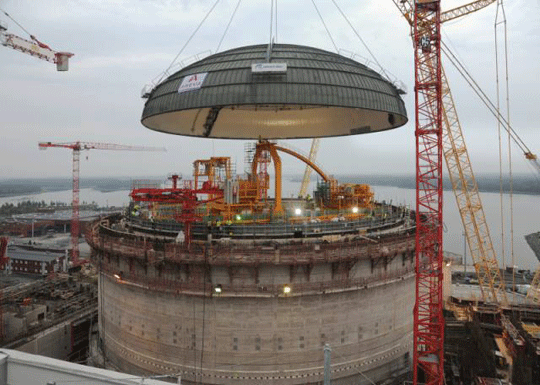 New nuclear: Finland’s cautionary tale for the UK ,Carbon Brief, 20 Oct 15,Finland has a 15-year-old problem called Olkiluoto 3. This nuclear plant was once the bright star of Finland’s energy future and Europe’s nuclear renaissance.
It was seen as a key component in Finland’s plans to reduce greenhouse gas emissionsby 80% by 2050 and end reliance on foreign imports of electricity, even during its long, dark Arctic winters. It is supposed to provide Finland with a low-carbon source of electricity for at least 60 years.
A 2006 article in the Telegraph spoke of the rebirth of Finnish love for nuclear power, describing the Olkiluoto site in phrases that could have been lifted from a pastoral poem: a “Baltic island of foraging swans”, “pine-scented” air and “unusually large salmon”.
But this source of hope has turned sour. Olkiluoto 3 — almost unpronounceable to non-Finns — is now nine years behind schedule and three times over budget. It has been subject to lawsuits, technology failure, construction errors and miscommunication. A rift between the companies behind the plant has been describedas “one of the biggest conflicts in the history of the construction sector”.
At best, it has been a turbulent lift-off to the lauded rebirth of nuclear power in western Europe. For the UK, which hopes to be a part of this renaissance, the story of Olkiluoto 3 offers a cautionary tale.
Background
The story of Olkiluoto 3 began in 2000…….
Construction problems
It is now 2015, and Finland still does not have its new nuclear plant.
The companies behind the project are at loggerheads. TVO is seeking compensation from Areva in court, the company responsible for supplying the reactor and turbine, and Areva is pursuing a counterclaim.
Herkko Plit, the deputy director of Finland’s energy department, tells Carbon Brief:
“I don’t think there’s anybody who can say they are pleased with the project.”……….
The case is being dealt with in the International Chamber of Commerce‘s arbitration court.
Nonetheless, Areva has been forced to accept losses. The company, which hasn’t turned a profit since 2010, recorded net losses of €4.8bn in 2014, largely due to Olkiluoto. It has agreed to sell a majority stake in its nuclear reactor business to EDF.
If the lawsuit turns against TVO, it could be Finland’s industry that feels the pain. The utilities company is owned by shareholders that buy the right to use the electricity produced by the power station……..
what’s most striking at the experience of Olkiluoto — just how many different things have gone wrong.” http://www.carbonbrief.org/new-nuclear-finlands-cautionary-tale-for-the-uk/
Amnerica’s newest nuclear power station too 42 years to finish
It Took 42 Years to Finish This U.S. Nuclear Power Plant, Bloomberg Naureen Malik HarryRWeber 22 Oct 15
-
Watts Bar Unit 2 given 40-year operating license by regulator
-
First U.S. atomic reactor authorized in almost two decades
-
Forty-two years and counting. That’s how long it’s taken to get America’s latest nuclear reactor up and running.
The stop-start saga behind Unit 2 at the Watts Bar complex near Knoxville, Tennessee, moved a step closer to its conclusion Thursday when the Nuclear Regulatory Commission granted the plant a 40-year operating license.
The length of time it took to get to this stage bears witness to the headwinds that have buffeted the atomic industry over the decades. Work on the reactor was suspended in 1985 when the owner decided it wasn’t needed, especially in an era of low fossil-fuel prices. More recently, costly safety upgrades in the wake of the Fukushima disaster and competition from a flood of cheap natural gas have taken a toll.
The go-ahead from the NRC clears the last remaining hurdle before the Tennessee Valley Authority can bring Unit 2 into service, at an estimated cost of about $6 billion. It’ll be the first new nuclear plant in the U.S. since TVA, the largest publicly owned U.S. power company, started running Unit 1 at Watts Bar in 1996. …….http://www.bloomberg.com/news/articles/2015-10-22/it-took-42-years-to-finish-this-nuclear-power-plant-in-the-u-s-
USA’s “Small Modular Nuclear Reactor” lobby pinning its hopes on Australia?
 16 October 2015, Elsewhere in the world, proponents of small nuclear reactors are pitted against the large reactors, but here in Australia, as Noel Wauchope reports, proponents of small reactors see them as enabling conventional nuclear and uranium mining to flourish. QUIETLY, AND pretty much under the media radar, a dispute is going on in the global nuclear industry between the advocates of “Generation III” — big nuclear reactors, and “Generation IV” — small nuclear reactors…….
the nuclear lobby’s spiel to Australia is something different, and very original. No dispute — because the argument is that small reactors would further the large reactor industry.
First articulated by Oscar Archer on ABC RN, March 2015, the idea is that Australia, in setting up small nuclear reactors, would enable the conventional nuclear industry and uranium mining to flourish:….. As Archer says, Australia would indeed be the pioneer for the new technology.
And that’s what the USA “new nuclear” lobby desperately needs. They need this, because they’re finding it impossible to go ahead in America. Why? Well it’s those pesky safety regulations imposed by the Nuclear Regulatory Commission.
What the “Small Nuclear” lobby needs is a “nuclear friendly” country – one with less stringent safety
regulations – to set up their nuclear reactors on a test site. Hence the enthusiasm of those lobbyists for the South Australia Nuclear Fuel Chain Royal Commission, as shown, for example, in a recent Royal Commission hearing speech by Thomas Marcille of Holtec International nuclear company.
……… the Nuclear Regulatory Commission(NRC) has proved to be real nuisance since it tightened regulations for the licensing process after the Fukushima nuclear disaster. The new nuclear marketers have had to go overseas, first to China, then perhaps to Australia?…. https://independentaustralia.net/environment/environment-display/why-australia-is-important-to-the-small-nuclear-lobby,8263
USA’s nuclear industry staggers to its tomb, as Pilgrim Station shuts down
Entergy’s decision to shut Pilgrim is welcomed by safe energy activists everywhere as part of the rapid collapse of the atomic power mis-adventure.
But across the U.S. some two dozen Fukushima clones still operate. The entire industry is a decayed, money-losing tombstone for the failed lies about “too cheap to meter.”
So it’s great another shut-down has been announced. But four more years of yet another decayed, increasingly dangerous and hugely unprofitable reactor being kept open is not acceptable.
The no nukes movement will not take it lying down. Stay tuned.
Another U.S Nuke Bites the Dust http://ecowatch.com/2015/10/14/nuclear-power-bites-dust/ Harvey Wasserman | October 14, 2015 The chain reactor operator Entergy has announced it will close the Pilgrim nuke south of Boston. The shut-down will bring U.S. reactor fleet to 98, though numerous other reactors are likely to face abandonment in the coming months.

But Entergy says it may not take Pilgrim down until June 1, 2019—nearly four years away.
Entergy is also poised to shut the FitzPatrick reactor in New York. It promises an announcement by the end of this month. Entergy also owns Indian Point 2 and Indian Point 3 some 40 miles north of Manhattan. Unit 2’s operating license has long since lapsed. Unit 3’s will expire in December.
Meanwhile California’s two reactors at Diablo Canyon are surrounded with earthquake faults. They are in violation of state and federal water quality laws and are being propped up by a corrupt Public Utilities Commission under fierce grassroots attack. With a huge renewable boom sweeping the state, Diablo’s days are numbered—and hopefully will shut before the next quake shakes them to rubble.
Meanwhile, like nearly all old American nukes, both Pilgrim and FitzPatrick are losing tons of money. Entergy admits to loss projections of $40 million/year or more at Pilgrim, with parallel numbers expected at FitzPatrick. The company blames falling gas and oil prices for the shortfalls.
Owners of King CONG (Coal, Oil, Nukes and Gas) facilities hate renewables. But in fact the boom in wind, solar, increased efficiency and other Solartopian advances are at the real core of nuke power’s escalating economic melt-down. Continue reading
Planned closure of Pilgrim Nuclear Plant – a sign of the transition to renewables that is now underway
 Pilgrim Nuclear Plant in Massachusetts to Close by 2019, Owner Says, nbc news, by ASSOCIATED PRESS, 13 Oct 15 The owners of the Pilgrim Nuclear Power Station in Plymouth, Massachusetts, have announced that they will close the plant by June 2019.
Entergy Corp. said Tuesday it is closing the only nuclear power plant in the state because of “poor market conditions, reduced revenues and increased operational costs.”
The decision by New Orleans-based Entergy Corp. comes about a month after federal inspectors downgraded the plant’s safety rating to the lowest level and said they would increase oversight in the wake of a shutdown during a winter storm…….The owners of the Pilgrim Nuclear Power Station in Plymouth, Massachusetts, have announced that they will close the plant by June 2019.
Entergy Corp. said Tuesday it is closing the only nuclear power plant in the state because of “poor market conditions, reduced revenues and increased operational costs.”Pilgrim Nuclear Power Plant’s Pilgrim Station is located a few miles down the coast from Plymouth Rock. Boston Globe / Boston Globe via Getty Images
The decision by New Orleans-based Entergy Corp. comes about a month after federal inspectors downgraded the plant’s safety rating to the lowest level and said they would increase oversight in the wake of a shutdown during a winter storm. Owners maintained that the plant remained safe although it needed millions of dollars in upgrades.
“The real issue here is the financial viability of the plant,” said Bill Mohl, president of Entergy Wholesale Commodities……….
The plant will remain under enhanced oversight by the federal Nuclear Regulatory Commission throughout the process, and Entergy expects to spend $45 million to $60 million at the plant during that time, he said. After shutting down, Pilgrim will transition to decommissioning. The Pilgrim nuclear decommissioning trust had a balance of about $870 million as of Sept. 30, Entergy said……..
Entergy’s decision was met with mixed reaction from groups that have been fighting for decades to have the plant shut down and fiercely fought relicensing. The state will continue to live in the shadow of a plant that many people consider dangerous, said Arlene Williamson of Cape Downwinders. “Entergy doesn’t have the financial ability to get Pilgrim out of the dog house, but it will continue to operate for four more years with many safety violations and mechanical failures,” she said………
U.S. Sen. Edward Markey, D-Massachusetts, also called for a greater commitment to renewable energy. “Pilgrim Nuclear Power Station is just the latest example of how nuclear power simply cannot compete in the current energy market,” he said.
He later added: “With this announcement we must also recognize that the time is now in New England and around the nation to rapidly transition toward the safe, affordable clean energy of wind, solar and geothermal power and continue to invest in energy efficiency and making the vehicles on our roads even more fuel efficient.” http://www.nbcnews.com/business/energy/pilgrim-nuclear-plant-massachusetts-close-2019-owner-says-n443566
A nuclear power plant project in India is stalled
Nalco’s foray into nuclear energy hits legal roadblock Proposed Rs 12,000-cr nuclear energy plant in a JV with Nuclear Power Corporation in limbo Business Standard, India, Dilip Satapathy | Bhubaneswar October 9, 2015 National Aluminium Company (Nalco)’s plan to foray intonuclear energy generation has hit a legal roadblock.
Though the aluminium major proposed to set up a Rs 12,000 crore nuclear energy plant in joint venture withNuclear Power Corporation of India Ltd (NPCIL), it is unable to go ahead with the project with the present act restricting the sector to only a couple of its own fully owned subsidiaries under the Atomic Energy Department…….
Though NPCIL is keen to involve other public sector firms like Nalco, IOCL and NTPC, with whom it has signed MoUs, for setting up of nuclear power plants in a bid to expand its nuclear power footprint in the country, the present act does not allow this.
The Atomic Energy Act, framed in 1962, also prohibits private control of nuclear power generation though it allows them minority investment……….Apart from the fuel supply issue and protests over establishment of nuclear power plants, changes in the act to allow JVs formed by NPCIL with other PSUs to make them workable is another hurdle, the India government has to take care if the country wants to achieve 20 GWe nuclear energy capacity by 2020, sources said.
Besides nuclear energy, the aluminium major has identified renewable energy as its next focused area.
“We have set up wind mills in Andhra Pradesh (50.4 Mw) and Jaisalmer (47.6 Mw) in Rajasthan. We plan to set up solar plants in Rajasthan and Maharashtra (50 Mw each) and Madhya Pradesh (20 Mw). We are also in the processing of installing a 14 Mw wind power mill at Damanjodi,” Chand said. http://www.business-standard.com/article/companies/nalcos-foray-into-nuclear-energy-hits-legal-roadblock-115100900777_1.html
Duke Energy very doubtful about new nuclear stations
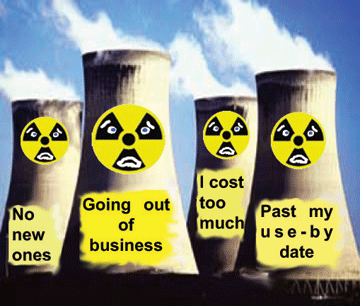 Will new nuclear plants be ‘part of the picture’ for Duke Energy? CEO raises doubt, Charlotte Business Journal, Oct 8, 2015, Duke Energy CEO Lynn Good sounded a strongly doubtful note about the company proceeding with its proposed Lee Nuclear Station in her speech Wednesday to the Winston-Salem Chamber of Commerce.Talking about what Charlotte-based Duke (NYSE:DUK) would look like in 2025, she said natural gas would be the backbone of its power fleet and that the utility would make greater use of renewable energy and battery storage.“Nuclear will continue to be an important part of energy supplies in the Carolinas,” she said “But whether or not new nuclear is a part of the picture remains to be seen.”
Abandoned plants Duke still includes the proposed 2,334-megawatt Lee plant in its long-range plans. But the utility has never formally committed to construction of the $12 billion project. Good’s comments raised new doubts about whether it ever will. Since 2012, Duke has abandoned plans to build new nuclear units in Raleigh and in Florida. The Lee plant, proposed for Gaffney, S.C., is the last new nuclear plant still included in the company’s plans……..the company will have to “look very hard at whether we can replace current nuclear with new nuclear,” she said.
That is likely to mean a much greater dependence on natural gas plants than there is now.
Good said that no new coal plants will be built in the United States…….http://www.bizjournals.com/charlotte/blog/energy/2015/10/will-new-nuclear-plants-be-part-of-the-picture-for.html
Rating agencies warn EDF of downgrade, if they continue with Hinkley nuclear station plan
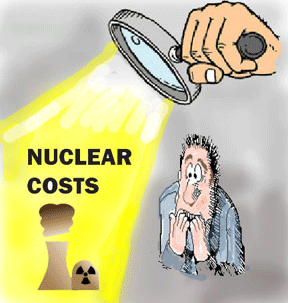 EDF faces threat of credit downgrade over Hinkley Point Two of the world’s biggest ratings agencies have warned that EDF and its Chinese partners face credit-rating downgrades if they press ahead with a £16 billion nuclear power station at Hinkley Point in Somerset.
Amid growing doubts about the deal, Moody’s said the project would have a “credit negative effect” on the companies because of the dangers of big cost overruns and delays to EDF’s untested EPR French reactor technology……. (subscribers only) .http://www.thetimes.co.uk/tto/business/industries/utilities/article4574734.ece
France’s nuclear corporation AREVA is still there – only just
 Areva still standing despite turbulent times News Advance October 3, 2015 Jason Ruiter Like an eroding plateau, the nuclear industry sloughed off a section of its market share – but it still stands.
Areva announced a loss of $5.3 billion in global income in 2014 from the year prior, resulting in a loss of roughly several hundred employees in the Lynchburg area and a need to consolidate, adopt austerity measures and sell a chunk of its business to Électricité de France, the largest utility in France which is also majority-owned by the French government. The power plant business segment of Areva – which employs most Areva Lynchburg employees and constructs, designs and services nuclear plants – will sell 75 percent of the company to EDF for an injection of equity into the business…….
survival came at a cost: Areva NA introduced an advanced severance package to qualified employees to retire early in addition to cutting 22 jobs in the area last fall. Last year, Areva, one of the biggest employers in the region, reported about 1,800 employees in the area. This year, they have about 1,500, a decrease of about 16 percent. For the North America continent, those numbers are steeper, decreasing roughly 20 percent from 5,000 full-time and part-time employees to “closer to 4,000,” Mignogna said……
“Debt is due now,” Mignogna said. “So the [French] government had to react now and try to work out a deal where we could get some cash inflow to the company and they chose to do that.” The result was the EDF purchase of Areva’s power plant operations, which will be consummated by the end of 2016.
Just how much Areva will be changed through the purchase by EDF is unclear. Mignogna said that due to anti-trust considerations, where Areva will be providing services to EDF’s competitors, the North American portion will be operated at “arm’s length.” But he wasn’t sure if Areva’s name will be changed to EDF as a result……..http://www.newsadvance.com/work_it_lynchburg/news/areva-still-standing-despite-turbulent-times/article_a2d991c0-4197-5c04-a163-e7ba145cfea1.html
Japn’s PM Abe keen to sell nuclear technology to India
Japan eyes nuclear deal with India October 5, 2015 Clearing the way for exports Nikkei Asian Review,
TOKYO –– Japanese Prime Minister Shinzo Abe is expected to visit India around the end of this year to sign an atomic energy agreement with counterpart Narendra Modi, laying the groundwork for exports by Japanese corporations in that field.
India holds nuclear weapons but is not a signatory of the Nuclear Nonproliferation Treaty (NPT), so a focal point of negotiations between Japan and India was how to prevent the spread of nuclear technologies. The two sides are expected to agree on tight management of nuclear technologies on a par with the NPT.
Another obstacle to an agreement had been Indian laws that hold nuclear plant manufacturers partly liable in the event of nuclear accidents. In January, the U.S. and India agreed that an insurance framework created by India would cover damages related to accidents. Japan and India are seen reaching an agreement with conditions similar to the deal that Washington signed for such matters as the management of nuclear technologies and liability for damages………http://asia.nikkei.com/Politics-Economy/International-Relations/Japan-eyes-nuclear-deal-with-India
Troubled nuclear corporation AREVA wooing Japanese company Mitsubishi
 French PM Valls discusses nuclear, China, culture on Japan visit, 2 Oct 15 Reuters/Toru Hanai/Files
By RFI French Prime Minister Manuel Valls met Japanese PM Shinzo Abe on Saturday during a three-day visit to the country that is Asia’s biggest investor in France. The Mitsubishi conglomerate could buy into troubled French nuclear power company, Areva, he said as his trip started……..
Nuclear power – French nuclear giant Areva is in trouble and its reactor branch is currently being bought by the EDF power company. Valls indicated that he was not opposed to Mitsubishi Heavy Industries investing in the branch in an interview with Asahi Shimbun newspaper and sources travelling with him said it could invest in Areva’s other activities, uranium mining for example. While 47 Japanese nuclear reactors remain closed following the Fukushima disaster, one reopened in August and another should be soon. Japan’s nuclear industry has always been an important client for Areva and EDF……http://www.english.rfi.fr/asia-pacific/20151003-french-pm-valls-discusses-nuclear-china-culture-japan-visit
1 This Month




PLEASE OPPOSE HR 8255 AND S.3639 – bills would accelerate satellite deployment, with no environmental review or safeguards – https://ncstd5li.quorum.us/campaign/169331/
To see nuclear-related stories in greater depth and intensity – go to https://nuclearinformation.wordpress.com
-
Archives
- September 2026 (339)
- August 2026 (330)
- July 2026 (355)
- June 2026 (287)
- May 2026 (306)
- April 2026 (356)
- March 2026 (251)
- February 2026 (267)
- January 2026 (308)
- December 2025 (358)
- November 2025 (359)
- October 2025 (375)
-
Categories
- 1
- 1 NUCLEAR ISSUES
- business and costs
- climate change
- culture and arts
- ENERGY
- environment
- health
- history
- indigenous issues
- Legal
- marketing of nuclear
- media
- opposition to nuclear
- PERSONAL STORIES
- politics
- politics international
- Religion and ethics
- safety
- secrets,lies and civil liberties
- spinbuster
- technology
- Uranium
- wastes
- weapons and war
- Women
- 2 WORLD
- ACTION
- AFRICA
- Atrocities
- AUSTRALIA
- Christina's notes
- Christina's themes
- culture and arts
- Events
- Fuk 2022
- Fuk 2023
- Fukushima 2017
- Fukushima 2018
- fukushima 2019
- Fukushima 2020
- Fukushima 2021
- general
- global warming
- Humour (God we need it)
- Nuclear
- RARE EARTHS
- Reference
- resources – print
- Resources -audiovicual
- Weekly Newsletter
- World
- World Nuclear
- YouTube
-
RSS
Entries RSS
Comments RSS

