$493 billion invested in nuclearweapons by banks, insurance companies and pension funds
 RBS slammed for investment in nuclear weapons http://www.ethicalconsumer.org/latestnews/entryid/1904/rbs-slammed-for-investment-in-nuclear-weapons.aspx 12/11/2015 New ‘Banking on the Bomb’ report
The report, Don’t Bank on the Bomb, published today by Dutch peace organization PAX, outlines how the institution has $6973million invested in the nuclear weapons industry. The company has investments in 21 out of the 26 nuclear weapons-producing companies outlined in the report, more than any other UK bank.
The report also identifies 382 banks, insurance companies and pension funds which have made USD 493 billion available to nuclear weapons producers since January 2012.
The top 10 investors alone provided more than USD 209 billion to the identified nuclear weapon producers. All of the top 10 are based in the USA.
The top 3: Capital Group, State Street, and Blackrock, have more than 95 billion USD combined invested in the producers named in this report.
In Europe, the most heavily invested are BNP Paribas (France), Royal Bank of Scotland(United Kingdom) and Crédit Agricole (France).
In the Asia-Pacific region, the biggest investors are Mitsubishi UFJ Financial (Japan), Life Insurance Corporation of India, and Sumitomo Mitsui Financial (Japan).
How the other UK banks faired:
- HSBC $4,469m
- Barclays $5,881m
- Lloyds Banking Group $1,921m
However it is not all bad news.
The research shows that 53 financial institutions prohibit or limit investments in nuclear weapon producers. This is a 150% increase compared to last year’s report.
The authors say that this overall increase illustrates the growing stigmatization of nuclear weapons because of the renewed focus on their humanitarian consequences.
Wilbert van der Zeijden, co-author of the report:
“No bank, pension fund or insurance company should have financial relations with companies involved in weapons of mass destruction. In the case of a nuclear detonation, the humanitarian consequences will last for decades and effective aid will not be possible. The only way to prevent this from happening is to outlaw and eliminate nuclear weapons. Stigmatizing these inhumane and indiscriminate weapons, and excluding them from investments, will help.”
Hall of Fame
There are 13 financial institutions listed in the report’s Hall of Fame who do not invest in any nuclear weapon producers.
These institutions have outstanding policies preventing any type of investment in any company with association to nuclear weapons.
The Co-op Bank was the only UK bank to make it into the Hall of Fame.
This comes on the back of the company re-establishing and strengthening their ethical policy after pressure from Ethical Consumer’s Save Our Bank campaign.
The researchers are now calling on all financial institutions to stop any investments into weapons of mass destruction, and on governments to ban nuclear weapons once and for all.
Ethical Consumer gave a presentation on Divestment to campaigners and Members of Parliament. Read the blog here.
The ever increasing costs of new nuclear energy – Australia, USA, S Africa, China
 You’ll never guess how much this Australian nuclear power plant will cost, http://www.bizjournals.com/pittsburgh/blog/energy/2015/11/youll-never-guess-how-much-this-australian-nuclear.html Matt Stroud, energy reporter for the Pittsburgh Business Times. Nov 6, 2015 A nuclear power plant has never been built in Australia before, but Westinghouse is putting a price tag on a new one they’re hoping to build there.
The price? About $12.3 billion.
 In testimony to Australia’s Nuclear Royal Commission — a body that’s investigating whether the
Australian state of South Australia should build the nation’s first nuclear power plant — Westinghouse executive Rita Bowser said that price was all inclusive, according to The Advertiser in Adelaide, South Australia. It would include land, environmental safeguards and construction.
Australia has zero nuclear power plants — and is known for being extremely averse to nuclear energy; it won’t even allow nuclear ships into its ports.
The historical aversion won’t affect the price much, apparently; the company’s guesstimate is in line with its current Vogtle project in Georgia, which has been plagued by cost overruns. It’s less than a comparable Chinese project, set to cost $24 billion. And it’s cheap in comparison to a project proposed in Johannesburg that could cost $100 billion.
The South Australia project’s future is fluid at the moment: the Nuclear Royal Commission hasn’t even decided whether it wants to recommend a nuclear facility.
That decision is set to come in May 2016. Tokyo-based Toshiba Corp. (TYO: 6502) owns 87 percent of the Cranberry-based Westinghouse Electric Co.
Time to anandon the fairy tale that nuclear power is affordable
It is past time for utility executives and their regulators to take a step back and reassess. An honest look at the real costs of nuclear power will show that the economics don’t add up. It is time to stop believing in impossible things
 Nuclear Power Economics Requires Believing In ‘Impossible Things‘, Energy Collective, Dennis Wamsted, 6 Nov 15 It is increasingly clear that the economics of nuclear power don’t add up. Just in the past two and a half years, for example, seven plants at six sites have been shut down due to uneconomic performance or massive equipment repair costs—and other plants are on the chopping block.
Similarly, the two ballyhooed active construction projects, in Georgia and South Carolina, are seriously behind schedule and way over budget. Nonetheless, utility executives and regulators in a number of states still have not gotten the message, notably in Florida and Virginia where executives at Juno Beach-based Florida Power & Light and Richmond-based Dominion soldier on, pushing new reactor proposals whose economics, simply put, just don’t add up and could leave ratepayers holding the bag for billions of dollars in nuclear construction costs. Continue reading
France’s effort to market nuclear technology to South Africa
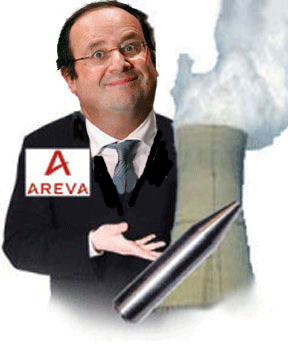 France seeks to win over SA on nuclear energy, Business Day, BY SISEKO NJOBENI, NOVEMBER 06 2015 AMID speculation about SA’s nuclear build programme, the French special envoy for the French-South African nuclear partnership Pascal Colombani is in the country punting his country for the highly anticipated programme.
During his two-day visit to the country, Mr Colombani is scheduled to have meetings “at the political level” as well with relevant public enterprises such as Eskom and the South African Nuclear Energy Co-operation (Necsa). However, he would not say who he was scheduled to meet in government.
“This is my first visit since I have been appointed by President (François) Hollande as his special envoy for the nuclear partnership with SA. Therefore, the overall purpose of my visit is to scale up our co-operation into a long-term strategic partnership in nuclear energy with SA,” Mr Colombani told Fin24.
He said France and SA shared ambitious goals for the development of nuclear energy, “which should become one key component of our strategic partnership”.
Mr Colombani said France was ready to scale up the co-operation between the two countries into a strategic long-term partnership, by supporting the development of SA’s new nuclear programme. Technology, training and safety were at the core of this partnership, he said……http://www.bdlive.co.za/business/energy/2015/11/06/france-seeks-to-win-over-sa-on-nuclear-energy
Pitfalls and huge costs make South Africa’s nuclear programme untenable
The nuclear build is a very risky exercise with numerous potential pitfalls. And there are alternatives. The shortfall in the projected nuclear capacity can be covered by a 50% larger than planned renewable energy investment. Wind and solar energy plants have been operationalised on schedule, and solar panel prices continue falling. The intermittence of renewable energy availability is considered manageable. Finally, energy saving strategies have yet to be fully explored.
 Why SA must abandon nuclear ambitions, The nuclear build is a very risky exercise with numerous potential pitfalls. And there are alternatives. Tech Central, By Hartmut Winkler, 6 Nov 15 It has been an eventful year in South Africa, characterised by power cuts, parliamentary confrontations about wasteful expenditure and student fee protests. There has, however, been an elephant in the room that has impacted all these issues but enjoyed surprisingly scarce attention. The idea, vigorously driven by government, is for the country to build nuclear plants with an expected price tag of R1 trillion.
This equates to 4 000 times the controversial costs to upgrade President Jacob Zuma’s Nkandla residence and 400 times the shortfall the tertiary education sector will experience in 2016 because of the freeze in university fee increases. Continue reading
USA- India nuclear sales quietly fading, as nuclear financially unviable
Solar power developers have offered to sell electricity in India at less than Rs 5/unit. This makes solar competitive with traditional forms of energy, and makes new nuclear power plants financially unviable. India must register the changed reality, and discard the idea of expensive Western reactors. Time to scrap the India-U.S. nuclear deal?
Hard on the heels of falling oil prices and affordable shale, comes another dramatic energy changes for the energy industry: The falling cost of solar energy. This has many implications, but the most immediate impact the nuclear power industry, large parts of which may have just become obsolete. This means that the new nuclear power plants being planned by India, especially those with foreign collaboration, must be reconsidered and scrapped if they are financially unviable.
“Nuclear can’t compete today”
Asked about Duke Power Florida’s August decision to cancel new reactor plans, Peter Bradford, a former NRC  commissioner, told theTampa Bay Times that a nuclear construction boom “was just this artificial gold rush. And yes, it does show the renaissance is dead.”
Nuclear Power: Dead in the Water it Poisoned, CounterPunch, by JOHN LAFORGE NOVEMBER 5, 2015 “……..Well before Fukushima’s triple meltdowns staggered nuclear’s future, Congress and the industry were struggling to ignore its abandonment by important players around the world and public condemnations made by former supporters, and since March 2011 major figures the world over are saying “No nukes.”
 Speaking in New York City Nov. 27, World Bank President Dr. Jim Yong Kim said, “The World Bank Group does not engage in providing support for nuclear power. … [O]ur focus is on finding ways of working in hydroelectric power, in geo-thermal, in solar, in wind. … and we don’t do nuclear energy.” A week earlier, Kim said governments weren’t doing enough to confront climate change, revealing that the WBG well knows that nuclear power is no answer.[33]
World Bank directors may have adopted the recommendation of the US Commission on the Prevention of Weapons of Mass Destruction Proliferation and Terrorism, which concluded in 2009 that governments can and should help stop nuclear weapons proliferation by “… discouraging … the use of financial incentives in the promotion of civil nuclear power.”[34]
More pointedly, Gregory Jaczko, who was Chairman of the NRC when Japan’s Fukushima-Daiichi catastrophe started in 2011, warned in 2012 that “All 104 nuclear power reactors now in operation in the US have a safety problem that cannot be fixed and they should be replaced with newer technology…”[35] When he left the NRC, theTimes editorialized that “the country is losing a strong advocate for public safety who was always willing to challenge the nuclear industry and its political backers in Congress.” Continue reading
The financial folly of South Africa’s nuclear power plan
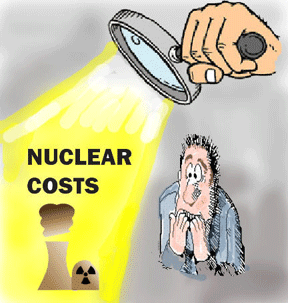
 Why South Africa should not build eight new nuclear power stations, Mail &Guardian, 05 NOV 2015 HARTMUT WINKLER South Africa has plans to build new power stations despite many calling for no nuclear energy in the country. t has been an eventful year in South Africa, characterised by power cuts, parliamentary confrontations about wasteful expenditure and student fee protests. There has, however, been a massive elephant in the room that has impacted all these issues but enjoyed surprisingly scarce attention. The idea, vigorously driven by government, is for the country to build nuclear plants with an expected price tag of one trillion rand.
This equates to 4 000 times the controversial costs to upgrade President Jacob Zuma’s Nkandla residence and 400 times the shortfall the tertiary education sector will experience in 2016 because of the freeze in university fee increases………
In South Africa too the need for the continued inclusion of nuclear power in the energy mix was being reexamined. Continue reading
Drastic risks to UK’s security, jobs, in the Hinkley Point C boondoggle
It is clear that this unprecedented handover of power and money to Chinese hands will prompt a justified reaction from those thousands of UK steel workers whose jobs are about to disappear due in part to the global dumping of steel by China.
Will the remnants of the steel industry and its workers see a fraction of the £76 billion to be spent by the Chancellor on his nuclear boondoggle? Not likely.
The nuclear option can and has been criticised in so many ways that the UK Government should think long and hard before proceeding with what many UK citizens will rightly consider an unpatriotic and unethical waste of money. It may even constitute a real and potent danger to our current lifestyle in Britain.
The Hinkley Point C boondoggle: a dangerous waste of money http://reneweconomy.com.au/2015/the-hinkley-point-c-boondoggle-a-dangerous-waste-of-money-57108 By Alex Russell and Peter Strachan on 2 November 2015 The UK Government’s pursuit of a new nuclear plant at Hinkley Point C represents not just a colossal waste of money, but could also be real danger to the UK’s national security, write Professors Alex Russell and Peter Strachan of Robert Gordon University. “Let us hope that the Prime Minister and Chancellor’s actions do not lead to the radicalisation of unemployed steel workers who are now being joined by unemployed renewable industry personnel.”
The Conservative government, arguably, has completely lost the plot in continuing to pursue its so called energy policy that depends so heavily on building a new fleet of nuclear power stations to keep the lights on in Britain. The government want to have 16 GW of new nuclear power stations built in the UK all using EDF’s troubled Generation-III design, of which Hinkley Point C (3.2 GW) is only the first installment.

With this project is George Osborne seeking an entry in the Guinness Book of Records as the first Chancellor of the Exchequer to commission the world’s most expensive nuclear power station? The Chancellor says the project represents good value for money. But the facts suggest otherwise. Further, and with the recent signing of a new nuclear accord as part of the State Visit of the President of China, not enough attention appears to have been given to national security issues.
Economic madness All in all, Hinkley Point C will cost an estimated £76 billion, for up to 3.2 GW of new generation capacity. Building costs are now estimated by EDF, the owner, at £24.5 billion. As a sobering thought, even offshore wind looks cheap when compared to the full commercial costs of this project.
This apparent blank cheque for new nuclear build is all the more surprising coming at a time when the Treasury has slashed support for onshore wind and solar power and other low carbon projects. Continue reading
Banking-industry style regulation needed for Europe’s nuclear decommissioning costs
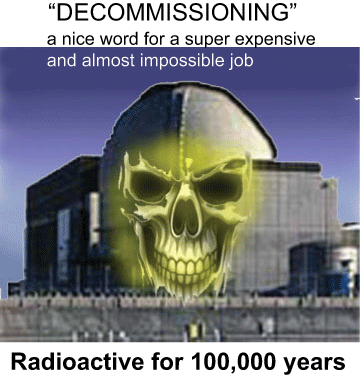 EU regulation of nuclear decommissioning costs needed -Capgemini http://www.reuters.com/article/2015/11/02/nuclear-decommissioning-idUSL8N12X22J20151102 Europe needs banking-industry style regulation to bring more transparency to the costs of nuclear reactors, consultancy Capgemini said in its annual energy market report.
Capgemini said gross provisions for decommissioning and long-term spent fuel management work out at 4.7 billion euros ($5.2 billion) per reactor in Germany, compared to just 1.2 billion in France and 3.38 billion euros in Britain.
Even if France’s nuclear fleet of 58 reactors is much bigger than Germany’s 17 reactors, economies of scale from the standardization of processes look too big to account for such a difference by themselves, according to Capgemini.
“Establishing what methodology is used to estimate the overall cost is essential, but it is never explained in annual reports, with each player relying on the estimates of their own experts in that area,” Capgemini said.
Nuclear operators like France’s EDF, Germany’s E.ON and RWE and Sweden’s Vattenfall all use different discount and inflation rates to calculate the present value of long-term liabilities and the parameters for these calculations are left to individual companies to decide, the consultancy said. “For obvious reasons to do with transparency, it is urgent that a process be instituted at European level … similar to the international regulatory framework for banks (Basel III) following the financial crisis that affected most European countries,” Capgemini said.
There are also strong disparities with regards to nuclear operators’ legal obligations in terms of covering these future costs, it said.
Only Finland’s Fortum, Vattenfall (for its Swedish activities), EDF and the Czech Republic’s CEZ have portfolios dedicated to the financing of these long-term obligations, with coverage ratios of 100, 78, 68 and 31 percent respectively, Capgemini said.
Other sector players do not have dedicated assets on their balance sheets, and German utilities currently do not cover their provisions, it added.
Last month, E.ON dropped plans to spin off its German nuclear power plants, bowing to political pressure to retain liability for billions of euros of decommissioning costs when the plants are shut down.
The International Energy Agency said late last year that almost 200 of the world’s 434 reactors in operation would be retired by 2040, and estimated the decommissioning cost at more than $100 billion, but many experts view this figure as way too low. ($1 = 0.9057 euros) (Reporting by Geert De Clercq; Editing by Susan Fenton)
Entergy closes unprofitable Fitzpatrick nuclear power plant
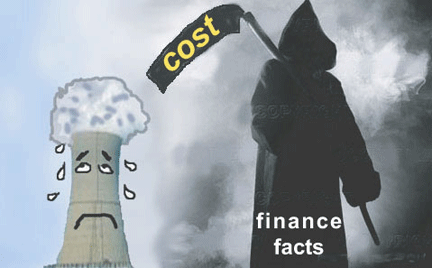
 Lack of profitability forces Entergy to close Fitzpatrick nuclear power plant, Enformable, 2 Nov 15 Entergy officials have confirmed that late 2016 or early 2017 the Fitzpatrick nuclear power plant will be shut down instead of refueled and brought back online.
The plant was scheduled for refueling in September 2016 but has been losing Entergy money and can no longer be kept afloat. Wall Street analyst Julien Dumoulin-Smith of UBS Securities, recently predicted FitzPatrick would lose about $40 million in 2016 and as much as $85 million by 2018. Entergy recently told investors that the Fitzpatrick plant had lost so much money, that it was worth nearly a billion dollars less than what it was valued at……http://enformable.com/2015/11/lack-of-profitability-forces-entergy-to-close-fitzpatrick-nuclear-power-plant/
Germany’s dash for renewables has helped to create new industries
Germany’s planned nuclear switch-off drives energy innovation, Guardian, Jennifer Rankin , 3 Nov 15
While Britain visualises a nuclear future, Angela Merkel’s aim of replacing it with renewables by 2022 is well under way Hinkley Point will be the first nuclear power plant to be built in Europe since the meltdown of Japan’s Fukushima reactor in 2011. But while the British government sees nuclear energy as a safe and reliable source of power, Germany is going in a different direction.
As a result of the Fukushima, Chancellor Angela Merkel pledged to switch off all nuclear power by 2022 and fill the gap with renewables – a process known as theenergiewende (energy transition).

Germany’s push for renewables grew out of the anti-nuclear protests of the 1980s and currently more than a quarter (26%) of its electricity comes from wind, solar and other renewable sources, such as biomass, although 44% is from coal. The country’s government wants to increase the share of renewables in electricity to 40% to 45% by 2025.
No other country of Germany’s size has attempted such a radical shift in its power supply in such a short space of time. Described by Merkel as a herculean task, the transition is Germany’s most ambitious economic project since die Wende – the phrase used to describe the fall of the Berlin wall and subsequent reunification of east and west – with an estimated cost of €1tn (£742bn) over the next two decades.
However, Reinhard Bütikofer, the Green party’s spokesman for industry in the European parliament, said the really “mind-blowing” energy transition is happening in the UK, where the Hinkley Point C nuclear plant in Somerset will cost electricity customers at least £4.4bn in subsidies. “They are cutting down on solar, PV [photovoltaics], purportedly for cost reasons, while on the other hand they pledge to guarantee the nuclear industry and energy price twice the market price for the next 30 years. That’s crazy.”
The energiewende is not uncontroversial, not least due to the rising cost of subsidies paid by ordinary bill payers, which has triggered complaints that poor households are subsidising affluent dentists to put solar panels on their roofs. But the transition is not opposed by Germany’s main business lobby, the BDI, despite lingering concerns about what the transition means for the country’s manufacturing base at a time when confidence in the Made in Germany brand has been knocked by the Volkswagen scandal.
“There is broad consensus in society on the political targets – to reduce CO2 and increase energy efficiency and the share of renewables,” said Carsten Rolle, the BDI’s head of energy and climate policy………
Germany’s dash for renewables has helped to create new industries. About 370,000 Germans work in the renewable energy industry, twice the number who work in fossil fuels, according to the Heinrich Böll Foundation, a green political thinktank.
The north German port city of Bremerhaven has staged a partial revival, after decades of decline following the collapse of the shipbuilding and fishing industries in the 1970s and 1980s……..
Bütikofer said it was a myth that the push to renewables was putting German companies out of business.
“The industrial Mittelstand has always persevered, moved ahead of the curve by being more effective than others,” he said. He believed that from damaging firms, the energy law can stimulate energy efficiency. “[The energiewende] is nudging sectors of German industry towards more ambitious innovation and I think that is the name of the game for future competitiveness.” http://www.theguardian.com/environment/2015/nov/02/germanys-planned-nuclear-switch-off-drives-energy-innovation
USA’s radioactive waste pile-up is ‘constipating’ the nuclear industry
 Beyond Yucca Mountain: The present impasse and uncertain future of nuclear waste storage, SNL By Andrew Coffman Smith, October 28, 2015
“If we don’t clean up the legacy of the past, there won’t be a nuclear future,”declared Mike Simpson, Idaho Congressman and chairman of the House Subcommittee on Energy and Water Development, during an Oct. 27 panel discussion on the issue….Thirty-three years after Congress passed the Nuclear Waste Policy Act and several years after the defunding of the proposed Yucca Mountain nuclear waste storage project, America has yet to find a permanent home for its nuclear waste, and a panel of experts said the future of nuclear storage lay with consenting communities.
Simpson said not having a solution for the long term storage of nuclear waste in the U.S. is “constipating” the nuclear energy sector…..
While the House continues to include funding for Yucca Mountain in budget proposals every year, the Senate has instead followed the recommendations of a Blue Ribbon Commission set up in 2010 by President Barack Obama and examined alternatives to Yucca Mountain using a community consent-based approach, said Simpson…..
Simpson said the current refurbishing of New Mexico’s Waste Isolation Pilot Plant, or WIPP, has led to a buildup of nuclear waste across the country at the expense of states because the facility cannot receive any more waste until the construction is completed. Simpson said that he expects that a surface facility will be built at WIPP to store the waste until the underground storage facilities at WIPP reopens to store nuclear waste in its deep geological repository.
Simpson also said the challenges faced in getting WIPP’s “relatively small” facility operating gives him great pause as to what will happen when the decision is made to operate the larger waste treatment plant in Hanford, Washington.
“We have to convince the American people that you can clean up this stuff that we have been doing for the last 50 years and the biggest challenge we face and the most eminent threat we face is probably at Hanford,” Simpson said.
Simpson said a third storage site that is in trouble is the Savannah River mixed oxide fuel facility, or MOX, in South Carolina that the U.S. Department of Energy is seeking to shut down. The DOE is seeking to have MOX’s uranium down blended and stored at WIPP or another location. Simpson said the problem with MOX is that the U.S. has an agreement with Russia that requires the existence of MOX and the support of both Russia and New Mexico is needed to transport the nuclear waste at MOX to WIPP…..
One of the things that we heard really pretty consistently across the country was a lack of confidence that the federal government was able or intended to live up to the commitments that it’s already made,” said Brailsford. “Once the waste is somewhere, that ‘somewhere’ has lost a lot of its bargaining power so how are you even going to hold the federal government’s feet to the fire to live up to what it has committed to?”
Japan’s govt admits that 40% of Fukushima evacuation personnel exposed to radiation of 1 mSv
 40% of Fukushima evacuation personnel exposed to radiation of 1 mSv http://www.japantoday.com/category/national/view/40-of-fukushima-evacuation-personnel-exposed-to-radiation-of-1-msv OCT. 27, 2015 TOKYO —
Nearly 40% of Self-Defense Forces troops, police officers and firefighters involved in evacuation operations right after the 2011 Fukushima nuclear crisis were exposed to radiation above the annual public limit of 1 millisievert, the government said Monday.
The Cabinet Office surveyed for the first time 2,967 personnel who assisted in evacuating residents living within a 20-kilometer radius of the Fukushima Daiichi nuclear complex as well as radiation cleanup and other activities from March 12 to 31, 2011.
The survey found that around 62% were exposed to radiation of less than 1 millisievert. But 38% were exposed to 1 millisievert or more, of whom 19% received 1 to 2 millisieverts and 5% received 5 to 10 millisieverts.
Daily radiation doses remained high until around March 15—the day the third reactor building suffered an explosion at the plant—and dropped below 0.1 millisievert from March 18.
The Cabinet Office revealed the data at a meeting to discuss ways to mitigate the radiation exposure of civilians helping others to evacuate in the event of a nuclear accident. The Japanese government is pushing for the reactivation of reactors that have cleared a set of new safety requirements imposed in the wake of the Fukushima crisis, triggered by a massive earthquake and tsunami on March 11, 2011, but public concern persists about whether smooth evacuations would be possible in the event of a nuclear accident.
The government plans to set a 1-millisievert-limit for civilians assisting in evacuations such as bus drivers. But some bus drivers are reluctant to accept the proposal.
The maximum radiation dose for ordinary members of the public is set at 1 millisievert per year. The limit for workers at nuclear facilities is 100 millisieverts over five years and 50 millisieverts per year in normal times, but it is raised in emergencies.
Down, down, down goes the price of uranium
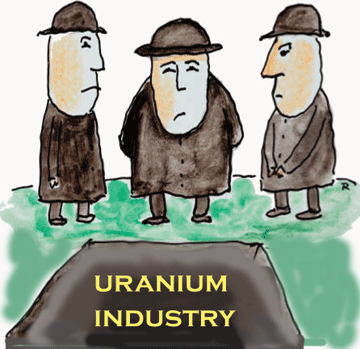 URANIUM DAILY SPOT PRICE TUMBLES $1.25 FROM A WEEK AGO TO $36.50/LB
Washington (Platts)–27 Oct 2015
The daily spot price of uranium Monday was $36.50/lb U3O8, down $1.15 from October 20, following a week when sellers accepted incrementally lower offer prices, according to price reporting company TradeTech.
The U3O8 daily spot price has declined nearly every day since TradeTech reported it at $37.75/lb October 16 and 19. The price was $37.65/lb October 20, $37.35/lb the next day, $37/lb October 22 and $36.50/lb on October 22, according to the company, which reported the spot price unchanged Monday.
In its report Friday for the week ended that day, TradeTech said, “a few sellers did attempt to draw out additional buying interest by lowering offer prices. A few buyers did step into the market to take advantage of lower prices, but most buyers remained largely disinterested.”
Overall, it reported an aggregate of 700,000 lb of U3O8 in six transactions were concluded for the week ending Friday, “with prices declining with each successive transaction.”
TradeTech on Friday reported the weekly U3O8 spot price at $36.50/lb, down $1.25 from October 16.
Price reporting company Ux Consulting on Monday also reported a $36.50/lb weekly U3O8 spot price, down $1.25 from October 19……. http://www.platts.com/latest-news/electric-power/washington/uranium-daily-spot-price-tumbles-125-from-a-week-21364472
1 This Month




PLEASE OPPOSE HR 8255 AND S.3639 – bills would accelerate satellite deployment, with no environmental review or safeguards – https://ncstd5li.quorum.us/campaign/169331/
To see nuclear-related stories in greater depth and intensity – go to https://nuclearinformation.wordpress.com
-
Archives
- September 2026 (339)
- August 2026 (330)
- July 2026 (355)
- June 2026 (287)
- May 2026 (306)
- April 2026 (356)
- March 2026 (251)
- February 2026 (267)
- January 2026 (308)
- December 2025 (358)
- November 2025 (359)
- October 2025 (375)
-
Categories
- 1
- 1 NUCLEAR ISSUES
- business and costs
- climate change
- culture and arts
- ENERGY
- environment
- health
- history
- indigenous issues
- Legal
- marketing of nuclear
- media
- opposition to nuclear
- PERSONAL STORIES
- politics
- politics international
- Religion and ethics
- safety
- secrets,lies and civil liberties
- spinbuster
- technology
- Uranium
- wastes
- weapons and war
- Women
- 2 WORLD
- ACTION
- AFRICA
- Atrocities
- AUSTRALIA
- Christina's notes
- Christina's themes
- culture and arts
- Events
- Fuk 2022
- Fuk 2023
- Fukushima 2017
- Fukushima 2018
- fukushima 2019
- Fukushima 2020
- Fukushima 2021
- general
- global warming
- Humour (God we need it)
- Nuclear
- RARE EARTHS
- Reference
- resources – print
- Resources -audiovicual
- Weekly Newsletter
- World
- World Nuclear
- YouTube
-
RSS
Entries RSS
Comments RSS

