Sloppy health data collection in the history of America’s nuclear workers

 Nuclear workers: Projects’ results were worth illnesses, deaths Amarillo.com December 28, 2015 Tribune News Service “…………The death toll for American workers has never been disclosed. The U.S. Department of Labor, which administers the compensation program, makes routine reports on how much it spends and how many people it serves, but never on the number who have died.
At first, department officials told TNS they do not even bother to collect information on the cause of injury or deaths for deceased workers. But later they said they do, on a limited basis, to comply with federal law.
The investigation also found vast differences in the way the federal program is run. As an example, workers at the nuclear facility at Hanford are nearly twice as likely to win money from the government as workers at their sister plant at Savannah River.
The department goes to great lengths to protect its data, taking several months to release it and comply with a request under the Freedom of Information Act. Then the department refused to release the names of companies that have provided medical care for sick workers under the program, formally called the Energy Employees Occupational Illness Compensation Program Act. The department cited privacy concerns, but TNS is appealing that decision.
An examination of the data reveals the program that began accepting applications in 2001 has far surpassed anything envisioned by its founders.
The explosive growth of the program surprised even its chief architect.
Bill Richardson, the former governor of New Mexico who served as energy secretary under President Bill Clinton, said sloppy record-keeping at the nuclear sites made it difficult to predict the ultimate size of the program.
“See, you don’t know when you enter a program like this what the result is going to be, except you need to be guided by: Is it the right thing to do?” he said in September.
Richardson said the federal government had shown “a lack of conscience” in its decades-long refusal to help workers who had legitimate claims until Congress finally reversed course.
He said getting the program passed became easier after the Washington Post in 1999 first reported that thousands of unsuspecting workers had been exposed to plutonium and other highly radioactive metals for 23 years at the Paducah Gaseous Diffusion Plant in western Kentucky.
Richardson, who apologized at the time for the government’s denial of any plutonium exposures, said the program’s dramatic growth is a good sign, adding that no one’s getting rich, with individual payments capped at $400,000.
James Melius — the chairman of the federal Advisory Board on Radiation and Worker Health, a presidential panel that examines compensation claims — said it’s hardly a surprise that the program has grown so rapidly.
“The DOE complex is huge,” he said, with “literally hundreds of thousands of workers who are potentially eligible who worked at various times within the complex.”……..
Congress passed the program in 2000 after the Department of Energy submitted studies covering 600,000 people that showed workers at 14 sites had increased risks of dying from cancer and nonmalignant diseases……….http://amarillo.com/news/latest-news/2015-12-28/nuclear-workers-projects-results-were-worth-illnesses-deaths#.VoMfhne5dh0.twitter
Is America oblivious to the fact of sick and dying nuclear workers?
U.S. shrugs on nuclear worker safety http://www.kentucky.com/opinion/editorials/article50563650.html
Contractors cut health benefits in push to reduce costs
Their story is sad.
This is outrageous: Workers in U.S. nuclear facilities are still being exposed to radiation on the job and will suffer the consequences to their health and longevity.
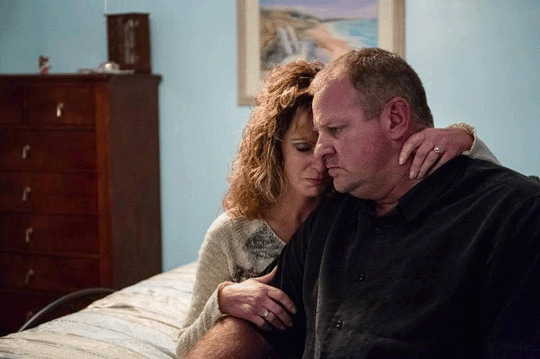
More than 186,000 workers have been exposed to radiation since 2001, when the federal government finally established a fund to compensate sick nuclear workers and their survivors.
The government has already paid $11 million to 118 workers who began working at nuclear weapons facilities after 2001, according to an exhaustive examination of federal data by the McClatchy Washington bureau.
Stronger safety standards and greater awareness are failing to protect today’s workers, even as the U.S. embarks on a $1 trillion, 30-year modernization of its nuclear arsenal.
(The goal is to reduce the number while sharpening the accuracy of our bombs. Whether the U.S. should pay so much to risk another nuclear arms race is a serious question for another day.)
The cost of compensating sick nuclear workers is also high, even though awards are relatively modest and workers and their families often must battle bureaucracy for years to qualify, according to McClatchy’s reporting.
Taxpayers have spent $12 billion so far to compensate nuclear workers whose sickness or deaths were linked to their occupations.
It’s significant that the government underestimated how sick its nuclear workforce would become. Original predictions were that the compensation program would serve 3,000 people. Instead, 53,000 sick workers have been compensated, while 107,394 have been diagnosed with cancer and other work-related diseases, and workers still are getting sick.
Some of the sick are Kentuckians who worked in Paducah, where uranium was enriched for weapons and military reactors and where environmental contamination is also a costly Cold War legacy. (Owned by the U.S. Department of Energy, the nation’s last remaining gaseous diffusion plant now produces nuclear fuel and is leased to a private corporation.)
As was the case in Paducah, nuclear workers still say that the risks are worth it because they have few or no alternatives that pay as well.
People in this line of work also say good health care benefits are a must but the government is pressuring contractors who run nuclear weapons facilities to reduce costs by cutting employee pay and benefits, including health care and sick leave.
As McClatchy reported from the Texas Panhandle, 1,100 union employees at the Pantex plant, where B61 gravity bombs are being modernized, went out on strike earlier this year to protest benefits cuts.
A partnership led by Bechtel and Lockheed Martin known as Consolidated Nuclear Security won the contract to run the Pantex plant and the Y-12 complex in Oak Ridge, Tenn. by promising to save the government $3.27 billion over 10 years
Bechtel and Lockheed Martin brought to the assignment a less than stellar record: a combined 11 complaints of retaliation against whistle blowers who raised safety concerns; and $70 million in violations, including falsifying test records and insufficient radiation controls, reports McClatchy.
The two companies’ employees and their survivors have received $200 million in compensation from taxpayers for job-related illnesses.
Pretending that nuclear workers no longer face serious health risks or that the government and its contractors are doing all they can to protect them is a brutal false economy. This country should do better.
Savannah River Nuclear Station’s scandal of sick and dying workers
Ailing nuclear workers: Relying on Jesus and morphine, Charlotte Observer, 13 Dec 15
‘Smitty’ dies at 62 from cancer after working as a reactor operator
No compensation for him, or for thousands of other workers
Frustration with government from workers across the country
BY ROB HOTAKAINEN, SAMANTHA EHLINGER AND MIKE FITZGERALDMcClatchy Washington Bureau AUGUSTA, GA. 19 Dec 15

On an oven-hot Sunday in late August, Smitty wore white dress shorts and a cool lilac shirt that contrasted nicely with his salt-and-pepper hair, dozing in the front pew of the Southside Baptist Church.
Holding a black zippered Bible on his lap, he had his left leg stretched out all the way, resting it on two pillows on the seat of a wheelchair positioned just in front of him. He did it that way to protect a raw wound from a blood clot that ran from his knee to his hip. Doctors told him it was one of the biggest clots they’d ever seen.
[Irradiated: Read the full four-part report]
After working 17 years at the Savannah River nuclear weapons plant, just across the Georgia state line in South Carolina, Smitty found out on Sept. 11, 2008, 10 years after he retired, that he had multiple myeloma, a cancer.
Just like 54,005 other workers who have tried to get help from the federal government after getting sick at a nuclear weapons plant, Smitty never got a penny.
At 62, he relied instead on Jesus and morphine.
That meant up to two 30 milligram tablets of morphine sulfate every four to six hours, as needed, and prayers all day long, including the reading of at least one chapter in the Bible each day…….
Until the end, Smitty said he could not understand how the feds could say there was insufficient evidence to approve his claim for compensation. He said it was particularly perplexing because federal officials first led him to believe that his claim would be accepted, then suddenly ruled against him.
“I thought I was approved and shared it with my wife, and within no time at all, it was disapproved,” Smitty said……..
Survivors such as Priscilla Maez Clovis of Albuquerque, N.M., say the people who run the Energy Employees Occupational Illness Compensation Program are doing what they’ve always done: “Delay, deny, until you die.”
Over the past year, McClatchy journalists found that, on average, it takes 21.6 months for a claimant to get approved, while 20,496 workers spent five or more years navigating the bureaucracy. The government’s data shows that one production worker at a defunct facility in Portsmouth, Ohio, had to wait 14 years for compensation. The unidentified employee had bladder and brain cancers.
Across the nation, stories of frustration abound:………
The Investigative Fund of The Nation Institute, a nonprofit media center based in New York City, helped support this project. http://www.charlotteobserver.com/news/nation-world/article49568870.html
South Carolina nuclear workers made sick, and dying, by radiation
Editorial: Nuclear workers show America’s darker side http://www.islandpacket.com/opinion/editorials/article50722150.html ISLANDPACKET newsroom@islandpacket.com The numbers are sobering. The problem is immense.
In a special report presented over the past week, our fellow McClatchy journalists put faces on the heavy and often hidden cost of America’s atomic weaponry.
A total of 107,394 workers have been diagnosed with cancers and other diseases after building the nation’s nuclear stockpile over the last seven decades. At least 33,480 former nuclear workers are dead after helping the U.S. win World War II and the Cold War before getting sick enough to qualify for government compensation.
Taxpayers have spent $12 billion so far treating and compensating more than 53,000 sick nuclear workers.
But fewer than half the workers who sought help had their claims approved. More than 54,000 workers have been denied government help. Some say the government’s tactic is to “Delay, deny, until you die.”
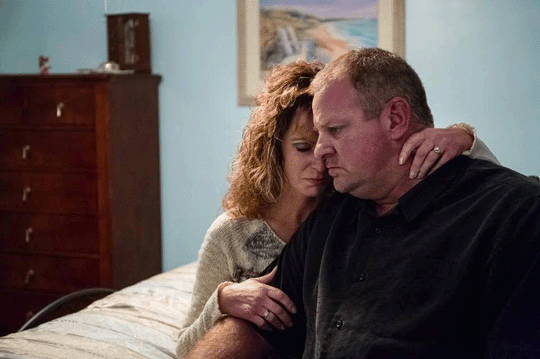
South Carolina, home to the Savannah River Site outside Aiken, has certainly paid a toll to the silent killer.The site that turned 65 this year was established by President Truman to produce the basic materials used in the fabrication of nuclear weapons.
Nearly 40 million gallons of highly radioactive nuclear waste remains at SRS — 90 miles up the Savannah River from where much of Beaufort County’s drinking water is withdrawn. The waste is stored in aging tanks.
And the federal government’s poor record for helping its workers is matched or exceeded by its miserable record of dealing with the nuclear waste that will threaten workers and communities ad infinitum.
Earlier, McClatchy reported that the United States already has generated more than 80,000 tons of spent nuclear fuel and high-level nuclear waste, and the toxic materials are stored at some 80 sites in 35 states…….
What we see is a nation in denial. We see a nation willing to consider workers in its hodgepodge of nuclear sites to be collateral damage. We see a nation that has grossly underestimated the cost to the workers.
And we see a nation that for pure politics will endanger entire communities and states by failing to confront its sick legacy of the atomic age.
We see a nation that should do much better by its own people.http://www.islandpacket.com/opinion/editorials/article50722150.html
McClatchy reportreveals the staggering death toll from radiation, among nuclear workers
More US fatalities from radiation exposure than in the wars in Afghanistan and Iraq, McClatchy report reveals, Fukushima Watch, December 15th, 2015, by Greg White The reverberations of nuclear power are most often reported on during the occasional nuclear meltdown, like the 1986 Chernobyl disaster and the 2011 Fukushima disaster. But, the consequences of nuclear power are far more persistent and prevalent than the mainstream media has often led the public to believe, even in the US. According to a yearlong investigation, a staggering 33,480 US nuclear workers have died from radiation exposure in the last seven decades.(1,2)The death count was published and disclosed for the first time by American publishing company McClatchy. The report revealed that the number of US workers who died from nuclear radiation exposure was four times greater than the number of American casualties in the wars in Afghanistan and Iraq. The count involves all workers who died after they or their survivors were compensated by a special fund established in 2001, which aided workers who helped build the US nuclear stockpile.
Approximately 107,394 workers were diagnosed with cancer or other maladies after building the country’s nuclear stockpile over the last seven decades. The researchers extrapolated information using a database obtained from the US Department of Labor under the Freedom of Information Act. In addition, the investigation involved over 100 interviews with nuclear workers, scholars, government authorities and environmental activists.
US GOVERNMENT VASTLY UNDERESTIMATES HEALTH RISKS OF NUCLEAR PRODUCTION The report underlined the fact that the federal government underestimated how sick the US nuclear workforce would become. At the beginning, the government expected a compensation program that would serve 3,000 people at an annual cost of $120 million. Fourteen years later, however, the government has spent $12 billion of taxpayer money to reimburse more than 53,000 nuclear workers.(1)
“I think that, when this program was created in 2001, there had been some awareness in Congress leading up to, and it was created through the efforts of the Clinton administration to compensate workers who had become ill,” explained Lindsay Wise, a reporter involved in the investigation.(3)
“It started to become apparent that many of these workers had been exposed to dangerous subjects, radioactivity and other toxins, without realizing it or without knowing the full extent of the health hazards that they were facing.”(3)
“And so once that started to come to light through some research of some reporters, The Washington Post and other places, there was pressure in Congress to pass a fund to compensate the workers.”(3)
Although the costs vastly exceeded government expectations, federal records reveal fewer than half of the nuclear workers who sought compensation have had their claims approved by the US Department of Labor.(3)…… http://www.fukushimawatch.com/2015-12-15-more-us-fatalities-from-radiation-exposure-than-in-the-wars-in-afghanistan-and-iraq-mcclatchy-report-reveals.html
Global trend towards bankruptcy for the nuclear industry
 Here is yet another reason why Solar (of all flavors) is starting to look better and better: ‘Nuclear power is risky and unprofitable’ Mycle Schneider, an expert on nuclear energy, expects bankruptcy in the nuclear industry and “substantial security risks.”
http://www.dw.de/nuclear-power-is-risky-and-unprofitable/a-18299318
DW: Mycle Schneider, every year you publish the World Nuclear Industry Status Report. What are the global trends?
The production costs for nuclear energy have increased over the last couple of years. It’s a dramatic development as the costs of all the other technologies, especially renewable energies, are decreasing. Renewable energies are, therefore, now in real competition. Furthermore, power demand in Europe is shrinking, and for operators of nuclear power stations, these are real problems.
So if nuclear power isn’t economically viable, why then are some governments – such as the British government – planning to build new nuclear power stations?
Energie- und Atomexperte Mycle Schneider
Sees nuclear power as too risky and expensive: Mycle Schneider, expert on nuclear energy.
For years, the British government has counted on nuclear power and not put forward a reasonable energy policy. Well, nuclear energy has become more expensive now but other, more intelligent scenarios have not been developed. It’s also not certain yet, whether or not the new Hinkley Point nuclear power plant will be built as planned. There are no signed contracts yet. But the estimated cost to generate power from these plants is about twice as high as the average price of electricity today.
India moves closer into nuclear industry of dubious safety
The strange love for nuclear energy http://www.thehindu.com/opinion/lead/on-the-indiajapan-civil-nuclear-deal/article7996972.ece M.V. RAMANA SUVRAT RAJU
The prospect of a nuclear deal with Japan is worrying because it ignores voices on the ground and takes India a step closer to the construction of untested and expensive reactors
During Japanese Prime Minister Shinzô Abe’s visit to India last week, Japan and India reportedly made progress on a nuclear deal that they have been discussing for more than seven years. The governments did not actually conclude the deal: the Joint Statement released by the Prime Ministers only includes a droll phrase welcoming the “agreement reached… on the Agreement… for Cooperation in the Peaceful Uses of Nuclear Energy” and expresses the hope that “this Agreement will be signed after the technical details are finalised”.
- These “details” include deep concerns about India’s growing weapons arsenal within Japan’s polity that even Mr. Abe’s militaristic government has found difficult to ignore. Nevertheless, even the prospect of an India-Japan nuclear deal is worrying because it takes the country a step closer to the construction of untested and expensive reactors. Moreover, despite the Narendra Modi government’s “Make in India” rhetoric, the agreement will primarily benefit multinational corporations based in Japan. Continue reading
Kansas’ nuclear workers with cancer from exposure to radiation
A 2008 government investigation uncovered processes that produced radioactive dust that workers would have inadvertently breathed in and eaten – and buildings given a soap-and-water cleanup and repurposed after Spencer sold off its nuclear operations.
National Institute for Occupational Safety and Health – a division of the Centers for Disease Control and Prevention – did conclude that because of deficiencies found in the way materials were handled, it was likely that workers outside the nuclear operation were also exposed to dangerous levels of radioactive materials
 Kansas cancer survivors fight for compensation for radiation exposure decades ago
Cancer survivors seeking compensation complain of delays, red tape
THE WICHITA EAGLE, BY DION LEFLER dlefler@wichitaeagle.com GALENA , 17 Dec 15
Robert and Sharon Houser are part of a “Special Exposure Cohort.”
It’s an honor they’d just as soon have done without.
What it means is that it may be marginally easier for them to get compensation from the government for the cancers they’ve suffered, which could be related to radiation exposure from when they worked at the Spencer Chemical Co.’s Jayhawk Works just north of Galena.
They were there when the company made a brief foray into processing uranium for the fledgling nuclear power industry in the 1950s and 1960s. Continue reading
Huge in crease in medical insurance claims by nuclear workers
Medical Care, Compensation Increase for Texas Nuclear Plant Workers http://www.insurancejournal.com/news/southcentral/2015/12/15/391907.htm December 15, 2015 The past few years have seen an increase in the number of workers at a nuclear weapons plant in the Texas Panhandle who have been compensated and given medical care for conditions caused by exposure to plant hazards.
Those hazards include chemicals in the maintenance warehouse, toxins on a production line and beryllium, a cancer-causing metal used in the production of nuclear warheads, according to the Fort Worth Star-Telegram.

The paper reviewed federal totals for health care and compensation awarded for workplace-related illnesses at the Pantex plant near Pampa.
About 20 percent of the worker claims for compensation were approved at the nation’s top facility for nuclear weapon assembly, disassembly and maintenance. Now, about half are being approved for workers across the 16,000-acre site, including auditors, firefighters, laboratory workers, janitors and security guards.
About $171 million in compensation and medical bills has been paid more than 1,300 workers and families since the Energy Employees Occupational Illness Compensation Program began in 2000.
The number of claimants was beyond estimates by those who devised the program, said Sarah Ray, a former Pantex critical safety systems training specialist, who has filed thousands of claims on behalf of Pantex workers and their families since the program started.
“Overall, there just has not been a real grasp of the true situations faced by nuclear weapons workers,” said Ray, who believes that thousands more are unaware they’re sick because they have not developed symptoms. Rachel P. Leiton, director of the Labor Department’s program, says the agency has over the years implemented shortcuts to ease access to the program for families.
“We try to the best we can to compensate them based on our statutory authority that we’re given,” she said.
Workers at Pantex undergo required annual physicals in which they submit blood samples sent for analysis to National Jewish Health, a Denver-based medical research facility that specializes in respiratory and allergic disorders.
Nuclear power an expensive distraction from REAL solutions to climate change – Gregory Jaczko
Given the lead-time of about ten to fifteen years for nuclear power plant design, approval and construction, a massive program of new construction would need to begin within the next few years to start to replace the soon-to-be-retiring units.
 The latest poster child for nuclear climate change salvation is a fleet of advanced reactors, which — on paper — do provide enticing improvements to the current generation of reactors. At best, however, this technology is several decades from becoming commercially viable, too far into the future to be relevant.
The reality with nuclear power is that it has proven time and again to take longer and cost more to develop than predicted. There is nothing in the new designs nor the performance of the industry today that suggests this trend will end.
 Nuclear Power and Climate Change http://www.huffingtonpost.com/gregory-jaczko/nuclear-power-and-climate_b_8806792.html?ir=Australia 15/12/2015 Gregory Jaczko Fmr. US Nuclear Regulatory Commission Chairman and Commissioner As world leaders convene in Paris in an attempt to prevent a rise in global temperatures, the nuclear industry has — not surprisingly — seized this moment to once again promise the perfect solution to the climate challenge. Having witnessed this industry up close for the last decade and a half, I am concerned that the uniquely perfect promise of safe, clean, predictable, and affordable nuclear power will divert our focus from solutions that will actually work to control greenhouse gas emissions. Continue reading
China keenly marketing nuclear technology to South Africa
 China confident of winning $80b S. Africa nuclear power bid
By Lyu Chang (China Daily): 2015-12-12 Industry officials are confident of China being the front-runner to win the right to build South Africa’s new generation of nuclear power stations.
“We think we are likely to win the bid, after preparing all the documents for the tender,” ZhengMingguang, head of the Shanghai Nuclear Engineering Research and Design Institute, ahigh-tech arm of the State Nuclear Power Technology Corp.
“The nuclear energy industry also involves other issues, so we can’t set any date yet on thefinal bidding process,” he said.
The country hopes to land the contract using its CAP1400 nuclear technology, which isdesigned by SNERDI and based on the AP1000 reactor technology developed by the UnitedStates-based Westinghouse Electric Co LLC.
South Africa currently operates the continent’s only nuclear power plant, near Cape Town, butthe country is currently facing chronic electricity shortages.
The Pretoria government invited tenders in July for an estimated $80 billion contract to buildfour nuclear reactors-the largest contract in the country’s history-which attractedwidespread interest, including from State Nuclear Power Technology Corp, Russia’s stateatomic agency Rosatom and French nuclear firms…….http://www.chinadaily.com.cn/business/2015-12/12/content_22695369.htm
America’s nuclear workers: 33,480 died from radiation- caused illnesses
At least 33,480 US nuclear workers died of exposure: Report http://www.presstv.ir/Detail/2015/12/13/441510/US-nuclear-arsenal-dead-Cold-War A yearlong investigation reveals that America’s great push to win World War II and the Cold War has left “a legacy of death on American soil,” with at least 33,480 US nuclear workers dying of radiation exposure over the course of the last seven decades.
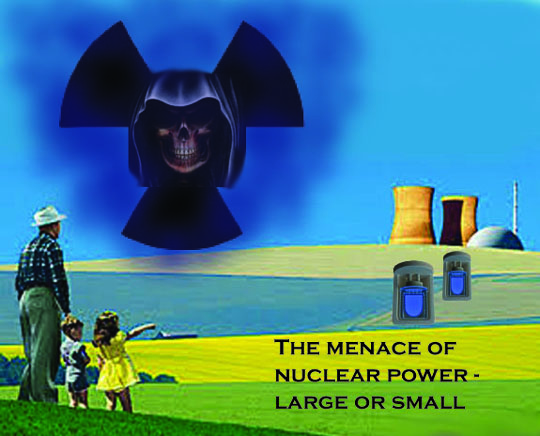
The death count, disclosed for the first time, is more than four times the number of American fatalities in the wars in Iraq and Afghanistan, according to a report from McClatchy called “irritated.”
The investigation has exposed the “enormous human cost” of the US nuclear weapons complex using more than 70 million records in a database obtained from the US Department of Labor under the Freedom of Information Act.
The count includes all workers who died after they or their survivors were compensated under a special fund established in 2001 to help those who were exposed to deadly materials while building the US nuclear stockpile, the report said.
A total of 107,394 workers, involved in the construction of America’s nuclear arsenal, have been diagnosed with cancers and other diseases over the last seven decades, records from an interactive database showed.
In addition to utilizing the federal data, McClatchy’s investigation is also based on over 100 interviews with nuclear workers, government officials, experts and activists.
The report noted that US government officials greatly underestimated how sick the nuclear workforce would become. At first, the government estimated that the compensation program would cost $120 million a year to cover 3,000 people. However, 14 years later, the government has spent $12 billion of taxpayer money to compensate more than 53,000 nuclear workers.
Despite the enormous costs, federal records show that only fewer than half of those who sought compensation have had their claims approved by the US Department of Labor.
Decades after the first victims of the radiation exposure have been identified; McClatchy’s investigation revealed that current safety standards have not reduced the exposure rates and day-to-day accidents in America’s nuclear facilities.
The government, meanwhile, seeks to save money by cutting current workers’ health plans, retirement benefits and sick leave. More than 186,000 nuclear employees have been exposed since the compensation program was created in 2001.
McClatchy conducted the project in partnership with the Investigative Fund of the Nation Institute, a nonprofit media center in New York City.
The report comes as the US prepares to upgrade its aging nuclear arsenal to the tune of $1 trillion over the next 30 years.
Idaho nuclear workers: 360 killed by by exposure to radiation
Federal government acknowledges nuclear radiation likely killed 396 in Idaho, George Zapo, Inquisitr, 13 Dec 15 The federal government acknowledged that nuclear radiation work performed at an Idaho site likely caused or contributed to the deaths of 396 workers. Hundreds of Idaho National Laboratory (INL) employees have filed health insurance claims, declaring the nuclear radiation work they performed at the United States’ leading center for nuclear energy research and development caused them to become ill, and in many cases die prematurely.
Jim Delmore worked at INL since 1966. He is one of the top experts in the nation on mass spectrometry, an analytical chemistry technique. He’s retired now, but he continues to work at the INL as a senior fellow.
Jim said has suffered through several bouts of five different cancers — all in remission now. Based on what he knew from a 1972 incident, he made a claim in 2013 under the Energy Employees Occupational Illness Compensation Program Act.
On November 13, 1972, Jim Delmore came to the laboratory he ran at the Idaho National Laboratory, and found the facility roped off from entry because of a plutonium contamination. It turns out, a chemist brought a sample of plutonium nitrate into the Mass Spectrometry Laboratory at the Idaho Chemical Processing Plant the day before that was 10,000 times larger than needed, Delmore said.
The plutonium nitrate spread throughout the lab. Internal tests showed the dose to the lungs of the 13 lab staff was small. However, it also showed that several of the workers had been previously contaminated and had not been adequately monitored.
Delmore received $150,000 in compensation. In addition, other INL workers, who were able to prove their work with nuclear radiation likely contributed to, or caused their illness, received part of $53 million in health care costs paid under the program.
Another $188 million was paid to the survivors of 471 former INL workers who’ve died, according to the Department of Labor.
The federal government acknowledged for the first time this year nuclear radiation work done by workers at Idaho National Laboratory probably caused or contributed to the deaths of 396 workers.
Though the U.S. federal government compensated the families of nearly 480 INL workers who died, official say that only 396 workers proved to the government’s satisfaction that nuclear radiation exposure at INL was 50 percent or more responsible for their deaths. So far, 15,809 of the nuclear worker deaths nationwide fit that test.
Idaho National Laboratory employees have been finding it difficult to prove eligibility. In fact, nearly two of every three claims are denied. When an INL worker has a disease that qualifies, they also have to prove they had been exposed to high levels of nuclear radiation or hazards.
Fortunately, because Jim Delmore brought the 1972 nuclear radiation incident and the lack of internal monitoring to the attention of the National Institute for Occupational Safety and Health (NIOSH) in his 2013 claim, many former employees may be eligible for compensation without having to prove anything — except that they have a qualifying disease.
Jim Delmore simply responded about the eligibility of his co-workers…….. http://www.inquisitr.com/2630254/government-acknowledges-nuclear-radiation-likely-killed-396/
Kansas nuclear workers: sickness and death toll from radiation-induced illness
nearly 300 former Kansas City Plant workers who have received more than $55 million in compensation for illnesses linked to their work, according to an analysis of government data obtained by McClatchy Newspapers through the Freedom of Information Act.
In more than half of the cases, the money went to survivors after the workers died.
Most of those who applied to the federal fund got nothing, including the families of at least 554 deceased Kansas City Plant workers whose claims the government denied.
Kansas City’s nuclear legacy trails weapon makers and their families
Scores of workers have died after making nuclear weapons at the Bannister Road plant
A government review finds more radioactive materials used at the plant than was known before
The federal government has paid $55 million to sickened workers, but a vast majority are still frustrated that they have not been compensated The Kansas Cty Star, BY LINDSAY WISE lwise@mcclatchydc.com AND SCOTT CANON scanon@kcstar.com 13 Dec 15 Marlon Smith , worked as a roofer at the Bannister Federal Complex in south Kansas City for just five months in 2005.
That’s all the time it took for him to suffer irreparable damage to his lungs by inhaling particles of beryllium, a hazardous metal used in nuclear weapons production.
Today the 58-year-old has chronic beryllium disease, a serious respiratory condition that can be fatal.
Smith says the subcontractor he worked for never warned him about the dangers of beryllium exposure, even after he asked why other workers in a tent a few yards away from him were fully suited in protective gear.
“I said, ‘Where is my suit?’ ” he recalls. “They said, ‘You don’t need one. You need just a dust mask.’ ”
News that beryllium and other toxins sickened workers at the site broke years ago. But a recent investigation by the federal government revealed that some employees at the Kansas City Plant might have been exposed to more radiation than previously known. Already, the government has paid workers from the plant, or their survivors, tens of millions in compensation for illnesses and deaths. That figure is still growing……..the latest investigation by the National Institute for Occupational Safety and Health and an advisory board appointed by the president has turned up proof that operations at the site in the 1950s, ’60s and ’70s involved more radioactive materials — and potentially higher radiation doses to workers — than previously disclosed in the public record.
More than 1,440 workers who fell ill after working at the Kansas City Plant have applied for compensation and medical coverage from the federal government. The money comes from a fund created in 2001 to recognize the sacrifices made by nuclear workers who helped America fight the Cold War.
Smith received a check this year for $150,000 from the federal government, a sum he considers a paltry price for his life and livelihood.
“How can you put a price on somebody’s life?” he asked.
The roofer is in a group of nearly 300 former Kansas City Plant workers who have received more than $55 million in compensation for illnesses linked to their work, according to an analysis of government data obtained by McClatchy Newspapers through the Freedom of Information Act.
In more than half of the cases, the money went to survivors after the workers died.
Most of those who applied to the federal fund got nothing, including the families of at least 554 deceased Kansas City Plant workers whose claims the government denied.
The approval rate for cases involving former workers at the plant is particularly low at just 23 percent — less than half the national average, McClatchy’s analysis found.
Workers and their relatives say they’re confounded by the paperwork and bureaucracy of the claims process.
Otha Gilliam has a stack of documents for his late parents’ compensation cases at least a foot thick in his home in south Kansas City.
The struggle to follow through with the claims leaves him overwhelmed……..
As the government now acknowledges, work with natural uranium took place at the plant in the early 1950s. Natural uranium emits about twice as much radioactivity per gram as depleted uranium. Workers also machined magnesium alloys containing thorium, a radioactive element, in the 1960s and ’70s. And they used tritium, a radioactive isotope of hydrogen, to prepare calibration sources and produce luminescent switch plates. Radioactive nickel-63 was plated on disks that also were used to calibrate radiation detectors.
The natural uranium and mag-thorium alloy machining could result in the biggest bumps to workers’ estimated radiation doses, said Stuart Hinnefeld, director of NIOSH’s Division of Compensation Analysis and Support……..http://www.kansascity.com/news/government-politics/article49473260.html
Texas nuclear workers sick and dying from exposure to radiation
widespread examples of payouts that occur only after a worker dies. She handled the claim of one widow who just this year received a payout on a claim that her husband filed in 2005. The husband died of cancer in 2011.
“Many claimants have commented that they think the claims are drug out so that the claimants die,” Ray said. “It truly is less costly to pay a survivor than it is to pay compensation and provide long-term healthcare for a living worker.”
Half of all claims are settled on behalf of survivors, including workers’ spouses, children, parents, grandchildren and grandparents
The perils of Pantex: Hundreds of workers sickened at Texas nuclear weapons plant, Star telegram, 13 Dec 15
Panhandle nuclear weapons assembly plant a hazardous workplace
Workers used to joke that they made soap at the facility
More than 1,300 workers and families have been awarded compensation since 2000 BY YAMIL BERARD yberard@star-telegram.com
AMARILLO “…..Years ago, it was popular for plant workers to tell spouses and other loved ones that they made soap at the nuclear weapons assembly facility on a 16,000-acre parcel. But Pantex now conjures up a different image, as hundreds have suddenly fallen ill or died at the plant, a vital component in the nation’s nuclear weapons program since the 1950s.
The federal government has made concessions to a growing number of workers, like Ruzich, whose Pantex jobs made them sick. Many hundreds have been provided with medical coverage and lump sum payments, under the energy employees’ compensation program, according to records provided to the Star-Telegram by the Labor Department.
Bob Ruzich, now 64, said he never thought the chemicals in the maintenance warehouse and the toxins on the production line would give him throat and tongue cancer.
“I didn’t think much about it, but I do now believe that’s what caused my cancer,’’ said Ruzich, who worked dismantling warheads and in the maintenance department since 1982.
Several years ago, less than 1 in 5 claims were decided in favor of workers and their families, according to records provided to the Star-Telegram. Now, more than half are typically handed compensation and medical care because of a prevalence of scientific evidence that their illness was caused by an exposure to plant hazards, records say.
All told, $171 million in compensation and medical bills has been disbursed to more than 1,300 workers and families since the energy employees’ compensation program began in 2000, the program’s numbers say.
“The number of claimaints or sick workers was beyond the expectations of those who originally created the program,” said Sarah Ray, a former Pantex critical safety systems training specialist, who has filed thousands of claims on behalf of Pantex workers and their families since the program started.
“Overall, there just has not been a real grasp of the true situations faced by nuclear weapons workers,” said Ray, who believes that thousands more aren’t aware that they are sick because they have not developed symptoms…….
Since 2000, David Pompa has documented each sick case in a running log that includes more than several hundred employees. Over the years, Pompa has gone with the sick to see doctors, to meet with supervisors and staff members and to special hearings with government claims examiners, employees said……
Ray, the former Pantex training specialist, said she now hears of more families burying their dead.
“Workers at Pantex are walking time bombs,’’ Ray said. “They have this false bravado — especially the guys. Then all of a sudden, they are really, really sick and they learn they are deathly ill from some lung problem. Then they’ve got something else and they die, just because they’re not paying attention to the minor signs.”……
Ray, who has filed thousands of claims on behalf of Pantex workers and their families, said it can take years for claimants to receive money or get healthcare assistance. Ray has a bachelor’s degree in business administration and a master’s in instructional technology.
She’s seen widespread examples of payouts that occur only after a worker dies. She handled the claim of one widow who just this year received a payout on a claim that her husband filed in 2005. The husband died of cancer in 2011.
“Many claimants have commented that they think the claims are drug out so that the claimants die,” Ray said. “It truly is less costly to pay a survivor than it is to pay compensation and provide long-term healthcare for a living worker.”
Half of all claims are settled on behalf of survivors, including workers’ spouses, children, parents, grandchildren and grandparents, Leiton indicated……..http://www.star-telegram.com/news/state/texas/article49500030.html
1 This Month




PLEASE OPPOSE HR 8255 AND S.3639 – bills would accelerate satellite deployment, with no environmental review or safeguards – https://ncstd5li.quorum.us/campaign/169331/
To see nuclear-related stories in greater depth and intensity – go to https://nuclearinformation.wordpress.com
-
Archives
- September 2026 (330)
- August 2026 (330)
- July 2026 (355)
- June 2026 (287)
- May 2026 (306)
- April 2026 (356)
- March 2026 (251)
- February 2026 (267)
- January 2026 (308)
- December 2025 (358)
- November 2025 (359)
- October 2025 (375)
-
Categories
- 1
- 1 NUCLEAR ISSUES
- business and costs
- climate change
- culture and arts
- ENERGY
- environment
- health
- history
- indigenous issues
- Legal
- marketing of nuclear
- media
- opposition to nuclear
- PERSONAL STORIES
- politics
- politics international
- Religion and ethics
- safety
- secrets,lies and civil liberties
- spinbuster
- technology
- Uranium
- wastes
- weapons and war
- Women
- 2 WORLD
- ACTION
- AFRICA
- Atrocities
- AUSTRALIA
- Christina's notes
- Christina's themes
- culture and arts
- Events
- Fuk 2022
- Fuk 2023
- Fukushima 2017
- Fukushima 2018
- fukushima 2019
- Fukushima 2020
- Fukushima 2021
- general
- global warming
- Humour (God we need it)
- Nuclear
- RARE EARTHS
- Reference
- resources – print
- Resources -audiovicual
- Weekly Newsletter
- World
- World Nuclear
- YouTube
-
RSS
Entries RSS
Comments RSS


