In 2016 we hope for the defeat of the worst trade agreement – Trans Pacific Partnership
In 2016, let’s hope for better trade agreements – and the death of TPP, Guardian, Joseph Stiglitz, 11 Jan 16 The Trans-Pacific Partnership may turn out to be the worst trade agreement in decades “………The most controversial geo-economic decisions last year concerned trade. Almost unnoticed after years of desultory talks, the World Trade Organization’s Doha Development Round – initiated to redress imbalances in previous trade agreements that favored developed countries – was given a quiet burial. America’s hypocrisy – advocating free trade but refusing to abandon subsidies on cotton and other agricultural commodities – had posed an insurmountable obstacle to the Doha negotiations. In place of global trade talks, the US and Europe have mounted a divide-and-conquer strategy, based on overlapping trade blocs and agreements.
As a result, what was intended to be a global free trade regime has given way to a discordant managed trade regime. Trade for much of the Pacific and Atlantic regions will be governed by agreements, thousands of pages in length and replete with complex rules of origin that contradict basic principles of efficiency and the free flow of goods.

The US concluded secret negotiations on what may turn out to be the worst trade agreement in decades, the so-called Trans-Pacific Partnership (TPP), and now faces an uphill battle for ratification, as all the leading Democratic presidential candidates and many of the Republicans have weighed in against it. The problem is not so much with the agreement’s trade provisions, but with the “investment” chapter, which severely constrains environmental, health, and safety regulation, and even financial regulations with significant macroeconomic impacts.
In particular, the chapter gives foreign investors the right to sue governments in private international tribunals when they believe government regulations contravene the TPP’s terms (inscribed on more than 6,000 pages). In the past, such tribunals have interpreted the requirement that foreign investors receive “fair and equitable treatment” as grounds for striking down new government regulations – even if they are non-discriminatory and are adopted simply to protect citizens from newly discovered egregious harms.
While the language is complex – inviting costly lawsuits pitting powerful corporations against poorly financed governments – even regulations protecting the planet from greenhouse gas emissions are vulnerable. The only regulations that appear safe are those involving cigarettes (lawsuits filed against Uruguay and Australia for requiring modest labeling about health hazards had drawn too much negative attention). But there remain a host of questions about the possibility of lawsuits in myriad other areas.
Furthermore, a “most favoured nation” provision ensures that corporations can claim the best treatment offered in any of a host country’s treaties. That sets up a race to the bottom – exactly the opposite of what US President Barack Obama promised.
Even the way Obama argued for the new trade agreement showed how out of touch with the emerging global economy his administration is. He repeatedly said that the TPP would determine who – America or China – would write the twenty-first century’s trade rules. The correct approach is to arrive at such rulescollectively, with all voices heard, and in a transparent way. Obama has sought to perpetuate business as usual, whereby the rules governing global trade and investment are written by US corporations for US corporations. This should be unacceptable to anyone committed to democratic principles.
Those seeking closer economic integration have a special responsibility to be strong advocates of global governance reforms: if authority over domestic policies is ceded to supranational bodies, then the drafting, implementation, and enforcement of the rules and regulations has to be particularly sensitive to democratic concerns. Unfortunately, that was not always the case in 2015.
In 2016, we should hope for the TPP’s defeat and the beginning of a new era of trade agreements that don’t reward the powerful and punish the weak. The Paris climate agreement may be a harbinger of the spirit and mindset needed to sustain genuine global cooperation. http://www.theguardian.com/business/2016/jan/10/in-2016-better-trade-agreements-trans-pacific-partnership
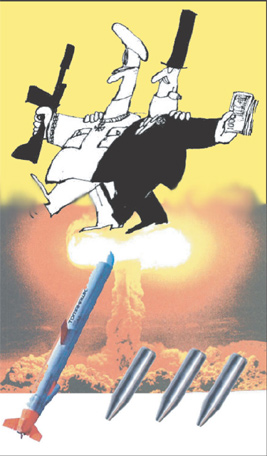
Nuclear corporations in America not only sell bombs, they influence government policy
the “privatization of nuclear war”. Corporations not only reap multibillion-dollar profits from the production of nuclear bombs, they also have a direct voice in setting the agenda regarding the use and deployment of nuclear weapons.
 No Danger of Nuclear War? The Pentagon’s Plan to Blow up the Planet By Prof Michel Chossudovsky Global Research, January 11, 2016
“………….Nuclear war –which threatens life on planet earth– is not front page news in comparison to the most insignificant issues of public concern, including the local level crime scene or the tabloid gossip reports on Hollywood celebrities.
What we are dealing with is the criminalization of the State, whereby officials in high office are complicit in fostering the pre-emptive use of nuclear weapons. The media has camouflaged the implications of America’s post Cold war nuclear doctrine, which was formulated in a secret meeting at US Strategic Command Headquarters on Hiroshima Day, August 6, 2003.
On August 6, 2003, on Hiroshima Day, commemorating when the first atomic bomb was dropped on Hiroshima (August 6 1945), a secret meeting was held behind closed doors at Strategic Command Headquarters at the Offutt Air Force Base in Nebraska.
Senior executives from the nuclear industry and the military industrial complex were in attendance. This mingling of defense contractors, scientists and policy-makers was not intended to commemorate Hiroshima. The meeting was intended to set the stage for the development of a new generation of “smaller”, “safer” and “more usable” nuclear weapons, to be used in the “in-theater nuclear wars” of the 21st Century.
In a cruel irony, the participants to this secret meeting, which excluded members of Congress, arrived on the anniversary of the Hiroshima bombing (August 6) and departed on the anniversary of the attack on Nagasaki (August 9). (Michel Chossudovsky, Towards a World War III Scenario, The Dangers of Nuclear War, Global Research, Montreal, 2012)
The Hiroshima Day 2003 meetings had set the stage for the “privatization of nuclear war”. Corporations not only reap multibillion-dollar profits from the production of nuclear bombs, they also have a direct voice in setting the agenda regarding the use and deployment of nuclear weapons.
All the safeguards of the Cold War era, which categorized the nuclear bomb as “a weapon of last resort”, have been scrapped. “Offensive” military actions using nuclear warheads are now described as acts of “self-defense”. During the Cold War, the doctrine of Mutually Assured Destruction (MAD) prevailed, namely that the use of nuclear weapons against the Soviet Union would result in “the destruction of both the attacker and the defender”.
In the post Cold war era, US nuclear doctrine was redefined. There is no sanity in what is euphemistically called US foreign policy. At no point since the first atomic bomb was dropped on Hiroshima on August 6th, 1945, has humanity been closer to the unthinkable…
Stay informed, spread the word far and wide. To reverse the tide of war, the broader public must be informed. Post on Facebook/Twitter.
Confront the war criminals in high office.
What we really need is real “Regime Change in America”. http://www.globalresearch.ca/there-is-no-danger-of-nuclear-war-or-is-there/5500276
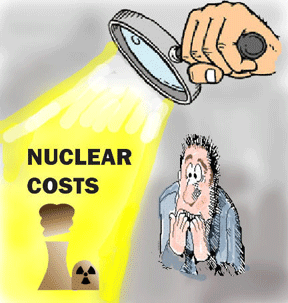
EDF struggling to raise money to fund UK’s new Hinkley Point reactors.

 EDF considers selling €3bn stake in UK nuclear business to help fund reactors
French energy firm may reduce stake in eight existing nuclear reactors it owns to raise money for Hinkley Point C project, Guardian, Terry Macalister, 8 Jan 16, EDF is considering the sale of a €3bn (£2.2bn) stake in its British nuclear business in a bid to raise cash for new Hinkley Point reactors.
Possible buyers would be state-owned Chinese companies, who are already committed partners on the £18bn Somerset project.
EDF could unveil details of a sell-off plan on 16 February, when it is scheduled to release annual financial figures and is expected to give a final investment decision on building Britain’s first new reactors for 20 years.
The French daily, Les Echos, reported on Thursday that EDF may reduce its stake in the eight existing nuclear reactors it owns from 80% to 51% by bringing in a new investor as part of a wider €6bn disposal programme. Industry sources told the Guardian that the possible sell off was only one of a number of different options that were under consideration as the group looked at financing Hinkley Point C and other projects.
They said it was still likely EDF would give the go ahead to Hinkley next month even though it did not have all the financing in place. The project is estimated to cost £18bn, according to EDF, though the European Union has warned it could go as high as £24bn.
Centrica, the owner of British Gas, already has a 20% holding but has made clear in the past that itdoes not want a larger commitment to nuclear, and declined to participate in the Hinkley newbuild scheme………
EDF struggled to interest anyone else in the Hinkley scheme, which many in the City have deemed over-expensive, so the Chinese would seem first in line to buy into the rest of the EDF nuclear business if it comes up for grabs……..
Environmentalists opposed to EDF’s new building plans in Britain believe the company may yet be forced to abandon Hinkley Point C because of a European legal challenge against the state aid promised by the UK. http://www.theguardian.com/business/2016/jan/07/edf-selling-3bn-stake-uk-nuclear-business-reactors-hinkley-point-c
Desperate marketing drive brings giant nuclear corporations together
 Great power relations: How the US, China and India will forge new partnerships on nuclear energy in 2016, South China Morning Post, James Wertsch, Shen Dingli and Swaran Singh say this year will see greater collaboration between the world’s three largest polluters – the US, China and India – following their pledges to move away from fossil fuels, 05 January, 2016
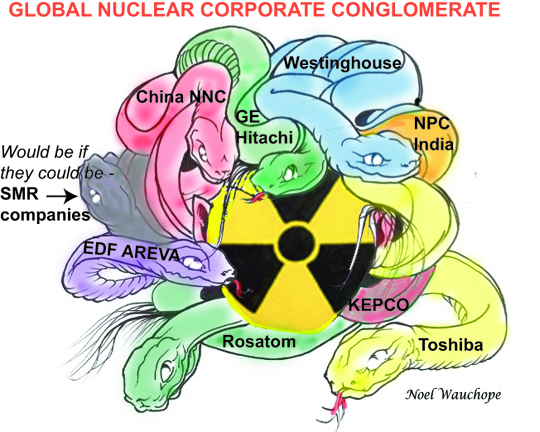
To begin with, complicated and long-winded structural integrity tests have just been declared successful for two of the four Westinghouse AP1000 nuclear power reactors being set up in China’s Zhejiang ( 浙江 ) and Shandong (山東) provinces. These should become operational in September and December respectively. Westinghouse is also in final stages of negotiations for six of the same type of reactor for Gujarat in India.
At a price tag of some US$5 billion to US$6 billion per reactor, such reports are boosting the share price of Westinghouse, which is negotiating to buy parts of the French nuclear reactor manufacturer Areva. It reportedly needs US$7.7 billion to balance its books. Areva’s losses are also allowing China’s Hualong to emerge as the new cost-effective player in the sensitive global nuclear market. That explains why US firms are tying up with China……
….US firms partly owned by Japan’s Toshiba and Hitachi, which explains the changing geopolitics as Prime Minister Shinzo Abe last month signed the long-awaited Indo-Japanese deal clearing the decks for American firms to deliver nuclear technology to India….
The coming together of the US, China and India in building nuclear partnerships has been expedited because Russian, French, Canadian and Kazakh firms have not been deterred by India’s domestic situation or legislation. Given this reality, the US – which originally facilitated India’s entry into global nuclear commerce – was beginning to look like a loser. Russia remains India’s largest supplier of nuclear reactors and the two last month signed another agreement for an additional 12 reactors.
Most interestingly, 2016 will see China entering the Indian market as well; not necessarily as a partner with US firms but as a new competitor. As well as working with India as members of the International Thermonuclear Experimental Reactor, China has a history of supplying heavy water and uranium fuel to New Delhi. The two began negotiating nuclear cooperation during President Xi Jinping’s ( 習近平 ) visit to India in September 2014 and China is keen to help build India’s energy security infrastructure. Beijing has also been exploring markets in Southeast Asia.
China’s Hualong One nuclear reactor has earned enough experience at home and prestige abroad to make it suitable for exploring new global partnerships. Last October, during Xi’s visit to the UK, he announced US$9 billion worth of investment for France’s EDF and China General Nuclear Power Corporation to build three power plants in the UK, which is expected to see Hualong-designed reactors go global.
India, as always, is never far behind. Since 2010, it has been offering to export its pressurised heavy water reactors, which may be ideal for states with smaller power grids. Last month again, during Prime Minister Narendra Modi’s visit to Moscow, Russia and India began negotiations on exploring joint third-country projects.
The recent shale revolution may have reinforced US energy supremacy, but it has also seen oil prices fall relentlessly, making large oil importers like China and India save their dollar reserves and invest in expensive nuclear technology. All this is whipping up US business interests that will redefine the proverbial “American exceptionalism”, especially in the global governance of nuclear commerce. It will also see the US explore more innovative ways in co-opting the interests of a rising China and emerging India, giving them a greater say in global nuclear decision-making.
James Wertsch is vice-chancellor for international relations at Washington University in St Louis, Shen Dingli is associate dean at the Institute of International Studies, Fudan University, Shanghai, and Swaran Singh is professor of disarmament studies at Jawaharlal Nehru University, New Delhi http://www.scmp.com/comment/insight-opinion/article/1898090/great-power-relations-how-us-china-and-india-will-forge-new
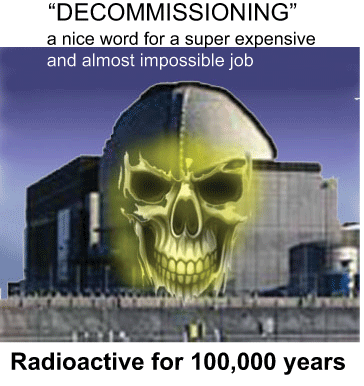
The nuclear industry really has only one likely future: reactor decommissioning
Invited Expert Commentary by Mycle Schneider
The stock market did not hear the call. The claim of four climate mousquetaires at a side event of the Paris climate talks that “nuclear has tremendous potential to be part of the solution to climate change” was lost in space. One day after that enthusiastic statement by former NASA scientist James Hansen, a member of the illustrious quartet, the share value of the largest nuclear operator in the world, the French state-controlled Électricité de France (EDF), dropped to its historic low, a 42-percent plunge since the beginning of the year and an 84-percent meltdown in eight years. On Monday, December 7, Euronext ejected EDF, “pillar of the Paris Stock Exchange”, from France’s key stock market index, known as CAC40. On Tuesday, December 8, EDF shares lost another four percent of their value. Two days later, the trade union representatives at the Central Enterprise Committee of EDF—unanimously and for the first time—launched an official “economic alert procedure” considering the “seriousness of the situation.”
These latest developments come as no surprise to analysts familiar with the international nuclear industry. Credit-rating agencies have warned for years that the launch of nuclear new-build projects are considered “credit-negative.” In October 2015, investment bank Investec advised clients to sell EDF shares amid fears that its connection with the nuclear plant project at Hinkley Point in the UK could put payouts to shareholders under threat. One month later, the French and British governments announced the signature of a framework agreement on a financing package including Chinese partners for the construction two French-built European Pressurized water Reactors (EPR) at Hinkley Point. The federation of EDF employee-shareholders EAS said in a statement that the interests of their company would be “gravely threatened” by the Hinkley Point project, calling it “a financial catastrophe foretold.” EAS asked the management of EDF “to stop this risky project, whose financial risks are too big for our company and which could put EDF’s very survival at risk.” Is EDF facing its Waterloo 200 years after Napoleon’s defeat?
Launched as a response to the Chernobyl disaster almost 30 years ago, not a single so-called Generation-III+ EPR reactor is generating power anywhere in the world.
In the meantime, the self-proclaimed “global leader in nuclear energy,” the French state-controlled AREVA, went bankrupt. After a cumulate loss of €8 billion ($8.7 billion) over the past four years, equivalent to its annual turnover, and a debt load of €6 billion ($6.5 billion), the company will not survive the year in its current form. AREVA is already deep in “junk” territory when it comes to its credit-rating, and its share value has eroded by 92 percent since 2008, hitting a new low on December 17. The government’s rescue strategy—forcing EDF to absorb AREVA’s reactor business—is in-turn increasing the risk for EDF. A significant barrier for the conclusion of the rescue deal remains the multibillion-euro liability of the Hinkley Point predecessor projects in Olkiluoto, Finland, and Flamanville, France. The EPR construction in Finland started 10 years ago. The plant was to begin generating carbon-free electricity by 2009 and was part of the country’s greenhouse gas abatement strategy. Now, the plant is scheduled to produce power in “late 2018.” The sister plant in France is not doing any better—on the contrary. Construction started in 2007 with completion planned for 2012. Officially, the current target date is the same as for the Finnish project. The investment-cost estimate exploded by more than a factor of three to €10.5 billion ($11.4 billion), and this is likely not the last word. In addition, EDF struggles with a €37.5 billion ($40.7 billion) debt burden, rapidly increasing production costs in its aging nuclear fleet, significant post-Fukushima and other investment needs, and a shrinking client base, with declining consumption levels over the past four years in a row.
The international outlook is not any rosier. There have been 40 reactors connected to the world’s power grids in 10 years—representing a negligible share of the overall added electricity generating capacity—after an average construction time of close to 10 years. Some 60 units now under construction have been in the building stage for an average of 7.5 years; at least three-quarters are delayed, four have been listed as “under construction” for over 30 years. The Organisation for Economic Co-operation and Development’s International Energy Agency projects in its “New Policy Scenario” a net addition of 222 GW over the coming 25 years. This compares with the net nuclear addition of 22 GW over the past 25 years—which illustrates the level of wishful thinking in current international projections.
You can spend a euro or a dollar only once. The investment in new nuclear reactors leads to an increase in greenhouse gas emissions as other options—notably intelligent energy services (like daylighting) that don’t depend on active systems, end-use and production efficiency, and now renewables—are not only considerably cheaper, they are much faster to implement.
Nuclear utilities and the nuclear industry in general badly need a reality check. The traditional utilities, nuclear or not, need to learn to sell something other than kilowatt-hours or they will not survive the ongoing energy revolution. And the reactor-building industry might want to turn to a safe haven: reactor decommissioning. Building these machines has turned out to be too expensive and too slow. The deconstructing business will only expand. Guaranteed.
China’s state-owned nuclear companies get together in export marketing drive
 State-owned enterprises eye overseas power projects, Nikkei Asian Review TETSUYA ABE, Nikkei staff writer BEIJING 5 Jan 16, — The global nuclear industry is likely to be another area where China’s growing presence will be keenly felt, as the government and state-owned corporations are working hand in hand to win overseas contracts. This development worries critics who are concerned about nuclear safety issues, as well as Beijing’s seeming lack of commitment to nuclear nonproliferation.United front In their meeting on Dec. 30, Sun Qin, chairman of China National Nuclear Corp., and He Yu, his counterpart at CGN, agreed to join hands to better compete with Western rivals in their pursuit to cultivate overseas nuclear power plant markets.
The two came to the National Development and Reform Commission’s building in Beijing on that day to sign an agreement to set up a joint venture. The new company, to be capitalized at 500 million yuan ($76.5 million), will handle export of Hualong One, a pressurized water reactor model that China claims to have developed on its own.
CNNC and CGN, each of which is a major player that ranks within the top three in the Chinese nuclear industry, are coming together with an eye toward increasing the chance of winning orders in Central Asia and Eastern Europe. Continue reading
The irrationality of the nuclear industry economics – hundreds of $billions in tax-payer subsidies
*Subsidies at inception, reducing capital costs and operating costs.
*Accounting rules allowing companies to write down capital costs after cost overruns, cancellations and plant abandonments, reducing capital-recovery requirements,
*Recovery of “stranded costs” (costs to a utility’s assets because of new regulations or a deregulated market) passed on to rate payers.
 Nuclear Energy Dangerous to Your Wallet, Not Only the Environment, CounterPunch, by PETE DOLACK , 1 JAN 16 The ongoing environmental disaster at Fukushima is a grim enough reminder of the dangers of nuclear power, but nuclear does not make sense economically, either. The entire industry would not exist without massive government subsidies.
Quite an insult: Subsidies prop up an industry that points a dagger at the heart of the communities where ever it operates. The building of nuclear power plants drastically slowed after the disasters at Three Mile Island and Chernobyl, so it is at a minimum reckless that the latest attempt to resuscitate nuclear power pushes forward heedless of Fukushima’s discharge of radioactive materials into the air, soil and ocean.
There are no definitive statistics on the amount of subsidies enjoyed by nuclear power providers — in part because there so many different types of subsidies — but it amounts to a figure, whether we calculate in dollars, euros or pounds, in the hundreds of billions. Quite a result for an industry whose boosters, at its dawn a half-century ago, declared that it would provide energy “too cheap to meter.”
Taxpayers are not finished footing the bill for the industry, however. There is the matter of disposing radioactive waste (often borne by governments rather than energy companies) and fresh subsidies being granted for new nuclear power plants. None of this is unprecedented — government handouts have the been the industry’s rule from its inception. Continue reading
Nuclear industry discounts the massive tax-payer future costs of radioactive wastes
Nuclear Energy Dangerous to Your Wallet, Not Only the Environment, CounterPunch, by PETE DOLACK , 1 JAN 16 “………There would at least be a small silver lining in this dark picture if the electricity produced were cheap. But that’s not the case. From the mid-1970s to the mid-1990s, the cost of producing electricity from nuclear power in France tripled and in the United States the cost increased fivefold, according to the Vermont Law School paper [page 46].
 Then there are the costs of nuclear that are not imposed by any other energy source: What to do with all the radioactive waste? Regardless of who ultimately shoulders these costs, the environmental dangers will last for tens of thousands of years. In the United States, there is the fiasco of the Yucca Mountain nuclear waste dump in Nevada. The U.S. government has collected $35 billion from energy companies to finance the dump, which is the subject of fierce local opposition and appears to have no chance of being built.
Presumably, the energy companies have passed on these costs to their consumers but nonetheless are demanding the government take the radioactive waste they are storing at their plants or compensate them. As part of this deal, the U.S. government made itself legally responsible for finding a permanent nuclear-waste storage facility.
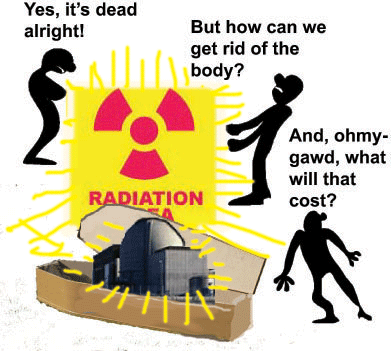
And, eventually, plants come to the end of their lives and must be decommissioned, another big expense that energy companies would like to be borne by someone else. The Heinrich Böll Stiftung studysays:
“[T]here is a significant mismatch between the interests of commercial concerns and society in general. Huge costs that will only be incurred far in the future have little weight in commercial decisions because such costs are “discounted.” This means that waste disposal costs and decommissioning costs, which are at present no more than ill-supported guesses, are of little interest to commercial companies. From a moral point of view, the current generation should be extremely wary of leaving such an uncertain, expensive, and potentially dangerous legacy to a future generation to deal with when there are no ways of reliably ensuring that the current generation can bequeath the funds to deal with them, much less bear the physical risk. Similarly, the accident risk also plays no part in decision-making because the companies are absolved of this risk by international treaties that shift the risk to taxpayers.” [page 17]
The British government, for instance, currently foots more than three-quarters of the bill for radioactive waste management and decommissioning, and for nuclear legacy sites. A report prepared for Parliament estimates that total public liability to date just for this program is around £50 billion, with tens of billions more to come……….http://www.counterpunch.org/2016/01/01/nuclear-energy-dangerous-to-your-wallet-not-only-the-environment/
Price Anderson Act and other gifts to nuclear industry make it APPEAR to be economic
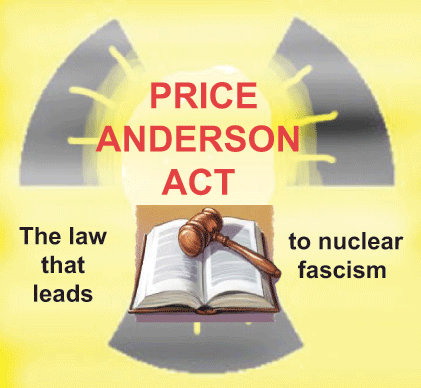 The Vermont Law School paper aptly sums up this picture with this conclusion:
“If the owners and operators of nuclear reactors had to face the full liability of a nuclear accident and meet the alternatives in competition that is unfettered by subsidies, no one would have built a nuclear reactor in the past, no one would build a reactor today, and anyone who owned one would exit the nuclear business as quickly as they could.” [page 69]
If we had a rational economic system, they surely would.
PG&E Corporation deliberately delaying decision on future of Diablo Nuclear Station

As long as PG&E keeps its options open, the state’s progress toward a sustainably carbon-free energy grid remains in suspended animation
PG&E plays coy on the future of Diablo Canyon nuclear plant, LA Times, Michael HiltzikContact Reporter, 1 Jan 16 The Economy Hub “……..More than just the future of Diablo Canyon lies in limbo. The plant’s generating capacity of 2,160 megawatts affects the development of the state’s renewable electric resources. Although PG&E has asserted that the plant’s continued operation would save its customers as much as $16 billion during the additional 20 years, the cost of bringing Diablo Canyon into compliance with environmental and seismic mandates may in fact not be worth the effort. Continue reading
Cost overruns are the norm for building nuclear power plants, but investors don’t pay
Nuclear Energy Dangerous to Your Wallet, Not Only the Environment, CounterPunch, by PETE DOLACK , 1 JAN 16 “……..Significant cost overruns are the norm in building nuclear power plants, and it isn’t investors who are on the hook for them.
Three nuclear projects are under construction in the United States and two in Western Europe, a group that features an assortment of cost overruns and generous guarantees:
*The two new Vogtle reactors in Georgia are already $3 billion over budget although their completion date is three and a half years away. The largest owner, Southern Company, has received $8.3 billion in federal loan guarantees. Overruns at this plant are not unprecedented; the two existing reactors cost $8.7 billion instead of the promised $600 million, resulting in higher electricity rates.
*The Watts Bar 2 nuclear reactor in Tennessee, which received its license to operate in October, has seen its cost rise to $6.1 billion from $2.5 billion. (This is technically a restart of a unit on which construction was suspended in 1985.) The existing reactor at this site has a history of safety problems.
*The Summer 2 and 3 reactors being built in South Carolina have already caused rate payers there to endure a series of rate increases. Cost overruns just since 2012 have totaled almost $2 billion.
*In October 2013, British authorities approved a new nuclear reactor at Hinkley Point, England, that features subsidies designed to give the owner, Électricité de France, aguaranteed 10 percent rate of return on the project. Power from the plant will be sold at a fixed price, indexed to the consumer inflation rate. In other words, The Independentreports, “should the market price fall below that [agreed-upon] levelthe Government would make up the difference.” The agreed-upon fixed price set by the Cameron government at the time was double the wholesale price for electricity.
*Olkiluoto-3 in Finland was supposed to have cost €3 billion, but is 10 years behind schedule and €5 billion over budget.
High costs despite high subsidies…….. http://www.counterpunch.org/2016/01/01/nuclear-energy-dangerous-to-your-wallet-not-only-the-environment/
Weakening of nuclear radiation standards would certainly suit Nuclear Medicine Industry

 Demystifying Nuclear Power: Problem: In a post-Fukushima-triple-meltdown world, do the numbers work for atomic power? Fairewinds,November 17, 2015 by Sue Prent “…..Nuclear medicine interests share some of the existential angst experienced by their atomic energy sector colleagues. So it is not surprising that Carol Marcus Ph.D., M.D. is a professor of Nuclear Medicine at U.C.L.A is one of the petitioners to the NRC to demand that it relax radiation illness standards. Nuclear medicine is where expansion of the development and application of new radiology treatments and specialized equipment represent a huge corporate industrial growth opportunity.
Ms. Marcus and her colleagues have a special interest in countering many medical evaluations and admonitions that are routinely raised by doctors and hospitals around the world about the over-use of radiation for diagnosis and treatment.
Adoption of the hormesis theory of benign radiation would really help the nuclear medicine industry as much as it will help the atomic reactor power industry. In fact, Dr. Marcus’ petition to the NRC seems to equate the fact that radiation can be useful in diagnosis and treatment of cancer with evidence that low-dose radiation is indeed beneficial, in spite of years of data proving that is not true, including the lengthy German study.
To that, one must counter that the benefits brought to cancer treatment by radiation have a very specific tissue-destroying capacity rather than any positive health function. There is no scientifically corroborated benefit for even an extremely low-dose of radiation. Rather than providing any actual proof for her hypothesis, the balance of Dr. Marcus’ petition seems to be filled with complaints detailing how existing radiation protection guidelines hamstring her profession.
The second petition to end LNT, submitted by Certified Health Physicist Mark L. Miller relies heavily on language identical to that of Dr. Marcus, suggesting a collaborative relationship.
The third petition was submitted by a group lead by one of the principle voices supporting the hormesis theory, Mohan Doss Ph.D. His cosigner’s predictably represent atomic corporate interests that have heavily financially invested in the success and expansion of atomic industries.
According to the Fox Chase Cancer Center website, Mr. Doss, who is an MCCPM (Member of the Canadian College of Physicists in Medicine) radiology practice includes
Mr. Doss, who has found a well-spring of opportunity in the convenient meme of hormesis, is quoted along with the other two petitioners in a New York Times article that uses the number of deaths from suicide and accident that have occurred among evacuees from Fukushima evacuation zone as a rallying call……… http://www.fairewinds.org/nuclear-energy-education/demystifying-nuclear-power-problem-in-a-post-fukushima-triple-meltdown-world-do-the-numbers-work-for-atomic-power
China keen to market nuclear expertise, but in the UK scrutiny is increasing
Nuclear energy: Beijing’s power play, Ft.com Christopher Adams and Lucy Hornby, December 29, 2015 China is intent on exporting its nuclear expertise but in the UK scrutiny is increasing. “………. The French-designed plant, which after five years of construction is about to undergo testing, will serve as the prototype for a huge power station planned by the UK in south-west England. It is set to cost £18bn according to the latest estimates by French energy group EDF, which is leading the project.
Hinkley Point, in Somerset, is home to a working nuclear plant and twin disused Magnox reactors. Now David Cameron, UK prime minister, wants the site to host the first of a new generation of reactors that he envisages will replace Britain’s ageing nuclear fleet by 2030.
Under a commercial pact struck during October’s state visit to London by Chinese president Xi Jinping, CGN will take a one-third stake in Hinkley. Its state-owned rival, China National Nuclear Corporation, may also participate. A decade from now, assuming all goes to plan, Taishan’s distinctive egg-shaped reactor domes, double-hulled walls and monster turbines will dominate the shoreline of the Severn estuary. Hinkley Point C will supply 7 per cent of the UK’s electricity……….
CGN can ill-afford errors at Taishan, one of three unfinished projects using a third-generation technology called the European pressurised reactor. Designed by Areva of France, these reactors are being touted as a revolution in nuclear power. But they have had a troubled start on projects at Flamanville in France and Olkiluoto in Finland.
Taishan, too, has suffered delays, albeit not as bad as those in Europe. As a result, CGN is treading carefully. The Chinese plant’s targeted completion date, originally late 2013, has already been put back once, in part because of safety rules after Fukushima. Now it will probably come online in 2017 — though CGN will not say exactly when. Says Mr Zheng: “We must perform a lot of tests, and since it’s now a first of a kind, we need to do more tests than we planned. Those tests should have been done already in Finland or France, but we must do them now.”
The construction problems highlight the complexity of the EPR projects. There are questions over whether there really is demand for these larger reactors, given their cost and size. Mr Guo, though, is bullish. Standing under an 80-tonne door that will one day seal off the reactor hall, he lists the EPR’s credentials…….
He Zuoxiu, a retired physicist who helped develop China’s nuclear programme in the 1960s, questions whether nuclear power will ever truly be safe, even with safeguards to prevent disasters such as Fukushima. He cites a statistic: the US, Russia and Japan each had more than 50 reactors when they suffered accidents. In other words, the more a country has, the greater the chance of something going wrong……..
UK concerns
There are worries, too, that Britain’s tilt towards China — and chancellor George Osborne’s embrace of its investment — will open the door to security risks. The UK shift has caused consternation in the US, which accuses China’s state-owned industry of benefiting from military-linked corporate espionage.
Patrick Cronin, an Asia expert at the Center for a New American Security, says Britain should take care to balance its economic needs against those of national security, particularly on critical infrastructure such as nuclear plants. “Let’s say that 10 years from now there is a major conflict with China. This would give China, effectively, a veto over UK participation, for example, over the Taiwan issue in the next decade,” says Mr Cronin.
“Just understanding the most vulnerable parts of reactors in Britain is a vulnerability. A Chinese state-owned enterprise may show that information to people who have ill intentions to the UK, especially if there’s a crisis.”
Concerns have also been raised in Whitehall over the prospect of China being able to build digital loopholes into hardware it supplies, allowing Beijing to exploit vulnerabilities at nuclear plants. CNNC’s background as China’s nuclear weapons developer before it built the country’s civilian reactors has added to those fears……… http://www.ft.com/cms/s/0/789e5070-974a-11e5-9228-87e603d47bdc.html#axzz3vvmo6esp
As Wylfa nuclear plant closes in Wales, delays continue for UK’s new nuclear stations
Wylfa nuclear plant closes in Wales Station in Anglesey, Wylfa the oldest in the UK, shuts as focus is on energy provider EDF over its plans for new facilities at Hinkley Point, Guardian, Terry Macalister, 31 Dec 15 Britain’s oldest nuclear plant closed on Wednesday, leaving in its wake a £700m decommissioning bill and further questions about the UK’s ability to keep the lights on.
The closure of the Wylfa plant in Wales after 44 years of service puts more pressure on EDF Energy to take a final investment decision for new reactors at Hinkley in Somerset.
The station on the island of Anglesey generated enough electricity to power 1m homes, and with a capacity of 1,000MW was once the largest facility of its kind in the world. But after an earlier life extension scheme expired, the last of the 26 British-designed Magnox reactors was switched off by the private consortium that manages the plant for the Nuclear Decommissioning Authority (NDA)…….
It will take another 10 years for the basic decommissioning to be undertaken at a cost of about £700m but the site cannot be redeveloped before the end of the century. High-level waste from Wylfa will remain on Anglesey until a national nuclear waste disposal facility is finally developed.
Britain still has a fleet of advanced cooled atomic reactors run by EDF but most of these will be retired by 2023 just as the government has also promised to halt all coal-fired power stations.
Hitachi of Japan is leading a Horizon Nuclear Power project to construct a new power plant at Wylfa, with a second earmarked for Oldbury in south Gloucestershire alongside a third facility planned in Cumbria. But the atomic industry’s revived fortunes ride primarily on the Hinkley C plant, which is expected to be the first new site since the Sizewell B station was completed in 1995.
The £18bn Somerset project has been repeatedly delayed but Chinese investors finally gave their support in the autumn while thegovernment promised the latest in a series of subsidies. EDF signalled in October that it would start work at Hinkley and it is expected to give the formal investment the go ahead within weeks before later saying it may not come until after Christmas.
Hinkley Point C, intended to provide about 7% of the UK’s total electricity, was originally scheduled for completion by 2018 but the latest date is 2025. Sceptics still question whether it will make that later date given the experiences of delays and cost overruns with a similar power project at Flamanville in Normandy, northern France.
There have also been problems at the new Olkiluoto nuclear plant in Finlandwhich is using the same plant design provided by EDF’s engineering partner Areva at Flamanville and planned for Hinkley………http://www.theguardian.com/environment/2015/dec/30/wylfa-nuclear-plant-closes-in-wales
Thousands of USA’s Oak Ridge nuclear workers sick and dying from cancers and other radiation-caused illnesses
Of the 33,480, the government has specifically acknowledged that exposure to radiation or other toxins on the job likely caused or contributed to the deaths of 15,809 workers. And this tally almost certainly underestimates the total dead among the 600,000 who worked in the weapons program at its peak.
The women who worked at the plant were told to keep their mouths shut, and those
who talked about their jobs were quickly let go.
 Nuclear workers: Projects’ results were worth illnesses, deaths Amarillo.com December 28, 2015 Tribune News Service Editor’s note: This is the third story in a series examining the health problems that afflict the U.S. nuclear workforce as the government launches a $1 trillion plan to modernize the arsenal.
In 1944, when the feds wanted young women to help out with a top-secret project in the hills of Tennessee, they found 19-year-old Evelyn Babb.
She grew up on four acres in Appalachia, where her family had one milk cow and a couple dozen chickens. She jumped at the chance to make 70 cents an hour at the new Y-12 plant in Oak Ridge, Tenn., twisting knobs on dials, with no clue what she was doing. Bosses advised her to tell friends she was making highchairs for infants.
When President Harry Truman dropped an atomic bomb on Hiroshima on Aug. 6, 1945, Babb learned the truth: She had helped produce the atomic hell that killed thousands of Japanese as one of the climactic acts of World War II.
In many cases, the money went to survivors. Of the 33,480, the government has specifically acknowledged that exposure to radiation or other toxins on the job likely caused or contributed to the deaths of 15,809 workers. And this tally almost certainly underestimates the total dead among the 600,000 who worked in the weapons program at its peak.
The plants with the highest number of deaths are the Y-12 National Security Complex in Tennessee, with 3,741, and the Hanford Site in Washington state, with 3,461. They’re the sites that provided the plutonium and uranium for the bombs, nicknamed Fat Man and Little Boy, that Truman used to wipe out Hiroshima and Nagasaki as part of the nation’s top-secret Manhattan Project.
“The death numbers tell you something, but they are just a slice of the story,” said Ralph Hutchison, a former Presbyterian pastor who’s coordinator of the Oak Ridge Environmental Peace Alliance, a group that has held peace vigils outside the Y-12 plant every Sunday for the last 16 years. “What’s the quality of life for people who have debilitating chronic illnesses?”
The number of dead is sure to grow much higher.
Seventy years after the atomic bombings, thousands of former workers at Department of Energy nuclear sites are sick from cancers and other diseases after being exposed to radiation, a long list of toxins and a brew of other dangerous substances.
Yet more than half of the 107,394 workers who have sought help since 2001 — 51.1 percent — have been denied, TNS’ investigation found.
And many workers have endured years of guilt after they unknowingly helped produce weapons of mass destruction.
“I felt proud until I started realizing that I had a part in killing all those people, and that’s something I didn’t believe in,” said Ruth Huddleston, 90, of Oliver Springs, Tenn., who went to work at Y-12 at age 18. “I had helped kill thousands of people.”……….http://amarillo.com/news/latest-news/2015-12-28/nuclear-workers-projects-results-were-worth-illnesses-deaths#.VoMfhne5dh0.twitter
1 This Month




PLEASE OPPOSE HR 8255 AND S.3639 – bills would accelerate satellite deployment, with no environmental review or safeguards – https://ncstd5li.quorum.us/campaign/169331/
To see nuclear-related stories in greater depth and intensity – go to https://nuclearinformation.wordpress.com
-
Archives
- September 2026 (330)
- August 2026 (330)
- July 2026 (355)
- June 2026 (287)
- May 2026 (306)
- April 2026 (356)
- March 2026 (251)
- February 2026 (267)
- January 2026 (308)
- December 2025 (358)
- November 2025 (359)
- October 2025 (375)
-
Categories
- 1
- 1 NUCLEAR ISSUES
- business and costs
- climate change
- culture and arts
- ENERGY
- environment
- health
- history
- indigenous issues
- Legal
- marketing of nuclear
- media
- opposition to nuclear
- PERSONAL STORIES
- politics
- politics international
- Religion and ethics
- safety
- secrets,lies and civil liberties
- spinbuster
- technology
- Uranium
- wastes
- weapons and war
- Women
- 2 WORLD
- ACTION
- AFRICA
- Atrocities
- AUSTRALIA
- Christina's notes
- Christina's themes
- culture and arts
- Events
- Fuk 2022
- Fuk 2023
- Fukushima 2017
- Fukushima 2018
- fukushima 2019
- Fukushima 2020
- Fukushima 2021
- general
- global warming
- Humour (God we need it)
- Nuclear
- RARE EARTHS
- Reference
- resources – print
- Resources -audiovicual
- Weekly Newsletter
- World
- World Nuclear
- YouTube
-
RSS
Entries RSS
Comments RSS

