EDF in a’panic’ over decision to be made on UK’s Hinkley nuclear power station
 Hinkley Point: EDF set for decision on nuclear plant amid claims of board ‘panic’, The Independent, Sources in France say decision on whether to give the green light to controversial project would be made on Wednesday Geoffrey lean , 24 Jan 16
- The final decision on whether to build Britiain’s first nuclear power station in decades is set to be made by energy giant EDF this week, amid claims of “panic” among the French firm’s board over the viability of the £18bn project.
- Sources in France said the decision on whether to give the green light to its controversial plant at Hinkley Point, Somerset – on which ministers are depending to “kick-start a major new generation of nuclear power stations” – would be made on Wednesday. But the largely state-owned company refused to comment, or even to confirm or deny that the meeting is taking place.
This secrecy reflects the extreme sensitivity about the decision with practicalities and politics pulling in opposite directions. The project suffered a serious blow last week when French regulators delayed a decision on what to do about safety flaws in a similar reactor. But cancelling it would be a huge humiliation for British ministers, and could cause a cross-Channel diplomatic row.
- The “final investment decision” by EDF’s board – repeatedly delayed over the past two years – is the project’s only remaining hurdle.
Last October the government persuaded China to invest heavily in the plant, filling a funding shortfall, and the Energy Secretary Amber Rudd is awaiting the decision before signing a deal to allow the company to charge double the present price for the electricity generated from Hinkley’s twin reactors. Three similar European Pressurised Reactor (EPR) projects are planned for Britain if it succeeds…….
- there are signs of last minute jitters. Union leaders are reportedly warning the company of “financial, industrial and legal risks” in the project, while the French financial journal Boursier.com has suggested that there is “panic on board”.
Last week the French nuclear regulator delayed until the end of the year a decision on what to do about “very serious” weaknesses detected in the pressure vessel of a similar EPR being built at Flamanville, Normandy. The same fault – which could lead to a nuclear accident – was detected in the vessels for the Hinkley reactors, which had been built and will now have to be replaced.
- The Flamanville plant is five years behind schedule and its cost has trebled, while the only other EPR being built in Europe, in Finland, is almost a decade late, and the cost has more than doubled. Two other EPRs being built in China are also thought to be over-running while the cost of Hinkley has already soared.
EDF’s share price has plunged to record lows, and the company is considering selling billions of pounds of assets to fund building Hinkley. On top of all that, Austria is taking Britain to the European Court, alleging it is subsidising the plant illegally.Some British experts believe that, faced with all these difficulties, EDF will defer a final decision again. http://www.independent.co.uk/news/uk/home-news/hinkley-point-edf-set-for-decision-on-nuclear-plant-amid-claims-of-board-panic-a6830456.html
France’s President Hollande visits India, hoping to market nuclear reactors
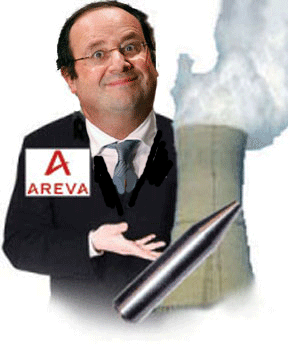 France Signals Rafale, Nuclear Progress as Hollande Visits India, Bloomberg, HeleneFouquet January 24, 2016 France signaled a state-to-state accord with India could be signed on Monday over a deal for 36 Dassault Aviation SA Rafale fighter jets, and that a six-year-old plan to build nuclear reactors in the South Asian nation would see some progress…………
The reactors are planned for Jaitapur, a coastal town in India’s western province of Maharashtra. Areva was seeking further clarity from India on its nuclear liability law before moving ahead with what would be India’s biggest nuclear plant.
The agreement India and the U.S signed recently over insurance-related issues for nuclear plants will help in overcoming certain hurdles, Royal said.
USA changes law to make it harder for nuclear radiation victims to get compensation
the directive signals an initial step toward trying to dismantle or rein in a $12 billion compensation program that has made payments to more than 53,000 sickened workers or their survivors since 2001.
 Nuclear workers fear new policy will make it harder to win compensation
Department of Labor says nuclear facilities are much safer since 1995
Workers and advocates worry it will be more difficult to prove cases
A fight is underway to get policy repealed in order to protect sick employees
BY LINDSAY WISE, ROB HOTAKAINEN AND FRANK MATT McClatchy Washington Bureau, 22 Jan 16 WASHINGTON
Abelardo Garza was working near tanks full of toxic sludge at Hanford nuclear reservation in Washington state last Aug. 14 when one of his co-workers noticed a strange smell.
Within minutes, Garza’s nose started bleeding. The next morning, he awoke gasping for breath.
It was the fourth time in five years that Garza would end up in the hospital after suspected exposure to chemical vapors at Hanford, a 586-square-mile site where workers once made plutonium for the bomb dropped on Nagasaki, Japan.
Now Garza, 65, worries that a new federal directive the government says was intended to speed up compensation claims by sick and dying nuclear workers could harm his chances of qualifying for benefits if his health worsens in the future.
The directive, which became effective in December 2014, orders claims examiners to conclude that workers at Department of Energy nuclear facilities have not have any significant exposure to toxins since 1995 “in the absence of compelling data to the contrary.”
To Garza, the wording of the government’s directive feels like a dismissal. Continue reading
How the tax payer funds the nuclear industry – to keep it alive
The many ways of counting subsidies
Among the goodies routinely given away, according to the Concerned Scientists, are:
- Subsidies at inception, reducing capital costs and operating costs.
- Accounting rules allowing companies to write down capital costs after cost overruns, cancellations and plant abandonments, reducing capital-recovery requirements,
- Recovery of ‘stranded costs’ (costs to a utility’s assets because of new regulations or a deregulated market) passed on to rate payers.
 Yes, you read that last item correctly. Even when the energy industry receives its wish to be rid of regulation, it is entitled to extra money because of the resulting rigors of market pressures.
The ongoing environmental disaster at Fukushima is a grim enough reminder of the dangers of nuclear power. But nuclear does not make sense economically, either. Continue reading
EDF Directors might delay UK Hinkley nuclear decision yet again
 Hinkley Point – Edf to decide whether to build nuclear power station next week By Central Somerset Gazette January 19, 2016 A DECISION on whether a nuclear power station is built at Hinkley Point could be announced next week.
Reports in the French press indicate that the board of directors of the French state electricity generator EDF will meet on January 27 to make a final investment decision on the construction of two nuclear reactors at Hinkley Point near Bridgwater.
The final investment decision on the project has been delayed due to the lengthy negotiations with Chinese partners.
However even now there are concerns that the board might defer the decision for the ninth time……….
EDF is also locked in negotiations surrounding a complex deal to buy a French nuclear reactor builder, Areva, and in the disposal of it’s stake in eight current British nuclear power stations, five in the US, one in Finland and a number of Polish coal fired plants
Preparation of the site stopped last year when negotiations over the financing of the power station stalled.
Campaigners opposed to the building of Hinkley Point C are sceptical that the project will ever see the light of day.
Stop Hinkley spokesperson Roy Pumfrey said: “I’ll believe it when I see it. This is the ninth time EDF has said a final investment decision is imminent. Just last October the chairman of EDF, Jean-Bernard Levy, said work would be starting before the end of 2015. It would be completely reckless of the Board to give the go-ahead to this £25 billion project when the company is in such a parlous state.” http://www.centralsomersetgazette.co.uk/8203-Hinkley-Point-Edf-decide-build-nuclear-power/story-28559932-detail/story.html
Nuclear industry survived only because of ‘liability cap’
After 60 years of nuclear power, the industry survives only on stupendous subsidies, Ecologist, Pete Dolack 4th January 2016 Without ‘liability caps’ the industry would have been dead long ago
The British government, for instance, currently foots more than three-quarters of the bill for radioactive waste management and decommissioning, and for nuclear legacy sites. A report prepared for Parliament estimates that total public liability to date just for this program is around £50 billion, with tens of billions more to come.
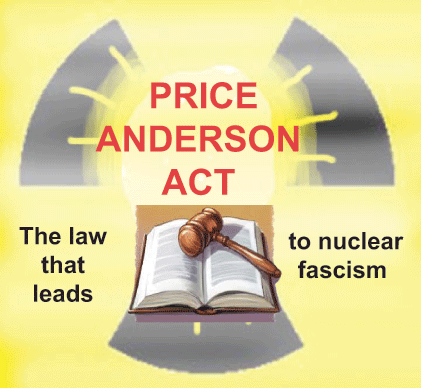
Liability caps for accidents are also routine. In the US the Price-Anderson Act, in force since 1957, caps the total liability of nuclear operators in the event of a serious accident or attack to $10.5 billion. If the total is higher, as it surely would be, taxpayers would be on the hook for the rest.
As a further sweetener, the Bush II / Cheney administration, in 2005, signed into law new nuclear subsidies and tax breaks worth $13 billion. The Obama administration, attempting its own nuclear push, has offered an additional $36 billion in federal loan guarantees to underwrite new reactor construction, again putting the risk on taxpayers, not investors.
The Vermont Law School paper aptly sums up this picture with this conclusion: [page 69]
“If the owners and operators of nuclear reactors had to face the full liability of a nuclear accident and meet the alternatives in competition that is unfettered by subsidies, no one would have built a nuclear reactor in the past, no one would build a reactor today, and anyone who owned one would exit the nuclear business as quickly as they could.”
If we had a rational economic system, they surely would.http://www.theecologist.org/News/news_analysis/2986749/after_60_years_of_nuclear_power_the_industry_survives_only_on_stupendous_subsidies.html
Kansai Electric plans to restart another nuclear reactor
Japan to restart another nuclear reactor Jan. 29, 1st on MOX fuel, Kyodo News, TOKYO, Jan. 21, Kyodo A nuclear plant in Fukui Prefecture is expected to restart operations on Jan. 29, the first that will run on uranium-plutonium mixed oxide fuel under new safety regulations, sources close to the matter said Thursday.
Final arrangements are under way to restart the No. 3 reactor of Kansai Electric Power Co.’s Takahama plant, the third such case after Japan returned to nuclear power generation last summer following the loss of nuclear energy amid safety concerns in the wake of the 2011 Fukushima disaster.
Last April, a district court banned Kansai Electric from restarting the Nos. 3 and 4 reactors of the Takahama plant citing safety concerns. But since the court lifted the injunction last month, the utility is now making preparations to reactivate the two reactors on the Sea of Japan coast, with the restart of the No. 4 unit planned for late February…..http://english.kyodonews.jp/news/2016/01/393890.html
Nuclear power: high costs, massive subsidies – some details
After 60 years of nuclear power, the industry survives only on stupendous subsidies, Ecologist, Pete Dolack 4th January 2016 It’s a global phenomenon
“………….Numerous research papers paint a fuller picture. A Congressional Research Service report found that nuclear power had received $74 billion for research and developmentby the US government for the period 1948 to 1998, more than all such money given for fossil fuels, renewables and energy efficiency combined.
A report by the venture-capital firm DBL Investors, Ask Saint Onofrio, reports that nuclear energy cumulatively has received four times more subsidies than solar energy in California, and that nuclear subsidies were higher than solar in 2011 and all previous years. Nuclear has received $8.2 billion in subsidies in California, while providing the state with 3% of its power in 2012.
The uneconomical state of nuclear power is a global phenomenon, not limited to any one place. A comprehensive study prepared for the Green Party of Germany’s Heinrich Böll Stiftung, The Economics of Nuclear Power: An Update, reports:
“Up to now, nuclear power plants have been funded by massive public subsidies. For Germany the calculations roughly add up to over €100 billion and this preferential treatment is still going on today. As a result the billions set aside for the disposal of nuclear waste and the dismantling of nuclear power plants represent a tax-free manoeuvre for the companies.
“In addition the liability of the operators is limited to €2.5 billion – a tiny proportion of the costs that would result from a medium-sized nuclear accident.”
The paper later says: “Successive studies by the British government in 1989, 1995, and 2002 came to the conclusion that in a liberalised electricity market, electric utilities would not build nuclear power plants without government subsidies and government guarantees that cap costs. In most countries where the monopoly status of the generating companies has been removed, similar considerations would apply.”
Yet new plants are being built, with new subsidies
Significant cost overruns are the norm in building nuclear power plants, and it isn’t investors who are on the hook for them. Three nuclear projects are under construction in the United States and two in Western Europe, a group that features an assortment of cost overruns and generous guarantees:
- The two new Vogtle reactors in Georgia are already $3 billion over budget although their completion date is three and a half years away. The largest owner, Southern Company, has received $8.3 billion in federal loan guarantees. Overruns at this plant are not unprecedented; the two existing reactors cost $8.7 billion instead of the promised $600 million, resulting in higher electricity rates.
- The Watts Bar 2 nuclear reactor in Tennessee, which received its license to operate in October, has seen its cost rise to $6.1 billion from $2.5 billion. (This is technically a restart of a unit on which construction was suspended in 1985.) The existing reactor at this site has a history of safety problems.
- The Summer 2 and 3 reactors being built in South Carolina have already caused rate payers there to endure a series of rate increases. Cost overruns just since 2012 havetotaled almost $2 billion.
- In October 2013, British authorities approved a new nuclear reactor at Hinkley Point, England, that features subsidies designed to give the owner, Électricité de France, aguaranteed 10% rate of return on the project. Power from the plant will be sold at a fixed price, indexed to the consumer inflation rate.
In other words, The Independent reports, “should the market price fall below that [agreed-upon] level the Government would make up the difference.” The agreed-upon fixed price set by the Cameron government at the time was double the wholesale pricefor electricity. Since then the gap has only widened. - Olkiluoto-3 in Finland was supposed to have cost €3 billion, but is 10 years behind schedule and €5 billion over budget.
High costs despite high subsidies
There would at least be a small silver lining in this dark picture if the electricity produced were cheap. But that’s not the case. From the mid-1970s to the mid-1990s, the cost of producing electricity from nuclear power in France tripled and in the United States the cost increased fivefold, according to the Vermont Law School paper [page 46].
Then there are the costs of nuclear that are not imposed by any other energy source: What to do with all the radioactive waste? Regardless of who ultimately shoulders these costs, the environmental dangers will last for tens of thousands of years.
In the United States, there is the fiasco of the Yucca Mountain nuclear waste dump in Nevada. The US government has collected $35 billion from energy companies to finance the dump, which is the subject of fierce local opposition and appears to have no chance of being built.
Presumably, the energy companies have passed on these costs to their consumers but nonetheless are demanding the government take the radioactive waste they are storing at their plants or compensate them. As part of this deal, the US government made itself legally responsible for finding a permanent nuclear waste storage facility.
And, eventually, plants come to the end of their lives and must be decommissioned, another big expense that energy companies would like to be borne by someone else.
As the Heinrich Böll Stiftung study says, [page 17], “there is a significant mismatch between the interests of commercial concerns and society in general. Huge costs that will only be incurred far in the future have little weight in commercial decisions because such costs are ‘discounted’. This means that waste disposal costs and decommissioning costs, which are at present no more than ill-supported guesses, are of little interest to commercial companies.
“From a moral point of view, the current generation should be extremely wary of leaving such an uncertain, expensive, and potentially dangerous legacy to a future generation to deal with when there are no ways of reliably ensuring that the current generation can bequeath the funds to deal with them, much less bear the physical risk. Similarly, the accident risk also plays no part in decision-making because the companies are absolved of this risk by international treaties that shift the risk to taxpayers.” http://www.theecologist.org/News/news_analysis/2986749/after_60_years_of_nuclear_power_the_industry_survives_only_on_stupendous_subsidies.html
France’s PM off to India to market nuclear reactors
 Defence & civil nuclear cooperation will dominate Francois Hollande’s visit Economic Times, By Dipanjan Roy Chaudhury, ET Bureau | 18 Jan, 2016, NEW DELHI: Defence and civil nuclear cooperation will not be the only things that will dominate the visit of Francois Hollande — the fifth French leader to be chief guest at India’s Republic Day celebrations — with India and Paris working to expand partnership in areas of smart cities, solar energy, counter-terrorism, rail infrastructure and space.
Companies involved in the project include Areva, Engie, Enel, HSBC France and Tata Steel. Areva is also setting up a nuclear power plant in Jaitapur, after France became the first country to conclude a civil nuclear deal with India following a clean waiver by Nuclear Suppliers Group in September 2008.
NuScale revs up its marketing propaganda for Small Modular Nuclear Reactors (SMRs)
 Mini-nuclear plants in UK by 2025, Fluor’s NuScale Says by Alex Morales, Financial Review, 18 Jan 16
UK ambitions to build small modular nuclear plants may be realised as soon as 2025, according to Fluor Corp’s NuScale unit, which is seeking to be a pioneer in the market.
 NuScale plans to submit its 50-megawatt reactor design for approval by US nuclear authorities towards the end of 2016. That would leave it well placed to seek the UK equivalent, called Generic Design Assessment, in 2017, Tom Mundy, executive vice-president for program development at the US company, said in an interview in London.
“Assuming the GDA is submitted and takes four years, we’d be looking at approval in 2021,” Mr Mundy said. “There’s then a 36- month construction time, so it’s plausible to expect that if all things line up, we could have a UK plant built by 2025.”
Britain is trying to secure new baseload power as it closes down all its coal-fired plants by 2025. Conventional nuclear power is proving expensive and time-consuming, while most companies don’t think it’s profitable to build new gas-fired stations. The Treasury in November said it will plow £250 million ($515 million) into research and development over the next five years aimed at building one of the world’s first small modular nuclear reactors in the 2020s………..
The global market for small modular reactors may total as much as £400 billion by 2035, according to a report in late 2014 by the National Nuclear Laboratory, which advises the UK government. It identified reactor designs that may meet UK requirements coming from NuScale, Toshiba.’s Westinghouse unit, China National Nuclear and the mPower venture by Babcock & Wilcox Enterprises. and Bechtel Group.
NuScale won’t manufacture its own reactors and has investigated the UK supply chain, according to Mr Mundy. Once established in Britain, the company could then export its modules to other European countries, he said………
When Chancellor of the Exchequer George Osborne announced the R&D funding for modular reactors, it was stated that a competition for funding will be held “early next year”. The Department of Energy and Climate Change said no fixed timetable has been set. Mr Mundy said he doesn’t doubt the government’s intentions.
“Nuclear power has a long legacy in this country, and our reactors are based on tried-and-tested light-water technology,” Mr Mundy said. “I’m optimistic that with what the chancellor said and the indications from DECC we’re going to continue to move forward.” http://www.afr.com/business/energy/nuclear-energy/mininuclear-plants-in-uk-by-2025-fluors-nuscale-says-20160118-gm89c4#ixzz3xd3bnLxN
US nuclear corporation salivates at thought of selling reactors to India
 Ahead Of PM Modi’s Trip To US, Hopes For A Major Nuclear Reactor Deal, NDTV
A Westinghouse team is already in India to negotiate the deal, Chief Executive Daniel Roderick told news agency Reuters, but talks are likely to go down to the wire, as the crucial issue of nuclear liability insurance for suppliers remains unresolved. The aim, however, was to make a “commercially significant announcement” during PM Modi’s expected US visit in March and sign a final contract later in the year, Mr Roderick said.
A US diplomat said the United States had invited PM Modi to the March 31-April 1 Nuclear Security Summit and that Washington was thinking of turning the trip into a full-fledged official visit, which would give the Indian leader a similar reception as Chinese President Xi Jinping.
The Westinghouse contract would give a big boost to India’s $150 billion nuclear power programme…….
India has given two sites to US companies – Westinghouse and a nuclear venture between General Electric Co and Hitachi – to build six reactors each. http://www.ndtv.com/india-news/ahead-of-pm-modis-trip-to-us-hopes-for-a-major-nuclear-reactor-deal-1266211
Electricite de France (EDF) at new low with crippling financial problems
EDF already needs to borrow money just to pay its dividend and is set to spend tens of billions of euros on upgrading its ageing reactors, building new nuclear plants in Hinkley Point, Britain and buying the reactor arm of Areva.
“This report is clearly negative for all nuclear operators, and most specifically for EDF and Areva”
EDF shares are down more than 44 percent in the 12 months,
EDF sinks to all-time low as nuclear waste cost estimate soars http://uk.reuters.com/article/edf-nuclear-waste-idUKL8N14W2RO20160112 PARIS | BY GEERT DE CLERCQ Jan 12 Shares in French utility EDF sank to all-time lows on Tuesday after the country’s Andra nuclear waste agency said that storage costs could be higher than EDF’s estimates.
Mirroring German utilities E.ON and RWE , which saw their shares hit decade lows late last year over worries about nuclear decommissioning costs, EDF fell as much as 7.3 percent before recovering to 4.1 percent lower.
A string of brokerage price target downgrades and French forward power prices falling to new decade lows only added to the gloom.
In a report released late on Monday, Andra said costs for the Cigeo deep geological storage project could be as high as 30 billion euros or as low as 20 billion depending on assumptions about different cost factors in coming years.
“There are different views on the calculation, more or less conservative, depending on estimates for future technological progress and optimisation,” Andra said in a statement. n a letter to the energy ministry, posted on the ministry’s website, EDF, fellow state-controlled company Areva and the CEA (Atomic Energy Authority) said they estimated the cost at around 20 billion euros.
“Andra’s study only took into account a small number of possible optimisations,” said the letter, adding that a certain number of costs and ratios used by the state agency were not in line with their experience.
“We are waiting for a decision of the energy minister on the cost of storage,” an EDF spokesman said.
Energy Minister Segolene Royal’s decision on the 10 billion euro gap in estimates could have a huge impact on the already stretched balance sheet of EDF, which operates 58 nuclear plants in France and generates the bulk of the country’s nuclear waste.
EDF already needs to borrow money just to pay its dividend and is set to spend tens of billions of euros on upgrading its ageing reactors, building new nuclear plants in Hinkley Point, Britain and buying the reactor arm of Areva.
“This report is clearly negative for all nuclear operators, and most specifically for EDF and Areva,” Bryan, Garnier analyst Xavier Caroen said in a note, adding that the risk of a cost revaluation was not new.
EDF shares are down more than 44 percent in the 12 months, the second-worst performer in the Stoxx utilities index after RWE. The company has been replaced in France’s CAC-40 index of leading shares by shopping centre operator Klepierre . (Additional reporting by Benjamin Mallet; Editing by Keith Weir)
Is it just Hinkley that’s finished or the whole of EDF?
No2Nuclear Power Jan 2016 “………French utility EDF is considering selling assets  worth over 6 billion euros (£4.5 billion) this year, according to French daily Les Echos – notably it is considering selling a stake in its eight British nuclear plants to fund plans to build Hinkley Point C. But it could only sell a 29% share of EDF Energy (which is supposed to be worth 9 billion euros in total). This would leave EDF with a 51% stake, because Centrica already owns 20%. The paper said a sale had been studied but the process had not been launched. The company needs 55 billion euros to upgrade its ageing nuclear plants, plans to invest 18 billion pounds in Hinkley and spend several billion euros to buy Areva’s reactor unit. (1)
Census shows rapid growth of solar industry jobs in USA
 USA National Solar Jobs Census 2015 Released http://www.energymatters.com.au/renewable-news/solar-jobs-census-em5291/ January 13, 2016
The U.S. solar workforce grew to a total of nearly 209,000 last year; adding more than 35,000 workers – the third consecutive year in which growth exceeded 20%.
The Solar Foundation’s National Solar Jobs Census 2015 states the workforce has increased by 123% since 2010.
“The solar industry has once again proven to be a powerful engine of economic growth and job creation,” said Andrea Luecke, President and Executive Director of The Solar Foundation. ” Our Census findings show that one out of every 83 new jobs created in the U.S. over the last 12 months was in the solar industry – 1.2% of all new jobs.”
The USA’s solar workforce is now three times the number employed in the coal mining industry and also larger than the oil and gas extraction industry.
Last year, solar industry employment grew 12 times faster than the overall US workforce.
In addition to direct employment, the US solar industry supports an additional 610,650 ancillary jobs throughout the supply chain.
When the first Census was run in 2010, the USA had installed 929MW of solar capacity that year. Last year, 7,430MW of capacity was added.
The installation sector represented the bulk of jobs in the US solar industry in 2015.
Installation – 119,931
Manufacturing – 30,282
Sales and distribution – 24,377
Project development – 22,452
All others – 11,816
Employment in all sectors grew in 2015, with the exception of solar manufacturing. However, manufacturing jobs are expected grow by 3,800 positions in 2016; supported by industry construction activity.
Approximately 90% of all solar workers are 100% dedicated to solar activities; a percentage that has been effectively unchanged since 2013.
Jobs in the solar industry continue to pay above the median wage of all occupations in the USA.
Looking ahead, a further 14.7% increase in positions is expected this year – an extra 30,000 jobs – bringing the total of U.S. solar workers to 239,625 by the end of 2016. It could perhaps be even higher as Census data collection was completed before the extension of the 30% Federal Investment Tax Credit (ITC) was announced.
The sixth annual National Solar Jobs Census can be viewed in full here (PDF).
China nuclear reactors – possible partnership with bankrupt AREVA
Radiation fears in Hong Kong from China’s unproven and possibly faulty nuclear reactors nearby, Post Magazine, Stuart Heaver, 10 Jan 16 “……. the only customer for the American Westinghouse AP1000 reactor is China, which is currently constructing four, in Zhejiang and Shandong provinces. The third-generation AP1000 is also untested in the real world, and the reactors being built in China are years behind schedule, too.
When, in November, Areva announced a possible minority stake sale to another major player, China National Nuclear Corp, and a partnership covering all aspects of the nuclear fuel cycle, some commentators saw it as a bailout by the Chinese. Schneider finds it astounding that anyone would seek a partnership with what he calls a “bankrupt company”.
“Everybody is scared to death about losing billions of euros if these plants don’t open,” says Schneider, adding that all eyes will be on tests in France scheduled for this year and the ASN will be under enormous pressure.
“You don’t need to be an expert to imagine the huge commercial pressure in play,” says Schneider. “But what does it mean when an almost bankrupt company is operating a nuclear facility?”…..http://www.scmp.com/magazines/post-magazine/article/1898583/hong-kong-fallout-chinas-reckless-nuclear-ambitions-feared
1 This Month




PLEASE OPPOSE HR 8255 AND S.3639 – bills would accelerate satellite deployment, with no environmental review or safeguards – https://ncstd5li.quorum.us/campaign/169331/
To see nuclear-related stories in greater depth and intensity – go to https://nuclearinformation.wordpress.com
-
Archives
- September 2026 (330)
- August 2026 (330)
- July 2026 (355)
- June 2026 (287)
- May 2026 (306)
- April 2026 (356)
- March 2026 (251)
- February 2026 (267)
- January 2026 (308)
- December 2025 (358)
- November 2025 (359)
- October 2025 (375)
-
Categories
- 1
- 1 NUCLEAR ISSUES
- business and costs
- climate change
- culture and arts
- ENERGY
- environment
- health
- history
- indigenous issues
- Legal
- marketing of nuclear
- media
- opposition to nuclear
- PERSONAL STORIES
- politics
- politics international
- Religion and ethics
- safety
- secrets,lies and civil liberties
- spinbuster
- technology
- Uranium
- wastes
- weapons and war
- Women
- 2 WORLD
- ACTION
- AFRICA
- Atrocities
- AUSTRALIA
- Christina's notes
- Christina's themes
- culture and arts
- Events
- Fuk 2022
- Fuk 2023
- Fukushima 2017
- Fukushima 2018
- fukushima 2019
- Fukushima 2020
- Fukushima 2021
- general
- global warming
- Humour (God we need it)
- Nuclear
- RARE EARTHS
- Reference
- resources – print
- Resources -audiovicual
- Weekly Newsletter
- World
- World Nuclear
- YouTube
-
RSS
Entries RSS
Comments RSS

