Convention on Supplementary Compensation for Nuclear Damage might or might not work for global nuclear salesmen
India Joins Nuclear Liability Pact, Opening Door to Foreign Reactor Investments http://www.insurancejournal.com/news/international/2016/02/05/397765.htm By Rajesh Kumar Singh and Stephen Stapczynski | February 5, 2016 India’s decision to join a global treaty on nuclear accident liability may help it woo reactor suppliers, including Westinghouse Electric Co. and General Electric Co., that have been reluctant to sell technology to the nation.
The country ratified the Convention on Supplementary Compensation for Nuclear Damage, also known as CSC, the International Atomic Energy Agency said on Thursday. India’s current law allows operators to hold suppliers responsible for accidents, making international equipment makers hesitant to sign deals as the nation seeks to expand nuclear power capacity more than 10-fold by 2032………
India’s decision to join a global treaty on nuclear accident liability may help it woo reactor suppliers, including Westinghouse Electric Co. and General Electric Co., that have been reluctant to sell technology to the nation.
The country ratified the Convention on Supplementary Compensation for Nuclear Damage, also known as CSC, the International Atomic Energy Agency said on Thursday. India’s current law allows operators to hold suppliers responsible for accidents, making international equipment makers hesitant to sign deals as the nation seeks to expand nuclear power capacity more than 10-fold by 2032.
One Step
Ratifying the CSC is the latest effort the government has taken to ease suppliers’ concerns that they would be open to liability claims in case of a nuclear accident. Joining the treaty “marks a conclusive step in the addressing of issues related to civil nuclear liability in India,” the country’s external affairs ministry said in a statement Thursday.
In 2011, India capped suppliers’ liability, saying claims by the nation’s nuclear plant operator can’t exceed the amount of compensation paid by the utility. That was followed last year with the creation of a 15 billion rupees ($222 million) insurance pool to shield the operator, Nuclear Power Corp. of India Ltd., and the suppliers against claims. The government also last year issued a note explaining the law, including the sections that leave suppliers exposed to lawsuits.
No Modification
“The ratification is a very important step for the comfort of foreign vendors,” said Sekhar Basu, secretary at India’s Department of Atomic Energy.
Westinghouse Electric expects to reach a deal with India by the end of this year to provide at least six nuclear reactors, Chief Executive Officer Daniel Roderick said in December. France’s Areva SA signed an accord in 2009 to supply six 1,650-megawatt reactors at Jaitapur, a coastal town in India’s western province of Maharashtra.
“Ratifying the CSC is a step in the right direction towards unlocking the market potential for further nuclear development in India,” Jeff Benjamin, senior vice president of new plants and major projects at Westinghouse, said by e-mail. General Electric and Areva didn’t respond to requests for comment outside normal business hours.
The ratification doesn’t change the country’s existing liability laws, according to R. Rajaraman, emeritus professor of physics at Jawaharlal Nehru University’s School of Physical Sciences.
“This will not lead to a re-think or a modification of our liability act,” Rajaraman said in an e-mail. “That would not be politically feasible.”
Vikas Swarup, spokesman for India’s External Affairs Ministry, didn’t respond to requests seeking comment. Calls to Jagdish Thakkar, a spokesman at the prime minister’s office, weren’t answered.–With assistance from Archana Chaudhary.
French waste group Veolia moving into nuclear clean-up business
 Veolia expands in nuclear waste clean-up with Kurion acquisition http://www.reuters.com/article/us-kurion-m-a-veolia-idUSKCN0VC0V4, 4 Feb 16
French water and waste group Veolia (VIE.PA) said it bought U.S. nuclear waste clean-up company Kurion for $350 million as it chases a slice of a market seen worth $210 billion over the next 15 years.
Veolia said it expects the new business to contribute annual revenue of $350-400 million by 2020, including about $250 million from waste treatment and $100-150 from decommissioning nuclear installations.
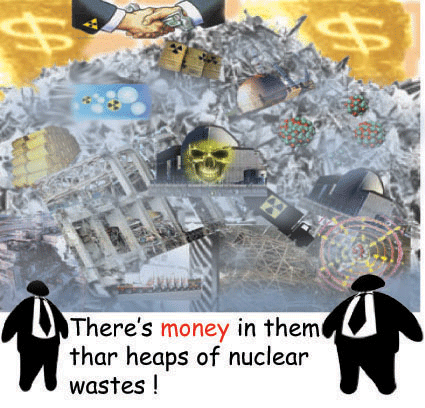
Kurion, which was one of few international firms involved in the early stages of the clean-up of the Fukushima nuclear disaster in Japan in 2011, currently has annual sales of about $100 million. Veolia generates about $20 million from cleaning up nuclear waste.
“Bringing Kurion and its employees into Veolia is going to enable us to develop a world-class integrated offer in nuclear facility clean-up and treatment of low-level radioactive waste around the world,” Veolia Chief Executive Antoine Frerot said.
Veolia plans to target the United States, Britain, France and Japan, which together amount to a market of $118 billion by 2030, and will focus on low-level radioactive waste, which represents 97 percent of the volume but just 0.1 percent of the radioactivity.
There are about 400 nuclear plants in operation worldwide, of which 100 to 150 will be decommissioned by 2030. Another 50 nuclear research centres will also have to be dismantled, Veolia said. Frerot said Veolia would focus on concentrating the waste to reduce its volume so that it can be stored safely, mostly in glass.
Kurion was founded in 2008 and and now employs over 200 people. Veolia had total revenue of 23.88 billion euros ($26.05 billion) in 2014. (Reporting by Geert De Clercq; Editing by James Regan)
$4.7 billion the present cost [and rising] of building Watts Bar nuclear reactor
 Cost of Watts Bar nuclear reactor rises to $4.7 billion http://newschannel9.com/news/local/cost-of-watts-bar-nuclear-reactor-rises-to-47-billion BY WTVC FRIDAY, FEBRUARY 5TH 2016 Rhea County — America’s first new power plant to be built in the 21st century may end up costing $200 million more than what it was budgeted last year.
The Tennessee Valley Authority directors voted in January to add $200 million more to the budget to the Unit 2 reactor at the Watts Bar Nuclear Plant, raising the completion budget to $4.7 billion since work was revived on the Westinghouse pressurized rector in 2007.
Watts Bar spokesman Mike Skaggs says the cost rose in part because of delays in completion and extra flood controls and emergency equipment required to prevent an accident like what happened at Fukushima, Japan.
The price for the new TVA plant is still below the projected expense of reactors being built at Plant Vogtle in Georgia, which are projected to top $10 billion.
Georgia State panel to do detailed probe of costs of Nuclear Plant Vogtle
 State panel to review Plant Vogtle costs http://chronicle.augusta.com/news/business/2016-02-02/state-panel-review-plant-vogtle-costs By Walter Jones ATLANTA, 4 Feb 16 — Electricity customers and the public will get a detailed look at what’s to blame for cost overruns in the construction of two nuclear reactors slated for power generation after a divided Public Service Commission voted Tuesday to begin its examination.The detailed probe of what Georgia Power has spent is expected to take 14 months to examine the delays that have added nearly $1 billion to the Plant Vogtle expansion.
European Commission faces the astronomic future costs of nuclear power
Without lifetime extensions, around 90% of the EU’s existing nuclear reactors would be shut down by 2030. But even with lifetime extensions, 90% of existing nuclear electricity production capacity will need to be replaced before 2050. This will cost €350-500 billion, estimates the Commission.
The Commission admits that the costs of new-build projects “are in the high range” of what analysts expected. Hinkley Point C tops the charts with €6.755 per KWe (vs. a €5.290 per KWe average for a “first of a kind” twin unit). There is a “historical trend of cost escalation”, the Commission concludes.
 EU paints challenging picture of Europe’s nuclear future, Energy Post. February 2, 2016 by Sonja van Renssen In a leaked draft document obtained by Energy Post, the European Commission outlines the investments in the EU nuclear industry that it believes are needed out to 2050. The document, originally announced for last year, but off the table again for February, paints a challenging picture for the European nuclear industry. €450-550 billion will have to be spent on new plants and lifetime extensions, costs of decommissioning and waste management are high, competitiveness is a challenge and nuclear’s share in the energy mix will decline from 27% today to 17-21%. Sonja van Renssen investigates.
The “Communication for a Nuclear Illustrative Programme” or PINC is a non-legislative document “periodically” produced by the European Commission, as required by the Euratom Treaty (article 40) that “provides an overview of investments in the EU for all the steps of the nuclear lifecycle”. The last PINC dates back to 2008 so the one currently under preparation will be the first since the Fukushima disaster in March 2011. It “provides a basis to discuss the role of nuclear energy in achieving the EU energy objectives”………
Globally, nuclear-related investment needs are estimated at around €3 trillion out to 2050, with most of that money due to be spent in Asia. ……
Total investments in EU nuclear energy approaching three-quarters of a trillion Euros are needed from now to 2050, the Commission calculates….
Escalating costs of new-build
Without lifetime extensions, around 90% of the EU’s existing nuclear reactors would be shut down by 2030. But even with lifetime extensions, 90% of existing nuclear electricity production capacity will need to be replaced before 2050. This will cost €350-500 billion, estimates the Commission.
“Different financing models are being examined or used in several EU Member States,” the Commission notes, citing the UK’s Contract for Difference for Hinkley Point C and the Mankala model in Finland. It does not give an opinion on state aid for nuclear, however, although this is fully within its remit. Then the understatement of the year: “Some new first of a kind projects in the EU, have experienced delays and cost overruns.” The Finnish Olkiluoto and French Flamanville projects are both at over three times their original budgets and years behind schedule.
The Commission admits that the costs of new-build projects “are in the high range” of what analysts expected. Hinkley Point C tops the charts with €6.755 per KWe (vs. a €5.290 per KWe average for a “first of a kind” twin unit). There is a “historical trend of cost escalation”, the Commission concludes. ……
Squeezing out lifetime extensions
The average age of the nuclear fleet in Europe is 29 years. By 2030, most of the EU’s nuclear fleet would be operating beyond its original design life. The Commission expects lifetime extensions of 10-20 years to require investments of €45-50 billion by 2050. Note that more than 80% of this would be spent from now to 2030. The post-Fukushima safety upgrades increase the cost of these lifetime extensions by some 5-25%, the Commission estimates……http://www.energypost.eu/exclusive-eu-paints-challenging-picture-europes-nuclear-future/
UK Hinkley Point nuclear plant project director quits
 EDF project director for UK Hinkley Point nuclear plant quits, 7 News, Reuters February 3, 2016 LONDON – An executive of French utility EDF in charge of Britain’s first new nuclear power station project for 20 years is leaving to join U.S. energy company Entergy Corp , the U.S. firm said on Tuesday.
As an executive director at EDF’s British unit, EDF Energy, Christopher Bakken had been project director since 2011 for the Hinkley Point C nuclear project in southwestern England.
He was responsible for the design, procurement, construction and commissioning of the planned new nuclear plant………
Intractable problems at two similar nuclear plants under construction in France and Finland threaten more delays to EDF’s British plans. https://au.news.yahoo.com/world/a/30718466/edf-project-director-for-uk-hinkley-point-nuclear-plant-quits/
Electricite De France : 6 union board members will oppose Hinkley Point nuclear project
 EDF’s union board members to oppose Hinkley Point – sources, Yahoo 7 News, Reuters February 3, 2016 By Geert De Clercq PARIS – The six union members on EDF’s 18-seat board would vote against the French utility’s plans for two nuclear reactors in the UK, but other board members do not want to postpone the project, sources familiar with the situation said.
The unions want EDF to put off the 18 billion pound project to build two Areva-designed European Pressurised Reactors (EPR) at Hinkley Point in southwest England until it has strengthened its balance sheet and started up at least one of the four EPRs it has under construction elsewhere.
A united front of EDF’s unions opposing a major investment decision would be unprecedented, but the lack of support from other board members removes a major element of uncertainty for the plan.
“If the Hinkley Point project was put to the board today, the six union representatives would all vote against it,” one of the sources told Reuters on Tuesday.
EDF first announced Hinkley Point in 2013 and said in Oct. 2015 that Chinese utility CGN would take a 33.5 percent stake in the project, but it has not yet taken a final investment decision as it struggles to find financing.
On Monday, EDF’s dominant CGT union, which has three board members, called on the firm to postpone the project, saying EDF should prioritise upgrading its ageing nuclear fleet in France, start up the long-delayed EPR it is building in Flamanville, and design a new-model EPR reactor…….
A united front of EDF’s unions opposing a major investment decision would be unprecedented, but the lack of support from other board members removes a major element of uncertainty for the plan.
“If the Hinkley Point project was put to the board today, the six union representatives would all vote against it,” one of the sources told Reuters on Tuesday.
EDF first announced Hinkley Point in 2013 and said in Oct. 2015 that Chinese utility CGN would take a 33.5 percent stake in the project, but it has not yet taken a final investment decision as it struggles to find financing.
On Monday, EDF’s dominant CGT union, which has three board members, called on the firm to postpone the project, saying EDF should prioritise upgrading its ageing nuclear fleet in France, start up the long-delayed EPR it is building in Flamanville, and design a new-model EPR reactor……https://au.news.yahoo.com/world/a/30718719/edfs-union-board-members-could-vote-against-hinkley-point-sources/
Increasingly, it’s the “back end” of nuclear power that will be astronomically costly
 EU paints challenging picture of Europe’s nuclear future, Energy Post. February 2, 2016 by Sonja van Renssen “…..Paying for the aftermathIt is the back-end of the fuel cycle – waste management and decommissioning – that is going to claim a rising share of investments in the years ahead. More than 50 of the EU’s 131 reactors are likely to be shut down by 2025, the Commission says. Member States are moving “from research to action” on geological disposal. The first facilities are expected to be up and running in Finland, Sweden and France between 2020 and 2030 (Finland is in the lead with a due date of 2023). Almost all other Member States are at the “preliminary studies” stage. Public acceptance remains a challenge. So does deciding who is finally liable for the waste.
The projected costs of long-term geological storage depositories run from less than half a billion in Slovenia and Croatia to over €20 billion in France, the Commission says. It all adds up to €68 billion, or nearly half of the total estimated waste management costs of €142 billion out to 2050. For these, the average result of €3.23 per MWh is more than double what was estimated in recent studies, the Commission notes. Over a third of the total costs are for France.
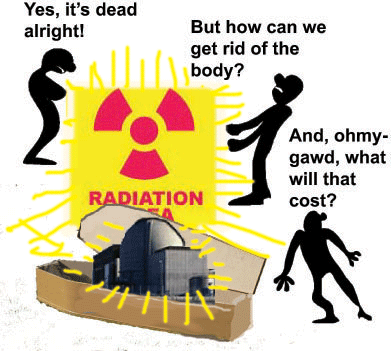 The other half of the end-of-life equation, decommissioning, is largely unknown terrain. When a nuclear site is decommissioned, it is released from regulatory oversight. Given “the ageing status of the European reactors, the capability of the industry and regulators to develop safe and cost effective decommissioning programs will determine to a great extent the future of nuclear commercial power in Europe”. This includes greater transparency in cost estimates, it adds. The Commission comes up with a total cost of €126 billion for decommissioning out to 2050. Some will argue that real costs are likely to be far higher.
Estimates of decommissioning costs per unit also vary “significantly” between Member States, from €0.20 billion in Finland to €1.33 billion in Lithuania. Germany and the UK are at the high end (€1.06 billion and €0.85 billion, respectively) while France is at the low end (€0.32 billion). The estimates depend on technology, the size and location of the reactor, and dismantling strategy, the Commission says.
Experience is scarce: although 89 reactors had been permanently closed in Europe as of October 2015, only three had been fully decommissioned. All three were in Germany. Worldwide, only 13 more have been decommissioned; all of them in the US. The Commission suggests a “European Centre of Excellence” to exchange best practice might help. http://www.energypost.eu/exclusive-eu-paints-challenging-picture-europes-nuclear-future/
EU paints challenging picture of Europe’s nuclear future, Energy Post. February 2, 2016 by Sonja van Renssen Not the full picture
In theory, the money for waste management and decommissioning is being accumulated throughout reactors’ lifetimes, primarily through a fixed contribution based on electricity sales. In most Member States, regulators define the method for securing funds (some, such as Germany however, rely on commercial law to require companies to build up reserves in their balance sheets).
Of the €268 billion needed in the EU by 2050, there is already €150 billion in the bank. In other words, as of 2014, European nuclear operators had dedicated assets that would cover 56% of the total estimated nuclear end-of-life costs, for reactors that were 64% of the way through their lives. A “possible explanation” for the difference is that some Member States are anticipating lifetime extensions.
The Commission concludes that “as a reliable low carbon technology and a major contributor to security of supply”, nuclear energy “is expected to remain an important component of the EU’s energy mix”. Maintaining EU technological leadership, including through the nuclear fusion project ITER, is “essential”. But this does not make nuclear energy competitive or affordable, nor does it ensure it can play a useful role in an EU power system dominated by renewables, where flexibility is central.
There are a few other things the draft PINC does not (yet) do. It does not advise on the involvement of foreign firms in supposedly strategic energy projects (e.g. China in Hinkley Point C). It does not draw lessons from recent upheavals in the nuclear industry (e.g. Areva’s bankruptcy). It does not tackle liability, although a former PINC suggested setting up a harmonised system of liability and financial mechanisms in case of an accident. And finally, it does not discuss harmonising strategies for decommissioning funds – also suggested in the former PINC – beyond proposing a European Centre of Excellence. http://www.energypost.eu/exclusive-eu-paints-challenging-picture-europes-nuclear-future/
Hinkley nuclear fiasco puts the wind up Hitachi, concerning investment in UK
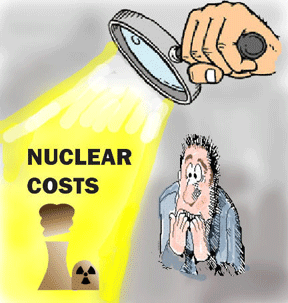
 Hinkley Point nuclear fiasco spooks Hitachi boss, Telegraph, 31 Jan 16
Hitachi boss raises concerns about funding of its own Wylfa Newydd project with foreign secretary during visit to Japan The head of Hitachi has warned that the debacle surrounding the construction of Hinkley Point nuclear plant throws up “very serious concerns” about its own investment in the UK.
Hiroaki Nakanishi, chairman and chief executive of the Japanese industrial giant, said the setbacks experienced by Hinkley’s developer EDF raised questions about how future plants including its Wylfa Newydd project are funded.
Hitachi’s subsidiary Horizon is planning to build a nuclear plant on Anglesey that is expected to start generating power by the mid-2020s.
In an interview with The Telegraph, Mr Nakanishi revealed that he had expressed concerns about the expected costs of the project with Philip Hammond during the Foreign Secretary’s visit to Japan this month.
Horizon is in talks with the Government to ensure the Wylfa deal presents value for money for both sides.
Mr Nakanishi said Hitachi had set out “very fair conditions for the making of our investment”, but could only commit to a deal it believed was viable.
“Hinkley Point [raises questions] about what are the real solutions for setting up financial support,” he said.
“Nuclear power construction requires huge money … we need to arrange a financial plan for which the kind of money needed can be introduced.
“Some part is government endorsement, some is more preferable investment conditions from the part of the finance industry.” Mr Nakanishi said the challenges faced by Hinkley Point could also affect Horizon. “The DECC worries about the stability of the scheduled construction of the [Hinkley Point] nuclear power plant, so some of the conditions – the credit requirements – those kind of things may affect us.
“In order to set up the financial conditions [to build Hinkley], Chinese capital was introduced, but what the real result will be – we have a very serious concern about that.”
Asked if the firm might step back if it believed a viable deal was not on the table, Mr Nakanishi replied: “Yes”.
Horizon is in negotiations with the Department of Energy and Climate Change (DECC) on issues such as the strike price, or the amount the Government will guarantee per unit of electricity produced, which will be key to attracting additional finance…….. http://www.telegraph.co.uk/finance/newsbysector/energy/12128405/Hinkley-Point-nuclear-fiasco-spooks-Hitachi-boss.html
Global nuclear industry – stagnation and decline
 Nuclear renaissance? Failing industry is running flat out to stand still Jim Green, 30 Jan 2016, The Ecologist,
Despite the endless rhetoric about a ‘nuclear renaissance’, there are fewer power reactors today than there were a decade ago, writes Jim Green. The one country with a really big nuclear build program is China, but no one expects it to meet its targets. And with over 200 reactor shut-downs due by 2040, the industry will have to run very hard indeed just to stay put. Over the next 10-20 years, global nuclear capacity may increase marginally, with strong growth in China more than masking patterns of stagnation and decline elsewhere. Beyond that, the aging of the global fleet of power reactors will be sharply felt.
Ten new power reactors began supplying electricity last year (eight of them in China), and eight reactors were permanently shut down.
Nuclear power’s 20-year pattern of stagnation continues. In 1995 there were 434 ‘operable’ reactors – operating plus temporarily shut down reactors. In 2005 there were 441, and now there are 439. Thus there are fewer reactors today than there were a decade ago. Moreover the 439 figure includes 41 reactors in Japan that have been shut down for several years, and not all of them will be restarted.
The nuclear power industry’s malaise was all too evident at the COP21 UN climate change conference in Paris in December. Former World Nuclear Association executive Steve Kidd noted:
“It was entirely predictable that the nuclear industry achieved precisely nothing at the recent Paris COP21 talks and in the subsequent international agreement. … Analysis of the submissions of the 196 governments that signed up to the Paris agreement, demonstrating their own individual schemes on how to reduce national carbon emissions, show that nearly all of them exclude nuclear power. The future is likely to repeat the experience of 2015 when 10 new reactors came into operation worldwide but 8 shut down. So as things stand, the industry is essentially running to stand still.”
According to the International Atomic Energy Agency, only seven out of 196 countries mentioned nuclear power in their climate change mitigation plans prepared for the COP21 conference: China, India, Japan, Argentina, Turkey, Jordan and Niger.
A striking feature of the debates around the COP21 conference was the vitriol directed at the anti-nuclear and environmental movements. Tim Judson from the Nuclear Information and Resource Service noted:
“The industry’s rhetoric is getting increasingly desperate and personal. The industry rolled out a new front group called ‘Nuclear for Climate’, which handed out thousands of copies of a book attacking anti-nuclear activists and blaming us for the climate crisis. Needless to say, their efforts to intimidate activists are backfiring. In fact, they have given us a clear sign of how close we are to winning. Greenpeace International’s Kumi Naidoo reminded activists in a speech in December – in which he broadened the call for divestment to include nuclear, as well as fossil fuels – of the famous adage attributed to Gandhi about the path to victory: ‘First they ignore you. Then they laugh at you. Then they fight you. And then you win.'”
Perhaps the five stages of grief are relevant as nuclear lobbyists confront the reality that the nuclear renaissance didn’t eventuate and isn’t likely to. Denial and anger are very much in evidence, along with some bargaining (‘we need all low carbon power sources’), depression and, in time, acceptance.
China’s great leap forward
With 30 operable reactors, 24 under construction, and many more in the pipeline, China remains the only country with significant nuclear expansion plans. China is unlikely to meet any of its targets – 58 GW by 2020, 110 GW by 2030 and up to 250 GW by 2050 – but growth will be significant nonetheless.
Growth could however be derailed by a serious accident, which is all the more likely because of China’s inadequate nuclear safety standards, inadequate regulation, lack of transparency, repression of whistleblowers, world’s worst insurance and liability arrangements, security risks, and widespread corruption.
There are fears, for example, that China may press ahead with its twin-EPR project at Taishan despite fears over the metallurgy of its reactor vessels and heads. Similar components supplied to the EPR at Flamanville in France have been found to have areas of excessive carbon leading to brittleness and possible failure in use. The French project is now on hold and may never be completed.
Over the next 10-20 years, global nuclear capacity may increase marginally, with strong growth in China more than masking patterns of stagnation and decline elsewhere. Beyond that, the aging of the global fleet of power reactors will be sharply felt: the International Energy Agency anticipates almost 200 permanent shut-downs by 2040.
Steve Kidd notes that the industry is running to stand still, and it will have to run faster to stand still as the annual number of shut-downs increases.
Growth elsewhere?
India is the only other country where there is a possibility of significant nuclear growth in the nearish-future. But nuclear growth in India has been modest – six reactor start-ups over the past decade – and may remain so.
In early 2015, India claimed to have resolved one of the major obstacles to foreign investment by announcing measures to circumvent a liability law which does not completely absolve suppliers of responsibility for accidents. But those claims were met with scepticism and a capital strike by most foreign suppliers is still in effect. Strong public opposition – and the Indian state’sbrutal response to that opposition – will also continue to slow nuclear expansion.
India has just signed an ‘preliminary agreement’ with EDF to build a massive six-reactor EPR project at Jaitapur, 360km south of Mumbai. But given the still-unresolved liability issues and the EPR’s disastrous construction record to date, it’s hard imagine any but the most cautious of progress taking place.
Meanwhile renewables are surging ahead. One part of the Jaitapur deal that is likely to move ahead fast is 142 MW of wind power in Gujarat that EDF is to develop with its Indian partner, SITAC.
And in mid-January 2016, the latest auction of solar energy capacity in India achieved a new record low price of 4.34 rupees / kWh (US$0.064; €0.059). Energy minister Piyush Goyal said: “Through transparent auctions with a ready provision of land, transmission and the like, solar tariffs have come down below thermal power cost.”
Russia has 35 operating reactors and eight under construction (including two very low power floating reactors). Only six reactors have started up over the past 20 years, and only four over the past decade. The pattern of slow growth will continue.
As for Russia’s ambitious nuclear export program, Steve Kidd noted in October 2014 that it “is reasonable to suggest that it is highly unlikely that Russia will succeed in carrying out even half of the projects in which it claims to be closely involved”.
South Korea has 25 operable reactors and three under construction. Six reactors have started up over the past decade. Along with China, India and Russia, South Korea is supposedly one of the four countries driving the ‘nuclear renaissance’. But the best the industry can hope for in South Korea is slow growth.
South Africa plans 9.6 GW of new nuclear capacity to add to the two Koeberg reactors. But the nuclear program is more theatre than reality. Pro-nuclear commentator Dan Yurman states:
“South Africa’s plans to build 9.6 GW of nuclear power will continue to be embroiled in political controversy and be hobbled by a lack of realistic financial plans to pay for the reactors. Claims by both Rosatom and Chinese state nuclear firms that they have won the business are not credible. Even if written down on paper, these claims of contracts cannot be guaranteed in the long term due to the political twists and turns by South African President Jacob Zuma. Most recently, he burned through three finance ministers over differences about whether the country could afford the cost of the reactors said to be at as much as US$100 billion including upgrades to the electrical grid. Additionally, Zuma is distracted by political and personal scandals.”
Brazil’s nuclear industry provided some theatre in 2015 with the arrest of Othon Luiz Pinheiro da Silva, the former CEO of Brazil’s nuclear power utility Eletronuclear, for allegedly accepting bribes to fix the bidding process for the Angra 3 reactor under construction 100 km from Rio de Janeiro. Fourteen other people were also charged as a result of the federal police’s ‘Operation Radioactivity’.
“The arrest is a tragedy for the industry,” said former Eletrobras’ chief executive Luiz Pinguelli Rosa. “The industry was already in crisis, but now the corruption concerns are bound to delay Angra 3 further and cause costs to rise even more.”
Newcomer countries: The World Nuclear Association claims that “over 45 countries are actively considering embarking upon nuclear power programmes.” Balderdash. Only two ‘newcomer’ countries are actually building reactors – Belarus and the United Arab Emirates. Other countries might join the nuclear club but newcomers will be few and far between.
Moreover, some countries are phasing out nuclear power. Countries with nuclear phase-out policies include Germany, Belgium, Taiwan, and Switzerland. Other countries – e.g. Sweden – may phase out nuclear power partly as a result of deliberate government policy and partly because of natural attrition: aging reactors are being shut down without replacement.
Stagnation and decline
Patterns of stagnation or slow decline in North America and western Europe can safely be predicted. In 2014, the European Commission forecast that EU nuclear generating capacity of 131 GW in 2010 will decline to 97 GW in 2025.
The European Commission forecasts that nuclear’s share of EU electricity generation will decline from 27% in 2010 to 21% in 2050, while the share from renewables will increase from 21% to 51.6%, and fossil fuels’ share will decline from 52% to 27%.
The most important nuclear power story of 2015 was legislation enacted in the French Parliament in July that will reduce nuclear’s share of electricity generation from 75% to 50% by ‘around’ 2025, and caps nuclear capacity at the current level of 63.2 GW.
The legislation also establishes a target of 32% of electricity generation from renewables by 2030, a 40% reduction in greenhouse gas emissions and a 20% reduction in overall energy consumption by 2030.
In April 2015, a report by ADEME, a French government agency under the Ministries of Ecology and Research, shows that 100% renewable electricity supply by 2050 in France is feasible and affordable.
French EPR reactor projects in France and Finland are three times over budget and many years behind schedule. As already noted, in April 2015 it was revealed that EDF’s Flamanville EPR under construction in France has a weak pressure vessel and head, and that the same problem may afflict China’s twin-EPR project with EDF at Taishan.
A January 2016 update to the World Nuclear Industry Status Report discusses the miserable state of the French nuclear industry:
“The French state-controlled AREVA, having announced an outlook of a further ‘heavy loss’ in 2015, was downgraded by credit-rating agency Standard & Poor’s to B+ (“highly speculative”). On 29 December 2015, the company plunged to a new historic low on the stock market (€5.30 compared to €72.50 eight years ago). On 7 December 2015, Euronext ejected the French heavy weight Électricité de France (EDF), largest nuclear utility in the world and “pillar of the Paris Stock Exchange”, from France’s key stock market index, known as CAC40. One day later, EDF shares lost another four percent of their value, which led to a new low, a drop of over 85 percent from its 2007 level. … The French nuclear industry’s international competitors are not doing much better. AREVA’s Russian counterpart Atomenergoprom as well as the Japanese controlled Toshiba-Westinghouse were both downgraded to ‘junk’ (‘speculative’) by credit-rating agencies during the year.”
Next door in Belgium, ageing reactors at Doel and Tihange – shut down a year ago because of serious safety concerns over numerous leaks and, at Tihange, 16,000 reactor vessel cracks – are scheduled to start up shortly, triggering serious concern across Europe. An Avaaz petition to be delivered to Belgium by German Environment Minister Barbara Hendricks on Monday has already attracted almost 500,000 signatures.
In the United States, utilities announced two more reactor shut-downs in 2015: the FitzPatrick reactor in New York will be shut down in 2016, and the Pilgrim reactor in Massachusetts will be closed between 2017 and 2019.
Five reactors are under construction but a greater number have been shut down recently or will be shut down in the next few years. The last reactor start-up was in 1996. In August 2015 the Environmental Protection Agency released its final Clean Power Plan, which failed to give the nuclear industry the subsidies and handouts it was seeking.
A decade ago, the US Nuclear Regulatory Commission was flooded with applications for US$127 billion (€117b) worth of reactor projects. Now, obituaries for the US nuclear power renaissance are increasingly common.
The situation is broadly similar in the United Kingdom – the nuclear power industry there is scrambling just to stand still. It should be clear by the end of this year whether the extraordinarily expensive Hinkley C EPR project will go ahead. But the signs are not good for the project’s backers: EDF was due to make its ‘final investment decision’ this week, but flunked out owing to its inability to raise the necessary £18 billion.
According to the World Nuclear Association, most of the UK’s reactors are to be retired by 2023. If other projects prove to be as expensive and difficult as Hinkley C, it’s unlikely that new nuclear capacity will match retirements.
In Japan, only two of the country’s 43 operable reactors are actually operating. Perhaps half to two-thirds of the reactors willeventually restart. Five reactors were permanently shut down in 2015, and the six reactors at Fukushima Daiichi have been written off.
Before the Fukushima disaster, Tokyo planned to add another 15-20 reactors to the fleet of 55, giving a total of 70-75 reactors. Thus, Japan’s nuclear power industry will be at most half the size it might have been if not for the Fukushima disaster……. www.theecologist.org/News/news_analysis/2987010/nuclear_renaissance_failing_industry_is_running_flat_out_to_stand_still.html
Anglesey nuclear plant project under threat over funding fears
Hitachi has warned it could walk away from Wylfa Newydd scheme unless it receives viable subsidy from UK Government 31 JAN 2016 BY OWEN HUGHES The Japanese firm behind Wylfa Newydd warned they could walk away from the £14bn nuclear project unless a viable funding deal could be found……..http://www.dailypost.co.uk/business/business-news/anglesey-nuclear-plant-project-under-10813851
UK nuclear power project a bonanza for Japanese companies, Hitachi-GE and others
Hitachi sees over 1tn yen in business for Japan companies http://asia.nikkei.com/Business/Deals/Hitachi-sees-over-1tn-yen-in-business-for-Japan-companies
 TOKYO — A nuclear power project in the U.K. will generate more than 1 trillion yen ($8.42 billion) in orders for Japanese businesses, it was learned Sunday, giving a shot in the arm to exports by an industry suffering from a lack of orders at home since the Fukushima accident of 2011.
More than 3 trillion yen is budgeted for the project if joint venture Hitachi-GE Nuclear Energy constructs four advanced boiling water reactors — and an even higher sum if six reactors get the nod. Hitachi has invited 40 or so Japanese companies to a meeting at the British Embassy here to explain details.
Also expected are water supply pump manufacturer Ebara as well as Kurita Water Industries and Kubota. Shimizu and Kajima, which have experience building housing structures for nuclear plants in Japan, will also likely go.
While Hitachi-GE will handle the reactor core, Japanese companies are expected to undertake key technologies for operating the nuclear plant, giving Japan about 40% of the project total.
(Nikkei)
Toshiba might sell off its unprofitable nuclear business in Japan
 Struggling Toshiba may spin off ailing Japan nuclear power business, Japan Times, 28 Jan 16, KYODO Scandal-hit Toshiba Corp. will consider splitting off its flagging nuclear power business in Japan and rebuilding it as a separate company as part of a sweeping restructure following an accounting scandal, sources said.
The 2011 Fukushima No. 1 nuclear plant disaster has made it difficult to build reactors in Japan amid safety concerns.
Toshiba’s subsidiary, Westinghouse Electric Co., which is in charge of its overseas nuclear power business, will seek to secure orders in emerging markets, the sources said Tuesday.
The move could trigger a realignment of the country’s nuclear power industry at a time when the government is aware of the need to bolster the competitiveness of domestic players, observers said…….
Toshiba said in November that Westinghouse had written down its assets by $1.3 billion in fiscal 2012 and 2013, revealing the difficulties facing the subsidiary in achieving profitability at the level anticipated by Toshiba.
Hit by the accounting scandal, Toshiba is proceeding with restructuring its unprofitable businesses….. http://www.japantimes.co.jp/news/2016/01/27/business/corporate-business/struggling-toshiba-may-spin-off-ailing-japan-nuclear-power-business/#.Vqkyc5p97Gh
French unions unhappy with arrangements for UK’s Hinkley nuclear build
New nuclear power: It’s consumer protection vs corporate profit, http://www.carolinelucas.com/latest/new-nuclear-power-its-consumer-protection-vs-corporate-profit January 27, 2016 The Government’s policy of burdening bill payers with eye watering subsidies for new nuclear power has received another blow. Just before a crucial board meeting at EDF (the French state owned energy giant relied on by the Government to invest in and operate Hinkley Point) French trade unions spoke out about their concerns.
When even staff working for EDF are raising serious doubts about numerous aspects of the proposal, UK Ministers’ cavalier attitude to Hinkley Point C needs to change, more urgently than ever.
In advance of an EDF board meeting due to take place today, where the company was rumoured to be making a final investment decision, French unions threw a welcome spanner in the works.
They’ve raise no fewer than 15 questions about the project, suggesting it would be difficult to complete on time and that financing it could threaten EDF’s survival. The good news, for now, is that EDF has, again, delayed the decision.
But the concerns of French unions are worth a closer look. They include pending legal cases, the lack of evidence Hinkley can be built on time, and the partnership with the Chinese nuclear energy company when no other investors appear to be interested.
Most telling of all is the following question: “what happens if the UK government decides to look after consumer interest?”
This shows that the Conservative Government’s pro-nuclear policy flies in the face of everything they say about looking after the interests of consumers and billpayers. Indeed, studies show that solar power coupled with energy storage and smart grid technology could generate the equivalent to Hinkley Point C at half the cost – to the Govt and to you and I. Wind power, even with backup, ischeaper than nuclear power too.
The Government’s obsession with outdated, inflexible, expensive nuclear power stations is looking more economically and environmentally reckless by the day. So I’ve tabled some more urgent parliamentary questions on Hinkley.
The first question relates to the problems with a similar model of nuclear power station being built at Flamenville in France. It’s already 6 years behind schedule, €7.5 billion over budget, and subject to safety tests following some serious flaws in the reactor vessel and bottom. The ruling on these safety concerns has itself been delayed. I’m pressing the Government on whether the agreement to proceed with Hinkley is conditional on the Flamanville plant demonstrating it’s capable of operating.
My second question is about the huge cost of new nuclear to consumers. It picks up on Ministers’ mindboggling double standards when it comes to subsidies for nuclear power verses solar power, onshore wind and other renewable technologies.
In the Commons earlier this month, the Energy Secretary again attempted to justify her huge cuts to solar subsidies on grounds that “subsidies for low carbon power should be temporary, not part of a permanent business model”. So my question asks exactly when she expects nuclear power stations to meet the same standards and operate on a subsidy free basis. Some renewable technologies are nearly there already, with the costs of others on a clear downward cost trajectory. Energy storage, interconnection and smart grids make Ministers appear stuck in the last century as they desperately argue about baseload.
The cost and climate change arguments against new nuclear power grow stronger every day. This week, workers have made their voices heard. It’s surely time the UK Government started to work for us rather than big energy companies and consign new nuclear to the dustbin of history. Ministers need to start listening to the many voices cautioning against Hinkely and instead back 21st century clean technologies.
In other major nuclear news this week, tomorrow sees a Special Parliamentary seminar co-organised by Nuclear Free Local Authorities and Nuclear Consulting Group: “UK Energy Policy: Late Lessons from Chernobyl, Early Warnings from Fukushima” The keynote speaker will be Naoto Kan, Former Prime Minister of Japan at the time of Fukushima.
South Afric a’s nuclear corporation in a mess
Step one: Sort out the mess at the nuclear corporation, Times Live The Times Editorial | 28 January, 2016
Power struggles, factionalism and claims of impropriety at state institutions have become so commonplace they are losing their shock value. “…….The latest public entity to be affected is the Nuclear Energy Corporation of SA, which is involved in two court actions over allegations of corporate governance breaches.
Phumzile Tshelane, the corporation’s chief executive and a supporter of the Zuma administration’s nuclear ambitions, is centrally involved in both cases.
The Nuclear Energy Corporation, meanwhile, is reportedly in disarray.
According to Business Day, it has yet to finalise its financial statements for the 2014-2015 financial year and is without a full board.
Several independent directors resigned, or left after their terms ended last year, after reportedly clashing with Energy Minister Tina Joemat-Pettersson. It would be tempting to dismiss the ructions at the corporation as just another public entity gone awry.
But the fact is that this is the institution that will play a key role in the government’s controversial plan to procure eight nuclear power reactors at a cost, experts warn, that could exceed R1-trillion.
Moreover, the government has decided to go ahead with the procurement and proceed to the next step, which is to invite tenders, even though the nuclear building programme has not been properly costed.
Surely the mess at the nuclear corporation needs to be sorted out before we take a single step further down the nuclear road.http://www.timeslive.co.za/thetimes/2016/01/28/Step-one-Sort-out-the-mess-at-the-nuclear-corporation
1 This Month




PLEASE OPPOSE HR 8255 AND S.3639 – bills would accelerate satellite deployment, with no environmental review or safeguards – https://ncstd5li.quorum.us/campaign/169331/
To see nuclear-related stories in greater depth and intensity – go to https://nuclearinformation.wordpress.com
-
Archives
- September 2026 (330)
- August 2026 (330)
- July 2026 (355)
- June 2026 (287)
- May 2026 (306)
- April 2026 (356)
- March 2026 (251)
- February 2026 (267)
- January 2026 (308)
- December 2025 (358)
- November 2025 (359)
- October 2025 (375)
-
Categories
- 1
- 1 NUCLEAR ISSUES
- business and costs
- climate change
- culture and arts
- ENERGY
- environment
- health
- history
- indigenous issues
- Legal
- marketing of nuclear
- media
- opposition to nuclear
- PERSONAL STORIES
- politics
- politics international
- Religion and ethics
- safety
- secrets,lies and civil liberties
- spinbuster
- technology
- Uranium
- wastes
- weapons and war
- Women
- 2 WORLD
- ACTION
- AFRICA
- Atrocities
- AUSTRALIA
- Christina's notes
- Christina's themes
- culture and arts
- Events
- Fuk 2022
- Fuk 2023
- Fukushima 2017
- Fukushima 2018
- fukushima 2019
- Fukushima 2020
- Fukushima 2021
- general
- global warming
- Humour (God we need it)
- Nuclear
- RARE EARTHS
- Reference
- resources – print
- Resources -audiovicual
- Weekly Newsletter
- World
- World Nuclear
- YouTube
-
RSS
Entries RSS
Comments RSS

