Years more delay for EDF’s Flamanville nuclear power station
EDF’s French nuclear plant faces years of further delay, Ft.com 20 Mar 16 Kiran Stacey and Tom Burgis EDF’s new nuclear power station in France faces years of further delays if tests confirm that the steel used in its reactor is flawed, the country’s atomic watchdog has warned.
It is one of the clearest signals to date of the scale of the setback faced by the French utility. The flagship plant at Flamanville in Normandy has already been subject to years of delays and cost overruns, which have made it difficult for EDF to fund the identically designed £18bn reactor at Hinkley Point in the UK — a key element in Britain’s energy strategy.
Initially, Flamanville was expected to cost €3.3bn and start operations in 2012 — it is now planned to start in 2018 at a cost of €10.5bn.
But Julien Collet, the deputy director of France’s Nuclear Safety Authority, has said that it could be delayed further by several years, depending on the results of tests started last year and due to end this summer on the steel being used in the reactor core.

If the steel fails the tests, regulators could order EDF to rip out and replace the top and bottom of the reactor vessel. Mr Collet told the Financial Times: “It takes a lot of time to build new components like this — we’re talking years.”……
The concerns over the steel used in the Flamanville plant are only the latest in a string of misfortunes at that project and another in Finland, both of which use Areva’s European Pressurised Reactor, or EPR, model.
These delays have caused difficulties for EDF’s contentious new project at Hinkley Point in Somerset, which was originally planned for 2017 but is now set to be built by 2025…….
EDF was thrown a lifeline last week, however, when Emmanuel Macron, the French economy minister said his government would recapitalise the company if necessary.
But executives will come under scrutiny on Wednesday when they are grilled in Westminster about Hinkley Point by MPs on the cross-party energy select committee. http://www.ft.com/intl/cms/s/0/73d62552-ec65-11e5-bb79-2303682345c8.html#axzz43g9nsyxB
AREVA’s huge loss on Finland nuclear project
 Areva Posts 2.04 Billion-Euro Loss on Finnish Project http://www.bloomberg.com/news/articles/2016-02-25/areva-delays-results-by-24-hours-after-securing-bridge-loan, 25 Feb 16 Francois De Beaupuy
The company, 87 percent owned by the French government, had a net loss of 2.04 billion euros in 2015 after a loss of 4.83 billion euros a year earlier, the company based near Paris said Friday in a statement. It took a 905 million-euro charge related to the Finnish power station project due to extra operating costs and the “probable impact” of further discussions with the customer to settle the disputes over the project and bring it to completion.
Areva said it expects negative net cash flow from operations in 2016 in the range of 1.5 billion to 2 billion euros, due partly to expenses to be incurred on large projects and an unfavorable change in working capital requirements.
As a result, Areva’s credit rating was downgraded in December by Standard & Poor’s to B+, four steps below investment grade. Shares of the company have dropped 32 percent this year, extending a drop of 40 percent in 2015. The company delayed its earnings report by one day in order to finalize a bridge loan.
EDF has said it will buy a majority stake in Areva’s reactor unit provided it’s not exposed to the Finnish atomic plant project.
Russia funding and building new nuclear power station in Finland

 Russian nuclear corporation to start construction of Hanhikivi NPP in Finland in 2017 http://tass.ru/en/economy/864293 NOVO-OGAREVO, March 22. /TASS/. Construction of the Hanhikivi 1 nuclear power plant in Finland to be implemented by the Russian nuclear corporation Rosatom will start in 2017. Such information is contained in materials for the working visit of Finland’s President Sauli Niinisto to Moscow.
The power plant is expected to start generating electric power in 2024.
In December 2013, Rusatom Overseas [Rosatom’s subsidiary – TASS] and Finnish Fennovoima signed the contract for construction of Hanhikivi-1 nuclear power plant. Along with the construction contract, a ten-year fuel contract was signed with Russia’s company TVEL.
Russia’s revenues from the Hanhikivi-1 nuclear power plant project will amount to €17.5 bln , head of Rosatom Sergey Kiriyenko said earlier. Of this amount only taxes to the federal budget will exceed €3 bln, he added.
According to Finnish media, the project’s cost will reach €6-7 bln, of which €1.6 bln will be invested by Fennovoima and the rest by Rosatom. The commissioning of the new nuclear power plant is scheduled for 2024.
Rusatom Overseas is to supply 1,200Mt reactor for Hakhikivi-1.
Future for nuclear energy in South Africa is not looking good.
Future looks bleak for nuclear energy: expert, Times Live Matthew le Cordeur | 22 March, 2016 Nuclear power generation has turned into an expensive operation, even when the machines are amortised, said nuclear expert Mycle Schneider. Schneider, author of the World Nuclear Industry Status Report, told Fin24 on Monday that he questioned whether nuclear power can be seen as an alternative to a whole range of other energy options.
Schneider’s 2015 report, which was released in South Africa this month, concluded that “the promise that Generation III+ designs would be simpler and therefore easier to build appears not to have been fulfilled”.
“Real costs have increased significantly compared to their predecessors suggesting the attempt to reduce complexity was not a success.
“The ‘nuclear renaissance’ appears, in retrospect, to have been a last chance for light water reactor technology,” the report says. “Given the failure to reduce costs – and there are few who would forecast costs are going to go down at all, much less decline to the levels originally claimed – and the apparent failure to reduce the incidence of construction overruns, the future looks bleak for light water technology.”
South Africa is forging ahead to build 9.6 GW of nuclear energy, which critics believe will drain the country’s fiscus due to the large upfront infrastructure costs they say will experience time and budget overruns.
Request for proposals – which would focus on the Generation III+ designs – will be released before the end of the month, the Department of Energy said.
Nuclear for SA would only be ready by 2025
“Nuclear power has the longest lead time of any option to generate electricity,” Schneider told Fin24. “The average construction time of the 40 nuclear reactors that have been brought on line in the world in the past 10 years was about 9.5 years, to which one has to add several years of site preparation and licensing procedures.
“In other words, new nuclear would only be available in SA after 2025. Other options, especially efficiency and renewables, can be implemented within months,” he said.
Schneider said that nuclear energy’s high capital expenditure (capex), low operating expenditure (opex) paradigm is gone.
“Nuclear power generation has turned into an expensive operation, even when the machines are amortised,” he said. “As assessments by the French Energy Regulatory Commission (CRE) and the French Court of Accounts have shown, all of the cost items have increased significantly, to reach a 20.6% increase between 2010 and 2013 to reach about 60 €/MWh.
“The ‘base load’ concept is also rapidly outlived by reality in the market,” he said. “With increasing penetration of renewables, flexibility is the master word.”
Nuclear the least flexible power
“Nuclear power is the least flexible of all of the power generating technologies and is therefore hardly suitable for a future orientated power grid with high levels of decentralised renewables,” he said……..http://www.timeslive.co.za/local/2016/03/22/Future-looks-bleak-for-nuclear-energy-expert
New York looks to fees to save uneconomic nuclear power stations
NY eyes fee to save some nuclear plants Democrat and Chronicle March 20, 2016 ALBANY – New York’s energy regulators have a problem. ……… two of the state’s three upstate nuclear plants — the R.E. Ginna Nuclear Power Plant in Wayne County and the James A. FitzPatrick Nuclear Power Plant in Oswego County — are facing financial trouble and could close as soon as mid-2017. The third, Nine Mile Point, is also in Oswego County.
A fourth plant — the Indian Point Energy Center in Buchanan, Westchester County —is facing opposition from Gov. Andrew Cuomo as owner Entergy Corp. seeks new federal licenses.
The solution? Money……..

“Nuclear is one thing. Nuclear a stone’s throw from 20 million people when you have no evacuation plan is problematic,” Cuomo told reporters Wednesday in Rochester.
In December, Cuomo directed the Public Service Commission to install the state’s carbon-cutting goals into state regulations. As part of that, Cuomo — who appoints the commission’s members — directed the board to come up with a plan to help save the “upstate nuclear facilities,” but not Indian Point.
The commission outlined its plan in late January. And, as expected, the proposal excluded Indian Point: Only plants with valid federal licenses through 2029 would be eligible. And Indian Point’s licenses are technically expired, though it is awaiting federal approval.
The remaining three nuclear plants — Ginna, FitzPatrick and Nine Mile Point — would be eligible……
EDF’s Flamanville nuclear power project – ever more delays
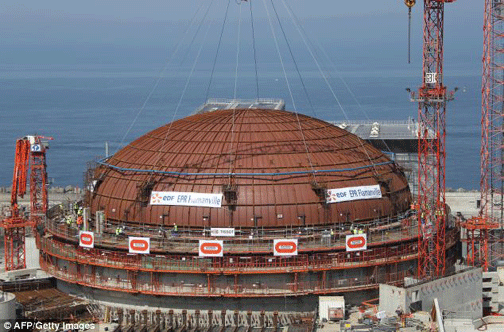
 EDF’s French nuclear plant faces years of further delay,Ft.com, 20 Mar 16 EDF’s new nuclear power station in France faces years of further delays if tests confirm that the steel used in its reactor is flawed, the country’s atomic watchdog has warned.
It is one of the clearest signals to date of the scale of the setback faced by the French utility. The flagship plant at Flamanville in Normandy has already been subject to years of delays and cost overruns, which have made it difficult for EDF to fund the identically designed £18bn reactor at Hinkley Point in the UK — a key element in Britain’s energy strategy.
Initially, Flamanville was expected to cost €3.3bn and start operations in 2012 — it is now planned to start in 2018 at a cost of €10.5bn.
But Julien Collet, the deputy director of France’s Nuclear Safety Authority, has said that it could be delayed further by several years, depending on the results of tests started last year and due to end this summer on the steel being used in the reactor core.
If the steel fails the tests, regulators could order EDF to rip out and replace the top and bottom of the reactor vessel. Mr Collet told the Financial Times: “It takes a lot of time to build new components like this — we’re talking years.”
The difficulties EDF is having with the steel at Flamanville have been caused by problems with the process of cooling and cutting a 450-tonne ingot of steel, which created an area the size of a dinner plate that was slightly more brittle than it should have been.
Areva, the French nuclear company in whose reactor business EDF is due to take a controlling stake, is working with regulators to test an identical piece to determine if it could lead to weakness in the reactor vessel.
The problem was discovered in late 2014 but EDF opted to push ahead with construction, potentially making it much more difficult to replace the faulty steel if needed……..
having agreed to fund 66.5 per cent of the [UK’s Hinkley Point C nuclear] project last year, EDF has delayed giving it final approval, with some at the top of the company arguing more investors should be brought in first.
Finding outside investment has been difficult because of the problems being experienced with other EPRs in France and Finland, according to senior people within the company………http://www.ft.com/intl/cms/s/0/73d62552-ec65-11e5-bb79-2303682345c8.html#axzz43TzEfz49
High costs loom for Xcel Energy’s nuclear reactors

 Xcel Energy faces more big investments to keep its nuclear units running Xcel faces $487 million in upgrades at its Prairie Island facility by 2020 By David Shaffer Star Tribune MARCH 19, 2016
The high cost of upgrading 40-year-old nuclear reactors is confronting Xcel Energy again.
Investments in the Prairie Island nuclear power plant in Red Wing, Minn., are projected to cost more than expected — $487 million by 2
20, with more spending needed in the next decade.
It’s not a replay of cost overruns at Xcel’s other reactor in Monticello, Minn. That 2013 surprise, which state regulators blamed on imprudent management, led Xcel to write off $125 million last year………
in a fresh surprise, Xcel also has offered to study shutting down Prairie Island years before the reactors’ operating licenses expire in 2033-34. Xcel isn’t pushing early retirement, which would accelerate the costly job of decommissioning. It’s an option being presented to the Minnesota Public Utilities Commission, which regulates Xcel’s rates and investments.
Two nuclear plants, including one in Wisconsin, have shut down for economic reasons since 2013. Four other nuclear plants in other states face similar challenges and are slated to close by 2019.
Even if Xcel retires its Prairie Island units in the 2020s, the Minneapolis-based utility said significant investment is needed just to keep them operating for a few years. One of the plant’s two generators is the original unit, and is to be replaced in 2018 if not sooner. Four cooling towers also need refurbishment or replacement, as do dozens of decades-old pumps, motors and controls, the utility said…….. the near-term investment in the Prairie Island plant isn’t the end of the story. Xcel said another $600 million to $900 million in additional work likely will be needed at Prairie Island in the 2020s………http://www.startribune.com/xcel-energy-faces-more-big-investments-to-keep-its-nuclear-units-running/372610701/
UK taxpayers up for huge liabilities if Hinkley nuclear power project goes ahead?
“The £22bn ‘poison pill’ effectively reduces the risk to zero for EDF and its backers, which is great for them. But from an outside perspective, it smacks of desperation.”
“Energy economics are changing rapidly and so the momentum is towards decentralised, smart and flexible energy systems. It is moving away from large, inflexible power plants like Hinkley. If it ever gets funded, it will be a white elephant before it is even finished and this government, with this £22bn ‘poison pill’, will have tied the next generation into paying for it, for no reason that I can understand. If it is simply political saving face, it really is pitiful.”
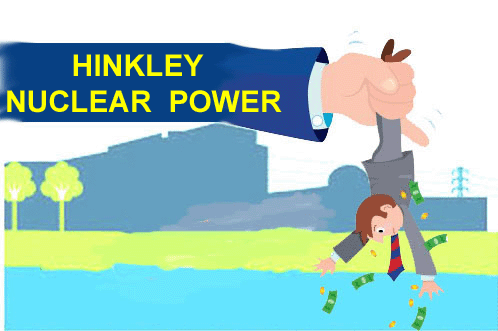
 Hinkley Point C nuclear deal contains £22bn ‘poison pill’ for taxpayer
Public left with huge liability for a government closure of power plant before 2060 under UK’s agreement with EDF, Guardian, Damian Carrington, 18 Mar 16, The Hinkley nuclear power deal contains a “poison pill” which could leave taxpayers with a £22bn bill if a future UK government closed the plant before 2060, according to an official document seen by the Guardian.
The huge liability shows Hinkley is a “terrible deal” for the UK public, according to critics, with the company also guaranteed three times today’s price for electricity for 35 years. The project has recently been battered by financial warnings and resignations at its prime backer EDF, although on Thursday France’s economics minister, Emmanuel Macron, said that the French state would bail the company out.
The deal the UK government has agreed with EDF, set out in an unpublicised “minute”, commits the British public to pay subsidies of up to about £40bn in real terms and provides state guarantees on nuclear waste disposal and insurance, while allowing the plant to begin producing electricity as late as 2033.
A shutdown that triggers the “poison pill” compensation is not entirely within the control of the UK government but could also be forced by the EU or an international regulator such as the International AtomicEnergy Agency, according to the document. [ EU par inserted here on original]
“This is a dreadful agreement for the nation,” said Prof Catherine Mitchell, an energy policy expert at the University of Exeter. “The government is already paying a high price, index-linked for an incredibly long 35 years. This should be more than sufficient for a professional, business contract.
“The £22bn ‘poison pill’ effectively reduces the risk to zero for EDF and its backers, which is great for them. But from an outside perspective, it smacks of desperation.”
“There could be so many reasons over 35 years that you would want to close the plant,” she said, including rising costs, changes to the UK’s energy system or loss of public confidence.
Green party MP Caroline Lucas said: “Even before we knew about this ‘poison pill’, Hinkley represented a terrible deal for taxpayers and a huge burden on bill payers too. This flies in the face of relentless ministerial rhetoric on value for consumers – especially compared to the costs of solar power and wind – which are already cheaper than nuclear and continue to fall.”………
Former Conservative energy secretary Lord Howell has criticised the Hinkley dealas “one of the worst deals ever” for British consumers and industry and has protested against “endless government guarantees for risk-free returns to the investors”.
Tom Burke at thinktank E3G, a former special adviser to three Conservative environment secretaries, said: “Why would a Conservative government want to buy 35 years of electricity ahead of time? They are supposed to believe in the market. But they have tied themselves in knots and now it is too embarrassing to untie it.”
The UK government argues that new nuclear power is essential to provide large amounts of reliable, low-carbon energy.
But Mitchell said: “Energy economics are changing rapidly and so the momentum is towards decentralised, smart and flexible energy systems. It is moving away from large, inflexible power plants like Hinkley. If it ever gets funded, it will be a white elephant before it is even finished and this government, with this £22bn ‘poison pill’, will have tied the next generation into paying for it, for no reason that I can understand. If it is simply political saving face, it really is pitiful.” http://www.theguardian.com/uk-news/2016/mar/18/hinkley-point-c-nuclear-deal-22bn-poison-pill-taxpayer
Toshiba to dump its nuclear business, as U.S. units probed?
 Toshiba says it may write down nuclear business, U.S. units probed, Reuters TOKYO | BY MAKIKO YAMAZAKI AND RITSUKO ANDO , 18 Mar 16, Japan’s Toshiba Corp (6502.T) said on Friday it was looking at whether it would need to write down its nuclear business given damage to the company’s credit profile after a $1.3 billion accounting scandal last year.
The electronics conglomerate also confirmed a report that U.S. authorities are probing accounting at its U.S. units, although its Westinghouse nuclear power subsidiary denied that its finances were under investigation.
Wanting to draw a line under the accounting scandal, Toshiba has sought to move on to streamlining its businesses, whose poor performances had been masked by years of false bookkeeping.
At a business strategy update on Friday, it unveiled an extra 3,000 job cuts, taking its planned total to 14,000 – a restructuring measure that comes on top of a $5.9 billion sale of its medical equipment unit as well as the sale of its home appliances business announced this week.
But the latest developments concerning its nuclear business and the probe highlight that its accounting woes are far from over…….
The Asahi newspaper reported earlier on Friday that Toshiba is considering a 200 billion yen ($1.8 billion) writedown for Westinghouse, fanning investor concerns that the value of assets and goodwill related to the unit were overstated.
Nuclear power has become less popular since Toshiba’s acquisition of Westinghouse in 2006, especially in the aftermath of the 2011 Fukushima disaster which prompted many countries to freeze nuclear energy expansion plans.
Toshiba confirmed a Bloomberg report that several U.S. units have received a request forinformation from the U.S. Department of Justice and the Securities and Exchange Commission regarding accounting issues…..http://www.reuters.com/article/us-toshiba-accounting-idUSKCN0WK02J
UK Members of Parliament to question EDF executives about Hinkley nuclear project financing
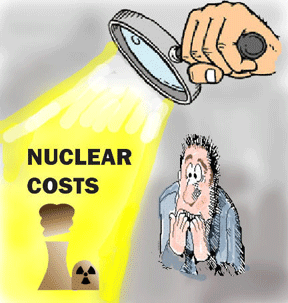
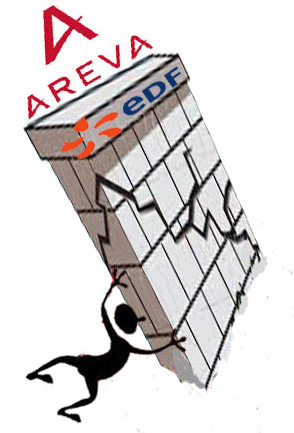 EDF Energy to be grilled by MPs over Hinkley Point C nuclear power plant , City AM. 17 Mar 16 EDF Energy will be grilled by a group of MPs next week over the controversial Hinkley Point C nuclear power plant in Somerset.
EDF’s chief executive Vincent de Rivaz, and managing director of new nuclear build Humphrey Cadoux-Hudson, will appear before the energy and climate change select committee on Wednesday.
It comes as French economy minister Emmanuel Macron pledged fresh financing for the £18bn project during a visit to a nuclear power plant there today.
EDF has been forced to defend Hinkley after its chief financial officer Thomas Piquemal resigned over the huge costs. It subsequently sent a letter to employees reiterating confidence that the project will go ahead.
“The hearing will give EDF Energy an opportunity to answer the committee’s questions on the investment plans for a new nuclear power station at Hinkley Point C in Somerset,” it said in a statement today……..http://www.cityam.com/237033/edf-energy-to-be-grilled-by-mps-over-hinkley-point-c-nuclear-power-plant
The health toll of Fukushima nuclear disaster – especially workers and children
Nuclear Expert: Fukushima “like the worst nightmare becoming reality” — Released as much as 1,000 atomic bombs worth of radioactive material — “Everyone on earth has been exposed… an increase in cancer will be the result” »
“Shocking how many people died in Fukushima” — Cremated bodies of Fukushima radiation workers found near plant — “Such a high rate of cancer” being detected in Fukushima children (VIDEOS) http://enenews.com/shocking-many-people-died-fukushima-cremated-remains-fukushima-radiation-workers-found-plant-high-rate-cancer-being-detected-children-videos?utm_source=feedburner&utm_medium=email&utm_campaign=Feed%3A+ENENews+%28Energy+News%29
AP,Mar 10, 2016 (emphasis added): Fukushima ‘Decontamination Troops’ Often Exploited, Shunned — The ashes of half a dozen unidentified laborers ended up at a Buddhist temple in this town just north of the crippled Fukushima nuclear plant… They were simply labeled “decontamination troops” — unknown soldiers in Japan’s massive cleanup campaign to make Fukushima livable again five years after radiation poisoned the fertile countryside… One laborer… said he was instructed never to talk to reporters… Minutes after chatting with some workers in Minamisoma, Associated Press journalists received a call from a city official warning them not to talk to decontamination crews… [W]orkers have developeddiabetes, cerebral and respiratory problems… local hospital intern Toyoaki Sawano said in a medical magazine last month… Hideaki Kinoshita, a Buddhist monk who keeps the unidentified laborers’ ashes at his temple [said] “There is no end to this job… Five years from now, the workers will still be around. And more unclaimed ashes may end up here.”
Mainichi, Mar 7, 2016: Experts divided on causes of high thyroid cancer rates among Fukushima children — A total of 166 children in Fukushima Prefecture had been either diagnosed with thyroid cancer or with suspected cases of cancer… “Compared to the estimated prevalence rates based on the country’s statistics on cancer, which are shown in data including regional cancer registration, the level of thyroid cancer detection is several dozen times higher(in children of Fukushima Prefecture),” said the final draft for the interim report compiled by the prefectural government’s expert panel on Feb. 15… [T]wo teams both concluded that the number of cancer cases found in Fukushima children was “about 30 times” that of national levels [and] agree that the “30 times higher (than the national occurrence rates)” is unexplainable. At the moment, the most likely theories for such a high rate of cancer detection are the “overdiagnosis theory” held by [the team led by Shoichiro Tsugane, a member of the Fukushima government’s expert panel] and the “radiation effect theory” that [the team led by Okayama University professor Toshihide Tsuda] supports… Tsugane is not completely denying the effects of radiation in children’s cancer… [Tsuda] argues that radiation exposure is the main cause of the high prevalence of cancer in children [and] because the spread of cancer cells to lymph nodes and other tissues could be seen in 92 percent of patients, Tsuda believes thatoverdiagnosis makes up 8 percent of the patients at most…
RT, Mar 11, 2016: ‘Shocking how many people died in Fukushima‘ – documentary director… Authorities in Japan want locals to think “nothing happened,” documentary director Jeffrey Jousan told RT. “The government prints the number of people who died as a result of the 2011 disaster in the newspapers… the (death toll) amounts to 300-400 people in each prefecture, but in Fukushima it is over 8,000 people… It is shocking… to see [how] many people have died in Fukushima”… [I]t is still unclear how many people have succumbed to or suffer from radiation-caused cancer diseases directly linked to the crippled plant.
Watch Press Conferences: Prof. Tsuda | Dr. Angelika Claussen, physician
The workers of the Fukushima nuclear clean-up
Fukushima Keeps Fighting Radioactive Tide 5 Years After Disaster, NYT By JONATHAN SOBLE MARCH 10, 2016 TOKYO — Of the thousands of workers who have answered the help-wanted ads at Fukushima Daiichi, the ruined and radioactive nuclear power plant in northeastern Japan, the part-time lettuce farmer and occasional comic-book artist Kazuto Tatsuta must be among the least likely.
“I needed a job,” Mr. Tatsuta, 51, recalled of his decision in 2012 to accept work at the site of one of the world’s worst nuclear accidents.
His duties included welding broken water pipes and inspecting remote-controlled robots that survey radioactive hot spots. And his comic strips, once populated with baseball players and gangsters, now tell stories of middle-aged, blue-collar men like himself who do the grunt work at Fukushima, some of whom find a sense of purpose and belonging they lacked in the outside world.
“It’s secure. You’re not going to get laid off there,” Mr. Tatsuta said. “But you’re also working for a goal.”
Five years after a powerful earthquake and tsunami struck, causing three reactors at Fukushima to melt down, that goal is the focus of a colossal effort at once precarious and routine. A veneer of stability at the plant masks a grueling, day-to-day battle to contain hazardous radiation, which involves a small army of workers, complex technical challenges and vexing safety trade-offs.
Fukushima has become a place where employees arrive on company shuttle buses and shop at their own on-site convenience store, but where they struggle to control radiation-contaminated water and must release it into the sea. Many of the most difficult and dangerous cleanup tasks still lie ahead, and crucial decisions remain unsettled………
The duration of the cleanup also creates the risk of labor shortages, he said, especially in jobs requiring special skills. Japan’s population is shrinking and, with the future of nuclear power uncertain, many young people are unwilling to stake careers on the industry.
For now, Fukushima is bustling with about 7,000 workers, much more than before the disaster and twice as many as two years ago. The town of Iwaki to the south has become a kind of workers’ village. At dawn, vans and buses line up to ferry workers to the plant via staging areas where they don protective white Tyvek suits, radiation monitors and gas masks.
“You think of it as totally normal work,” said Mr. Tatsuta, who asked to be identified only by his pen name to avoid being blacklisted by the plant’s owner, Tokyo Electric Power Company……….
For workers at the site, radiation is a constant enemy — though many see it more as a threat to their livelihoods than their lives. Government regulations forbid cleanup workers to be exposed to too much radiation, and when they hit the limits, they risk being laid off or reassigned to lower-paying jobs.
“If you go over the radiation limits, you can’t work,” Mr. Tatsuta said. “You’re always calculating how to keep the dose low.”
The temptation to cheat can be strong, for both workers and their managers. A government examination of Tokyo Electric’s safety practices in 2013 found that it had underreported the radiation exposure of a third of the workers whose records were reviewed. The company says it has since tightened reporting procedures……..http://www.nytimes.com/2016/03/11/world/asia/japan-fukushima-nuclear-disaster.html?_r=0
India may have to shut down two uneconomic reactors at Tarapur
 Oldest Indian Nuclear Reactors Near Mumbai May Be Shut Down, Bloomberg, Rajesh Kumar Singh, 14 Mar 16
-
Tarapur 1 & 2 unprofitable, undergoing frequent maintenance
-
Nuclear Power Corp. may seek higher tariff from regulator
-
India may shut two of its oldest reactors almost five decades after they went into operation as power tariffs aren’t keeping pace with maintenance costs, according to Sekhar Basu, secretary at the Department of Atomic Energy.
The first two reactors at Tarapur, about 100 kilometers (62 miles) from Mumbai at India’s western coast, suffer frequent maintenance shutdowns that make them unprofitable, Basu said in a phone interview. They earn about 0.89 rupees (1 cent) for every kilowatt hour of electricity produced, which isn’t enough to sustain operations. Nuclear plants in India received an average tariff of 2.78 rupees per kilowatt hour in the year ended March 2015, according to the Department of Atomic Energy.
“We are pouring in money into the reactors rather than making income from them,” Basu said. “At the current tariff, it’s become unviable to run the two reactors and we may be forced to shut them down if the tariff is not increased.”
Basu didn’t provide details on the timing of a possible decommissioning, a process that can take decades and generate thousands of tons of radioactive waste. Nuclear Power Corp., the nation’s sole operator of nuclear power plants, may approach the electricity regulator for a tariff increase when operations become unsustainable, Basu said. -
Liability Law
Nuclear Power spokesman N. Nagaich couldn’t be reached on his office phone for a comment. Sanjeev Kumar, chairman at Maharashtra State Electricity Distribution Co., which buys power from the reactors, didn’t respond to phone calls and a text message sent on his mobile phone.
The boiling water reactors, which can produce 160 megawatts each, were supplied by General Electric Co. and started operating in 1969, marking India’s foray into nuclear energy. India plans to raise atomic power capacity more than ten-fold by 2032 as part of its clean-energy drive. The expansion plans have been complicated by the nation’s liability law. The statute, which exposes plant equipment suppliers to accident claims, is borne out of concerns over nuclear safety……..http://www.bloomberg.com/news/articles/2016-03-15/india-mulls-shutting-oldest-nuclear-plants-amid-mounting-costs
Tax-payer money proposed in Senate, to keep uneconomic Fitzpatrick nuclear plant going
 Senate proposal includes $100M to keep Fitzpatrick nuclear plant online, North Country Public Radio, by Payne Horning (WRVO) , in Oswego, NY Mar 15, 2016 — The New York Senate Republican budget proposal includes money for Oswego County’s Fitzpatrick nuclear power plant. It would give $100 million to try to extend the life of the financially struggling plant.
The money would provide the immediate support Fitzpatrick needs to pay for the costs of refueling the plant, a lengthy and expensive process that has to take place this year. The ultimate goal is to keep Fitzpatrick open until 2017 when lucrative tax credits from the state could become available……..
Entergy is planning to close the facility next January because they said Fitzpatrick is losing $60 million annually. Since the decision to close the plant was announced last fall, lawmakers have been working to find a quick financial fix. If approved, the $100 million could be available as soon as April, but lawmakers in Albany are just starting the budget process and the proposal could be removed or changed. http://www.northcountrypublicradio.org/news/story/31295/20160315/senate-proposal-includes-100m-to-keep-fitzpatrick-nuclear-plant-online
France’s auditor brands Hinkley Point nuclear project as financially risky
 Hinkley Point branded potentially risky for EDF by French auditor, Guardian 11 Mar 16
Cour des Comptes urges greater study of nuclear project’s risks given poor recent investments and the fact EDF must fund likely cost overruns. EDF’s £18bn project to build nuclear reactors in Britain is potentially risky for the state-owned utility, whose foreign investments in recent years have proved disappointing, France’s top public auditor has said.
In a report on EDF’s international strategy, the Cour des Comptes – the French equivalent of the UK’s National Audit Office – said EDF and its 85% state shareholding should take a close look at the risks associated with the project to build two nuclear reactors at Hinkley Point in Somerset.
The report, which focuses on the 2009-2014 period – which includes EDF’s October 2013 agreement with the British government but not its deal in October 2015 with the Chinese utility CGN to take a one-third stake – said the financing around the Hinkley Point deal was potentially risky for EDF.
The auditor said EDF’s cashflow and high debt limit its capacity to invest abroad, especially given the huge sums needed to upgrade its ageing French nuclear plants.
“Even though the [Hinkley Point] deal has not been finalised, the complexity of the deal and especially the way it could impact the responsibility of EDF suffice to raise serious questions,” the auditor ……..http://www.theguardian.com/business/2016/mar/11/hinkley-point-risky-edf-french-auditor-cour-de-comptes?CMP=share_btn_tw
1 This Month




PLEASE OPPOSE HR 8255 AND S.3639 – bills would accelerate satellite deployment, with no environmental review or safeguards – https://ncstd5li.quorum.us/campaign/169331/
To see nuclear-related stories in greater depth and intensity – go to https://nuclearinformation.wordpress.com
-
Archives
- September 2026 (330)
- August 2026 (330)
- July 2026 (355)
- June 2026 (287)
- May 2026 (306)
- April 2026 (356)
- March 2026 (251)
- February 2026 (267)
- January 2026 (308)
- December 2025 (358)
- November 2025 (359)
- October 2025 (375)
-
Categories
- 1
- 1 NUCLEAR ISSUES
- business and costs
- climate change
- culture and arts
- ENERGY
- environment
- health
- history
- indigenous issues
- Legal
- marketing of nuclear
- media
- opposition to nuclear
- PERSONAL STORIES
- politics
- politics international
- Religion and ethics
- safety
- secrets,lies and civil liberties
- spinbuster
- technology
- Uranium
- wastes
- weapons and war
- Women
- 2 WORLD
- ACTION
- AFRICA
- Atrocities
- AUSTRALIA
- Christina's notes
- Christina's themes
- culture and arts
- Events
- Fuk 2022
- Fuk 2023
- Fukushima 2017
- Fukushima 2018
- fukushima 2019
- Fukushima 2020
- Fukushima 2021
- general
- global warming
- Humour (God we need it)
- Nuclear
- RARE EARTHS
- Reference
- resources – print
- Resources -audiovicual
- Weekly Newsletter
- World
- World Nuclear
- YouTube
-
RSS
Entries RSS
Comments RSS

