India’s planned 12 new nuclear reactors are not economically viable – report
 New Report Claims India’s 12 New Nuclear Reactors Are Economically Unviable http://cleantechnica.com/2016/03/31/new-report-claims-indias-12-new-nuclear-reactors-economically-unviable/?utm_source=feedburner&utm_medium=feed&utm_campaign=Feed%3A+IM-cleantechnica+%28CleanTechnica%29 March 31st, 2016 by Joshua S Hill
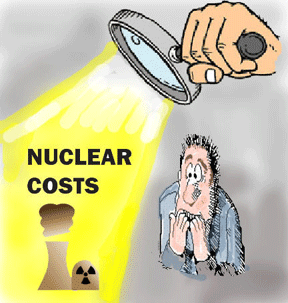
A new report published by the Institute for Energy Economics and Financial Analysis has concluded that India’s plans to build 12 new nuclear reactors is economically unviable.
According to the new report (PDF), published this week by the Institute for Energy Economics and Financial Analysis (IEEFA), India’s current plans to build 12 new nuclear-powered plants is not only economically unviable, but fraught with risk, as the plants are intended to be a “first-of-its-kind” design that is untested. As such, the development of the nuclear power plants would likely result in numerous delays and technical problems.
David Schlissel, IEEFA’s director of resource planning analysis, concludes that the proposed nuclear plants, designed by Toshiba-Westinghouse and General Electric-Hitachi, and planned for the Mithi Virdi and Kovvada complexes, “are neither economically nor financially viable.” The plans intend for the 12 plants to be built across two separate sites in India. Six would be sited at Mithi Virdi in Gujarat, and would use the new Westinghouse AP1000 reactor design — which Schlissel notes has already “run into technical problems and significant cost increases and schedule delays” in other locations where the design is already under construction. The other six new plants, intended to be developed in Kovvada in Andhra Pradesh, would use GE’s Economic Simplified Boiling Water Reactor (ESBWR) design, and would be the first country in the world to develop this particular design.
“They would take much longer than expected to build, they would result in higher bills for ratepayers, and, if they are built, they might not work as advertised,” Schlissel said.
The report also noted that the development of the new nuclear power plants would come at the expense of solar, leading the author to conclude that India would do well to instead direct that money and effort into developing solar resources. “Investing in new solar photovoltaic (PV) capacity would be a much lower-cost, significantly less environmentally harmful and far more sustainable alternative to the Mithi Virdi and Kovvada projects,” Schlissel said.
Among the report’s specific findings:
- Capital costs of the 12 plants would far exceed those of comparable solar-energy projects and, barring long-term and probably unsustainable government subsidies, consumers will pay more for electricity from the plants than they would for solar energy
- The first new reactors in the expansions at Mithi Virdi and Kovvada will take 11 to 15 years to build, if approved, even assuming the projects manage to avoid likely delays. None of the new reactors at Mithi Virdi and Kovvada would generate any power for the electric grid until sometime between 2029 and 2032. The remaining units at each project are unlikely to be completed, if approved, until late in the 2030s
- Even without likely time-and-cost overruns, both projects would require massive investment over the next two decades, ranging from Rs. 6.3 lakh crores (US $95 billion) to 11.3 lakh crore rupees (US $170 billion). It is unlikely that the Indian government would be able to simultaneously support other electricity-sector expansions, including in renewable resources and energy-efficiency programs
- Both projects, if approved, would probably be slowed by lengthy land-acquisition delays, complicated liability issues, lags associated with new-technology difficulties and compliance with the country’s “Make in India” policy
“All of these can be expected to lead to substantial, and perhaps indefinite, delays and significant increases in capital costs, possibly even far beyond those we have assumed in our analyses,” Schlissel said.
Chinese nuclear corporation decides not to get involved in UK’s dubious Hinkley nuclear project

 CGN Power’s dropped nuke deal in UK is a “sensible move”: analyst. Asian Power, 28 Mar 16 It would’ve locked up a bulk of capital in the long-term.
Last October, China signed a deal with the UK to participate in three UK nuclear power projects, with CGNPC, the parent of CGN Power, owning a 20.0%-66.5% stake in each of the projects.
Under a non-competition deed granted by CGNPC, CGN Power has the option of investing in any UK nuclear project that is either being planned or constructed by the parent group. Thus far, the independent non-executive directors of CGN Power have elected not to pursue the UK projects.
According to CCB International’s Cathy Chan and Felix Lam, the decision by CGN Power’s independent non-executive directors not to get involved in the construction of the UK nuclear projects did not come as a surprise given the company’s strategy of refraining from involving itself in nuclear power projects that do not have at least one unit already in commercial operation.
The UK project does not yet meet this criterion as it is still at the initial stage of development and has several major hurdles to negotiate, not least of which is insufficient funding from other stakeholders, in particular Électricité de France (EDF FP, NR), a French power company…….. analyst http://asian-power.com/power-utility/news/cgn-powers-dropped-nuke-deal-in-uk-sensible-move-analyst
Further doubt on future of Hinkley Point nuclear project, as costs rise again
Hinkley, No2NuclearPower, 31 March 2016
Closing Canada’s Pickering nuclear station will result in jobs, savings and safety
 Shuttering Pickering = jobs, savings and safety
Closing the Pickering Nuclear Station when its license expires in 2018 and getting to work on dismantling the plant immediately will be safer, create more jobs between now and 2030, and save hundreds of millions of dollars.
That’s the finding of a new report commissioned by Ontario Clean Air Alliance Research from energy consultants Torrie Smith and Associates. Torrie Smith compared Ontario Power Generation’s (OPG’s) plan of leaving the plant untouched for 30 years before starting decommissioning to the internationally preferred approach of immediate decommissioning.
They found that getting to work immediately would create 16,000 person years of employment, save $800 million to $1.2 billion on decommissioning costs, and ensure a smoother transition for workers and the local economy.
In fact, Torrie Smith points out that the only reason to leave Canada’s oldest nuclear plant sitting idle on the Pickering waterfront for the next 30+ years is money. While there is enough money in OPG’s Decommissioning Fund to fully cover the costs of decommissioning Pickering today, OPG would prefer to wait and let investment returns over the next three decades do the heavy financial lifting.
From a safety perspective, a 30-year wait simply means that Pickering’s components and structures will continue to age and deteriorate, actually raising risks while producing more low-level radioactive waste. A 30-year delay will have little impact on levels of radioactivity in the plant or affect how the dismantling work is approached, which is why the International Atomic Energy Agency states that “the preferred decommissioning strategy shall be immediate dismantling.”
The Pickering Nuclear Station is North America’s 4th oldest and one of the largest nuclear stations on the continent. We should not leave this legacy of a bygone era to future generations to deal with. Instead, we should seize the opportunity to develop expertise in a growing new industry – nuclear decommissioning.
Given that Canada’s nuclear industry hasn’t sold a new reactor in 30 years, the future of our nuclear industry clearly lies in providing the expertise to safely decommission old nuclear facilities – including other aging CANDU reactors in Canada and around the world.
Please send Premier Wynne a message here asking her to order OPG to develop an immediate decommissioning plan for Pickering and to close this dinosaur by 2018 (when its license expires) at the latest.
Nine Mile Point Nuclear Station desperate for money: call for taxpayer funding
 Nine Mile Point nuclear plant faces financial peril, exec says, syracuse.com, By Tim Knauss | tknauss@syracuse.com 31 Mar 16 SCRIBA, N.Y. — Nine Mile Point Nuclear Station is “losing a lot of money” and could someday face an early closure like its Oswego County neighbor, the FitzPatrick plant, unless state officials develop price supports for Upstate nuclear plants, a top company official said Wednesday.
The pending shutdown of FitzPatrick has dominated headlines, but the larger Nine Mile Point station next door suffers similar financial hardships, said Joseph Dominguez, executive vice president of plant owner Exelon Corp.
Dominguez said the 1,900-megawatt Nine Mile Point facility no longer makes enough money to cover operating expenses. He declined to say how steep its losses are………
state officials scramble to implement new subsidies that would reward Upstate nuclear plants for generating carbon-free power and provide them with millions in additional revenue.
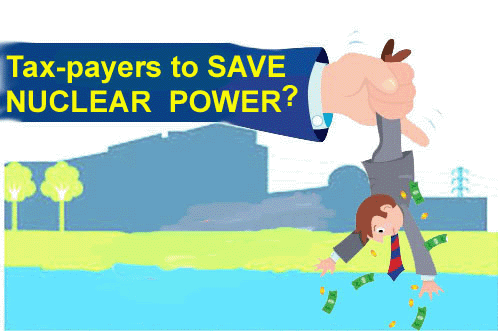
Gov. Andrew Cuomo in December ordered state regulars to establish so-called “zero emission” subsidies for Upstate nuclear plants for a 15-year period. Cuomo has committed to cutting carbon emissions 40 percent by 2030. If nuclear reactors shut down and are replaced by natural gas-fired plants, carbon emissions would increase.
But Cuomo’s plan is opposed by some advocates of renewable energy, who say forcing utility ratepayers to pay more for nuclear power is a waste of resources that should be devoted to cleaner technologies like wind and solar power.
Details of the nuclear price supports have not been worked out. But the staff of the Public Service Commission estimated last month that current wholesale electric prices are about $15 per megawatt-hour lower that what Upstate nuclear plants need to survive. If utility ratepayers have to make up that difference, the cost could be $300 million a year or more, even with FitzPatrick closed……..
Most recently, state Sen. Patty Ritchie proposed $100 million in the state budget to keep FitzPatrick operating until permanent nuclear price supports are in place.
FitzPatrick’s owner, Entergy Corp., has rejected such efforts and stays on course to close the plant.
Dominguez, of Exelon, said FitzPatrick is just one of four Upstate reactors at risk of shutting down -“ including the two at Nine Mile Point and Exelon’s other Upstate facility, the Ginna nuclear plant in Wayne County.
“We appreciate the focus that the legislators are putting on FitzPatrick, but it’s really an issue that’s broader than FitzPatrick,” he said. “It’s four units up there. A limited one-time budget fix for one plant frankly isn’t going to do it. You’re just going to end up with another plant that’s going to be in jeopardy within months, or at most years.”…….http://www.syracuse.com/news/index.ssf/2016/03/nine_mile_point_nuclear_plant_faces_financial_peril_exelon_exec_says.html
South Africa and the madnessof its nuclear build programme
 The madness of the nuclear build programme http://www.rdm.co.za/politics/2016/03/29/the-madness-of-the-nuclear-build-programme
Nuclear vendors are loathe to submit to a competitive tendering process based on a long-term, fixed-priced contract ANTON EBERHARD 29 MARCH 2016 IT IS time for the gloves to come off. The onus is on those who support the procurement of nuclear power stations to demonstrate that this initiative is not corrupt and will not be ruinous for the economy.
We face a possible credit rating downgrade to junk, which will make us all poorer: it will cost a lot more to service our debt, there will be less money for social programmes, the rand will fall even further, and inflation will rise.
Yet some still promote a huge nuclear programme that is not needed, that is more expensive and risky than alternative energy sources, that is hard to finance, and that will create contingent liabilities for the Treasury when we can least afford them.
SA does not need to procure large chunks of new power now. Electricity demand is not growing: it’s falling, and is lower than it was a decade ago. Depressed economic activity is partly the reason, but it’s not the most important one.
Electricity and economic growth data no longer track each other. The size of SA’s economy has continued to increase, albeit slowly, but electricity consumption has headed in the opposite direction. Countries such as Australia have seen a similar decoupling of energy and economic growth.
Could electricity demand in SA rebound if economic growth revives? Do we need to cater for depressed electricity demand as a result of Eskom supply constraints? Possibly. But we also need to recognise that there are profound changes to the energy-intensity of our economy, as smelters and mines close. The structure of our economy is changing. A fourfold increase in electricity prices in the past decade has accelerated energy-efficiency investments and energy conservation.
Official electricity demand forecasts and plans are obsolete. If demand for electricity were to reignite, it would fire off a lower base, and the rate of growth would be lower. When we project demand forward to 2030 or beyond, it’s obvious that we need a lot less power than was forecast in the Integrated Resource Plan of 2010 (the basis for the 9600MW nuclear commitment).
But we also need to replace old coal power plants, and compensate for the decline in the performance of Eskom’s existing power stations. I’ve taken all these arguments into account, and calculate that we need about 17GW of new electricity generating capacity by 2030. Some may calculate a slightly different number, but the required capacity will be close to this.
We have already ordered more power than we need by 2030. The new Eskom Medupi and Kusile coal power stations will add 9.6GW; its Ingula pumped storage scheme, 1.3GW. Two peaking power stations — Desisa and Avon, ordered by the Department of Energy — will add 1GW.
Contracted industrial co-generation and the department’s coal independent power producers (IPPs) will each add 1GW, with plans for more. In addition, 92 projects, totalling 6,347MW, have been contracted in the first four rounds of the department’s renewable energy IPP programme. Granted, this is intermittent power and will need to be complemented by gas power plants that the department plans to procure this year. More than 3GW are in the pipeline.
In the meantime, SA has negotiated 2.5GW of hydro power from the Inga 3 development in the Democratic Republic of Congo, and is considering further hydro imports from the region.
Together, these power procurements exceed what we need in the next 15 years.
Our cheapest sources of power are now wind and solar energy. The Department of Energy has awarded long-term, fixed-price contracts for wind energy as low as 57c/kWh, far below Eskom’s average cost of supply. Renewable energy combined with gas power can offer reliable base load supply at less than R1/kWh. Imported hydro and coal IPPs will also beat this.
I challenge any nuclear power vendor to sign a long-term power contract at less than R1/kWh. Whenever I ask them what nuclear power will cost in the country, they say “it depends”, and “it will need to be negotiated”.
This is the point: nuclear vendors are loathe to submit to a competitive tendering process based on a long-term, fixed-priced contract in which they take the risks of construction time and cost overruns. But all the other energy technology providers are prepared to do so. This has been the basis of the success of the IPP programme that has delivered such spectacular investment outcomes and price certainty for consumers. So why would we opt for a nuclear procurement programme that aims only to select a strategic partner, with subsequent price negotiations that have uncertain outcomes?
Nuclear power plants are also hard to finance. A couple of years ago in Davos, President Jacob Zuma was asked how 9,600MW of nuclear power would be financed. His answer, remarkably, was: “I’ll speak to my finance minister.”
He would have had that conversation by now and it will be clear that there is no fiscal space to finance a programme that will cost more than a half-a-trillion rand, when we raise just more than a trillion rand annually in taxes to fund all SA’s needs. Debt financing is now the fastest-growing component of the national budget and interest payments are more than twice the spend on higher education.
Our traditional mechanisms for funding power investments are also constrained. Eskom’s balance sheet is stressed, and it is struggling to raise sufficient debt on private capital markets to complete Medupi and Kusile. It has no possibility of raising finance for even one nuclear power station.
The private sector will not finance a nuclear plant in SA. The only possibility is funding from nuclear vendor countries. France will struggle: its nuclear company, Areva, is technically bankrupt and its latest UK nuclear contract — at £92.50/MWh (R2/kWh) — would be unaffordable for us.
Russia will not be able to finance all of its nuclear ambitions. China is a possibility, but financing will need to be backed by a long-term contract with an agreed electricity tariff, and the government will have to provide a sovereign guarantee and insurance cover, which will add contingent liabilities to the Treasury that will hasten a credit rating downgrade.
Eskom’s management recently expressed interest in further investments in large coal and nuclear projects. Its big coal, big nuclear, and big networks strategy is Neanderthal. Why would SA want to go down this route? It’s irrational. SA’s economic situation is precarious. The government now needs to act in concert and remove uncertainty about this nuclear folly. We don’t need it, it is too expensive, and we cannot afford it.
• Eberhard is a professor at the University of Cape Town’s Graduate School of Business
EDF senior engineers call for delay in UK Hinkley nuclear power development
Dissenting EDF engineers urge delay to Hinkley nuclear project Complexity makes completion date unrealistic, argues report, but French group sticks to timetable Ft.com : By Michael Stothard in Paris, 29 Mar 16,
Senior engineers at French utility EDF have called for at least a two year delay at the controversial Hinkley Point nuclear project in the UK and recommended a redesign of the reactor technology.
An internal white paper written by dissenting EDF engineers, which has been seen by the Financial Times, argues that Hinkley Point is so complex and untested that the company should announce a later completion date than the target of 2025.
The paper, circulated among top executives, said that the “realistic service date was 2027” due to the size of the project, continuing design modifications to the European Pressurised Reactor system and the “very low” competency of French supplier Areva in making some of the large components……..
The unsigned white paper was written after Mr Piquemal’s resignation by a group of senior engineers and other dissidents, according to people with knowledge of the document. The company plans to make the final investment decision on the project at a board meeting on May 11……..
The paper also addresses wider fears that the Hinkley project will in any case not be completed by 2025 and might suffer years of construction delays.
One person on the EDF board who had read the white paper said: “Few believe that we can build this [Hinkley Point] by 2025 any more.”…….
Three people close to the company said that CGN, EDF’s Chinese partner for Hinkley, also feared possible delays, attempting to insert a clause so it would take on a lower financial risk if there were a large problem.
In the case of a £5bn cost overrun, despite EDF having a 66.5 per cent stake in the project, EDF would be liable for 80 per cent of the additional costs, according to a document sent by the EDF finance department to the board’s audit committee in January…….https://next.ft.com/content/2ef61abe-f5b1-11e5-96db-fc683b5e52db
Marketing frenzy to sell nuclear reactors to the Middle East
Nuclear Power to the People The Middle East’s New Gold Rush, Foreign Affairs May 2015 By Bennett Ramberg There’s a gold rush in the Middle East, but it isn’t gold that prospectors are seeking. It’s reactor sales; these have been talked about for decades, but they’re now picking up steam. So far, Russia has taken the lead. Having built the region’s only operational nuclear power plant—Iran’s Bushehr reactor—it will begin construction in Turkey later this year or next on four reactors, with energy set to begin flowing in the early 2020s. Russia has also stuck agreements with Algeria, Egypt, Iran, and Jordan, and it is seeking to enter the Saudi market.
Other countries are now trying to make up for lost time. South Korea has already contracted to build four plants in the United Arab Emirates, with the first expected to come online in 2017. And Argentina, Canada, China, the Czech Republic, Finland, France, Japan, and the United Kingdom are among those pursuing their own agreements for reactors, component parts and/or service deals.
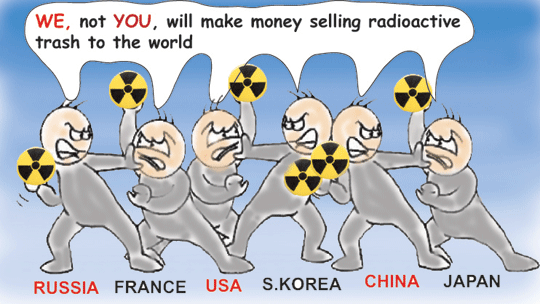
The United States, subject to Section 123 of the U.S. Atomic Energy Act—which requires that nuclear recipients adhere to a set of nonproliferation criteria to receive transfers of nuclear material, equipment, or components—finds itself more constrained in exploiting the markets. Still, in addition to supplying the Emirates with component and engineering support services under the 123 Agreement, the U.S. Commerce Department reports that GE-Hitachi and Toshiba-Westinghouse have signed contracts with Exelon to pursue reactor construction in Saudi Arabia, presuming that a 123 Agreement will be negotiated…….(registered readers only) https://www.foreignaffairs.com/articles/middle-east/2015-05-25/nuclear-power-people
Russia marketing nuclear power to Bolivia
 Bolivia Hopes to Gain Knowledge From Nuclear Deal With Russia, Sputnik News, 29 Mar 16, “……..Russia and Bolivia signed an agreement on peaceful nuclear cooperation in 2015. Rosatom and the Bolivian Hydrocarbon and Energy Ministry signed a memorandum of understanding on cooperation for peaceful uses of nuclear energy in November. http://sputniknews.com/business/20160329/1037166194/bolivia0russia-rosatom-nuclear.html#ixzz44KHYmPUv
The coming wave of shutdowns of old nuclear reactors in America
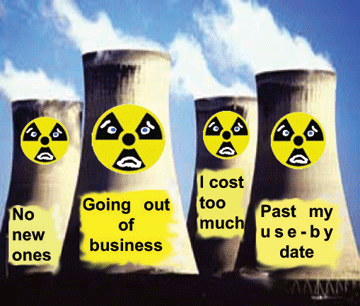 One-Third Of US Nuclear Reactors Are Near Mandatory Retirement The Daily Caller, ANDREW FOLLETT, 29 Mar 16 A 39-year-old nuclear plant in Ohio, which was only designed to operate for 40 years, was shut down Sunday for life-extending maintenance.
The Ohio reactor isn’t unique either. The average age for American nuclear reactors is 35, nearly obsolete by modern design standards and near the end of 40-year operating licenses. Sixteen American nuclear reactors are more than 42 years old, according to government data compiled and mapped last week by The Daily Caller News Foundation…….
$47 billion and counting – the cost of nuclear safety upgrades, post Fukushima
 Nuclear safety upgrades post-Fukushima cost $47 billion, The Barrel, Platt’s, 20 Mar 16 Five years after the accident at Fukushima I in Japan resulted in three reactor meltdowns, the global nuclear industry is spending $47 billion on safety enhancements mandated after the accident revealed weaknesses in plant protection from earthquakes and flooding. This is according to a Platts review put together by Steven Dolley in DC, Benjamin Leveau in London, Yuzo Yamaguchi from Tokyo, as well as Platts correspondents in Sweden, South Korea and China.
Reactions to the March 11, 2011 accident ranged from pauses in new nuclear construction programs in China to Germany’s decision to gradually phase out nuclear generation.
But in the majority of countries with nuclear power, plans for new reactors have been scaled back, not just because of the Fukushima I accident but for economic reasons, as competing sources of power become less expensive, renewable energy grows in popularity and slow economic growth curbs demand.
Global nuclear regulators carried out reviews of the accident, and in most countries nuclear plant operators were required to install backup sources of electric power and cooling water along with additional protection from earthquakes and flooding. A record-setting earthquake triggered a tsunami that swamped backup emergency power generators and disabled on-site power distribution systems at Fukushima I, leading to a complete loss of cooling.
Those safety improvements have come at a high cost.
A Platts review found that in nine of the 13 countries with the largest nuclear fleets, costs to comply with post-Fukushima requirements will total more than $40 billion, mostly before 2020. Those countries accounted for 289, or two-thirds, of the power reactors in operation worldwide.
The median of the costs was $46.9 million/reactor.
If the remaining reactors not covered in the Platts survey spent the median amount to meet post-Fukushima regulatory requirements, the global cost to make post-Fukushima enhancements would be $47.2 billion. The greatest cost per country was in Japan, where operators may spend $640 million per reactor to enhance safety.
The OECD Nuclear Energy Agency released a five-year status report on the Fukushima I accident, concluding that actions implemented by member countries had improved the overall safety of the world’s nuclear fleet, but that enhancing safety remains “a long-term process.”……..
Anti-nuclear groups have said the regulatory and industry response following the Fukushima I accident has been insufficient. Regulators in the US have “capitulated” to industry by failing to order vent filters, the group Beyond Nuclear said in a March 10 statement.
Measures to protect nuclear plants from earthquakes and flooding have left unaddressed vulnerabilities in areas such as plant security, the group said.
The biggest problem facing US nuclear plant operators recently has been economic. Low natural gas prices and an abundance of cheap renewable electricity in some markets have created financial problems for nuclear plants in competitive electricity markets. Entergy in late 2015 said it would permanently shut two stations, the 849 MW FitzPatrick in New York state and 728 MW Pilgrim in Massachusetts.
Japan’s nuclear reactors were all shut following the Fukushima I accident, and only two have met regulatory requirements and restarted.
The country’s nuclear industry has budgeted about Yen 3.1 trillion ($27.5 billion) for earthquake and tsunami protection following the accident………http://blogs.platts.com/2016/03/29/nuclear-safety-upgrades-post-fukushima/
India’s push for solar power to bring over a million jobs
 India Solar Power Push May Produce Over 1 Million Jobs http://cleantechnica.com/2016/03/23/india-solar-power-push-may-produce-over-1-million-jobs/ March 23rd, 2016 by Smiti Mittal Originally published on Sustainnovate. India’s massive solar power capacity addition target is expected to be a revolution in the Indian jobs market as well.
According to a report by the Natural Resources and Defense Council (NRDC), India may end up creating over a million new jobs in its endeavour to have 100 GW of operational solar power capacity by March 2022.
The report suggests that a massive army of engineers, construction, and maintenance workers shall be required set up the scores of solar power capacity planned by the central and state governments.

Around 210,800 site engineers and designers would be required to set the large-scale as well as rooftop solar power systems rolling. Around 624,600 semi-skilled workers would be needed for the construction and on-field execution of the projects. To monitor ongoing operations at the power plants and their maintenance, another 182,400 semi-skilled workers would be needed. Thus, a total of 1,017,800 jobs are expected be created if India indeed manages to set up a cumulative operational capacity of 100 GW by 2022.
Jobs creation and empowering youth is one of the major policies of the current government. The ‘Skill India’ program launched by the Indian government aims to provide employment to youth by providing them industrial training in the solar power sector. Several agencies across the country have already started such training programs.
Some state governments have also announced financial support to unemployed youth to set up rooftop solar power systems to help them generate a source of income.
Nuclear safety too costly for Japan- scraps 6th nuclear reactor
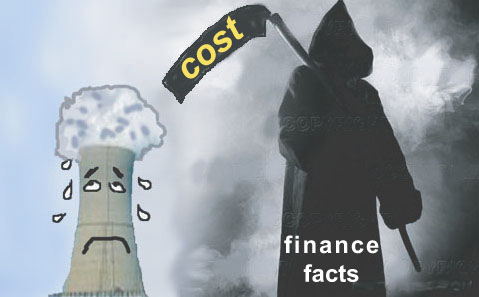
 Japan scraps 6th nuclear reactor since tsunami disaster over heavy safety costs http://www.straitstimes.com/asia/east-asia/japan-scraps-6th-nuclear-reactor-since-tsunami-disaster-over-heavy-safety-costsTOKYO (AFP) – Japanese nuclear power operator said on Friday (March 25) it would decommission an ageing reactor because of the cost of upgrading, the sixth to be scrapped due to tougher rules brought in after the Fukushima disaster.
Japan is pushing to restart its nuclear reactors, which were shuttered after a huge earthquake-triggered tsunami sent the Fukushima Daiichi nuclear plant into meltdown in 2011.
But safety regulations brought in after the disaster, which require companies to build structures to guard against huge waves and earthquakes, means it could cost billions to overhaul old reactors. Only two are on line after passing the tests, while power companies have already announced plans to scrap at least five other old reactors.
Shikoku Electric Power had planned to restart the No. 1 reactor at Ikata nuclear complex in Ehime, western Japan, but said Friday it would decommission the 39-year-old technology instead.
The Nikkei business daily estimated safety upgrades needed to meet the new safety standards could cost 200 billion yen (S$2.43 billion).
Japan set up an independent watchdog, the Nuclear Regulation Authority, after the Fukushima disaster, replacing the previous arrangement where the industry ministry both oversaw the regulator and promoted nuclear power.
Prime Minister Shinzo Abe and utility companies have been pushing for a return to nuclear power as the disaster forced Japan to turn to pricey fossil fuels to plug the energy gap left by the shutdowns.
USA’s nuclear industry in death spiral?
 Has U.S. Nuclear Power’s Death Spiral Begun? With carbon markets and subsidies in doubt, nuclear is no longer affordable IEEE Spectrum, By Peter Fairley 25 Mar 2016 U.S. nuclear power plant operators are fighting a war on two fronts: Crashing prices for natural gas and accelerating market penetration of renewable energy have both contributed to dramatic drops in wholesale power price levels—in some states, they’ve fallen by more than two-thirds over the past decade. This has left nuclear power, whose operating costs are pretty much fixed, with few options other than surrender.
That marks quite a reversal, says Gregory Jaczko, former chairman of the U.S. Nuclear Regulatory Commission. “It’s been a widely held belief that nuclear is incredibly cheap to operate. That was the case 10 years ago, when nuclear plants were cash cows. That’s not the case today, especially as the plants age,” he says.
Fission is already giving ground. Two plants, in Wisconsin and Vermont, shut down in 2013 and 2014, respectively. More shutdowns are anticipated in Massachusetts, New Jersey, and New York, and at least half a dozen more plants are teetering on the brink of insolvency.
Nuclear operators had been expecting President Obama’s Clean Power Plan, which would have established national carbon regulations and increased the cost of fossil-fuel-generated electricity, to offer them a reprieve. But their hope was short-lived: The U.S. Supreme Court decided in February to stay implementation of the plan.

Operators’ next best hope is that state governments will be motivated to step in and save them. ……
By June, state regulators plan to detail special payments for New York’s nuclear plants. For companies that open their books and show that their plants are losing money, New York is vowing to make them whole.
“It’s probably the stickiest energy policy question there is in the electric sector,” says Julien Dumoulin-Smith, a senior power markets analyst with New York City–based UBS Investment Research.
New York is not alone. Several states, including Illinois and Ohio, are seeking to give nuclear power plants an extra boost. Exelon lists the dual-reactor Quad Cities site in Illinois among its uncompetitive plants. Dumoulin-Smith says local power prices are being “pummeled” by wind power, noting that Quad Cities sits just across the border from Iowa, which leads the United States in wind power penetration.
Quad Cities, along with Exelon’s nine other reactors in Illinois, caught a break from regional grid operator PJM, which last year began offering more supplements to power plants that commit to staying in its energy market for several years, thus backstopping its power supply. Those Illinois plants raked in more than US $1.5 billion from PJM’s capacity market last September, ensuring that Quad Cities will remain in operation through mid-2018.
But experts say that tougher times could lie ahead, as the extension of tax breaks for wind and solar power voted through the U.S. Congress in December fuels further growth in renewable generation. New York’s program appears to anticipate this, positing that assistance to nuclear reactors is more of a temporary lifeline than a long-term guarantee. State aid is, according to a white paper from the N.Y. Public Service Commission, a means of supporting “a smooth emission-free transition from nuclear to nonnuclear resources” in the event that energy prices “are not able to support the continued financial viability of the [fission] plants.” This article appears in the March 2016 print issue as “U.S. Fission Fizzles.” http://spectrum.ieee.org/energy/nuclear/has-us-nuclear-powers-death-spiral-begun
Safety upgrade costs spur Shikoku Electric to ditch plan to restart aging Ehime reactor
Japan Times 25 Mar 16 OSAKA – Shikoku Electric Power Co. plans to give up restarting reactor 1 of its Ikata nuclear complex in Ehime Prefecture and scrap it because extending the aging unit’s lifespan would be hugely expensive, company sources said Friday. – (subscribers only) http://www.japantimes.co.jp/news/2016/03/25/national/safety-upgrade-costs-spur-shikoku-electric-ditch-plan-restart-aging-ehime-reactor/#.VvS2Sex97Gh

1 This Month




PLEASE OPPOSE HR 8255 AND S.3639 – bills would accelerate satellite deployment, with no environmental review or safeguards – https://ncstd5li.quorum.us/campaign/169331/
To see nuclear-related stories in greater depth and intensity – go to https://nuclearinformation.wordpress.com
-
Archives
- September 2026 (330)
- August 2026 (330)
- July 2026 (355)
- June 2026 (287)
- May 2026 (306)
- April 2026 (356)
- March 2026 (251)
- February 2026 (267)
- January 2026 (308)
- December 2025 (358)
- November 2025 (359)
- October 2025 (375)
-
Categories
- 1
- 1 NUCLEAR ISSUES
- business and costs
- climate change
- culture and arts
- ENERGY
- environment
- health
- history
- indigenous issues
- Legal
- marketing of nuclear
- media
- opposition to nuclear
- PERSONAL STORIES
- politics
- politics international
- Religion and ethics
- safety
- secrets,lies and civil liberties
- spinbuster
- technology
- Uranium
- wastes
- weapons and war
- Women
- 2 WORLD
- ACTION
- AFRICA
- Atrocities
- AUSTRALIA
- Christina's notes
- Christina's themes
- culture and arts
- Events
- Fuk 2022
- Fuk 2023
- Fukushima 2017
- Fukushima 2018
- fukushima 2019
- Fukushima 2020
- Fukushima 2021
- general
- global warming
- Humour (God we need it)
- Nuclear
- RARE EARTHS
- Reference
- resources – print
- Resources -audiovicual
- Weekly Newsletter
- World
- World Nuclear
- YouTube
-
RSS
Entries RSS
Comments RSS

