Price Anderson Act and other gifts to nuclear industry make it APPEAR to be economic
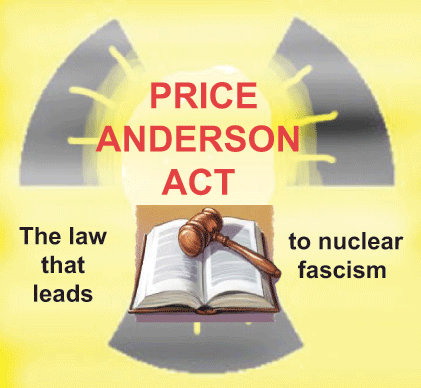 The Vermont Law School paper aptly sums up this picture with this conclusion:
“If the owners and operators of nuclear reactors had to face the full liability of a nuclear accident and meet the alternatives in competition that is unfettered by subsidies, no one would have built a nuclear reactor in the past, no one would build a reactor today, and anyone who owned one would exit the nuclear business as quickly as they could.” [page 69]
If we had a rational economic system, they surely would.
PG&E Corporation deliberately delaying decision on future of Diablo Nuclear Station

As long as PG&E keeps its options open, the state’s progress toward a sustainably carbon-free energy grid remains in suspended animation
PG&E plays coy on the future of Diablo Canyon nuclear plant, LA Times, Michael HiltzikContact Reporter, 1 Jan 16 The Economy Hub “……..More than just the future of Diablo Canyon lies in limbo. The plant’s generating capacity of 2,160 megawatts affects the development of the state’s renewable electric resources. Although PG&E has asserted that the plant’s continued operation would save its customers as much as $16 billion during the additional 20 years, the cost of bringing Diablo Canyon into compliance with environmental and seismic mandates may in fact not be worth the effort. Continue reading
Cost overruns are the norm for building nuclear power plants, but investors don’t pay
 Nuclear Energy Dangerous to Your Wallet, Not Only the Environment, CounterPunch, by PETE DOLACK , 1 JAN 16 “……..Significant cost overruns are the norm in building nuclear power plants, and it isn’t investors who are on the hook for them.
Three nuclear projects are under construction in the United States and two in Western Europe, a group that features an assortment of cost overruns and generous guarantees:
*The two new Vogtle reactors in Georgia are already $3 billion over budget although their completion date is three and a half years away. The largest owner, Southern Company, has received $8.3 billion in federal loan guarantees. Overruns at this plant are not unprecedented; the two existing reactors cost $8.7 billion instead of the promised $600 million, resulting in higher electricity rates.
*The Watts Bar 2 nuclear reactor in Tennessee, which received its license to operate in October, has seen its cost rise to $6.1 billion from $2.5 billion. (This is technically a restart of a unit on which construction was suspended in 1985.) The existing reactor at this site has a history of safety problems.
*The Summer 2 and 3 reactors being built in South Carolina have already caused rate payers there to endure a series of rate increases. Cost overruns just since 2012 have totaled almost $2 billion.
*In October 2013, British authorities approved a new nuclear reactor at Hinkley Point, England, that features subsidies designed to give the owner, Électricité de France, aguaranteed 10 percent rate of return on the project. Power from the plant will be sold at a fixed price, indexed to the consumer inflation rate. In other words, The Independentreports, “should the market price fall below that [agreed-upon] levelthe Government would make up the difference.” The agreed-upon fixed price set by the Cameron government at the time was double the wholesale price for electricity.
*Olkiluoto-3 in Finland was supposed to have cost €3 billion, but is 10 years behind schedule and €5 billion over budget.
High costs despite high subsidies…….. http://www.counterpunch.org/2016/01/01/nuclear-energy-dangerous-to-your-wallet-not-only-the-environment/
Weakening of nuclear radiation standards would certainly suit Nuclear Medicine Industry

 Demystifying Nuclear Power: Problem: In a post-Fukushima-triple-meltdown world, do the numbers work for atomic power? Fairewinds,November 17, 2015 by Sue Prent “…..Nuclear medicine interests share some of the existential angst experienced by their atomic energy sector colleagues. So it is not surprising that Carol Marcus Ph.D., M.D. is a professor of Nuclear Medicine at U.C.L.A is one of the petitioners to the NRC to demand that it relax radiation illness standards. Nuclear medicine is where expansion of the development and application of new radiology treatments and specialized equipment represent a huge corporate industrial growth opportunity.
Ms. Marcus and her colleagues have a special interest in countering many medical evaluations and admonitions that are routinely raised by doctors and hospitals around the world about the over-use of radiation for diagnosis and treatment.
Adoption of the hormesis theory of benign radiation would really help the nuclear medicine industry as much as it will help the atomic reactor power industry. In fact, Dr. Marcus’ petition to the NRC seems to equate the fact that radiation can be useful in diagnosis and treatment of cancer with evidence that low-dose radiation is indeed beneficial, in spite of years of data proving that is not true, including the lengthy German study.
To that, one must counter that the benefits brought to cancer treatment by radiation have a very specific tissue-destroying capacity rather than any positive health function. There is no scientifically corroborated benefit for even an extremely low-dose of radiation. Rather than providing any actual proof for her hypothesis, the balance of Dr. Marcus’ petition seems to be filled with complaints detailing how existing radiation protection guidelines hamstring her profession.
The second petition to end LNT, submitted by Certified Health Physicist Mark L. Miller relies heavily on language identical to that of Dr. Marcus, suggesting a collaborative relationship.
The third petition was submitted by a group lead by one of the principle voices supporting the hormesis theory, Mohan Doss Ph.D. His cosigner’s predictably represent atomic corporate interests that have heavily financially invested in the success and expansion of atomic industries.
According to the Fox Chase Cancer Center website, Mr. Doss, who is an MCCPM (Member of the Canadian College of Physicists in Medicine) radiology practice includes
Mr. Doss, who has found a well-spring of opportunity in the convenient meme of hormesis, is quoted along with the other two petitioners in a New York Times article that uses the number of deaths from suicide and accident that have occurred among evacuees from Fukushima evacuation zone as a rallying call……… http://www.fairewinds.org/nuclear-energy-education/demystifying-nuclear-power-problem-in-a-post-fukushima-triple-meltdown-world-do-the-numbers-work-for-atomic-power
China keen to market nuclear expertise, but in the UK scrutiny is increasing

 Nuclear energy: Beijing’s power play, Ft.com Christopher Adams and Lucy Hornby, December 29, 2015 China is intent on exporting its nuclear expertise but in the UK scrutiny is increasing. “………. The French-designed plant, which after five years of construction is about to undergo testing, will serve as the prototype for a huge power station planned by the UK in south-west England. It is set to cost £18bn according to the latest estimates by French energy group EDF, which is leading the project.
Hinkley Point, in Somerset, is home to a working nuclear plant and twin disused Magnox reactors. Now David Cameron, UK prime minister, wants the site to host the first of a new generation of reactors that he envisages will replace Britain’s ageing nuclear fleet by 2030.
Under a commercial pact struck during October’s state visit to London by Chinese president Xi Jinping, CGN will take a one-third stake in Hinkley. Its state-owned rival, China National Nuclear Corporation, may also participate. A decade from now, assuming all goes to plan, Taishan’s distinctive egg-shaped reactor domes, double-hulled walls and monster turbines will dominate the shoreline of the Severn estuary. Hinkley Point C will supply 7 per cent of the UK’s electricity……….
CGN can ill-afford errors at Taishan, one of three unfinished projects using a third-generation technology called the European pressurised reactor. Designed by Areva of France, these reactors are being touted as a revolution in nuclear power. But they have had a troubled start on projects at Flamanville in France and Olkiluoto in Finland.
Taishan, too, has suffered delays, albeit not as bad as those in Europe. As a result, CGN is treading carefully. The Chinese plant’s targeted completion date, originally late 2013, has already been put back once, in part because of safety rules after Fukushima. Now it will probably come online in 2017 — though CGN will not say exactly when. Says Mr Zheng: “We must perform a lot of tests, and since it’s now a first of a kind, we need to do more tests than we planned. Those tests should have been done already in Finland or France, but we must do them now.”
The construction problems highlight the complexity of the EPR projects. There are questions over whether there really is demand for these larger reactors, given their cost and size. Mr Guo, though, is bullish. Standing under an 80-tonne door that will one day seal off the reactor hall, he lists the EPR’s credentials…….
He Zuoxiu, a retired physicist who helped develop China’s nuclear programme in the 1960s, questions whether nuclear power will ever truly be safe, even with safeguards to prevent disasters such as Fukushima. He cites a statistic: the US, Russia and Japan each had more than 50 reactors when they suffered accidents. In other words, the more a country has, the greater the chance of something going wrong……..
UK concerns
There are worries, too, that Britain’s tilt towards China — and chancellor George Osborne’s embrace of its investment — will open the door to security risks. The UK shift has caused consternation in the US, which accuses China’s state-owned industry of benefiting from military-linked corporate espionage.
Patrick Cronin, an Asia expert at the Center for a New American Security, says Britain should take care to balance its economic needs against those of national security, particularly on critical infrastructure such as nuclear plants. “Let’s say that 10 years from now there is a major conflict with China. This would give China, effectively, a veto over UK participation, for example, over the Taiwan issue in the next decade,” says Mr Cronin.
“Just understanding the most vulnerable parts of reactors in Britain is a vulnerability. A Chinese state-owned enterprise may show that information to people who have ill intentions to the UK, especially if there’s a crisis.”
Concerns have also been raised in Whitehall over the prospect of China being able to build digital loopholes into hardware it supplies, allowing Beijing to exploit vulnerabilities at nuclear plants. CNNC’s background as China’s nuclear weapons developer before it built the country’s civilian reactors has added to those fears……… http://www.ft.com/cms/s/0/789e5070-974a-11e5-9228-87e603d47bdc.html#axzz3vvmo6esp
As Wylfa nuclear plant closes in Wales, delays continue for UK’s new nuclear stations
Wylfa nuclear plant closes in Wales Station in Anglesey, Wylfa the oldest in the UK, shuts as focus is on energy provider EDF over its plans for new facilities at Hinkley Point, Guardian, Terry Macalister, 31 Dec 15 Britain’s oldest nuclear plant closed on Wednesday, leaving in its wake a £700m decommissioning bill and further questions about the UK’s ability to keep the lights on.
The closure of the Wylfa plant in Wales after 44 years of service puts more pressure on EDF Energy to take a final investment decision for new reactors at Hinkley in Somerset.
The station on the island of Anglesey generated enough electricity to power 1m homes, and with a capacity of 1,000MW was once the largest facility of its kind in the world. But after an earlier life extension scheme expired, the last of the 26 British-designed Magnox reactors was switched off by the private consortium that manages the plant for the Nuclear Decommissioning Authority (NDA)…….
 It will take another 10 years for the basic decommissioning to be undertaken at a cost of about £700m but the site cannot be redeveloped before the end of the century. High-level waste from Wylfa will remain on Anglesey until a national nuclear waste disposal facility is finally developed.
Britain still has a fleet of advanced cooled atomic reactors run by EDF but most of these will be retired by 2023 just as the government has also promised to halt all coal-fired power stations.
Hitachi of Japan is leading a Horizon Nuclear Power project to construct a new power plant at Wylfa, with a second earmarked for Oldbury in south Gloucestershire alongside a third facility planned in Cumbria. But the atomic industry’s revived fortunes ride primarily on the Hinkley C plant, which is expected to be the first new site since the Sizewell B station was completed in 1995.
The £18bn Somerset project has been repeatedly delayed but Chinese investors finally gave their support in the autumn while thegovernment promised the latest in a series of subsidies. EDF signalled in October that it would start work at Hinkley and it is expected to give the formal investment the go ahead within weeks before later saying it may not come until after Christmas.
Hinkley Point C, intended to provide about 7% of the UK’s total electricity, was originally scheduled for completion by 2018 but the latest date is 2025. Sceptics still question whether it will make that later date given the experiences of delays and cost overruns with a similar power project at Flamanville in Normandy, northern France.
There have also been problems at the new Olkiluoto nuclear plant in Finlandwhich is using the same plant design provided by EDF’s engineering partner Areva at Flamanville and planned for Hinkley………http://www.theguardian.com/environment/2015/dec/30/wylfa-nuclear-plant-closes-in-wales
Thousands of USA’s Oak Ridge nuclear workers sick and dying from cancers and other radiation-caused illnesses
Of the 33,480, the government has specifically acknowledged that exposure to radiation or other toxins on the job likely caused or contributed to the deaths of 15,809 workers. And this tally almost certainly underestimates the total dead among the 600,000 who worked in the weapons program at its peak.
The women who worked at the plant were told to keep their mouths shut, and those
who talked about their jobs were quickly let go.

 Nuclear workers: Projects’ results were worth illnesses, deaths Amarillo.com December 28, 2015 Tribune News Service Editor’s note: This is the third story in a series examining the health problems that afflict the U.S. nuclear workforce as the government launches a $1 trillion plan to modernize the arsenal.
In 1944, when the feds wanted young women to help out with a top-secret project in the hills of Tennessee, they found 19-year-old Evelyn Babb.
She grew up on four acres in Appalachia, where her family had one milk cow and a couple dozen chickens. She jumped at the chance to make 70 cents an hour at the new Y-12 plant in Oak Ridge, Tenn., twisting knobs on dials, with no clue what she was doing. Bosses advised her to tell friends she was making highchairs for infants.
When President Harry Truman dropped an atomic bomb on Hiroshima on Aug. 6, 1945, Babb learned the truth: She had helped produce the atomic hell that killed thousands of Japanese as one of the climactic acts of World War II.
In many cases, the money went to survivors. Of the 33,480, the government has specifically acknowledged that exposure to radiation or other toxins on the job likely caused or contributed to the deaths of 15,809 workers. And this tally almost certainly underestimates the total dead among the 600,000 who worked in the weapons program at its peak.
The plants with the highest number of deaths are the Y-12 National Security Complex in Tennessee, with 3,741, and the Hanford Site in Washington state, with 3,461. They’re the sites that provided the plutonium and uranium for the bombs, nicknamed Fat Man and Little Boy, that Truman used to wipe out Hiroshima and Nagasaki as part of the nation’s top-secret Manhattan Project.
“The death numbers tell you something, but they are just a slice of the story,” said Ralph Hutchison, a former Presbyterian pastor who’s coordinator of the Oak Ridge Environmental Peace Alliance, a group that has held peace vigils outside the Y-12 plant every Sunday for the last 16 years. “What’s the quality of life for people who have debilitating chronic illnesses?”
The number of dead is sure to grow much higher.
Seventy years after the atomic bombings, thousands of former workers at Department of Energy nuclear sites are sick from cancers and other diseases after being exposed to radiation, a long list of toxins and a brew of other dangerous substances.
Yet more than half of the 107,394 workers who have sought help since 2001 — 51.1 percent — have been denied, TNS’ investigation found.
And many workers have endured years of guilt after they unknowingly helped produce weapons of mass destruction.
“I felt proud until I started realizing that I had a part in killing all those people, and that’s something I didn’t believe in,” said Ruth Huddleston, 90, of Oliver Springs, Tenn., who went to work at Y-12 at age 18. “I had helped kill thousands of people.”……….http://amarillo.com/news/latest-news/2015-12-28/nuclear-workers-projects-results-were-worth-illnesses-deaths#.VoMfhne5dh0.twitter
Sloppy health data collection in the history of America’s nuclear workers
Nuclear workers: Projects’ results were worth illnesses, deaths Amarillo.com December 28, 2015 Tribune News Service “…………The death toll for American workers has never been disclosed. The U.S. Department of Labor, which administers the compensation program, makes routine reports on how much it spends and how many people it serves, but never on the number who have died.
At first, department officials told TNS they do not even bother to collect information on the cause of injury or deaths for deceased workers. But later they said they do, on a limited basis, to comply with federal law.
The investigation also found vast differences in the way the federal program is run. As an example, workers at the nuclear facility at Hanford are nearly twice as likely to win money from the government as workers at their sister plant at Savannah River.
The department goes to great lengths to protect its data, taking several months to release it and comply with a request under the Freedom of Information Act. Then the department refused to release the names of companies that have provided medical care for sick workers under the program, formally called the Energy Employees Occupational Illness Compensation Program Act. The department cited privacy concerns, but TNS is appealing that decision.
An examination of the data reveals the program that began accepting applications in 2001 has far surpassed anything envisioned by its founders.
The explosive growth of the program surprised even its chief architect.
Bill Richardson, the former governor of New Mexico who served as energy secretary under President Bill Clinton, said sloppy record-keeping at the nuclear sites made it difficult to predict the ultimate size of the program.
“See, you don’t know when you enter a program like this what the result is going to be, except you need to be guided by: Is it the right thing to do?” he said in September.
Richardson said the federal government had shown “a lack of conscience” in its decades-long refusal to help workers who had legitimate claims until Congress finally reversed course.
He said getting the program passed became easier after the Washington Post in 1999 first reported that thousands of unsuspecting workers had been exposed to plutonium and other highly radioactive metals for 23 years at the Paducah Gaseous Diffusion Plant in western Kentucky.
Richardson, who apologized at the time for the government’s denial of any plutonium exposures, said the program’s dramatic growth is a good sign, adding that no one’s getting rich, with individual payments capped at $400,000.
James Melius — the chairman of the federal Advisory Board on Radiation and Worker Health, a presidential panel that examines compensation claims — said it’s hardly a surprise that the program has grown so rapidly.
“The DOE complex is huge,” he said, with “literally hundreds of thousands of workers who are potentially eligible who worked at various times within the complex.”……..
Congress passed the program in 2000 after the Department of Energy submitted studies covering 600,000 people that showed workers at 14 sites had increased risks of dying from cancer and nonmalignant diseases……….http://amarillo.com/news/latest-news/2015-12-28/nuclear-workers-projects-results-were-worth-illnesses-deaths#.VoMfhne5dh0.twitter
Is America oblivious to the fact of sick and dying nuclear workers?
U.S. shrugs on nuclear worker safety http://www.kentucky.com/opinion/editorials/article50563650.html
Contractors cut health benefits in push to reduce costs
Their story is sad.
This is outrageous: Workers in U.S. nuclear facilities are still being exposed to radiation on the job and will suffer the consequences to their health and longevity.
More than 186,000 workers have been exposed to radiation since 2001, when the federal government finally established a fund to compensate sick nuclear workers and their survivors.
The government has already paid $11 million to 118 workers who began working at nuclear weapons facilities after 2001, according to an exhaustive examination of federal data by the McClatchy Washington bureau.
Stronger safety standards and greater awareness are failing to protect today’s workers, even as the U.S. embarks on a $1 trillion, 30-year modernization of its nuclear arsenal.
(The goal is to reduce the number while sharpening the accuracy of our bombs. Whether the U.S. should pay so much to risk another nuclear arms race is a serious question for another day.)
The cost of compensating sick nuclear workers is also high, even though awards are relatively modest and workers and their families often must battle bureaucracy for years to qualify, according to McClatchy’s reporting.
Taxpayers have spent $12 billion so far to compensate nuclear workers whose sickness or deaths were linked to their occupations.
It’s significant that the government underestimated how sick its nuclear workforce would become. Original predictions were that the compensation program would serve 3,000 people. Instead, 53,000 sick workers have been compensated, while 107,394 have been diagnosed with cancer and other work-related diseases, and workers still are getting sick.
Some of the sick are Kentuckians who worked in Paducah, where uranium was enriched for weapons and military reactors and where environmental contamination is also a costly Cold War legacy. (Owned by the U.S. Department of Energy, the nation’s last remaining gaseous diffusion plant now produces nuclear fuel and is leased to a private corporation.)
As was the case in Paducah, nuclear workers still say that the risks are worth it because they have few or no alternatives that pay as well.
People in this line of work also say good health care benefits are a must but the government is pressuring contractors who run nuclear weapons facilities to reduce costs by cutting employee pay and benefits, including health care and sick leave.
As McClatchy reported from the Texas Panhandle, 1,100 union employees at the Pantex plant, where B61 gravity bombs are being modernized, went out on strike earlier this year to protest benefits cuts.
A partnership led by Bechtel and Lockheed Martin known as Consolidated Nuclear Security won the contract to run the Pantex plant and the Y-12 complex in Oak Ridge, Tenn. by promising to save the government $3.27 billion over 10 years
Bechtel and Lockheed Martin brought to the assignment a less than stellar record: a combined 11 complaints of retaliation against whistle blowers who raised safety concerns; and $70 million in violations, including falsifying test records and insufficient radiation controls, reports McClatchy.
The two companies’ employees and their survivors have received $200 million in compensation from taxpayers for job-related illnesses.
Pretending that nuclear workers no longer face serious health risks or that the government and its contractors are doing all they can to protect them is a brutal false economy. This country should do better.
Savannah River Nuclear Station’s scandal of sick and dying workers
Ailing nuclear workers: Relying on Jesus and morphine, Charlotte Observer, 13 Dec 15
‘Smitty’ dies at 62 from cancer after working as a reactor operator
No compensation for him, or for thousands of other workers
Frustration with government from workers across the country
BY ROB HOTAKAINEN, SAMANTHA EHLINGER AND MIKE FITZGERALDMcClatchy Washington Bureau AUGUSTA, GA. 19 Dec 15

On an oven-hot Sunday in late August, Smitty wore white dress shorts and a cool lilac shirt that contrasted nicely with his salt-and-pepper hair, dozing in the front pew of the Southside Baptist Church.
Holding a black zippered Bible on his lap, he had his left leg stretched out all the way, resting it on two pillows on the seat of a wheelchair positioned just in front of him. He did it that way to protect a raw wound from a blood clot that ran from his knee to his hip. Doctors told him it was one of the biggest clots they’d ever seen.
[Irradiated: Read the full four-part report]
After working 17 years at the Savannah River nuclear weapons plant, just across the Georgia state line in South Carolina, Smitty found out on Sept. 11, 2008, 10 years after he retired, that he had multiple myeloma, a cancer.
Just like 54,005 other workers who have tried to get help from the federal government after getting sick at a nuclear weapons plant, Smitty never got a penny.
At 62, he relied instead on Jesus and morphine.
That meant up to two 30 milligram tablets of morphine sulfate every four to six hours, as needed, and prayers all day long, including the reading of at least one chapter in the Bible each day…….
Until the end, Smitty said he could not understand how the feds could say there was insufficient evidence to approve his claim for compensation. He said it was particularly perplexing because federal officials first led him to believe that his claim would be accepted, then suddenly ruled against him.
“I thought I was approved and shared it with my wife, and within no time at all, it was disapproved,” Smitty said……..
Survivors such as Priscilla Maez Clovis of Albuquerque, N.M., say the people who run the Energy Employees Occupational Illness Compensation Program are doing what they’ve always done: “Delay, deny, until you die.”
Over the past year, McClatchy journalists found that, on average, it takes 21.6 months for a claimant to get approved, while 20,496 workers spent five or more years navigating the bureaucracy. The government’s data shows that one production worker at a defunct facility in Portsmouth, Ohio, had to wait 14 years for compensation. The unidentified employee had bladder and brain cancers.
Across the nation, stories of frustration abound:………
The Investigative Fund of The Nation Institute, a nonprofit media center based in New York City, helped support this project. http://www.charlotteobserver.com/news/nation-world/article49568870.html
South Carolina nuclear workers made sick, and dying, by radiation
Editorial: Nuclear workers show America’s darker side http://www.islandpacket.com/opinion/editorials/article50722150.html ISLANDPACKET newsroom@islandpacket.com The numbers are sobering. The problem is immense.
In a special report presented over the past week, our fellow McClatchy journalists put faces on the heavy and often hidden cost of America’s atomic weaponry.
A total of 107,394 workers have been diagnosed with cancers and other diseases after building the nation’s nuclear stockpile over the last seven decades. At least 33,480 former nuclear workers are dead after helping the U.S. win World War II and the Cold War before getting sick enough to qualify for government compensation.
Taxpayers have spent $12 billion so far treating and compensating more than 53,000 sick nuclear workers.
But fewer than half the workers who sought help had their claims approved. More than 54,000 workers have been denied government help. Some say the government’s tactic is to “Delay, deny, until you die.”
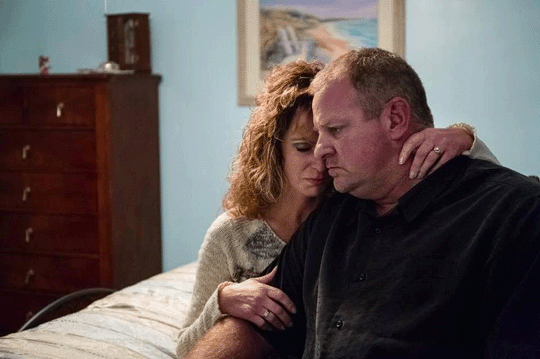
South Carolina, home to the Savannah River Site outside Aiken, has certainly paid a toll to the silent killer.The site that turned 65 this year was established by President Truman to produce the basic materials used in the fabrication of nuclear weapons.
Nearly 40 million gallons of highly radioactive nuclear waste remains at SRS — 90 miles up the Savannah River from where much of Beaufort County’s drinking water is withdrawn. The waste is stored in aging tanks.
And the federal government’s poor record for helping its workers is matched or exceeded by its miserable record of dealing with the nuclear waste that will threaten workers and communities ad infinitum.
Earlier, McClatchy reported that the United States already has generated more than 80,000 tons of spent nuclear fuel and high-level nuclear waste, and the toxic materials are stored at some 80 sites in 35 states…….
What we see is a nation in denial. We see a nation willing to consider workers in its hodgepodge of nuclear sites to be collateral damage. We see a nation that has grossly underestimated the cost to the workers.
And we see a nation that for pure politics will endanger entire communities and states by failing to confront its sick legacy of the atomic age.
We see a nation that should do much better by its own people.http://www.islandpacket.com/opinion/editorials/article50722150.html
McClatchy reportreveals the staggering death toll from radiation, among nuclear workers
More US fatalities from radiation exposure than in the wars in Afghanistan and Iraq, McClatchy report reveals, Fukushima Watch, December 15th, 2015, by Greg White The reverberations of nuclear power are most often reported on during the occasional nuclear meltdown, like the 1986 Chernobyl disaster and the 2011 Fukushima disaster. But, the consequences of nuclear power are far more persistent and prevalent than the mainstream media has often led the public to believe, even in the US. According to a yearlong investigation, a staggering 33,480 US nuclear workers have died from radiation exposure in the last seven decades.(1,2)The death count was published and disclosed for the first time by American publishing company McClatchy. The report revealed that the number of US workers who died from nuclear radiation exposure was four times greater than the number of American casualties in the wars in Afghanistan and Iraq. The count involves all workers who died after they or their survivors were compensated by a special fund established in 2001, which aided workers who helped build the US nuclear stockpile.
Approximately 107,394 workers were diagnosed with cancer or other maladies after building the country’s nuclear stockpile over the last seven decades. The researchers extrapolated information using a database obtained from the US Department of Labor under the Freedom of Information Act. In addition, the investigation involved over 100 interviews with nuclear workers, scholars, government authorities and environmental activists.
US GOVERNMENT VASTLY UNDERESTIMATES HEALTH RISKS OF NUCLEAR PRODUCTION The report underlined the fact that the federal government underestimated how sick the US nuclear workforce would become. At the beginning, the government expected a compensation program that would serve 3,000 people at an annual cost of $120 million. Fourteen years later, however, the government has spent $12 billion of taxpayer money to reimburse more than 53,000 nuclear workers.(1)
“I think that, when this program was created in 2001, there had been some awareness in Congress leading up to, and it was created through the efforts of the Clinton administration to compensate workers who had become ill,” explained Lindsay Wise, a reporter involved in the investigation.(3)
“It started to become apparent that many of these workers had been exposed to dangerous subjects, radioactivity and other toxins, without realizing it or without knowing the full extent of the health hazards that they were facing.”(3)
“And so once that started to come to light through some research of some reporters, The Washington Post and other places, there was pressure in Congress to pass a fund to compensate the workers.”(3)
Although the costs vastly exceeded government expectations, federal records reveal fewer than half of the nuclear workers who sought compensation have had their claims approved by the US Department of Labor.(3)…… http://www.fukushimawatch.com/2015-12-15-more-us-fatalities-from-radiation-exposure-than-in-the-wars-in-afghanistan-and-iraq-mcclatchy-report-reveals.html
Global trend towards bankruptcy for the nuclear industry
 Here is yet another reason why Solar (of all flavors) is starting to look better and better: ‘Nuclear power is risky and unprofitable’ Mycle Schneider, an expert on nuclear energy, expects bankruptcy in the nuclear industry and “substantial security risks.”
http://www.dw.de/nuclear-power-is-risky-and-unprofitable/a-18299318
DW: Mycle Schneider, every year you publish the World Nuclear Industry Status Report. What are the global trends?
The production costs for nuclear energy have increased over the last couple of years. It’s a dramatic development as the costs of all the other technologies, especially renewable energies, are decreasing. Renewable energies are, therefore, now in real competition. Furthermore, power demand in Europe is shrinking, and for operators of nuclear power stations, these are real problems.
So if nuclear power isn’t economically viable, why then are some governments – such as the British government – planning to build new nuclear power stations?
Energie- und Atomexperte Mycle Schneider
Sees nuclear power as too risky and expensive: Mycle Schneider, expert on nuclear energy.
For years, the British government has counted on nuclear power and not put forward a reasonable energy policy. Well, nuclear energy has become more expensive now but other, more intelligent scenarios have not been developed. It’s also not certain yet, whether or not the new Hinkley Point nuclear power plant will be built as planned. There are no signed contracts yet. But the estimated cost to generate power from these plants is about twice as high as the average price of electricity today.
India moves closer into nuclear industry of dubious safety
The strange love for nuclear energy http://www.thehindu.com/opinion/lead/on-the-indiajapan-civil-nuclear-deal/article7996972.ece M.V. RAMANA SUVRAT RAJU
The prospect of a nuclear deal with Japan is worrying because it ignores voices on the ground and takes India a step closer to the construction of untested and expensive reactors
During Japanese Prime Minister Shinzô Abe’s visit to India last week, Japan and India reportedly made progress on a nuclear deal that they have been discussing for more than seven years. The governments did not actually conclude the deal: the Joint Statement released by the Prime Ministers only includes a droll phrase welcoming the “agreement reached… on the Agreement… for Cooperation in the Peaceful Uses of Nuclear Energy” and expresses the hope that “this Agreement will be signed after the technical details are finalised”.
- These “details” include deep concerns about India’s growing weapons arsenal within Japan’s polity that even Mr. Abe’s militaristic government has found difficult to ignore. Nevertheless, even the prospect of an India-Japan nuclear deal is worrying because it takes the country a step closer to the construction of untested and expensive reactors. Moreover, despite the Narendra Modi government’s “Make in India” rhetoric, the agreement will primarily benefit multinational corporations based in Japan. Continue reading
Kansas’ nuclear workers with cancer from exposure to radiation
A 2008 government investigation uncovered processes that produced radioactive dust that workers would have inadvertently breathed in and eaten – and buildings given a soap-and-water cleanup and repurposed after Spencer sold off its nuclear operations.
National Institute for Occupational Safety and Health – a division of the Centers for Disease Control and Prevention – did conclude that because of deficiencies found in the way materials were handled, it was likely that workers outside the nuclear operation were also exposed to dangerous levels of radioactive materials
 Kansas cancer survivors fight for compensation for radiation exposure decades ago
Cancer survivors seeking compensation complain of delays, red tape
THE WICHITA EAGLE, BY DION LEFLER dlefler@wichitaeagle.com GALENA , 17 Dec 15
Robert and Sharon Houser are part of a “Special Exposure Cohort.”
It’s an honor they’d just as soon have done without.
What it means is that it may be marginally easier for them to get compensation from the government for the cancers they’ve suffered, which could be related to radiation exposure from when they worked at the Spencer Chemical Co.’s Jayhawk Works just north of Galena.
They were there when the company made a brief foray into processing uranium for the fledgling nuclear power industry in the 1950s and 1960s. Continue reading
1 This Month

of the week– Nuclear Reactor Information Task Force

14 May – online event From Bombs to Data Centres: the Face of Nuclear Colonialism
To see nuclear-related stories in greater depth and intensity – go to https://nuclearinformation.wordpress.com
-
Archives
- May 2026 (92)
- April 2026 (356)
- March 2026 (251)
- February 2026 (268)
- January 2026 (308)
- December 2025 (358)
- November 2025 (359)
- October 2025 (376)
- September 2025 (257)
- August 2025 (319)
- July 2025 (230)
- June 2025 (348)
-
Categories
- 1
- 1 NUCLEAR ISSUES
- business and costs
- climate change
- culture and arts
- ENERGY
- environment
- health
- history
- indigenous issues
- Legal
- marketing of nuclear
- media
- opposition to nuclear
- PERSONAL STORIES
- politics
- politics international
- Religion and ethics
- safety
- secrets,lies and civil liberties
- spinbuster
- technology
- Uranium
- wastes
- weapons and war
- Women
- 2 WORLD
- ACTION
- AFRICA
- Atrocities
- AUSTRALIA
- Christina's notes
- Christina's themes
- culture and arts
- Events
- Fuk 2022
- Fuk 2023
- Fukushima 2017
- Fukushima 2018
- fukushima 2019
- Fukushima 2020
- Fukushima 2021
- general
- global warming
- Humour (God we need it)
- Nuclear
- RARE EARTHS
- Reference
- resources – print
- Resources -audiovicual
- Weekly Newsletter
- World
- World Nuclear
- YouTube
-
RSS
Entries RSS
Comments RSS
 nuclear-news
