Small Modular Nuclear reactor companies keen to sell their wares to UK

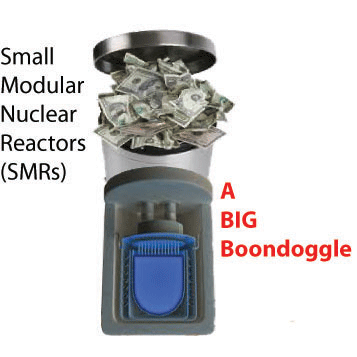 38 companies express interest in building mini nuclear power station at Trawsfynydd, Wales Online, 24 MAY 2016 BY CHRIS KELSEY , OWEN HUGHES
The old nuclear power station site in Snowdonia could be the site for a new generation of nuclear power stations
-
A competition to develop a miniature nuclear power station at Trawsfynydd has attracted interest from 38 companies from around the world.
Small modular reactors (SMRs) are reactors with an electricity output less than 300MW. They have been compared to the nuclear reactors that have been used to power submarines since the 1950s. All the Royal Navy’s submarines are powered by nuclear reactors.
Last year the UK Government announced £250m funding over the next five years for nuclear research and development, including a competition to identify the best value SMR design for the UK…….
- It is understood that they will be told in the coming weeks whether they have moved to the next phase.
The Times has reported that among the companies interested in Trawsfynydd are US firm Bechtel, which has been signed up to build Wylfa Newydd.
Other firms with a background in this type of reactor and understood to be interested are US firms NuScale and Westinghouse, China’s CNNC and a Korean consortium…….
- A report by the Energy and Climate Change Committee has identified Trawsfynydd in Gwynedd – which is currently being decommissioned – as a potential site for a mini nuclear power plant……..http://www.walesonline.co.uk/business/business-news/38-companies-express-interest-building-11376387
USA desperately wants to market nuclear power to India

 U.S. official says India has addressed nuclear concerns, May 24, 2016 Reuters WASHINGTON | BY PATRICIA ZENGERLE A U.S. State Department official assured lawmakers on Tuesday that India has addressed concerns over liability that had for years kept U.S. corporations from signing nuclear power contracts in the country.
“We believe that the steps that India has taken have addressed by and large the key concerns that have been in place,” Assistant Secretary of State for South and Central Asian Affairs Nisha Desai Biswal told the Senate Foreign Relations Committee.
She also said the United States supported India joining the Nuclear Suppliers Group, a 48-member group of nuclear trading nations.
India wants to increase its nuclear energy capacity dramatically………
ndia was shut out of the nuclear trade for decades because of its weapons program. A 2008 agreement with the United States gave it access to foreign suppliers without giving up arms primarily meant as a deterrent against nuclear-armed China.
But hopes that U.S. nuclear reactor manufacturers would get billions of dollars of new business evaporated after India adopted a law in 2010 giving the state-run Nuclear Power Corp of India Ltd (NPCIL) the right to seek damages from suppliers in the event of an accident.
Biswal declined to say that all U.S. companies would now be comfortable doing business in India. “Those are going to be individual determinations that companies are going to have to make,” she said.
Some companies are moving into the market. The chief executive of Toshiba Corp’s Westinghouse Electric said in March he expected to sign a deal in June to build six nuclear reactors in India.
Senator Edward Markey questioned Biswal on whether India had met the requirements to join the Nuclear Suppliers Group, which is dedicated to curbing nuclear arms proliferation by controlling the export and re-transfer of materials that could foster nuclear weapons development.
Diplomats quietly launched a new push last year to induct India into the group, which would carry the risk of antagonizing Pakistan as well as its ally, China. Beijing could veto any application by India.
Biswal said the United States backs India. http://www.reuters.com/article/us-usa-india-nuclearpower-idUSKCN0YF2C1
China wants to market nuclear power to Sudan
China’s CNNC Seeking to Build Sudan’s First Nuclear Reactor http://www.bloomberg.com/news/articles/2016-05-24/china-s-cnnc-seeking-to-build-sudan-s-first-nuclear-reactor Stephen Stapczynski sstapczynski Aibing Guo May 24, 2016
-
State-owned CNNC signs deal with Sudan’s electricity ministry
-
Sudan said last year it aims to begin building reactor by 2021
-
China National Nuclear Corp. agreed with Sudan to build the African nation’s first atomic reactor, China’s latest effort to expand its nuclear technology footprint abroad.
A framework agreement between the two countries was signed Monday during a three-day visit to Sudan by Nur Bekri, director of China’s National Energy Administration, according to Xinhua News Agency. CNNC also signed a cooperation agreement with Sudan’s Ministry of Water Resources and Electricity, according to the People’ Daily.
China is seeking wider acceptance for its atomic technology and expertise amid a global call for cleaner energy. The country plans to export about 30 homegrown nuclear units by 2030, CNNC Chairman Sun Qin said in March, according to China Daily.
“The agreement is a step forward for China’s grand ‘One Belt, One Road’ plan to export technology, including nuclear power and high-speed railway technologies, to African and European nations,” Shi Yan, a Shanghai-based analyst at UOB-Kay Hian, said by phone. “China can provide both technological and financial support for developing nuclear power projects.” - CNNC has plans to build reactors in Argentina and Pakistan, while China General Nuclear Power Corp. is aiming for its own project in Kenya. CGN and Electricite de France SA signed an accord in October to build three reactors in the U.K., including the Hinkley Point plant in southwest England and a Chinese-developed reactor at Bradwell.
Sudan aims to begin building its first nuclear reactor in 2021 and start commercial operations by 2027, according to a government presentation last year for the International Atomic Energy Agency. The country is seeking to build two 600-megawatt pressurized water reactors, it said in the presentation.
With its current power capacity of roughly 3,025 megawatts, nuclear power will help it meet demand that is expected to swell to 8,500 megawatts by 2031, it said.
USA wants to market nuclear power to Vietnam
Enhancing U.S.-Vietnam Civil Nuclear Clean Energy Cooperation “…… Earlier this month, the United States and Vietnam signed the Administrative Arrangement under our historic agreement on the peaceful uses of nuclear energy (123 Agreement), which initially opened the door to nuclear trade between our two countries in 2014.
To further build on this robust cooperation in the civil nuclear field, the United States and Vietnam aim to:
Build Institutional Connections: Continue reading
Former radioactive waste workers take legal action over their radiation caused illnesses
Former McDonnell Douglas workers, residents file suit over radiation exposure, St Louis Public Radio By DURRIE BOUSCAREN • MAY 20, 2016 Three former aircraft workers and seven north St. Louis County residents who say they were exposed to radioactive waste stored near Lambert Airport after World War II, have filed a federal lawsuit against Mallinckrodt and the Cotter Corporation.
They hope to join a larger case, filed in 2012, that represents about 250 plaintiffs who lived or worked near the airport waste site, Coldwater Creek, and another storage site in Hazelwood.
“There were a lot of fellow employees that are no longer with us. And I feel that I’m speaking for them,” said the lead plaintiff, 72-year-old Bob Malon, who survived a colon cancer diagnosis in 2004.
The personal injury lawsuit, filed Friday in the U.S. District Court for the Eastern District of Missouri, seeks unspecified damages………
The nine plaintiffs claim that Mallinckrodt and other federal contractors acted negligently and allowed materials to leach into the environment, putting people nearby at a greater risk for several types of cancer and thyroid disease………
The 10 plaintiffs allege they were exposed to doses above 500 millirem a year without their knowledge.
Ken Brennan, the lead attorney on the lawsuit, hopes to consolidate it with ongoing litigation filed in 2012, McClurg et. al v. MI Holdings, Inc. et al. About 250 people who believe their health issues are connected to their exposure to radioactive contamination in north St. Louis County are represented by the consolidated suit, and another 150 have filed similar suits.
“We reconstruct, based on data that’s available, how much radiation was stored at the airport site, how that radiation was then distributed through weather and erosion and wind patterns,” Brennan said.
Brennan estimates a quarter of the plaintiffs are former employees of Boeing or McDonnell Douglas. The majority lived near the airport or along Coldwater Creek. Many plaintiffs, including Malon, were made aware of the litigation by a Facebook group that has tracked cancer and other health issues near Coldwater Creek since 2011, when a group of friends planning a high school reunion realized that many of their classmates had developed cancer or passed away.
“When we determine the extent to which each of our clients was exposed to radiation, we use existing science to demonstrate that their cancers were more likely than not caused by that radiation,” Brennan said……..
The people who worked at the waste site could be eligible to receive compensation from the federal government—and 48 of them have filed to do so, according to the Department of Labor.
By law, contractors and subcontractors who worked at nuclear sites between 1942 and 1971 can receive a lump sum and coverage of medical bills if they meet certain conditions. 22 cancers are specified in the law, including lung, breast and colon cancer.
Residents and nearby workers are not included, but Malon and the other plaintiffs believe their injuries stem from the same contamination. …. http://news.stlpublicradio.org/post/former-mcdonnell-douglas-workers-residents-file-suit-over-radiation-exposure?utm_content=buffer961c0&utm_medium=social&utm_source=twitter.com&utm_campaign=buffer
American and Japanese corporations to sell nuclear reactors to UK, in North Wales
 £14bn North Wales nuclear power station to be built by the Japanese and
  Americans 22 MAY 2016 BY SION BARRY
Menter Newydd is a joint venture between Bechtel Management Company and Hitachi Nuclear Energy Europe. A US-Japanese consortium has been established to build the £14bn Wylfa Newydd nuclear plant.
Horizon Nuclear Power has appointed Menter Newydd to help deliver the company’s lead nuclear new build project on Anglesey.
Menter Newydd is a joint venture of Hitachi Nuclear Energy Europe, US giant Bechtel Management Company and Japanese firm JGC Corporation (UK) and will be responsible for the construction of Wylfa Newydd, overseen by Horizon Nuclear Power…..http://www.walesonline.co.uk/business/business-news/14bn-north-wales-nuclear-power-11368974
USA using Westinghouse nuclear reactors and fuel to compete with Russia for European dominance
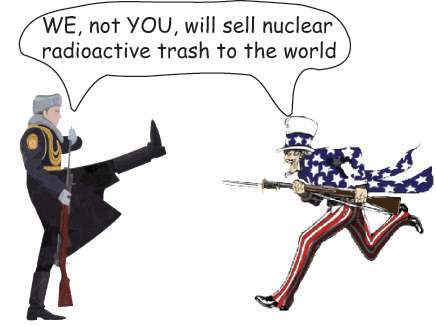
The U.S. is going after Russian nukes in Europe. And they’re counting on just one company to do it. Oddly enough, it’s Japanese.
If you thought the energy security issue the U.S. has been selling to Europe was only about American liquefied natural gas, look closer. It’s also about Russian nuclear energy behind the old Iron Curtain.
Energy security in Eastern Europe is a thermo-nuclear reactor war that mainly pits Westinghouse Electric (WEC) against Russian Rosatom. It’s a drawn-out and extremely costly energy game the U.S. is trying desperately to win. State Department chief Hillary Clinton even “lobbied” for Westinghouse in Prague in 2012.
It’s not a secret.
Westinghouse Chief Executive Danny Roderick says Clinton’s showing made a big impression on the Czechs. “I was proud that she was in the trenches with me,” he reportedly said.
The unstated goal: lessen Russian control of the nuclear power market in Eastern Europe, even if that does not translate into an immediate market share for Westinghouse. Historically, for some of those countries Rosatom and its fuel assembly maker TVEL are the only game in town. Continue reading
UK designs for more beautiful nuclear reactors
 Realistic or idyllic? Nuclear plant designs shortlisted http://www.itv.com/news/border/2016-05-20/realistic-or-idyllic-nuclear-plant-designs-shortlisted/
A series of possible designs for the new Moorside nuclear development in Cumbria have been drawn up.
NuGen invited designers from around the world to come up with ideas for what would become Europe’s biggest new nuclear power plant.
Here are some of the schemes have been shortlisted for different parts of the nuclear development.
The shortlisted ideas were selected by an independent panel of experts, including Sir Terry Farrell (the British architect and urban designer famous for work including the MI6 Building in London) and Paul Tiplady (former Chief Executive of the Lake District National Park Authority).
The architecture and landscape community have embraced the challenge and have delivered some thoughtful, considered and visually breath-taking proposals for our Moorside Project.
We’ve narrowed the entries down to five – but we’re very keen to hear what the public think of our selection.
America gets Ukraine to hop on its nuclear power marketing bandwagon
How Washington Is Fighting For Russia’s Old Europe Energy Market, Forbes, Kenneth Rapoza , 17 May 16
“……..Nuking Ukraine
Getting Ukraine to hop on the Westinghouse band wagon was particularly crafty. Either it was simply fantastic timing on the part of Westinghouse, or the U.S. government and the new, post-Euromaidan government of Ukraine colluded to kick Russia to the curb.
“I think that Westinghouse was somehow involved in getting the EC to push Ukraine away from Russia on this front,” says Tomas Vlcek, an nergy security expert based out of Masaryk University in the Czech Republic.
In March 2014, just two months after the pro-Russian president Viktor Yanukovych was ousted, a European environmentalist group called Bellona sent out stories saying that the Russian government was ready to punish Ukraine with an embargo on nuclear fuel supplies from TVEL.
When compared to what Gazprom has done with gas supplies, Putin ordering a stop on TVEL sales of nuclear fuel assemblies simply sounded like something he would propose. Only, it is not possible to ban nuclear fuel supply. Not only does the fuel rod stay in the reactor for years, someone else can make it for the reactor instead of the Russians. Like Westinghouse.
The Bellona coverage brandished Russia as a villain in the nuclear energy business too. Brussels called for “diversification” in Ukraine’s nuclear fuel market and gave Westinghouse’s European fuel division millions of euros in subsidies for the sake of “energy security”.
The whole shebang had nothing to do with Westinghouse in Pennsylvania. Their spokeswoman said she’s never heard of Bellona. Her colleagues in Europe, on the other hand-
Derek Taylor, the former E.U. civil servant who works at the Brussels branch of Bellona is also a Senior Advisor on energy at Burson-Marsteller which, in turn,is a public affairs firm working for Westinghouse worldwide.
Despite the civil war in East Ukraine, sanctions and Gazprom gas disputes, the Russians have never missed any scheduled nuclear fuel delivery to Ukrainian nuclear power plants.
Westinghouse is more than a brand name American power company. It’s a battering ram used by Washington to promote energy security.
In 2012, Ukraine’s nuclear regulator banned the use of Westinghouse fuel assemblies in the country pending an investigation. Two years later, according to sources in Ukraine, then-Prime Minister, Arseniy Yatsenyuk consulted Westinghouse on picking a new nuclear safety regulator for his new government.
In 2015 during a scheduled outage at a reactor unit at the South Ukraine nuclear power plant, two of the Westinghouse-made fuel assemblies were found to be leaking contrary to Westinghouse’s claims that those were of an ‘improved’ modification to fit the Rosatom VVER-1000 type nuclear reactors there.
Regardless, anti-Russia politics trumps technological problems. Westinghouse is currently planning to deliver five reloads of fuel to the South Ukraine and Zaporizhia nuclear power plants, the company said on April 28, meaning the new regulator has concluded its study and their VVER-1000 fuel assemblies are as good as those made in Russia. Capturing that market, as Toshiba says it will in corporate presentations, serves as a means to punish the Russians. It’s a political convenience the Russian’s are not willing to ignore.
“Our ability to make VVER fuel is not in question,” says Westinghouse Roderick. “We will continue to sell to VVER-1000s. I think it’s good to have competition in that market.”
It is good. Political pressure, whether Russian or American, is probably more harm than good. And it’s going to really irk countries, like Russia, who clearly see it as Washington poking them in the eye on purpose.
Energy security is therefore as much fact as it is fiction. It is as much a means to market Russian rivals as it is to limit the serious role energy politics plays in Russian-European relations.
But derailing nuclear projects while running into technical difficulties with Westinghouse fuel assemblies in Rosatom reactors is a dangerous way to promote energy security there. Paradoxically as it might seem, it plays into Russia’s hands when those projects to work according to plan. The Russians look reliable and solid by comparison.
“On the finance side too, I think Rosatom has Westinghouse beat,” says Jirusek about the Russian company’s ability to finance the construction of a new power plant and long term fuel supply deals.
Apart from Ukraine, where diversification was imposed for political reasons, Rosatom’s TVEL still holds its market share. Japan’s Westinghouse, despite paying no corporate tax in the U.S., will continue applying the pressure with the help of Washington and the U.S. taxpayer.
For the Russia-United States nuclear stand off , once again it is a war of attrition.
On May 12, Toshiba said it is coming back from the brink. It will post an operating profit of $1.1 billion this year after losing $6.6 billion last year due to massive write downs associated with Westinghouse and restructuring costs in the wake of a damaging accounting scandal.
No one should bet that Washington will suddenly stop selling their Westinghouse nukes to the Europeans. They could promote another Japanese-American hybrid, like the General Electric/Hitachi boiled water reactors. Or Oregon-based NuScale, who make a smaller modular reactor that is less capital intensive and is designed to be integrated into a renewable energy grid. But they do not, obviously. It’s not because those are inferior products or even that Europe is currently a pressurized water reactor market. They do it because Westinghouse competes directly with the Russians. That’s what Washington is really after. http://www.forbes.com/sites/kenrapoza/2016/05/17/washingtons-european-energy-security-boondoggle/#4247a5f362ef
Toshiba’s Economic Nuclear Meltdown
How Washington Is Fighting For Russia’s Old Europe Energy Market, Forbes, Kenneth Rapoza , 17 May 16
“………Toshiba’s Economic Meltdown
Toshiba’s problems are Westinghouse’s problems. In Europe, going after the Russian market is a survival tactic.
Toshiba used to design and build reactors for half of Japan, also supplying those reactors with fuel. The March 2011 Fukushima disaster lit a match to those service contracts. Toshiba’s Fukushima reactors are decommissioned.
After Fukushima, Germany shut its reactors down, and they also used Westinghouse as a source for fuel rods, the assembly units that store the uranium that ultimately powers the reactor and makes energy. In less than two years, the company lost contracts at 60 reactors.
They were hemorrhaging money. Between 2012 and 2014, Westinghouse Electric’s cumulative operating losses reached $1.43 billion, according to Toshiba. Which means the company has no taxable income and, thus, is not paying taxes in the U.S. until its cumulative profits exceed that amount.
Their fuel fabrication plant in Västerås was on the verge of closing down.
Then the Ukrainian crisis came along. The Russians became super-duper bad guys and energy diversification was quickly put in play. While gas makes the headlines, nuclear power accounts for more than half of Ukraine’s electricity.
In March 2014, shortly after the annexation of Crimea and the first round of sanctions, the European Commission published an energy security strategy that included nukes as part of Europe’s energy diversification away from Russia. The EU issued a grant for $2.2
million to subsidize nuclear fuel diversification for Eastern European reactors. Guess who got the grant?
After the Czech Republic deal, Westinghouse secured a contract with the Bulgarian government to build a new AP1000 reactor at the Kozloduy nuclear power plant. It followed Bulgaria’s Prime Minister Boyko Borisov’s decision to suspend the construction of a two reactor power plant in Belene, a joint project between Bulgaria’s National Electric Company and Rosatom. What became known as the “Belene saga” would later cost the Bulgarians $1.3 billion in payments and legal fees to Rosatom for not honoring a 2008 contract. The Russians, of course, think they were boondoggled.
Borisov practically admitted that the decision to scrap Belene and award the Kozloduy project to Westinghouse was more political than not. During a meeting with the American Chamber of Commerce, the Bulgarian News Agency quoted Borisov saying “We are one. We are friends… We stop Russian planes, we also stop three Russian (energy) projects, and if we aren’t your partners, then who is?”
Cheerleading From The State Department
An Oct. 30, 2015 unclassified State Department emails dated March 28, 2012 from Richard Morningstar, Special Envoy for Eurasian Energy, addressed to Clinton’s Chief of Staff Huma Abedin, showed that Morningstar asked Abedin to pass on the message to Clinton that Bulgarian Foreign Minister Nikolay Mladenov told Morningstar his government had just canceled the Belene nuclear power project with Rosatom. He added that “Westinghouse is talking with the Bulgarians about doing a project at Kozloduy using the Russian reactor,” which probably means being the supplier of fuel rods instead of TVEL. The director of policy planning, Jacob Sullivan, was forwarded the email by Morningstar, to which Sullivan replied, “Not bad work.”
As competition between TVEL and Westinghouse continues, the United States will keep supporting Westinghouse projects, both politically and financially, to diminish the Kremlin’s influence, according to Stratfor.
“It would be wrong to suggest that no political influence takes place in the bidding process,” wrote Trusted Sources energy analysts led by James Henderson in an October 2014 study.
Nuclear power accounts for 27% of the EU’s electricity generation via 131 units in 16 countries, according to a June 2014 study by the European Commission. Historically, in Eastern Europe, Russian share in nuclear tech market has been nearly 100%. Over the years, the industry has modernized to a point where any third party can build fuel rods to fit a competitor’s reactor.
Westinghouse can build fuel assemblies for Rosatom’s new and old-model reactors and vice-versa, with varying degrees of success and almost always at a higher price. Russia is the cheaper producer of the two, so when countries turn to Westinghouse for the fuel assemblies, they have to pay a premium for diversification.
The Russians have an edge. Rosatom has won all fuel supply tenders in Eastern Europe in the last 10 years, but back home in Russia there are no tenders to be head. None of 35 reactors operated by Rosatom in Russia have fuel suppliers other than TVEL. It’s a monopoly. That’s how they both get volume, money and the data necessary for quality improvement; a luxury Westinghouse does not have.
One source who wished to remain anonymous said Westinghouse is looking for market share in the fuel services markets of East Europe, because, “It’s the only way to prevent their looming insolvency,” this source said. “Their new reactor division is loss-making, the fuel division is their only cash cow and it is not growing and existing margins are getting slimmer and slimmer. We think Westinghouse has spent millions of dollars to include nuclear fuel as part of the energy security narrative, and the current E.U. sentiment against Russia play into their hand.”…….. http://www.forbes.com/sites/kenrapoza/2016/05/17/washingtons-european-energy-security-boondoggle/#4247a5f362ef
Russia aims to set up a nuclear sales empire, now pushing nuclear power to South East Asia
Putin Pushes Nuclear Power To Southeast Asia, Forbes, Kenneth Rapoza 20 May 16 Russian president Vladimir Putin did some lobbying for state owned Rosatom in Sochi on Friday, telling southeast Asian countries there that it was time to go nuclear.
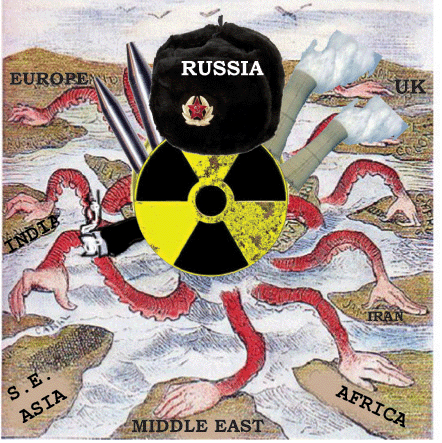
“The level of cooperation between Russia and ASEAN in the fuel and energy sphere needs to be taken to a new level,” Putin was quoted as saying in the local press today. ASEAN stands for Association of Southeast Asian Nations. “Moscow is ready to cover the market and is ready to offer member countries projects on the construction of next generation nuclear electrical power stations,” he said during the Russia-ASEAN Summit in Sochi.
None of the 10 ASEAN nations are currently hooked up to nuclear power…..Rosatom is the world’s third largest developer of nuclear reactors. Its subsidiary TVEL producers fuel assembly rods, the technology that holds the uranium used to power the reactor and generate electricity. It competes with Westinghouse Electric Company, AREVA Inc. and now Chinese companies are starting to get in on the action, primarily in China but also in Eastern Europe, an historic strong hold for Russian utilities…..
No reactor deals between Rosatom and ASEAN nations have been signed at this time. http://www.forbes.com/sites/kenrapoza/2016/05/20/putin-pushes-nuclear-power-to-southeast-asia/#6ec263f32e0a
Russia to build Bushehr Nuclear Plant in Iran

 ‘A Partner We Can Trust’: Iran Chooses Russia to Build Bushehr Nuke Plant Russia’s State Atomic Energy Corporation, Rosatom, will start work on Iran’s Bushehr-2 nuclear power plant by the end of this year after the construction site preparations are completed……
Russia runs pro nuclear workshop in Vietnam
Workshop promotes nuclear power A workshop to enhance the understanding of nuclear power among people and media alike was held on May 19 in Hanoi. The event, part of activities of the “2016 Nuclear Science Day in Hanoi ,” was jointly organised by Russia ‘s State Nuclear Energy Corporation (ROSATOM), the Vietnam Atomic Energy Agency under the Ministry of Science and Technology, the Information Center on Nuclear Energy (ICONE) and the Hanoi University of Technology.Speaking at the event, Andrey Stankevich from ROSATOM Vietnam attached significance to publicity work to promote the development of nuclear energy…….
Communication work is crucial to raise public awareness of the development of the nuclear sector and get people’s approval of nuclear power, said Deputy Director of the Agency Nguyen Thi Thu Trang
According to the representative from ROSATOM Asia, the press and media need to be a reliable source of basic information on radiation, nuclear science and the safety of nuclear power plants.
They should also promote the benefits of the sector in terms of socio-economic development, health care, agriculture and industry.
Numerous activities will also take place during the “2016 Nuclear Science Day in Hanoi” programme, which runs until May 20, including a lecture by a professor from the Russia National Research Nuclear University (MEPhI) and an awards presentation for the recent Physics Olympiad winners. http://english.vietnamnet.vn/fms/science-it/156747/workshop-promotes-nuclear-power.html
Russia looks to nuclear colonise Africa
Russia’s Rosatom seeks cooperation agreements for African nuclear expansion By Wendell Roelf CAPE TOWN (Reuters) 20 May 16, – Russia’s state nuclear agency Rosatom plans to sign cooperation agreements with Kenya, Uganda and Zambia to lay the groundwork for an expanded presence in Sub-Saharan Africa beyond its planned bid to build nuclear power plants in South Africa.
Rosatom has voiced confidence in its ability to see off competition from China, France and South Korea in a planned South African tender to build a 9,600 megawatts (MW) nuclear power fleet in the continent’s most industrialised country. It sees scope, however, for more deals across the region, from the building of plants to supplying reactor fuel……
Victor Polikarpov, Rosatom’s regional vice-president for Sub-Saharan Africa, said on Thursday.
“We want South Africa to become our springboard for the rest of Africa. We want to create a nuclear cluster, a group of companies here that can operate with us in Africa.”
President Jacob Zuma’s government was checking the financial and commercial impact of its nuclear ambitions before it issues a tender.
South Africa’s 1,800 MW Koeberg station near Cape Town is the continent’s only commercial nuclear power plant at present, though Rosatom is building a nuclear plant in Egypt that is expected to be completed by 2022.
Meanwhile, South Africa’s nuclear energy corporation Necsa is being encouraged by government to revive nuclear enrichment and conversion facilities to reduce dependence on imported reactor fuels……
Rosatom’s Polikarpov, however, said it might not be viable for South Africa to restart enrichment facilities dismantled before white minority rule ended in 1994.
“Another solution is just to have fuel supplied from Russia. We can guarantee supply of fuel non-stop for the duration of operation of all power plants,” he said.
Nigeria, however, looks a more distant prospect as its economy contracts amid the global plunge in oil prices.
“Given the extremely bad economic situation in Nigeria today, it might take a bit longer. But the government and the new president are still determined to go nuclear,” Polikarpov said.
(Editing by James Macharia and David Goodman) http://af.reuters.com/article/investingNews/idAFKCN0YA1CH
‘Generation IV’ nuclear companies desperate for tax-payers’ money
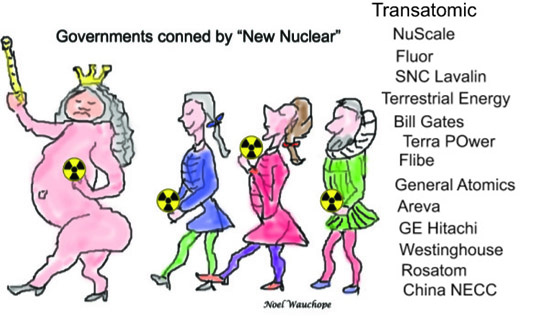
 Nuclear Firms: More Federal Money for Advanced Reactors. Bloomberg BNA, By Rebecca Kern May 17 — Nuclear companies said in a Senate hearing that continued support from Congress is needed to further develop and commercialize advanced nuclear reactors, several of which are getting some Department of Energy funding.
“Successful completion of the DOE cost-share program depends on sustained congressional support and continued appropriations,” John Hopkins, chairman and chief executive officer of NuScale Power LLC, an advanced nuclear reactor company, said at a May 17 Senate Energy and Natural Resources hearing on advanced reactors. “We appreciate your past support and we ask that you continue to prioritize small modular reactor programs in a tight budgetary environment.”……
NuScale has been receiving cost-share grants from the DOE since 2013 and expects to submit its first-of-a-kind small modular reactor licensing application to the Nuclear Regulatory Commission by the end of 2016, Hopkins said……
John Gilleland, chief technical officer of TerraPower LLC—a nuclear design company developing a generation-four reactor—also said there is a need for more government funding….
TerraPower is working with the China National Nuclear Corporation, an economic corporation overseen by the Chinese government, to develop a 1,200 megawatt electric liquid sodium-cooled fast reactor that uses depleted uranium as fuel in the metallic form. They hope it will be commercially deployable in the 2020-2030 time frame, Gilleland told Bloomberg BNA May 17.
Support for Advanced Nuclear Bills
Jacob DeWitte, co-founder and chief executive officer of Oklo, an advanced reactor start-up company, lauded the work done by the committee to pass the Energy Policy Modernization Act (S. 2012) in late April (76 ECR, 4/20/16). The bill included language from a bill sponsored by Sen. Mike Crapo (R-Idaho) that would establish a National Nuclear Innovation Center between the Energy Department and the NRC to establish capabilities for the private sector to test and demonstrate advanced reactor concepts.
He also supported S. 2795 introduced by Sen. James Inhofe (R-Okla.) that would promote the development of advanced nuclear technologies, which is being marked-up by the Senate Environment and Public Works committee this week…..
Also, Rep. Bob Latta (R-Ohio) has introduced H.R. 4979 which would direct DOE and the NRC to work together on an advanced nuclear reactor framework. This bill will be marked up by the House Energy and Commerce committee this week (92 ECR, 5/12/16)……
To contact the reporter on this story: Rebecca Kern in Washington atrkern@bna.com
To contact the editor responsible for this story: Larry Pearl atlpearl@bna.com http://www.bna.com/nuclear-firms-federal-n57982072580/
1 This Month




PLEASE OPPOSE HR 8255 AND S.3639 – bills would accelerate satellite deployment, with no environmental review or safeguards – https://ncstd5li.quorum.us/campaign/169331/
To see nuclear-related stories in greater depth and intensity – go to https://nuclearinformation.wordpress.com
-
Archives
- September 2026 (330)
- August 2026 (330)
- July 2026 (355)
- June 2026 (287)
- May 2026 (306)
- April 2026 (356)
- March 2026 (251)
- February 2026 (267)
- January 2026 (308)
- December 2025 (358)
- November 2025 (359)
- October 2025 (375)
-
Categories
- 1
- 1 NUCLEAR ISSUES
- business and costs
- climate change
- culture and arts
- ENERGY
- environment
- health
- history
- indigenous issues
- Legal
- marketing of nuclear
- media
- opposition to nuclear
- PERSONAL STORIES
- politics
- politics international
- Religion and ethics
- safety
- secrets,lies and civil liberties
- spinbuster
- technology
- Uranium
- wastes
- weapons and war
- Women
- 2 WORLD
- ACTION
- AFRICA
- Atrocities
- AUSTRALIA
- Christina's notes
- Christina's themes
- culture and arts
- Events
- Fuk 2022
- Fuk 2023
- Fukushima 2017
- Fukushima 2018
- fukushima 2019
- Fukushima 2020
- Fukushima 2021
- general
- global warming
- Humour (God we need it)
- Nuclear
- RARE EARTHS
- Reference
- resources – print
- Resources -audiovicual
- Weekly Newsletter
- World
- World Nuclear
- YouTube
-
RSS
Entries RSS
Comments RSS

