UK Members of Parliament to question EDF executives about Hinkley nuclear project financing
 EDF Energy to be grilled by MPs over Hinkley Point C nuclear power plant , City AM. 17 Mar 16 EDF Energy will be grilled by a group of MPs next week over the controversial Hinkley Point C nuclear power plant in Somerset.
EDF’s chief executive Vincent de Rivaz, and managing director of new nuclear build Humphrey Cadoux-Hudson, will appear before the energy and climate change select committee on Wednesday.
It comes as French economy minister Emmanuel Macron pledged fresh financing for the £18bn project during a visit to a nuclear power plant there today.
EDF has been forced to defend Hinkley after its chief financial officer Thomas Piquemal resigned over the huge costs. It subsequently sent a letter to employees reiterating confidence that the project will go ahead.
“The hearing will give EDF Energy an opportunity to answer the committee’s questions on the investment plans for a new nuclear power station at Hinkley Point C in Somerset,” it said in a statement today……..http://www.cityam.com/237033/edf-energy-to-be-grilled-by-mps-over-hinkley-point-c-nuclear-power-plant
The health toll of Fukushima nuclear disaster – especially workers and children
Nuclear Expert: Fukushima “like the worst nightmare becoming reality” — Released as much as 1,000 atomic bombs worth of radioactive material — “Everyone on earth has been exposed… an increase in cancer will be the result” »
“Shocking how many people died in Fukushima” — Cremated bodies of Fukushima radiation workers found near plant — “Such a high rate of cancer” being detected in Fukushima children (VIDEOS) http://enenews.com/shocking-many-people-died-fukushima-cremated-remains-fukushima-radiation-workers-found-plant-high-rate-cancer-being-detected-children-videos?utm_source=feedburner&utm_medium=email&utm_campaign=Feed%3A+ENENews+%28Energy+News%29
AP,Mar 10, 2016 (emphasis added): Fukushima ‘Decontamination Troops’ Often Exploited, Shunned — The ashes of half a dozen unidentified laborers ended up at a Buddhist temple in this town just north of the crippled Fukushima nuclear plant… They were simply labeled “decontamination troops” — unknown soldiers in Japan’s massive cleanup campaign to make Fukushima livable again five years after radiation poisoned the fertile countryside… One laborer… said he was instructed never to talk to reporters… Minutes after chatting with some workers in Minamisoma, Associated Press journalists received a call from a city official warning them not to talk to decontamination crews… [W]orkers have developeddiabetes, cerebral and respiratory problems… local hospital intern Toyoaki Sawano said in a medical magazine last month… Hideaki Kinoshita, a Buddhist monk who keeps the unidentified laborers’ ashes at his temple [said] “There is no end to this job… Five years from now, the workers will still be around. And more unclaimed ashes may end up here.”
Mainichi, Mar 7, 2016: Experts divided on causes of high thyroid cancer rates among Fukushima children — A total of 166 children in Fukushima Prefecture had been either diagnosed with thyroid cancer or with suspected cases of cancer… “Compared to the estimated prevalence rates based on the country’s statistics on cancer, which are shown in data including regional cancer registration, the level of thyroid cancer detection is several dozen times higher(in children of Fukushima Prefecture),” said the final draft for the interim report compiled by the prefectural government’s expert panel on Feb. 15… [T]wo teams both concluded that the number of cancer cases found in Fukushima children was “about 30 times” that of national levels [and] agree that the “30 times higher (than the national occurrence rates)” is unexplainable. At the moment, the most likely theories for such a high rate of cancer detection are the “overdiagnosis theory” held by [the team led by Shoichiro Tsugane, a member of the Fukushima government’s expert panel] and the “radiation effect theory” that [the team led by Okayama University professor Toshihide Tsuda] supports… Tsugane is not completely denying the effects of radiation in children’s cancer… [Tsuda] argues that radiation exposure is the main cause of the high prevalence of cancer in children [and] because the spread of cancer cells to lymph nodes and other tissues could be seen in 92 percent of patients, Tsuda believes thatoverdiagnosis makes up 8 percent of the patients at most…
RT, Mar 11, 2016: ‘Shocking how many people died in Fukushima‘ – documentary director… Authorities in Japan want locals to think “nothing happened,” documentary director Jeffrey Jousan told RT. “The government prints the number of people who died as a result of the 2011 disaster in the newspapers… the (death toll) amounts to 300-400 people in each prefecture, but in Fukushima it is over 8,000 people… It is shocking… to see [how] many people have died in Fukushima”… [I]t is still unclear how many people have succumbed to or suffer from radiation-caused cancer diseases directly linked to the crippled plant.
Watch Press Conferences: Prof. Tsuda | Dr. Angelika Claussen, physician
The workers of the Fukushima nuclear clean-up
Fukushima Keeps Fighting Radioactive Tide 5 Years After Disaster, NYT By JONATHAN SOBLE MARCH 10, 2016 TOKYO — Of the thousands of workers who have answered the help-wanted ads at Fukushima Daiichi, the ruined and radioactive nuclear power plant in northeastern Japan, the part-time lettuce farmer and occasional comic-book artist Kazuto Tatsuta must be among the least likely.
“I needed a job,” Mr. Tatsuta, 51, recalled of his decision in 2012 to accept work at the site of one of the world’s worst nuclear accidents.
His duties included welding broken water pipes and inspecting remote-controlled robots that survey radioactive hot spots. And his comic strips, once populated with baseball players and gangsters, now tell stories of middle-aged, blue-collar men like himself who do the grunt work at Fukushima, some of whom find a sense of purpose and belonging they lacked in the outside world.
“It’s secure. You’re not going to get laid off there,” Mr. Tatsuta said. “But you’re also working for a goal.”
Five years after a powerful earthquake and tsunami struck, causing three reactors at Fukushima to melt down, that goal is the focus of a colossal effort at once precarious and routine. A veneer of stability at the plant masks a grueling, day-to-day battle to contain hazardous radiation, which involves a small army of workers, complex technical challenges and vexing safety trade-offs.
Fukushima has become a place where employees arrive on company shuttle buses and shop at their own on-site convenience store, but where they struggle to control radiation-contaminated water and must release it into the sea. Many of the most difficult and dangerous cleanup tasks still lie ahead, and crucial decisions remain unsettled………
The duration of the cleanup also creates the risk of labor shortages, he said, especially in jobs requiring special skills. Japan’s population is shrinking and, with the future of nuclear power uncertain, many young people are unwilling to stake careers on the industry.
For now, Fukushima is bustling with about 7,000 workers, much more than before the disaster and twice as many as two years ago. The town of Iwaki to the south has become a kind of workers’ village. At dawn, vans and buses line up to ferry workers to the plant via staging areas where they don protective white Tyvek suits, radiation monitors and gas masks.
“You think of it as totally normal work,” said Mr. Tatsuta, who asked to be identified only by his pen name to avoid being blacklisted by the plant’s owner, Tokyo Electric Power Company……….
For workers at the site, radiation is a constant enemy — though many see it more as a threat to their livelihoods than their lives. Government regulations forbid cleanup workers to be exposed to too much radiation, and when they hit the limits, they risk being laid off or reassigned to lower-paying jobs.
“If you go over the radiation limits, you can’t work,” Mr. Tatsuta said. “You’re always calculating how to keep the dose low.”
The temptation to cheat can be strong, for both workers and their managers. A government examination of Tokyo Electric’s safety practices in 2013 found that it had underreported the radiation exposure of a third of the workers whose records were reviewed. The company says it has since tightened reporting procedures……..http://www.nytimes.com/2016/03/11/world/asia/japan-fukushima-nuclear-disaster.html?_r=0
India may have to shut down two uneconomic reactors at Tarapur
 Oldest Indian Nuclear Reactors Near Mumbai May Be Shut Down, Bloomberg, Rajesh Kumar Singh, 14 Mar 16
-
Tarapur 1 & 2 unprofitable, undergoing frequent maintenance
-
Nuclear Power Corp. may seek higher tariff from regulator
-
India may shut two of its oldest reactors almost five decades after they went into operation as power tariffs aren’t keeping pace with maintenance costs, according to Sekhar Basu, secretary at the Department of Atomic Energy.
The first two reactors at Tarapur, about 100 kilometers (62 miles) from Mumbai at India’s western coast, suffer frequent maintenance shutdowns that make them unprofitable, Basu said in a phone interview. They earn about 0.89 rupees (1 cent) for every kilowatt hour of electricity produced, which isn’t enough to sustain operations. Nuclear plants in India received an average tariff of 2.78 rupees per kilowatt hour in the year ended March 2015, according to the Department of Atomic Energy.
“We are pouring in money into the reactors rather than making income from them,” Basu said. “At the current tariff, it’s become unviable to run the two reactors and we may be forced to shut them down if the tariff is not increased.”
Basu didn’t provide details on the timing of a possible decommissioning, a process that can take decades and generate thousands of tons of radioactive waste. Nuclear Power Corp., the nation’s sole operator of nuclear power plants, may approach the electricity regulator for a tariff increase when operations become unsustainable, Basu said. -
Liability Law
Nuclear Power spokesman N. Nagaich couldn’t be reached on his office phone for a comment. Sanjeev Kumar, chairman at Maharashtra State Electricity Distribution Co., which buys power from the reactors, didn’t respond to phone calls and a text message sent on his mobile phone.
The boiling water reactors, which can produce 160 megawatts each, were supplied by General Electric Co. and started operating in 1969, marking India’s foray into nuclear energy. India plans to raise atomic power capacity more than ten-fold by 2032 as part of its clean-energy drive. The expansion plans have been complicated by the nation’s liability law. The statute, which exposes plant equipment suppliers to accident claims, is borne out of concerns over nuclear safety……..http://www.bloomberg.com/news/articles/2016-03-15/india-mulls-shutting-oldest-nuclear-plants-amid-mounting-costs
Tax-payer money proposed in Senate, to keep uneconomic Fitzpatrick nuclear plant going

 Senate proposal includes $100M to keep Fitzpatrick nuclear plant online, North Country Public Radio, by Payne Horning (WRVO) , in Oswego, NY Mar 15, 2016 — The New York Senate Republican budget proposal includes money for Oswego County’s Fitzpatrick nuclear power plant. It would give $100 million to try to extend the life of the financially struggling plant.
The money would provide the immediate support Fitzpatrick needs to pay for the costs of refueling the plant, a lengthy and expensive process that has to take place this year. The ultimate goal is to keep Fitzpatrick open until 2017 when lucrative tax credits from the state could become available……..
Entergy is planning to close the facility next January because they said Fitzpatrick is losing $60 million annually. Since the decision to close the plant was announced last fall, lawmakers have been working to find a quick financial fix. If approved, the $100 million could be available as soon as April, but lawmakers in Albany are just starting the budget process and the proposal could be removed or changed. http://www.northcountrypublicradio.org/news/story/31295/20160315/senate-proposal-includes-100m-to-keep-fitzpatrick-nuclear-plant-online
France’s auditor brands Hinkley Point nuclear project as financially risky
 Hinkley Point branded potentially risky for EDF by French auditor, Guardian 11 Mar 16
Cour des Comptes urges greater study of nuclear project’s risks given poor recent investments and the fact EDF must fund likely cost overruns. EDF’s £18bn project to build nuclear reactors in Britain is potentially risky for the state-owned utility, whose foreign investments in recent years have proved disappointing, France’s top public auditor has said.
In a report on EDF’s international strategy, the Cour des Comptes – the French equivalent of the UK’s National Audit Office – said EDF and its 85% state shareholding should take a close look at the risks associated with the project to build two nuclear reactors at Hinkley Point in Somerset.
The report, which focuses on the 2009-2014 period – which includes EDF’s October 2013 agreement with the British government but not its deal in October 2015 with the Chinese utility CGN to take a one-third stake – said the financing around the Hinkley Point deal was potentially risky for EDF.
The auditor said EDF’s cashflow and high debt limit its capacity to invest abroad, especially given the huge sums needed to upgrade its ageing French nuclear plants.
“Even though the [Hinkley Point] deal has not been finalised, the complexity of the deal and especially the way it could impact the responsibility of EDF suffice to raise serious questions,” the auditor ……..http://www.theguardian.com/business/2016/mar/11/hinkley-point-risky-edf-french-auditor-cour-de-comptes?CMP=share_btn_tw
Nuclear power unsafe, too costly – Ex-Japan PM Naoto Kan
 Ex-Japan PM: nuclear power remains unsafe and too costly Naoto Kan, who presided over country during Fukushima disaster in 2011, cautions over plans to build new UK plants, Guardian, Terry Macalister 12 Mar 16 Nuclear power is unsafe and too expensive to justify building new plants anywhere in the world, according to the Japanese prime minister at the time of the Fukushima nuclear accident. Speaking on the fifth anniversary of the disaster, Naoto Kan said he was against the idea of Japanese manufacturers such as Hitachi and Toshiba building plants in the UK.
“Nuclear power is not safe. In the worst case scenario up to 50 million people would have had to be evacuated. Nuclear power is not a suitable technology and renewable power is much better,” Kan told the Guardian.
The former prime minister insisted he did not want to tell other countries such as Britain what to do but he said he did not support the reactors being switched back on in Japan.
His warning came as Britain’s nuclear plans are hanging in the balance because of delays over the go-ahead for EDF Energy’s Hinkley Point C project in Somerset and concerns about the project’s financial viability.
While the French company EDF is at the centre of the Hinkley scheme, Hitachi and Toshiba are behind similar intiatives being developed for new reactors atWylfa on Anglesey, Oldbury in South Gloucestershire, and Sellafield in Cumbria.
Kan said it “did not make sense” to construct new atomic plants because of the cost, especially in those countries where there were no long-term storage facilities for high level radioactive waste. This includes Britain and Japan.
“What I experienced as prime minister made me feel that it does not make sense to rely on nuclear. New generation plant designs are supposed to increase safety but all these do is increase the cost.”………..The £18bn Hinkley Point C nuclear project was thrown into doubt this week after after EDF’s finance director, Thomas Piquemal, resigned after opposing the deal. He believes the costly agreement threatens the company’s future. http://www.theguardian.com/world/2016/mar/11/japan-naoto-kan-nuclear-power-unsafe-fukushima
Uranium price – even further down the drain!
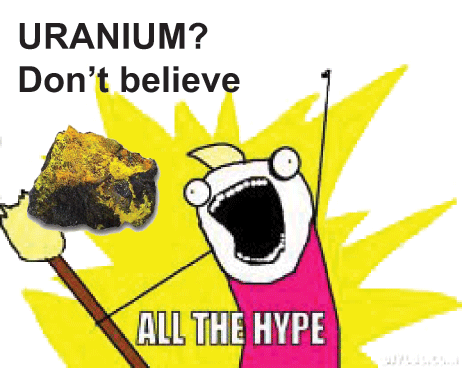 Nuclear power market still suffers from Japan’s Fukushima disaster -5-year disaster anniversary shows little nuclear power progress in Japan Market Watch, By MYRAP. SAEFONG MARKETS/COMMODITIES REPORTER 11 MAR 16 “……“Unfortunately, the uranium [and] nuclear market is still suffering significantly as a result of the Fukushima aftereffects,” said Jonathan Hinze, executive vice president of international operations at the Ux Consulting Company, the world’s leading nuclear-fuel consultancy.
In the wake of the nuclear accident, nuclear power became somewhat of an outcast……
Uranium supply ‘overhang’ Back in September, Jim Ostroff, senior editor of Platts Nuclear Publications, estimated that Japanese utilities had around 120 million pounds of uranium stockpiled, which was likely enough to have supplied all of Japan’s pre-Fukushima needs for six years.
Today, there remains an “overhang of excess supply to demand,” he said.
With such few active reactors, the Japanese are not buying uranium to make nuclear fuel and the companies that make the fuel from uranium, known as converters, are selling excess amounts because prices are so low, said Ostroff.
“With little, if any, demand to purchase [uranium] right now on the spot market, utilities are leery to buy any material because they are looking for a bottom” in prices, he said.
As of March 7, weekly spot uranium prices stood at $31.10 a pound, down from the March 7, 2011 weekly price of $66.50, according to data from UxC Consulting. UxC uranium futures UXM6, -1.60% are traded on Globex, with the June contract at $29 Friday, but volume is small.
The “bottom is falling out on prices again,” said Ostroff, noting that daily spot prices had stabilized at around $34.75 a pound earlier this year before its recent retreat.
In response to the low prices, it’s “fair to say that most of the world’s producers have abandoned any expansion plans and have curtailed their existing operations,” said Ostroff.
Year to date, shares of uranium producer Cameco Corp. CCJ, +2.69% has lost around 2.5%, while the Global X Uranium exchange-traded fund URA, +1.96% is down about 3.5%. But the losses pale in comparison to last year’s declines of nearly 25% for Cameco shares and more than 38% for the ETF……..http://www.marketwatch.com/story/nuclear-power-market-still-suffers-from-japans-fukushima-disaster-2016-03-11
Nuclear expansion in Asia – sounds great – BUT
it’s unclear whether such plans will ever see the light of day. “It will be very difficult to find people willing to invest billions of dollars in this area, especially given the likelihood of another accident taking place in another part of the world,”
Nuclear energy booming in Asia, DW 12 Mar 16 Five years after the Fukushima nuclear disaster, India and China have embraced nuclear power. Other countries in the region also want to build more plants – even in high-risk areas prone to earthquakes and tsunamis…..
China: on track to becoming number 1 Following the Fukushima disaster, China’s government initially suspended the construction of additional nuclear power plants. Instead, comprehensive security policies were adopted. But in the autumn of 2012, Beijing lifted the moratorium on future development – and since then, has pursued a more ambitious nuclear program……….
Nuclear power is considered a relatively “clean” alternative to coal. In daily congressional meetings, the Communist Party has been discussing plans for a massive expansion of nuclear energy. By 2030, a total of 110 nuclear power plants will be in operation.
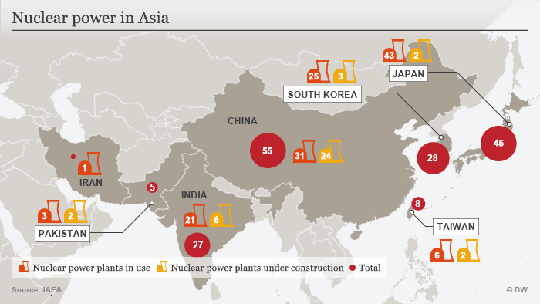
China would overtake the US as the country with the most nuclear power plants connected to the grid. Greenpeace nuclear expert Heinz Smital views the speed at which the reactors are being developed as problematic: “The Chinese safety authorities do not have the capacity to examine the buildings properly,” said Smital. “They will likely wave things through, rubber-stamp everything and not mess with the state-run construction consortiums. There is a big security risk.”……..
India. Delhi is planning a far-reaching expansion of nuclear power. Prime Minister Narendra Modi wants to build dozens of new reactors in the next 15 years.
The technical know-how is sourced internationally. Over the past decade, India has reached civil nuclear agreements with the United States, Canada, France and Russia. 21 nuclear power plants are already in operation. Two of the plants are in Kudankulam and Kalpakkam, located on the southeast coast of the country – areas prone to tsunamis. In December 2006, a tsunami hit Kalpakkam causing extensive damage, but not to the nuclear power plant, according to its operator.
Pakistan: Reactors in flood-prone areas
India’s neighbor, Pakistan, is also struggling with blackouts and outdated infrastructure. The country currently operates three small reactors, with the nuclear plant west of Karachi – located in a flood-prone area – being one of the oldest in the world. The remaining two reactors are situated in an earthquake-prone area some 300 kilometers (186.4 miles) south of the capital Islamabad. The government is planning to build two other reactors in the same area. According to Pakistan’s Atomic Energy Commission, Islamabad wants to build a total of seven new reactors by 2030 – with assistance from China.
South Korean expansion Although South Korea is about the size of the former German Democratic Republic (GDR), the country boasts 25 active nuclear plants. Three additional ones are under construction, while two others are set to be completed by 2029. The government plans to increase the share of nuclear power in the country’s overall energy mix from currently 30 to 40 percent.
Still, South Koreans are becoming increasingly skeptical about nuclear energy – and not just because of the 2011 Fukushima disaster. In 2012 and 2013, a scandal related to the use of fake safety certificates rocked the country’s nuclear industry lobby. State-owned (KHNP) had thousands of small components featuring falsified certificates fitted into the country’s nuclear plants. As it turns out, large amounts of bribe money changed hands between KHNP employees, construction firms and politicians.
This led not only to Korean media speaking of a “nuclear mafia,” but also to a massive drop in the approval ratings for nuclear energy – from 70 percent before the Fukushima disaster to 35 percent. In spite of this, Seoul is sticking to its plans to expand the use of nuclear power in the East Asian country.
Southeast Asia pigeonholes nuclear plans
In Southeast Asia, the production of nuclear energy is a hotly debated issue. For instance, while Vietnam wants Russian assistance to build eight nuclear plants, Hanoi has yet to make a final decision. Thailand is planning to build five reactors, whereas Malaysia and the Philippines each want a nuclear reactor to go online.
However, it’s unclear whether such plans will ever see the light of day. “It will be very difficult to find people willing to invest billions of dollars in this area, especially given the likelihood of another accident taking place in another part of the world,” said Greenpeace nuclear expert Smital.
“The costs related to the production of nuclear energy are only likely to increase, whereas renewable energy is becoming increasingly affordable. This is why the free market can only barely manage to finance nuclear plants at the moment,” Smital added. http://www.dw.com/en/nuclear-energy-booming-in-asia/a-19110848
Even South Australia’s pro nuclear Royal Commission admits the diseconomic s of the nuclear industry
 The Nuclear Industry Prices Itself Out Of Market For New Power Plants, Climate Progress, BY JOE ROMM MAR 8, 2016 “….. in newly-released findings, South Australia’s nuclear royal commission found that the price of electricity from new nukes greatly exceeded not only business-as-usual projections for electricity prices but also prices in a “strong climate action” case. The Commission concluded “it would not be commercially viable to generate electricity from a nuclear power plant in South Australia in the foreseeable future.”
The Commission explicitly looked at plausible electricity prices for a new reactor in 2030 based on both current designs and possible fourth-generation ones, such as small modular reactors (SMRs). The Commission estimated the cost for the most viable nukes at US$7 billion for a typical large 1125-megawatt reactor and $2.8 billion for two 180-megawatt SMRs. The smaller SMRs would be providing electricity for a whopping US$0.17 a kilowatt-hour!
A study done for the Commission found that both large nukes and SMRs “consistently deliver strongly negative NPVs” (net present values) for both 2030 and 2050 — even for the strong climate action scenario. The Commission Chair noted that given how Australia’s National Electricity Market works, renewables are “the first energy that goes into the market” because they have the lowest costs.
The Commission’s findings are consistent with a 2014 Energy Policy study, “The cost of nuclear electricity: France after Fukushima.” Using cost data released by the French government after the Fukushima disaster, the study found the cost of French nuclear plants steadily escalated over the past four decades. Further, it projects “the future cost of nuclear power in France to be at least 76€/MWh (US$0.084/KWh) and possibly 117€/MWh (US$0.129/KWh),” which “compares unfavorably against alternative fuels,”……. such as wind.http://thinkprogress.org/climate/2016/03/08/3757281/nuclear-industry-prices/
Nukes are cursed with cost escalation everywhere
“An international comparative assessment of construction cost overruns for electricity infrastructure,” examined the cost history of 180 large nuclear reactors worldwide, and found, “these overruns afflicted more than 97 percent of nuclear projects and led to a mean cost escalation of 117 percent per project.
Nuclear plants have large cost overruns, and it appears to be an intrinsic feature of them. The authors of “Revisiting the Nuclear Power Construction Costs Escalation Curse,” had a very important conclusion in their analysis of escalating costs for French nuclear reactors:
Our last result says that those reactors with better safety performance were more expensive. Then achieving higher safety levels also helped to explain the cost escalation in the French nuclear fleet.
I’m pretty sure the vast majority of Americans, like the vast majority of French, would prefer we built reactors with the best safety performance. That doesn’t come cheap
The Nuclear Industry Prices Itself Out Of Market For New Power Plants, Climate Progress, BY JOE ROMM MAR 8, 2016 In the modern era, nuclear power plants have almost always become more and more expensive over time. They have a “negative learning curve” — along with massive delays and cost overruns in market economies. This is confirmed both by recent studies and by the ongoing cost escalations of nuclear plants around the world, as I’ll detail in this post.
The cost escalation curse of nuclear power
India’s Prime Minister Modi in the grip of the global nuclear salesmen
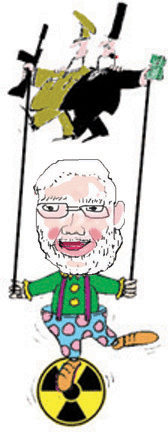 PM’s recent visits to France, Russia and Japan India Infoline News Service | Mumbai | March 10, 2016
The Prime Minister Narendra Modi’s recent visits to France, Russia and Japan were aimed to bring in socio-economic and scientific development particularly in the field of atomic energy
Resignation of EDF’s finance director heralds crisis in UK Hinkley nuclear project
Hinkley Point C nuclear project in crisis as EDF finance director resigns
Proposed £18bn Somerset plant has been pushed by George Osborne but some on French company’s board fear risky spending, Guardian, Terry Macalister, 7 Mar 16, The £18bn Hinkley Point C nuclear project was in crisis on Sunday night after reports that the finance director of EDF, the company behind the scheme, had resigned.EDF tells contractors to restart work on Hinkley Point, report says
 Thomas Piquemal has stood down from his post after expressing trenchant opposition to those on the EDF board who want to give the green light to the project within weeks, sources said.
The resignation of such an important figure on the EDF board will make it much harder for the remaining executives to proceed with Hinkley in the short term……..
Piquemal is said to have been arguing that pursuing what would be the world’s most expensive power project at this moment could jeopardise the French group, which already has rising debts.
Union members on the EDF board are also implacably opposed to Hinkley Point, saying it is too expensive and a risk to the energy company’s future…….http://www.theguardian.com/environment/2016/mar/07/hinkley-point-c-nuclear-project-in-crisis-as-edf-finance-director-resigns?CMP=twt_a-environment_b-gdneco
Burdened by the failure of AREVA, Electricite De France struggles for survival
French Mastery of Nuclear Power at Stake in U.K. Reactor Project, Bloomberg Francois De Beaupuy March 4, 2016
-
EDF faces dilemma of whether to proceed with $26 billion plant
-
Unions argue for a delay because company’s future is `at risk’
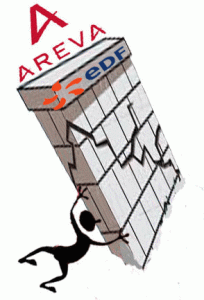 Electricite de France SA, the world’s largest operator of nuclear power plants, is stuck in a multibillion-dollar quandary that will shape its future.
Going ahead with new EPR atomic plants in the U.K. would strain the limits of its balance sheet as slumping electricity prices across Europe reduce cash flow. Dropping the Hinkley Point venture in southwest England would further damage the image of a new French-designed reactor, already tarnished by delays and cost overruns at projects elsewhere…….
The EPR reactor design from French nuclear group Areva SA was once a symbol of the nation’s engineering prowess. EDF’s former Chief Executive Officer Pierre Gadonneix predicted it would sell “like hotcakes” around the world. Project setbacks and the safety fears following the Fukushima disaster in Japan in 2011 stymied those plans, while a flood of competing energy supplies from solar and wind has left one of the nation’s most important industries in distress. - The two 1,600-megawatt plants at Hinkley Point would cost about 18 billion pounds ($26 billion), with China General Nuclear Power Corp. paying for a third. Standard & Poor’s is threatening to downgrade EDF’s credit rating if the U.K. project, which has been planned for more than eight years, goes ahead……
- EDF shares, 85 percent of which are owned by the French state, have lost as much as 89 percent of their value since peaking in 2007 and hit a record low on Feb. 25. French year-ahead wholesale electricity prices dropped 60 percent over the same period…….
-
Areva Burden
Areva has complicated matters for EDF, accumulating 5.5 billion euros of losses on the construction of an EPR in Finland that’s already seven years late. Areva was due to take 10 percent of Hinkley Point, with EDF taking 45 percent to 50 percent and two Chinese partners holding the remaining 40 percent. As Areva’s finances worsened, it withdrew, forcing EDF to raise its stake to 66.5 percent. To make matters worse, EDF was called to rescue Areva by the French government by taking a majority stake in its troubled reactor unit.
EDF has its own problems with the EPR it’s building in Flamanville. Costs have more than tripled to 10.5 billion euros and construction is now six years behind schedule. The French nuclear watchdog has expressed concerns about the strength of the reactor vessel, forcing EDF and Areva to conduct tests to prove its safety.
“EDF is vulnerable to events over which it has no control: falling power prices following deregulation, and the balance sheet knock-on impact from Areva’s financial troubles,” said Adam Dickens, an analyst at HSBC Holdings Plc, in a March 1 report.
The company is borrowing money to pay its dividend and plans to sell assets to finance new developments. It cut annual operational expenditures by 300 million euros, or 1.4 percent, last year and plans to reduce them by a further 700 million euros by 2018. On Feb. 16, it reduced its estimate for how much it will spend to extend the life of its French reactors by 5 billion euros to 50 billion euros.
“Risks are way too high, ” Francis Raillot, a representative of the CFE-CGC union at EDF, said on Feb. 29. “We want the final investment decision to be delayed. The future of the company is at stake.” http://www.bloomberg.com/news/articles/2016-03-03/french-mastery-of-nuclear-power-at-stake-in-u-k-reactor-project
Japan’s tax-payers up for $100bn bill for Fukushima disaster
 Japan taxpayers foot $100bn bill for Fukushima disaster, Ft.com Robin Harding in Tokyo 7 Mar 16 The Fukushima nuclear disaster has cost Japanese taxpayers almost $100bn despite government claims Tokyo Electric is footing the bill, according to calculations by the Financial Times.
Almost five years after a huge tsunami caused the meltdown of three Tepco reactors by knocking out their supply of power for cooling, the figure shows how the public have shouldered most of the disaster’s cost.
It highlights the difficulty of holding a private company to account for the immense expense of nuclear accidents — a concern for countries such as the UK that are building new nuclear power stations.
The Financial Times used Ritsumeikan University professor Kenichi Oshima’s estimate that the disaster has cost Y13.3tn ($118bn) to date relative to the loss of equity value for Tepco shareholders.
“The underlying cost is mainly being paid by the public, either through electricity bills or as tax,” said Mr Oshima.
Japan’s government gives no single figure for the cost of the disaster, but Mr Oshima estimates the biggest cost to date is compensation to businesses and evacuees of Y6.2tn, followed by decontamination of the Fukushima area at Y3.5tn, and decommissioning of the reactor site at Y2.2tn.
Cash for compensation and decommissioning comes from Tepco but it gets grants from the government to keep it solvent. In theory, this cash will come back via a levy on Tepco and other nuclear operators — but this is ultimately be paid by electricity users, making it a tax by another name…….http://www.ft.com/intl/cms/s/0/97c88560-e05b-11e5-8d9b-e88a2a889797.html#axzz42AZmNd2J
1 This Month

of the week– Nuclear Reactor Information Task Force

14 May – online event From Bombs to Data Centres: the Face of Nuclear Colonialism
To see nuclear-related stories in greater depth and intensity – go to https://nuclearinformation.wordpress.com
-
Archives
- May 2026 (82)
- April 2026 (356)
- March 2026 (251)
- February 2026 (268)
- January 2026 (308)
- December 2025 (358)
- November 2025 (359)
- October 2025 (376)
- September 2025 (257)
- August 2025 (319)
- July 2025 (230)
- June 2025 (348)
-
Categories
- 1
- 1 NUCLEAR ISSUES
- business and costs
- climate change
- culture and arts
- ENERGY
- environment
- health
- history
- indigenous issues
- Legal
- marketing of nuclear
- media
- opposition to nuclear
- PERSONAL STORIES
- politics
- politics international
- Religion and ethics
- safety
- secrets,lies and civil liberties
- spinbuster
- technology
- Uranium
- wastes
- weapons and war
- Women
- 2 WORLD
- ACTION
- AFRICA
- Atrocities
- AUSTRALIA
- Christina's notes
- Christina's themes
- culture and arts
- Events
- Fuk 2022
- Fuk 2023
- Fukushima 2017
- Fukushima 2018
- fukushima 2019
- Fukushima 2020
- Fukushima 2021
- general
- global warming
- Humour (God we need it)
- Nuclear
- RARE EARTHS
- Reference
- resources – print
- Resources -audiovicual
- Weekly Newsletter
- World
- World Nuclear
- YouTube
-
RSS
Entries RSS
Comments RSS
 nuclear-news