EDF/AREVA keen to get in on selling nuclear reactors to South Africa
 Bullish Areva wants in on SA’s nuclear tender, City Press Yolandi Groenewald 2016-06-
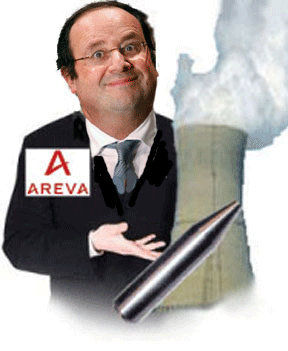 10 France’s state-owned nuclear businesses are focused on winning the lucrative South African nuclear tender despite recent financial difficulties.
The French will bid as EDF/Areva – nuclear technology company Areva sold its reactor business to the state-owned energy utility EDF earlier this year……..
EDF was facing large investments at its French operations. Its investment compromised about €50 billion (R869.6 billion) over 10 to 15 years, which would extend the operating lifespan of its ageing fleet to 60 years……
The French nuclear industry has faced a number of storms during the past year. Areva teetered on the edge of bankruptcy after years of losses wiped out its equity. It was rescued by French state aid and a sale of its reactor business to EDF.
The Flamanville project in France, Areva’s first European Pressurised Reactor (EPR) nuclear pressurised water reactor, is years behind schedule, way over budget and riddled with technical difficulties…….
France, Russia, China, the US and South Korea are competing for what could be South Africa’s biggest procurement project. The contract, estimated to cost between R580 billion and R1.56 trillion, aims to add nuclear capacity of 9 600 megawatts.
The government has said the nuclear programme would be developed at a pace the country can afford……..http://city-press.news24.com/Business/bullish-areva-wants-in-on-sas-nuclear-tender-20160603
USA not yet able to get India into the Nuclear Suppliers Group
 Nuclear Suppliers Group Meeting On India’s Membership Ends Inconclusive http://www.ndtv.com/india-news/nuclear-suppliers-group-meeting-on-indias-membership-ends-inconclusive-1417783 Agencies | June 10, 2016 VIENNA:
HIGHLIGHTS
- No decision on India’s application to enter NSG in Vienna meeting
- Application to be taken up in meeting in Seoul on June 20
- Countries led by US support India’s bid, others led by China oppose
India’s application is now expected to be taken up in a meeting in Seoul on June 20.
The US-led push for India to join the club of countriescontrolling access to sensitive nuclear technology had made some headway on Thursday as several opponents appeared more willing to work towards a compromise, but China has consistently remained defiant.
The Nuclear Suppliers Group or NSG aims to prevent the proliferation of nuclear weapons by restricting the sale of items that can be used to make those arms. It was set up in response to India’s first nuclear test in 1974.
India already enjoys most of the benefits of membership under a 2008 exemption to NSG rules granted to support its nuclear cooperation deal with Washington, even though India has developed atomic weapons and never signed the nuclear Non-Proliferation Treaty, the main global arms control pact.
After meeting with Prime Minister Narendra Modi at the White House on Thursday, President Barack Obama pledged America’s backing for India to be given a seat in the NSG.
But China on Thursday maintained its position that the Non-Proliferation Treaty is central to the NSG, diplomats said.
List of worldwide nuclear stations headed for closing soon
 Illinois Power Plant Closings Reveal Worldwide Nuclear Issues, Clean Technica June 9th, 2016 by Sandy Dechert “………..International Nuclear Power
The World Nuclear Association……… enumerates 89 reactors scheduled to close by the end of 2025. Among the planned closures:
Armenia 1 in 2026
Belgium 2 by 2015, 5 more by 2025.
Canada 4 by 2015, 10 by 2025, 5 more by 2040.
Finland 3 by 2040
Germany 9 by 2025
Hungary 2 by 2025, 2 more by 2040
Mexico 2 by 2040
Netherlands 1 by 2025
Pakistan 1 by 2025, 1 more by 2040
Russia 1 by 2015, 23 by 2025, 4 more by 2040
Slovakia 2 by 2025
South Africa 2 by 2025
South Korea 1 by 2025, 1 more by 2040
Spain (7 reactors whose licenses run out before 2025, no decisions yet)
Sweden 2 by 2025, 5 more by 2040
Switzerland 34 by 2025, 2 more by 2040
Ukraine 2 by 2015, 10 more by 2025, 3 more by 2040
United Kingdom 1 by 2015, 6 more by 2025, 2 more by 2040
These numbers do not include the Japanese reactors shut down for safety checks following Fukushima, a third of France’s 58 nuclear reactors, and 7 Spanish reactors whose licenses are expiring without a close/refurbish decision by national regulators. Interestingly, the Philippines is converting a nuclear reactor to natural gas.
Worldwide, more than 60 reactors are under construction in 15 countries. However, other developments may threaten what some perceive as an international “nuclear renaissance”:
- One Indian reactor has been… under construction for 12 years with no hook-up date in sight;
- In Taiwan, two reactor units under construction for 15 years were halted this past April due to political opposition;
- At least 50 of the units listed as “under construction” have encountered construction delays — delays lasting from several months to several years;
- In China, ground zero for the so-called nuclear renaissance, 21 of the 28 units under construction are experiencing delays lasting between several months and more than two years; and
- Of the 17 remaining projects, a few have come online but many have yet to reach a targeted start-up date, and may or may not face delays or cancellations in the future.
………. the future of nuclear power still definitely lies in the “partly cloudy” range. https://cleantechnica.com/2016/06/09/illinois-power-plant-closings-reveal-worldwide-nuclear-issues/
Stumbling block prevents Toshiba Westingouse selling nuclear technology to India
Nisha Desai Biswal, assistant secretary of State for South Asian affairs, told a Senate committee on May 24 that a commercial deal was “quite close.”
The stumbling block, however, has been one article in a 2010 piece of Indian legislation that would make Westinghouse — and its suppliers — potentially vulnerable to crippling litigation under local Indian laws in the event of an accident. India has offered to establish insurance pools, but companies have not accepted that plan. There was no indication Tuesday that this issue had been resolved.
“They’ve painted themselves into a corner,” Omer F. Brown, a lawyer and nuclear liability expert, said of the Indian government. “I don’t know how they get out of it given that they wrote the law the way they did.”
Westinghouse and General Electric’s nuclear arm have been striving to reach a deal with India for more than a decade, and in 2008 Congress approved an agreement to promote nuclear cooperation with India, which critics said undermined half a century of U.S. nonproliferation efforts.
Daryl Kimball, director of the Arms Control Association, said the U.S. push for India’s membership in the NSG “would compound the damage in my view of Bush administration’s exemption” for India. He and 16 other non-proliferation experts, including from the Obama administration, have written a letter urging the administration to drop its support for India’s membership……..http://www.ndtv.com/india-news/6-nuclear-power-reactors-for-andhra-deal-on-but-foreign-media-1416685
Gloabl nuclear industry problems shown up in Illinois political battle over government subsidy
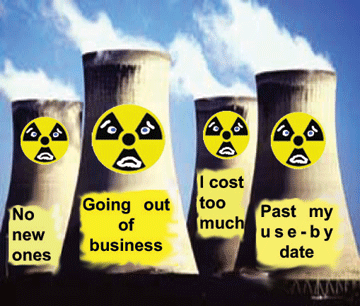 Illinois Power Plant Closings Reveal Worldwide Nuclear Issues, Clean Technica June 9th, 2016 by Sandy Dechert The many-sided battle over nuclear power continues with a clear break over politics in Illinois. The company and the government are dancing around the issues currently, with the industry essentially taking the position that government (read: the people) should subsidize the waning years of nuclear installations, or else. That state’s legislature adjourned its spring session last week without extending subsidies for nuclear power (the Next Generation Energy Plan advocated by the nuclear industry).
In return, Exelon Corporation—the nation’s largest nuclear power supplier—announced that it would have to close two of the state’s best-performing plants. It has said that the Clinton Power Station will close next June, and the Quad Cities Generating Station will close a year later. Despite their high scores, they have apparently lost $800 million over the past seven years. Exit papers are in preparation.
Joe Dominguez, executive vice president for governmental and regulatory affairs and public policy at Exelon, describes his company’s bottom line:
“We think that the costs of new nuclear right now are not competitive with other zero-carbon technologies, renewables, and storage that we see in the marketplace…. Right now we just don’t have any plans on the board to build any new reactors.”
Renewables broke all world records in 2015, say the United Nations Environment Programme and Bloomberg New Energy Finance. Also, renewables (excluding large hydro) accounted for more than half of new power generation capacity for the first time last year.Including large hydro, renewables’ share of all global electricity generation rose to more than 20%.
The human cost of closing the two Illinois plants includes 4,200 direct and indirect jobs and over $1.2 billion in economic activity annually. An earlier state report that Exelon quotes estimates that wholesale energy costs would rise in the region by $439 million to $645 million annually because of the plant closures. Exelon claims consumers will have to pay about $0.25 monthly to sustain the plants. Critics charge it will hike electric bills by about $3.00. Exelon has its eye on three other American closures, and Entergy is considering two at last report.
Industry-Wide Issues
Although this squabble has plagued Illinois for years, it brings up some nuclear issues that impact on the larger energy scene, both nationally and worldwide. These include not only competition from renewable energy but also unique financial factors, extension of design limits for the plants, decreasing reliability as reactors age, stability of the power grid, inadequate measures for disposal of radioactive waste. For all of these, potential near-term usefulness in slowing climate change—by limiting carbon releases associated with other forms of electric power generation—should be a major consideration……….
No commercial plants have been built in this country during the past 20 years. Eight have remained “under construction” during this time. These are mostly in the South, which still retains a protective regulatory environment. Only two are already scheduled to come online. In 2015, TVA Bellefonte ceased construction.
And decommissioning involves even greater expenses in the short term than keeping unprofitable plants afloat. Some of this huge expense (including the vital component of all project management, which the NRC’s Office of Nuclear Material Safety and Safeguards carries out) involves using more public funds…………..https://cleantechnica.com/2016/06/09/illinois-power-plant-closings-reveal-worldwide-nuclear-issues/
Nuclear industry’s next “renaissance” getting ever more unlikely
 As more costly nuclear power plants face closure, industry’s rebound only gets tougher, Tampa Bay Times Robert Trigaux, Times Business Columnist, June 8, 2016 The more the nuclear power industry mopes over its once bright future the more that vision darkens. The latest marketing pitch aimed at reviving a clearly overpriced nuke business is to claim that nuclear power is America’s best new friend in the battle against climate change. Close those polluting coal power plants, nuclear proponents say. Build more nukes instead and enjoy round-the-clock electricity — carbon free.
It’s a smart message. Except for one thing: It doesn’t work. Nukes, as they are now designed and financed, cannot compete with cheap natural gas alternatives.
Some attempts to build nuclear plants have been abandoned — as Duke Energy Florida customers saw with the proposed Levy County nuclear plant north of Tampa Bay. Other plants — Southern Co.’s Vogtle nuclear plant in Georgia or the V.C. Summer plant in South Carolina — are behind schedule and billions over budget.
Consider five examples of why the U.S. nuclear power business is losing ground:
1. The V.C. Summer project so far has cost $1.5 billion more than originally estimated. As Duke Energy Florida ratepayers can empathize, South Carolina law allows utilities to charge customers more for cost overruns.
2. Exelon, a major Chicago-based power provider, said this month it plans to shut two money-losing nuclear plants in Illinois after failing to win a bailout in the state’s legislature.
3. Marvin Fertel, president of the Nuclear Energy Institute, the industry’s trade association, warned last month that another 15 to 20 nuclear plants are at risk of a premature shutdown in the next decade due to bad economics.
“Over the last several years, companies have shut down — or announced plans to shut down — eight nuclear reactors … about 6,300 megawatts of capacity … 6,000 direct jobs and at least that many indirect jobs … almost 10 percent of the Clean Power Plan’s 2030 carbon reduction goal,” Fertel told an audience at the U.S. Department of Energy’s Nuclear Summit on May 19.
4. In California, the Diablo Canyon plant near San Luis Obispo is the only nuke facility left in the state. Pacific Gas & Electric may seek permission to extend its operating license past 2024. But opponents want the plant to follow the fate of the San Onofre Nuclear Generating Station, shuttered in early 2012.
5. In May, CEO Tim Burke of the Omaha Public Power District urged his board to close its Fort Calhoun Nuclear Generating Station in Nebraska by year end. It is too expensive to operate, he said.
At this rate, there soon won’t be many U.S. nuclear plants left to worry about. Only 99 nuclear reactors are currently in use….http://www.tampabay.com/news/business/energy/as-more-costly-nuclear-power-plants-face-closure-industrys-rebound-only/2280720
Contradictions in the nuclear marketing frenzy – theme for June 2016
One contradiction is the increasing recognition that nuclear power is uneconomic, and could even bankrupt the sellers. It’s doubtful that the sellers will really make money out of it, especially Russia, funding so many other countries’ nuclear set ups. Still, we know why, really. It’s all part of the irrational battle to be Topp, to have that geopolitical presence and advantage in other countries.
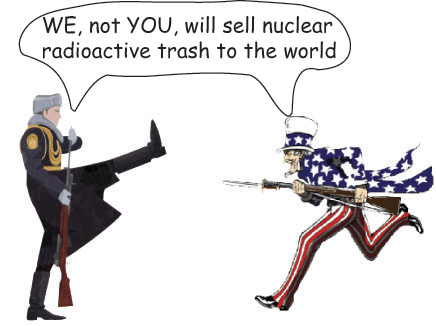
An obvious contradiction is the way in which both Russia and the West agonise about nuclear terrorism and nuclear weapons proliferation, while enthusiastically marketing nuclear technology to all and sundry. Never mind if it’s to an unstable Middle Eastern or East Asian regime, with a high risk of both terrorism and nuclear weapons development.
Another contradiction is the pretense going on that Big nuclear reactors and Small nuclear reactors are being happily promoted at the same time. The “conventional” big reactor companies. Toshiba Westinghouse, Rosatom, AREVA etc are determined to sell their stuff, and no way want to let the “new little” nuclear reactors take over the market. You can see this battle going on in Britain, with the “little nukes” lobbying away, and getting themselves set up as a “charity” for goodness’ sake!
How long will it be before the world recognises that the commercial nuclear empire is crumbling. We don’t need their toxic expensive product. Meanwhile renewable energy gets ever cheaper, fast to set up, versatile, and attractive to the public.
India’s Prime Minister Modi lobbying the world, for India to join the nuclear salesmen
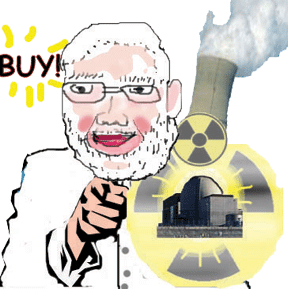 Modi’s global nuclear lobby tour, Nikkei Asian Review KIRAN SHARMA, Nikkei staff writer NEW DELHI 7 June 16, — Indian Prime Minister Narendra Modi is personally lobbying Switzerland, the U.S. and Mexico for his country’s admission into the 48-nation Nuclear Suppliers Group ahead of its next meeting in Vienna on Thursday.
India’s entry has been opposed by China, and Modi’s lobbying is the major component in a five-nation tour begun Saturday that also takes in Afghanistan and Qatar.
The announcement in Geneva was a boost to India because Switzerland had earlier been dubious about backing entrance to the NSG by nonsignatories to the Treaty on the Non-Proliferation of Nuclear Weapons. India considers the NPT discriminatory, and has not signed up.
India applied for Nuclear Suppliers Group membership on May 12 after preparing for several years. The group was created in response to India’s first nuclear test in 1974 to control the global supply of atomic material and technology. ……..
China, India’s biggest neighbor, argues that any new Nuclear Suppliers Group member should have signed the NPT. The U.S. backs India, citing its clean nonproliferation record. The U.S. helped India secure a special waiver from the NSG in 2008 for a bilateral civil nuclear deal. ………
India says it seeks a nuclear industry compliant with international norms and practices, but views the NSG and the NPT as separate matters.
“The NSG is a regime,” said Jaishankar. “It is a sort of a flexible arrangement amongst states, which is quite different from the NPT — which is a treaty.” The Indian foreign secretary pointed out that the central words in the two titles were “supplier” and “proliferation.” “So, I think the objectives are different,” he said……..
After the NSG’s meeting this week in Vienna, the group will meet in Seoul on June 24 and will review India’s application…..http://asia.nikkei.com/Politics-Economy/International-Relations/Modi-s-global-nuclear-lobby-tour
A hitch in India’s entry to the nuclear selling cartel
- Nuclear Suppliers Group still debating India’s application
-
Obama and Modi have pushed for membership in nuclear cartel
India will probably need to wait a while longer before it joins the elite club of nations that control trade in advanced nuclear technologies, according to three diplomats with knowledge of the process.
The Nuclear Suppliers Group, or NSG, is unlikely to accept India’s application for membership when it meets June 20 in Seoul because officials in New Delhi haven’t yet met all the criteria for admission, said the diplomats, who represent governments inside the 48-nation group. They asked not to be named in line with diplomatic rules for discussing private deliberations.
 A delay could roil plans by U.S. President Barack Obama and Indian Prime Minister Narendra Modi, who were meeting in Washington on Tuesday, to bring the world’s second-most-populous nation into the nuclear mainstream. It would push back a decision on Indian membership to later in the year, and risk bumping into the U.S. presidential election. Continue reading
Europe and North America: aging nuclear reactors, components becoming obsolete
Escalating costs of nuclear power: too risky for Australia?, Independent Australia Climate News Network 7 June 2016, The nuclear industry worldwide faces an escalating battle to keep ageing reactors running as about a quarter of components and computer systems become obsolete. Paul Brown from Climate News Network reports.
LIFE EXTENSIONS to nuclear plants in Europe and North America are repeatedly being granted by safety regulators. But, according to nuclear plant owners, 25% of parts are now obsolete, so keeping the reactors going is becoming an increasing problem as components wear out
This is the background to the Nuclear Power Plant Optimisation Summit being held in Brussels Tuesday and Wednesday this week, when 150 of the world’s top nuclear executives will share experience on how to keep their stations open.
In theory, it makes economic sense to keep running a nuclear reactor well beyond its original design life, so long as it does not pose safety problems. With the capital cost of building the reactor written off decades earlier, profits can be substantial if the running costs can be kept low.
Life extensions In France, where 75% of electricity supply comes from 58 reactors, the government announced in February that it was prepared to raise the limit on the life of reactors from 40 to 50 years.
Also in February, two reactors in the UK that began generating in 1983 and are due to close in 2019 had their lives extended to 2024. Two others commissioned in 1988 will now work on until 2030. In all four cases, the owner can apply for further life extensions after that.
But nuclear power plants built across the world in the 1970s and 80s rely on computer technology and components now long out of production. Replacing worn-out parts is becoming a serious problem, causing an increasing number of unplanned and expensive shutdowns while components are updated.
Finding people with the expertise to operate obsolete equipment is a problem as experienced staff retire……
In Europe, there is little chance of replacing the obsolescent fleet with new plant. Perhaps the starkest example is France, with its 58 ageing reactors. It is building only one new replacement reactor.
This plant, at Flamanville in Normandy, should already be in operation, but is years late and three times over budget. Plans to build others have been shelved……https://independentaustralia.net/environment/environment-display/escalating-costs-of-nuclear-power-too-risky-for-australia,9079
India and Japan – no progress yet on nuclear business co-operation deal
India-Japan nuclear deal stuck on technical details, THE HINDU, KALLOL BHATTACHERJEE
The agreement misses Japan’s National Diet session
The India-Japan civil nuclear agreement is likely to have a long waiting period, probably more than a year, before it fructifies. This is because, the National Diet failed to take up the agreement in the summer legislative session which ended on June 1. Japanese diplomats further told The Hindu that even the “technical details” of the deal were yet to be finalised.
The civil nuclear agreement firmed up during the visit of Prime Minister Shinzo Abe in December 2015 needs the legislative approval as Japan wants to convince the political parties in the Diet that the “nuclear cooperation by Japan shall be carried out only for peaceful purposes”, Yasuhisa Kawamura, Press Secretary of Ministry of Foreign Affair of Japan told The Hindu.
- “The summer session of the Diet ended on June 1 and the nuclear agreement was not taken up for discussion. The next session of the Diet is in autumn,” Japanese ambassador to India Kenji Hiramatsu said on Tuesday in Delhi indicating that the agreement failed to make it to the Diet despite growing expectation that Japan would fast track the legislative approval for the same which came up after India concluded similar agreements with several major nuclear energy producing countries including the U.S.
Elaborating on the ambassador’s comments, Mr. Kawamura said “both Japan and India have been working on technical details of the Japan-India nuclear cooperation agreement, which have to be finalised as is mentioned in the memorandum which two Prime Ministers signed last December,” and added that the “schedule of submitting the Agreement to the Diet has not been yet decided”…….http://www.thehindu.com/news/national/indiajapan-nuclear-deal-stuck-on-technical-details/article8701794.ece
Russia pushing United Arab Emirates to buy nuclear technology
 Nuclear power key for UAE energy security, Khaleej Times Sarakshi Rai/moscow June 5, 2016 Nuclear power is the best way for the world and the UAE to meet its energy demands, according to top nuclear energy professionals at the recently concluded Rosatom Atomexpo 2016.
Atomexpo is the largest exhibition venue for meetings and negotiations between world leaders in the nuclear power sector. This year’s exhibition and conference focused on new players entering the nuclear energy sector.
Mohamed Shaker, minister of electricity and mineral resources, Egypt; Hassan Mahmoud Hassanein, first deputy minister of electricity and mineral resources, Egypt; Khaled Toukan, chairman of Jordan Atomic Energy Commission; and Hashem Yamani, president of King Abdullah City for Atomic and Renewable Energy, Saudi Arabia; featured in day two of the conference at a panel discussion highlighting the future of nuclear power and new players…….
Russia’s Rosatom keenly marketing nuclear power to Thailand, Vietnam, Indonesia, Malaysia, Cambodia, Myanmar and Laos
Russian nuclear agency bullish on Asean outlook ACHARA DEBOON ME THE NATION, Thailand, MOSCOW June 6, 2016 ROSATOM, Russia’s state nuclear-energy agency, is bullish on the outlook of its business in Southeast Asia after the speedy development of a project in Vietnam and a range of agreements with every country in the region except Singapore, the Philippines and Brunei.
“Public acceptance is a key element, and we pay much attention to it,” he said…….
At the expo, a number of agreements with Indonesia were signed, also involving the training of specialists. This followed an agreement on the basic reactor design signed last year.
In the past few years, seven countries including Thailand have signed cooperation agreements with Rosatom. This month, a working group was established with Cambodia’s National Council for Sustainable Development after an agreement on the peaceful uses of atomic energy. Myanmar and Laos also have similar cooperation agreements.
Three Myanmar students are now studying nuclear science in Russia on scholarships……
USA tries to bend the rules, so Toshiba-Westinghouse can sell nuclear reactors to India
No Exceptions for a Nuclear India http://www.nytimes.com/2016/06/05/opinion/sunday/no-exceptions-for-a-nuclear-india.html?_r=0 By THE EDITORIAL BOARD JUNE 4, 2016 America’s relationship with India has blossomed under President Obama, who will meet with Prime Minister Narendra Modi this week. Ideally, Mr. Obama could take advantage of the ties he has built and press for India to adhere to the standards on nuclear proliferation to which other nuclear weapons states adhere.President Bush squandered an opportunity to demand more of India when he signed the 2008 deal, which opened the door to American trade in nuclear technology for civilian energy, something India had insisted was a prerequisite to more cooperation and lucrative business deals.
As part of the 2008 deal, the Indians promised they would be “ready to assume the same responsibilities and practices” as other nations with advanced nuclear technology. But they have fallen far short by continuing to produce fissile material and to expand their nuclear arsenal.
The Nuclear Suppliers Group is to discuss India’s application later this month. Mr. Obama is lobbying for India to win membership through a special exception. If he succeeds, India would be in a position to keep Pakistan, which has also applied for membership, from gaining membership because group decisions must be unanimous. That could give Pakistan, which at one time provided nuclear technology to North Korea and Iran, new incentives to misbehave.
Opposition from China, which is close to Pakistan and views India as a rival, could doom India’s bid for now. But the issue will not go away. India is growing in importance and seeking greater integration into organizations that govern international affairs. If it wants recognition as a nuclear weapons state, it should be required to meet the nuclear group’s standards, including opening negotiations with Pakistan and China on curbing nuclear weapons and halting the production of nuclear fuel for bombs.
Finland’s Fennovoima nuclear station dependent on Russia for all the finance
“……the extraordinary problems at Olkiluoto have cast doubts over Finland’s ability to manage such projects, while Fennovoima was hit by a farcical hunt for European investors for Hanhikivi.
Worries about Russian involvement almost brought down the previous Finnish coalition government. The Green party left the administration, accusing its former partners, some of whom are still in power, of pursuing a policy of “Finlandisation” — an extremely loaded term locally meaning the accommodation of Russian views in Finnish policy. …..
The deal is also of huge importance to Rosatom and its international ambitions to play a leading role in any revival of nuclear power outside the former Soviet Union…..” Finland raises its bet on nuclear power, Ft.com 5 June 16
1 This Month




PLEASE OPPOSE HR 8255 AND S.3639 – bills would accelerate satellite deployment, with no environmental review or safeguards – https://ncstd5li.quorum.us/campaign/169331/
To see nuclear-related stories in greater depth and intensity – go to https://nuclearinformation.wordpress.com
-
Archives
- September 2026 (330)
- August 2026 (330)
- July 2026 (355)
- June 2026 (287)
- May 2026 (306)
- April 2026 (356)
- March 2026 (251)
- February 2026 (267)
- January 2026 (308)
- December 2025 (358)
- November 2025 (359)
- October 2025 (375)
-
Categories
- 1
- 1 NUCLEAR ISSUES
- business and costs
- climate change
- culture and arts
- ENERGY
- environment
- health
- history
- indigenous issues
- Legal
- marketing of nuclear
- media
- opposition to nuclear
- PERSONAL STORIES
- politics
- politics international
- Religion and ethics
- safety
- secrets,lies and civil liberties
- spinbuster
- technology
- Uranium
- wastes
- weapons and war
- Women
- 2 WORLD
- ACTION
- AFRICA
- Atrocities
- AUSTRALIA
- Christina's notes
- Christina's themes
- culture and arts
- Events
- Fuk 2022
- Fuk 2023
- Fukushima 2017
- Fukushima 2018
- fukushima 2019
- Fukushima 2020
- Fukushima 2021
- general
- global warming
- Humour (God we need it)
- Nuclear
- RARE EARTHS
- Reference
- resources – print
- Resources -audiovicual
- Weekly Newsletter
- World
- World Nuclear
- YouTube
-
RSS
Entries RSS
Comments RSS

