USA’s supposed nuclear renaissance is just fizzling out
 The U.S. Nuclear Boom Has Turned Into a Dud, The Motley Fool, 21 June 16 One of America’s biggest nuclear power plant owners doesn’t see a future for two of its plants. Five years ago, we were supposed to be entering a nuclear renaissance. A string of new nuclear plants were being planned and there were loan guarantee programs in place from the federal government to make their construction possible.
Alas, today, the nuclear industry in the U.S. is dying. Old plants are shutting down, new plants are vastly over budget, and there doesn’t seem to be any appetite to take a risk on starting construction on next-generation plants. Where did things go wrong?
America’s nuclear champion abandons its post
Exelon (NYSE:EXC) is the country’s largest nuclear plant operator and has a huge incentive to see nuclear succeed. But it’s losing the battle to keep its older nuclear plants alive. ……
After the Illinois legislature declined to provide financial incentives to the Clinton Power Station and Quad Cities Generating Station it appears the plants are going to be the next to shut down. The company said it will close the Clinton plant next June and the Quad Cities plant a year later.
This could be a bad sign for Duke Energy (NYSE:DUK), FirstEnergy (NYSE:FE), andEntergy (NYSE:ETR), all of whom own multiple nuclear plants across the country. If Exelon can’t justify keeping plants open based on economics, how long will other plants last?
New nuclear plants have been a disaster
Older plants are being shut down, but new plants aren’t faring much better. Southern Company’s (NYSE:SO) Vogtle nuclear plant addition has seen costs surge more than 50% over the original budget to over $21 billion. And at that price, there’s no chance nuclear would be competitive on a cost basis with natural gas or renewable energy. …….http://www.fool.com/investing/2016/06/21/the-us-nuclear-boom-has-turned-into-a-dud.aspx
Financially imprudent for India to let Westinghouse build nuclear reactors
 The cost of nuclear diplomacy, THE HINDU, SUVRAT RAJU, 20 JUNE 16 The government’s decision to let Westinghouse build six nuclear reactors in India smacks not only of arbitrary use of executive authority but is also financially imprudent
 In their recent joint statement, Prime Minister Narendra Modi and President Barack Obama “welcomed the start of preparatory work… in India for six AP1000 reactors to be built by Westinghouse…” Judging by the cost of similar reactors under construction in the U.S., these six reactors may cost as much as Rs.4 lakh crore. This makes the deal potentially the largest commercial contract in the offing between the two countries.
Economically unviable When the United Progressive Alliance government announced its intention to start work on two reactors each from Westinghouse and General Electric (GE) in the 12th Plan period (2012-2017), it did little to pretend that these contracts made sense on their own merits. Instead, as the former chairperson of the Atomic Energy Commission, Anil Kakodkar, explained, India had “to keep in mind the commercial interests of foreign countries and of the companies there” and was obliged to purchase these reactors in return for U.S. diplomatic support on other issues.
Last year, GE backed out of this arrangement citing concerns about India’s liability law. This was good riddance; GE was offering India an untested design that it has not yet managed to sell anywhere in the world. But the government’s decision to deepen India’s investment in Westinghouse — even as negative news about the company has accumulated — makes little sense.
In April, Toshiba, which acquired Westinghouse in 2006, announced a $2.3 billion write-down in its value, largely because of persistent concerns about the economic viability of Westinghouse’s AP1000 design. Of more than a dozen orders that Westinghouse expected from within the U.S. a decade ago, only four have materialised. Just last month, a utility called Florida Power and Light postponed its plans for two AP1000 reactors by at least four years. And in February, the Tennessee Valley Authority, a U.S. government company, cancelled its plans for two AP1000 reactors explaining that this was “the fiscally responsible action”.
- the government has persisted in making concessions to Westinghouse. In February, it ratified the “Convention on Supplementary Compensation” (CSC) for Nuclear Damage that contradicts India’s domestic liability law and protects nuclear suppliers from liability for an accident. Now, in the event of a disaster, Indian courts may find it difficult to exercise jurisdiction over Westinghouse that is not based in India and could point to India’s international commitments under the CSC to block any potential claims against it.
- For example, Dow Chemicals has rebuffed attempts to make it contribute to a clean-up in Bhopal by arguing that Indian courts have “no jurisdiction over it”. And in a cautionary tale about how flawed international agreements can subvert the domestic legal system, in 2011, an international arbitration tribunal awarded White Industries Australia Ltd. AU$4 million under a bilateral investment treaty even as its dispute with the Indian government was sub judice in India’s Supreme Court……..http://www.thehindu.com/opinion/op-ed/the-cost-of-nuclear-diplomacy/article8748864.ece
Call for Britain to have Russia build UK’s new nuclear stations

 UK government needs a nuclear plan B, says Tim Yeo, Guardian, Terry Macalister, 19 June 16, “…….. Tim Yeo, a former chair of the energy and climate change committee, said the government should also consider whether the Russian state operator, Rosatom, or the British state could build new atomic plants.
The Hinkley project in Somerset has been hit by a series of delays, with its developer, EDF, recently postponing a final investment decision until September.
Yeo said continuing opposition from EDF unions to spending huge sums of money in Britain and political uncertainty ahead of the French elections next spring could hold up the project further……..
Yeo said the Russian political situation made it harder for the UK government, but Russian nuclear sources have previously said Rosatom would like to talk.
In 2014, a senior Decc officialconfirmed that there had been serious contact between the two sides……
The pro-nuclear campaigner said the total cost of any new reactor to energy billpayers could be reduced if the British government became directly involved, as some City analysts have claimed…….https://www.theguardian.com/uk-news/2016/jun/19/uk-government-should-have-a-nuclear-plan-b-tim-yeo-hinkley-point-bradwell-scheme
South Carolina Electric and Gas Co slugging customers for costs of nuclear reactors that might never be built
 Power surge: Cost overruns at South Carolina nuclear plant growing part of SCE&G customer bills, Post and Courier David Wren Email @David_Wren_ 19 June 16 The state legislation allowing South Carolina Electric & Gas Co. to charge customers for two new reactors at its nuclear power plant years before they are completed has been compared to making payments on a new car without knowing the final price and before it leaves the assembly line.
The monthly payments continue to rise, but it’s not certain whether the customer making those payments will ever drive the car.
At least now, SCE&G’s customers have an idea how much the expansoin of the V.C. Summer Nuclear Station is costing them each month. The state’s Office of Regulatory Staff, which represents the public’s interest in utility issues, this month said SCE&G’s customers are paying an average of $23.16 each billing period — or 16.1 percent of their total bill — toward building the Midlands nuclear plant
And that’s likely to increase if the state Public Service Commission approves the company’s request to boost the project’s cost by another $852 million to $14 billion — more than $4 billion higher than original cost estimates.
SCE&G is using a state law called the Base Load Review Act to finance the nuclear project near Jenkinsville.
The law allows the utility to charge its 700,000 customers for construction as the project proceeds. ……
Critics like Frank Knapp, president and CEO of the state’s Small Business Chamber of Commerce, say the act “has turned into a blank check” for SCE&G.
The utility is allowed by state regulators to take up to 10.5 percent of the construction costs as profit. And Knapp says the pay-as-you-go method is unfair because some customers now paying for the project will leave the utility’s service area before it comes online……. http://www.postandcourier.com/20160618/160619424/power-surge-cost-overruns-at-south-carolina-nuclear-plant-growing-part-of-sceg-customer-bills
USA nuclear plants going down like ninepins. Diablo next?
Closing Diablo would make California entirely nuke-free
Along with most nukes around the world, the only other remaining west coast reactor, WPPS2 on Washington’s Hanford military reservation, is also losing massive amounts of money.
Should California follow suit at Diablo, its conversion to a wholly green-powered economy would accelerate, likely leading Los Angeles to become the world’s first Solartopian megalopolis.
Ironically, with citizen action, a big push in that direction could now come from a state commission’s decision to enforce environmental protections signed into law by California’s most pro-nuke governor.
Because they can’t evenly compete with renewable energy or gas, a tsunami of shut-downs has swept away a dozen U.S. reactors since October, 2012. Dozens more teeter at the brink, including two at Indian Point, just north of Manhattan, and Ohio’s rapidly crumbling Davis-Besse reactor near Toledo.
5 More U.S. Nukes to Close, Will Diablo Canyon Be Next? http://ecowatch.com/2016/06/17/diablo-canyon-meeting/ Harvey Wasserman | June 17, 2016 A rising tsunami of U.S. nuke shut-downs may soon include California’s infamous Diablo Canyon double reactors. But it depends on citizen action, including a statewide petition.

Five U.S. reactor closures have been announced within the past month. A green regulatory decision on California’s environmental standards could push the number to seven.
The focus is now on a critical June 28 California State Lands Commission meeting. Set for Sacramento, the hearing could help make the Golden State totally nuke free, ending the catastrophic radioactive and global warming impacts caused by these failing plants. A public simulcast of the Sacramento meeting is expected to gather a large crowd at the Morro Bay Community Center near the reactor site. The meeting starts at 10 a.m., but environmental groups will rally outside the community center starting at 9 a.m.
The three State Lands Commissioners will decide whether to require a legally-mandated Environmental Impact Report under the California Environmental Quality Act (CEQA). If ordered, a public scoping process will begin, allowing interested groups and individuals to weigh in on the environmental impacts of operation of two nuclear reactors on California’s fragile coastline. Continue reading
Woes of France’s nuclear company AREVA, as it splits into three
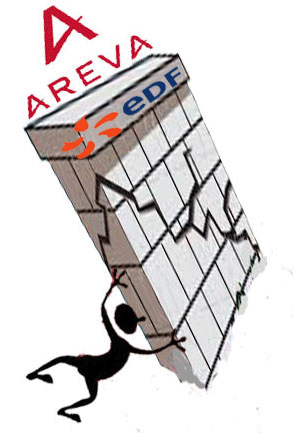
 French firm involved in Hinkley Point C unveils restructure plan Areva, a 10% equity participant in the Somerset scheme, reveals plans to split into three to stem losses and isolate Finnish project, Guardian, Terry Macalister, 16 June 16, Areva, one of the French companies at the heart of the controversial Hinkley Point C nuclear project, has unveiled plans to break itself up into three parts in a bid to stem huge losses.
The 87% state-owned atomic engineering and uranium mining company is hoping to raise €9bn (£7bn) from the government and from selling off assets after running up losses of €2bn last year.
Areva, a 10% equity participant in the £18bn planned new Hinkley scheme, is also using the split to isolate financial commitments to a hugely delayed project at Olkiluoto in Finland……
EDF, which is also part-owed by the French state, has its own massive debt problems and had refused to buy part of Areva, as ministers wanted, unless it could take the business without any financial commitments for the Olkiluoto 3 scheme.
Areva, which is providing the same European pressurised water reactor for Olkiluoto as is planned for Hinkley, is currently in a standoff over competing legal claims with the Finnish utility TVO relating to the project in Finland…….
A formal decision to go ahead with the investment at Hinkley has been put off until September amid internal opposition at EDF from unions and others about the wisdom of taking on such a major financial commitment……..https://www.theguardian.com/business/2016/jun/15/french-firm-involved-in-hinkley-point-c-unveils-restructure-plan
Nuclear marketers see India as a saviour of nuclear industry
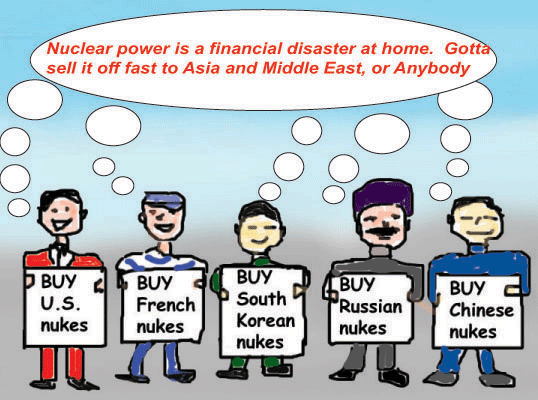
U.S. President Barack Obama and Indian Prime Minister Narendra Modi agreed at a June 7 summit that U.S. nuclear reactor maker Westinghouse Electric, a subsidiary of Japan’s Toshiba, would build power plants in the South Asian nation. In a statement following their meeting in Washington, Modi and Obama said they welcomed the announcement by the Nuclear Power Corp. of India and Westinghouse that they would finalize a contract by June 2017. The two companies had said they would immediately begin the work of designing reactors and selecting locations.
As the nation opens its market for nuclear plants, competition is likely to intensify between the U.S., France, Japan and other countries seeking a greater market share.
France reached an agreement early this year to start a development project in western India in 2017. Although a formal agreement has yet to be signed, the country will compete with the U.S. to become the first Western country in about 40 years to deliver a reactor to India. Japan also reached a broad agreement with India in late 2015……..http://asia.nikkei.com/magazine/20160616-POWER-PERFORMERS-of-the-Asia300/Business/Nuclear-power-plant-builders-see-new-opportunities-in-India
India paying high cost to save Westinghouse’s nuclear business
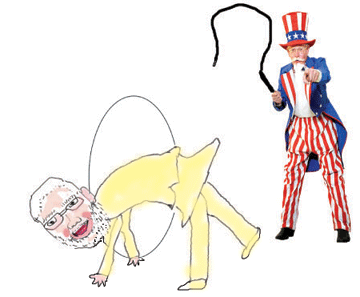 The Cost of Modi’s US Visit: Offering Rs. 2.8 lakh crore to Westinghouse, News Click, Prabir Purkayastha, June 09, 2016
The 4th visit of Modi to the US has very little to show as achievements. No wonder, the headlines screamed about “the start of the preparatory work” on six nuclear reactors as a major achievement. Not content with this, the Westinghouse AP 1000 reactors were even hyped as 5th generation reactors, skipping two whole generations of reactors in between. The earlier AP 600 reactors are recognised as 2nd generation reactors, making the AP 1000 the 3rd generation, which is how they are known in the rest of the world – except to certain gentlemen in the Indian media.
The reality is that after 8 years of negotiations on the Westinghouse reactors, India has now shifted the location from Mithivirdhi in Gujarat to Srikakulam in Andhra Pradesh. The negotiations for the deal with Westinghouse are still stuck, and only a new beginning is being sought with this new site. All that Westinghouse has agreed is that they will do some preliminary work for this new site — “start of the preparatory work”.
In today’s world, nuclear energy is a dying technology. Its costs are too high, its ability to build to schedule is non existent and it faces the challenge of renewables – wind and solar – the costs of which are dropping rapidly. The US, after a brief flirtation with nuclear energy – the so-called nuclear renaissance – has pretty much decided not to invest any further in this technology.
It is only China and India that can revive the dying nuclear industry of the US. Both Westinghouse and GE are without any further orders in the US and in the EU. So it is not the US showing its willingness to “give” us nuclear reactors to India that is the issue; it is India helping to revive a patient – the US nuclear industry – which has currently one foot already in the grave.
How much are we committing to pay to revive a dying Westinghouse? Continue reading
Watts Bar-2 nuclear reactor – 43 years to build – shut down after 2 days
Nuclear fail: New reactor took 43 years to build, shut down after 2 days, REneweconomy, By Craig Morris on 16 June 2016 Renewables International
More than four decades after construction began, the Watts Bar-2 reactor was finally connected to the grid on 3 June 2016. However, two days later, while operating at 12.5 percent power, the reactor automatically shut down.
According to the U.S. Nuclear Regulatory Commission (NRC), the reactor tripped when a high pressure turbine valve failed to open. As of 8 June 2016, the reactor has not restarted and no restart schedule has been fixed yet, according to a spokesperson for plant owner the Tennessee Valley Authority (TVA)……….
TVA filed the construction license application for Watts Bar on 18 May 1971. On 18 September 1972, TVA applied for the exceptional authorization of certain site preparation activities, although it had not transmitted the final environmental impact statement and the construction license was still pending. TVA argued that startup of unit 1 by May 1977 “is vital in order to permit-TVA to meet its summer 1977 peak loads” and beyond:
“The present schedule for constructing the Watts Bar Nuclear Plant is predicated on beginning construction in October 1972. This schedule is extremely tight and failure to begin construction in October casts serious doubts on TVA’s ability to meet its load commitments in the 1977-78 period.”
TVA also insisted that cost of any delay be passed on to the ratepayer:
Fort Calhoun nuclear plant too expensive to run

 OPPD’s Fort Calhoun nuclear plant has become too expensive to run, company says, Omaha.com By Cole Epley / World-Herald staff writer
The nuclear plant at Fort Calhoun is simply too expensive to run when compared to other, cheaper forms of power, the Omaha Public Power District’s chief executive said Thursday. So it needs to shut down by the end of the year, he said.
OPPD President and Chief Executive Tim Burke told the utility’s board of directors that it no longer makes financial sense to continue operations at Fort Calhoun, which is the smallest nuclear power plant in the United States. The site for the plant was purchased in 1965.
The board will reconvene on June 16 to make a decision on Burke’s recommendation.
Closing the plant would mean lower overhead costs when it comes to complying with federal nuclear regulations and other expenses — including the $20 million a year OPPD pays an outside firm to run the plant. That firm, Exelon, has run Fort Calhoun since 2013 after OPPD was rapped hard by federal regulators for serious safety lapses; the plant was shut from mid-2011 until December 2013 as the utility dealt with Missouri River flooding and correcting violations of federal nuclear safety rules.
Shutting the plant permanently would move the utility away from relatively expensive-to-generate nuclear energy in an era of low-priced natural gas and an increasing reliance on wind power.
The recommendation to shut the plant comes with a guarantee, Burke said: Ratepayers won’t see a general rate increase until at least 2022 because of the savings from shuttering Fort Calhoun.
“You have to say enough is enough and curb the costs,” OPPD board member Tom Barrett said. “That’s the cold, hard facts of this business.”
The costs of nuclear generation put it at a disadvantage to wind and natural gas, according to the federal Energy Information Administration. The EIA in June of last year reported the total costs per megawatt-hour for a new nuclear plant to be about $95. In comparison, the cheapest natural gas-fired generation is about $75 or less per megawatt-hour and wind generation is about $74 per megawatt-hour…….
John Keeley, a spokesman for the Washington, D.C.-based Nuclear Energy Institute, an industry advocate, said the Fort Calhoun situation is an example of the vulnerability of similar nuclear plants to market conditions — mainly, the sources of energy that, at the moment, can produce electricity more cheaply, like natural gas and wind. (Five nuclear plants have closed in the past few years; two others are set to close.)…….
OPPD ratepayer Mark Welsch, who attended Thursday’s meeting, commended the utility’s management team and board for taking up the issue. Welsch is the head of the Omaha chapter of the advocacy group Nebraskans for Peace. He said the utility should be tilting toward renewable sources of energy, like wind.
“I’m very proud to be a customer-owner of OPPD right now,” he said. “The board is taking a hard look at a very hard potential decision it will have to make.”
If the board follows through on the recommendation, OPPD’s wind and renewable generation will make up 49 percent of its energy portfolio by 2020, up from 38 percent that is currently forecast.
OPPD’s relationship with renewables grew in 2014 when the utility approved a long-term generation plan that included the phase-out some of its coal-burning units, conversion of others to natural gas and the addition of 400 megawatts of wind power from a massive wind farm near O’Neill, Nebraska.
Under the plan presented Thursday, those plans would remain intact, but Burke said the most economically viable course is one that does not include nuclear power and effectively ends more than 40 years of nuclear generation…….
Decommissioning can take 10 years under a process known as Decon, under which a plant is dismantled and contaminated materials are either decontaminated or removed. In a deferred dismantling process known as Safstor, facilities are maintained for a period of up to 60 years and radioactivity decays to a safe level.
OPPD in its 2015 annual report estimated that the costs to decommission Fort Calhoun would be about $884 million. The utility has socked away about $373 million for those costs.
The board will take 30 days to consider management’s proposal, during which time it will field concerns and suggestions from stakeholders and ratepayers…………. Contact the writer: 402-444-1534, cole.epley@owh.com http://www.omaha.com/money/oppd-s-fort-calhoun-nuclear-plant-has-become-too-expensive/article_f8b86658-184e-11e6-b852-8f5144170b67.html
Company wants customers to pay more in advance for building nuclear project
“The amount that SCE&G customers are unjustly forced to pay in advance for the nuclear project has become a significant burden”
“That SCE&G customers are now paying over 16 percent of the bill for a project that may face more delays and cost overruns should cause alarm about skyrocketing rates, rates that are certain to go even higher due to the nuclear project.”
SCE&G asking for $852 million more to finish Summer nuclear plants BY RODDIE BURRIS rburris@thestate.com The State, 13 June 16, COLUMBIA, SC
The SCANA-owned utility also seeks a new fixed price contract option
Utility says future cost overruns would belong to construction contractor Westinghouse
S.C. public interest agency says price tag would not be “fixed”; likely to cost more
SCE&G is asking state regulators to approve an $852 million increase in the projected cost of building two nuclear reactors in Fairfield County, but the company says the potential for any other cost increases is limited.
Critics of the requested increase — which would be paid for by customers — call the request “stunning.” If the state Public Service Commission approves the higher cost, South Carolina Electric & Gas Co.’s 702,000 electric customers would likely face higher rates.
But SCE&G says its contract with the project’s new construction company essentially “fixes” the reactors’ cost in place. “The fixed-price option provides substantial value to our customers, investors and our company by limiting the risk of future cost increases,” said Eric Boomhower, SCE&G spokesman.
The S.C. Office of Regulatory Staff said Monday it is skeptical. The agency represents the public’s interest in utility regulation and must make a recommendation on SCE&G’s request to the S.C. Public Service Commission by Sept. 1……
“(This proposal’s) got some aspects of a fixed price, but there’s stuff in there that’s not fixed and we are going through that now.”
The latest proposed increase follows the company’s decision in October to replace the construction project’s contractor with Westinghouse Electric Co. After a review of the project, Westinghouse and SCE&G agreed on the new contract with the higher projected cost. The project’s new total cost would be $14 billion, about 43 percent higher than the $9.8 billion price tag announced in 2008.
SCANA, parent company of SCE&G, and Santee Cooper, the state-owned utility, have partnered to build Reactors 2 and 3 at the V.C. Summer plant in Jenkinsville. SCANA owns 55 percent of the project.
The 2005 Energy Policy Act provides a production tax credit for electricity produced by new nuclear power plants. But to qualify for the nuclear production tax credit, a new nuclear power plant must be in service by Dec. 31, 2020.
The Unit 2 and Unit 3 reactors under construction at the Summer plant are eligible for the tax credits. But construction delays, which also drive cost overruns, have plagued progress and some are concerned about the project qualifying for the tax credits…….
Within 30 days, SCE&G will outline an electric rate increase request to the PSC under the state’s Base Load Review Act, which allows utilities to collect construction finance costs on nuclear construction projects prior to completion of the plants. SCE&G said the practice saves ratepayers additional costs later on……
critics aren’t happy. “The amount that SCE&G customers are unjustly forced to pay in advance for the nuclear project has become a significant burden, as revealed by” Scott’s office, said Tom Clements, director of Savannah River Site Watch, a watchdog group.
“That SCE&G customers are now paying over 16 percent of the bill for a project that may face more delays and cost overruns should cause alarm about skyrocketing rates, rates that are certain to go even higher due to the nuclear project.” http://www.thestate.com/news/business/article83609292.html
India’s nuclear lobbying
Viewpoint: India’s nuclear lobbying and an increasingly isolated Pakistan, BBC News, By Ahmed RashidLahore 14 June 2016
India’s American-backed bid to join the prestigious Nuclear Suppliers Group (NSG) has once again isolated Pakistan in South Asia.
Pakistan is increasingly finding itself friendless in the region as Iran, Afghanistan and India all find fault with Pakistan’s inability to end terrorism on its soil and in particular to bring the Afghan Taliban to the table for peace talks, as Islamabad promised to do nearly two years ago.
The 48-nation NSG, which sets global rules for international trade in nuclear energy technology, has become the latest diplomatic battleground between India and Pakistan. It is due to hold a crucial meeting this month. The Pakistani military is angry that after Indian Prime Minister Narendra Modi’s recent trip to Washington, the US has been furiously lobbying all member countries to give India a seat at the NSG table.
Pakistan then asked for the same, but its proliferation record is not as good as India’s and it clearly would not succeed. Instead, it has asked China to veto the Indian bid which it is likely to do. However, smaller countries are angry with the US, who they accuse of browbeating them, and complain that neither India nor Pakistan can become members until they sign the nuclear non-proliferation treaty (NPT) which is an essential requirement.
President Obama is going against his own policy of nuclear restraint and disarmament by offering to make India – but not Pakistan – a member of the NSG, when the US has also tied up plans to sell India six nuclear power plants……..http://www.bbc.com/news/world-asia-36518330
The alarming hidden costs of nuclear power stations
 The scary hidden cost of building a nuclear power station, http://www.rdm.co.za/business/2016/06/13/the-scary-hidden-cost-of-building-a-nuclear-power-station
Even assuming that SA can find the funds, we would do well to take into account the non-negotiable costs of decommissioning and waste management BRENDA MARTIN
13 JUNE 2016 Consider decommissioning costs before committing to new nuclear power investment
As South Africa prepares to invest in new nuclear power, we may do well to consider the other end of such investment: decommissioning. In the north of Germany, the Greifswald nuclear power plant (also known as Lubmin) has been undergoing the process of decommissioning since 1990. Before its closure, with a total planned capacity of 8 x 400MW plant built, but with only 5 reactors fuelled, Lubmin was to be the largest nuclear power station in East Germany prior to reunification. The reactors were of the VVER-440/V-230 type, or so-called second generation of Soviet-design. When it is concluded, the full process of decommissioning at Lubmin will have taken 30 years from first shutdown. In 1990 the company responsible for decommisioning this 8 x 400MW nuclear power plant, Energiewerke Nord, estimated a cost of half a billion DM per unit. Later this estimate was adjusted to 3.2 billion/unit. Today 4.1 billion/unit is a conservative final estimate (Energiewerke Nord, 2016).
More recently, early in 2012, following the Fukushima disaster in March 2011, the German government announced the immediate withdrawal of the operating licenses of eight German nuclear power plants and revived its plans to phase out nuclear power — by 2022. As this process unfolds, it will be possible to move beyond speculation, to actual data on costs, process and skills required for decommissioning.
What is involved in decommissioning a nuclear power plant?
Nuclear decommissioning is the process whereby a nuclear power plant site as a whole is dismantled to the point that it no longer requires measures for radiation protection to be applied. It is both an administrative and a technical process, including clean-up of all radioactive materials and then progressive demolition of the plant. Once a facility is fully decommissioned it should present no danger of radiation exposure. After a facility has been completely decommissioned, it is released from regulatory control and the plant licensee is no longer responsible for its safety.
The costs of decommissioning are spread over the lifetime of a facility and given that most nuclear power plants operate for over 40 years, funds need to be saved in a decommissioning fund to ensure that future costs are provided for.
What are the current estimates for nuclear power plant decommissioning?
This year, on April 28, an independent commission appointed by the German government (Kommission zur Überprüfung des Kernenergieausstiegs, KFK) presented its recommendations to the Ministry of Economics and Energy. The commission recommended that reactor owners — EnBW, EOn, RWE and Vattenfall — pay an initial sum of €23.3-billion ($26.4-billion) over the next few years, into a state-owned fund set up to cover the costs of decommissioning of the plants and managing radioactive waste. This sum includes a “risk premium” of around 35% to close the gap between provisions and actual costs.
According to the ministry, there will be approximately 10 500 tonnes of used fuel from 23 nuclear power plants, which will need to be stored in about 1 100 containers. A further 300 containers of high- and intermediate-level waste are also expected from the reprocessing of used fuel, as well as 500 containers of used fuel from research and demonstration reactors. In addition, some 600 000 cubic meters of low- and intermediate-level waste will need to be disposed of, including waste from industry, medicine and research.
Just before KFK started its work in October 2015, a study conducted by German audit firm Warth & Klein Grant Thornton for the Ministry of Economics and Energy had estimated the following costs for decommissioning 23 nuclear power plants, in 2014 money i.e. the cost if plants were to be decommissioned in 2014:
- Closure and decommissioning: €19.7-billion
- Containers, transport: €9.9-billon
- Intermediate storage: €5.8-billion
- Final low heat waste storage: €3.75-billion
- Final high active waste storage: €8.3-billion
i.e. a total of €47.5-billion.
However, decommissioning of all of Germany’s 23 nuclear power plants will not be undertaken at the same time. Most costs will be incurred in the future. Annexure 9 of the Warth & Klein Grant Thornton report provides an estimate of likely decommissioning costs when taking into account projected interest rate and inflation scenarios, as well as various likely nuclear-specific cost increases. Their conclusion? Total costs of decommissioning all nuclear power plants in Germany could reach up to €77.4-billion.
Given these emerging figures, even assuming that SA can find the necessary funds needed for new nuclear power investment, we would do well to take into account the increasingly known, non-negotiable related costs of decommissioning and waste management — of both old and new nuclear-related investment.
AREVA’s second biggest shareholder, Kuwait funds, wants to sell out of AREVA
 Kuwait fund wants to sell French nuclear group Areva stake -media, 13 June 16, ra ra http://www.reuters.com/article/us-areva-kuwait-idUSKCN0YZ19M Sovereign wealth fund Kuwait Investment Authority (KIA) has told French authorities it wants to sell its stake in nuclear group Areva (AREVA.PA), La Lettre de l’Expansion reported on Monday.KIA is Areva’s second-biggest shareholder with a 4.82 percent stake, according to ThomsonReuters data.
The newsletter said the Kuwaiti fund had complained that its investment in Areva, which is majority owned by the French government, was made based on incorrect company accounts.
French Industry Minister Emmanuel Macron and Areva declined to comment on the report. KIA was not immediately available for comment.
KIA paid 600 million euros ($676 mln) for the stake in 2010, but since then Areva shares have plunged by about 90 percent as the firm’s equity has been wiped out by years of losses. Areva will be rescued by a 5 billion euro state-funded capital increase and its nuclear reactor unit will be taken over by state-owned utility EDF (EDF.PA) later this year or early next year.
The French state holds about 87 percent of Areva’s capital.
KIA or other minority shareholders have never publicly complained about Areva’s accounts, but former Areva chief executive Anne Lauvergeon was put under formal investigation last month for her role in the 2007 acquisition of uranium mining firm Uramin.
In France, a formal investigation does not automatically lead to a trial but often does.
Lauvergeon has repeatedly denied any wrongdoing and has said that asset depreciations at Uramin were partly due to the collapse of uranium prices after the Fukushima nuclear disaster in Japan in March 2011.
Areva has had to write down billions of euros on Uramin, which contributed to years of losses and eventually wiped out its equity, leading to a state rescue package early this year.
($1 = 0.8875 euros)
(Reporting by Geert De Clercq, Michel Rose and Andrew Torchia; Editing by Susan Fenton and Alexander Smith)
Russians call US nuclear reactors a “white elephant” for India
US Nuclear Reactors to Prove White Elephant for India. Sputnik News 13 June 16 India’s latest move in the direction of implementing a nuclear energy pact with the US is gaining strong resentment as the US reactors are most likely to cost three times more than that of Russian reactors already well operational.
1 This Month




PLEASE OPPOSE HR 8255 AND S.3639 – bills would accelerate satellite deployment, with no environmental review or safeguards – https://ncstd5li.quorum.us/campaign/169331/
To see nuclear-related stories in greater depth and intensity – go to https://nuclearinformation.wordpress.com
-
Archives
- September 2026 (330)
- August 2026 (330)
- July 2026 (355)
- June 2026 (287)
- May 2026 (306)
- April 2026 (356)
- March 2026 (251)
- February 2026 (267)
- January 2026 (308)
- December 2025 (358)
- November 2025 (359)
- October 2025 (375)
-
Categories
- 1
- 1 NUCLEAR ISSUES
- business and costs
- climate change
- culture and arts
- ENERGY
- environment
- health
- history
- indigenous issues
- Legal
- marketing of nuclear
- media
- opposition to nuclear
- PERSONAL STORIES
- politics
- politics international
- Religion and ethics
- safety
- secrets,lies and civil liberties
- spinbuster
- technology
- Uranium
- wastes
- weapons and war
- Women
- 2 WORLD
- ACTION
- AFRICA
- Atrocities
- AUSTRALIA
- Christina's notes
- Christina's themes
- culture and arts
- Events
- Fuk 2022
- Fuk 2023
- Fukushima 2017
- Fukushima 2018
- fukushima 2019
- Fukushima 2020
- Fukushima 2021
- general
- global warming
- Humour (God we need it)
- Nuclear
- RARE EARTHS
- Reference
- resources – print
- Resources -audiovicual
- Weekly Newsletter
- World
- World Nuclear
- YouTube
-
RSS
Entries RSS
Comments RSS

