India’s nuclear insurance policy aims to transfer liability risk from nuclear suppliers
 India’s first insurance cover to NPCIL aims to transfer liability risk from nuclear suppliers, International Business Times (IBT) July 3, 2016 By Prabha K S National Power Corporation of India Ltd (NPCIL), the government-owned nuclear power generation company, received India’s first insurance policy that may offset liability risks seen as a bottleneck by foreign nuclear plant suppliers, reported IANS.
The policy, according to the report, will be applicable to all the plants of NPCIL. It covers their liability to the public in the event of accidents specified in the policy and the power plant’s “right of recourse against the equipment suppliers.”
The reinstatement premium will be decided after a claim is filed based on the insurer’s capacity to undertake further risks, said the official……He also added that the policy is devoid of ‘policy excess’, defined as the first amount uncovered by the policy and hence liable to be paid by the company……
The announcement comes after NPCIL paid Rs. 50,000 to each of the six workers who suffered burn injuries at the Kudankulam nuclear plant in May 2014 on successful intervention by National Human Rights Commission, as reported by the Indian Express.
NPCIL is currently mired in allegations of misleading people about the safety of the Kovvada plant in Andhra Pradesh.
Earlier, General Electric chairman Jeffrey Immelt also expressed reservations on building a nuclear plant in India, citing the liability law. http://www.ibtimes.co.in/indias-first-insurance-cover-npcil-aims-transfer-liability-risk-nuclear-suppliers-685317
New India Assurance Company Ltd to insure nuclear reactors
Nuclear plants insured http://www.thehindu.com/news/national/nuclear-plants-insured/article8804348.ece, 4 July 16 India’s first insurance policy covering public liability to an atomic power plant operator has been issued to Nuclear Power Corporation of India Ltd (NPCIL) but the reinstat-ement of insurance value post a claim will be decided later, industry officials said.
“We recently got the insurance policy covering all our atomic power plants. The total premium came around Rs. 100 crore for a risk cover of Rs. 1,500 crore,” S.K. Sharma, Chairman and Managing Director, NPCIL, said.
The policy complies with all the provisions of the Civil Liability for Nuclear Damage Act (CLND), said a known insurance industry official.
The Central government had announced in June 2015 the setting up of the Rs. 1,500-crore India Nuclear Insurance Pool to be managed by national reinsurer GIC Re.
The insurance policy was issued by the country’s largest non-life insurer New India Assurance Company Ltd.
The policy would cover the liability towards public as a consequence of any nuclear accident in the plants covered under the policy and also the right of recourse of NPCIL against equipment suppliers. The insurance coverage will be for all the NPCIL’s plants— like a floater cover.
Queried about the reinstatement premium, the official said it would be decided post a claim based on the capacity — to underwrite the risk — available with the insurers.
Complications in who pays for costs of Germany’s nuclear phase-out
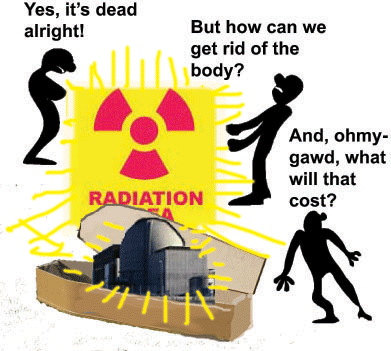 Who pays for Germany’s nuclear phase-out?,DW Hilke Fischer 1 July 16 Germany’s decision a few years ago to phase out nuclear power was an abrupt move. But it still remains unclear who foots the bill for shutting down the nation’s nuclear plants, as utilities seek damages from the state. Months after a Tsunami resulted in a nuclear disaster at the Fukushima Daiichi plant in Japan, Germany’s coalition government, led by Chancellor Angela Merkel, decided to phase out nuclear power in the country.
Immediately after Fukushima, eight of 17 functioning nuclear plants were shut down, and the government’s decision established a timeline of taking the remaining plants offline by 2022.
Five years later, it’s gradually becoming clear how much this hasty exit could cost. Feeling dispossessed by the move, major utilities have filed a raft of lawsuits claiming damage payments from the government amounting to around 20 billion euros ($22.3 billion).
An eagerly awaited ruling
Complying with the government’s nuclear moratorium, Germany’s biggest energy provider Eon had to shut down its power plants Isar 1 and Unterweser. The company has therefore sued both the federal government as well as the state governments of Bavaria and Lower Saxony, seeking damage payments to the tune of around 380 million euros. The state court of Hanover is expected to deliver its ruling on the case on Monday, July 4………..
the energy companies take issue not only with the moratorium. They – RWE, Eon and Vattenfall – have also lodged numerous cases at the constitutional court in Karlsruhe against the government’s entire policy mandating an accelerated exit from nuclear power……..
State responsible for disposal costs?
Lodging cases before the constitutional court is a pressure tactic, said Green Party politician Oliver Krischer in March. “It’s to obtain concessions over the financing of nuclear waste disposal,” he remarked, pointing to the nuclear commission the government had set up to advise it on how to allocate the costs of storage and disposal of nuclear waste as well as the decommissioning of the power stations.
At the end of April, the commission presented its recommendations: The companies have to bear the costs of decommissioning the nuclear power plants. Furthermore, Eon, RWE, Vattenfall and EnBW are to pay 23.3 billion euros into a fund to manage the storage and disposal of nuclear waste.
In return, the state is to take on all the residual financial risks associated with radioactive waste management. A number of scientists and economists argue that the costs would be much higher than the 23.3 billion euros, and that the taxpayers would be on the hook for those cost overruns.
Germany’s parliament is expected to vote on the recommendations after the summer break, and should it approve them, they would come into force at the end of the year. http://www.dw.com/en/who-pays-for-germanys-nuclear-phase-out/a-19372796
China trying to market nuclear reactors to Argentina
 China and Argentina reaffirm reactor agreement World Nuclear News, 01 July 2016 China and Argentina have signed a memorandum of understanding (MOU) reaffirming their plans to construct two new nuclear power reactors in the Latin American country with financing from Chinese banks. Construction of Argentina’s fourth reactor is to start early next year……..
America’s future in renewables: nuclear can’t compete on costs nor on safety
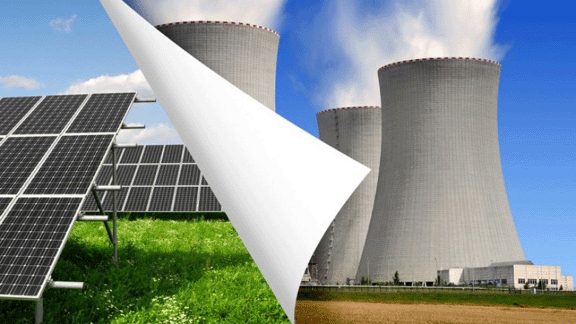
 Our future is in green energy not aging, costly nuclear plants Seattle Times, June 29, 2016 By Robert McCullough “……..The nuclear station, now called the Columbia Generating Station (CGS), was once known as Washington Public Power Supply System No. 2. This is a relic of an energy plan begun in the 1960s and built with technology from the 1970s. It is an 8-track tape player in an iPad world. The prices of electric power have plummeted over the years as renewables have sharply declined in price, natural gas is facing a glut and new technologies from LED lighting to rooftop solar have arrived.
Why is the plant so expensive? It is in a poor location — competing with far less costly renewable resources like wind and hydroelectricity. When the wind blows and the rivers surge, we have to turn off these resources, since the nuclear plant can’t adjust its output like alternative-energy resources. We have no storage solution for the nuclear waste that is being stored in its elevated spent fuel pool and in dry casks outside the plant. The plant is a singleton, rather than having twin units — there are strong economies of scale for twin plants that share repair and operating resources.
However, even more efficient, better-located nuclear plants are closing across the U.S. — recent announcements indicate plants closing in Illinois, New York, California, Massachusetts, and Nebraska. These plants are not closing because they are ailing. They are closing because the costs of aging nuclear is simply much higher than cleaner and simpler technologies.
The Nebraska closure is a case in point. Last week, the Omaha Public Power District, a public power entity comparable to Energy Northwest, announced the closure of the Fort Calhoun Nuclear Station on economic grounds. This was a thoughtful, well-considered opinion that weighed the costs over the rhetoric…….
Moldova hesitant – for now, resisting China’s nuclear marketing
 Will China Bring Nuclear Power to Moldova?, Eurasia Net 30 June 16 China appears willing to help Moldova become a nuclear power. But for now officials in Chi?in?u seem hesitant to go all-in on atomic energy.
Chinese representatives from the state-run National Nuclear Power Company (NNPC) were in Moldova in mid-May for talks aimed at identifying opportunities to boost “bilateral cooperation in the energy sector,” according to an official statement. Chinese and Moldovan officials agreed to complete a feasibility study on “launching new projects for producing electricity in Moldova” by the end of 2016……
For now, the Moldovan government seems more interested in renewable energy. ……
Târ?u said that he advised against a nuclear power plant because of the environmental risks, plus Moldova’s lack of water resources, facilities for storing radioactive waste, and “qualified and experienced staff in this field.”
Another risk also exists: an Associated Press report in late 2015 indicated that Moldova could be atrafficking hub for nuclear materials. Criminal groups with supposed Russian ties allegedly have used the country four times since 2010 to try and pass radioactive materials to anti-Western customers (including a Moldovan undercover agent posing as a representative of the Islamic State terror organization). None of the attempts succeeded……..
energy expert Târ?u does not believe that a nuclear power plant will be built in Moldova. Thirteen years ago, Moldova also considered the possibility of a French-built nuclear power plant, but the discussions resulted in nothing . http://www.valuewalk.com/2016/06/china-nuclear-plant-moldova/
Russia’s nuclear marketing: the ambitions and the reality
 Russia’s nuclear energy expansion – a geopolitical footprint?, New Eastern Europe
  News, , 28 June 2016 “…….As the low oil and gas prices globally have squeezed Russia’s fossil fuel export revenues, an integral part of the country’s income, the nuclear industry has been looking for a worldwide expansion. Rosatom, Russia’s state-owned nuclear champion, has in the recent years set an ambitious course to deliver Russian nuclear power generating technology to both traditional partner countries as well as to new “developing“ economies…….
Nuclear ambitions
Over the past decade state-owned nuclear corporation Rosatom and its network of subsidiaries have made direct or indirect commitments to build nuclear power plants in a number of countries around the world. As stated by a Rosatom official in a recent interview, Russia has signed intergovernmental agreements for the possible construction of 36 nuclear reactors overseas and is holding “active and consistent” tendering negotiations about 21 others. It is apparent that Russia seems to be looking away from Europe and its traditional markets in search of new business opportunities for its nuclear industry.
During the Russia – ASEAN (Association of Southeast Asian Nations) summit held on 19 and 20 May in Sochi, Russia’s president Vladimir Putin said his country is ready to provide a Generation III nuclear reactor technology to countries in Southeast Asia. Another Rosatom official called forAfrica to invest in nuclear energy during an annual energy forum in Johannesburg in February 2016.
The reality
The overall expansion agenda seems really impressive, but in fact only some of the projects are in an active construction phase – such as those in Belarus, China, Finland, India, and Slovakia. The projects in Egypt, Hungary, Iran and Vietnam are also likely to get the go-ahead in the near future. As for the rest, the picture has not been so rosy.
Turkey’s Akkuyu project is becoming increasingly bogged down after the relationship between Moscow and Ankara embittered last November. Ukraine has denounced an agreement with Russia on the construction of two units at the Khmelnitsky site as the two countries have become increasingly hostile due to the looming Donbas and Crimea crises. China appears to have taken over the project for the expansion of the Atucha plant in Argentina. And nuclear development on the African continent (except for South Africa and Egypt) is nowhere closer to reality in the near future.
Looking back at Europe, both Finland’s Hanhikivi and Hungary’s Paks 2 nuclear new build projects have come under scrutiny of the authorities. In the Finnish case, the main condition set by Helsinki to allow the project was for 60 per cent of the ownership of Fennovoima, the company building Hanhikivi, to be held by investors from the EU. This meant Rosatom could only be a minority owner with its 34 per cent. As with Hungary, the European Commission (EC) has launched two procedures against the government in Budapest looking into the legality of the state aid and public procurement conditions around the Paks 2 project. The EC has expressed its doubts on whether the deal with Russia fully meets EU regulations and has been concluded on market terms. The EC said it would assess if a private investor would have financed the project on similar terms or whether Hungary’s investment constitutes state aid.
Economics and geopolitics
From an economic point of view, nuclear projects are specific with their high upfront capital costs. This fact often creates major hurdles for countries or companies looking to build nuclear capacities………
Apart from the initial investment, which is undoubtedly good business for Rosatom, even more attractive is the possibility for nuclear fuel supplies the Russian-designed reactors will be using over their operational lifetime. As this is on average 30-50 years, it is a brilliant opportunity for continued revenue over a very long period of time. ……
Forced to play by the common rules, Russia has to accommodate to open competition on EU terms. Therefore, it is looking for an ambitious expansion of its nuclear exports around the world, striving to “conquer” market shares as a first mover, while major nuclear industries in Europe and Japan are plagued by shrinking business opportunities, financial problems, and negative public opinions. The real contenders to Russia’s nuclear expansion in the short and medium term will become China and the US. It only remains to be seen where the business ends and geopolitics begins. http://www.neweasterneurope.eu/articles-and-commentary/2040-russia-s-nuclear-energy-expansion-a-geopolitical-footprint
South Carolina Electric and Gas wants more ratepayers’ money for building nuclear reactors
 SCE&G files for 3.1 percent rate increase to fund nuclear plant construction, The Post and Courier David Wren Email @David_Wren_ Jun 28 2016 South Carolina Electric & Gas is asking state regulators to approve the largest single rate increase yet under a state law that lets the utility charge customers for construction of two new reactors at the V.C. Summer nuclear plant in Jenkinsville years before they are completed.
The proposed increase, which needs approval from the state’s Public Service Commission, would boost residential customers’ rates by 3.1 percent, or an average of $4.44 per bill for those using 1,000 kilowatt hours of electricity per month. Commercial customers would see their rates increase by between 3 percent and 3.3 percent, depending on the size of the business, if the new rate structure is approved.
Until now, the biggest annual increase was 2.87 percent in 2013……..If the increase is approved, nearly 19 percent of residential customers’ monthly bills will be going solely toward construction of the new reactors, according to Dukes Scott, executive director of the state’s Office of Regulatory Staff, which represents consumers’ interests in utility matters.
To date, SCE&G has charged its customers more than $1 billion for construction of the units, Scott said. The proposed rate increase would raise another $74.2 million and would take effect at the end of November if approved……..
The proposed rate increase is part of the Base Load Review Act, passed in 2008 by the General Assembly. The law allows the utility to charge its 700,000 customers for construction as the nuclear project proceeds. Historically, utilities have financed construction through bond sales that are repaid after the project is completed.
The Base Load Review Act amounts to a “blank check” for SCE&G, according to Frank Knapp, president and CEO of the S.C. Small Business Chamber of Commerce and an opponent of the rate increases.
“The law was written by the industry, the General Assembly didn’t understand it and there has been no good evaluation of it since it was passed,” Knapp said. “Consequently, here we are.”……..
The nuclear reactors initially were supposed to go online in 2016 and 2018, but are now about two years behind schedule. Further construction delays could lead to more rate increases. SCE&G plans to receive $2.2 billion in federal Production Tax Credits, but those credits — part of the Energy and Policy Act of 2005 — expire if the units aren’t up and running by Dec. 31, 2020……http://www.postandcourier.com/20160628/160629448/sceg-files-for-31-percent-rate-increase-to-fund-nuclear-plant-construction
Russia’s spurious nuclear marketing deals
Experts say some deals Rosatom boasts about are not contracts, just a “memorandum of understanding” or “framework agreement.” Many of these are with countries that will not be ready for nuclear for years, if not decades, such as Algeria, Argentina, Bolivia and Nigeria.
whether any new plants ever get built, Rosatom is likely to keep signing new deals around the globe.
“Rosatom likes to sign MOUs everywhere, they like one every few months, for the photo opportunity,”
Rosatom’s Global Nuclear Ambition Cramped by Kremlin Politics, Fortune by Reuters JUNE 26, 2016 The problem is that Russia wants to parlay Rosatom’s success into political leverage.
The $100 billion overseas order book of Russia’s nuclear power plant builder Rosatom—bigger than all its Western competitors combined—makes it look like the giant in its field.
But if the company—formed in 2007 from the Russian Atomic Energy Ministry and tasked with turning nuclear power into a major export industry—is ever to reach its potential as a global industrial giant, it will have to shed Russia’s reputation for using energy policy as a means to political ends.
Deal after deal has collapsed in Europe, where individual countries and the European Union as a whole consider it a priority to reduce dependency on Russian energy, and relations have deteriorated over Moscow’s intervention in Ukraine.
A project in fast-growing, energy-hungry Turkey—possibly the ideal market on paper—has been stalled because of a collapse in relations between the two countries supporting opposite sides in the Syrian civil war.
And an array of deals announced in poorer developing countries like Egypt, Jordan and Bangladesh seem unlikely to reach fruition any time soon because of the countries’ lack of experience with nuclear power, shortage of capital and grids that are unsuitable.
“Rosatom is pretty good at announcing $100 billion euros of orders in 25 countries, but not an awful lot of these are firm contracts, they are just bits of paper,” said Steve Kidd at East Cliff Consulting. Continue reading
Plan for closing Diablo Canyon Nuclear Plant to save money and carbon
 Closing Diablo Canyon Nuclear Plant Will Save Money And Carbon, Forbes, Amory B. Lovins, Cofounder and Chief Scientist, Rocky Mountain Institute, ablovins@rmi.org,www.rmi.org
A widespread claim—that dozens of nuclear plants, too costly to run profitably, now merit new subsidies to protect the earth’s climate—just collided with market reality.
The CEO of one of America’s most prominent and technically capable utilities, Pacific Gas & Electric Company—previously chairman of the Nuclear Energy Institute and the Edison Electric Institute—just announced its decision (subject to regulatory approvals) to close PG&E’s well-running twin nuclear reactors at Diablo Canyon because they’re uneconomic and won’t be needed.
Unlike previous nuclear shutdowns, some of which were too abrupt for immediate replacement with carbon-free resources, PG&E’s nuclear output will be phased out over 8–9 years, replaced timely and cost-effectively by efficiency and renewables. That means no more fossil fuel burned nor carbon emitted, all at less cost to ratepayers. How much less? Natural Resources Defense Council (NRDC) says at least $1 billion (net present value to 2044).
PG&E also agrees that removing the inflexible “must-run” nuclear output, which can’t easily and economically ramp down much, will help integrate more renewable power reliably into the grid. Midday solar, rather than being increasingly crowded out by continued nuclear overgeneration, will be able to supply more energy. As Germany found, integrating varying solar and windpower with steady “baseload” plants can present challenges for the the opposite of the reason originally supposed: not because wind and solar power vary (demand varies even less predictably), but because “baseload” plants are too inflexible.
The big economic lesson here is that nuclear power’s ability to displace fossil-fueled generation is not simply about tons of carbon dioxide saved. Nuclear power also incurs an operating cost that for many reactors, including Diablo Canyon, has become very high. Saving and reinvesting that avoidable cost can buy a larger quantity of cheaper carbon-displacing resources, saving even more carbon. Nearly all commentators, even Bloomberg’s astute editorial board(twice), have overlooked this advantageous swap.
As the Italian proverb says, arithmetic is not an opinion. So let’s do the math.
Renewables and efficiency cost less than operating many nuclear plants
Diablo Canyon’s forward operating cost, about $70/MWh (levelized 2014 $), is in the top quartile of the national nuclear fleet according to the industry’s latest published data. That quartile’s national average operating cost in 2010–12 averaged $62/MWh in 2013 $. (These operating costs include major repairs, called Net Capital Additions, that tend to rise in the aging fleet, but they exclude all charges for the original construction cost and its financing.)
But carbon-free replacements cost far less. In California, windpower and utility-scale photovoltaics cost around $30–50/MWh to build and run. U.S.-average renewables cost roughly $10/MWh less than in California. Here are their empirical market prices:……..
Saving carbon by closing uneconomic reactors…….
Propaganda meets reality
PG&E’s historic proposal contradicts each key premise of the crusade for more subsidies to avert the shutdown of uncompetitive nuclear plants. Most prominently, PG&E’s resource plan is designed specifically to get carbon-free replacements online to displace nuclear output before it’s turned off—not to substitute fossil fuels, as critics are vehemently assuming (as if they hadn’t read the proposal)……… http://www.forbes.com/sites/amorylovins/2016/06/22/close-a-nuclear-plant-save-money-and-carbon-improve-the-grid-says-pge/:
Every State can go Nuclear Free: California shows the way with a blue-green alliance
 California Is Going Nuclear-Free, Which Means Everyone Else Can, Too, Fast Coexist.com MICHAEL SHANK 06.21.16
A historic deal to replace the Diablo Canyon nuclear plant with renewable energy could be a model for the rest of the country. “……, a new historic agreement between a major American power company and environmental groups shows that another way is possible. America can, in fact, transition off nuclear in the short-term and replace it with renewable energy, efficiency and energy storage resources. It’s totally feasible. Take a look at the groundbreaking agreement:
First, the 100-plus year-old California-based power giant, Pacific Gas and Electric (PG&E), just agreed to shut down its two 30 year-old nuclear reactors in Diablo Canyon, letting the licenses expire in 2024 and 2025, respectively. This is a big deal, and it’ll make California, the world’s sixth largest economy, nuclear free.
This is no small thing. These two PG&E nuclear reactors, which spurred the start of the environmental organization Friends of the Earth, comprise roughly 20% of the annual electricity production in the company’s service territory and 10% of California’s annual production.
That’s a lot of power. And yet the transition off these kinds of plants is entirely doable and illustrative of switches that should happen across the U.S., including much older plants with long-expired licenses. Entergy’s Indian Point nuclear reactors north of New York City, for example, could be closed even sooner than Diablo Canyon and replaced with a portfolio of renewables, efficiency, and storage. Taking a cue from California, we should be replicating this everywhere.
Second, this agreement indicates that California is outpacing other states in how its utilities are redefining their future, as PG&E didn’t stop with the Diablo Canyon closure. They committed to ramping up their renewable energy portfolio over the next 15 years so that renewables will comprise the majority of their total retail power, at 55%, voluntarily exceeding California’s standards for 2030.
That’s also a big deal and heralds a new tide of utility leadership. PG&E sees the markets moving and wants to make the switch early. Utilities across the U.S., many of which are notoriously conservative in thinking and practice, are seeing the writing on the wall. And in the coming years, we’ll only see more of this switching as the economics are rapidly driving the conversion.
Senior EDF managers want Hinkley nuclear project to be postponed
 EDF Managers Tell UK MPs That Hinkley Point C Should Be Postponed http://www.nucnet.org/all-the-news/2016/06/20/edf-managers-tell-uk-mps-that-hinkley-point-c-should-be-postponed
Plans & Construction 20 Jun (NucNet): Senior managers at EDF have told British MPs that a final investment decision (FID) on the planned Hinkley Point C nuclear project should be delayed until problems including the reactor design and “multi-billion litigation” over the Olkiluoto-3 project in Finland have been resolved.
The letter from EDF managers to the UK parliament’s energy and climate change committee is a setback for the proposed £18bn (€23bn, $26bn) nuclear station in Somerset, England. The station is a flagship of the government’s energy policy and is intended to provide seven percent of Britain’s electricity from about 2025.
In April, the state-controlled French company said it was delaying the FID until September while it consulted with trade unions.
A letter dated 13 June and addressed to Angus MacNeil, the chairman of the committee, from the Fédération Nationale des Cadres Supérieurs de l’Énergie (FNCS) union, “advises to delay the FID until better upfront industrial visibility is evidenced”.
Outstanding problems highlighted by in the letter include:
– Areva NP, the designer of the European pressurised water reactor (EPR) planned for Hinkley Point, “is currently facing a difficult situation”.
– The French nuclear safety authority (ASN) may not approve operation of the Flamanville-3 EPR under construction in northwest France due to various anomalies with the reactor vessel bottom and the reactor vessel head.
– There may be “identical flaws” in an Areva EPR being built at Taishan-1 in China.
– Litigation between Areva and the Finnish energy group TVO over delays to the Olkiluoto-3 EPR remain unsettled.
– An EDF offer to purchase Areva expired on 31 March, leaving “governance uncertainties upon the implementation of the Hinkley Point C project”.
The letter says that on 25 May, ASN declared at an annual hearing in the French parliament that financial and economic challenges that both EDF and Areva are facing would be “time consuming”. The necessary reorganisations “would need long delays before a proper recovery happens” and ASN would prioritise regulatory oversight of the existing fleet rather than any new project.
According to the letter, ASN is concerned that while EDF is dedicating its efforts to new nuclear projects, the financing of safety improvements for the normal operation of the French nuclear fleet could be delayed or even given up.
The letter says “heavy evidence” still needs to be brought prior to further commitments, in order to make those commitments “gain robustness and reliability”.
On 7 June, three French workers unions sent a letter to energy minister Ségolène Royale asking for clarification about the “orientation” of the French nuclear industry.
Vincent de Rivaz, the chief executive officer of EDF’s UK subsidiary EDF Energy told MPs last month that he could not give a definite time for when the company will make the FID.
Mr de Rivaz was called to reappear before the committee after indicating at an appearance in March that the FID could be taken by early May. The committee asked him to explain why that had not happened.
The letter is online: http://bit.ly/1Uc8N0F
Business analysts do not share the optimism of Toshiba’s new CEO, on nuclear power
 Toshiba’s new CEO sticks to nuclear target branded ambitious by analysts http://www.thefiscaltimes.com/latestnews/2016/06/23/Toshibas-new-CEO-sticks-nuclear-target-branded-ambitious-analysts Fiscal Times, 23 June 16, “Its achievable,” Satoshi Tsunakawa told reporters on Thursday, a day after assuming the top post, when asked about the company’s goal of building 45 nuclear power reactors globally by the business year ending March 2031….
Historic nuclear free agreement between Pacific Gas and Electric and Friends of the Earth
 Diablo Canyon nuclear plant to be shut down, power replaced by renewables, efficiency, storage
California, world’s sixth largest economy, going nuclear-free http://www.foe.org/news/news-releases/2016-06-diablo-canyon-nuclear-plant-to-be-shut-down June 21, 2016 BERKELEY, CALIF. –
An historic agreement has been reached between Pacific Gas and Electric, Friends of the Earth, and other environmental and labor organizations to replace the Diablo Canyon nuclear reactors with greenhouse-gas-free renewable energy, efficiency and energy storage resources. Friends of the Earth says the agreement provides a clear blueprint for fighting climate change by replacing nuclear and fossil fuel energy with safe, clean, cost-competitive renewable energy.
The agreement, announced today in California, says that PG&E will renounce plans to seek renewed operating licenses for Diablo Canyon’s two reactors — the operating licenses for which expire in 2024 and 2025 respectively. In the intervening years, the parties will seek Public Utility Commission approval of the plan which will replace power from the plant with renewable energy, efficiency and energy storage resources. Base load power resources like Diablo Canyon are becoming increasingly burdensome as renewable energy resources ramp up. Flexible generation options and demand-response are the energy systems of the future.
By setting a certain end date for the reactors, the nuclear phase out plan provides for an orderly transition. In the agreement, PG&E commits to renewable energy providing 55 percent of its total retail power sales by 2031, voluntarily exceeding the California standard of 50 percent renewables by 2030.
“This is an historic agreement,” said Erich Pica, president of Friends of the Earth. “It sets a date for the certain end of nuclear power in California and assures replacement with clean, safe, cost-competitive, renewable energy, energy efficiency and energy storage. It lays out an effective roadmap for a nuclear phase-out in the world’s sixth largest economy, while assuring a green energy replacement plan to make California a global leader in fighting climate change.”
A robust technical and economic report commissioned by Friends of the Earth served as a critical underpinning for the negotiations. The report, known as “Plan B,” provided a detailed analysis of how power from the Diablo Canyon reactors could be replaced with renewable, efficiency and energy storage resources which would be both less expensive and greenhouse gas free. With the report in hand, Friends of the Earth’s Damon Moglen and Dave Freeman engaged in discussions with the utility about the phase-out plan for Diablo Canyon. NRDC was quickly invited to join. Subsequently, International Brotherhood of Electrical Workers Local 1245, Coalition of California Utility Employees, Environment California and Alliance for Nuclear Responsibility partnered in reaching the final agreement. The detailed phase out proposal will now go to the California Public Utility Commission for consideration. Friends of the Earth (and other NGO parties to the agreement) reserve the right to continue to monitor Diablo Canyon and, should there be safety concerns, challenge continued operation.
The agreement also contains provisions for the Diablo Canyon workforce and the community of San Luis Obispo. “We are pleased that the parties considered the impact of this agreement on the plant employees and the nearby community,” said Pica. “The agreement provides funding necessary to ease the transition to a clean energy economy.”
Diablo Canyon is the nuclear plant that catalyzed the formation of Friends of the Earth in 1969. David Brower left the Sierra Club and founded Friends of the Earth over a disagreement about nuclear power and the Diablo Canyon plant specifically. The plant was the first issue on the organization’s agenda and it has been fighting the plant ever since. This agreement is not only a milestone for renewable energy, but for Friends of the Earth as an organization.
For more information, see the final, signed Joint Proposal and the Joint Letter to the State Lands Commission.
===========================================================================
Growing list of reactor closures and looming closures
The average age of the U.S. nuclear power fleet is 35 years. That’s the equivalent of about 70 human years so it’s no surprise that a growing number of reactors are falling off the perch:
- Dominion’s Kewaunee in Wisconsin and Entergy’s Vermont Yankee have closed for economic reasons since 2013. Both plants were licensed to keep operating into the 2030s.
- Southern California Edison permanently shut down the last two operating reactors at the San Onofre plant in California in 2013, after steam generators replaced in a US$700 (€628m) million upgrade failed, only a couple of years after their installation.
- In February 2013 Duke Energy announced that the Crystal River nuclear plant in Florida would be permanently shut down, following a botched attempt to repair the concrete containment dome.
- Entergy’s FitzPatrick plant in New York will be closed in 2017, and Entergy’s Pilgrim plant in Massachusetts is slated to be closed in 2019, but could close sooner.
- Exelon’s Oyster Creek plant in New Jersey is scheduled to be permanently shut down by December 2019.
Matt Crozat from the Nuclear Energy Institute said that “several nuclear power plants around the country are vulnerable to weak market conditions, particularly smaller facilities in competitive markets.” Marvin Fertel from the same organization said on May 19 that 15‒20 reactors in the U.S. are at risk of being shut over the next 5‒10 years due to economic challenges such as low power prices, and competition from gas and renewables. He said that small, single-unit plants are the most vulnerable.
It can now be said with certainty that new build (five reactors are under construction) will be outpaced by closures this decade in the U.S., and it’s highly likely that the pattern will repeat itself in the 2020s. BP’s recently-released ‘Energy Outlook: 2016 Edition’ projects a 13% decline in nuclear power generation in North America from 2014‒2035 (and a 29% fall in the EU).
California’s nuclear energy era coming to a close
 End of California Nuclear Era: Last Plant to Close by 2025, abc news, By ELLEN KNICKMEYER, ASSOCIATED PRESS SAN FRANCISCO — Jun 21, 2016, California’s last nuclear power plant will close by 2025 under an accord announced Tuesday, ending three decades of safety debates that helped fuel the national anti-nuclear power movement.
The state’s largest utility, Pacific Gas & Electric Co., and environmental groups reached an agreement to replace production at Diablo Canyon nuclear plant with solar power and other energy sources that do not produce climate-changing greenhouse gases.
The facility, which sits along a bluff on California’s central coast, supplies 9 percent of the state’s power.
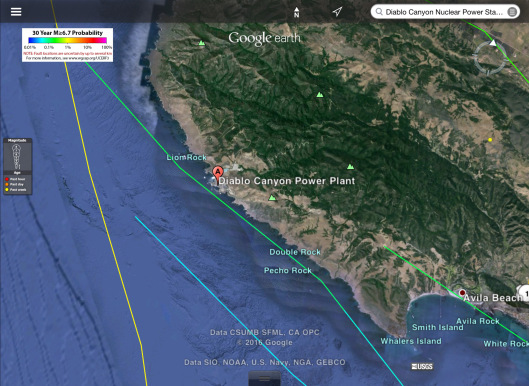
Environmentalists have pressed the Nuclear Regulatory Commission to close Diablo given its proximity to seismic faults in the earthquake-prone state. One fault runs 650 yards from the plant’s reactors.
Worries of earthquakes fracturing the facility have been a dominant theme since PG&E first announced plans for Diablo Canyon in the 1960s. The project helped consolidate opposition to nuclear power within the country’s then-fledgling environmental movement.
“This is an historic agreement,” said Erich Pica, president of the Friends of the Earth environmental group, founded in 1969 in opposition to Diablo Canyon.
PG&E has long said the plant is safe from the largest potential earthquake in the region. But new research has led to more questions about nearby faults, their shaking potential and how the company evaluates them.
Under the deal, the utility agreed not to renew Diablo Canyon’s license. Closing the plant should be cheaper than operating the facility through 2044 as planned, meaning the utility probably won’t have to increase rates, PG&E said………
The country has 61 nuclear plants, including Diablo Canyon, according to the U.S. Energy Information Administration. California already has banned construction of new facilities until the federal government finds a permanent disposal site for radioactive waste. http://abcnews.go.com/Technology/wireStory/california-closing-nuclear-plant-decades-40014195
1 This Month




PLEASE OPPOSE HR 8255 AND S.3639 – bills would accelerate satellite deployment, with no environmental review or safeguards – https://ncstd5li.quorum.us/campaign/169331/
To see nuclear-related stories in greater depth and intensity – go to https://nuclearinformation.wordpress.com
-
Archives
- September 2026 (330)
- August 2026 (330)
- July 2026 (355)
- June 2026 (287)
- May 2026 (306)
- April 2026 (356)
- March 2026 (251)
- February 2026 (267)
- January 2026 (308)
- December 2025 (358)
- November 2025 (359)
- October 2025 (375)
-
Categories
- 1
- 1 NUCLEAR ISSUES
- business and costs
- climate change
- culture and arts
- ENERGY
- environment
- health
- history
- indigenous issues
- Legal
- marketing of nuclear
- media
- opposition to nuclear
- PERSONAL STORIES
- politics
- politics international
- Religion and ethics
- safety
- secrets,lies and civil liberties
- spinbuster
- technology
- Uranium
- wastes
- weapons and war
- Women
- 2 WORLD
- ACTION
- AFRICA
- Atrocities
- AUSTRALIA
- Christina's notes
- Christina's themes
- culture and arts
- Events
- Fuk 2022
- Fuk 2023
- Fukushima 2017
- Fukushima 2018
- fukushima 2019
- Fukushima 2020
- Fukushima 2021
- general
- global warming
- Humour (God we need it)
- Nuclear
- RARE EARTHS
- Reference
- resources – print
- Resources -audiovicual
- Weekly Newsletter
- World
- World Nuclear
- YouTube
-
RSS
Entries RSS
Comments RSS

