Nuclear plant retirements are likely to continue
 Fitch: US Nuclear Retirements Continue Amid Low Power Prices http://www.businesswire.com/news/home/20160714005752/en/Fitch-Nuclear-Retirements-Continue-Power-Prices July 14, 2016
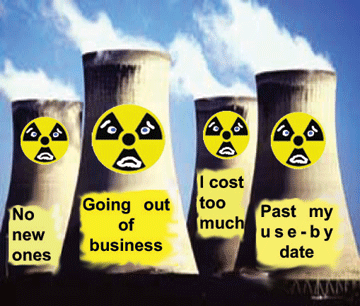
Nuclear plant retirements driven by economic and policy headwinds are likely to continue. Based on announced nuclear retirements, Fitch Ratings expects that the amount of retired and retiring gigawatts (GW) will outpace new nuclear plant additions between 2013 and 2025.
Key factors driving the shutdowns include low natural gas prices due to abundant US supply and actual and anticipated penetration of renewable generation and regulatory constructs that do not adequately compensate for nuclear energy’s non-emitting attributes.
The recent spate of announced nuclear facility retirements is not surprising in light of the depth and duration of the current extended downturn in wholesale power prices and policy challenges faced by nuclear plant operators. Plant closings appear likely to continue unless there are policy changes to address market structures and incentives.
While smaller single-unit merchant nuclear facilities are particularly vulnerable, larger rate-regulated and merchant nuclear facilities are also at risk.
For more information on this topic, see Fitch’s full rating report on “Pacific Gas and Electric Company,” available on our website at www.fitchratings.com.
Additional information is available on www.fitchratings.com.
Poland halts nuclear power plans, looks to renewable energy
 Polish nuclear capacity will not be built before 2030: PGE -Adam Easton, newsdesk@platts.com
–Edited by Jonathan Loades-Carter, jonathan.carter@spglobal.com Warsaw (Platts)–12 Jul 2016
* PGE may modify nuclear investment
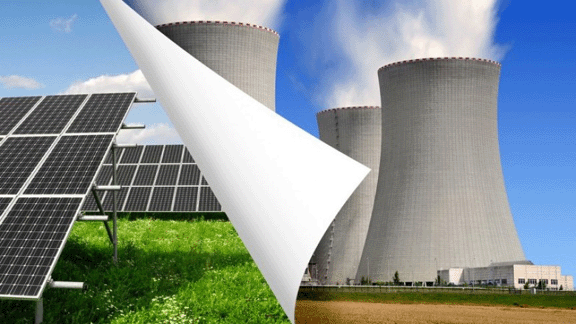
Poland’s largest utility Polska Grupa Energetyczna (PGE) is not giving up its plans to build the country’s first nuclear reactors but the investment may be modified and will not be realized until after 2030, PGE’s chief executive Henryk Baranowski said Tuesday……..
the company was looking at other means of financing the nuclear project after the PiS government, which took office last November, rejected contracts for difference.
“What is certain is that nuclear power cannot be carried out today under a purely market formula. Developing the optimal financing method will require in-depth dialogue. The result will have to be a compromise between the demands of the investors and the needs of the consumers,” he said……
In terms of renewable energy Baranowski said PGE was interested in developing offshore wind in the Baltic Sea.
“An interesting and least talked about technology today is offshore wind. We will continue to prepare to build such capacity in the Baltic despite the high costs. Now we’re calculating the profitability of such investments and we’re analyzing possible financing models,” he said…….http://www.platts.com/latest-news/electric-power/warsaw/polish-nuclear-capacity-will-not-be-built-before-26489875
Workers on strike at Hanford Nuclear Reservation due to health concerns
 Work stoppage continues at Hanford Nuclear Reservation http://q13fox.com/2016/07/12/work-stoppage-continues-at-hanford-nuclear-reservation/ JULY 12, 2016, BY ASSOCIATED PRESS SPOKANE, Wash. (AP) — A rare work stoppage continues by some Hanford Nuclear Reservation workers who contend that radioactive wastes left from the production of nuclear weapons are making them sick.
Union president Dave Molnaa, who ordered the work stoppage, said it will continue until all employees are provided with bottled air when working around all of the underground nuclear waste storage tanks on the Hanford site.
Workers have contended for years that chemical vapors escaping from the tanks are making them sick.
The steel tanks, some dating back to World War II, contain wastes created by the production of plutonium for nuclear weapons.
The Hanford Atomic Metal Trades Council, a coalition of 15 unions that represent workers on the site near Richland, issued the “stop work” order on Monday morning.
Ratepayer ripoff: $19 billion nuclear plant for Virginia

 Virginia group says new nuclear plant would be boondoggle, WP, By Alan Suderman | AP July 12 RICHMOND, Va. — If Dominion Virginia Power goes ahead with plans to build a $19 billion nuclear plant, it would be one of the biggest ratepayer rip-offs in the history of producing electricity, a consumer group said in comments filed Tuesday.
In the comments filed with state regulators, the Virginia Citizens Consumer Council argue that Dominion Virginia Power should stop spending money on a potential new plant because it will unfairly burden the company’s customers while enriching its investors.
“The rich get richer and the ratepayers get poorer,” said Mark Cooper, a senior fellow for economic analysis with the Institute for Energy and the Environment at Vermont Law School who was hired by the VCCC as an expert witness……..
The attorney general’s office estimates that the cost of building North Anna 3, which wouldn’t be completed until 2029, would raise residential rates by 25 percent.
The Virginia State Corporation Commission’s three commissioners would have to give approval for Dominion to build North Anna 3. If approved, the company would be guaranteed a profit on all reasonable and prudent construction costs.
Cooper said the potentially large and steady cash flow from building North Anna 3 is what entices Dominion to continue to pursue the project. But he said customers would unfairly have to pay at least $6 billion more than is necessary to comply with potential federal emission rules. That would rank the project as “one of the grossest examples of enrichment by a utility” in the “entire history of energy production,” Cooper said. ………https://www.washingtonpost.com/local/virginia-group-says-new-nuclear-plant-would-be-boondoggle/2016/07/12/67986070-485e-11e6-8dac-0c6e4accc5b1_story.html?postshare=491468349029908&tid=ss_tw
Japan joins the crowd marketing nuclear reactors to Britain
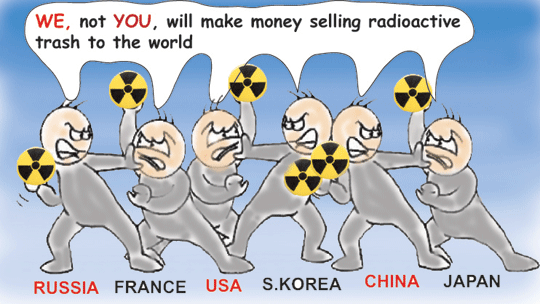
Japan Atomic Power to join Hitachi’s nuclear plant business in Britain http://www.japantimes. co.jp/news/2016/07/07/business/corporate-business/japan-atomic-power-join-hitachis-nuclear-plant-business-britain/#.V39eRdJ97GhJapan Atomic Power Co. will join Hitachi Ltd.’s nuclear power plant business in Britain, informed sources said Thursday.
The two companies will soon sign a cooperation agreement to make Japan Atomic Power the first Japanese power supplier to take part in an overseas nuclear power plant business in full scale.
Japan Atomic Power will become part of a project to build nuclear reactors in Britain, which is undertaken by Horizon Nuclear Power Ltd., a Hitachi unit in Britain, possibly engaging in licensing procedures for reactor construction.
Japan Atomic Power hopes that overseas operations will become a new source of revenue at a time when its nuclear reactors in Japan have been suspended following the 2011 core meltdowns at Tokyo Electric Power Company Holdings Inc.’s Fukushima No. 1 nuclear plant.
Hitachi, which has no experience as a nuclear plant operator, asked for Japan Atomic Power’s cooperation over the British project.
FPL has delayed construction plans of two new nuclear generators at Turkey Point
FPL’s plan to not charge customers $22 million in fees is approved, Miami Herald
FPL has delayed construction plans of two new nuclear generators at Turkey Point
The $22 million in fees is money FPL is permitted to collect for planning and construction of nuclear plants
Because of the construction delay, the utility doesn’t want to collect the fees in 2017
BY MARY ELLEN KLAS Herald/Times Tallahassee Bureau TALLAHASSEE , 8 July 16
The Florida Public Service Commission on Wednesday unanimously approved a request from Florida Power & Light to take a one-year break from charging customers in advance for planning and construction of its proposed new nuclear power plant.
The decision is expected to save customers $22 million in nuclear cost recovery fees that regulators typically approve to allow the company FPL to charge for planning and construction of the company’s proposed nuclear units at its Turkey Point site on Biscayne Bay. Since 2008, FPL has charged customers $282 million in advance for the construction, under the advanced nuclear cost recovery fee it helped to push through the Legislature in 2006……..
The decision to stop charging customers follows the decision by FPL to delay nuclear construction. After eight years of planning, FPL announced in April it was postponing construction on units 6 and 7 of its nuclear fleet until at least 2020. It said, however, it would continue to pursue a federal license that would clear the way for construction. The company has yet to receive federal approval to construct the plant.
The delay means two next-generation reactors initially projected to go online as early as 2018 and 2020 likely would not fire up for perhaps another decade. http://www.miamiherald.com/news/business/article88228052.html
Hinkley nuclear costs now estimated at £37bn
 Estimated cost of Hinkley Point C nuclear plant rises to £37bn Critics point to volatility of scheme but energy department says price ‘will not affect bill payers’, Guardian, Terry Macalister, 8 July 16, The total lifetime cost of the planned Hinkley Point C nuclear power plant could be as high as £37bn, according to an assessment published by the UK government. The figure was described as shocking by critics of the scheme, who said it showed just how volatile and uncertain the project had become, given that the same energy department’s estimate 12 months earlier had been £14bn.
The latest prediction comes amid increasing speculation about the future of the controversial project in Somerset, whose existence has been put in further doubt by post-Brexit financial jitters.
Hinkley has been a flagship energy project for the British government and in particular for the chancellor, George Osborne, who lobbied hard and successfully for China to take a stake in the scheme…….
Critics of the scheme have claimed that the fall in the value of the pound since the referendum vote will increase the costs of the scheme to EDF’s French contractors, who work in euros………. the EDF staff council last month began legal action to try to force the company to release documents relating the project, including all the contracts it had signed with the British government and its co-investor, the Chinese utility CGN.
The fall in power prices in the UK and continental Europe that has influenced the latest lifetime cost assessment for Hinkley is also responsible for some of the financial difficulties at EDF.
There have also been suggestions that Chinese investors are becoming more nervous about Hinkley and are demanding more concessions from EDF, so that more Chinese project managers and suppliers are involved. EDF has denied this. https://www.theguardian.com/uk-news/2016/jul/07/hinkley-point-c-nuclear-plant-costs-up-to-37bn
France marketing its nuclear reactors to India
 France submits fresh plan for six nuclear plants in Jaitapur, Economic Times, By PTI | Jul 07, 2016 NEW DELHI: France has given a fresh techno-commercial proposal for building six atomic reactors in Jaitapur even as it again raised concerns over India’s civil liability law and sought “same level of protection” which are available for companies at the international level.
“All these steps will help us bring nuclear industry players from France to India. The delegation has asked to provide same level of protection to the EDF which is available at the international level,” a top EDF official told PTI.
We have also given a fresh techno-commercial proposal to NPCIL. It’s now up to the NPCIL to decide,” the official added.
The proposal includes negotiating with India for six reactors as against two, which was the case earlier. This would help bring down the cost. It also includes a proposal for localisation of technology to make the project cost effective.
NuScale “small nuclear” company marketing hard in UK, providing funding
NuScale to forge strong US-UK partnership with Sheffield Forgemasters, B Daily, Nick Hill, 8 July 16 NuScale Power’s aim to build a UK-U.S. partnership has made significant steps forward.
Sheffield Forgemasters International Ltd (SFIL) and NuScale are set to collaborate to develop the manufacturing techniques that will be required for the future deployment of Small Modular Reactors (SMRs) in the UK.
SFIL will forge a large civil nuclear reactor vessel head by the end of 2017, as part of a programme supported by Innovate UK, to develop forging and fabrication solutions for the nuclear industry.
NuScale Power is providing funding to support the use of the geometries required by its SMR design……..
NuScale Power will be holding a Supplier Day at the Advanced Manufacturing Research Centre in Sheffield on 13 July aimed at giving UK-based engineering, manufacturing and construction companies the opportunity to learn about the company’s programme of work.
NuScale is also participating in the UK Government’s competition to choose the best value SMR, aimed at seeing SMRs deployed in the UK in the 2020s. https://bdaily.co.uk/industrials/08-07-2016/nuscale-to-forge-strong-us-uk-partnership-with-sheffield-forgemasters/
Renewables beat nuclear on economics, as Wall Street now finds
New Wind & Solar Lower Greenhouse Gas Emissions & Cost Less Than Keeping Aging Nuclear Power Plants Running, Clean Technica July 5th, 2016 by Christopher Arcus Recently, we have seen a spate of older nuclear reactors shut down by their owners for economic reasons. One of the first bellwethers of this trend was the Kewaunee power plant closure. While the public at large may not be aware, nuclear power plant owners are aware of the increasing costs of aging reactors and have responded accordingly. A recent quote from the head of Dominion following the Kewaunee closing tells the story. Thomas Farrell II, chairman, president, and CEO of Dominion, stated:
“This decision was based purely on economics. Dominion was not able to move forward with our plan to grow our nuclear fleet in the Midwest to take advantage of economies of scale.”

This story has been repeated as a succession of older nuclear power plants have announced closure, among them: Diablo Canyon, Crystal River, San Onofre, Fitzpatrick, Fort Calhoun,Vermont Yankee, Clinton, Quad Cities, and Pilgrim.
Wall Street Wakes Up
Things are crook, very crook, for the uranium industry
Uranium spot prices descend beyond decade low
The descending uranium price has put global producers under pressure. by Tess Ingram Uranium spot prices are still likely to stage a rapid recovery on the back of improving demand, industry analysts and executives argue, despite a persistent supply glut driving prices to a largely unanticipated 11-year low.
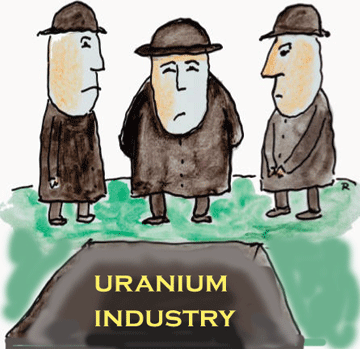
Spot prices for uranium oxide, which is used mainly as fuel for nuclear reactors, crept below $US27 ($36) a pound in June for the first time since mid-2005.
The current levels are lower than when prices were sent spiralling after the Fukushima nuclear disaster. After hitting over $US130 a pound in 2007, prices had stabilised to about $US70 a pound at the beginning of 2011 before Fukushima sent them gradually declining to a low of $US28 a pound in May 2014. Prices increased in 2015 but have since slumped about 21 per cent year-to-date.
Argonaut analyst Matthew Keane said prices had persisted “a lot lower than a lot of people expected” and forecasts for the timing of an anticipated supply deficit needed to improve prices “keep getting kicked along”.
“We just haven’t got the reactors online and even though the Chinese build program is very aggressive, we haven’t caught up and really sucked away the inventory yet,” Mr Keane said. “The US and Europe are still sitting on adequate stockpiles.”…… http://www.afr.com/business/mining/uranium/uranium-spot-prices-descend-beyond-decade-low-20160705-gpyupv
South Australia’s financially risky nuclear waste import scheme
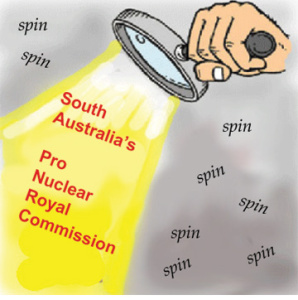 Shunning nuclear power but not its waste: Assessing the risks of Australia becoming the world’s nuclear wasteland http://www.sciencedirect.com/science/article/pii/S2214629616301323 Mark Diesendorf
Abstract
The South Australian Nuclear Fuel Cycle Royal Commission has undertaken ‘an independent and comprehensive investigation into the potential for increasing South Australia’s participation in the nuclear fuel cycle’. In its Final Report, issued 6 May 2016, it acknowledges that nuclear power would not be commercially viable in South Australia in the foreseeable future. However it recommends that ‘the South Australian Government establish used nuclear fuel and intermediate level waste storage and disposal facilities in South Australia’.
This is a business proposition to store a large fraction of global nuclear wastes, providing interim above-ground storage followed by permanent underground storage in South Australia.
The present critical evaluation of the scheme finds that the Royal Commission’s economic analysis is based on many unsubstantiated assumptions. Furthermore, the scheme is financially risky for both Australian taxpayers and customers and has a questionable ethical basis.
Struggling nuclear company EDF now looking for a nuclear shut-down business
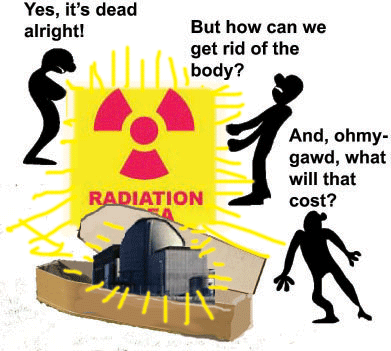 France’s EDF sets sights on $200 bln nuclear decommissioning market By Bate Felix and Benjamin Mallet PARIS, July 4 (Reuters) – EDF aims to snare a sizeable share of the global nuclear decommissioning market, worth an estimated 200 billion euros ($222 billion) over the next 15 years, by virtue of experience gained in dismantling its old reactors.
The French state-controlled utility is in the process of dismantling nine reactors and has 58 others in operation, supplying France with about 75 percent of its energy needs.
Worldwide, 110 reactors have been halted and will need to be safely dismantled, EDF executives said, adding that the company has a team of 800 experts in the complex process.
“Nuclear decommissioning is a very important market with opportunities for the international and local nuclear sector,” Dominique Miniere, executive director for EDF’s nuclear and thermal plants, told journalists in Paris……
Based on the completed decommissioning of reactors in the United States, EDF estimates that it will cost about 400 million euros to dismantle a 900 megawatt pressurised water reactor — a process that could take up to 15 years.
The company’s first dismantling of a nuclear reactor in France — the Chooz A reactor that ceased operating in 1991 — is expected to be completed in 2022. ($1 = 0.8974 euros) (Editing by David Goodman) http://af.reuters.com/article/energyOilNews/idAFL8N19Q3N4
Bond sale for nuclear construction as its costs soar
Santee Cooper greenlights $831M bond sale to fund nuclear construction, Utility Dive By Robert Walton | July 5, 2016
Dive Brief:
- The Santee Cooper Board of Directors has taken steps to lock in the cost of developing two new units at the V.C. Summer Nuclear Station by taking a fixed price option as part of an amended Engineering, Procurement and Construction Agreement.
- The board also approved the sale of $831 million in revenue obligation bonds, primarily to fund nuclear deveopment but with a portion going to refinance existing utility debt.
- Under the fixed price option, Santee Cooper’s cost of the facility’s costs will total $6.2 billion, 20% more than the utility estimated in 2012, the Post and Courier noted. Santee Cooper is developing the plant alongside South Carolina Electric & Gas Co. ……
The decision follows revelations that development costs at the facility are rising. SCE&G last month informed state regulators that its share of the development of two new nuclear units had increased significantly, rising about $852 million to reach $7.7 billion, with the total price tag coming in at around $14 billion. SCE&G attributed the ballooning costs to its choice of a fixed price option to construct reactors.
Santee Cooper owns 45% of the nuclear expansion project, and SCE&G owns 55%. In the fall, the the two utilities negotiated an amended EPC agreement with Westinghouse Electric Co. LLC, which Santee Cooper said including terms to incentivize schedule adherence and shift financial risk to Westinghouse for any additional delays in the current scope of work……..http://www.utilitydive.com/news/santee-cooper-greenlights-831m-bond-sale-to-fund-nuclear-construction/422007/
Delay £18bn building of Hinkley nuclear station – EDF workers’ committee

 EDF workers’ committee expected to demand that nuclear power plant at Hinkley Point in Somerset is delayed http://www.thisismoney.co.uk/money/markets/article-3672592/EDF-workers-committee-expected-demand-nuclear-power-plant-Hinkley-Point-Somerset-delayed.html By CITY & FINANCE REPORTER FOR THE DAILY MAIL, 4 July 2016 EDF’S workers’ committee is expected to demand today that a nuclear power plant at Hinkley, Somerset, is delayed.
The energy firm has yet to make a decision on how to raise £18bn of funds needed for the power station, and has put off deciding until September to allow time to consult the unions.
The unions are obliged to deliver their opinion today on whether Hinkley should go ahead. But three of them issued a statement last week to say that Britain’s vote to leave the European Union added new elements of uncertainty.
It follows a legal action launched earlier this month in French courts by EDF’s Works Council, who asked for the project to be put off.
It is feared that if the unions do not support the project it could further delay Hinkley, which was due to be completed in 2017 but is currently expected to be finished by 2025.
1 This Month




PLEASE OPPOSE HR 8255 AND S.3639 – bills would accelerate satellite deployment, with no environmental review or safeguards – https://ncstd5li.quorum.us/campaign/169331/
To see nuclear-related stories in greater depth and intensity – go to https://nuclearinformation.wordpress.com
-
Archives
- September 2026 (330)
- August 2026 (330)
- July 2026 (355)
- June 2026 (287)
- May 2026 (306)
- April 2026 (356)
- March 2026 (251)
- February 2026 (267)
- January 2026 (308)
- December 2025 (358)
- November 2025 (359)
- October 2025 (375)
-
Categories
- 1
- 1 NUCLEAR ISSUES
- business and costs
- climate change
- culture and arts
- ENERGY
- environment
- health
- history
- indigenous issues
- Legal
- marketing of nuclear
- media
- opposition to nuclear
- PERSONAL STORIES
- politics
- politics international
- Religion and ethics
- safety
- secrets,lies and civil liberties
- spinbuster
- technology
- Uranium
- wastes
- weapons and war
- Women
- 2 WORLD
- ACTION
- AFRICA
- Atrocities
- AUSTRALIA
- Christina's notes
- Christina's themes
- culture and arts
- Events
- Fuk 2022
- Fuk 2023
- Fukushima 2017
- Fukushima 2018
- fukushima 2019
- Fukushima 2020
- Fukushima 2021
- general
- global warming
- Humour (God we need it)
- Nuclear
- RARE EARTHS
- Reference
- resources – print
- Resources -audiovicual
- Weekly Newsletter
- World
- World Nuclear
- YouTube
-
RSS
Entries RSS
Comments RSS

