Consumer-funded nuclear bail out will have an unprecedented impact on the nuclear power industry
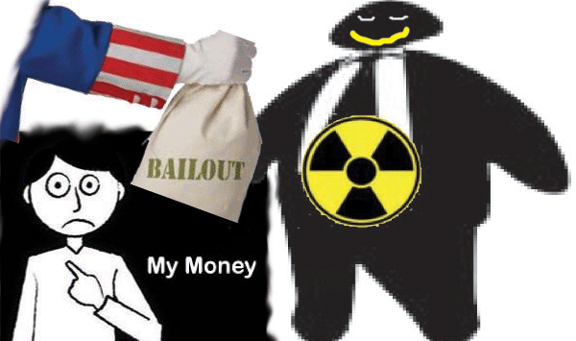 Impacts of NY’s Nuclear Power ‘Bail Out’ and Solar, Wind Boost, Epoch Times, By Tara MacIsaac, Epoch Times | August 3, 2016
It includes what has been called a consumer-funded bail out of upstate New York’s struggling nuclear power plants.
Nuclear energy is treated in the state’s plan as a bridge to a renewable energy future. The commission said nuclear is necessary to maintain stability in the power grid as New York makes the transition toward the standard’s goal of 50 percent renewable energy by 2030.
By subsidizing nuclear power alongside solar and wind, the state is making a bold statement about the value of nuclear reactors as zero-emission energy sources. This could ripple to other states, inspiring similar initiatives to revive the sputtering nuclear industry.
Impacts of the clean energy plan on the nuclear, solar, and wind industries will affect New Yorkers in many ways………
How It Works
Electricity providers will be required to obtain a targeted number of renewable energy credits (RECs) and zero-emissions credits (ZECs) each year.
A REC is created each time 1 megawatt-hour (MWh) of electricity is generated by a renewable resource. RECs can then be sold and traded among providers. ZECs, on the other hand, are related solely to the nuclear plants. These credits are created when zero-emission nuclear power is generated.
So the state awards ZECs to the nuclear companies, which the energy providers must buy from them. The costs of the ZECs that electricity providers purchase will be passed on to the consumer, baked into the supply charges on consumers’ bills.
How It Will Affect Consumers
The nuclear industry is having trouble competing with low natural gas prices. ZECs essentially force state residents and businesses to pay above-market rates for nuclear energy.
But the governor’s office and Public Service Commission Chair Audrey Zibelman suggested a back door may be opened for New Yorkers opposed to supporting nuclear energy.
A press release from Cuomo’s office stated that consumers may be offered a 100 percent renewable energy option. The idea is that consumer demand for 100 percent renewable energy could naturally encourage the development of new renewable energy facilities.
“If it does that,” Zibelman said at the commission hearing on Aug. 1, “then I think it’s fair to say to those customers, if you truly don’t want to buy nuclear, we will allow you not to be required to contribute to that program.
“We’re asking staff to look at that and we’ll see how we can make that happen.”
In addition to providing various options for consumers, Zibelman said clear labeling will be important. “What I would like to know, as a consumer, [is] that if I’m … buying what is a ‘green product’ … are those megawatts really green,” she said. If it’s only 50 percent renewable, for example, the consumer will be told so in clear terms……..http://www.theepochtimes.com/n3/2130861-impacts-of-nys-nuclear-power-bail-out-and-solar-wind-boost/
Changing energy markets make it imperative for Britain to rethink Hinkley nuclear power plan

 Why changing market forced re-think on UK nuclear power station http://www.afr.com/business/energy/nuclear-energy/changing-market-forces-rethink-on-uk-nuclear-power-station-20160804-gqligy 5 Aug 16 The UK government wants to do a rethink on the proposed rethink of Hinkley Point C nuclear power station because of a change in the structure of the UK energy market. Matt Cardy
Less than three years ago the British government struck a deal with EDF, a French state-owned utility, to subsidise the first new nuclear power station built in Britain since 1995: Hinkley Point C on the Somerset coast. The agreement was hailed by David Cameron, the then-prime minister, as “brilliant news”. But a lot has changed since then—and not just the incumbent at 10 Downing Street.
On July 28th, hours after EDF’s board narrowly endorsed a decision to go ahead with the £18 billion ($24 billion) Hinkley Point investment, the new government of Theresa May unexpectedly slammed the brakes on, launching a review of the project that it says it will finish by the autumn. It is understood to want to probe a deal with China General Nuclear Power, a Chinese state behemoth, which had offered to stump up one-third of the price tag in exchange for permission to build a nuclear-power station of its own at Bradwell, in Essex. The delay is the clearest sign that Mrs May is rethinking the open-door industrial policies of her predecessor.
Yet analysts say there is more to the delay than mere Sinophobia. Hinkley is “big and based on last-century technology, which is not what the UK’s power system needs for the future,” says Michael Grubb of University College London. A review of the assumptions prevailing when the government struck the deal reveals how flimsy the economic rationale was.
Price outlook changes Hinkley already operates as a nuclear power station. The plan was to expand with another reactor. But the changing demand for baseload power is now said to require a rethink. Andrew Matthews
In 2012 Britain’s energy boffins predicted that for the foreseeable future the price of non-nuclear fuels, such as natural gas, would be more than double where they are today. As a result, they estimated that wholesale electricity prices—the basis for determining the level of subsidy to EDF—would remain above £70 per megawatt hour. They are currently below £40. Last month the National Audit Office, a spending watchdog, said that forecasting error alone had almost quintupled the implied value of the subsidy, from £6 billion to almost £30 billion over 35 years.
At the time, the civil servants reckoned that by 2025, when Hinkley Point is due to open, the cost of producing electricity from a nuclear-power station would be lower than from a gas-fired one—and much lower than from wind farms and solar-power plants. They have since reversed those views (see chart). Since Hinkley became a serious proposal less than a decade ago, the cost of nuclear power has increased, that of renewables has fallen and the price of battery storage—which could one day disrupt the entire power system—has plummeted. What is more, EDF’s nuclear technology has failed to get off the ground in the two projects in Finland and France that have sought to use it. “When so much has changed, it would have been inappropriate not to pause,” says Professor Grubb.
Hinkley’s supporters counter that it would help to plug a looming gap in the country’s energy supply. Over the next 15 years, Britain plans to shut down its coal-fired power stations and decommission all but one of its ageing nuclear plants, losing 23 gigawatts (GW) of power-generating capacity. Hinkley Point C, with a capacity of 3.2GW, is intended to ensure there is enough clean energy to offset that, by kickstarting a broader revival of nuclear power in the country. It would also strengthen energy security, reducing reliance on Russian gas. And its power would be clean: without it, supporters say, Britain would fail to meet its obligation under the 2008 Climate Change Act to reduce greenhouse gases to 80% below their 1990 level by 2050.
Renewables have bigger share But these arguments fail to account for how quickly the energy landscape is changing. First, as their costs continue to drop, renewables are becoming a bigger part of the energy mix. They currently account for about one-quarter of Britain’s power output. But renewables are intermittent, generating little power on days that are calm or overcast. So they must be complemented by alternative sources of energy, which add to the total cost. Big power stations such as Hinkley Point cannot fill that role: nuclear power is hard to flex up and down. Combined-cycle gas turbines (CCGTs) are cheaper and more nimble. As a backup to renewables, they can enable Britain to “muddle along” at least for another 20 years, says Deepa Venkateswaran of Bernstein Research, a firm of analysts. That would buy time to assess the progress of other clean technologies, such as battery storage and carbon capture.
Smaller businesses are also jostling to step into the breach, offering standby power when shortages occur. One such firm, UK Power Reserve, uses small gas-fired generators that can be switched on and off quickly. It calls itself a “scalpel” compared with a CCGT “sledgehammer”. Another, Upside Energy, proposes selling to the grid surplus power stored in battery systems that back up everything from office computers to traffic lights. Others enable companies to shift their power consumption to times of lower demand, cutting their bills. Such options may not provide the bedrock of power or thousands of jobs that EDF promises at Hinkley Point, and may require more innovative policymaking. But in terms of value for money, they could beat it hands down.
Hinkley nuclear fiasco is a threat to French company EDF
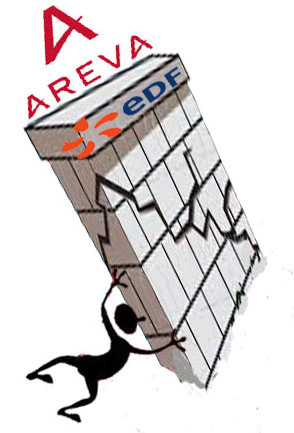 Nu Clear News No 87 5 Aug 16 EDF’s future threatened. Perhaps of more immediate concern is that a go-ahead for Hinkley could threaten the future of the company itself. EDF is a company in a very precarious financial situation. The ratings agency, S&P, postponed a decision to downgrade its credit rating when the UK Government announced the review. (7) EDF has €37 billion of debt. The collapse in energy prices has pushed earnings down 68% in 2015. The Company needs to spend €50 billion upgrading its network of 58 ageing reactors by 2025. It is scrambling to sell €4 billion of new shares and €10 billion of assets to strengthen its balance sheet. EDF is also expected to participate in the €5 billion bailout of Areva, the bankrupt developer of EPR technology, by taking a 75 per cent stake. (8) About the last thing it needs is a new €15 billion millstone around its neck.
Roy Pumfrey said “The EDF Board should take the opportunity presented by this pause to see that its Nuclear SatNav has taken the Company down a dead end; it’s only a matter of time before we hear that voice saying “At the next opportunity, turn round!”‘
He continues: “Perhaps most disappointing if not unexpected has been the reaction of the big UK Union leaders. Whilst confessing themselves ‘baffled’ by the government’s ‘bonkers’ decision, they should ask why the French union leaders representing EDF’s own workers were (and are) solidly and vocally opposed to HPC. This project involves a reactor which many of EDF’s own staff regard as unconstructable, selling off the family silver to fund it and putting EDF and therefore their own livelihoods at risk. UK unions do not seem to appreciate that the fantasy 25,000 jobs on HPC are a conjurer’s trick. Only 30% will be ‘local’, which means 90 minutes drive time from HPC, and with only 5,600 on site on any one day, a job with a particular skill set will only be good for two years at most. That’s assuming that
HPC can be built in an optimistic ten years, even that too long to keep the lights on.”
Over recent months several different alternative to building Hinkley Point C have been detailed (10) Most recently consultancy firm Utilitywise has described the proposed nuclear station as an “unnecessary expense” Energy efficiency measures could save the equivalent amount of electricity along with £12bn
Roy Pumfrey said: “This Government review of Hinkley Point C provides us with a wonderful opportunity to turn Somerset into a sustainable energy hub for England. The alternatives would be better for jobs, better for consumers, would reduce the mountain of dangerous waste we don’t know how to deal with and save Somerset from a decade of disruption caused by one of the biggest construction projects in the world The sooner EDF and the UK Government come to their senses the better. http://www.no2nuclearpower.org.uk/nuclearnews/NuClearNewsNo87.pdf
With UK and USA government help, NuScale hopes to go ahead with “mini” nuclear reactors
New Nuclear UK : fears Hinkley uncertainty will affect Wylfa, Moorside, Sizewell and Bradwell
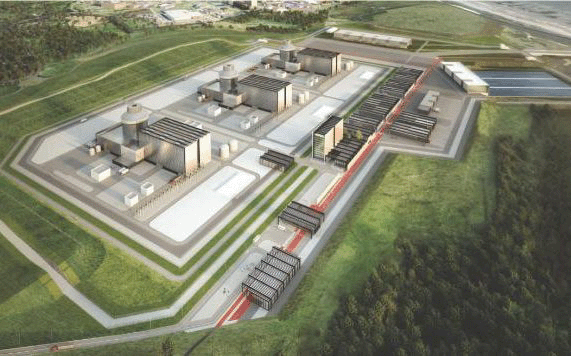 NucClear News No 87, 5 Aug 16 New Nuclear: Wylfa, Moorside, Sizewell and Bradwell. Horizon and NuGen are both insisting that their projects at Wylfa and Moorside are not dependent on EDF getting the go-ahead for Hinkley. But Industry experts have warned that confidence across the sector would be damaged if Theresa May pulls the plug, especially given the French energy giant has already invested £2.4bn in Hinkley with unstinting Government support until now. If Hinkley were cancelled without any reimbursement for EDF, this would “significantly undermine” other developers’ confidence and might prompt them to seek some sort of financial guarantee. (1)
Westinghouse to try to take over Nuclear Fuel Production In Ukraine

|
Westinghouse To Build Nuclear Fuel Production Unit In Ukraine, Oil PriceBy Zainab Calcuttawala – Aug 04, 2016 The American firm Westinghouse will be building a nuclear fuel production unit in Ukraine in order to help the country reduce its reliance on Russia, according to officials who announced the project on Thursday.Ukraine, which was formerly a Soviet Republic, has been trying to sever ties with Russia since the February 2014 revolution that tore the country apart. The Kremlin-backed president is now in self-imposed exile in Russia, while pro-European Union forces rule the country…….
Nasalyk visited the United States two months ago in an effort to find new sources of fuel and new forms of energy. Towards the end of his visit, he told reporters that Westinghouse would build a nuclear production factory in Ukraine in the future. Russia has argued in the past that American fuel would be unsafe for nuclear plants built by Soviet scientists who operated under their own guidelines and standards. “We have agreed to diversify our sources of fuel delivery to nearly half of our nuclear blocks,” Nasalyk said. “And we agreed (for Westinghouse Electric Sweden) to construct a nuclear fuel production facility on the territory of Ukraine.” Ukraine’s relationship with Russia has been falling apart further in recent days……http://oilprice.com/Latest-Energy-News/World-News/Westinghouse-To-Build-Nuclear-Fuel-Production-Unit-In-Ukraine.html |
GE Hitachi to provide human resources development program for nuclear energy, Malaysia
Hitachi-GE to launch nuclear energy course in Malaysia, WNN 04 August 2016 Japan’s Hitachi-GE Nuclear Energy has renewed an agreement with two Malaysian universities under which it will conduct a new international human resources development program to train workers for the nuclear power industry.
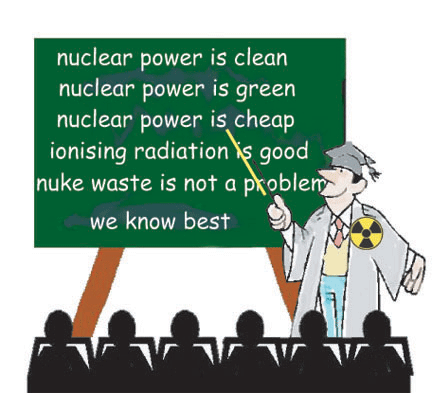
Hitachi-GE announced today that it has renewed an agreement with the National University of Malaysia (UKM) and the Universiti Tenaga Nasional (Uniten), a private university operated by Malaysia’s largest power company, Tenaga Nasional Berhad.
Under the agreement, Hitachi-GE will run an international human resources development program for nuclear energy, leveraging a course that the company has jointly conducted with Tokyo Institute of Technology (Tokyo Tech) for the past five years. So far the course has been held at venues in Southeast Asia and other regions and attended by more than 2000 students. For the new program, Hitachi-GE will work with Tokyo Tech, which has cooperation arrangements with UKM and Uniten……….http://www.world-nuclear-news.org/NN-Hitachi-GE-to-launch-nuclear-energy-course-in-Malaysia-0408164.html
Zero new nuclear builds so far in 2015 – report
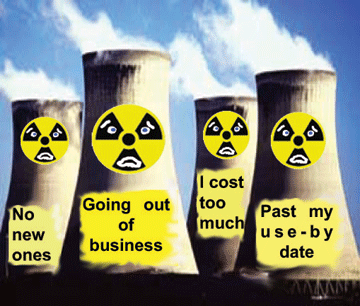 New nuclear reactor builds fall to zero in first half of 2016 – report http://in.reuters.com/article/nuclear-industry-decline-idINKCN0ZT0PV Jul 13, 2016 Construction starts for new nuclear reactors fell to zero globally in the first half of 2016 as the atomic industry struggles against falling costs for renewables and a slowdown in Chinese building, a report on the industry showed on Wednesday.
The last time there were no new reactors started over a full year was in 1995, according to the World Nuclear Industry Status Report 2016. The number of reactors under construction is in decline for a third year, with 58 being built by the end of June, down from 67 reactors at the end of 2013, the report said.
The latest figures highlight the struggles the nuclear sector is facing after the Fukushima atomic disaster in Japan five years ago, as higher costs and delays take their toll while other sources of energy become cheaper.
The nuclear industry faces a risk it “will not be easily protected from: the economic and financial risks from nuclear power being irreversibly out-competed by renewable power,” Tomas Kaberger, energy and environment professor at Chalmers University of Technology in Sweden, wrote in a forward in the report.
Kaberger is also a member of the board of state-owned Swedish utility Vattenfall, which owns 10 nuclear reactors, according to its website.
Construction started on six reactors in China in 2015, three times more than the rest of the world, while eight went into operation there last year, out of 10 globally, underlining how the world’s biggest energy user is a bright spot for the nuclear industry.
Three reactors have started up this year in China, with one in South Korea and another in the U.S., Watts Bar 2, which took 43 years to build, according to the report.
But even in China, renewables investment and capacity additions are outstripping nuclear, the report said.
New nuclear reactor builds fall to zero in first half of 2016 – report Renewables investments totalled $100 billion in China last year, more than five times the amount for new reactors, which was $18 billion.
Wind energy output totalled 185 terawatt hours (TWh) last year in China, compared with 161 TWh for nuclear. Solar power output totalled 39 TWh in 2015, up from 23 TWh the year before.
The report’s lead authors are industry analysts Mycle Schneider, based in Paris, and London-based Antony Froggatt. Both have advised European government bodies on energy and nuclear policy.
The report is available in full at:
Nuclear companies NuGen and Horizon keen for projects in UK, despite the Hinkley nuclear fiasco
UK new nuclear programme not dependent on Hinkley, say rivals, Telegraph, Emily Gosden, energy editor 2 AUGUST 2016 Nuclear developers NuGen and Horizon have played down fears that scrapping Hinkley Point would derail the wider UK new-build programme, insisting their projects are not dependent on EDF’s getting the go-ahead.
Industry experts have warned that confidence across the sector would be damaged if Theresa May pulls the plug on the £18bn project, especially given the French energy giant has already invested £2.4bn in Hinkley with unstinting Government support until now.
But NuGen, which is jointly owned by Japan’s Toshiba and France’s Engie, said it would continue developing its project at Moorside in Cumbria “irrespective of the status of other developers’ plans”.
Hitachi’s Horizon project, which plans reactors on Anglesey,also distanced itself from the worries over Hinkley, saying its “sole focus remains, as it always has been, on making strong progress with our own flagship Wylfa Newydd power station project”.
Despite Mrs May’s surprise review of Hinkley, a Horizon spokesman said it had “no qualms about the continued commitment of the Government to UK nuclear new build”.
Reports in recent days have suggested the UK Government could face compensation demands from EDF if it pulled out of Hinkley.
Peter Atherton, an associate at consultants Cornwall Energy, said EDF had been operating under “an implicit guarantee from the Government that, provided you can get your technology through the approval process, and we can reach a satisfactory contractual arrangement, the project will go ahead”.
The Department for Business, Energy and Industrial Strategy on Tuesday reiterated that there would be no liabilities for the UK taxpayer or consumer if Hinkley were cancelled, as no contracts had been signed.
However, Mr Atherton said that if Hinkley were cancelled without any reimbursement for EDF, this would “significantly undermine” other developers’ confidence and might prompt them to seek some sort of financial guarantee.
“If I was them I would say to the Government, OK, if want us to carry on developing this project, we need you to fund it or to guarantee that if you pull the plug on us you pay those development costs,” he said.
Both Horizon and NuGen are privately keen to emphasise the differences between their projects and EDF’s.
Neither project has Chinese involvement, understood to be one of the key causes of concern for Mrs May over Hinkley, which would be one-third funded by Chinese state companies.
Both have also long been working to meet the Government’s expectation that they will be cheaper than Hinkley…..http://www.telegraph.co.uk/business/2016/08/02/uk-new-nuclear-programme-not-dependent-on-hinkley-say-rivals/
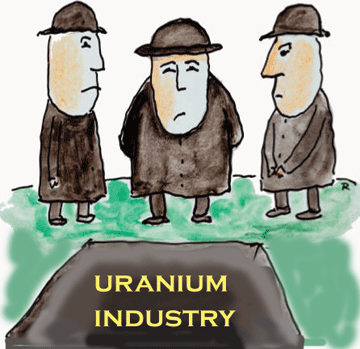
Uranium industry faces an ever bleaker future
The price of uranium has slumped to $25 a pound, its lowest level since April 2005.
It is the worst-performing mined commodity this year. Other natural resources such as copper, coal and iron ore have gained year to date.
 Japan Nuclear-Power Jitters Weigh on Global Uranium Market Antinuclear sentiment in Japan, weak U.S. demand, rising Chinese stockpiles depress price of nuclear fuel http://www.wsj.com/articles/japan-nuclear-power-jitters-weigh-on-global-uranium-market-1469990663 By RHIANNON HOYLE and MAYUMI NEGISHI July 31, 2016
Five years ago, meltdowns at the Fukushima Daiichi power plant in Japan sparked what would become a prolonged slide in prices for uranium nuclear fuel. Today, the world’s worst nuclear disaster in a quarter-century is depressing prices again.
Antinuclear sentiment is gaining momentum in Japan with the election three weeks ago of an antinuclear governor in the only Japanese prefecture with an operating nuclear-power plant, and the likelihood that a court injunction will halt the next reactor slated to go online in August.
Japan was once the world’s No. 3 nuclear-power generator, behind the U.S. and France. The slump in the uranium market is being exacerbated by weak demand from the U.S. and plentiful uranium supplies in China, an emerging nuclear-power producer.
The price of uranium has slumped to $25 a pound, its lowest level since April 2005, according to the Ux Consulting Co., a nuclear-fuel research firmthat publishes weekly market prices. The fuel’s value is down 27% since the start of this year and is a fraction of the $136 a pound it traded for at its 2007 peak.
It is the worst-performing mined commodity this year. Other natural resources such as copper, coal and iron ore have gained year to date.
Below Cost of Production- sad plight of the uranium industry
 Uranium Prices Remain Below Cost of Production, Recovery is Years Away, Economic Calendar, Donald Levit, July 27, 2016 Uranium prices continue to hover at an eleven-year low, with the commodity’s collapse to the price weeks ago failing to inspire any renewed buying interest, and according to a recent forecast from UBS, a turnaround in the market could be years off.
UBS analysts recently revised their average spot uranium prices for the years ahead, and all of these revisions were downward. For 2016 the forecast is now $30/lb. down from $37/lb., for 2017 they cut the forecast to $32/ lb. from $55/lb., for 2018 to $42/lb. from $60/ lb.,and for 2019 to $55/lb. from $60.
The reason behind the languishing prices, and why UBS expects the tough times to continue, is that fact that Japanese reactor restarts have been much slower than expected, while the pace of nuclear expansion across the globe has also disappointed…….http://www.economiccalendar.com/2016/07/27/uranium-prices-remain-below-cost-of-production-recovery-is-years-away/
Russia’s Rosatom keen to establish entire nuclear industry in Egypt
 Cairo, Moscow Agree on Egypt’s First Nuclear Power Plant Construction Terms http://sputniknews.com/middleeast/20160731/1043814467/egypt-russia-agree-plant-construction.html The Egyptian presidential office announced that Egypt and Russia have agreed on all the clauses of the commercial contract on construction of the first nuclear power plant in the country. The date of contract signing is expected to be announced right after its approval by the country’s supreme administrative court, the Council of State.
Russia and Egypt signed an intergovernmental agreement on the construction of the Dabaa nuclear power plant on the Mediterranean Sea coast in November 2015. It is set to become the largest construction project carried out by Russia and Egypt since the Aswan Dam.
The contract for the construction of the nuclear power plant is estimated to be worth over $26 billion. The plant will include four units, each one with a capacity reaching 1200 megawatts. The complete offer of the state corporation Rosatom suggests assistance from Russia in the establishment of an entire nuclear industry in Egypt.
Astronauts 5 times more likely to die from heart disease due to cosmic radiation
 Cosmic radiation: Apollo astronauts 5 times more likely to die from heart disease, says study Rt.com 29 Jul, 2016 The first study of Apollo astronauts – the only people to have traveled beyond Earth’s protective magnetic shield – has found that those who ventured to the moon are five times more likely to die from heart disease.
The NASA and Florida State University study revealed its findings on Thursday. They state that so far three Apollo astronauts, including Neil Armstrong, the first person to walk on the moon, have died from cardiovascular disease, apparently as a result of the extreme cosmic radiation they were exposed to during their missions. The researchers concentrated on a small group for the study: 42 astronauts who flew in space, seven of whom were Apollo veterans, the other 35 being non-flight astronauts.
The study, published in the Scientific Reports journal, found that Apollo astronauts are four to five times more likely to die from cardiovascular disease death than astronauts who either never entered space or only flew on low-altitude missions.
“These data suggest that human travel into deep space may be more hazardous to cardiovascular health than previously estimated,” it said. https://www.rt.com/usa/353865-apollo-study-heart-disease/#.V5smTINhh9Q.facebook
5 reasons not to rush into NY’s $7 billion plan to rescue nuclear plants
5 reasonable criticisms of NY’s $7 billion plan to rescue nuclear plants , Syracuse.com By Tim Knauss | tknauss@syracuse.com Email the author | Follow on Twitter July 29, 2016 “……..
2. The nuclear subsidy might be illegal
Three months ago, the Supreme Court of the United States invalidated a Maryland incentive program for new power plants on the grounds that it interfered with wholesale markets, which operate under federal – not state – authority.
To some observers, including a group of non-nuclear power plant owners and energy suppliers in New York, the Supreme Court’s decision in Hughes v. Talen Energy Marketing is directly applicable to what New York is attempting.
Upstate nuclear plants that receive state-mandated subsidies will have an unfair advantage in the wholesale market and will drive down the prices other power plants can charge, the group argues…..
3. The price of the subsidy is too high
In April, Exelon told the PSC it would need to recover $50 per megawatt-hour to justify the continued operation of its Upstate nuclear plants. But the PSC staff proposal would guarantee the company $56.50 per megawatt-hour, or 13 percent more. And every two years, the minimum price would be revised upward.
Lawyers for the Nucor Steel plant in Auburn suggest that even the $50 price sought by Exelon is more than the nuke operator needs. …..
4. The contract term is too long
According to the long-term price forecast by PSC analysts, wholesale power prices will rise steadily over the next decade until they exceed the price guaranteed to the nuclear plants…….long-term price forecasts are notoriously unreliable. National Grid recommended limiting nuclear subsidy contracts to six years……
5. There has not been enough time to ponder details
This is a big decision. It will affect the Upstate economy and the NY energy industry for years to come. Yet the details of the PSC staff proposal were released just three weeks ago. Comments were accepted for just two weeks…….http://www.syracuse.com/news/index.ssf/2016/07/5_reasonable_criticisms_of_nys_7_billion_plan_to_rescue_nuclear_plants.html
France’s State-owned nuclear company EDF decides to go ahead with UK’s Hinkley nuclear station
£18 billion Hinkley Point nuclear power station gets go ahead from EDF, Mirror, 28 JUL 2016 BY ALAN JONES , MIKEY SMITH
The French energy giant has decided to press ahead of a new plant in a crunch board meeting in Paris
EDF has given the go ahead to building a new nuclear power station at Hinkley Point, after a crunch board meeting in Paris.
The French energy giant had been expected to make the final investment decision today , clearing the way for the £18 billion project to go ahead.
Reports said the board voted by 10-7 in favour. EDF in the UK made no immediate comment.
John Sauven, Greenpeace executive director, said: “This deal was more riven with dissension in the EDF board than anyone expected. It’s unprecedented division and far closer than predicted.
“Countless experts have warned that for British families this power station will be terrible value for money.
“This is a bitter pill to swallow for hard up people who have been told that the Government is trying to keep bills down while dealing with energy security and lowering carbon emissions………..
A director opposed to the construction of Hinkley Point C resigned before the board met.
Gerard Magnin said in his resignation letter that Hinkley Point was “very risky”.
He did not attend the board meeting, leaving 17 directors to make the crucial decision. http://www.mirror.co.uk/news/uk-news/18-billion-hinkley-point-nuclear-8514859
1 This Month




PLEASE OPPOSE HR 8255 AND S.3639 – bills would accelerate satellite deployment, with no environmental review or safeguards – https://ncstd5li.quorum.us/campaign/169331/
To see nuclear-related stories in greater depth and intensity – go to https://nuclearinformation.wordpress.com
-
Archives
- September 2026 (323)
- August 2026 (330)
- July 2026 (355)
- June 2026 (287)
- May 2026 (306)
- April 2026 (356)
- March 2026 (251)
- February 2026 (267)
- January 2026 (308)
- December 2025 (358)
- November 2025 (359)
- October 2025 (375)
-
Categories
- 1
- 1 NUCLEAR ISSUES
- business and costs
- climate change
- culture and arts
- ENERGY
- environment
- health
- history
- indigenous issues
- Legal
- marketing of nuclear
- media
- opposition to nuclear
- PERSONAL STORIES
- politics
- politics international
- Religion and ethics
- safety
- secrets,lies and civil liberties
- spinbuster
- technology
- Uranium
- wastes
- weapons and war
- Women
- 2 WORLD
- ACTION
- AFRICA
- Atrocities
- AUSTRALIA
- Christina's notes
- Christina's themes
- culture and arts
- Events
- Fuk 2022
- Fuk 2023
- Fukushima 2017
- Fukushima 2018
- fukushima 2019
- Fukushima 2020
- Fukushima 2021
- general
- global warming
- Humour (God we need it)
- Nuclear
- RARE EARTHS
- Reference
- resources – print
- Resources -audiovicual
- Weekly Newsletter
- World
- World Nuclear
- YouTube
-
RSS
Entries RSS
Comments RSS

