Georgia Public Service Commission (PSC) authorizes Georgia Power to spend up to $99 million on new nuclear station

 Georgia Power gets green light on new nuclear plant, Atlanta Business Chronicle, Jul 28, 2016, State energy regulators gave Georgia Power Co. the go-ahead Thursday to start laying the groundwork for a new nuclear power plant south of Columbus, Ga.
But the Atlanta-based utility won’t be able to charge customers as much as it wanted to conduct preliminary site work and seek an operating license for a proposed nuclear facility at a 7,000-acre site in rural Stewart County.
The Georgia Public Service Commission (PSC) voted 4-1 to authorize Georgia Power to spend up to $99 million on the early stages of the project through the second quarter of 2019. The utility was asking the commission for authority to recover from customers up to $175 million in costs associated with the work.
The PSC’s staff had recommended that the commission put off a decision on the new nuclear plant until 2019…..
Commissioner Lauren “Bubba” McDonald, who voted against Wise’s motion, said Georgia Power should be willing to invest its own money in the Stewart County project rather than charge customers.
“If they’re as sure about another nuclear program in 2025 and beyond … let their investors make the first investment,” he said.
McDonald questioned the wisdom of building a nuclear plant along the Chattahoochee River because of the huge volumes of water consumed in nuclear power generation and noted that the federal government still doesn’t have a long-term plan for disposing of the nuclear wastes being generated today at plants across the country…..http://www.bizjournals.com/atlanta/news/2016/07/28/georgia-power-gets-green-light-on-new-nuclear.html
French government propping up nuclear company EDF with a cash boost
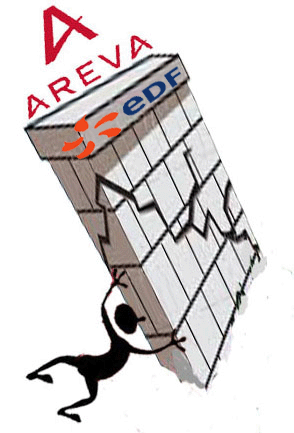
 French nuclear company EDF to get cash infusion http://www.dw.com/en/french-nuclear-company-edf-to-get-cash-infusion/a-19428058
The French government has said it will go ahead with a 4-billion-euro share issue for state-controlled electricity firm EDF. The move will help finance the construction of two controversial nuclear reactors in the UK. The French state – which holds 85 percent of EDF – said it will buy three billion euros’ worth of the newly issued EDF shares sometime this year. The fourth billion will be chipped in by other investors.
EDF’s board of directors is expected to give final investment approval this week for the construction of two EPR nuclear reactors at Hinkley Point in southwestern England, home to two old Magnox reactors that are no longer in operation and two AGR gas-cooled reactors whose construction began in 1967 and are still in operation, but whose decommissioning date is currently set for 2023.
EDF had delayed the final investment decision on the new Hinkley Point reactors several times, as it sought other investors to share the costs amid concerns the heavily indebted company will struggle to meet its financial commitments.
Internal skeptics abound The six labor-union representatives sitting on EDF’s 18-member board have repeatedly opposed the project. They wanted to see it delayed by three years to give EDF time to complete the construction of similar reactors in France, Finland and China, which are several years behind schedule.
The company’s works council secretary, Jean-Luc Magnaval, told the news agency Reuters that his union had filed a complaint on the matter with a Paris court, which has scheduled a hearing on the case for August 2.
EDF’s chief financial officer has resigned over the threat the project represents to the company’s finances.
EDF is also planning to speed up renovation of its 58 nuclear reactors in France, a task expected to cost about 51 billion euros.
EDF, which has already spent about 3 billion euros on Hinkley Point C, needs the project “to maintain its know-how and prepare for the retirement and renewal of its aging French and British nuclear fleet,” chief executive Jean-Bernard Levy told shareholders on Tuesday. He added that the new capital would also help the bolster the company’s credit rating and its ability to refinance its 37.4 billion euro debt.
Sparing no expense The Hinkley Point project is a joint venture between EDF and China General Nuclear Power Corporation. It’s one of the world’s most costly nuclear power plant projects.
The most recently projected price tag was a whopping 18 billion pounds ($24 billion, 21.7 billion euros), before Brexit lowered the value of the pound.
However, a complex system of subsidies approved by former UK finance minister, George Osborne, could cost up to 37 billion pounds, according to a recent estimate published by the UK Department of Energy and Climate Change.
Nuclear renaissance?
The UK’s environment secretary, Andrea Leadsom, recently reiterated that the Hinkley Point project will kick-start a “nuclear renaissance” in Britain that would see 18 gigawatts of new capacity added if sites at Sizewell, Bradwell, Moorside, Wylfa and Oldbury are developed along with Hinkley Point C.
Nuclear power accounts for around 16 percent of the UK’s energy requirements, which could drop to three per cent in 2030 unless new reactors are built in the meantime, Leadsom said.
EPR reactors are third-generation nuclear reactors which use pressurised water as their cooling fluid. At present, most operating reactors around the world are second-generation reactors; only around a dozen Generation 3 reactors are in operation so far.
A variety of Generation 4 reactor designs, which engineers hope will be more inherently safe and more cost-efficient than previous generations, are in various stages of prototype development, but none are expected to be commercially available before about 2030 or 2040.
By that time, however, renewable energy technologies and battery storage systems may have attainedsuch a low cost that construction of new nuclear power stations may prove a tough sell financially. That’s already the case for the Hinkley Point C project and for EDF’s other three existing EPR reactor projects around the world, all of which have proven to be far more expensive than optimistic early estimates, and very likely none of which would be getting built had they not been supported by heavy government subsidies.
Report questions value of new nuclear projects in Wales compared with renewables
 New nuclear projects in Wales must be ‘cost-competitive’ with renewables, say MPs , Business Green, 26 July 16 Planned nuclear sites in North Wales should only go ahead if government can prove development is ‘value for money’, as Business Secretary Greg Clark visits Japan to fan investor interest in UK nuclear projects
Lawmakers on the Welsh Affairs Committee have published a new report insisting that before proposed nuclear developments at Wylfa Newydd and Trawsfynydd in North Wales go ahead the government must prove the financial viability and community benefit of the projects.
“The government must prove that the cost of any nuclear development is well understood and competitive with renewable sources. These costs must be made public in a format that can be easily understood,” Committee chair David Davies MP said.
“There has to be a demonstrable benefit for the local community as well,” he added. “Local businesses must form a key part of the supply-chain and be given sufficient information to allow this to happen.”………
The report concludes the government should only support the development at Wylfa Newydd if the strike price for the project’s electricity is competitive with renewables and below that of Hinkley Point C, EDF’s controversial nuclear project in Somerset which is due to receive a final investment decision this week. Hinkley’s strike price is £92.50 per MWh – more than double the current market price of power. In comparison, the strike price for onshore wind is around £80 per MWh with some experts now arguing new onshore wind farms can be built at a lower levelised cost than new gas power plants. ……..
Cost estimates for Wylfa Newydd must cover the lifetime of the project, including decommissioning and waste disposal, MPs said, after concerns were raised during their investigation that nuclear power projects are often subject to delays and cost schedule overruns. Cost estimates for Hinkley Point C have ballooned from £16bn in 2012 to almost £21bn earlier this year, while last week EDF’s Paris headquarters were raided by the French finance authorities investigating concerns about its reporting of maintenance and development costs………http://www.businessgreen.com/bg/news/2465917/new-nuclear-projects-in-wales-must-be-cost-competitive-with-renewables-say-mps
 |
Click here to Reply or Forward
|
Cost of Hitachi nuclear plant for North Wales is far too high
Hitachi U.K. Nuclear Plant Should Get Less Than EDF, Panel Says http://www.bloomberg.com/news/articles/2016-07-25/hitachi-u-k-nuclear-plant-should-get-less-than-edf-panel-saysAlex Morales AlexJFMorales
-
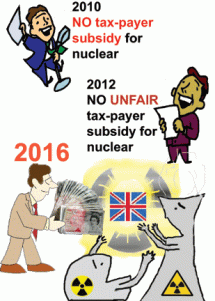 EDF’s Hinkley Point is set for $39 billion of future subsidies
 -
Hinkley secured guaranteed power price at twice current rate
-
Hitachi Ltd. should be paid less for the power from its planned nuclear plant in North Wales than Electricite de France SA has been promised for reactors in western England, a panel of U.K. lawmakers said, seeking to keep a lid on energy prices paid by consumers.
The government should also ensure the cost of the Wylfa Newydd project by Hitachi’s Horizon unit is competitive with renewable-power plants such as onshore wind farms, the cross-party Welsh Affairs Committee said Tuesday in an e-mailed report. The lawmakers called for a “clear and comprehensible explanation” of the lifetime costs of the 2.7-gigawatt project and for a “demonstrable benefit” to the local community.
The U.K. is struggling to build generating capacity fast enough to keep up with the closure of aging nuclear power stations and a phase-out of coal-fired plants. EDF is set to make a final investment decision on Thursday on whether to proceed with an 18-billion-pound ($24 billion) plan to build two reactors at Hinkley Point. The utility has repeatedly postponed a decision on the long-delayed project, despite securing a U.K. government guarantee that it’ll receive 92.50 pounds per megawatt-hour of power, more than double current rates.
- “The government should only build Wylfa Newydd if the strike price is below that agreed for the Hinkley Point C and competitive with renewable sources,” the committee said in a statement. “They must be transparent on cost and provide a clear and comprehensible explanation of the lifetime cost of the project, including decommissioning and waste disposal.”
Fixed Amount
Power from Hinkley Point and Wylfa will be paid for under a so-called contract for difference, which fixes the amount the utility receives per megawatt-hour, making its income predictable. If prevailing power prices are lower than the agreed “strike price,” utilities recoup the difference through consumer bills. If the prevailing price is greater, the utility returns the difference to consumers.
- Because prices have fallen since the EDF contract was agreed in 2013, the future subsidy cost to consumers of Hinkley has increased, according to areport earlier this month from the National Audit Office, which scrutinizes government spending. Using current projections for the wholesale power price, it estimated the lifetime cost of the top-ups has ballooned to 29.7 billion pounds from 6.1 billion pounds originally.The Welsh Affairs Committee also called on ministers to draw up contingency plans in case the Wylfa plant, consisting of two Hitachi advanced boiling-water reactors, isn’t completed as planned by 2025. EDF had originally envisaged its new reactors would generate power by Christmas 2017. Under its current schedule, Hinkley won’t come online until 2025, the same year as Hitachi aims to complete Wylfa.
Growth spurt for green bonds in the financial market
Green bonds the new black in the market as environmental financing surges, ABC News, 26 July 16 By business reporter Stephen Letts The environmentally sensitive shoots developing in the global bonds market appear to be heading for a serious growth spurt with another record quarter of “green bonds” issuance.
In a research note on the sector, the credit ratings agency Moody’s found environmentally focused green bond issuance in the June quarter hit a record $US20.3 billion ($27 billion), well above the $US16.9 billion ($22.5 billion) recorded in the first quarter of the year.
Added together, the two quarters raised almost 90 per cent more capital than in the first half of 2015.
“The global green bond market is now poised to reach $US75 billion ($100 billion) in total volume for 2016 and so set a new record for the fifth consecutive year, given the strong issuance already observable in the first two weeks of Q3,” Moody’s senior vice president Henry Shilling said.
That fresh flow in the third quarter includes $300 million worth of bonds from Victoria put out to tender earlier this month, the first green issuance from an Australian state or federal government……
Clean energy projects dominate the market
The increasing demand has been supported by many big pension funds now carrying mandates that stipulate portfolios must hold required levels of environmentally friendly investments.
Around two-thirds of green bond proceeds in the quarter were directed to renewable energy and energy efficient projects, with clean transport accounting for a further 17 per cent of the money raised.
The US dominated issuance, with 23 per cent of the market, followed by the big development agencies such as the World Bank, with 17 per cent, although China is expected to bounce back to its dominant position in the market with $US3 billion worth of bonds in the pipeline for sale in coming months……. http://www.abc.net.au/news/2016-07-27/green-is-new-black-in-the-bonds-market-environmental-finance/7664414
USA marketing nuclear power to Mexico
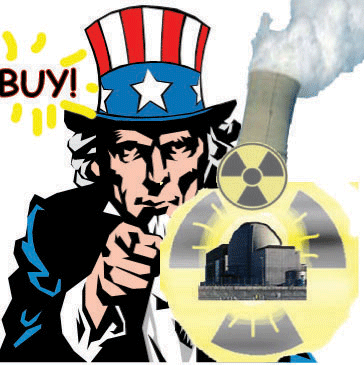 US and Mexico map out agreement on nuclear power issues Utility Dive| July 26, 2016
Dive Brief:
- United States and Mexico have committed to negotiate a bilateral agreement for peaceful nuclear cooperation, according to the White House.
- The agreement is aimed at strengthening the existing legal framework and providing an enhanced basis for the transfer of nuclear technology, fuel, and components between the countries.
- In addition to enhancing potential power sector emissions reductions, the agreement aims to enhance the capacities of both nations in the supply chain and nuclear fuel services and to facilitate the sharing of best practices.
South Korea in charge of nuclear power system in United Arab Emirates
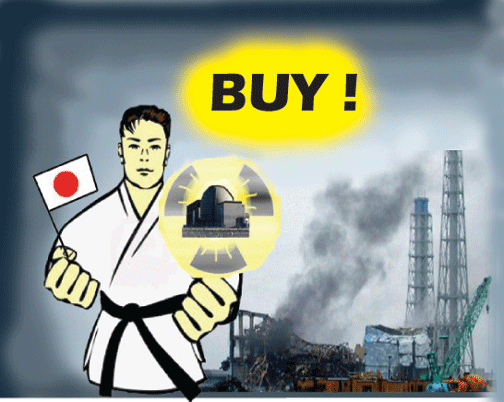 South Korea signs $880 million nuclear reactor staffing deal in UAE http://www.upi.com/Business_News/2016/07/25/South-Korea-signs-880-million-nuclear-reactor-staffing-deal-in-UAE/9691469456937/ The reactors, still under construction, are Korean-designed and made. By Ed Adamczyk ABU DHABI, United Arab Emirates, July 25 (UPI) — South Korea will manage four nuclear reactors under construction in the United Arab Emirates, a deal worth an estimated $880 million, officials said Monday.
Cho Seok, CEO of state-run Korea Hydro & Nuclear Power, signed an operation support services agreement in a ceremony Monday to run the four Korean-made reactors at Barakah, UAE.
Construction of the four reactors began in 2009, with the finish of the first scheduled for May 2017. All four are expected to be completed by 2020. At a signing ceremony in Abu Dhabi on Monday, Mohamed al-Hammadi, CEO of the UAE’s Emirates Nuclear Energy Corp., said, “Over the next decade and beyond, the agreement will continue to build on and enhance the existing long-term nuclear energy partnership between the UAE and South Korea.”
UK proposal to offer subsidy contracts to Russia, China and South Korea to build nuclear power stations!



Russia, China and South Korea ‘should be invited to build UK nuclear plants’, Telegraph Emily
Gosden, energy editor 23 JULY 2016
Russian, Chinese and South Korean nuclear companies should be offered subsidy contracts to build reactors in the UK if they are cheaper than other projects already under development, a prominent nuclear lobbyist has said.
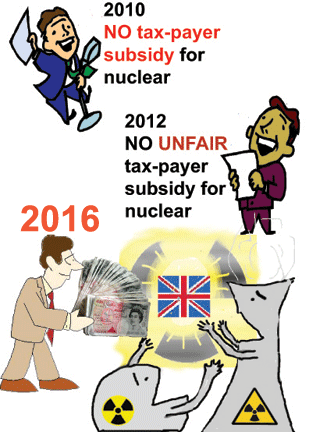
Tim Yeo, the former chairman of the House of Commons energy select committee, said EDF’s proposed £18bn plant at Hinkley Point, which is expected to get the go-ahead this week, should be allowed to proceed, but he urged the Government to rethink its approach to future projects.The Japanese-owned Horizon and Franco-Japanese NuGen consortia are both developing plans for reactors at sites in the UK and hope to secure approval for their technologies and subsidy deals from the Government.
Mr Yeo, the MP for South Suffolk for 32 years until the 2015 general election, now chairs New Nuclear Watch Europe, a lobby group whose members include the Korean nuclear firm Kepco. He urged the Government to “urgently examine which nuclear vendors can deliver the cheapest electricity, maximise the number of UK supply chain jobs and minimise the risk of construction delays”………..
He also advocated a new funding approach under which “most of the construction costs are funded by government borrowing throughout the construction period” to help cut financing costs. http://www.telegraph.co.uk/business/2016/07/23/russia-china-and-south-korea-should-be-invited-to-build-uk-nucle/
Russia marketing its nuclear clean-up business to Japan
Take our tech
Around a 100km drive west of St. Petersburg, on the Gulf of Finland, sits Sosnovy Bor, home to state nuclear energy giant Rosatom’s waste disposal operations. Inside a controlled perimeter, subsidiary RosRAO, the facility’s manager, has created a prototype water decontamination plant for use at Tokyo Electric Power Co. Holdings‘ Fukushima Daiichi nuclear power station — the site of Japan’s largest nuclear disaster in March 2011.
The scrubbing facility, unveiled in June, is capable of removing tritium, or radioactive hydrogen, from nuclear-tainted water, something beyond the capabilities of the Fukushima plant’s current cleanup equipment. Distillation and electrolysis isolate and concentrate the isotope, which is then locked away in titanium. Experiments under conditions similar to those on the ground reportedly show the technology cutting wastewater’s radioactive material content to one-6,000th the initial level, making it safe for human consumption or release into the ocean.
Duplicating the facility near the Fukushima site and running it for the five years necessary to process 800,000 cu. meters of contaminated water would cost around $700 million in all. Companies in Japan and the U.S. are at work on their own facilities for tritium disposal, but the Russian plan’s cost and technological capability make it fully competitive, according to the project’s chief.
Rosatom has made other overtures to Japan. Executives from a mining and chemical unit have visited several times this year for talks with Japanese nuclear companies, aiming to cooperate on decommissioning the Fukushima plant and upgrading a reprocessing plant in Aomori Prefecture for spent nuclear fuel. Russia has amassed a wealth of expertise dealing with damaged nuclear reactors in the wake of the Chernobyl disaster, and would like Japan to draw on that knowledge, the subsidiary’s chief executive said.
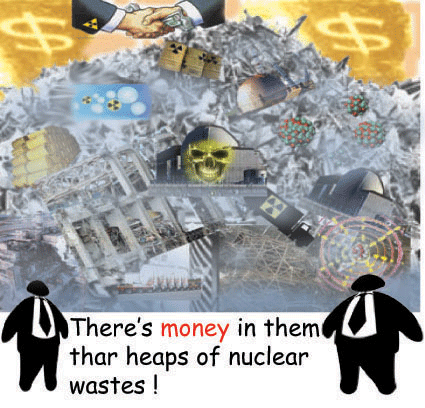
Nuclear expertise
Revving up nuclear technology exports is essential to re-energizing Russia’s domestic industry and breaking free of dependence on the resource sector, Moscow has decided. The nuclear business, along with the space industry, is one of the few tech-intensive sectors where the country is internationally competitive. President Vladimir Putin has leaned more heavily on leaders in Europe and emerging countries in recent years to agree to deals with Russia’s nuclear companies………..http://asia.nikkei.com/Politics-Economy/International-Relations/Japan-nuclear-cleanup-next-target-in-Russian-economic-offensive
Nuclear power salesmen vie with each other to sell nukes to South Africa
Eskom Influence Growing In Proposed South African Nuclear Tender, AFK Insider,

While South Africa’s energy department will choose the successful vendor, Eskom, as the owner-operator of the new nuclear plants, will have a large input. David Nicholls, chief nuclear officer at Eskom, gave delegates a glimpse this week of Eskom’s vision for nuclear by defining a leading role for the state utility at the Power-Gen and DistribuTech Africa conference in Johannesburg.
A chosen vendor will lead the early process with Eskom’s input. This is how South Africa’s only operating nuclear plant, Koeberg, north of Cape Town, was built in the 1980s, he said.
Once the design base has been established with the first plant, South Africa will increasingly take charge.
Nicholls’ remarks show that Eskom is in favor of a proven standardized fleet of reactors, with sibling international plants to learn from. This indicates South Africa is likely to choose one vendor and stick with them……….. Vendors from Russia, France, South Korea, the U.S. and China are all hoping to win the lucrative South African nuclear contract.South Africa has opted for a pressurized water reactor technology,……..http://afkinsider.com/130186/eskom-influence-growing-in-proposed-south-african-nuclear-tender/
South Korean nuclear company to staff Emirates nuclear reactors
Hydro & Nuclear staff to operate Abu Dhabi’s Barakah plant, New agreement will see KHNP staff stationed at Barakah until 2030 Gulf Business, By Robert Anderson, 23 July 16
Emirates Nuclear Energy Corporation has signed an operating support services deal with Korea Hydro & Nuclear Power that will see the company dispatch personnel to the Barakah Nuclear Power Plant until 2030.
Under the agreement, the Korean firm will provide main control room operators and local operator to support ENEC’s recently launched local operating subsidiary Nawah Energy Company……http://gulfbusiness.com/korea-hydro-nuclear-power-staff-operate-abu-dhabis-barakah-plant/#.V5UxYtJ97Gg
Japanese business community wants renewable power, losing faith in nuclear power
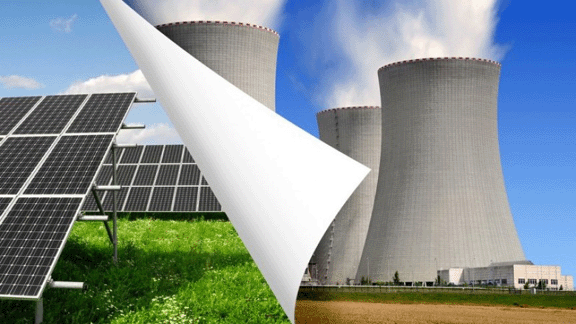
 Japan business lobby says Abe government can’t rely on nuclear energy http://www.reuters.com/article/us-japan-energy-idUSKCN1020XH TOKYO | BY OSAMU TSUKIMORI AND AARON SHELDRICK, 22 July 16 Japan’s use of nuclear power is unlikely to meet a government target of returning to near pre-Fukushima levels and the world’s No.3 economy needs to get serious about boosting renewables, a senior executive at a top business lobby said.
Under Prime Minister Shinzo Abe’s energy policies, nuclear is supposed to supply a fifth of energy generation by 2030, but Teruo Asada, vice chairman of the Japan Association of Corporate Executives, said Japan was unlikely to get anywhere near this.
The influential business lobby has issued a proposal urging Tokyo to remove hurdles for renewable power amid the shaky outlook for nuclear power after the 2011 Fukushima disaster.
The move shows how business attitudes are now shifting as reactor restarts get held up by legal challenges, safety issues and public scepticism.
“We have a sense of crisis that Japan will become a laughing stock if we do not encourage renewable power,” said Asada, who is also chairman of trading house Marubeni Corp.
Long dependent on imported fossil fuels, Japan’s government and big business actively promoted nuclear energy despite widespread public opposition.
The government wants nuclear to make up 20-22 percent of electricity supply by 2030, down from 30 percent before Fukushima. So far, however, only two out of 42 operable reactors have started and the newly elected governor of the prefecture where they are located has pledged to shut them.
New York’s nuclear subsidy plan will grow to a $multibillion cost to ratepayers
 Nuclear Subsidies Are Key Part of New York’s Clean-Energy Plan, NYT By VIVIAN YEE JULY 20, 2016 “………The commission is considering a proposal that makes the state’s three upstate nuclear plants important parts of its efforts to wean itself off fossil fuels, offering nearly $1 billion in ratepayer-financed subsidies over the next two years to save plants battered by rising costs and competition from cheap natural gas.
With very little process, and very little time for the public to even know this is happening, what they’re proposing here is a multibillion-dollar uncompetitive subsidy to one company,” said Jessica Azulay, a spokeswoman for the Alliance for a Green Economy, an environmentalist group.
The alliance has calculated the total cost over 12 years as more than $7.6 billion…..http://www.nytimes.com/2016/07/21/nyregion/nuclear-subsidies-new-york-clean-energy-plan.html?_r=0
Middle Eastern countries – a bonanza for Western nuclear salesmen
Despite years of building and development, nuclear power is on the decline in many parts of the world with its share of global electricity decreasing from 18 percent in 1996 to around 11 percent today according to the International Energy Agency.
Nuclear has become unfashionable in several countries not just because of the Chernobyl and Fukushima disasters: New safety requirements mean the cost of building nuclear facilities has been rapidly mounting.
The cost of the UAE’s Barakah plant is estimated at between US$25 bn and $32 bn, most of it being paid out of state funds. The initial cost estimate of Saudi Arabia’s nuclear programme – involving French, Chinese, Argentinian and South Korean companies building facilities both for power generation and for desalination – is $80 bn.
Energy analysts say that rather than spending billions of dollars on prestige nuclear projects, subsidies should be eliminated to curtail usage and alternative energy sources should be developed.
The use of solar power is still minimal in many countries in the region yet it has enormous potential.
Following the disasters at the Chernobyl and Fukushima power plants, many countries either cancelled or put on hold projects for nuclear power facilities but in the Middle East region at least 25 plants are planned and many more are being talked about.
Some studies indicate that up to a total of 90 nuclear facilities, – both big and small – are in the pipeline………
Opponents of the plans say going nuclear in what is one of the world’s most volatile geopolitical regions poses serious safety and security issues. Among other concerns there are the eye watering costs involved in nuclear building programmes and unresolved problems over radioactive waste disposal.
The nuclear salespeople have been busy across the region in recent years: in the United Arab Emirates, the Barakah nuclear power facility in Abu Dhabi, built and operated by the South Koreans, is due to come on stream next year, aiming to supply up to 25 percent of the UAE’s electricity.
Saudi Arabia plans to have its first nuclear power plant on stream by 2022, with another 15 facilities of varying size in the pipeline. Jordan and Egypt have signed agreements with Rosatom, the Russian state nuclear conglomerate, to build and operate reactors.
Despite recent tensions between Turkey and Russia, Rosatom is continuing construction of Turkey’s first nuclear power plant on the country’s southern coast.
Tunisia and Algeria have also been in nuclear discussions with the Russians and other suppliers…….. Continue reading
China trying to market nuclear power to India
China Can Cooperate With India In Nuclear Sector: Official NDTV, 22 July 16 NEW DELHI: Describing China as an “important player” in the nuclear sector, a senior Chinese state policy researcher has said it is one of the areas where it can cooperate with India, a remark which comes amidst growing strain between the two countries over the NSG issue.
Speaking in Delhi, Wenling, a senior researcher of the Chinese State Council Research Office, also made a strong pitch for long-term visas for Chinese nationals visiting India, which she said would boost bilateral trade and investments.
On areas where the two neighbours can cooperate, she said manufacturing, nuclear energy, bullet trains, tourism, education, agriculture and services industry are among the areas where they can enhance their cooperation.
“China is an important player in the nuclear sector. Chinese energy players are investing in the US market,” she remarked during a discussion with a select gathering in Delhi in the presence of Minister Counselor Cheng Guangzhong yesterday…….http://www.ndtv.com/india-news/china-can-cooperate-with-india-in-nuclear-sector-official-1434936
1 This Month




PLEASE OPPOSE HR 8255 AND S.3639 – bills would accelerate satellite deployment, with no environmental review or safeguards – https://ncstd5li.quorum.us/campaign/169331/
To see nuclear-related stories in greater depth and intensity – go to https://nuclearinformation.wordpress.com
-
Archives
- September 2026 (323)
- August 2026 (330)
- July 2026 (355)
- June 2026 (287)
- May 2026 (306)
- April 2026 (356)
- March 2026 (251)
- February 2026 (267)
- January 2026 (308)
- December 2025 (358)
- November 2025 (359)
- October 2025 (375)
-
Categories
- 1
- 1 NUCLEAR ISSUES
- business and costs
- climate change
- culture and arts
- ENERGY
- environment
- health
- history
- indigenous issues
- Legal
- marketing of nuclear
- media
- opposition to nuclear
- PERSONAL STORIES
- politics
- politics international
- Religion and ethics
- safety
- secrets,lies and civil liberties
- spinbuster
- technology
- Uranium
- wastes
- weapons and war
- Women
- 2 WORLD
- ACTION
- AFRICA
- Atrocities
- AUSTRALIA
- Christina's notes
- Christina's themes
- culture and arts
- Events
- Fuk 2022
- Fuk 2023
- Fukushima 2017
- Fukushima 2018
- fukushima 2019
- Fukushima 2020
- Fukushima 2021
- general
- global warming
- Humour (God we need it)
- Nuclear
- RARE EARTHS
- Reference
- resources – print
- Resources -audiovicual
- Weekly Newsletter
- World
- World Nuclear
- YouTube
-
RSS
Entries RSS
Comments RSS

