Westinghouse puts on hold plans to build nuclear fuel plant in Ukraine
US Westinghouse gives no confirmation of decision to build nuclear fuel plant in Ukraine,
Ukrainian Energy and Coal Industry Minister Nasalik earlier announced that Westinghouse and Kiev had reached a deal on building a nuclear fuel factory in Ukraine.
KIEV, August 16. /TASS/. The US-based Westinghouse has not confirmed a decision to finance the construction of a nuclear fuel factory in Ukraine as was previously announced by Ukrainian Energy and Coal Industry Minister Igor Nasalik.
As Westinghouse Vice-President and Managing Director for Northern and Eastern Europe Aziz Dag told Deutsche Welle publication, surplus capacities for nuclear fuel production can be observed in the world at present and, therefore, the construction of a new factory won’t bring any considerable economic benefits for the country….. http://tass.ru/en/economy/894536
Renewable energy, energy efficiency would create over 145,000 jobs in Alberta, Canada
 Alberta could produce over 145,000 jobs by going green: report HTTP://EDMONTONJOURNAL.COM/BUSINESS/ENERGY/ALBERTA-COULD-PRODUCE-OVER-145000-JOBS-BY-GOING-GREEN-REPORT GORDON KENT April 22, 2016 Alberta could create more than 145,000 jobs by investing more heavily in renewable energy, energy efficiency and public transit, a report by three environmental organizations says.
The move would boost employment when oil prices have dropped, reduce carbon emissions and help shift the economy toward green industries, according to the report released Friday by Greenpeace, the Alberta Green Economy Network and Gridworks Energy Group.
“The government can start putting people back to work without having to wait for the price of oil to go back up,” co-author David Thompson said Friday, which was also Earth Day.
The report estimates 68,400 positions are available from energy efficiency upgrades on more than 183,000 older homes and other buildings, requiring spending of $1 billion over five years.
Another 30,000 to 40,000 places would come from building LRT lines at a cost of more than $3.6 billion, along with the unpriced expansion of bike lanes, sidewalks and other sustainable transportation.
As well, there could be 46,780 jobs created by 2020 by almost doubling the amount of wind power to seven per cent of the electricity grid, boosting solar and geothermal production, and improving energy efficiency and storage.
No price tag is attached to this development. The provincial budget calls for investing $6.2 billion raised by the new carbon levy in green infrastructure, renewable energy, energy efficiency and other work over five years.
Many communities are already shifting toward renewable power.
The Lubicon Lake First Nation of Little Buffalo, 465 kilometres northwest of Edmonton, put in an 80-panel, 20.8-kilowatt solar electricity system next to its health centre last summer. The Louis Bull First Nation at Maskwacis, 70 kilometres south of Edmonton, will start installing 340 solar panels on four public buildings next month, training residents to work in this field and cutting electricity bills, councillor Desmond Bull said.
The approximately $300,000 cost is being covered with money from the federal government.
The project is intended to help the environment as well as produce economic development, Bull said.
“There’s not really any template or model for how First Nations can move in this direction.”
City of Edmonton chief economist John Rose cautioned this week that governments need to be prudent about major investments in renewable energy, but Thompson said Alberta has big wind and solar resources.
“We can learn from the mistakes others have made … We can go down the tunnel and hopefully get less scratched.”
Entergy and Exelon ask New York regulators to approve sale of FitzPatrick nuclear plantby Nov 18
Companies ask regulators to approve sale of FitzPatrick nuclear plant , syracuse.com, 23 Aug 16 By Tim Knauss | tknauss@syracuse.com Email the author | Follow on Twitter SYRACUSE, N.Y. – The companies involved in the $110 million sale of FitzPatrick nuclear plant have asked New York regulators to approve the transaction by Nov. 18, saying the deal could fall apart without prompt regulatory approval.
Entergy Corp., the current owner, and Exelon Corp., the buyer, filed a petition Monday asking the state Public Service Commission to approve the sale. They also will seek approvals soon from the U.S. Nuclear Regulatory Commission, the Federal Energy Regulatory Commission, the IRS and other agencies.
The sale will be automatically canceled, unless Entergy and Exelon mutually agree to move ahead, if PSC approval and other conditions are not met by Nov. 18, according to a copy of the sales agreement provided to state regulators.
Exelon wants state regulators to approve the sale before investing “tens of millions of dollars” in a planned refueling outage in January that would extend FitzPatrick’s operating life, according to the petition…..
Exelon and Entergy could face other obstacles to completing the deal, including court challenges.
Several parties, including the owners of non-nuclear power plants, warned the PSC that nuclear subsidy payments might violate federal rules over wholesale energy markets……..
Before they approve the sale of FitzPatrick, New York regulators will examine whether the transaction would give Exelon the ability to manipulate the wholesale market by giving it control over too many power plants…..http://www.syracuse.com/news/index.ssf/2016/08/companies_ask_regulators_to_approve_sale_of_fitzpatrick_nuclear_plant.html
Russian financing, Russia selling nuclear power plant to Jordan
 Jordan seeking funds for first nuclear power plant — official, Jordan Times By Mohammad Ghazal – Aug 20,2016 – AMMAN — Jordan’s first nuclear power plant could be operational by 2025, if sufficient financing is secured, the Jordan Atomic Energy Commission (JAEC) said on Thursday.
“Jordan is currently in talks with German, Czech, Chinese and Japanese companies among others to supply turbines and electrical systems for the power plant and things are going well,” said JAEC Chairman Khaled Toukan.
Thirty per cent of the $10 billion project will be financed equally by Jordan and Russia, who are partners in the project. JAEC is engaged in discussions with companies to secure the remaining 70 per cent to pay for turbines and electrical systems, Toukan said.
“If we secure finance by the end of 2017, we will be able to operate the first reactor by 2025,” he noted.
Under an agreement with Russia, Jordan plans to build a power plant with two nuclear reactors, each with a capacity of 1,000 megawatts.
Toukan was speaking at a press conference on Thursday to announce the results of a report on the programme by the International Advisory Group (IAG).
The IAG was formed in November 2015 to provide consultations on the strategy to deal with nuclear waste, and the best options and mechanisms to finance the plant.
The group includes former energy minister Khaled Shraideh and seven international industry experts. …….http://www.jordantimes.com/news/local/jordan-seeking-funds-first-nuclear-power-plant-%E2%80%94-official
Foreign companies depend on UK nuclear success for their global marketing drive
 The major hurdle for Horizon and NuGen is that they must sell their visions to global investors. Both developers say they will build their plants for less than the £18bn it will cost to build Hinkley Point, but they will not say by how much……
For Toshiba and Hitachi, building nuclear reactors in the UK represents a  chance to boost their reputations — and the image of nuclear power more generally around the world
Energy: Generating criticism Kiran Stacey, Energy Correspondent, Ft.com 18 Aug 16 The UK’s ambitious plans to build six nuclear plants are raising concerns that it is losing control over critical infrastructure
In a field in a remote part of north-west Wales, a lone farmer cuts the grass, parcelling it up into hay bales which can be sold for a modest profit. His farm, and even the hill on which it sits, will soon be demolished by the Japanese-owned company Horizon — ground zero in an ambitious scheme to build one of a string ofnuclear power stations across the UK.
Wylfa, on the island of Anglesey, is one of several sites designated for the plants, which could cost up to £100bn and, if all goes to plan, will replace the UK’s ageing coal power stations. But despite the billions of pounds about to be poured into nuclear energy in Britain, only some is likely to stay in the UK. Of the six plants being planned, none will be owned by a British company.
For nuclear power groups from France, China, the US and Japan, the UK’s ambitious plans represent a ripe opportunity in an otherwise difficult global market. Following the meltdowns at the Fukushima plant in Japan in 2011, several countries, including Japan and Germany, scaled back or cancelled their nuclear energy plans.
The lack of British participation in such a massive domestic programme has drawn opposition. Critics say the project represents yet another example of the country’s propensity to allow foreign companies and governments to profit from the UK’s most sensitive — and lucrative — infrastructure projects.
That critique appears to be shared by some in the UK government. When Theresa May, the prime minister, unexpectedly delayed the £18bn plant planned for Hinkley Point in south-west England, allies said it was over concerns about the involvement of two Chinese state-backed companies alongside France’s EDF, the state-backed utility. Some officials see the plant as a matter of national security, warning that the Chinese state could have the power to turn off a large chunk of Britain’s electricity supply.
Mrs May’s decision has caused consternation in Beijing, where officials had been reassured by the previous government’s unflagging support for the project. She will travel to China next month to steady bilateral relations, and is expected to make a decision over the project around the time of that trip…….
Made in Japan At Wylfa, the Hitachi branding on the cranes involved in initial groundworks give a signal of how integral the Japanese company, which owns Horizon, is to every stage of the process. The entire station will be built in Hitachi City in Japan before being shipped over, piece by piece, to north Wales. Horizon has submitted its design to regulators for approval, and will only make the final decision to go ahead after it has funding in place and made the necessary planning applications.
At Moorside, in the northern county of Cumbria, a company called NuGen is developing another site over the road from Sellafield power station. NuGen is a joint venture of Japan’s Toshiba and Engie, the French utility, whose biggest shareholder is the French state. Its reactor has been designed by Westinghouse, the US industrial company, most of which is owned by Toshiba.
If Mrs May is worried about the Chinese being able to shut down Hinkley Point, she might be even more concerned with the plans of EDF, China General Nuclear Power and China National Nuclear Corp in eastern England. After the consortium develops another plant at Sizewell, in Suffolk, the Chinese groups are hoping to design and build the plant at Bradwell in Essex……..
One of the main motivations for EDF’s Chinese partners to invest in the UK is the stamp of quality they would gain as they market their Hualong One design internationally.
“With both the government and public opinion in favour of nuclear power, Britain is a very attractive market for building new nuclear plants,” a spokesman for Hitachi says.
The major hurdle for Horizon and NuGen is that they must sell their visions to global investors. Both developers say they will build their plants for less than the £18bn it will cost to build Hinkley Point, but they will not say by how much……
For Toshiba and Hitachi, building nuclear reactors in the UK represents a chance to boost their reputations — and the image of nuclear power more generally around the world…….. http://www.ft.com/cms/s/0/8135630a-5a5d-11e6-9f70-badea1b336d4.html#axzz4HoS1C8dw
Britain’s Hinkley fiasco should give Pakistan pause to reconsider its nuclear power plans
It would make sense therefore not to invest in projects that are destined to be overtaken by superior alternatives. The funds going into nuclear power stations would be better spent on making use of wind and solar power for which Pakistan has substantial potential.
No one can predict what the energy scene would look like in 2050, when all of the planned nuclear power stations are to become operational. What is clear is that they won’t remain competitive as new technologies come along to elbow out some of the old ones.
 A case for reviewing nuclear power plants http://aaj.tv/2016/08/a-case-for-reviewing-nuclear-power-plants/ August 18, 2016 by Farah Jamil Last month, something interesting and unusual happened in Britain that should give a pause to Islamabad as it walks in a certain direction without thinking what lies in store. Continue reading
Nuclear reactors, old or new designs, doomed without hefty tax-payer subsidies
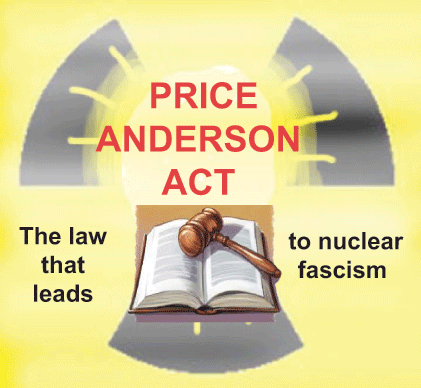 under the 1957 Price-Anderson Act, each plant owner’s accident liability is limited to some $300 million per year, even though the Fukushima disaster showed that nuclear accident costs can exceed $100 billion. If private companies that own U.S. nuclear power plants had been responsible for accident liability, they would not have built reactors. The same is almost certainly true of responsibility for spent fuel disposal.
 free or low-carbon-emitting –What they discovered is that each nuclear power plant releases huge amounts of Radioactive Carbon14 which converts to CO2 in the atmosphere.
 Bradford, The Conversation, August 18, 2016 “…….The nuclear industry, led by the forlornly named lobbying group Nuclear Matters, still obtains large subsidies for new reactor designs that cannot possibly
compete at today’s prices. But its main function now is to save operating reactors from closure brought on by their own rising costs, by the absence of a U.S. policy on greenhouse gas emissions and by competition from less expensive natural gas, carbon-free renewables and more efficient energy use.
General Electric Co. and Hitachi sell Canadian nuclear technology buisness
BWXT to buy Ontario nuclear business from GE-Hitachi, double presence in Canada, Globe and Mail, MISSISSAUGA, Ont. — The Canadian Press, Aug. 18, 2016 General Electric Co. and Hitachi Ltd. are selling a Canadian joint venture that supplies nuclear fuel and equipment for Candu nuclear reactors – a key source of electricity for Ontario.
The buyer is a Canadian subsidiary of BWX Technologies Inc., a U.S. publicly traded company headquartered in Virginia.
BWXT says the acquisition will nearly double its presence in Canada and “signals a long-term strategic commitment” to the Candu nuclear power segment.
Nuclear power a poor deal for India, despite aggressive marketing by USA, France Russia
India is better advised to put money instead into its abundant solar energy, which will definitely be less expensive and less risky. “Investing in new solar photovoltaic capacity would be a much lower-cost, significantly less environmentally harmful and far more sustainable alternative to the Mithi Virdi and Kovvada projects,”
Nuclear power costly, inefficient, SANKAR RAY | Fri, 12 Aug 2016- , Mumbai , dna Reactors reduced to status of old furniture as no new ones are being made With Prime Minister Narendra Modi and US President Barrack Obama, finalising the import of 12 AP1000 nuclear reactors plants – six from the Westinghouse Electric — for Mithi Virdi, Gujarat, and another six from the GE-Hitachi’s Economic Simplified Boiling Water Reactor for Kovvada, Andhra Pradesh, nuclear hawks have become super-active. The US Export-Import Bank is about to complete a financing package for the  project. The Nuclear Power Corporation of India and Toshiba Corp’s (6502.T) Westinghouse Electric too confirmed that engineering and site design work would begin shortly. Small wonder, anti–US hawks too have swung into action to nail the very concept of importing nuclear power reactors from the US, arguing that the cost from the US reactors is very high, estimated provisionally at $7.5 million per megawatt in stark contrast to $ 2.9 million of the Russian ones that are installed at Kudankulam.
Prof Sujay Basu, a doyen among energy experts and former — the first too – director, School of Energy Studies, Jadavpur University, expressed his chagrin against import of reactors. “First, the Kudankulam reactors were sold by Russia at distressed price. Second, reactor manufacture, from the very beginning of the new century, ceased to be a profitable business. American nuclear industry is worried for want of buyers and escalation of cost.
France tried to sell one or two reactors to Finland but backed out. Nowhere in the world, except Japan, are new reactors marketable without political lobbying. Energy gap cannot be narrowed by setting up more nuclear plants. In India, the more pressing problem is how to retire several ageing with effective disposal of nuclear hazards.” Indeed, almost all the components of the reactor were manufactured during the 1980s and were rendered surplus due to post-Chernobyl cancellation of over two dozen reactors after the mega-catastrophe in the twilight years of Soviet Union.
V T Padmanabhan, noted analyst and member of the Nuclear Consultancy Group, considered as a crusader for nuclear safety and health effects (genetic and somatic) of ionising radiation, divulged in countercurrents.org about six months ago that the Kudankulam reactor tripped 20 times and was off-grid for 468 days.
Kudankulam Nuclear Power Plant (KKNPP-1), the first reactor, built jointly by the NPCIL and Russia’s Atomstroyexport (ASE), is the only operating Generation-III pressurised water reactor (VVER-1000) the world over. During the 840 days of its grid connection since 22 October 2013, the reactor worked for 372 days, although this so-called brand new Russian machine, commissioned a year ago, underwent a seven-month-long overhaul since 24 June 2015 and achieved criticality in the afternoon of 21 Jan 2016.
Following a series of experiments, the generator was connected to the grid in the morning of 30 Jan 2016. According to the database of Power Reactor Information systems of the International Atomic Energy Agency, the KKNPP-1 operated for only 4,212 hours in 2014, less than half the time-schedule. Mentioning this, Prof M V Ramana, a nuclear physicist and currently associated with the Programme on Science and Global Security at Princeton University, a good fraction of those operations evidently involved the reactor generate below the corresponding rated power capacity. “In all, the reactor generated less than a third of the electricity that it could have if it had operated at full power, 24 hours a day, 365 days a year.” Things worsened in the following year. The NPCIL website admitted that between April 2015 and January 2016, the plant had an abysmally load factor of 20 per cent.
There is no denying that the KKNPP-1 is a congenitally sick baby, a junk reactor. Maybe, the sickly state of KKNPP-1, prompted the NDA government (if not an alibi) to opt for the US plants. But in end-March this year, the Institute for Energy Economics and Financial Analysis, which is engaged in research and analysis on financial and economic issues related to energy, in order to quicken the transition to a diverse, sustainable and profitable energy economy, released a report, Bad Choice: The Risks, Costs and Viability of Proposed US Nuclear Reactors in India, which negates the economic viability of Indian plan to build 12 new nuclear-powered plants using untested technology. The lead author of it, IEEFA’s director of resource planning analysis, David Schlissel, stated that these nuclear plants are “first-of-kind” designs by Toshiba-Westinghouse and General Electric-Hitachi planned for the Mithi Virdi and Kovvada complexes, are neither economically nor financially viable.“They would take much longer than expected to build, they would result in higher bills for ratepayers, and, if they are built, they might not work as advertised.”
The IEEFA pointed out that it would take 11 to 15 years to build, if approved, the first new reactors at Mithi Virdi and Kovvada, provided there is no time lag. These reactors can’t start generation for the electric grid before 2029.
Furthermore, stated Schlissel, even if there is zero time-and-cost overruns, “both projects would require massive investment over the next two decades, ranging from Rs 6.3 lakh crores (US $95 billion) to 11.3 lakh crore rupees (US $170 billion).” The IEEFA warned against slowdown in project implementation due to lengthy land-acquisition and complicated nuclear liability issues. India is better advised to put money instead into its abundant solar energy, which will definitely be less expensive and less risky. “Investing in new solar photovoltaic capacity would be a much lower-cost, significantly less environmentally harmful and far more sustainable alternative to the Mithi Virdi and Kovvada projects,” quipped Schlissel…….http://www.dnaindia.com/analysis/column-nuclear-power-costly-inefficient-2244012
The sun setting on UK’s nuclear industry? Time for clean energy
The international race toward universal grid parity may see an unsubsidised tipping point next year. Frontrunner Australia is expected to achieve a renewable energy scenario which is cheaper than conventional supply, says a recent report from Deutschebank.
UK nuclear sunset? http://www.timesofmalta.com/articles/view/20160814/environment/UK-nuclear-sunset.622012 Anne ZammitIt’s coming up to six years since badgers were relocated to make way for Britain’s next nuclear power station on the Somerset coast. In the pipeline for nearly a decade, plans for Hinkley Point took an unexpected turn in July.
Last month, as Britain’s Prime Minister, Theresa May was advised by her Chief of Staff to put a contract for the French/Chinese-backed Hinkley Point nuclear power station on hold, subject to review.
Mrs May was barely a year old when Britain’s worst ever nuclear disaster spread radioactive dust across northern Europe.
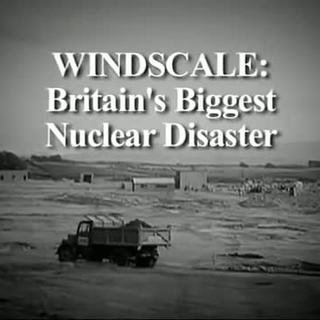 Windscale was built after WWII, to produce plutonium for England’s nuclear weapons programme. A bunker mentality still hung about the facility even after it became a provider of electric power to the public in 1956.
The following year a fire broke out at the plant and burned for three days before it could be contained. In the weeks that followed, milk from cows grazing within a 500 kilometre radius was diluted and destroyed.
Windscale, renamed Sellafield in attempt to erase dark beginnings, was put out of commission in 1973 after a dangerous  leak capped a long history of incidents. The facility switched to reprocessing of nuclear fuel. This drew bitter opposition from Ireland and Scandinavia over dumping of contaminated water into the Irish Sea.
Ireland’s complaint to the UN was verified by a UK government study which found traces of radioactive substances in salmon bred at fish farms near the plant.
Sellafield was shut down completely in 2005 after uranium and plutonium spilled from a broken pipe. (Since then an American-led multinational corporation has been overseeing the closure process which could drag on into the next century.)
That same year, advisors to Tony Blair urged that emissions targets would best be met with more nuclear power stations. This ran contrary to the UK government stance taken three years earlier when energy efficiency and renewables were tagged as the most cost efficient path to meet immediate energy priorities.
 Commenting on Mrs May’s decision to put the Hinkley Point contract on hold, energy economist Tooraj Jamasb of Durham University noted that the new government has not had time to develop a new coherent energy policy.
A 2002 review of UK energy policy veered away from further government subsidies and passed the baton to the private sector. As the UK government gave the go-ahead for a new generation of nuclear power stations to be built, environmentalists alleged unlawful State aid for the nuclear power industry in Britain, filing a complaint with the European Commission. Scotland made it clear that it would not accept any new power stations on Scottish soil.
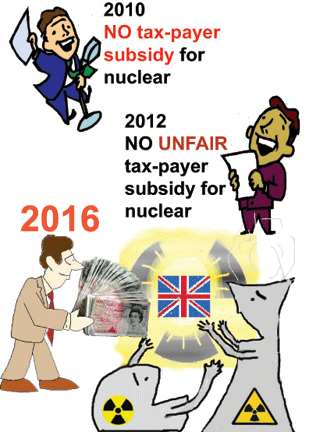 The time has come for policymakers to shift their focus to clean energy
After the 2011 Fukushima power plant disaster France vowed to scale down the share of electricity from nuclear sources and Germany announced a phase out of nuclear power by 2022.
Germany’s Federal Environment Agency has declared that the technology to make the switch to 100 per cent renewable energy is already available but requires that electricity is produced and used more efficiently. Meeting climate change targets can be done without nuclear if there are stronger efforts toward demand reduction and lifestyle changes.
The international race toward universal grid parity may see an unsubsidised tipping point next year. Frontrunner Australia is expected to achieve a renewable energy scenario which is cheaper than conventional supply, says a recent report from Deutschebank.
Viewed as covert factories for materials to build apocalyptic weapons, nuclear power stations also face resistance from groups such as the Campaign for Nuclear Disarmament. As pointed out by CND-UK the cost of nuclear power has continued to rise as the cost of renewable energy has fallen sharply.
A 2006 review by the Office of Nuclear Regulation, which led to assessment of reactor designs ahead of choosing sites, was challenged in court by Greenpeace as “seriously flawed”. Key details of the economics of nuclear power were not published until well after the review was final.
Hinkley Point nuclear power station has undergone a number of reincarnations since the first phase was built in 1956. Reactors on Hinkley Point ‘A’ were shut down permanently after an inspectorate found defects too expensive to fix in 1999. De-commissioning of a successor, Hinkley Point ‘B’ (built 1967) should have happened this year but has been extended to 2023.
The Hinkley Point C proposal by Électricité de France (EDF) and Chinese investors commits British consumers to pay more for nuclear-generated electricity than it costs to buy electricity from offshore windfarms.
Yet a study by Britain’s National Audit Office published last month cited calculations from the National Infrastructure Commission which show that if five per cent of current peak demand were met by demand flexibility then power saved would be equal to a new nuclear power station.
Households and businesses could use electricity more flexibly, using less during times of peak demand and more during times of low demand. Cutting down on use of electricity at peak times reduces the megawatt capacity needed.
The NAO also noted that the expected subsidy for Hinkley Point C has doubled to £37 billion in the past three years.
It is not just the economics of nuclear which now plague decision makers at Whitehall. As former Home Secretary and overseer of MI5, Theresa May approaches the nuclear question from a security perspective.
 Security experts have expressed concern that the Chinese could use their role in the project to build weaknesses into computer systems allowing them to shut down Britain’s energy production at will.
Fears that China could engage in cyber-sabotage may have been overblown. The bomb of public subsidy running into billions is the real gremlin in the Hinkley Point contract.
A cross-party Commons Energy and Climate Change Committee fears that failure to build new nuclear capacity by 2025 would mean greater reliance on imported gas in the medium term. This would affect energy security and force a review of how UK carbon emission targets are to be met.
On the other hand, the committee identified risk factors which could jeopardise proposals like Hinkley Point C. Sudden policy changes by the UK government, an inconsistent approach, poor transparency and lack of long-term vision have created uncertainty for investors.
Delaying or cancelling the Hinkley Point project threatens Britain’s relations with China and France. Joel Kenrick, a former advisor to the Energy Secretary, believes that the contract for Hinkley Point C will go ahead come autumn. However, he expressed doubt over whether it would actually be built with EDF’s poor track record in delivering big
projects.
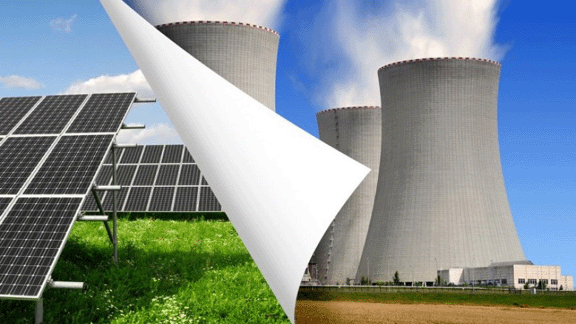 Corporate finance leader at EY Global Power & Utilities and RECAI editor Ben Warren believes that the time has come for policymakers to shift their focus to clean energy. “Market access, fair play, technology improvements and cost curves will lead to a level of renewables deployment not even imagined,” says Mr Warren. www.energypost.eu/renewable-energy-versus-nuclear-dispelling-myths
With Hinkley Big Nuclear in decline, the “Small Nuclear” lobby sees its chance
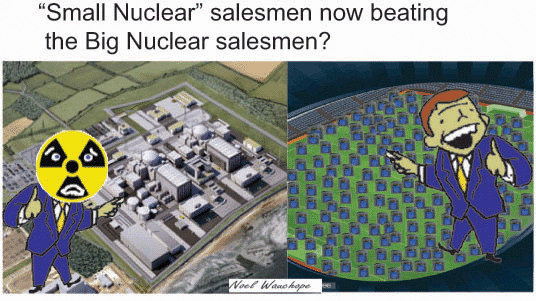
Hinkley Point may be taking all the attention at present, but it is not the be all and end all of nuclear power in the UK. There is plenty more in the pipeline so, whatever happens in Somerset, progress can be made elsewhere. The UK’s Office for Nuclear Regulation aims to complete Generic Design Assessments for new reactors, the AP1000 and Advanced Boiling Water Reactor (ABWR), during 2017.
NuGen, jointly owned by Japan’s Toshiba and France’s Engie, is progressing with plans to build an AP1000 at Moorside in West Cumbria. At present, they are carrying out site assessment surveys, including geophysical surveys, geological age dating and some borehole drilling work, which must be completed before construction can begin. AP1000 reactors, designed by Westinghouse, are being planned in multiple countries worldwide, with the first plants scheduled to come online in China this year. There have been some delays on these world-first reactors, but not as serious as those in France and Finland for the European Pressurised Reactor (EPR) proposed for Hinkley…….
In addition to these planned sites, there is also ongoing research and development into the next generation of advanced nuclear reactors. The Government promised, in Autumn 2015, an investment of £250 million over 5 years to develop the reactors of the future. This includes a competition to decide which small modular reactor or reactors should be demonstrated in the UK. Advanced reactors have the potential to be cheaper, even cleaner and even safer than current designs, and have added benefits such as the potential ability to use up spent fuel and the plutonium stockpile. (Weinberg Next Nuclear will soon be publishing a report on how to manage plutonium)….http://www.the-weinberg-foundation.org/2016/08/11/dont-worry-british-nuclear-doesnt-have-all-its-eggs-in-one-basket/
Queen Elizabeth’s Estate notes that renewable energy is cheaper than Hinkley nuclear
Crown estate wades into Hinkley Point nuclear debate https://www.theguardian.com/environment/2016/aug/14/crown-estate-hinkley-point-nuclear-debate
Body says, with government reviewing £18.5bn project, benefits of renewables such as offshore wind should be looked at, Guardian, Terry Macalister, 14 Aug 16, The crown estate has waded into the battle over Hinkley Point, pointing out that offshore windfarms are already being built at cheaper prices than the proposed atomic reactors for Somerset.
While not arguing the £18.5bn nuclear project should be scrapped, the organisation – still legally owned by the Queen – said that the government’s current Hinkley review makes it a good time to consider the advantages of other low carbon technologies.
The crown estate said that windfarms at sea will be on course to meet 10% of the country’s electricity by 2020 while Hinkley Point C is not expected to be constructed till the mid 2020s, to produce 7%.
“The [wind] sector has undergone a sea change over the last few years, driven by rapid advances in technology, cost and the industry’s ability to deliver on time and to budget,” said Huub den Rooijen, the director of energy, minerals and infrastructure at the crown estate.
“In the Netherlands, there has been an even bigger step change. In the busy time around the EU referendum, many people will have missed the publication of their most recent offshore wind tender.
“Although there are differences in terms of regulation, most would agree that the Dutch are now going to be paying the equivalent of about £80/MWh for their 700 megawatt windfarm. That is significantly lower than Hinkley Point at £92.50/MWh.”
The comments come after an unpublished report by the energy department shows that it expects onshore wind power and large-scale solar to cost about £50-£75 per megawatt hour of power generated in 2025. New nuclear is anticipated to be around £85-£125/MWh, in line with the guaranteed price of £92.50/MWh that the government has offered Hinkley’s developer, EDF.
Government data published last Thursday showed that renewables generated a quarter of the UK’s electricity in the first quarter of this year. About half of that came from on and offshore wind combined.
The Hinkley project has been hit by controversies since it was first raised as a possibility by EDF more than nine years ago. There have been delays and concerns about the costs of the £18.5bn project. In recent days a new row has blown upabout the wisdom of allowing EDF’s proposed Chinese partner access to the UK energy infrastructure for national security reasons.
Den Rooijen said the government’s committee on climate change has urged ministers to consider alternatives if there are delays to renewing our nuclear fleet. “We should remember our seabed is a powerful energy asset. At present, we have 2,200 wind turbines in operation and under construction taking up less than 1% of our total seabed,” he said.
“National Grid estimates that nearly half of all power could be generated from our seabed by 2030 through offshore wind, combined with tidal power lagoons and strong electrical connections to our neighbouring countries.
“We have an inexhaustible supply of reliable and clean power right on our doorstep, and competitively priced offshore wind now offers a mature part of the solution for the UK’s energy mix.”
Doubts that Russia can actually deliver on all its much touted nuclear sales deals
 False nuclear hope, HIMAL South Asian BY M V RAMANA AND ZIA MIAN14 AUGUST 2016
“……Can Russia deliver?
The Russian deal for Rooppur has its specific set of challenges. There are at least two reasons to question Russia’s ability to deliver on its commitments. First, Russia has made so many nuclear deals in recent years that it may not be able to deliver on all of them. The Russian State Atomic Energy Corporation (Rosatom) claims to have orders for 30 nuclear power plant units in 12 different countries at a total value of over USD 300 billion.
The Russian Parliament’s independent Audit Chamber has documented delays and cost increases in reactors that Rosatom is building within Russia. It is likely that Russian reactor projects abroad will also experience delays and cost escalations. A second reason Russia may not be able to deliver on Rooppur is the collapse of its currency, the ruble. In the case of the reactor for Belarus, the Russians made a fixed price deal that was denominated in dollars. Because the ruble has fallen relative to the dollar, costs to Rosatom have reportedly gone up by 71 percent and Belarus has been asked to provide additional financial support to keep the project going.
Since the Rooppur contract, like most nuclear contracts, is not publicly available, one cannot be sure about the specifics of the deal. However, according to media reports, the contract with Bangladesh is not a “fixed price” but a “cost plus” one where “the vendor has the right to come up with any cost escalation (plus their profit margin) to be incorporated into the contract amount”. Russia seems to have prepared for the possibility that the Rooppur project will cost more than expected and to protect its profits.
Bottom line: the Rooppur reactors may be good for status-seeking project for Bangladeshi politicians; for the bureaucrats and technocrats of the Bangladesh Atomic Energy Commission; and for the Russian nuclear complex and the middlemen who will likely profit from the many subcontracts that would be signed. But it does not look like a good bargain for the people of Bangladesh.
~ M V Ramana is with the Nuclear Futures Laboratory and the Program on Science and Global Security at Princeton University, and the author of The Power of Promise: Examining Nuclear Energy in India. http://himalmag.com/false-nuclear-hope-bangladesh-russia/
Russia’s rush to sell nuclear reactors to Bangladesh may not succeed
 False nuclear hope, HIMAL South Asian BY M V RAMANA AND ZIA MIAN14 AUGUST 2016 Plans to construct Bangladesh’s first nuclear power plant are moving forward fast. On 26 July 2016, Mohammad Mejbahuddin, Senior Secretary of the Economic Relations Department of Bangladesh, and Russia’s deputy finance minister, Sergei Anatolievich Storchak, signed an inter-governmental agreement in Moscow for the construction and commissioning of two 1200 megawatt (MW) VVER-1200 nuclear reactors at Rooppur (also spelt Ruppur) at an estimated cost of USD 12.65 billion, with Russia committing to loan 90 percent of the costs to Bangladesh. Earlier, in December 2015, when the two government Cabinet committees approved the proposal, the Bangladeshi Minister for Science and Technology Yeafesh Osman said, “I believe USD 12.65 billion is a good bargain”. But the question is: For whom?
Bangladesh’s first nuclear power plant is not a good way to meet its energy needs. A brief history
The idea of building nuclear reactors at Rooppur is very old. It goes back to a 1963 plan by the Pakistan Atomic Energy Commission to build one reactor in West Pakistan and one in East Pakistan. This fifty-year quest for constructing a reactor is blind to what has been learned over the same period about nuclear energy. This history suggests there are now good reasons to believe the people of Bangladesh will end up waiting a long time for nuclear electricity from Rooppur, be stuck with big bills, and be forced to live with the constant worry of a nuclear plant accident.
The main player in this quest to build a nuclear plant is the Bangladesh Atomic Energy Commission (BAEC), which was created in 1973. As spelt out by a senior official in the organisation, “BAEC has, since then, been trying to do the needful so as to make the country embark on NP [Nuclear Power] program”. Successive Bangladeshi governments have been attracted to the idea of a nuclear plant as a modern technological solution to energy shortages in the country, with officials thinking of the possession of a nuclear plant as an exclusive privilege. As Finance Minister Abdul Muhit put it in December 2015, “Now, we are on the verge of entering the elite club of the countries who have nuclear power plants.” Prime Minister Sheikh Hasina even termed Rooppur “the nation’s dream”.
Encouraging the BAEC in this quest are the International Atomic Energy Agency (IAEA), whose mandate calls for the agency to “seek to accelerate and enlarge the contribution of atomic energy to peace, health and prosperity throughout the world”, and various nuclear reactor vendors who hope to profit from the sales of nuclear power plants. The IAEA began work in Bangladesh a while back. It carried out a planning study in 1974-75 and projected between approximately1200 and 3000 MW of nuclear capacity in Bangladesh by 1995, with nuclear power constituting 47 percent of the country’s electricity capacity; a high projection that emphasised nuclear power as single biggest source to meet energy needs.
Finally, there are countries like the US, Germany, France and China which have, over the decades, supported their nuclear industries’ efforts to sell reactors. France, for example, signed an agreement with Bangladesh for the “peaceful use of nuclear energy” in 1980 and offered to sell 125 and 300 MW reactors in the 1980s. But in the last few years, Russia has taken the lead, edging out other countries that could have sold Bangladesh a reactor.
Misleading promises
What can we expect for the Russian reactors coming to Rooppur? The pace of contract signing and government approvals should not mislead one into thinking that the reactors will be ready anytime soon. At the time of signing of the general contract between the two countries in December 2015, the claim was that the two Rooppur reactors would start generating electricity within five or six years, by 2021 and 2022. Evidence suggests that it could be twice as long before the reactors actually start producing electricity.
Establishing nuclear power plants is a slow process. In developing countries that have just one or two reactors, the average construction time – between the first pouring of concrete and the reactor starting commercial operation – were 19, 16, 8.5, and 38 years respectively in the cases of Brazil, Mexico, South Africa, and Iran, as can be calculated from the dates given in the IAEA’s Power Reactor Information System (PRIS). These time periods do not include the lengthy preparation period before the actual commencement of construction…….
A better alternative
The purported reason for Bangladesh to embark on this project is to meet its increasing energy demand. But a sustainable strategy for meeting the energy demand would prioritise economical sources of electricity generation that can be brought online quickly. Renewable sources such as solar energy meet the twin goals of lower cost and timeliness far better than nuclear power. Globally, there is already little doubt that solar energy and wind energy are more attractive investments than nuclear power plants. As the 2016 World Nuclear Industry Status Report points out, “global investment decisions on new nuclear power plants remained an order of magnitude below investments in renewables.”…….
Finally, unlike nuclear power plants, solar energy installations can be commissioned relatively quickly, in typically one to two years. This means that by choosing to put money into solar power, Bangladesh could start getting electricity many years earlier than if it built the Rooppur plant. Bangladesh is beginning the process of significant investment in renewables, setting a target of 3168 MW of electricity from renewable energy sources by 2021. The technical potential of solar energy in Bangladesh has been estimated at 50,174 MW…..http://himalmag.com/false-nuclear-hope-bangladesh-russia/
Hinkley going down? Next glorious gimmick – Small Nuclear Reactors
UK set to continue developing baby nuclear reactors which may fuel Rolls-Royce jobs, This Is Money By NEIL CRAVEN, FINANCIAL MAIL ON SUNDAY, 14 August 2016 Britain is to forge ahead with plans to develop ‘baby’ nuclear reactors just two weeks after the Prime Minister threw energy policy into chaos by revealing there will be a shock delay to making a decision over Hinkley Point.
The announcement over whether to proceed with Hinkley in Somerset has been postponed until next month.
That allows new Premier Theresa May more time to consider concerns relating to the cost of the £25billion project and potential security risks posed by Chinese involvement.
This weekend the Government revealed it will shortly select preferred partners to construct Small Modular Reactors – which could help provide an alternative to Hinkley. They would be built using British factories and participation and could boost UK firms including Rolls-Royce.
Whitehall sources said the project, currently involving 33 engineering groups, would reaffirm Britain’s determination to be a ‘world leader’ in SMR production.
It is not yet clear whether the decision to develop the ‘baby’ reactors is linked to the Hinkley delay.
The Government has already earmarked £250 million to fund a five-year programme to develop SMRs and this autumn it is expected to announce the next phase including naming the lead companies to be involved.
Hinkley supporters fear an announcement could be timed to coincide with a final decision on Hinkley, drawing the sting if the Government decides to cancel the larger project……http://www.thisismoney.co.uk/money/markets/article-3739075/UK-set-continue-developing-baby-nuclear-reactors-fuel-Rolls-Royce-jobs.html
1 This Month




PLEASE OPPOSE HR 8255 AND S.3639 – bills would accelerate satellite deployment, with no environmental review or safeguards – https://ncstd5li.quorum.us/campaign/169331/
To see nuclear-related stories in greater depth and intensity – go to https://nuclearinformation.wordpress.com
-
Archives
- September 2026 (323)
- August 2026 (330)
- July 2026 (355)
- June 2026 (287)
- May 2026 (306)
- April 2026 (356)
- March 2026 (251)
- February 2026 (267)
- January 2026 (308)
- December 2025 (358)
- November 2025 (359)
- October 2025 (375)
-
Categories
- 1
- 1 NUCLEAR ISSUES
- business and costs
- climate change
- culture and arts
- ENERGY
- environment
- health
- history
- indigenous issues
- Legal
- marketing of nuclear
- media
- opposition to nuclear
- PERSONAL STORIES
- politics
- politics international
- Religion and ethics
- safety
- secrets,lies and civil liberties
- spinbuster
- technology
- Uranium
- wastes
- weapons and war
- Women
- 2 WORLD
- ACTION
- AFRICA
- Atrocities
- AUSTRALIA
- Christina's notes
- Christina's themes
- culture and arts
- Events
- Fuk 2022
- Fuk 2023
- Fukushima 2017
- Fukushima 2018
- fukushima 2019
- Fukushima 2020
- Fukushima 2021
- general
- global warming
- Humour (God we need it)
- Nuclear
- RARE EARTHS
- Reference
- resources – print
- Resources -audiovicual
- Weekly Newsletter
- World
- World Nuclear
- YouTube
-
RSS
Entries RSS
Comments RSS

