Fort Calhoun nuclear plant too expensive to run

 OPPD’s Fort Calhoun nuclear plant has become too expensive to run, company says, Omaha.com By Cole Epley / World-Herald staff writer
The nuclear plant at Fort Calhoun is simply too expensive to run when compared to other, cheaper forms of power, the Omaha Public Power District’s chief executive said Thursday. So it needs to shut down by the end of the year, he said.
OPPD President and Chief Executive Tim Burke told the utility’s board of directors that it no longer makes financial sense to continue operations at Fort Calhoun, which is the smallest nuclear power plant in the United States. The site for the plant was purchased in 1965.
The board will reconvene on June 16 to make a decision on Burke’s recommendation.
Closing the plant would mean lower overhead costs when it comes to complying with federal nuclear regulations and other expenses — including the $20 million a year OPPD pays an outside firm to run the plant. That firm, Exelon, has run Fort Calhoun since 2013 after OPPD was rapped hard by federal regulators for serious safety lapses; the plant was shut from mid-2011 until December 2013 as the utility dealt with Missouri River flooding and correcting violations of federal nuclear safety rules.
Shutting the plant permanently would move the utility away from relatively expensive-to-generate nuclear energy in an era of low-priced natural gas and an increasing reliance on wind power.
The recommendation to shut the plant comes with a guarantee, Burke said: Ratepayers won’t see a general rate increase until at least 2022 because of the savings from shuttering Fort Calhoun.
“You have to say enough is enough and curb the costs,” OPPD board member Tom Barrett said. “That’s the cold, hard facts of this business.”
The costs of nuclear generation put it at a disadvantage to wind and natural gas, according to the federal Energy Information Administration. The EIA in June of last year reported the total costs per megawatt-hour for a new nuclear plant to be about $95. In comparison, the cheapest natural gas-fired generation is about $75 or less per megawatt-hour and wind generation is about $74 per megawatt-hour…….
John Keeley, a spokesman for the Washington, D.C.-based Nuclear Energy Institute, an industry advocate, said the Fort Calhoun situation is an example of the vulnerability of similar nuclear plants to market conditions — mainly, the sources of energy that, at the moment, can produce electricity more cheaply, like natural gas and wind. (Five nuclear plants have closed in the past few years; two others are set to close.)…….
OPPD ratepayer Mark Welsch, who attended Thursday’s meeting, commended the utility’s management team and board for taking up the issue. Welsch is the head of the Omaha chapter of the advocacy group Nebraskans for Peace. He said the utility should be tilting toward renewable sources of energy, like wind.
“I’m very proud to be a customer-owner of OPPD right now,” he said. “The board is taking a hard look at a very hard potential decision it will have to make.”
If the board follows through on the recommendation, OPPD’s wind and renewable generation will make up 49 percent of its energy portfolio by 2020, up from 38 percent that is currently forecast.
OPPD’s relationship with renewables grew in 2014 when the utility approved a long-term generation plan that included the phase-out some of its coal-burning units, conversion of others to natural gas and the addition of 400 megawatts of wind power from a massive wind farm near O’Neill, Nebraska.
Under the plan presented Thursday, those plans would remain intact, but Burke said the most economically viable course is one that does not include nuclear power and effectively ends more than 40 years of nuclear generation…….
Decommissioning can take 10 years under a process known as Decon, under which a plant is dismantled and contaminated materials are either decontaminated or removed. In a deferred dismantling process known as Safstor, facilities are maintained for a period of up to 60 years and radioactivity decays to a safe level.
OPPD in its 2015 annual report estimated that the costs to decommission Fort Calhoun would be about $884 million. The utility has socked away about $373 million for those costs.
The board will take 30 days to consider management’s proposal, during which time it will field concerns and suggestions from stakeholders and ratepayers…………. Contact the writer: 402-444-1534, cole.epley@owh.com http://www.omaha.com/money/oppd-s-fort-calhoun-nuclear-plant-has-become-too-expensive/article_f8b86658-184e-11e6-b852-8f5144170b67.html
Company wants customers to pay more in advance for building nuclear project
“The amount that SCE&G customers are unjustly forced to pay in advance for the nuclear project has become a significant burden”
“That SCE&G customers are now paying over 16 percent of the bill for a project that may face more delays and cost overruns should cause alarm about skyrocketing rates, rates that are certain to go even higher due to the nuclear project.”
 SCE&G asking for $852 million more to finish Summer nuclear plants BY RODDIE BURRIS rburris@thestate.com The State, 13 June 16, COLUMBIA, SC
The SCANA-owned utility also seeks a new fixed price contract option
Utility says future cost overruns would belong to construction contractor Westinghouse
S.C. public interest agency says price tag would not be “fixed”; likely to cost more
SCE&G is asking state regulators to approve an $852 million increase in the projected cost of building two nuclear reactors in Fairfield County, but the company says the potential for any other cost increases is limited.
Critics of the requested increase — which would be paid for by customers — call the request “stunning.” If the state Public Service Commission approves the higher cost, South Carolina Electric & Gas Co.’s 702,000 electric customers would likely face higher rates.
But SCE&G says its contract with the project’s new construction company essentially “fixes” the reactors’ cost in place. “The fixed-price option provides substantial value to our customers, investors and our company by limiting the risk of future cost increases,” said Eric Boomhower, SCE&G spokesman.
The S.C. Office of Regulatory Staff said Monday it is skeptical. The agency represents the public’s interest in utility regulation and must make a recommendation on SCE&G’s request to the S.C. Public Service Commission by Sept. 1……
“(This proposal’s) got some aspects of a fixed price, but there’s stuff in there that’s not fixed and we are going through that now.”
The latest proposed increase follows the company’s decision in October to replace the construction project’s contractor with Westinghouse Electric Co. After a review of the project, Westinghouse and SCE&G agreed on the new contract with the higher projected cost. The project’s new total cost would be $14 billion, about 43 percent higher than the $9.8 billion price tag announced in 2008.
SCANA, parent company of SCE&G, and Santee Cooper, the state-owned utility, have partnered to build Reactors 2 and 3 at the V.C. Summer plant in Jenkinsville. SCANA owns 55 percent of the project.
The 2005 Energy Policy Act provides a production tax credit for electricity produced by new nuclear power plants. But to qualify for the nuclear production tax credit, a new nuclear power plant must be in service by Dec. 31, 2020.
The Unit 2 and Unit 3 reactors under construction at the Summer plant are eligible for the tax credits. But construction delays, which also drive cost overruns, have plagued progress and some are concerned about the project qualifying for the tax credits…….
Within 30 days, SCE&G will outline an electric rate increase request to the PSC under the state’s Base Load Review Act, which allows utilities to collect construction finance costs on nuclear construction projects prior to completion of the plants. SCE&G said the practice saves ratepayers additional costs later on……
critics aren’t happy. “The amount that SCE&G customers are unjustly forced to pay in advance for the nuclear project has become a significant burden, as revealed by” Scott’s office, said Tom Clements, director of Savannah River Site Watch, a watchdog group.
“That SCE&G customers are now paying over 16 percent of the bill for a project that may face more delays and cost overruns should cause alarm about skyrocketing rates, rates that are certain to go even higher due to the nuclear project.” http://www.thestate.com/news/business/article83609292.html
India’s nuclear lobbying
Viewpoint: India’s nuclear lobbying and an increasingly isolated Pakistan, BBC News, By Ahmed RashidLahore 14 June 2016
India’s American-backed bid to join the prestigious Nuclear Suppliers Group (NSG) has once again isolated Pakistan in South Asia.
Pakistan is increasingly finding itself friendless in the region as Iran, Afghanistan and India all find fault with Pakistan’s inability to end terrorism on its soil and in particular to bring the Afghan Taliban to the table for peace talks, as Islamabad promised to do nearly two years ago.
The 48-nation NSG, which sets global rules for international trade in nuclear energy technology, has become the latest diplomatic battleground between India and Pakistan. It is due to hold a crucial meeting this month. The Pakistani military  is angry that after Indian Prime Minister Narendra Modi’s recent trip to Washington, the US has been furiously lobbying all member countries to give India a seat at the NSG table.
Pakistan then asked for the same, but its proliferation record is not as good as India’s and it clearly would not succeed. Instead, it has asked China to veto the Indian bid which it is likely to do. However, smaller countries are angry with the US, who they accuse of browbeating them, and complain that neither India nor Pakistan can become members until they sign the nuclear non-proliferation treaty (NPT) which is an essential requirement.
President Obama is going against his own policy of nuclear restraint and disarmament by offering to make India – but not Pakistan – a member of the NSG, when the US has also tied up plans to sell India six nuclear power plants……..http://www.bbc.com/news/world-asia-36518330
The alarming hidden costs of nuclear power stations
 The scary hidden cost of building a nuclear power station, http://www.rdm.co.za/business/2016/06/13/the-scary-hidden-cost-of-building-a-nuclear-power-station
Even assuming that SA can find the funds, we would do well to take into account the non-negotiable costs of decommissioning and waste management BRENDA MARTIN
13 JUNE 2016 Consider decommissioning costs before committing to new nuclear power investment
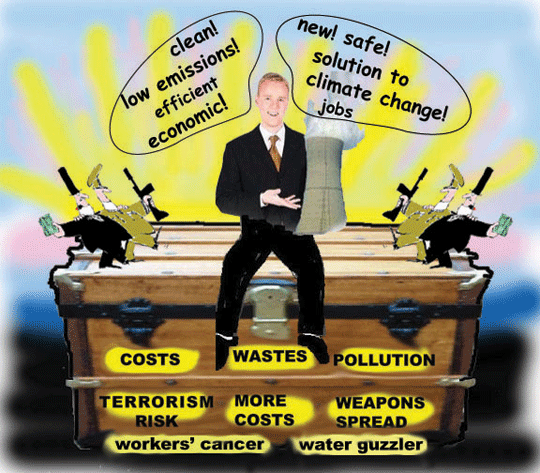
As South Africa prepares to invest in new nuclear power, we may do well to consider the other end of such investment: decommissioning. In the north of Germany, the Greifswald nuclear power plant (also known as Lubmin) has been undergoing the process of decommissioning since 1990. Before its closure, with a total planned capacity of 8 x 400MW plant built, but with only 5 reactors fuelled, Lubmin was to be the largest nuclear power station in East Germany prior to reunification. The reactors were of the VVER-440/V-230 type, or so-called second generation of Soviet-design. When it is concluded, the full process of decommissioning at Lubmin will have taken 30 years from first shutdown. In 1990 the company responsible for decommisioning this 8 x 400MW nuclear power plant, Energiewerke Nord, estimated a cost of half a billion DM per unit. Later this estimate was adjusted to 3.2 billion/unit. Today 4.1 billion/unit is a conservative final estimate (Energiewerke Nord, 2016).
More recently, early in 2012, following the Fukushima disaster in March 2011, the German government announced the immediate withdrawal of the operating licenses of eight German nuclear power plants and revived its plans to phase out nuclear power — by 2022. As this process unfolds, it will be possible to move beyond speculation, to actual data on costs, process and skills required for decommissioning.
What is involved in decommissioning a nuclear power plant?
Nuclear decommissioning is the process whereby a nuclear power plant site as a whole is dismantled to the point that it no longer requires measures for radiation protection to be applied. It is both an administrative and a technical process, including clean-up of all radioactive materials and then progressive demolition of the plant. Once a facility is fully decommissioned it should present no danger of radiation exposure. After a facility has been completely decommissioned, it is released from regulatory control and the plant licensee is no longer responsible for its safety.
The costs of decommissioning are spread over the lifetime of a facility and given that most nuclear power plants operate for over 40 years, funds need to be saved in a decommissioning fund to ensure that future costs are provided for.
What are the current estimates for nuclear power plant decommissioning?
This year, on April 28, an independent commission appointed by the German government (Kommission zur Überprüfung des Kernenergieausstiegs, KFK) presented its recommendations to the Ministry of Economics and Energy. The commission recommended that reactor owners — EnBW, EOn, RWE and Vattenfall — pay an initial sum of €23.3-billion ($26.4-billion) over the next few years, into a state-owned fund set up to cover the costs of decommissioning of the plants and managing radioactive waste. This sum includes a “risk premium” of around 35% to close the gap between provisions and actual costs.
According to the ministry, there will be approximately 10 500 tonnes of used fuel from 23 nuclear power plants, which will need to be stored in about 1 100 containers. A further 300 containers of high- and intermediate-level waste are also expected from the reprocessing of used fuel, as well as 500 containers of used fuel from research and demonstration reactors. In addition, some 600 000 cubic meters of low- and intermediate-level waste will need to be disposed of, including waste from industry, medicine and research.
Just before KFK started its work in October 2015, a study conducted by German audit firm Warth & Klein Grant Thornton for the Ministry of Economics and Energy had estimated the following costs for decommissioning 23 nuclear power plants, in 2014 money i.e. the cost if plants were to be decommissioned in 2014:
- Closure and decommissioning: €19.7-billion
- Containers, transport: €9.9-billon
- Intermediate storage: €5.8-billion
- Final low heat waste storage: €3.75-billion
- Final high active waste storage: €8.3-billion
i.e. a total of €47.5-billion.
However, decommissioning of all of Germany’s 23 nuclear power plants will not be undertaken at the same time. Most costs will be incurred in the future. Annexure 9 of the Warth & Klein Grant Thornton report provides an estimate of likely decommissioning costs when taking into account projected interest rate and inflation scenarios, as well as various likely nuclear-specific cost increases. Their conclusion? Total costs of decommissioning all nuclear power plants in Germany could reach up to €77.4-billion.
Given these emerging figures, even assuming that SA can find the necessary funds needed for new nuclear power investment, we would do well to take into account the increasingly known, non-negotiable related costs of decommissioning and waste management — of both old and new nuclear-related investment.
AREVA’s second biggest shareholder, Kuwait funds, wants to sell out of AREVA
 Kuwait fund wants to sell French nuclear group Areva stake -media, 13 June 16, ra ra http://www.reuters.com/article/us-areva-kuwait-idUSKCN0YZ19M Sovereign wealth fund Kuwait Investment Authority (KIA) has told French authorities it wants to sell its stake in nuclear group Areva (AREVA.PA), La Lettre de l’Expansion reported on Monday.KIA is Areva’s second-biggest shareholder with a 4.82 percent stake, according to ThomsonReuters data.
The newsletter said the Kuwaiti fund had complained that its investment in Areva, which is majority owned by the French government, was made based on incorrect company accounts.
French Industry Minister Emmanuel Macron and Areva declined to comment on the report. KIA was not immediately available for comment.
KIA paid 600 million euros ($676 mln) for the stake in 2010, but since then Areva shares have plunged by about 90 percent as the firm’s equity has been wiped out by years of losses. Areva will be rescued by a 5 billion euro state-funded capital increase and its nuclear reactor unit will be taken over by state-owned utility EDF (EDF.PA) later this year or early next year.
The French state holds about 87 percent of Areva’s capital.
KIA or other minority shareholders have never publicly complained about Areva’s accounts, but former Areva chief executive Anne Lauvergeon was put under formal investigation last month for her role in the 2007 acquisition of uranium mining firm Uramin.
In France, a formal investigation does not automatically lead to a trial but often does.
Lauvergeon has repeatedly denied any wrongdoing and has said that asset depreciations at Uramin were partly due to the collapse of uranium prices after the Fukushima nuclear disaster in Japan in March 2011.
Areva has had to write down billions of euros on Uramin, which contributed to years of losses and eventually wiped out its equity, leading to a state rescue package early this year.
($1 = 0.8875 euros)
(Reporting by Geert De Clercq, Michel Rose and Andrew Torchia; Editing by Susan Fenton and Alexander Smith)
Russians call US nuclear reactors a “white elephant” for India
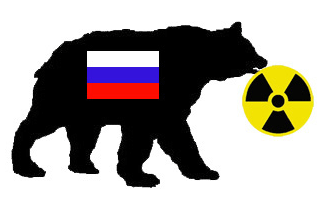 US Nuclear Reactors to Prove White Elephant for India. Sputnik News 13 June 16 India’s latest move in the direction of implementing a nuclear energy pact with the US is gaining strong resentment as the US reactors are most likely to cost three times more than that of Russian reactors already well operational.
EDF/AREVA keen to get in on selling nuclear reactors to South Africa
 Bullish Areva wants in on SA’s nuclear tender, City Press Yolandi Groenewald 2016-06-
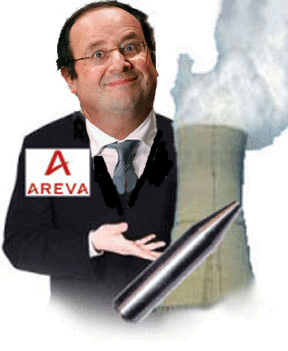 10 France’s state-owned nuclear businesses are focused on winning the lucrative South African nuclear tender despite recent financial difficulties.
The French will bid as EDF/Areva – nuclear technology company Areva sold its reactor business to the state-owned energy utility EDF earlier this year……..
EDF was facing large investments at its French operations. Its investment compromised about €50 billion (R869.6 billion) over 10 to 15 years, which would extend the operating lifespan of its ageing fleet to 60 years……
The French nuclear industry has faced a number of storms during the past year. Areva teetered on the edge of bankruptcy after years of losses wiped out its equity. It was rescued by French state aid and a sale of its reactor business to EDF.
The Flamanville project in France, Areva’s first European Pressurised Reactor (EPR) nuclear pressurised water reactor, is years behind schedule, way over budget and riddled with technical difficulties…….
France, Russia, China, the US and South Korea are competing for what could be South Africa’s biggest procurement project. The contract, estimated to cost between R580 billion and R1.56 trillion, aims to add nuclear capacity of 9 600 megawatts.
The government has said the nuclear programme would be developed at a pace the country can afford……..http://city-press.news24.com/Business/bullish-areva-wants-in-on-sas-nuclear-tender-20160603
USA not yet able to get India into the Nuclear Suppliers Group
Nuclear Suppliers Group Meeting On India’s Membership Ends Inconclusive http://www.ndtv.com/india-news/nuclear-suppliers-group-meeting-on-indias-membership-ends-inconclusive-1417783 Agencies | June 10, 2016 VIENNA:
HIGHLIGHTS
- No decision on India’s application to enter NSG in Vienna meeting
- Application to be taken up in meeting in Seoul on June 20
- Countries led by US support India’s bid, others led by China oppose
India’s application is now expected to be taken up in a meeting in Seoul on June 20.
The US-led push for India to join the club of countriescontrolling access to sensitive nuclear technology had made some headway on Thursday as several opponents appeared more willing to work towards a compromise, but China has consistently remained defiant.
The Nuclear Suppliers Group or NSG aims to prevent the proliferation of nuclear weapons by restricting the sale of items that can be used to make those arms. It was set up in response to India’s first nuclear test in 1974.
India already enjoys most of the benefits of membership under a 2008 exemption to NSG rules granted to support its nuclear cooperation deal with Washington, even though India has developed atomic weapons and never signed the nuclear Non-Proliferation Treaty, the main global arms control pact.
After meeting with Prime Minister Narendra Modi at the White House on Thursday, President Barack Obama pledged America’s backing for India to be given a seat in the NSG.
But China on Thursday maintained its position that the Non-Proliferation Treaty is central to the NSG, diplomats said.
List of worldwide nuclear stations headed for closing soon
 Illinois Power Plant Closings Reveal Worldwide Nuclear Issues, Clean Technica June 9th, 2016 by Sandy Dechert “………..International Nuclear Power
The World Nuclear Association……… enumerates 89 reactors scheduled to close by the end of 2025. Among the planned closures:
Armenia 1 in 2026
Belgium 2 by 2015, 5 more by 2025.
Canada 4 by 2015, 10 by 2025, 5 more by 2040.
Finland 3 by 2040
Germany 9 by 2025
Hungary 2 by 2025, 2 more by 2040
Mexico 2 by 2040
Netherlands 1 by 2025
Pakistan 1 by 2025, 1 more by 2040
Russia 1 by 2015, 23 by 2025, 4 more by 2040
Slovakia 2 by 2025
South Africa 2 by 2025
South Korea 1 by 2025, 1 more by 2040
Spain (7 reactors whose licenses run out before 2025, no decisions yet)
Sweden 2 by 2025, 5 more by 2040
Switzerland 34 by 2025, 2 more by 2040
Ukraine 2 by 2015, 10 more by 2025, 3 more by 2040
United Kingdom 1 by 2015, 6 more by 2025, 2 more by 2040
These numbers do not include the Japanese reactors shut down for safety checks following Fukushima, a third of France’s 58 nuclear reactors, and 7 Spanish reactors whose licenses are expiring without a close/refurbish decision by national regulators. Interestingly, the Philippines is converting a nuclear reactor to natural gas.
Worldwide, more than 60 reactors are under construction in 15 countries. However, other developments may threaten what some perceive as an international “nuclear renaissance”:
- One Indian reactor has been… under construction for 12 years with no hook-up date in sight;
- In Taiwan, two reactor units under construction for 15 years were halted this past April due to political opposition;
- At least 50 of the units listed as “under construction” have encountered construction delays — delays lasting from several months to several years;
- In China, ground zero for the so-called nuclear renaissance, 21 of the 28 units under construction are experiencing delays lasting between several months and more than two years; and
- Of the 17 remaining projects, a few have come online but many have yet to reach a targeted start-up date, and may or may not face delays or cancellations in the future.
………. the future of nuclear power still definitely lies in the “partly cloudy” range. https://cleantechnica.com/2016/06/09/illinois-power-plant-closings-reveal-worldwide-nuclear-issues/
Stumbling block prevents Toshiba Westingouse selling nuclear technology to India
Nisha Desai Biswal, assistant secretary of State for South Asian affairs, told a Senate committee on May 24 that a commercial deal was “quite close.”
The stumbling block, however, has been one article in a 2010 piece of Indian legislation that would make Westinghouse — and its suppliers — potentially vulnerable to crippling litigation under local Indian laws in the event of an accident. India has offered to establish insurance pools, but companies have not accepted that plan. There was no indication Tuesday that this issue had been resolved.
“They’ve painted themselves into a corner,” Omer F. Brown, a lawyer and nuclear liability expert, said of the Indian government. “I don’t know how they get out of it given that they wrote the law the way they did.”
Westinghouse and General Electric’s nuclear arm have been striving to reach a deal with India for more than a decade, and in 2008 Congress approved an agreement to promote nuclear cooperation with India, which critics said undermined half a century of U.S. nonproliferation efforts.
Daryl Kimball, director of the Arms Control Association, said the U.S. push for India’s membership in the NSG “would compound the damage in my view of Bush administration’s exemption” for India. He and 16 other non-proliferation experts, including from the Obama administration, have written a letter urging the administration to drop its support for India’s membership……..http://www.ndtv.com/india-news/6-nuclear-power-reactors-for-andhra-deal-on-but-foreign-media-1416685
Gloabl nuclear industry problems shown up in Illinois political battle over government subsidy
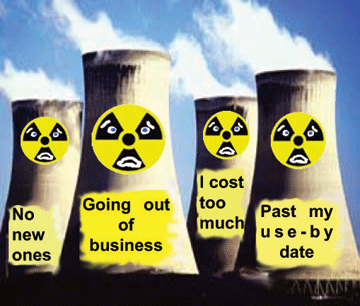 Illinois Power Plant Closings Reveal Worldwide Nuclear Issues, Clean Technica June 9th, 2016 by Sandy Dechert The many-sided battle over nuclear power continues with a clear break over politics in Illinois. The company and the government are dancing around the issues currently, with the industry essentially taking the position that government (read: the people) should subsidize the waning years of nuclear installations, or else. That state’s legislature adjourned its spring session last week without extending subsidies for nuclear power (the Next Generation Energy Plan advocated by the nuclear industry).
In return, Exelon Corporation—the nation’s largest nuclear power supplier—announced that it would have to close two of the state’s best-performing plants. It has said that the Clinton Power Station will close next June, and the Quad Cities Generating Station will close a year later. Despite their high scores, they have apparently lost $800 million over the past seven years. Exit papers are in preparation.
Joe Dominguez, executive vice president for governmental and regulatory affairs and public policy at Exelon, describes his company’s bottom line:
“We think that the costs of new nuclear right now are not competitive with other zero-carbon technologies, renewables, and storage that we see in the marketplace…. Right now we just don’t have any plans on the board to build any new reactors.”
Renewables broke all world records in 2015, say the United Nations Environment Programme and Bloomberg New Energy Finance. Also, renewables (excluding large hydro) accounted for more than half of new power generation capacity for the first time last year.Including large hydro, renewables’ share of all global electricity generation rose to more than 20%.
The human cost of closing the two Illinois plants includes 4,200 direct and indirect jobs and over $1.2 billion in economic activity annually. An earlier state report that Exelon quotes estimates that wholesale energy costs would rise in the region by $439 million to $645 million annually because of the plant closures. Exelon claims consumers will have to pay about $0.25 monthly to sustain the plants. Critics charge it will hike electric bills by about $3.00. Exelon has its eye on three other American closures, and Entergy is considering two at last report.
Industry-Wide Issues
Although this squabble has plagued Illinois for years, it brings up some nuclear issues that impact on the larger energy scene, both nationally and worldwide. These include not only competition from renewable energy but also unique financial factors, extension of design limits for the plants, decreasing reliability as reactors age, stability of the power grid, inadequate measures for disposal of radioactive waste. For all of these, potential near-term usefulness in slowing climate change—by limiting carbon releases associated with other forms of electric power generation—should be a major consideration……….
No commercial plants have been built in this country during the past 20 years. Eight have remained “under construction” during this time. These are mostly in the South, which still retains a protective regulatory environment. Only two are already scheduled to come online. In 2015, TVA Bellefonte ceased construction.
And decommissioning involves even greater expenses in the short term than keeping unprofitable plants afloat. Some of this huge expense (including the vital component of all project management, which the NRC’s Office of Nuclear Material Safety and Safeguards carries out) involves using more public funds…………..https://cleantechnica.com/2016/06/09/illinois-power-plant-closings-reveal-worldwide-nuclear-issues/
Nuclear industry’s next “renaissance” getting ever more unlikely
 As more costly nuclear power plants face closure, industry’s rebound only gets tougher, Tampa Bay Times Robert Trigaux, Times Business Columnist, June 8, 2016 The more the nuclear power industry mopes over its once bright future the more that vision darkens. The latest marketing pitch aimed at reviving a clearly overpriced nuke business is to claim that nuclear power is America’s best new friend in the battle against climate change. Close those polluting coal power plants, nuclear proponents say. Build more nukes instead and enjoy round-the-clock electricity — carbon free.
It’s a smart message. Except for one thing: It doesn’t work. Nukes, as they are now designed and financed, cannot compete with cheap natural gas alternatives.
Some attempts to build nuclear plants have been abandoned — as Duke Energy Florida customers saw with the proposed Levy County nuclear plant north of Tampa Bay. Other plants — Southern Co.’s Vogtle nuclear plant in Georgia or the V.C. Summer plant in South Carolina — are behind schedule and billions over budget.
Consider five examples of why the U.S. nuclear power business is losing ground:
1. The V.C. Summer project so far has cost $1.5 billion more than originally estimated. As Duke Energy Florida ratepayers can empathize, South Carolina law allows utilities to charge customers more for cost overruns.
2. Exelon, a major Chicago-based power provider, said this month it plans to shut two money-losing nuclear plants in Illinois after failing to win a bailout in the state’s legislature.
3. Marvin Fertel, president of the Nuclear Energy Institute, the industry’s trade association, warned last month that another 15 to 20 nuclear plants are at risk of a premature shutdown in the next decade due to bad economics.
“Over the last several years, companies have shut down — or announced plans to shut down — eight nuclear reactors … about 6,300 megawatts of capacity … 6,000 direct jobs and at least that many indirect jobs … almost 10 percent of the Clean Power Plan’s 2030 carbon reduction goal,” Fertel told an audience at the U.S. Department of Energy’s Nuclear Summit on May 19.
4. In California, the Diablo Canyon plant near San Luis Obispo is the only nuke facility left in the state. Pacific Gas & Electric may seek permission to extend its operating license past 2024. But opponents want the plant to follow the fate of the San Onofre Nuclear Generating Station, shuttered in early 2012.
5. In May, CEO Tim Burke of the Omaha Public Power District urged his board to close its Fort Calhoun Nuclear Generating Station in Nebraska by year end. It is too expensive to operate, he said.
At this rate, there soon won’t be many U.S. nuclear plants left to worry about. Only 99 nuclear reactors are currently in use….http://www.tampabay.com/news/business/energy/as-more-costly-nuclear-power-plants-face-closure-industrys-rebound-only/2280720
Contradictions in the nuclear marketing frenzy – theme for June 2016
One contradiction is the increasing recognition that nuclear power is uneconomic, and could even bankrupt the sellers. It’s doubtful that the sellers will really make money out of it, especially Russia, funding so many other countries’ nuclear set ups. Still, we know why, really. It’s all part of the irrational battle to be Topp, to have that geopolitical presence and advantage in other countries.
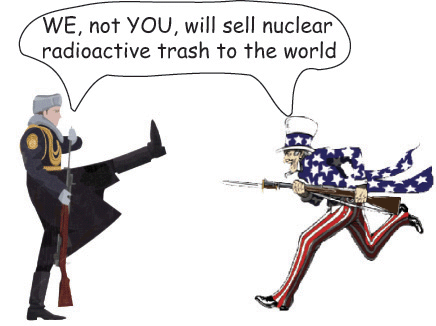
An obvious contradiction is the way in which both Russia and the West agonise about nuclear terrorism and nuclear weapons proliferation, while enthusiastically marketing nuclear technology to all and sundry. Never mind if it’s to an unstable Middle Eastern or East Asian regime, with a high risk of both terrorism and nuclear weapons development.
Another contradiction is the pretense going on that Big nuclear reactors and Small nuclear reactors are being happily promoted at the same time. The “conventional” big reactor companies. Toshiba Westinghouse, Rosatom, AREVA etc are determined to sell their stuff, and no way want to let the “new little” nuclear reactors take over the market. You can see this battle going on in Britain, with the “little nukes” lobbying away, and getting themselves set up as a “charity” for goodness’ sake!
How long will it be before the world recognises that the commercial nuclear empire is crumbling. We don’t need their toxic expensive product. Meanwhile renewable energy gets ever cheaper, fast to set up, versatile, and attractive to the public.
India’s Prime Minister Modi lobbying the world, for India to join the nuclear salesmen
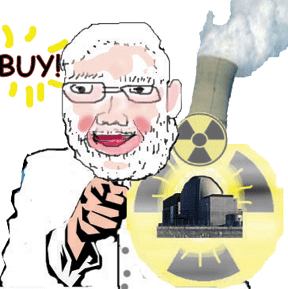 Modi’s global nuclear lobby tour, Nikkei Asian Review KIRAN SHARMA, Nikkei staff writer NEW DELHI 7 June 16, — Indian Prime Minister Narendra Modi is personally lobbying Switzerland, the U.S. and Mexico for his country’s admission into the 48-nation Nuclear Suppliers Group ahead of its next meeting in Vienna on Thursday.
India’s entry has been opposed by China, and Modi’s lobbying is the major component in a five-nation tour begun Saturday that also takes in Afghanistan and Qatar.
The announcement in Geneva was a boost to India because Switzerland had earlier been dubious about backing entrance to the NSG by nonsignatories to the Treaty on the Non-Proliferation of Nuclear Weapons. India considers the NPT discriminatory, and has not signed up.
India applied for Nuclear Suppliers Group membership on May 12 after preparing for several years. The group was created in response to India’s first nuclear test in 1974 to control the global supply of atomic material and technology. ……..
China, India’s biggest neighbor, argues that any new Nuclear Suppliers Group member should have signed the NPT. The U.S. backs India, citing its clean nonproliferation record. The U.S. helped India secure a special waiver from the NSG in 2008 for a bilateral civil nuclear deal. ………
India says it seeks a nuclear industry compliant with international norms and practices, but views the NSG and the NPT as separate matters.
“The NSG is a regime,” said Jaishankar. “It is a sort of a flexible arrangement amongst states, which is quite different from the NPT — which is a treaty.” The Indian foreign secretary pointed out that the central words in the two titles were “supplier” and “proliferation.” “So, I think the objectives are different,” he said……..
After the NSG’s meeting this week in Vienna, the group will meet in Seoul on June 24 and will review India’s application…..http://asia.nikkei.com/Politics-Economy/International-Relations/Modi-s-global-nuclear-lobby-tour
A hitch in India’s entry to the nuclear selling cartel
- Nuclear Suppliers Group still debating India’s application
-
Obama and Modi have pushed for membership in nuclear cartel
India will probably need to wait a while longer before it joins the elite club of nations that control trade in advanced nuclear technologies, according to three diplomats with knowledge of the process.
The Nuclear Suppliers Group, or NSG, is unlikely to accept India’s application for membership when it meets June 20 in Seoul because officials in New Delhi haven’t yet met all the criteria for admission, said the diplomats, who represent governments inside the 48-nation group. They asked not to be named in line with diplomatic rules for discussing private deliberations.
 A delay could roil plans by U.S. President Barack Obama and Indian Prime Minister Narendra Modi, who were meeting in Washington on Tuesday, to bring the world’s second-most-populous nation into the nuclear mainstream. It would push back a decision on Indian membership to later in the year, and risk bumping into the U.S. presidential election. Continue reading
1 This Month

of the week– Nuclear Reactor Information Task Force

14 May – online event From Bombs to Data Centres: the Face of Nuclear Colonialism
To see nuclear-related stories in greater depth and intensity – go to https://nuclearinformation.wordpress.com
-
Archives
- May 2026 (81)
- April 2026 (356)
- March 2026 (251)
- February 2026 (268)
- January 2026 (308)
- December 2025 (358)
- November 2025 (359)
- October 2025 (376)
- September 2025 (257)
- August 2025 (319)
- July 2025 (230)
- June 2025 (348)
-
Categories
- 1
- 1 NUCLEAR ISSUES
- business and costs
- climate change
- culture and arts
- ENERGY
- environment
- health
- history
- indigenous issues
- Legal
- marketing of nuclear
- media
- opposition to nuclear
- PERSONAL STORIES
- politics
- politics international
- Religion and ethics
- safety
- secrets,lies and civil liberties
- spinbuster
- technology
- Uranium
- wastes
- weapons and war
- Women
- 2 WORLD
- ACTION
- AFRICA
- Atrocities
- AUSTRALIA
- Christina's notes
- Christina's themes
- culture and arts
- Events
- Fuk 2022
- Fuk 2023
- Fukushima 2017
- Fukushima 2018
- fukushima 2019
- Fukushima 2020
- Fukushima 2021
- general
- global warming
- Humour (God we need it)
- Nuclear
- RARE EARTHS
- Reference
- resources – print
- Resources -audiovicual
- Weekly Newsletter
- World
- World Nuclear
- YouTube
-
RSS
Entries RSS
Comments RSS
 nuclear-news