The miserable and ongoing history of EDF’s unfinished nuclear reactors in Flamanville and Olkiluoto
The £18bn Hinkley gamble: Nuclear deal will cost every UK family an extra £1,000 as May signs off on the plans to protect Britain’s national security
- Prime Minister approved plans after restricting influence of Chinese state
- Britain will guarantee EDF £92.50 per megawatt hour, up on current market price of £38.91
- Tory MP Zac Goldsmith said the plant would generate ‘most expensive energy in the history of energy generation’
By JASON GROVES DEPUTY POLITICAL EDITOR FOR THE DAILY MAIL, 16 Sept 16 “……..Construction at the site near Cherbourg began in 2007, with a scheduled completion date of 2012. But within a year, cracks were found in the concrete base and a quarter of the welds in the reactor’s secondary steel lining were found to be defective.
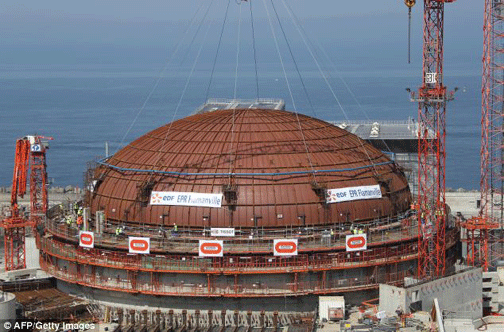
Inspections also revealed holes in concrete pillars and faults in buildings where nuclear fuel is to be stored.
A report by France’s nuclear safety authority in 2011 recorded 13 incidents of sub-standard safety measures. In 2013, a welder fell to his death. Then last year defects were discovered in safety valves in the cooling system.
Chillingly, this was similar to a problem that led to the Three Mile Island nuclear plant accident in Pennsylvania in 1979, which before Chernobyl was the world’s worst nuclear accident, and resulted in $1billion (£750million) of clean-up costs.
It was also in 2015 that Flamanville suffered a potentially killer-blow.
Tests on the steel used to construct the base and lid of the nuclear reactor vessel showed that too much carbon had been used, leading to weaknesses in the structure.
Professor Steve Thomas, of the University of Greenwich, said that if this led to the reactor failing, there would be no warning. ‘It will fail catastrophically and allow its radioactive contents into the environment,’ he said.
For their part, EDF and its project partner – the majority French state-owned company Areva, which makes nuclear reactors – have been forced to make more tests on the steel.
At the time the faults were found, the Financial Times said: ‘The scale of the risks to EDF if those tests identify a serious problem is hard to exaggerate.’
Whatever the findings of these new tests, Flamanville’s opening date – which has already been put back six years – is still nowhere in sight.
Professor Thomas warns that if it has to be rebuilt, the process could take up to five years, adding: ‘That might be prohibitively expensive and the whole plant could be abandoned.’
All this assumes that government-owned EDF doesn’t go bust in the meantime – which is a possibility.
In March, the company’s finance director Thomas Piquemal resigned, saying that taking on Hinkley as a project risked driving the firm to bankruptcy. Problems were compounded by the fact that Areva has had to be bailed out by the French government, with an injection of £3.4billion of public money in April. Inevitably, the European Commission has launched an investigation into this rescue package to check it did not ‘unduly distort competition’.
For some time, Areva – which is 87 per cent owned by the state – had been struggling with a downturn in the nuclear industry and has suffered big financial losses on its projects.
Once the pride of France, the reactor designer saw its credit rating downgraded last year, and in February it reported a €2billion (£1.7billion) net loss for 2015.
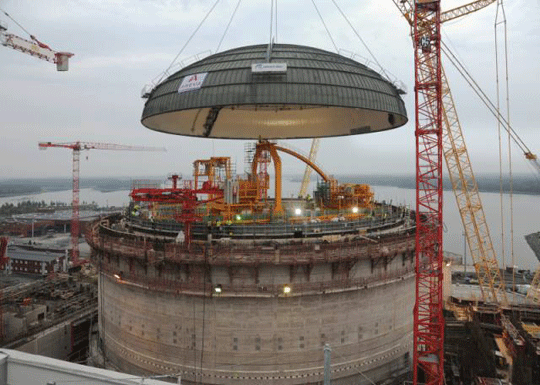
The project been subject to lawsuits, technology failure, construction errors and a bitter row between participant companies that has been described as ‘one of the biggest conflicts in the history of the construction sector’.
Work began on the EPR in 2005 and was scheduled to be completed in 2009. But from early on, problems emerged.
The concrete base on which the plant was to be built proved to be faulty, and had to be taken up and relaid. Then there was a problem with the electronic control systems.
Because it is absolutely vital that engineers can manage the temperature inside the reactor, a new nuclear plant must have two parallel control systems in case one fails.
The problem at Olkiluoto was that the two systems were too similar – meaning that if something caused the first one to shut down, there was a big risk that the second one would also close down.
The issue took five years to resolve – with the result that the power station is not expected to open until 2018 at the earliest.
Not surprisingly, the Finnish government has cancelled an option to buy a second reactor.http://www.dailymail.co.uk/news/article-3791895/The-18bn-Hinkley-gamble-nuclear-deal-cost-UK-family-extra-1-000-signs-plans-protect-Britain-s-national-security.html
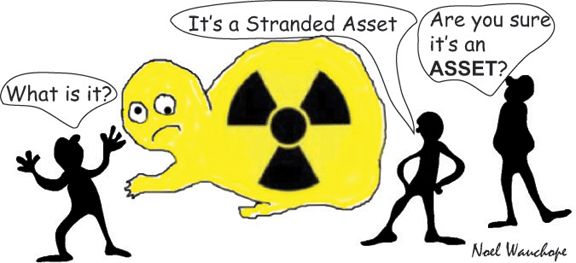
Hinkley nuclear plant vulnerable to becoming a “stranded asset”
A Nuclear Lesson For Big Oil (And Vice Versa), Bloombeg Gadfly, 16 Sept 16 By Liam Denning It is a reasonable bet that the $24 billion Hinkley Point C nuclear power project in the U.K., due online in 2025, will neither be ready by 2025 nor cost just $24 billion. Indeed, it’s so reasonable that, as fellow Gadfly Chris Bryant lays out here, the stock market appears to be making that very same bet.
Leave aside the also reasonable conspiracy theories about London buttering up Paris and Beijing by approving the project and focus on the ostensible reason for doing it: maintaining security of energy supply……….
The oil and gas industry’s experience reveals one more insidious risk facing the nuclear project.
There’s a reason EDF demanded the U.K. government guarantee an electricity price for Hinkley Point’s output atdouble the current wholesale price. Financing a $24 billion project that won’t produce a cent of revenue for a decade is really tough — especially in an industry carrying as muchhistorical baggage on busted budgets and timescales as nuclear power does. Subsidies and guarantees help bridge the risk gap………
mega-projects can prove vulnerable not despite their scale but because of it. They might extract savings on, say, procurement, but their inherent complexity makes it hard to apply lessons from previous examples to gain efficiency. ……..
And once a company is several years into building a new power plant or LNG terminal, the compulsion to complete it is enormous, due to the already huge sunk costs (and need to save face), even if budgets and schedules have been blown through or — as was the case with fracking — another technology has disrupted the market……..
With energy technology in such flux right now, ranging from renewable power to batteries to energy efficiency, is there a high risk that a giant plant a decade or more away from completion becomes stranded? You bet…..……
In Hinkley Point’s case, of course, any future U.K. government wouldn’t dare try to wriggle out of those high, guaranteed power prices for fear of enraging the French. Because that’s never happened. https://www.bloomberg.com/gadfly/articles/2016-09-16/hinkley-point-nuclear-power-project-s-lesson-for-big-oil
Huge workforce maintains Japan’s shuttered nuclear power stations
Nuclear plant can’t sell power but thousands still work there Japan’s utilities keep plants open, hoping to restart them, Straits Times, 16 Sept 16 TOKYO • More than 6,000 workers cycle through the world’s biggest nuclear plant every day to operate and maintain a facility that has not sold a kilowatt of electricity in more than four years.
The buzz at Tokyo Electric Power’s (Tepco’s) Kashiwazaki-Kariwa plant plays out daily across Japan, where utilities employ thousands of workers and spend billions of dollars awaiting the green light to restart commercial operations.
With only three of the country’s 42 operable reactors running, they are betting a national government committed to nuclear power will win over local officials and a wary public who do not believe enough has been done to guarantee safety after the worst meltdown since Chernobyl.
“Even though operating expenses of non-generating reactors remain high, utilities would prefer to keep them open while there is any chance they can restart,” said Mr James Taverner, a Tokyo-based analyst at IHS Markit.
“Utilities have already committed significant expenditure for plants to meet new safety standards, and decommissioning costs are considerable.”
The plant, the world’s biggest with generating capacity of about 8.2 gigawatts, has seven reactors at a facility spread across more than 400ha and located about 217km north-west of Tokyo in the prefecture of Niigata…….
o boost confidence in its facility’s safety, Tepco has spent 470 billion yen on flood barriers, a 15m seawall and a reservoir the size of 30 Olympic-sized swimming pools to supply water in the event a reactor pump fails.
KK’s restart is far from assured. The plant was forced to shut for 21 months following an earthquake in July 2007. Though some units eventually restarted, all were shuttered again after the March 2011 Fukushima accident for safety checks.
The restart of nuclear reactors is opposed by 53 per cent of Japanese and supported by just 30 per cent, according to a nationwide poll conducted earlier this year by the Mainichi newspaper.
Should KK clear the necessary regulatory, legal and political hurdles and resume operations, Tepco plans to maintain the facility’s workforce at current levels, a reflection of how many workers are needed even during a period called cold shutdown. http://www.straitstimes.com/asia/east-asia/nuclear-plant-cant-sell-power-but-thousands-still-work-there
Nuclear industry will grind to a halt, if no waste disposal solution

 Progress on waste issue key to support for nuclear: US senator Washington (Platts)–15 Sep 2016 US Senator Dianne Feinstein of California said at an appropriations subcommittee hearing Wednesday that she cannot continue to support nuclear power if there is “no strategy for the long-term storage of the waste.”

Feinstein, the senior Democrat on the Appropriations Subcommittee on Energy and Water Development, criticized the nuclear power industry in her opening statement on what she called its failure to speak with “one voice” on the need for interim storage of utility spent fuel. The country, she said, “should be working to establish interim [spent fuel] storage far away from reactors and population centers.” The hearing was scheduled to look at the future of nuclear power.
The lesson of the Yucca Mountain repository project is “any solution to nuclear waste needs to be voluntary,” Feinstein said. She and subcommittee chairman Lamar Alexander, a Tennessee Republican, and Senators Lisa Murkowski, an Alaska Republican and chairman of the Senate Energy and Natural Resources Committee, and Maria Cantwell of Washington, the ranking Democrat on the energy committee, have introduced legislation that would, among other things, establish a consent-based siting process. The bill has not moved out of committee, however.
Secretary of Energy Ernest Moniz told the subcommittee that a voluntary siting process is needed and that DOE will discuss during at a public meeting Thursday in Washington input the department received during eight public meetings held across the US on what a consent-based siting process should involve this year.
Support for a nuclear waste facility has to be aligned on the community, state and federal levels to avoid “bad surprises later on,” Moniz said.
In response to a question from Feinstein, Moniz said DOE’s general counsel has said the department has the authority, although not specifically stated, to use a private-sector facility to store utility spent fuel. He said DOE could move forward on setting up contracts with such facilities.
Currently, private-sector efforts are underway in Texas and New Mexico to site consolidated interim storage facilities that would have DOE as its only customer. http://www.platts.com/latest-news/electric-power/washington/progress-on-waste-issue-key-to-support-for-nuclear-21519625
US COULD LOSE NEARLY HALF ITS NUCLEAR POWER FLEET
 US COULD LOSE NEARLY HALF ITS FLEET, ALEXANDER SAYS
By 2038, 48 US reactors will be at least 60 years old, Alexander said, adding that the country would lose about half of its reactor fleet if their NRC operating licenses are not extended beyond 60 years. NRC’s initial operating licenses for power reactors are for 40 years. Most units have received, or are seeking, a 20-year license renewal, putting their total operating time at 60 years.
Exelon Generation said June 7 it will seek a second 20-year renewal, also known as a subsequent license renewal, of its NRC operating license for the Peach Bottom units 2 and 3 boiling water reactors in Delta, Pennsylvania. If NRC approves the renewal, the Peach Bottom units would be licensed to operate for a total of up to 80 years.
Exelon’s announcement came after Dominion said in November that it plans to seek subsequent license renewal for the two pressurized water reactors at its Surry station in Virginia.
–Elaine Hiruo, elaine.hiruo@spglobal.com
–Edited by Valarie Jackson, valarie.jackson@spglobal.com http://www.platts.com/latest-news/electric-power/washington/progress-on-waste-issue-key-to-support-for-nuclear-21519625
Hinkley nuclear deal to be followed by an Essex nuclear deal with China?
 China to build nuclear reactor in Essex after Hinkley deal approved, Telegraph UK, Emily Gosden, energy editor 15 SEPTEMBER 2016
China is to begin developing a new nuclear power station in Essex after the Government heralded a new wave of UK reactors by approving the £18bn Hinkley Point plant in Somerset.
Chinese state nuclear firm CGN will fund one-third of Hinkley, which is led by French state energy giant EDF, in return for the chance to build its own design of reactor at Bradwell with EDF’s support………
The only change to the Hinkley deal is that the Government has taken powers to veto EDF selling its controlling stake in the project, leading critics to call Mrs May’s review “a lot of hot air”……..Both CGN and EDF made clear they did not regard the new safeguards as any obstacle to proceeding with the plans for a Chinese reactor at Bradwell.
Although ministers made no mention of Bradwell in their announcement, sources told the Telegraph that CGN had privately received Government assurance its plans, which were endorsed by the previous administration, were still welcome.
CGN said it was “delighted” by the Hinkley decision which would allow it to “move forward and deliver” Bradwell.
It is understood the firm hopes to begin the process of seeking UK safety approval for its Hualong One reactor design in the autumn. EDF has previously said such a plant could begin construction as early as 2022, subject to approval by UK regulators.
Mrs May’s joint chief of staff, Nick Timothy, has previously raised concerns that China could use its role in UK nuclear plants to “build weaknesses into computer systems which will allow them to shut down Britain’s energy production at will”………http://www.telegraph.co.uk/business/2016/09/15/china-to-build-nuclear-reactor-in-essex-after-hinkley-deal-appro/
Major USA utility sees Renewables and Efficiency as a Better Deal Than Nuclear
 How a Major Utility Came to See Renewables and Efficiency as a Better Deal Than Nuclear Greeen Tech Media by Tam Hunt September 14, 2016 Pacific Gas & Electric, California’s biggest utility, made a historic proposal to shut down California’s last nuclear power plant, called Diablo Canyon. PG&E is arguing that replacing Diablo’s output with a mix of energy efficiency and renewables will not only cost less than relicensing Diablo, but will also lead to a more reliable and flexible grid. ……..
Energy efficiency and renewables come with none of the downsides of nuclear power. There is no radioactive waste that must be stored for literally thousands of years, there is no terrorist target, there is no ticking time bomb waiting for an earthquake to trigger it. There is a much larger footprint for renewables like solar and wind, but many countries around the world are demonstrating now that these resources can reach high penetration levels without spoiling views, impacting wildlife overly much, or taking up too much land.
Another benefit of shutting down Diablo that PG&E highlights in the joint application is the ability to better absorb increasing amounts of renewable energy. Diablo is a very large non-flexible “baseload” resource. It can’t be turned up or down to accommodate variable renewable resources — it’s either on or off. And as we push toward the current goal of 50 percent renewables by 2030, which is now mandated by law (SB 350), we need more flexible resources to accommodate an ever-increasing share of renewables.
Moreover, having such large, inflexible resources on the grid requires its own share of backup power, because if Diablo experiences a scheduled or unscheduled outage, such an outage will generally require replacement resources to make up for this loss. Renewables like wind and solar get a lot of negative attention for being variable and needing some grid backup, but this problem is actually far worse with very large inflexible generation assets like Diablo. By shutting down Diablo at the end of its current license, system-reserve requirements will actually be reduced.
How to avoid further nuclear boondoggles
The recent shutdown of San Onofre Nuclear Generating Station (SONGS) in Southern California turned into an extremely contentious battle over a number of issues, but primarily over who should bear the cost of this extremely expensive power plant.
PG&E’s joint application may entail some similar issues, as it requests a full reimbursement of all costs for the plant to date, without specifying exactly what those costs will be. As described above, the net cost of replacing Diablo with preferred resources will be about one-third less than the equivalent cost of relicensing Diablo.
That said, PG&E will need to present more information about the full costs of the shutdown, including the costs of decommissioning. With respect to SONGS, the total shutdown and decommissioning costs became a major issue. To avoid a similar fate, PG&E should be as transparent as possible as early as possible……http://www.greentechmedia.com/articles/read/how-a-major-utility-came-to-see-renewables-as-a-better-deal-than-nuclear
Subsidising NewYork’s nuclear power stations – not agood plan
Nuclear power vs. other carbon-free fuels While power markets do indeed undervalue low-carbon fuels, all of the other premises underlying the nuclear industry approach are flawed. In California and in Nebraska, utilities plan to replace nuclear plants that are closing early for economic reasons almost entirely with electricity from carbon-free sources. Such transitions are achievable in most systems as long as the shutdowns are planned in advance to be carbon-free.
In California these replacement resources, which include renewables, storage, transmission enhancements and energy efficiency measures, will for the most part be procured through competitive processes. Indeed, any state where a utility  threatens to close a plant can run an auction to ascertain whether there are sufficient low-carbon resources available to replace the unit within a particular time frame. Only then will regulators know whether, how much and for how long they should support the nuclear units.
Closing the noncompetitive plants would be a clear benefit to the New York economy. This is why a large coalition of big customers, alternative energy providers and environmental groups opposed the long-term subsidy plan.
Compete or Suckle: Should Troubled Nuclear Reactors Be Subsidized? http://www.theenergycollective.com/energy-post/2387838/compete-or-suckle-should-troubled-nuclear-reactors-be-subsidized September 13, 2016 by Energy Post, by Peter Bradford, Adjunct Professor Vermont Law School. Courtesy The Conversation. Since the 1950s, U.S. nuclear power has commanded immense taxpayer and customer subsidy based on promises of economic and environmental benefits. Many of these promises are unfulfilled, but new ones take their place. More subsidies follow.
Today the nuclear industry claims that keeping all operating reactors running for many years, no matter how uneconomic they become, is essential in order to reach U.S. climate change targets. Continue reading
After 40 years to build – nuclear power plant never worked, now for sale at peppercorn price
 US Nuclear Plant up for Sale at Fraction of Cost, abc news, By JAY REEVES, ASSOCIATED PRESS HOLLYWOOD, Ala. — Sep 11, 2016 After spending more than 40 years and $5 billion on an unfinished nuclear power plant in northeastern Alabama, the nation’s largest federal utility is preparing to sell the property at a fraction of its cost.
The Tennessee Valley Authority has set a minimum bid of $36.4 million for its Bellefonte Nuclear Plant and the 1,600 surrounding acres of waterfront property on the Tennessee River. The buyer gets two unfinished nuclear reactors, transmission lines, office and warehouse buildings, eight miles of roads, a 1,000-space parking lot and more………
The sale is bittersweet for site manager Jim Chardos, who went to work at Bellefonte in 1994 expecting it to be finished as a nuclear power plant. All these years later, he commutes 90 minutes each way to work to oversee a plant that has never been stocked with radioactive fuel or used either of its reactors to generate a single watt of electricity.
Work began at Bellefonte in the mid-’70s on the backside of the nuclear energy boom in the United States, Chardos said. The utility initially planned to construct four reactors at the site, but demand for power in the region never met those early expectations and work halted in 1988. A series of starts and stops preceded TVA’s decision earlier this year to sell Bellefonte……….http://abcnews.go.com/US/wireStory/us-nuclear-plant-sale-fraction-cost-42010576
South Korea trying to get in on the frenzy of nuclear marketing to Britain
 Koreans near investment in new Cumbrian nuclear plant http://www.ft.com/cms/s/0/573d713e-7833-11e6-a0c6-39e2633162d5.html#axzz4Jz1Iolbo Financial Times, 12 Sept 16, Jim Pickard and Andrew Ward in London A South Korean energy group is closing in on a multibillion investment in a new nuclear power station near Sellafield in the latest sign of Asian interest in Britain’s energy industry.
The deal, if it goes ahead, would add momentum to Moorside at a time when the rival Hinkley Point nuclear power project in Somerset has been thrown into doubt by concerns about its high cost and the role of Chinese investors in the scheme.
Theresa May, prime minister, is expected to decide this month whether to go ahead with Hinkley, led by EDF of France with Chinese backing, after ordering a review of the £18bn project.
NuGen sees the uncertainty as a chance to leapfrog Hinkley in the race to build the first new nuclear reactor in the UK for more than two decades. However, it is still years behind EDF in securing financing and regulatory approval for its project.
For Kepco, an investment in Moorside would be a chance to gain a foothold in the UK as it builds its presence in the global nuclear industry.
The Cumbrian plant — designed to provide power for 6m homes — would be supplied with reactors by Westinghouse, the US subsidiary of Toshiba. But Kepco sees the UK as a potential future market for its own technology.
South Korea has set a goal to become the world’s third-largest exporter of nuclear reactors by 2030 and has already won a $20bn contract in Abu Dhabi. Tom Samson, chief executive of NuGen, is former chief operating officer of the Abu Dhabi company, Emirates Nuclear Energy Corporation, which struck that deal.
Kepco is not without controversy, having been rocked by a domestic safety scandal three years ago. The country’s atomic watchdog said safety certificates for thousands of components procured by Korean reactors over the previous nine years had been forged. An ally of Kepco said the scandal was behind it and the group was now seen as “a first division player” in nuclear power.
The group, 51 per cent owned by the South Korean government, first entered talks with NuGen three years ago, but no deal was reached. Four people with knowledge of the situation said talks had since resumed and made progress over a potential equity stake in NuGen as well as a possible role in construction.
NuGen declined to comment on Kepco but said it had a “universe of options for financing” and was talking to a variety of potential investors and contractors. Kepco could not be immediately reached for comment.
The UK government has put nuclear power at the heart of its energy policy, with a target for 14GW of generating capacity from new reactors by 2035. However, its refusal to inject public money has left ministers dependent on foreign investors to finance the programme.
As well as Hinkley and Moorside, Hitachi of Japan also has plans for reactors at Wylfa in Anglesey and Oldbury-on-Severn in Gloucestershire. EDF and its Chinese state-backed partner CGN are planning further reactors at Sizewell in Suffolk and Bradwell in Essex.
The latter project has been the focus of close scrutiny from Downing Street since Mrs May became prime minister because Bradwell would involve Chinese rather than French reactor technology.
New nuclear power stations are seen as crucial to UK energy security in the coming decades as dirty coal-fired power stations and old nuclear reactors are phased out. But critics say nuclear is too expensive and believe a mix of renewables and natural gas could keep the lights on at a lower cost while still reducing carbon emissions.
Bulgaria has to quickly pay up for cancelled Belene nuclear project
Russia demands swift payment for canceled Bulgarian nuclear plant , Reuters, 10 Sept 16 Russian nuclear company Rosatom has asked Bulgaria to swiftly pay 620 million euros ($696 million) in compensation over the canceled Belene nuclear project, it said on Saturday.
An arbitration court ruled in June that Sofia must pay for the equipment produced by Rosatom for the project, which Bulgaria abandoned in 2012 due to financial constraints and concerns in Brussels and Washington over its energy dependence on Russia…….Bulgaria’s prime minister has said that the compensation, estimated by Sofia at about 560 million euros, will be paid in full and quickly, to avoid paying interest of 167,000 euros a day.
Bulgaria is considering selling the 2,000 megawatt nuclear project to private investors, keeping a small state stake in it, after its attempt to sell the equipment to Iran did not succeed.
(Reporting by Tsvetelia Tsolova; Editing by Alexander Smith) http://www.reuters.com/article/us-russia-bulgaria-idUSKCN11G0D7
As nuclear costs rise, top economist urges nuclear operators on early decommissioning of reactors
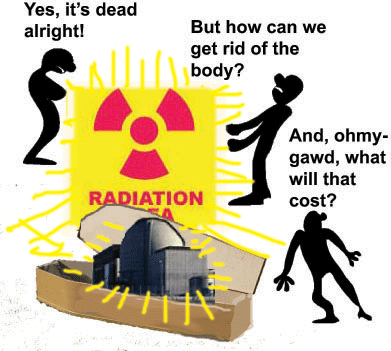 US operators urged to decommission immediately to prevent cost hikes, Nuclear Energy Insider, Sep 7, 2016 Nuclear plant operators should start decommissioning activities of shutdown reactors as early as possible as the deferral of decontamination and dismantling (D&D) exposes operators to delay-related costs, investment risks and loss of crucial expertise as workers leave the industry, Geoffrey Rothwell, Principal Economist at the OECD’s Nuclear Energy Agency, told Nuclear Energy Insider.
There are currently 17 U.S. nuclear power plants being decommissioned and this will soon increase following a recent spate of plant closure announcements due to sustained low power prices.
Operators have announced the early closures of California’s Diabolo Canyon, Nebraska’s Fort Calhoun and Illinois’ Clinton and Quad Cities plants in recent months as low gas prices, rising renewable energy capacity and energy efficiency measures pressure electricity prices.
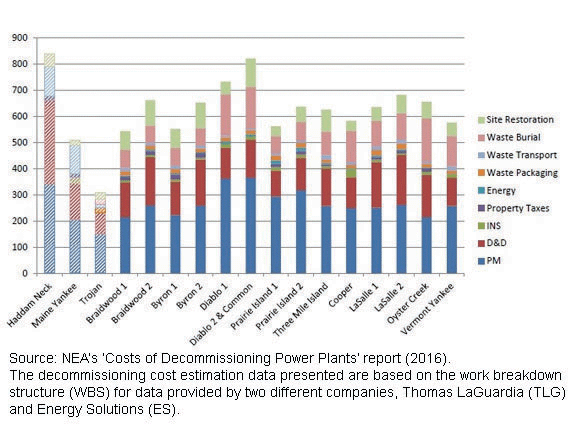
The majority of current U.S. decommissioning projects are being carried out under the deferred “SAFSTOR” method of deferred decontamination, but this process incurs the risk of cost hikes, Rothwell said.
U.S. operators build up nuclear decommissioning trust funds (DTFs) based on estimated costs but data from completed projects shows the actual cost of decommissioning has varied substantially, as operators have faced fresh site-specific challenges and regulation which can differ between states.
The variance in costs of three completed ‘immediate’ D&D projects was highlighted earlier this year in a report by the Nuclear Energy Agency (NEA), co-authored by Rothwell, which cited figures from a Pacific Northwest National Laboratories [PNNL] study.
The chart below shows actual costs for the Haddam Neck, Main Yankee and Trojan plants, laid out alongside estimated costs for 14 other reactors, showed large differences in spending on Project Management, Decontamination and Dismantling (D&D) and Waste Management.
Internal expertise
Project management costs tend to be a function of the duration of D&D activities, rather than plant size and this is highlighted by the data from completed projects, Rothwell noted.
Portland General Electric (PGE), licensee of the 1.2 GW Trojan plant, decided to perform the decommissioning of the plant itself and conducted the project efficiently and without major changes or setbacks.
In comparison, the licensees for the 582 MW Haddam Neck plant in Connecticut and the 900 MW Maine Yankee plant chose to contract the D&D work to a decommissioning operations contractor (DOC) and then later in the process they chose to resume execution of decommissioning activities themselves.
In both cases, the management changes led to complications and delays and escalated costs, NEA said in its report.
A major advantage of carrying out D&D activities immediately is that current operations staff have in-depth knowledge of plant specifics, including previous incidents and undocumented facility detail, which avoids unnecessary work-arounds, Rothwell said.
“The maintenance crew have all sorts of implicit, tacit knowledge…If you wait for 60 years they are all gone,” he said.
Dismantling challenge
Actual D&D costs have varied substantially as a lack of identical reference projects has meant operators have had to perform “first of a kind” operations such as the time-consuming task of dismantling main reactor components, Rothwell said.
“It’s cutting up the reactor and the steam generator, these are big pieces of equipment and we are just learning how to do this,” Rothwell said.
PG&E was able to limit the D&D costs for its Trojan plant through its access to the U.S. Ecology low-level waste facility at Hanford, Washington. PG&E was permitted to ship reactor internals to the Hanford facility as one package and avoid some of the on-site cutting-up of components.
At Haddam Neck, the segmentation of the internals proved challenging and took approximately 29 months, according to NEA’s report. Regulations also required the operator to store the internals on-site at the ISFSI.
The duration of D&D activities at Haddam Neck exceeded original estimates, as did the total radiation exposure accrued during the operations, NEA said.
“Decontamination of exposed faces of buildings and foundations were also extensive tasks,” it said.
The results of an environmental survey at the Trojan plant site indicated no radioactivity had spread to the environment, including surface water and groundwater, which also limited costs.
By deferring D&D activities for a substantial time, operators raise the chance of chemical or radiation leaks spreading, which can require further D&D work and incur higher costs, Rothwell said.
Waste rules
According to the NEA’s report, waste management costs do not necessarily depend on the capacity of the plant.
“Waste costs appear to be more sensitive to the management strategies and solutions selected or assumed, for the specific plant, and the related unit costs individually applied. The accessibility of waste management routes can even determine the way the decommissioning of the reactor is undertaken,” NEA said.
PG&E’s ability to ship the reactor vessel for the Trojan plant as a single package reduced the volume of waste and the number of radioactive shipments, and also reduced personnel exposure. However, NEA noted that without regulatory changes, the single package approach will not be available to other commercial nuclear plant decommissioning projects in the US.
In contrast, waste management costs for Haddam Neck were driven up by high volumes of waste produced, “mostly attributable to the release criteria and clean-up levels adopted by the State of Connecticut,” the report said.
Regulatory risk is another reason to commence D&D immediately as regulation is more likely to increase if there is a long time period before SAFSTOR facilities are decommissioned, Rothwell said.
Operators choosing to defer D&D also face investment risks for DTFs, in addition to escalating cost estimates, Rothwell noted.
Rates of return for DTFs have been lower than expectations, and operators which have accelerated closure plans should leverage current staff expertise and optimize decommissioning schedules to allocate decommission fund portfolios so the “liquidity matches your plans,” he said…….http://analysis.nuclearenergyinsider.com/us-operators-urged-decommission-immediately-prevent-cost-hikes?utm_campaign=NEI+07SEP16+Newsletter+B&utm_medium=email&utm_source=Eloqua&elqTrackId=ce386029dbb04d9db19579ed2046a746&elq=f4dbaf77167c423b93658800346bc887&elqaid=22066&elqat=1&elqCampaignId=9714
Energy chief says Hinkley Point is a deal out of date and too expensive

 Hinkley Point deal out of date and too expensive, says energy chief, Telegraph, UK, Emily Gosden, energy editor 3 SEPTEMBER 2016 The head of energy giant ScottishPower has waded into the row over Hinkley Point, insisting that the controversial subsidy deal for EDF’s proposed nuclear plant should be renegotiated because it is too expensive.
Keith Anderson, the firm’s chief corporate officer, said the deal, provisionally agreed by the Government in 2013 following lengthy negotiations, no longer made sense in the light of lower gas and offshore wind costs.
“It looks like a contract that was written five years ago on a business case that was probably pulled together 10 years ago. It looks out of line with what’s going on in the market now,” he said.
In an interview with Telegraph, Mr Anderson praised Theresa May’s “brave” decision to review the £18bn project and urged her to look at it in its entirety, not just her apparent concerns over Chinese state nuclear firms’ involvement.Becoming the latest high-profile figure to criticise the deal, Mr Anderson said that it now looked “expensive” and that gas and offshore wind offered faster, easier and cheaper ways of keeping the lights on and decarbonising, respectively.
“I can’t understand why anybody feels we need to sign a contract of that size and over that time period, at that price,” he said.
ScottishPower is seeking government support to develop both offshore wind and gas-fired power stations.
Its East Anglia offshore wind farm project last year won a subsidy contract at nearly £120 per MWh for 15 years. However, costs are falling rapidly, with ministers setting a cap of £105 per MWh on future contracts and a target of £85. EDF has insisted the deal is good value……http://www.telegraph.co.uk/business/2016/09/03/hinkley-point-deal-out-of-date-and-too-expensive-says-energy-chi/
Nuclear power procurement costs for South Africa could cost triple the estimate
 MPs told nuclear power could cost triple the estimate http://www.timeslive.co.za/thetimes/2016/09/08/MPs-told-nuclear-power-could-cost-triple-the-estimate JAN-JAN JOUBERT | 08 September, 2016
Parliament was warned yesterday that the final bill for nuclear power procurement could be three times higher than projected because of unpredictable cost escalations and the expense of decommissioning nuclear power plants.
The parliamentary budget office briefed MPs yesterday morning on the cost and other considerations of the country’s electricity generation options.
The office’s research on the costs incurred by more than 400 projects worldwide found that nuclear power generation costs exceeded the original estimates by an average of 117%, compared with 70% for hydroelectric power, 13% for thermal, including coal, 8% for wind power and 1% for solar power.
The office agreed with DA MP Gordon Mackay when he said that decommissioning added 100% to nuclear power costs. The office said the outlay for nuclear power was 67% higher than for gas and 16% more than for coal.
Mackay took the budget office to task for a lack of clarity on:
- The actual cost of the projected nuclear building programme, estimated at R600-million to R1.7-billion;
- Infrastructure construction costs not factored into projections for gas as an energy resource;
- No reference being made by the budget office to the energy preferences listed in the National Development Plan, which supposedly guided government policy;
- The budget office had not reached any conclusion on the costs to consumers of the energy options;
- The effect of each option on the country’s economic growth was not adequately estimated;
- The huge decline in South African energy demand was not sufficiently explained; and
- The decommissioning of the coal-fired power stations was not factored in.
Budget office head Mohammed Jahed said that Mackay’s objections fell outside the mandate given to his office by parliament’s appropriations committee but could be dealt with at a follow-up meeting.
Terrestrial Energy faces safety risks and poor market prospects for its new nuclear reactors
Nuclear Firm’s $17 Million Bid on a New Reactor Design “…….Terrestrial Energy is looking to use the money raised up until now to complete the first phase of the Canadian Nuclear Safety Commission’s pre-licensing vendor design review, a technology assessment usually carried out in advance of a license application……
“Dirty tools, dirty components, cleansers [and] foreign material in the coolant stream will cause the coolant to activate over time,” he predicted. “I’m curious what the releases and radioactivity accident risks look like with the coolant after 10 years of operation.”……
Even if Terrestrial Energy is able to sail through licensing and brush off safety concerns, though, it will still have to overcome the problem of a diminishing appetite for nuclear power across a number of the industry’s key markets, including the U.S…... Greentech Media 8 Sept 16
1 This Month




PLEASE OPPOSE HR 8255 AND S.3639 – bills would accelerate satellite deployment, with no environmental review or safeguards – https://ncstd5li.quorum.us/campaign/169331/
To see nuclear-related stories in greater depth and intensity – go to https://nuclearinformation.wordpress.com
-
Archives
- September 2026 (323)
- August 2026 (330)
- July 2026 (355)
- June 2026 (287)
- May 2026 (306)
- April 2026 (356)
- March 2026 (251)
- February 2026 (267)
- January 2026 (308)
- December 2025 (358)
- November 2025 (359)
- October 2025 (375)
-
Categories
- 1
- 1 NUCLEAR ISSUES
- business and costs
- climate change
- culture and arts
- ENERGY
- environment
- health
- history
- indigenous issues
- Legal
- marketing of nuclear
- media
- opposition to nuclear
- PERSONAL STORIES
- politics
- politics international
- Religion and ethics
- safety
- secrets,lies and civil liberties
- spinbuster
- technology
- Uranium
- wastes
- weapons and war
- Women
- 2 WORLD
- ACTION
- AFRICA
- Atrocities
- AUSTRALIA
- Christina's notes
- Christina's themes
- culture and arts
- Events
- Fuk 2022
- Fuk 2023
- Fukushima 2017
- Fukushima 2018
- fukushima 2019
- Fukushima 2020
- Fukushima 2021
- general
- global warming
- Humour (God we need it)
- Nuclear
- RARE EARTHS
- Reference
- resources – print
- Resources -audiovicual
- Weekly Newsletter
- World
- World Nuclear
- YouTube
-
RSS
Entries RSS
Comments RSS

