South Africa’s nuclear energy plans stalled: too expensive
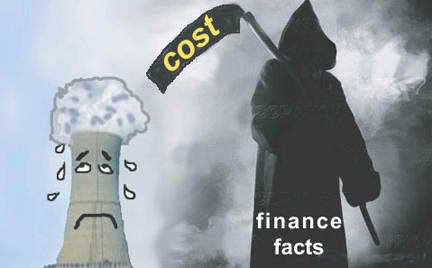
 Energy plan stalls on cost of nuclear, Business Day Live, BY CAROL PATON, 15 JULY 2016 THE Integrated Resource Plan (IRP), the government’s long-term plan for electricity generation, is again stuck in the works, despite being six years out of date, with modellers and government officials wrestling over an appropriate price estimate for nuclear energy.
Should the cost of nuclear energy come in too high compared to other technologies, then the nuclear build programme, which is championed by President Jacob Zuma, could be blown out of the water.
The IRP is a 20-year plan that estimates demand, plans for supply, and makes policy decisions on the energy mix based on a range of factors, including energy security and affordability. Regular updates to the IRP — every two years — are crucial to ensure energy security and prevent overbuilding capacity.
In the latest draft, being drawn up by technical experts based at Eskom on behalf of the Department of Energy, the overnight cost for nuclear energy is said to have been estimated at $6,000/kW.
The number comes from several industry sources, who are privy to the information, but was not confirmed by the government. Overnight costs include construction costs, but exclude interest…..
In previous drafts of the IRP, overnight costs for nuclear were estimated at $5028/kW in 2010, and $5800/kW in 2013. The 2013 IRP, which cautioned against nuclear energy due to lower than expected demand and the high risk involved, has never been adopted by the Cabinet.
At the time, it was speculated that the Department of Energy held it back, as it was not nuclear-friendly enough. Instead, the government has continued to use the 2010 IRP, despite its outdated assumptions and modelling, and a wide acknowledgement in the energy industry that its credibility is shot.
The IRP process under way right now is a new attempt to update the plan, which is six years out of date.
But since the modelling team submitted its draft to the department earlier in 2016, the process appears to have stalled. Energy Minister Tina Joemat-Pettersson said in September that the new IRP would be completed by March. But the draft is far from finished, and public consultations — which should take place under the policy framework — are still far from a reality……
South Africa’s nuclear sector in crisis
Nuclear sector in crisis as SA weighs options, Business day Live, BY MARK ALLIX, 15 JULY 2016 THE world nuclear industry status report for 2016 may give SA pause for thought about its ambitions to build nuclear power capacity.
The report says the global nuclear industry is in crisis, and renewable energy is taking over……
SA’s government is adamant that nuclear will be part of the energy mix, and of the country’s commitments to cutting carbon emissions. Existing solar and wind energy technologies cannot cater for base-load electricity demand to run modern industries, it says.
Safety and the funding of huge initial financial costs for nuclear reactors remain critical factors, despite the promise of lower carbon emissions, and ultimately, much lower electricity retail costs. Costs of up to R1-trillion have been estimated for SA’s proposed 9,600MW of nuclear power.
Knox Msebenzi, MD of the Nuclear Industry Association of SA, said on Thursday it was difficult to obtain an authoritative figure. The association, whose members included potential nuclear bidders, had not made an independent estimation of what such a project would cost.
“There are a lot of variables, which if not defined, could push the price up or down,” he said.
Project cost estimations could use typical industry accepted valuations. But despite including plenty of local content such as concrete and steel, costs were also subject to possible litigation over projects and exchange rate volatility for imported technologies.
Silas Zimu, the special energy adviser to President Jacob Zuma, said earlier in July that SA would have to build nuclear power plants on a piecemeal basis, according to what it could afford. It would also need to purchase the best technology, amid huge delays in the global nuclear industry…..http://www.bdlive.co.za/business/energy/2016/07/15/nuclear-sector-in-crisis-as-sa-weighs-options
Russia paying for setting up nuclear power plant in Vietnam
 Work on Russian-assisted nuclear power plant in Vietnam to begin in 2023 https://rbth.com/news/2016/07/15/work-on-russian-assisted-nuclear-power-plant-in-vietnam-to-begin-in-2023_611821 TASS
“The schedule is still set for 2028,” Tuan said. Construction will begin in 2022 or 2023, he added.
Such a timeframe is indicated in the revised master plan of Vietnam’s energy sector development, the official said.
Russia’s Rosatom is acting as a partner in the Ninh Thuan 1 nuclear power plant in Vietnam.
World Nuclear Industry Status Report 2016 launched in Tokyo
Schneider, DeWit & Katsuta: Global Launch of “The World Nuclear Industry Status Report 2016”
 The World Nuclear Industry Status Report 2016 — Global Launch in Tokyo, http://www.worldnuclearreport.org/ 13 July 2016 The year 2016, marking the 30th anniversary of the Chernobyl catastrophe and the 5th year since the Fukushima disaster started unfolding, strangely might go down in history as the period when the notion of risk of nuclear power plants turned into the perception of nuclear power plants at risk. Indeed, an increasing number of reactors is threatened by premature closure due to the unfavorable economic environment. Increasing operating and backfitting costs of aging power plants, decreasing bulk market prices and aggressive competitors.
The development started out in the U.S., when in May 2013 Kewaunee was shut down although its operator, Dominion, had upgraded the plant and in February 2011 had obtained an operating license renewal valid until 2033. Two reactors at San Onofre followed, when replacement steam generators turned out faulty. Then Vermont Yankee shut down at the end of 2014. Early shutdown decisions have also hit Pilgrim and Fitzpatrick, likely to close before the end of 2017 and 2019. Utility Exelon, largest nuclear operator in the U.S., has announced on 2 June 2016 that it was retiring its Clinton (1065 MW) and Quad Cities (2 x 940 MW) nuclear facilities in 2017 as they have been losing money for several years. Only days later, PG&E in California announced that they would close the two Diablo Canyon units by 2025, replacing the capacity by energy efficiency and renewables, making the sixth largest economy in the world (having overtaken France in 2016) nuclear-free. Still in the same month of June 2016, the Omaha Public Power District (OPPD) Board voted unanimously to shut down the Fort Calhoun reactor by the end of the year—in the words on one board member, “simply an economic decision”. Nuclear Energy Institute President Marv Fertel stated in May 2016 that “if things don’t change, we have somewhere between 10 and 20 plants at risk”.
“Nuclear plants at risk”; the expression has become a common phrase in the news world, not only in the U.S. In Germany, the Grafenrheinfeld reactor was taken off the grid in 2015, six months earlier than required by law, because refueling was not worthwhile anymore. In Sweden, after two years of work and spending of several hundred million euros, upgrading was halted on Oskarshamn-2 in 2015 and the reactor was permanently closed. Oskarshamn-1 will follow in 2017 and Ringhals-1 and -2 will close in 2020 and 2019 respectively. Ringhals operator Vattenfall stated: “Sweden’s nuclear power industry is going through what is probably the most serious financial crisis since the first commercial reactors were brought into operation in the 1970s.” Even in Asia, nuclear plants are coming under economic pressure. The two Indian units Tarapur-1 and -2 are likely to be closed in the short term because they are not competitive under current market prices. “We are pouring in money into the reactors rather than making income from them”, Sekhar Basu, secretary at the Department of Atomic Energy stated.
In addition to the usual, global overview of status and trends in reactor building and operating, as well as the traditional comparison between deployment trend in the nuclear power and renewable energy sectors, the 2016 edition of the World Nuclear Industry Status Report (WNISR) provides an assessment of the trends of the economic health of some of the major players in the industry. Special chapters are devoted to the aftermath of the Chernobyl and Fukushima disasters.
World Nuclear Industry Status Report 2016 shows nuclear build at zero so far this year
New nuclear reactor builds fall to zero in H1 2016: report http://www.reuters.com/article/us-nuclear-industry-decline-idUSKCN0ZT0QS Construction starts for new nuclear reactors fell to zero globally in the first half of 2016 as the atomic industry struggles against falling costs for renewables and a slowdown in Chinese building, a report on the industry showed on Wednesday.
The last time there were no new reactors started over a full year was in 1995, according to the World Nuclear Industry Status Report 2016. The number of reactors under construction is in decline for a third year, with 58 being built by the end of June, down from 67 reactors at the end of 2013, the report said.
The latest figures highlight the struggles the nuclear sector is facing after the Fukushima atomic disaster in Japan five years ago, as higher costs and delays take their toll while other sources of energy become cheaper.
The nuclear industry faces a risk it “will not be easily protected from: the economic and financial risks from nuclear power being irreversibly out-competed by renewable power,” Tomas Kaberger, energy and environment professor at Chalmers University of Technology in Sweden, wrote in a forward in the report.
Kaberger is also a member of the board of state-owned Swedish utility Vattenfall, which owns 10 nuclear reactors, according to its website.
Construction started on six reactors in China in 2015, three times more than the rest of the world, while eight went into operation there last year, out of 10 globally, underlining how the world’s biggest energy user is a bright spot for the nuclear industry.
Three reactors have started up this year in China, with one in South Korea and another in the U.S., Watts Bar 2, which took 43 years to build, according to the report.
But even in China, renewables investment and capacity additions are outstripping nuclear, the report said. Renewables investments totaled $100 billion in China last year, more than five times the amount for new reactors, which was $18 billion.
Wind energy output totaled 185 terawatt hours (TWh) last year in China, compared with 161 TWh for nuclear. Solar power output totaled 39 TWh in 2015, up from 23 TWh the year before.
The report’s lead authors are industry analysts Mycle Schneider, based in Paris, and London-based Antony Froggatt. Both have advised European government bodies on energy and nuclear policy.
The report is available in full at: here
(Reporting by Aaron Sheldrick; Editing by Christian Schmollinger)
UK’s Department of Energy and Climate Change (DECC) compares falling costs of renewables with rising costs of nuclear power
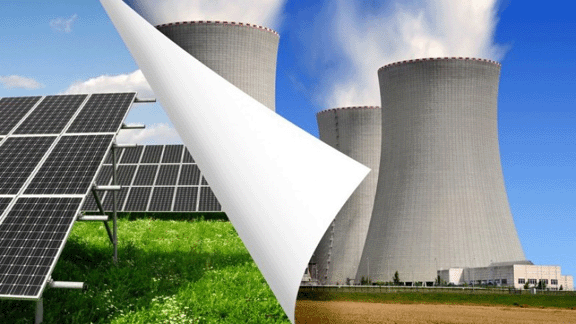
 Nuclear competitiveness falling with rise of renewables, says government watchdog, businessGreen, Jocelyn Timperley, 14 July 16, A new report on the future of Britain’s electricity supply from the government spending watchdog has highlighted the falling costs of renewables compared with nuclear, with figures projecting onshore wind and solar will be the cheapest ways of generating electricity by 2025.
The report examines how new sources of electricity can be used to meet the looming capacity gap the UK faces over the coming decade while supporting emissions targets and keeping energy bills affordable.
Its findings show that renewables may be a cheaper option than conventional energy sources, with Department of Energy and Climate Change (DECC) forecasts for the levelised cost of energy of wind and solar in 2025 having decreased since 2010. The cost forecast for nuclear during the same time period has increased while it has remained constant for gas.
“Supporting early new nuclear projects could lead to higher costs in the short term than continuing to support wind and solar,” the report concludes. “The cost competitiveness of nuclear power is weakening as wind and solar become more established.”………
The NAO also lays out how the projected costs of Hinkley Point C have skyrocketed since the strike price was initially agreed based on an estimated cost of £6.1bn in October 2013. Projections laid out in the report show the top-up subsidy payments for the nuclear plant have changed along with forecasts of the wholesale price of power, with the most recent estimate in March 2016 valuing the payments at £29.7bn.
In addition, the NAO warned of the risks for consumers of signing up to the 35-year Hinkley Point C contract, expected to begin in 2025, due to the difficulty in predicting how wholesale electricity prices will fluctuate, as well as how other energy technologies will develop. “Over a longer time frame there is greater potential for technological changes that reduce the competitiveness of nuclear compared with other power sources,” the report says.
The new report comes just days after DECC vastly raised its estimate of how much the Hinkley project would cost in subsidies over its lifetime, suggesting it will cost £37bn in total subsidies, more than double its £14.4bn estimate a year ago……..
Among a host of other environment and energy decisions, Theresa May will soon have to make the long-awaited decision on whether to go ahead with Hinkley Point. And the NAO report makes clear it will be as much a strategic and political decision as an economic one. http://www.businessgreen.com/bg/analysis/2464823/nuclear-competitiveness-falling-with-rise-of-renewables-says-government-watchdog
UK taxpayers up for an extra £30bn for Hinkley Point C nuclear project?
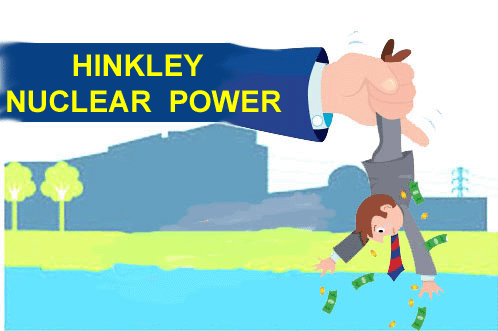 Report reveals top-up fees for Hinkley Point C could cost us an extra £30bn http://www.bristolpost.co.uk/report-reveals-top-up-fees-for-hinkley-point-c-could-cost-us-an-extra-30bn/story-29511798-detail/story.html A government spending watchdog has warned tax payers could cost energy consumers £30 billion in “top-up payments” for Hinkley Point C. By David_Clensy July 14, 2016
The deal for the Somerset nuclear power station sees the government paying EDF a fixed price for electricity generation over 35 years from 2025. But if the wholesale price falls, the government pays EDF a top-up fee.
The National Audit Office had previously estimated that this top-up fee would amount to £6.1 billion during the 35 year period, but in its latest report the watchdog has scaled up the estimate to £29.7 billion – nearly doubling the cost of the £37 billion construction project.
The report also expressed fears that taxpayers could end up with a range of other payments under debt guarantees agreed by the government with EDF. “Supporting early new nuclear projects could lead to higher costs in the short term than continuing to support wind and solar. The cost competitiveness of nuclear power is weakening as wind and solar become more established,” the report, Nuclear Power in the UK, states.
Environmental lobbying group Greenpeace has jumped upon the opportunity to call upon the new Prime Minister to scrap the entire project.
John Sauven, director of Greenpeace UK, said: “The government’s line that Hinkley is a good deal for billpayers is falling apart. Today’s damaging report from the NAO should kill this myth once and for all. It makes the government’s slash and burn approach towards help for homegrown renewable energy companies look completely out of step with reality. Unlike nuclear the cost of renewables is falling every year.”
Nuclear plant retirements are likely to continue
 Fitch: US Nuclear Retirements Continue Amid Low Power Prices http://www.businesswire.com/news/home/20160714005752/en/Fitch-Nuclear-Retirements-Continue-Power-Prices July 14, 2016
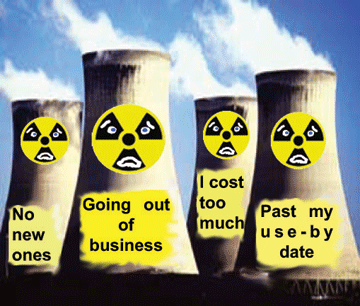
Nuclear plant retirements driven by economic and policy headwinds are likely to continue. Based on announced nuclear retirements, Fitch Ratings expects that the amount of retired and retiring gigawatts (GW) will outpace new nuclear plant additions between 2013 and 2025.
Key factors driving the shutdowns include low natural gas prices due to abundant US supply and actual and anticipated penetration of renewable generation and regulatory constructs that do not adequately compensate for nuclear energy’s non-emitting attributes.
The recent spate of announced nuclear facility retirements is not surprising in light of the depth and duration of the current extended downturn in wholesale power prices and policy challenges faced by nuclear plant operators. Plant closings appear likely to continue unless there are policy changes to address market structures and incentives.
While smaller single-unit merchant nuclear facilities are particularly vulnerable, larger rate-regulated and merchant nuclear facilities are also at risk.
For more information on this topic, see Fitch’s full rating report on “Pacific Gas and Electric Company,” available on our website at www.fitchratings.com.
Additional information is available on www.fitchratings.com.
Poland halts nuclear power plans, looks to renewable energy
Polish nuclear capacity will not be built before 2030: PGE -Adam Easton, newsdesk@platts.com
–Edited by Jonathan Loades-Carter, jonathan.carter@spglobal.com Warsaw (Platts)–12 Jul 2016
* PGE may modify nuclear investment
Poland’s largest utility Polska Grupa Energetyczna (PGE) is not giving up its plans to build the country’s first nuclear reactors but the investment may be modified and will not be realized until after 2030, PGE’s chief executive Henryk Baranowski said Tuesday……..
the company was looking at other means of financing the nuclear project after the PiS government, which took office last November, rejected contracts for difference.
“What is certain is that nuclear power cannot be carried out today under a purely market formula. Developing the optimal financing method will require in-depth dialogue. The result will have to be a compromise between the demands of the investors and the needs of the consumers,” he said……
In terms of renewable energy Baranowski said PGE was interested in developing offshore wind in the Baltic Sea.
“An interesting and least talked about technology today is offshore wind. We will continue to prepare to build such capacity in the Baltic despite the high costs. Now we’re calculating the profitability of such investments and we’re analyzing possible financing models,” he said…….http://www.platts.com/latest-news/electric-power/warsaw/polish-nuclear-capacity-will-not-be-built-before-26489875
Workers on strike at Hanford Nuclear Reservation due to health concerns
 Work stoppage continues at Hanford Nuclear Reservation http://q13fox.com/2016/07/12/work-stoppage-continues-at-hanford-nuclear-reservation/ JULY 12, 2016, BY ASSOCIATED PRESS SPOKANE, Wash. (AP) — A rare work stoppage continues by some Hanford Nuclear Reservation workers who contend that radioactive wastes left from the production of nuclear weapons are making them sick.
Union president Dave Molnaa, who ordered the work stoppage, said it will continue until all employees are provided with bottled air when working around all of the underground nuclear waste storage tanks on the Hanford site.
Workers have contended for years that chemical vapors escaping from the tanks are making them sick.
The steel tanks, some dating back to World War II, contain wastes created by the production of plutonium for nuclear weapons.
The Hanford Atomic Metal Trades Council, a coalition of 15 unions that represent workers on the site near Richland, issued the “stop work” order on Monday morning.
Ratepayer ripoff: $19 billion nuclear plant for Virginia

 Virginia group says new nuclear plant would be boondoggle, WP, By Alan Suderman | AP July 12 RICHMOND, Va. — If Dominion Virginia Power goes ahead with plans to build a $19 billion nuclear plant, it would be one of the biggest ratepayer rip-offs in the history of producing electricity, a consumer group said in comments filed Tuesday.
In the comments filed with state regulators, the Virginia Citizens Consumer Council argue that Dominion Virginia Power should stop spending money on a potential new plant because it will unfairly burden the company’s customers while enriching its investors.
“The rich get richer and the ratepayers get poorer,” said Mark Cooper, a senior fellow for economic analysis with the Institute for Energy and the Environment at Vermont Law School who was hired by the VCCC as an expert witness……..
The attorney general’s office estimates that the cost of building North Anna 3, which wouldn’t be completed until 2029, would raise residential rates by 25 percent.
The Virginia State Corporation Commission’s three commissioners would have to give approval for Dominion to build North Anna 3. If approved, the company would be guaranteed a profit on all reasonable and prudent construction costs.
Cooper said the potentially large and steady cash flow from building North Anna 3 is what entices Dominion to continue to pursue the project. But he said customers would unfairly have to pay at least $6 billion more than is necessary to comply with potential federal emission rules. That would rank the project as “one of the grossest examples of enrichment by a utility” in the “entire history of energy production,” Cooper said. ………https://www.washingtonpost.com/local/virginia-group-says-new-nuclear-plant-would-be-boondoggle/2016/07/12/67986070-485e-11e6-8dac-0c6e4accc5b1_story.html?postshare=491468349029908&tid=ss_tw
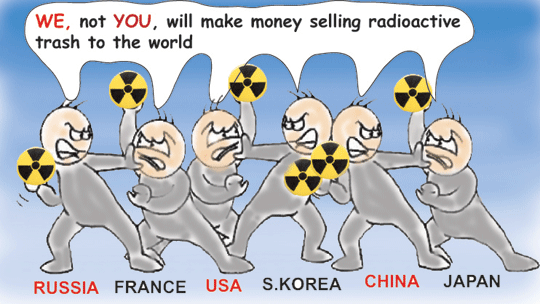
Japan joins the crowd marketing nuclear reactors to Britain
Japan Atomic Power to join Hitachi’s nuclear plant business in Britain http://www.japantimes.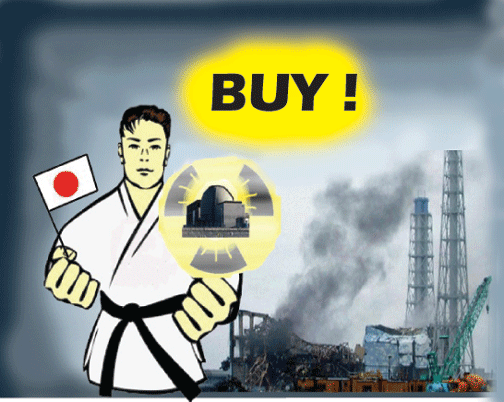 co.jp/news/2016/07/07/business/corporate-business/japan-atomic-power-join-hitachis-nuclear-plant-business-britain/#.V39eRdJ97GhJapan Atomic Power Co. will join Hitachi Ltd.’s nuclear power plant business in Britain, informed sources said Thursday.
The two companies will soon sign a cooperation agreement to make Japan Atomic Power the first Japanese power supplier to take part in an overseas nuclear power plant business in full scale.
Japan Atomic Power will become part of a project to build nuclear reactors in Britain, which is undertaken by Horizon Nuclear Power Ltd., a Hitachi unit in Britain, possibly engaging in licensing procedures for reactor construction.
Japan Atomic Power hopes that overseas operations will become a new source of revenue at a time when its nuclear reactors in Japan have been suspended following the 2011 core meltdowns at Tokyo Electric Power Company Holdings Inc.’s Fukushima No. 1 nuclear plant.
Hitachi, which has no experience as a nuclear plant operator, asked for Japan Atomic Power’s cooperation over the British project.
FPL has delayed construction plans of two new nuclear generators at Turkey Point
FPL’s plan to not charge customers $22 million in fees is approved, Miami Herald
FPL has delayed construction plans of two new nuclear generators at Turkey Point
The $22 million in fees is money FPL is permitted to collect for planning and construction of nuclear plants
Because of the construction delay, the utility doesn’t want to collect the fees in 2017
BY MARY ELLEN KLAS Herald/Times Tallahassee Bureau TALLAHASSEE , 8 July 16
The Florida Public Service Commission on Wednesday unanimously approved a request from Florida Power & Light to take a one-year break from charging customers in advance for planning and construction of its proposed new nuclear power plant.
The decision is expected to save customers $22 million in nuclear cost recovery fees that regulators typically approve to allow the company FPL to charge for planning and construction of the company’s proposed nuclear units at its Turkey Point site on Biscayne Bay. Since 2008, FPL has charged customers $282 million in advance for the construction, under the advanced nuclear cost recovery fee it helped to push through the Legislature in 2006……..
The decision to stop charging customers follows the decision by FPL to delay nuclear construction. After eight years of planning, FPL announced in April it was postponing construction on units 6 and 7 of its nuclear fleet until at least 2020. It said, however, it would continue to pursue a federal license that would clear the way for construction. The company has yet to receive federal approval to construct the plant.
The delay means two next-generation reactors initially projected to go online as early as 2018 and 2020 likely would not fire up for perhaps another decade. http://www.miamiherald.com/news/business/article88228052.html
Hinkley nuclear costs now estimated at £37bn
 Estimated cost of Hinkley Point C nuclear plant rises to £37bn Critics point to volatility of scheme but energy department says price ‘will not affect bill payers’, Guardian, Terry Macalister, 8 July 16, The total lifetime cost of the planned Hinkley Point C nuclear power plant could be as high as £37bn, according to an assessment published by the UK government. The figure was described as shocking by critics of the scheme, who said it showed just how volatile and uncertain the project had become, given that the same energy department’s estimate 12 months earlier had been £14bn.
The latest prediction comes amid increasing speculation about the future of the controversial project in Somerset, whose existence has been put in further doubt by post-Brexit financial jitters.
Hinkley has been a flagship energy project for the British government and in particular for the chancellor, George Osborne, who lobbied hard and successfully for China to take a stake in the scheme…….
Critics of the scheme have claimed that the fall in the value of the pound since the referendum vote will increase the costs of the scheme to EDF’s French contractors, who work in euros………. the EDF staff council last month began legal action to try to force the company to release documents relating the project, including all the contracts it had signed with the British government and its co-investor, the Chinese utility CGN.
The fall in power prices in the UK and continental Europe that has influenced the latest lifetime cost assessment for Hinkley is also responsible for some of the financial difficulties at EDF.
There have also been suggestions that Chinese investors are becoming more nervous about Hinkley and are demanding more concessions from EDF, so that more Chinese project managers and suppliers are involved. EDF has denied this. https://www.theguardian.com/uk-news/2016/jul/07/hinkley-point-c-nuclear-plant-costs-up-to-37bn
France marketing its nuclear reactors to India
France submits fresh plan for six nuclear plants in Jaitapur, Economic Times, By PTI | Jul 07, 2016 NEW DELHI: France has given a fresh techno-commercial proposal for building six atomic reactors in Jaitapur even as it again raised concerns over India’s civil liability law and sought “same level of protection” which are available for companies at the international level.
“All these steps will help us bring nuclear industry players from France to India. The delegation has asked to provide same level of protection to the EDF which is available at the international level,” a top EDF official told PTI.
We have also given a fresh techno-commercial proposal to NPCIL. It’s now up to the NPCIL to decide,” the official added.
The proposal includes negotiating with India for six reactors as against two, which was the case earlier. This would help bring down the cost. It also includes a proposal for localisation of technology to make the project cost effective.
1 This Month

of the week– Nuclear Reactor Information Task Force

14 May – online event From Bombs to Data Centres: the Face of Nuclear Colonialism
To see nuclear-related stories in greater depth and intensity – go to https://nuclearinformation.wordpress.com
-
Archives
- May 2026 (82)
- April 2026 (356)
- March 2026 (251)
- February 2026 (268)
- January 2026 (308)
- December 2025 (358)
- November 2025 (359)
- October 2025 (376)
- September 2025 (257)
- August 2025 (319)
- July 2025 (230)
- June 2025 (348)
-
Categories
- 1
- 1 NUCLEAR ISSUES
- business and costs
- climate change
- culture and arts
- ENERGY
- environment
- health
- history
- indigenous issues
- Legal
- marketing of nuclear
- media
- opposition to nuclear
- PERSONAL STORIES
- politics
- politics international
- Religion and ethics
- safety
- secrets,lies and civil liberties
- spinbuster
- technology
- Uranium
- wastes
- weapons and war
- Women
- 2 WORLD
- ACTION
- AFRICA
- Atrocities
- AUSTRALIA
- Christina's notes
- Christina's themes
- culture and arts
- Events
- Fuk 2022
- Fuk 2023
- Fukushima 2017
- Fukushima 2018
- fukushima 2019
- Fukushima 2020
- Fukushima 2021
- general
- global warming
- Humour (God we need it)
- Nuclear
- RARE EARTHS
- Reference
- resources – print
- Resources -audiovicual
- Weekly Newsletter
- World
- World Nuclear
- YouTube
-
RSS
Entries RSS
Comments RSS
 nuclear-news