Russia marketing its nuclear clean-up business to Japan
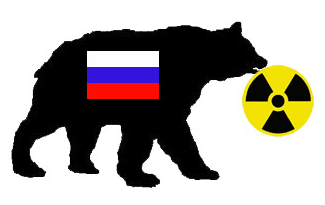 Take our tech
Around a 100km drive west of St. Petersburg, on the Gulf of Finland, sits Sosnovy Bor, home to state nuclear energy giant Rosatom’s waste disposal operations. Inside a controlled perimeter, subsidiary RosRAO, the facility’s manager, has created a prototype water decontamination plant for use at Tokyo Electric Power Co. Holdings‘ Fukushima Daiichi nuclear power station — the site of Japan’s largest nuclear disaster in March 2011.
The scrubbing facility, unveiled in June, is capable of removing tritium, or radioactive hydrogen, from nuclear-tainted water, something beyond the capabilities of the Fukushima plant’s current cleanup equipment. Distillation and electrolysis isolate and concentrate the isotope, which is then locked away in titanium. Experiments under conditions similar to those on the ground reportedly show the technology cutting wastewater’s radioactive material content to one-6,000th the initial level, making it safe for human consumption or release into the ocean.
Duplicating the facility near the Fukushima site and running it for the five years necessary to process 800,000 cu. meters of contaminated water would cost around $700 million in all. Companies in Japan and the U.S. are at work on their own facilities for tritium disposal, but the Russian plan’s cost and technological capability make it fully competitive, according to the project’s chief.
Rosatom has made other overtures to Japan. Executives from a mining and chemical unit have visited several times this year for talks with Japanese nuclear companies, aiming to cooperate on decommissioning the Fukushima plant and upgrading a reprocessing plant in Aomori Prefecture for spent nuclear fuel. Russia has amassed a wealth of expertise dealing with damaged nuclear reactors in the wake of the Chernobyl disaster, and would like Japan to draw on that knowledge, the subsidiary’s chief executive said.
Nuclear expertise
Revving up nuclear technology exports is essential to re-energizing Russia’s domestic industry and breaking free of dependence on the resource sector, Moscow has decided. The nuclear business, along with the space industry, is one of the few tech-intensive sectors where the country is internationally competitive. President Vladimir Putin has leaned more heavily on leaders in Europe and emerging countries in recent years to agree to deals with Russia’s nuclear companies………..http://asia.nikkei.com/Politics-Economy/International-Relations/Japan-nuclear-cleanup-next-target-in-Russian-economic-offensive
Nuclear power salesmen vie with each other to sell nukes to South Africa
Eskom Influence Growing In Proposed South African Nuclear Tender, AFK Insider,

While South Africa’s energy department will choose the successful vendor, Eskom, as the owner-operator of the new nuclear plants, will have a large input. David Nicholls, chief nuclear officer at Eskom, gave delegates a glimpse this week of Eskom’s vision for nuclear by defining a leading role for the state utility at the Power-Gen and DistribuTech Africa conference in Johannesburg.
A chosen vendor will lead the early process with Eskom’s input. This is how South Africa’s only operating nuclear plant, Koeberg, north of Cape Town, was built in the 1980s, he said.
Once the design base has been established with the first plant, South Africa will increasingly take charge.
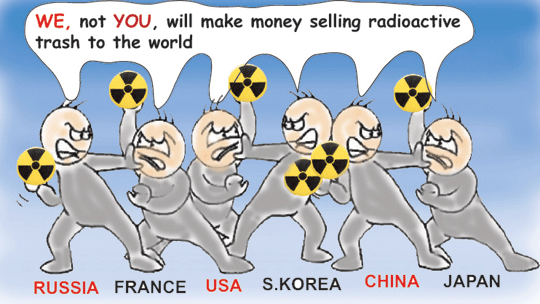
Nicholls’ remarks show that Eskom is in favor of a proven standardized fleet of reactors, with sibling international plants to learn from. This indicates South Africa is likely to choose one vendor and stick with them……….. Vendors from Russia, France, South Korea, the U.S. and China are all hoping to win the lucrative South African nuclear contract.South Africa has opted for a pressurized water reactor technology,……..http://afkinsider.com/130186/eskom-influence-growing-in-proposed-south-african-nuclear-tender/
South Korean nuclear company to staff Emirates nuclear reactors
 Hydro & Nuclear staff to operate Abu Dhabi’s Barakah plant, New agreement will see KHNP staff stationed at Barakah until 2030 Gulf Business, By Robert Anderson, 23 July 16
Emirates Nuclear Energy Corporation has signed an operating support services deal with Korea Hydro & Nuclear Power that will see the company dispatch personnel to the Barakah Nuclear Power Plant until 2030.
Under the agreement, the Korean firm will provide main control room operators and local operator to support ENEC’s recently launched local operating subsidiary Nawah Energy Company……http://gulfbusiness.com/korea-hydro-nuclear-power-staff-operate-abu-dhabis-barakah-plant/#.V5UxYtJ97Gg
Japanese business community wants renewable power, losing faith in nuclear power
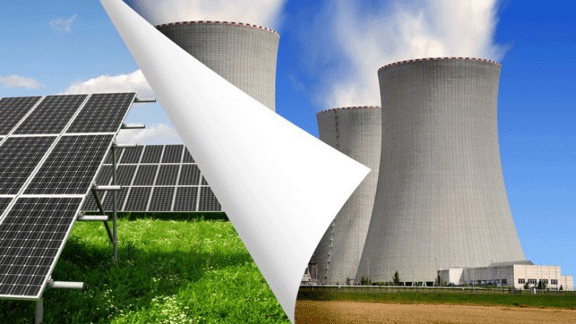
 Japan business lobby says Abe government can’t rely on nuclear energy http://www.reuters.com/article/us-japan-energy-idUSKCN1020XH TOKYO | BY OSAMU TSUKIMORI AND AARON SHELDRICK, 22 July 16 Japan’s use of nuclear power is unlikely to meet a government target of returning to near pre-Fukushima levels and the world’s No.3 economy needs to get serious about boosting renewables, a senior executive at a top business lobby said.
Under Prime Minister Shinzo Abe’s energy policies, nuclear is supposed to supply a fifth of energy generation by 2030, but Teruo Asada, vice chairman of the Japan Association of Corporate Executives, said Japan was unlikely to get anywhere near this.
The influential business lobby has issued a proposal urging Tokyo to remove hurdles for renewable power amid the shaky outlook for nuclear power after the 2011 Fukushima disaster.
The move shows how business attitudes are now shifting as reactor restarts get held up by legal challenges, safety issues and public scepticism.
“We have a sense of crisis that Japan will become a laughing stock if we do not encourage renewable power,” said Asada, who is also chairman of trading house Marubeni Corp.
Long dependent on imported fossil fuels, Japan’s government and big business actively promoted nuclear energy despite widespread public opposition.
The government wants nuclear to make up 20-22 percent of electricity supply by 2030, down from 30 percent before Fukushima. So far, however, only two out of 42 operable reactors have started and the newly elected governor of the prefecture where they are located has pledged to shut them.
New York’s nuclear subsidy plan will grow to a $multibillion cost to ratepayers
 Nuclear Subsidies Are Key Part of New York’s Clean-Energy Plan, NYT By VIVIAN YEE JULY 20, 2016 “………The commission is considering a proposal that makes the state’s three upstate nuclear plants important parts of its efforts to wean itself off fossil fuels, offering nearly $1 billion in ratepayer-financed subsidies over the next two years to save plants battered by rising costs and competition from cheap natural gas.
With very little process, and very little time for the public to even know this is happening, what they’re proposing here is a multibillion-dollar uncompetitive subsidy to one company,” said Jessica Azulay, a spokeswoman for the Alliance for a Green Economy, an environmentalist group.
The alliance has calculated the total cost over 12 years as more than $7.6 billion…..http://www.nytimes.com/2016/07/21/nyregion/nuclear-subsidies-new-york-clean-energy-plan.html?_r=0
Middle Eastern countries – a bonanza for Western nuclear salesmen
Despite years of building and development, nuclear power is on the decline in many parts of the world with its share of global electricity decreasing from 18 percent in 1996 to around 11 percent today according to the International Energy Agency.
Nuclear has become unfashionable in several countries not just because of the Chernobyl and Fukushima disasters: New safety requirements mean the cost of building nuclear facilities has been rapidly mounting.
The cost of the UAE’s Barakah plant is estimated at between US$25 bn and $32 bn, most of it being paid out of state funds. The initial cost estimate of Saudi Arabia’s nuclear programme – involving French, Chinese, Argentinian and South Korean companies building facilities both for power generation and for desalination – is $80 bn.
Energy analysts say that rather than spending billions of dollars on prestige nuclear projects, subsidies should be eliminated to curtail usage and alternative energy sources should be developed.
The use of solar power is still minimal in many countries in the region yet it has enormous potential.
Following the disasters at the Chernobyl and Fukushima power plants, many countries either cancelled or put on hold projects for nuclear power facilities but in the Middle East region at least 25 plants are planned and many more are being talked about.
Some studies indicate that up to a total of 90 nuclear facilities, – both big and small – are in the pipeline………
Opponents of the plans say going nuclear in what is one of the world’s most volatile geopolitical regions poses serious safety and security issues. Among other concerns there are the eye watering costs involved in nuclear building programmes and unresolved problems over radioactive waste disposal.
The nuclear salespeople have been busy across the region in recent years: in the United Arab Emirates, the Barakah nuclear power facility in Abu Dhabi, built and operated by the South Koreans, is due to come on stream next year, aiming to supply up to 25 percent of the UAE’s electricity.
Saudi Arabia plans to have its first nuclear power plant on stream by 2022, with another 15 facilities of varying size in the pipeline. Jordan and Egypt have signed agreements with Rosatom, the Russian state nuclear conglomerate, to build and operate reactors.
Despite recent tensions between Turkey and Russia, Rosatom is continuing construction of Turkey’s first nuclear power plant on the country’s southern coast.
Tunisia and Algeria have also been in nuclear discussions with the Russians and other suppliers…….. Continue reading
China trying to market nuclear power to India
 China Can Cooperate With India In Nuclear Sector: Official NDTV, 22 July 16 NEW DELHI: Describing China as an “important player” in the nuclear sector, a senior Chinese state policy researcher has said it is one of the areas where it can cooperate with India, a remark which comes amidst growing strain between the two countries over the NSG issue.
Speaking in Delhi, Wenling, a senior researcher of the Chinese State Council Research Office, also made a strong pitch for long-term visas for Chinese nationals visiting India, which she said would boost bilateral trade and investments.
On areas where the two neighbours can cooperate, she said manufacturing, nuclear energy, bullet trains, tourism, education, agriculture and services industry are among the areas where they can enhance their cooperation.
“China is an important player in the nuclear sector. Chinese energy players are investing in the US market,” she remarked during a discussion with a select gathering in Delhi in the presence of Minister Counselor Cheng Guangzhong yesterday…….http://www.ndtv.com/india-news/china-can-cooperate-with-india-in-nuclear-sector-official-1434936
USA trying to market nuclear power to Mexico
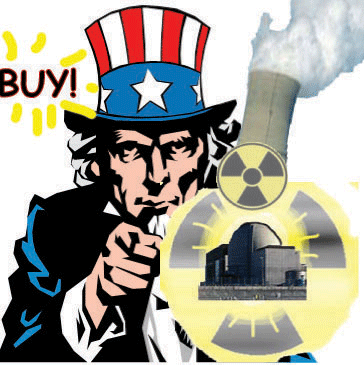 U.S., Mexico talk nuclear energy, Washington Examiner By 7/22/16 “….President Obama discussed the nuclear energy collaboration with Mexican President Enrique Pena Nieto after a meeting Friday….. we are pursuing an agreement this year on sharing civilian nuclear technology,” the president said. “This fall our new U.S.-Mexico Energy Business Council will meet for the very first time to strengthen the ties between our energy industries.”
Russian, USA, Japanese nuclear salesmen move their Indian nuclear plans to Andhra Pradesh
A.P. set to be country’s nuclear power hub http://www.thehindu.com/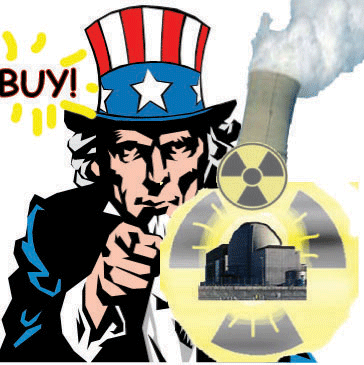 news/national/andhra-pradesh/ap-set-to-be-countrys-nuclear-power-hub/article8876943.ece SUHASINI HAIDAR
Govt. is pinning its mega plans for generating the ‘clean’ energy on coastal Andhra Pradesh.
Weeks after the government announced that U.S. company Westinghouse’s Nuclear Power Project (NPP), planned in Gujarat’s Mithi Virdi, is being moved to Andhra Pradesh, sources confirmed to The Hindu that Russian-owned Rosatom will build its next phase of six reactors in Andhra Pradesh as well.
With other States like Gujarat, Tamil Nadu, West Bengal and Maharashtra facing local protests over NPPs, the government is now pinning its mega plans for generating the ‘clean’ energy on coastal Andhra Pradesh. In fact, if all the projects under consideration from Russia, the U.S. and NPCIL were to actually go through, NPPs in Andhra could account for more than 30,000 MW of the Modi government’s goal of 63,000 MW installed capacity by 2031. The site for the next set of six Russian reactors was discussed during A.P. Chief Minister Chandrababu Naidu’s recent visit to Russia, where he met Russian PM Dmitry Medvedev.
Sources told The Hindu the project site identified, believed to be Kavali in Nellore district, could be announced during President Vladimir Putin’s visit to India in October. “It’s huge,” said Commerce Minister Nirmala Sitharaman, who had led the delegation to Russia. “In Andhra Pradesh, six nuclear centres are going to be created, totalling thousands of megawatts in capacity. Of course, Andhra Pradesh will have both American and Russian participation in nuclear energy generation, but the Russians will be the first to “Make in India” in the nuclear sphere in Andhra,” Ms. Sitharaman told The Hindu.
The “American participation” referred to is the plan for Toshiba-Westinghouse to set up 6 AP1000 reactors of 1,100 megawatts each, a proposal that had run into trouble in Gujarat due to “stiff protests from farmers” during the land acquisition process for 777 hectares, a senior official in the Gujarat government said.
“In addition, Tata, Adani and Essar, which are the largest power producers in the State, were never comfortable with another giant plant being set up in the State,” the official said. During Prime Minister Narendra Modi’s visit to Washington in June 2016, NPCIL and Westinghouse had announced the move to Andhra Pradesh, with a commitment to complete the commercial agreement for 6 reactors by June 2017.
Meanwhile, another Russian project that has been hanging fire for years, to build 6 ‘VVER’ (Water-Water Energy) Reactors of 1000 MWe in West Bengal’s Haripur may also be moved to Andhra Pradesh due to local protests. “We are looking for a site in some coastal area of Andhra Pradesh where a similar reactor, which was meant for Haripur, will come up,” Dr. Sekhar Basu, now Chairman of the Atomic Energy Commission, had told reporters last September, although West Bengal officials told The Hindua final decision has not been taken.
State officials hope Tamil Nadu, Gujarat and West Bengal’s loss will soon be Andhra Pradesh’s gain, and the State already has the Kovvada nuclear park project for 6 1000MW reactors in Srikakulam under way. However, the coast isn’t completely clear. Kovvada has seen some protests of the kind seen at Kudankulam, Mithi Virdi and Haripur. While many local residents are unwilling to part with land, others have concerns over environmental hazards, especially given that some of the sites identified for nuclear projects are in a seismically sensitive zone, and have seen tremors in the past.
Confirming that several projects are only in “preliminary stages”, the Andhra Pradesh government’s media adviser Parkala Prabhakar told The Hindu: “The Central government has asked some more sites for other plants. We have asked the Collectors of Prakasam and Nellore to spot the sites. Once those sites are identified, the NPCIL will come for inspection to check the compatibility,” indicating that while Andhra’s nuclear power-hub dreams are in sight, they may take a while to come to fruition. (With Appaji Reddem in Vijayawada & Mahesh Langa in Ahmedabad)
Dirty uranium industry not a job creator for South Africa

 Uranium is the dirty underbelly of nuclear – scientist http://www.engineeringnews.co.za/article/uranium-is-the-dirty-underbelly-of-nuclear-scientist-2016-07-21 21ST JULY 2016 BY: NEWS24WIRE Anti nuclear sentiment tends to focus onnuclear waste or operational risks, but more focus should be on the “dirty underbelly” of uranium mining, according to a science adviser.
“Whenever people get excited about nuclear power stations, they kind of forget where the actual uranium comes from,”Dr Stefan Cramer, science adviser for environmentalist groupSafcei, told Fin24 in an interview recently.
“Nuclear is a fallacy, both economically and environmentally,” Cramer, who was born in Germany but not now lives in Graaff-Reinet, claimed.
“Uranium mining is the dirty underbelly of this whole nuclearcycle,” he said. “It’s where it all starts.”
“One must stop nuclear industries in (their) tracks because it leaves future generations with an immeasurable task and legacy,” he said. “The best point to start is at the source, where the whole cycle of nuclear technology begins, and that is at uranium mining.
“Uranium mining is very much the dirtiest part of the entire industry.”
Anti-uranium mining boost Cramer’s focus on anti-uranium mining was given a boost this month when Australian company Tasman Pacific Minerals Limited said it is downsizing its mining application in South Africa by almost 90%.
“Overall, the area covered by Tasman’s new and existingmining right and prospecting right applications in the Western and Eastern Cape will reduce by almost 300 000 ha to approximately 465 000 ha,” it said.
Tasman is punting job creation as necessitating the success of its new application. “Currently very few opportunities for additional economic development exist,” it said in a recent report.
“Tasman believes that uranium mining has a significant role to play in improving the economic outlook of the region, not only from an employment perspective, but also in the economic activity that is generated by associated businessactivities that extend beyond mining itself.”
“We desperately need jobs in the Karoo,” he said. “The Karoo is an area of high poverty, (with) very low employment opportunities. Any opportunity is usually highly welcome and it is to be welcomed because we need jobs desperately. Buturanium mining is a very poor process to create jobs.
“If we are really serious about job creation in the Karoo, there are other opportunities, which are much more valuable.
“Agriculture is still the main employment opportunity and needs to be protected and improved. Agri-tourism is a very new and very fast rising opportunity, but the best (opportunity) of all is renewable energy.”Renewable energy jobs boost
“South African already has 28 000 jobs in the renewable energy industry as compared to 2 600 in the nuclearindustry,” said Cramer. “Even the most ambitious job projections in the nuclear field would be up to 30 000 jobs if they whole country is run onnuclear energy. If we go into renewable energies, it’s an order of magnitude.
“The Department of Energy predicts up to 350 000 jobs inrenewable energy, so uranium mining is clear(ly) not a good strategy,” he said.
Cramer said nuclear is also a fallacy from a democratic point of view, “because it creates a veil of secrecy over this whole industry”. “That is clearly shown in our court case against the South African government for its failure to disclose the contents of an agreement with Russia,” he said.
Climate change threatens economies, as workers hampered by increasing heat
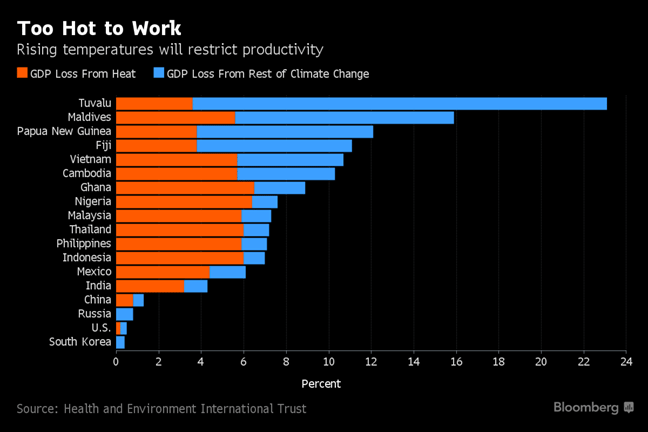
Hotter Temperatures Threaten Southeast Asian Economies: Chart http://www.bloomberg.com/news/articles/2016-07-19/too-hot-to-work, Jessica Shankleman July 19, 2016 Rising global temperatures may cost global economies more than $2 trillion by 2030, restricting working hours in some of the poorest parts of the world, according to United Nations research published Tuesday. As many as 43 countries, especially those in Southeast Asia, will experience declines in their economies because of heat stress, says Tord Kjellstrom, a director at the Health and Environment International Trust, based in Nelson, New Zealand.“With heat stress, you cannot keep up the same intensity of work, and we’ll see reduced speed of work and more rest in labor-intensive industries,” he said.
Green State, Golden State: Clean Energy Policy Creates Good Jobs
 http://capitalandmain.com/latest-news/issues/labor-and-economy/green-state-golden-state-clean-energy-policy-makes-good-jobs-0719/ by Dean Kuipers July 19, 2016 California’s deserts are blooming with windmills and solar farms and, according to a new University of California, Berkeley report, these large-scale projects are creating top quality jobs. The Link Between Good Jobs and a Low Carbon Future, issued by the Don Vial Center on the Green Economy at Berkeley’s Labor Center, finds that despite the one-off nature of large, clean energy construction projects, these renewable-power enterprises are creating high-paying, long-lasting blue-collar jobs.
UK’s House of Lords’ members, UK banks – financial interests in Trident nuclear programme
 According to the House of Lords register of interests, around 15% of sitting members are directors of, or shareholders in, companies that are either directly contracted to the Trident programme or invest in it.
Specifically Barclays and HSBC. A report by Don’t Bank on the Bomb details the involvement of major financial institutions in the western nuclear weapons industry.
 The truth about Trident: the shocking fact that would turn us all against paying for nukes, The Canary, JULY 18TH, 2016 STEVE TOPPLE As parliament debates the renewal of Trident, the UK’s “nuclear deterrent” – the arguments surrounding the controversial weapons system rage as fiercely as ever. But there’s one aspect which has been repeatedly overlooked. UK banks not only finance our nuclear deterrent, but also our supposed “enemy” Russia’s as well, and senior politicians enjoy a direct financial profit through keeping Trident.
The name Trident refers to the nuclear missiles that are carried on four Vanguard-Class submarines. Based out of Faslane, on the Clyde in Scotland, at any one time, there is one submarine on active patrol, another in service, another preparing to patrol and a final one on exercise.
Each submarine can carry 16 Trident missiles (but since 2010 this has been reduced to eight), and each missile can hold 40 warheads.
The cost of replacing the Trident system with “Successor” (which is what the parliamentary debate on Monday is about) is disputed. The official Ministry of Defence (MoD) line is £41 bn per submarine. The Campaign for Nuclear Disarmament (CND) says the true cost is around £205 bn for all four, when you included the cost of their upkeep.
The mainstream arguments for and against Trident are fairly clear cut………
However, there are two arguments that both sides fail to acknowledge – maybe because if they did, it would bring the whole military industry into question. The role of multinational banks and senior UK politicians.
All aboard the Westminster gravy train
The main companies involved in Trident are US multinational Lockheed Martin (who produce the missiles), BAE Systems, Babcock & Wilcox and Rolls-Royce – who are involved in the Successor programme – and also names like Bechtel, Honeywell, Raytheon and Serco who are contracted or subcontracted in relation to the current Trident system.
According to the House of Lords register of interests, around 15% of sitting members are directors of, or shareholders in, companies that are either directly contracted to the Trident programme or invest in it.
Prominent names include Lord Hollick, a Labour Peer who is a director of Honeywell. Lord (William) Hague, chair of the Royal United Services Institute (RUSI). RUSI, who are supposedly impartial US and UK government defence advisors, are sponsored by Babcock, Lockheed Martin, Raytheon and Rolls-Royce.
But one of the most telling individuals is Labour’s Lord Hutton, defence secretary under Gordon Brown. He is an adviser to Bechtel, consultant for Lockheed Martin and chair of the Nuclear Industries Association (NIA). The revolving door (the phrase used to describe MP’s who, once finished in parliament, go into jobs related to their previous role) has never spun so quickly.
It may be no wonder then, that the majority of parliament (excluding the SNP and the Green party) are supportive of renewing Trident.
With reference to the role of multinational financial institutions, all the companies listed above, aside from being involved in Trident, share one other common denominator. They are all financed, or owned, by UK banks. Specifically Barclays and HSBC. A report by Don’t Bank on the Bomb details the involvement of major financial institutions in the western nuclear weapons industry. http://www.thecanary.co/2016/07/18/truth-trident-shocking-fact-turn-us-paying-nukes/
.The 15 most costly nuclear events
A Rethink of Nuclear Risk Assessment, ETH Zurich, Department of Management, Technology and Economics 11.07.2016
 “……..The 15 most costly nuclear events analysed by the team are:
1. Chernobyl, Ukraine (1986) – $259 billion
2. Fukushima, Japan (2011) – $166 billion
3. Tsuruga, Japan (1995) – $15.5 billion
4. TMI, Pennsylvania, USA (1979) – $11 billion
5. Beloyarsk, USSR (1977) – $3.5 billion
6. Sellafield, UK (1969) – $2.5 billion
7. Athens, Alabama, USA (1985) – $2.1 billion
8. Jaslovske Bohunice, Czechoslovakia (1977) – $2 billion
9. Sellafield, UK (1968) – $1.9 billion
10. Sellafield, UK (1971) – $1.3 billion
11. Plymouth, Massachusetts, USA (1986) – $1.2 billion
12. Chapelcross, UK (1967) – $1.1 billion
13. Chernobyl, Ukraine (1982) – $1.1 billion
14. Pickering, Canada (1983) – $1 billion
15. Sellafield, UK (1973) – $1 billion
An open-source database of all 216 analysed events is available athttps://innovwiki.ethz.ch/index.php/Nuclear_events_database, containing dates, locations, cost in US dollars, and official magnitude ratings. This is the largest public database of nuclear accidents ever compiled. https://www.mtec.ethz.ch/news/d-mtec-news/2016/07/a-rethink-of-nuclear-risk-assessment.html
The $US2 trillions cost of climate change, as places too hot to work in
 Many places ‘too hot to work’ by 2030
 http://www.heraldsun.com.au/news/breaking-news/many-places-too-hot-to-work-by-2030/news-story/67761e405a9405d45d94279104016f7c Beh Lih Yi, AAP
It showed that in Southeast Asia alone, up to 20 per cent of annual work hours may already be lost in jobs with exposure to extreme heat with the figures set to double by 2050 as the effects of climate change deepen.
Across the globe, 43 countries will see a fall in their gross domestic product (GDP) due to reduced productivity, the majority of them in Asia including Indonesia, Malaysia, China, India and Bangladesh, Tord Kjellstrom, a director at the New Zealand-based Health and Environment International Trust, said. Indonesia and Thailand could see their GDP reduced by six per cent in 2030, while in China GDP could be reduced by 0.8 per cent and in India by 3.2 per cent.
Kjellstrom authored one of six papers on the impact of climate change on health that were put together by the United Nations University’s International Institute for Global Health in Kuala Lumpur and published in the Asia Pacific Journal of Public Health.
Kjellstrom warned that the lowest-paid workers – those in heavy labour, agricultural and manufacturing – were most at risk of exposure to extreme heat.
The other papers in the series showed around 2.1 million people worldwide died between 1980 and 2012 due to nearly 21,000 natural catastrophes such as floods, mudslides, extreme heat, drought, high winds or fires.
In Asia Pacific, 1.2 billon people have been affected by 1215 disasters – mostly floods, cyclones and landslides – since 2000.
The first three months of 2016 have broken temperature records and 2015 was the planet’s warmest year since records began in the 19th century.
1 This Month

of the week– Nuclear Reactor Information Task Force

14 May – online event From Bombs to Data Centres: the Face of Nuclear Colonialism
To see nuclear-related stories in greater depth and intensity – go to https://nuclearinformation.wordpress.com
-
Archives
- May 2026 (82)
- April 2026 (356)
- March 2026 (251)
- February 2026 (268)
- January 2026 (308)
- December 2025 (358)
- November 2025 (359)
- October 2025 (376)
- September 2025 (257)
- August 2025 (319)
- July 2025 (230)
- June 2025 (348)
-
Categories
- 1
- 1 NUCLEAR ISSUES
- business and costs
- climate change
- culture and arts
- ENERGY
- environment
- health
- history
- indigenous issues
- Legal
- marketing of nuclear
- media
- opposition to nuclear
- PERSONAL STORIES
- politics
- politics international
- Religion and ethics
- safety
- secrets,lies and civil liberties
- spinbuster
- technology
- Uranium
- wastes
- weapons and war
- Women
- 2 WORLD
- ACTION
- AFRICA
- Atrocities
- AUSTRALIA
- Christina's notes
- Christina's themes
- culture and arts
- Events
- Fuk 2022
- Fuk 2023
- Fukushima 2017
- Fukushima 2018
- fukushima 2019
- Fukushima 2020
- Fukushima 2021
- general
- global warming
- Humour (God we need it)
- Nuclear
- RARE EARTHS
- Reference
- resources – print
- Resources -audiovicual
- Weekly Newsletter
- World
- World Nuclear
- YouTube
-
RSS
Entries RSS
Comments RSS
 nuclear-news