South Africa’s new nuclear construction programme remains in doubt
Nuclear plan still uncertain, IOL, 4 Dec 16 Cape Town – The new nuclear construction programme remains in doubt as questions on funding remain unresolved by the government.
It appears that the National Treasury does not have the funds for the project despite Eskom pushing ahead with plans to publish the Request for Proposals this month and wanting to start implementation of the project in 2025.
Reports emerged last week that the government did not have the money to fund nuclear energy. It was reported that the Treasury had told Eskom that its R350 billion guarantee for its construction programme would not cover nuclear energy.
The portfolio committee on energy in the National Assembly said this week that it would appoint a panel of experts to investigate the costs and other implications for nuclear energy. The financing of nuclear power has been one of the sticking points for the programme.
The committee said the panel would conduct public hearings early next year. It would include experts who supported nuclear energy and those opposed to it.
President Zuma has said South Africa will undertake the nuclear programme if the scale and scope is affordable. It is this question of affordability that appears to throw the programme into a tailspin.
Finance Minister Pravin Gordhan said last week that the Energy Department had undertaken a feasibility study to determine the cost of nuclear power.
Eskom has since been appointed by the cabinet to be the implementing agent of nuclear energy.
Recently Eskom acting CEO Matshela Koko told journalists the nuclear programme would be implemented by 2025.
This flies in the face of the review by the Energy Department that postpones the implementation of the programme from 2022 to 2037.
In its initial plans, the department had anticipated that the first nuclear power plant would come on stream in 2022 and the last one in 2029.
But Gordhan said last week that it shared its findings on the cost implications for nuclear energy with officials from the department of energy.
It said the department had not yet completed a cost-benefit analysis on nuclear energy……..http://www.iol.co.za/news/nuclear-plan-still-uncertain-7094028
Nuclear industry’s legacy – stranded wastes, safety fears, collapsing communities
 As nuclear plants age, risks rise, telegram.com Christine Legere, Dec 4, 2016
Electricite de France (EDF) – what a nuclear mess!
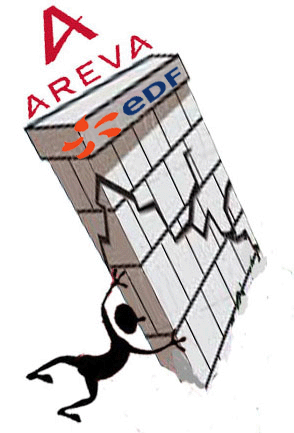 France’s nuclear-energy champion is in turmoil http://www.economist.com/news/business/21711087-electricit-de-france-has-had-shut-down-18-its-58-nuclear-reactors-frances-nuclear-energy Electricité de France has had to shut down 18 of its 58 nuclear reactors THESE are difficult times for Electricité de France (EDF), the country’s quasi-monopolistic electricity provider, serving 88% of homes. Outages at no fewer than 18 of the 58 EDF-owned nuclear reactors that provide three-quarters of France’s electricity have meant a slump in production: the company says annual nuclear output could fall to 378 terawatt hours (TWH), from 417 TWH last year. Eight reactors are currently lying idle and several may not restart for weeks or months. Power stations are burning coal at a rate not seen since the 1980s. As electricity imports and prices soar, officials are having to deny that a cold snap could bring blackouts.
The cause of the crisis—possibly faulty reactor parts throughout EDF’s fleet—suggests it may not be easily contained. France’s nuclear regulator, the Autorité de Sûreté Nucléaire (ASN), this summer ordered urgent tests of reactor parts, mostly bases of cylindrical steam generators. Inspectors are worried about high carbon levels found in steel forged by Creusot Forge, which is owned by Areva, another French firm, and by Japan Casting & Forging Corporation, a Japanese supplier. In some pieces carbon deposits are over 50% above permitted levels, risking fracture in case of a sudden change in the temperature of the steel.
The cost for EDF is rising. As well as lost earnings from shuttered plants, switching one generator (a reactor can have three) can take six months and cost €150m ($159m). And its decision in November finally to stump up €2.5bn for Areva Nuclear Power (most of Areva, including Creusot Forge) now seems rather like paying to swallow a highly radioactive dinner.The two firms have one important joint project: a new European Pressurised Reactor (EPR), built by Areva and mostly run by EDF. Here too, forging faults are a problem: they were first found last year on the installed reactor vessel at Flamanville 3, a new EPR near Cherbourg. Another serious source of concern is safety-valve design.
The regulator will rule on Flamanville’s future in mid-2017. More tests or design changes may mean putting off its opening far beyond 2018.That would also deliver another blow to France’s reputation in nuclear power. The only other EPR in Europe, that at Olkiluoto, Finland, is years overdue and three times over budget.
Delays might also hinder EDF in its plan to build two EPRs at Hinkley Point, in Britain, for £24.5bn ($30.7bn). British loan guarantees need certain conditions to be met, and these reportedly include seeing Flamanville operate by 2020. Steve Thomas, an energy expert in London, concurs with the opinion of many in the nuclear-power industry when he calls the EPR a dud. EDF is pushing on regardless, but the financial strain is mounting. In March, EDF’s then chief financial officer, Thomas Piquemal, quit, calling Hinkley Point unaffordable.
The sense of crisis looks likely to grow. Yves Marignac, a nuclear-energy expert in Paris, calls EDF “already financially crippled”. Only state backing prevents EDF’s credit rating falling steeply, analysts say. And it is not only the ASN that has EDF in its sights. On November 22nd French competition officials raided its offices, seeking evidence that its dominant position is squeezing rivals and sending prices higher than they should be (even though lower electricity prices in recent years have sapped its revenues). Its share price has halved in two years.
The future looks bleak. Some four-fifths of French nuclear plants were built in a decade from the late 1970s. The plants have a 40-year lifespan, meaning that several a year face retirement over the next decade. Energy planners have assumed there will be extensions to 50 years or more. But the ASN may hesitate after the forging problems, or impose higher costs. Cyrille Cormier, a nuclear engineer who is now at Greenpeace, a campaign group that opposes nuclear power, says a total refit could cost EDF an extra €60bn-200bn.
Closing plants permanently would be extremely costly, too. France has never closed a large one. EDF may be under-provisioning the costs of decommissioning plants. It has set aside €36bn, less than the €45bn that Germany has allowed, even though France’s neighbour has a smaller nuclear fleet. Then there is nuclear waste. The five pools storing spent fuel at La Hague, Areva’s central reprocessing plant, are nearly full, says Mr Marignac. When sorrows come, they come in battalions.
Nuclear marketing: sellers keen to finance Kenya ?
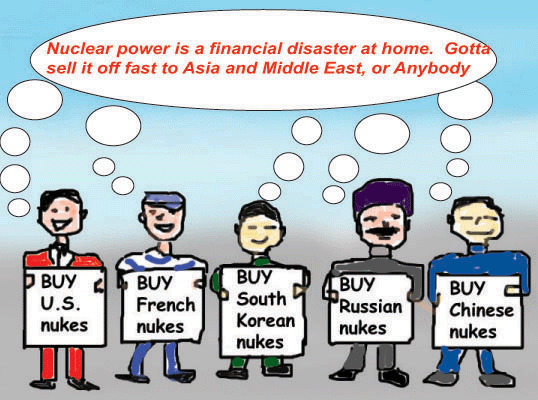
Who’s Paying For This $5 Billion Nuclear Plant In Kenya?,Daily Caller, ANDREW FOLLETT
Energy and Science Reporter, 1 Dec 16 Kenya is getting ready to start building a $5 billion dollar nuclear power plant, but its unclear where the money is coming from.
Kenya’s first nuclear reactor is scheduled to be completed by 2027 and will generate an estimated 1,000 megawatts of power. Kenya has signed agreements with China for the larger country to help finance and construct similar reactors. China’s state-controlled nuclear companies have already offered technical assistance in handling the nuclear fuel Kenya will need.
Another potential funding source for the reactor is South Korea, which signed agreements to collaborate on designing, operating and financing Kenyan reactors.
“When we talk of 1,000 megawatts, we are talking half of the capacity we have right now in the country,” Collins Gordon Juma, CEO of Kenya’s Nuclear Electricity Board, told Bloomberg Markets Tuesday. “It is very expensive, so we are looking at several funding options. We are speaking to various governments.”……..
Kenya is one of the most stable countries in East Africa, but the country has a serious problem with Islamic terrorism. In 1998, 200 people were killed when al-Qaida affiliate Egyptian Islamic Jihad bombed the U.S. embassy in the country. Another 13 were killed in an attack on an Israeli-owned Paradise hotel in 2002. More recently, the militant Islamic terror group, Al-Shabaab, killed 67 people in an attack on a shopping mall in 2013.
The country’s new reactor would not produce the weapons-grade plutonium necessary to make a nuclear weapon, but materials from them could be used to create dirty bombs. A dirty bomb combines radioactive material with conventional explosives that could contaminate the local area with high radiation levels for long periods of time and cause mass panic, though it would be millions of times weaker than an actual nuclear device. The Islamic State wants to steal this kind of radioactive material for a dirty bomb.
France’s nuclear power industry in a bad way – former EDF director
 French nuclear power in ‘worst situation ever’, says former EDF director
In the week Britain exports electricity to France for first time in four years, Gérard Magnin says renewable power will match Hinkley Point C on cost, Guardian, Adam Vaughan, 29 Nov 16, The French nuclear industry is in its “worst situation ever” because of a spate of plant closures in France and the complexities it faces with the UK’s Hinkley Point C power station, according to a former Électricité de France director.
Gérard Magnin, who called Hinkley “very risky” when he resigned as a board member over the project in July, told the Guardian that with more than a dozen French reactors closed over safety checks and routine maintenance, circumstances for the state-owned EDF had deteriorated since he stepped down.
The closures have seen Britain this week exporting electricity to France for the first time in four years. An industry report on Tuesday also warned that the offline reactors could lead to a “tense situation” for energy supply in France, in the event of a cold snap this winter.
The situation is likely to be exacerbated by damage during Storm Angusto the main cable that carries electricity back and forth between the UK and France. It is believed a boat dropping anchor during the storm may have been responsible but National Grid is investigating the cause and working to repair the Interconnexion France-Angleterre, which is buried in the seabed and heavily armoured.
The operator said that four of the eight cables in the interconnector had been damaged, reducing its capacity from 2,000MW to 1,000MW until February next year. It added that due to the French reactor closures, it had already factored in a reduction in energy supplies from France this winter.
Magnin said that instead of backing new nuclear, the UK and France should capitalise on falling wind and solar power costs and help individuals and communities to build and run their own renewable energy projects. He founded an association of cities switching to green energy, joined the EDF board in 2014, and is now director of a renewable energy co-op in France.
“The most surprising [thing] for me is the attitude of the UK government which accepts the higher cost of electricity … in a time where the costs of renewables is decreasing dramatically,” he said. “In 10 years [when Hinkley Point C is due to be completed], the cost of renewables will have fallen again a lot.”
Of the Hinkley C design, known as the European Pressurised Reactor (EPR), Magnin said: “A lot of people in EDF have known for a long time the EPR has no future – too sophisticated, too expensive – but they assume their commitments and try to save the face of France.”
The UK’s business department conceded in September that by the time Hinkley is operational the price of electricity guaranteed to EDF will be above the comparable costs for large-scale solar and onshore windfarms. Officials argued that using renewables instead would cost more in grid upgrades and balancing the intermittent nature of wind and solar……. https://www.theguardian.com/environment/2016/nov/29/french-nuclear-power-worst-situation-ever-former-edf-director
Very dubious market for nuclear power in South East Asia
 The limited role for nuclear can be explained by the high upfront capital costs, limited access to financing, and uneven and tepid public support in the wake of the Fukushima Daiichi nuclear accident. Public opposition has been especially evident in Indonesia, Malaysia, Philippines and Thailand.”
former Rosatom head Sergey Kirienko’s team has been excellent at drawing up and signing nonbinding nuclear agreements … Actually building nuclear plants seems to be beyond them.
Vietnam’s amazing nuclear journey – why it ended, what it means for South East Asia, Energy Post, November 29, 2016 by Jim Green On November 10, Vietnam took the historic decision to scrap its nuclear power program, after many decades of nuclear preparations, up to a ground-breaking ceremony at the first proposed nuclear site in the country in 2014. Jim Green, editor of Nuclear Monitor, published by WISE (World Information Service on Energy), tells the amazing story of nuclear power in Vietnam – and discusses what the Vietnamese decision means for the prospects of nuclear power in South East Asia. Courtesy of Nuclear Monitor.
2016 cancellation
On November 10, Duong Quang Thanh, CEO of staterun Electricity of Vietnam, said the government would propose the cancellation of plans for reactors at the two Ninh Thuan sites to the National Assembly. He added that nuclear power was not included (or budgeted for) in the power plan which runs until 2030 and had already been approved by Prime Minister Nguyen Xuan Phuc.
The National Assembly voted on November 22 to support the government’s decision to abandon plans to build nuclear power plants. Energy analyst Mycle Schneider said: “Vietnam is only the latest in a long list of countries, including more recently Chile and Indonesia, that have postponed indefinitely or abandoned entirely their plans for nuclear new-build.”
The decision to abandon nuclear power was primarily based on economics. Duong Quang Thanh said nuclear power is “not economically viable because of other cheaper sources of power.”
Le Hong Tinh, vice-chair of the National Assembly Committee for Science, Technology and Environment, said the estimated cost of four reactors at the two sites in Ninh Thuan province had nearly doubled to VND400 trillion (US$18 bn; €17.9 bn). The estimated price of nuclear-generated electricity had increased from 4‒4.5 US cents / kwh to 8 cents / kwh. Vietnam has spent millions of dollars on the project so far, Tinh said, but continuing the program would add more pressure to the already high public debt.
Another media report states that Japanese and Russian consultants said that the cost has escalated from the original estimate of US$10 billion to US$27 billion (€9.5‒25.6 bn). “The plants will have to sell power at around 8.65 cents a kWh, which is almost twice the rate approved in the project license and is not competitive at all,” according to the VN Express newspaper.
Vietnam’s rising public debt, which is nearing the government’s ceiling of 65% of GDP, was another reason for the program’s cancellation, saidCao Si Kiem, a National Assembly member and former governor of the central bank………
A May 2016 report by WWF-Vietnam and Vietnam Sustainable Energy Alliance (VSEA) finds that 100% of Vietnam’s power can be generated by renewable energy technologies by 2050. There are many available renewable power sources in Vietnam including solar, wind, geothermal heat, biomass and ocean energy. The report contrasts three scenarios: business as usual (with only modest growth of renewables), a Sustainable Energy Scenario (81% renewable power generation by 2050) and an Advanced Sustainable Energy Scenario (100%).
Nuclear power in South East Asia – or not
A 2015 International Energy Agency report anticipates that nuclear power will account for just 1% of electricity generation in south-east Asia by 2040.
The report states: “All countries in Southeast Asia that are interested in deploying nuclear power face significant challenges. These include sourcing the necessary capital on favourable terms, creation of legal and regulatory frameworks, compliance with international norms and regulations, sourcing and training of skilled technical staff and regulators, and ensuring public support. … The limited role for nuclear can be explained by the high upfront capital costs, limited access to financing, and uneven and tepid public support in the wake of the Fukushima Daiichi nuclear accident. Public opposition has been especially evident in Indonesia, Malaysia, Philippines and Thailand.”
A June 2016 media article began: “Rosatom, Russia’s state nuclear-energy agency, is bullish on the outlook of its business in Southeast Asia after the speedy development of a project in Vietnam and a range of agreements with every country in the region except Singapore, the Philippines and Brunei.”
Nikolay Drozdov, director of Rosatom’s international business department, said Rosatom is focusing a lot of attention on south-east Asia, reflected by the decision to establish a regional headquarters in Singapore.
Russia has nuclear cooperation agreements with seven countries in south-east Asia ‒ Vietnam, Indonesia, Malaysia, Thailand, Cambodia, Myanmar and Laos. But not one of those seven countries ‒ or any other country in south-east Asia ‒ has nuclear power plants (the only exception is the Bataan reactor in the Philippines, built but never operated) and not one is likely to in the foreseeable future. Nor are other nuclear vendors likely to succeed where Russia is failing.
Drozdov said that after the (stalled) nuclear power project in Vietnam, Indonesia and Malaysia would likely be the next countries in the region to develop nuclear power.2 But Indonesia’s situation is much the same as Vietnam’s ‒ decades of wasted efforts with little to show for it (and the same could be said about Thailand).
Malaysia’s consideration of nuclear power is preliminary. Why would Russia be making such efforts in southeast Asia given that nuclear power prospects in the region are so dim? The answer may lie with domestic Russian politics. Given Rosatom’s astonishing industry in lining up non-binding nuclear agreements with over 20 countries ‒ ‘paper power plants’ as Vladimir Slivyak calls them ‒ we can only assume that such agreements are looked on favorably by the Russian government.
Slivyak writes: “These ‘orders’ are not contracts specifying delivery dates, costs and a clear timescale for loan repayments (in most cases the money lent by Russia for power plant construction comes with a repayment date). Eighty to ninety per cent of these reported arrangements are agreements in principle that are vague on details, and in the overwhelming majority of cases the contracts aren’t worth the paper they’re printed on. … So it is clear that [former Rosatom head Sergey] Kirienko’s team has been excellent at drawing up and signing nonbinding nuclear agreements … Actually building nuclear plants seems to be beyond them.” http://energypost.eu/vietnam-dumps-nuclear-power-economic-reasons-rest-south-east-asia-may-follow/
Contrary to World Nuclear Association propaganda, the nuclear industry is an economic basket case
To say that the French nuclear industry is in crisis is perhaps an understatement. There are obviously flow on effects on the European power industry
in China solar and wind projects are on steep cost declines, while the cost of nuclear builds continues to rise.
 Nuclear Industry Challenged: Solar And Wind Winning The Low Carbon Competition, Seeking Alpha , Keith Williams 26 Nov 16
- Significant delays in nuclear implementation in China, with targets not met.
- France has 20 of 58 nuclear reactors out of action.
- Vietnam abandons plans to build nuclear reactors with Japan and Russia.
- Switzerland can’t give its reactors away.
World Nuclear Association figures continue to paint a misleading picture of the industry.
With substantial action on climate change and efforts to reduce greenhouse gas emissions becoming a major focus, one might expect that the nuclear industry would be a substantial beneficiary.
The big picture on nuclear power
A recent report (The World Nuclear Industry Status Report 2016) examines the proposal for decarbonising the world economy and there is a section comparing proposals involving renewable energy (solar, wind power) in comparison with nuclear initiatives. The report is comprehensive and provides a lot of factual information about the industry.
Perhaps a key fact is that in 2015, despite it being a good year for the nuclear industry, with nuclear power increasing by 31 TWh (almost all of it in China), renewable energy increase was 250 TWh (8x more than new nuclear capacity).
Ten reactors started up in 2015. While this was more than for any year since 1990, construction of ALL of these reactors was commenced prior to the Fukushima disaster.
In 2010 there were 15 constructions started; in 2015 there were 8 starts, while in the first half of 2016 no construction starts happened.
The number of units under construction has declined for the third year in a row. There were 8 early closures of nuclear plants in 2015.
In 9 of 14 countries currently building nuclear plants, all projects are delayed and mostly by several years. Chile suspended and Indonesia abandoned nuclear plans in 2015.
In 2015 globally, wind power grew by 17%, solar by 33% and nuclear by 1.3%.
Some highlights/lowlights
The above describes the key insights in the World Nuclear Industry Status Report 2016.
Here I show that recent developments in France, China, Switzerland and Vietnam are even more challenging for the nuclear industry, notwithstanding major pressure on fossil fuel exploitation as a result of the COP21 agreement becoming binding.
France……. France is not at the end of this crisis yet. All told there are 87 irregularities concerning operational EDF reactors in France, plus 20 issues concerning parts for the Flamanville 3 EPR reactor. There are also other irregularities indicating unacceptable practices in the French nuclear industry.
Since France has been a major figure in the worldwide nuclear industry, questions are being asked about reactors in other parts of the world, including China, Finland, Belgium and the UK. Japanese steel forger JCFC has built partsfor a number of Japanese nuclear reactors, including the Sendai No 2 reactor, which is one of the few Japanese nuclear reactors in operation.
It isn’t suggested that these problems suggest imminent failure, but EDF is being cautious considering the massive implications for a nuclear accident. Recent evaluation has suggested carbon content of the steel in some components (0.39%) being almost double the design specification of 0.22% carbon.
It has been reported as of 25 October to a French Parliamentary hearing that 1-2 more years are needed to check out the reported irregularities. The situation as of October 2016 is that 6 affected French nuclear plants have been given approval to restart, while 7 are being inspected as part of planned outages. Five more have been ordered off-line for checks; 3 more are scheduled to be unavailable through the winter and 1 has been shut down following detection of an irregularity.
To say that the French nuclear industry is in crisis is perhaps an understatement. There are obviously flow on effects on the European power industry….
UK
Will the above issues confronting the French nuclear industry impact the recent UK decision to proceed with the major Hinkley Point C development?
Given that the (still under development) French Flamanville 3 reactor is affected by the French nuclear problems and no new generation reactor is yet operable, one wonders whether the Hinkley Point C project will ever see commercial operation. Indeed the steel casing for EPR reactors in China (two reactors in Taishan) and that proposed for Hinkley Point C (2 reactors) uses/plans to use construction with a similar Areva forging technique used at Flamanville 3.
China
China is the country which carries the future of the nuclear industry. Nuclear power has been part of China’s plans to reduce its dependence on fossil fuels, along with hydropower, solar and wind energy. Hydro, solar and wind have all overachieved in terms of China’s initial goals.
Nuclear developments have been more problematic after Fukushima, which led to a review of the program. Today the goal is for 58 GW of nuclear power to be installed and operational by 2020. Currently there are 31.4 GW operating and 19.3 GW under construction. This leaves a shortfall of 7.3 GW, so that the 58 GW goal seems almost certain not to be met.
Just as is happening everywhere else in the world, in China solar and wind projects are on steep cost declines, while the cost of nuclear builds continues to rise.
Vietnam
The Vietnamese Parliament has decided to stop nuclear plans……..
World Nuclear Organisation
Given the slowdown in China, the disaster in France, Vietnam’s decision to stop two nuclear developments and aging nuclear fleets around the world, there are few reasons for optimism, especially for nuclear power in the developed world. India is perhaps the exception.
However, an uncritical viewing of the World Nuclear Organization website exhibits none of these concerns.
Indeed the World Nuclear Association continues to claim 436 operable nuclear reactors worldwide, notwithstanding that a significant proportion of these reactors (notably in Japan) have not operated for more than 5 years.
A recent report “World Nuclear Performance Report 2016, Asia Edition” presents an optimistic view of the industry. It is perhaps relevant to read that report with the knowledge of the kinds of announcements that provide the content in this article.
Conclusion
The Fukushima nuclear accident changed the course of the nuclear industry, not only in Japan but globally. The recent problems in France exacerbate the problem and raise issues about new projects such as Hinkley Point C. Developments in other countries (Switzerland, Vietnam) all point to acceleration of the trend away from nuclear power as the world decarbonises. Unlike China’s continued acceleration of renewable energy build, its nuclear program is not meeting its targets.
On the other hand while there is controversy about oversupply of solar PV panels and many solar companies (e.g. First Solar (NASDAQ:FSLR)) are trading near year lows, there is every sign that solar companies will become major beneficiaries from the COP21 agreement and declining prospects for the nuclear industry. Of course wind is an essentially carbon free energy source that complements solar PV. Contrarian investors with a long term view might well look at opportunities in solar and wind before these companies come out of the shadows….http://seekingalpha.com/article/4026366-nuclear-industry-challenged-solar-wind-winning-low-carbon-competition
France’s aging nuclear reactors and EDF’s debt crisis
EDF faces a seemingly impossible financial equation. It has colossal debt of €37 billion; it must deal with the complex €2.5 billion takeover of Areva; and find the money to extend the life of its 58 reactors at costs estimated between €60 and €100 billion up to 2030. (8)
Meanwhile EDF has been accused by Greenpeace France of grossly underestimating the cost of nuclear electricity.
Greenpeace claimed that if EDF disclosed the true cost of running its fleet of reactors in France while financing two new ones in the UK, it would be declared bankrupt.
“In summary, the French nuclear fleet is at the end of its course, dilapidated and dotted with deficient parts. At the same time, the finances of EDF are in such a deplorable state that the company could soon join Areva in bankruptcy, and is in any case unable to properly maintain its reactors.”
NuClear News No 90 , 26 Nov 16 Problems discovered at Areva’s metal forge at Le Creusot have been growing over the past six months and are now even threatening to derail EDF’s takeover of Areva’s reactor business.
Last spring when Economy Minister Emmanuel Macron visited to tell the workers at Le Creusot that he had every confidence in the nuclear sector, despite the difficulties, 400 files which were being examined for suspected “anomalies” had to be hastily moved out of the meeting room. Now, six months later a crane has been moving prefabricated office buildings into position so that 6,000 records concerning nuclear components – 2.4 million pages – forged at Le Creusot over the last 60 years can be re-examined. Areva has had to accept that the original 400 suspicious files are just the tip of an iceberg and not the only ones containing “irregularities”. 50 people are now trawling through the paperwork and as many more are being recruited for a job that will take at least another eighteen months.
EDF’s CEO Jean-Bernard Lévy says if Le Creusot’s “problems prove insurmountable, the acquisition will not happen”. (1)
With potentially more than half of France’s 58 reactors affected by the “carbon segregation” problem the French nuclear watchdog, the Autorité de Sûreté Nucléaire (ASN) has ordered preventative measures to be taken immediately to ensure public safety. ASN confirmed that, as of late October, 20 reactors were offline and more could be shut down over coming weeks.
Questionable Materials and Documentation
At the heart of France’s nuclear crisis are two problems. One concerns the carbon content of the steel used in critical reactor components, steam heat exchangers, and other components manufactured or supplied by AREVA SA, the French state-owned nuclear engineering firm and global producer of nuclear reactors. The second problem concerns forged, falsified, or incomplete quality control reports about the critical components themselves. Excessive levels of carbon in the steel parts could make them more brittle and subject to sudden fracture or tearing under sustained high pressure, which is obviously unacceptable.
Steam generators from 18 reactors have carbon levels that are above the acceptable level. Some of these were forged at Le Creusot, but others were forged in Japan by JCFC, a subcontractor of Areva. Twelve reactors equipped with JCFC steel are still at a standstill and will be in December while inspections are carried out.
The massive outages are draining power from all over Europe. In the event of severe cold weather this winter, there could be blackouts. Worse, new questions continue to swirl about both the safety and integrity of EDF’s nuclear fleet, as well as the quality of some French- and Japanese-made components that EDF is using in various high-profile nuclear projects around the world.
In October EDF was forced to reduce its 2016 generation targets from 395–400 TWh to 380– 390 TWh, while estimates for nuclear output in 2017 have also been lowered to between 390 TWh and 400 TWh. For perspective, annual nuclear production averaged 417 TWh in the period 2005–2015.
Flamanville
The problem was originally discovered at the Flamanville EPR project in 2014. Since then an internal probe at Le Creusot where many of the components in question were manufactured, has uncovered new anomalies. AREVA is now reported to be reviewing all 9,000 manufacturing records at the forge dating back as far as 1943, including files from more than 6,000 nuclear components.
This autumn there have been almost weekly revelations resulting in plant shutdowns, extended outages, reduced generation, and lots more questions. According to ASN there are now a significant number of reactors offline, with more to be inspected in the next few weeks. “We are now finding carbon segregation problems from components coming from both Le Creusot and [the Kitakyushu-based Japan Casting & Forging Corp.] JCFC plant. As for now, there [are] 20 EDF reactors offline,” the official said, noting that the number will fluctuate as inspections take place.
The analyses performed by EDF thus far have found that since 2015 certain channel heads of the steam generators manufactured by Le Creusot and JCFC “contain a significant carbon concentration zone which could lead to lower than expected mechanical properties,” according to ASN. The Japan Times reports that the JCFC is now also under scrutiny by Japan’s Nuclear Regulation Authority.
Shaun Burnie for Greenpeace said “As a result of substandard manufacturing in Japan, citizens in France have been unknowingly exposed to the risk of catastrophic failure of critical reactor components which could result in a reactor core meltdown. Japanese-supplied steel is now at the centre of France’s unprecedented nuclear crisis the scale of which has never been seen in any country. All 12 reactors supplied by JCFC are either in forced shutdown or about to be. It lacks all credibility that the Japanese nuclear industry would claim that there are no implications for the safety of their own nuclear reactors. The steel production records released in France did not reveal the scale of excess carbon, which was only found after physical testing. There are currently no plans for such tests in Japan. That is wholly unacceptable. There are many urgent questions that need to be answered by the industry and the NRA, and with full public disclosure and transparency.” (2)
Energy traders and analysts warn that the French market needs to prepare for longer maintenance periods in coming years given the age of the nuclear fleet and the continuing design flaw revelations. With the average French reactor now more than 30 years old, equipment will need to be replaced more frequently, and increasingly stringent safety requirements will mean that components could be delayed, especially as ASN imposes additional checks. The safety inspections and other reviews “will lead in particular to extensions of certain planned outages,” EDF said in a press release.
Erring on the Side of Safety?
Despite the outages and findings from the carbon quality investigations, EDF continues to downplay the risk. “The safety margins are very large and the carbon content does not undermine integrity or security, even in the case of an accident,” an EDF spokesperson told Le Monde newspaper. But questions about quality control practices at Le Creusot continue to grow. Indeed, the greater the scrutiny, the more problems are being discovered. The number of components affected by irregularities and already installed in operating reactors increased from 33 known issues in April to 83 by the end of September. Startlingly, irregularities affecting just the Flamanville EPR project increased from two to 20 during the same period.
While EDF and AREVA are dealing with costly damage control, ASN and other agencies are erring on the side of caution. Indeed, the ASN representative said, “We take no risks. That is the rule. If we don’t know the dangers of the carbon segregation, then we must take the reactors offline until we know what the situation is and [can confirm that] it’s not dangerous.”
ASN revealed that AREVA has now identified at least 87 irregularities concerning EDF reactors in operation, including vessels, steam generators, and main primary system piping, plus the 20 issues for parts intended for Flamanville 3, and one more affecting a steam generator planned for installation in Gravelines 5. Inspectors have also found four irregularities affecting transport packaging for radioactive substances. ASN said that whatever the outcome of these investigations, the irregularities “reveal unacceptable practices.”
External Parties Push for Answers
After the discovery of anomalies in the composition of steel in certain zones of the vessel closure head and the vessel bottom head of the EPR reactor being built at Flamanville in 2014, an internal audit was carried out and released in April 2015, suggesting the existence of many more anomalies. These were initially downplayed by ASN and AREVA. But in September 2015 an independent evaluation conducted by Large and Associates for Greenpeace France really set the cat amongst the pigeons. “The nature of the flaw in the steel, an excess of carbon, reduces steel toughness and renders the components vulnerable to fast fracture,” said the report’s author, John Large. The Greenpeace report, “Amplified the questions ASN already had,” said an ASN representative.
12 reactors have been identified by ASN to have carbon problems in replacement steam generators forged by JCFC. In these reactors initial surface tests were followed by more invasive studies. The first reactors to enter scheduled refuelling outages for a more thorough examination were Tricastin 1 and 3. The early nondestructive inspection results for the JCFC bottom channel heads at these reactors revealed an alarming 0.39% level of carbon present, almost 100% greater than the maximum permissible level. That finding, with its associated reduction in material toughness, rendered the component vulnerable to fast fracture, reported Greenpeace in a late October update. ASN decided to order the shutdown of all but one of these reactors and these shutdowns will remain in force until EDF can demonstrate each reactor is safe to re-enter service.
Uncertainty Remains
At a French parliamentary hearing into the situation on October 25, ASN said it would need another year or two to examine the thousands of documents at the Le Creusot foundry and more anomalies and irregularities will probably be discovered. (3
As of late October 2016 ASN has confirmed the following:
- Six reactors have been granted approval to restart and are operating normally: Blayais 1, Chinon 1 and 2, Dampierre 2 and 4, and Saint-Laurent-des-Eaux B2.
- Seven reactos are in planned outages and have been, or are being, inspected. They are: Bugey 4, Civaux 2, Dampierre 3, Gravelines 2, Saint-Laurent-des-Eaux B1, and Tricastin 1 and 3. (4) The Times reports that the re-start of Civaux 2 and Dampierre 3 has been delayed until 31st December.
(5) · Five reactors have been ordered by ASN to be taken offline to conduct checks before 18th January 2017. They are: Civaux 1, Fessenheim 1, Gravelines 4, and Tricastin 2 and 4. (6)
- Three reactors are currently scheduled to remain unavailable throughout the winter months. They are: Bugey 5, Gravelines 5, and Paluel 2.
- One reactor has been ordered by ASN to shut down following the detection of an irregularity in the lower shell of the steam generator. That unit is Fessenheim 2.
- Incidentally, Paluel 2 has been offline since May 2015. Its maintenance period is continuing, following an incident on March 31, 2016, in which a 465-ton steam generator tipped over during removal. (7)
EDF’s Debts
EDF faces a seemingly impossible financial equation. It has colossal debt of €37 billion; it must deal with the complex €2.5 billion takeover of Areva; and find the money to extend the life of its 58 reactors at costs estimated between €60 and €100 billion up to 2030. (8)
Meanwhile EDF has been accused by Greenpeace France of grossly underestimating the cost of nuclear electricity.
Greenpeace claimed that if EDF disclosed the true cost of running its fleet of reactors in France while financing two new ones in the UK, it would be declared bankrupt. Greenpeace commissioned an audit by AlphaValue, the equity research company. The French government has agreed to inject €3 billion into the group this year and has renounced dividend payments until next year. Shares in EDF, 85% of which are owned by the French state, have lost almost a third of their value in the past year and the company is no longer listed on the Paris blue-chip index.
The AlphaValue report described EDF as an “uncompetitive firm – incapable of reacting rapidly and efficiently to the variations in electricity needs and the changes created by the liberalisation of European markets”. It said that EDF’s rivals had written down the value of their nuclear plants because of the move to renewable energy and the fall in electricity prices and that EDF had failed to follow suit. Juan Camilo Rodriguez, author of the report, said the company might have to close 17 of its 58 French reactors to meet the government’s requirement that nuclear power should provide 50 per cent of the nation’s electricity in 2025, down from 75 per cent now.
“The provisions to safeguard the burden of financing the decommissioning of the French reactors are far from sufficient. [If 17 are closed], the group should increase its provisions by more than €20 billion.” Mr Rodriguez said the cost of handling nuclear waste added at least €33.5 billion to that figure. “Whatever scenario is retained, an adjustment of the nuclear provisions . . . would lead to the bankruptcy of EDF from an accountancy point of view,” he added. The report said that EDF would need to find a further €165 billion during the next decade to finance projects such as Hinkley Point and the renovation of reactors in France. EDF says it will spend €51 billion renovating its reactors and £12 billion on Hinkley Point. A spokesman for EDF accused AlphaValue of making erroneous calculations that failed to take account of long-term electricity price movements and differences between France and other European markets. (9) Greenpeace filed a complaint against EDF and its CEO, Jean-Bernard Lévy, for “stock trading offences” at the end of November and EDF responded by suing the group for making “false allegations”.
Greenpeace has asked the public prosecutor “to open a preliminary investigation or to appoint an investigating judge”, saying that “shareholders, investors but also French citizens are being misled by EDF and its CEO”. (10)
According to Stéphane L’homme, Directeur de l’Observatoire du nucléaire: “In summary, the French nuclear fleet is at the end of its course, dilapidated and dotted with deficient parts. At the same time, the finances of EDF are in such a deplorable state that the company could soon join Areva in bankruptcy, and is in any case unable to properly maintain its reactors.” http://www.no2nuclearpower.org.uk/nuclearnews/NuClearNewsNo90.pdf
Business Unity South Africa (Busa) warns Eskom on nuclear procurement plansx
Busa warns Eskom on nuclear plans IOL, 25 November 2016, Siseko Njobeni Johannesburg – Business Unity South Africa (Busa) yesterday warned power utility Eskom not to proceed with preparations to procure nuclear while consultations on the draft integrated resource plan (IRP) had not been completed.
Busa said it was concerned that the difficulties that renewable projects faced in gaining access to the grid appeared to be used as an artificial constraint on renewable energy sources.
“Furthermore, Busa is concerned that Eskom and the government do not seem to be aligned on the question of the nuclear element of the IRP,” the business group said.
“Busa believes that the role of Eskom, particularly in respect of its position as the sole purchaser of electricity, needs to be clearly defined.”
“Additionally, Eskom’s role as the developer of new generation capacity should not proceed independently of the IRP which is only expected to be finalised in the third quarter of next year,” Busa said.
Procurement
The business body said any procurement of large-scale generation should commence only after finalisation of the IRP as the national plan.
The warning comes after the Department of Energy published the draft integrated energy plan and the draft IRP for the country on Tuesday. The documents are out for public comment.
The assumptions and scenarios in the IRP will be the subject of public consultation at Nedlac – the government, labour and business negotiating chamber – and provincial road shows in February next year…….
Meanwhile, the Nuclear Industry Association of South Africa said yesterday that it was alarmed at the prospect of a delay of the nuclear programme to 2037. http://www.iol.co.za/business/companies/busa-warns-eskom-on-nuclear-plans-2093258
Costs too high: India has to postpone its nuclear power programme
 Empty Pockets Leave Indian Nuclear Plants Incomplete https://sputniknews.com/asia/201611231047759881-india-incomplete-nuclear-plants/ ASIA & PACIFIC 23.11.2016 India’s target to rapidly step up nuclear power capacity may be stumbling because many suppliers have not been paid. The Government is now trying to borrow from state-owned companies to complete the projects.
New Delhi : India’s ambitious nuclear power plans are facing the sword of financial uncertainty. The Indian Government has acknowledged that major equipment for two nuclear power projects was delivered on time because the suppliers had not been paid. The projects are being set up by the government-owned Nuclear Power Corporation of India Limited (NPCIL).
India had changed the Atomic Energy Law this year to allow NPCIL enter into joint ventures with other government entities. “After the changes in the law, India would be able to set up a new nuclear power reactor in every four year,” says Rajiv Nayan, senior research associate, Institute of Defense and Security Analysis.
Sources say that companies like NTPC, Indian Oil Corporation and NALCO have agreed to invest $ 1,500 million each in joint ventures with NPCIL. “India will not get far even after adding this money with the amount available with NPCIL for investment. Costs and financing, therefore, complicate India’s ability to scale up nuclear power through its own means without relying on foreign imports,” writes Anirudh Mohan, Junior Fellow at Observer Research Foundation in a research paper. Currently, India is setting up 6,700-megawatt nuclear power projects across the country with an estimated cost of more than $ 18 billion. Being the sole company authorized to set up nuclear power plants, NPCIL is faced problems in generating funds for these projects.
Economic and Social Research Institute tots up the cost of a nuclear disaster in Europe – €160bn
European nuclear disaster would cost €160bn, Peter O’Dwyer November 22 2016, http://www.thetimes.co.uk/edition/ireland/european-nuclear-disaster-would-cost-160bn-trb3bcrp9
A nuclear disaster in northwest Europe could cost Ireland as much as €161 billion. A report compiled by the Economic and Social Research Institute found that agricultural production would grind to a halt, with the tourism industry and exports also incurring substantial damage.
The estimated cost of a disaster like that in Chernobyl in 1986 or Fukushima in Japan five years ago could be almost twice the €85 billion bailout Ireland received in 2010.
The UK has 15 active reactors and there are a further 58 in France and eight in Germany, according to the World Nuclear Association. EDF, the French nuclear company, is building an £18 billion (€21.2 billion) plant at Hinkley Point in Somerset, about 150 miles from Rosslare, Co Wexford, on the east coast.
Even under the most benign scenario considered by the ESRI, where no contamination occurs, the total loss is estimated at €4 billion. By comparison, the total value of corporation tax collected in the first nine months of the year was €4.16 billion.
The report focused on the potential impact of a nuclear disaster on tourism, agriculture and food, including both the initial shock and the long-run reputational damage.
The report’s authors said that their analysis was likely to omit several additional losses and could underestimate the true extent of the potential cost to the Irish economy. Concerns over the health risks associated with high levels of contamination could, for example, put a significant strain on the health service.
The total cost of a low-level contamination scenario, which requires the imposition of food controls to reassure the public, and which would cause restrictions on food imports from Ireland, would be about €18 billion.
The third scenario considered would require food controls be put in place for months and steps taken to protect agricultural production. Irish exports would be severely impacted, as in the previous scenario, while Irish consumers would also shun Irish food produce in a further setback for the sector.
The impact on tourism would also be significant, with long-term reputational damage resulting in an economic cost of €80 billion.
The most severe economic shock would arise where the contamination warrants the imposition of food controls for years. Under this scenario, the impact could persist for 60 years, though the most substantial economic impacts would arise in the first 30 years.
It is assumed that Irish agricultural production would cease entirely for three years, costing about €5 billion, and that EU member states would begin importing Irish produce after this period. Trade with international partners would take another 12 years to restart.
Culling and disposing of contaminated livestock could cost more than €5 billion.
Not only would exports be decimated but the need to import much of the country’s food would lead to far higher domestic costs. There could also be significant emigration.
Under this worst-case scenario, the estimated economic loss was €161 billion.
A spokesman for the Department of Communications, Climate Action and Environment was not available for comment.
Ameren Illinois opposes Exelon’s Illinois nuclear energy bill
Ameren opposes Exelon’s Illinois nuclear energy bill, Utility Dive, Peter Maloney, Nov. 22, 2016
Dive Brief:
- Ameren Illinois is opposing a bill now before the state’s general assembly that includes provisions aimed at shoring up two financially strapped Exelon nuclear plants, the Herald & Review reports.
- Ameren is concerned about the impact the bill would have in its current form on its 1.2 million customers in central and south Illinois.
- The bill, which faces a short legislative session, could come to a vote early next week.
Dive Insight:
In addition to funding support for the Exelon’s Clinton and Quad City nuclear plants, the bill, SB 2814, includes add-on payments for south Illinois coal plants, potentially including some owned by Ameren, as well as a range of other provisions including funding for utility energy efficiency measures, community solar programs and microgrids, as well as a shift in rate structure to demand charges and the elimination of retail net metering for solar power.
A previous version of the bill would have shifted ratepayers to demand charges based on the peak demand for the month. The latest version of the bill uses average demand over the course of the month.
Two earlier versions of the energy bill have also faced opposition and not been passed by the state’s General Assembly.
Craig Nelson, Ameren’s senior vice president of regulatory affairs and financial services, last week told a legislative committee that Ameren would not be able to shift to the new rate structure until it finishes installing smart meters for all its customers, which is not expected to be completed until late in 2019……http://www.utilitydive.com/news/ameren-opposes-exelons-illinois-nuclear-energy-bill/430887/
A new nuclear plant at Wylfa on Anglesey? the economics don’t stack up
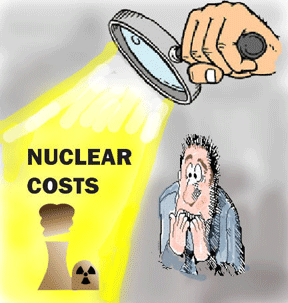
 Economic case for nuclear ‘falling apart’ anti-Wylfa Newydd protesters claim http://www.dailypost.co.uk/news/north-wales-news/economic-case-nuclear-falling-apart-12201243
Rally urges government not to build new nuclear plant on Anglesey ERYL CRUMP 19 NOV 2016
The economic case for nuclear energy is “falling apart”, a leading anti-nuclear campaigner claimed. Dr Carl Clowes made the claim at an anti-nuclear power rally at Llangefni. An audience of more than 50 listened to arguments against building a new nuclear plant at Wylfa on Anglesey.
Dr Clowes said: “There’s been a proposal to develop Wylfa Newydd for some years now and we believe passionately this is not the right way forward for either energy or employment on the island. “It’s going to cause as many problems as it may potentially solve and it leaves a legacy which is wholly inappropriate for future generations. “There are better more effective, more efficient ways of producing energy now and we need to address those rather than waste our time and money indeed on something that may not happen at the end of the day.
“The economic case for nuclear is falling apart. We’ve seen already this week Vatenfall, a Danish company, is aiming to produce electricity with offshore wind at something like half the price, 45 pence per kiolwatt hour that the Government has agreed for Hinkley C with EDF.
“So it’s a no brainer for an economist or a Government minister they should be seriously looking at the way ahead and it’s not nuclear.” Dylan Morgan of PAWB (People against Wylfa B) claims Hitachi’s Advanced Boiling Water Reactor (ABWR) which they are proposing for Wylfa B is not a proven technology.
“Since the explosions and triple meltdowns at nuclear reactors in Fukushima in March 2011, none of the four ABWRs which were operating in Japan are now operational. “One nuclear power complex shut down in June 2006 after only running from its start up in January 2005.
“Also a plan to build an ABWR in the USA was abandoned in March 2011 because nobody wanted to invest in it,” he said.
The meeting also considered why small nuclear reactors should not be built at the site of the now decommissioned nuclear power station at Trawsfynydd near Blaenau Ffestiniog or anywhere else.
A competition to develop a miniature nuclear power station at Trawsfynydd earlier this year attracted interest from 38 companies from around the world.
Small modular reactors (SMRs) have been compared to the nuclear reactors that have been used to power submarines since the 1950s.
Last year the UK Government announced £250m in funding over the next five years for nuclear research and development, including a competition to identify the best value SMR design for the UK.
Swiss can’t give away nuclear reactors, let alone sell them

 Swiss try to give away nuclear plants, but find no takers, REneweconomy, By Craig Morris on 18 November 2016 Energy Transition The operator of Switzerland’s nuclear reactors, Alpiq, reportedly offered reactors to France’s EDF at no cost or “a symbolic franc.” The French, who have their hands full with their own struggling fleet at home, refused the offer. A potential power shortfall still looms in the background. Craig Morris explains.
On the weekend, Swiss media reported (in German and in French) that Swiss reactor operator Alpiq could find no buyer for its two nuclear plants and is therefore hoping to give them to the Swiss state. The firm’s CEO is quoted saying that France’s EDF was not interested even at no cost because it “has its own problems pertaining to nuclear power at present.”
It is possible that the announcement is a bargaining chip just in case the Swiss decide in their referendum later this month to phase out nuclear. Alpiq’s Gösgen reactor would then have to close in 2024; Leibstadt, in 2029. The company may thus be looking for ways to ask for money from the Swiss state in return for a closure. At present, the firm is apparently losing 2 billion francs annually but can only pass on half of those losses to consumers.
Oddly, neighboring France faces a power shortage that should lead to greater demand in Switzerland; the aforementioned losses have been part of a longer trend stemming back to the solar boom of Germany (see my report from 2012), which began bringing down prices on spot power markets despite Chancellor Merkel’s nuclear phaseout of 2011. Solar and wind have simply grown faster than anyone expected.
As I recently explained, France has more than a third of its reactors closed at present. At the beginning of November, it was announced (in French) that five of the 20 reactors (out of 58) currently undergoing inspections would not come back online this month as expected.
Concerns of a power shortage also extend to the UK, where system operator National Grid warned of a potential shortfall on Monday, November 07. Power prices have reached as high as 40 pence on the spot market, whereas 4 pence would be more usual (play around with this table). The British were importing power full blast on line from the Netherlands and France, thereby contributing to the drain on French supply.
As a result, French prices were also high that Monday, reaching nearly 40 cents. But that’s nothing: a power trader says it is “almost certain” that France will reach its price cap of three euros per kilowatt-hour on the exchange this winter. The head of EDF, which operates all of France’s reactors, has now said that the danger of a blackout this winter is real (in French). At that point, France might import from the UK no matter what the cost, and the British would fire up their strategic reserve……..
The problem is thus that France and the UK have failed to build enough renewables, especially biogas plants running on waste (which are dispatchable), while they wasted time hoping to build nuclear plants that never emerged. As for the Swiss, well, they have suffered from the same indecision but may set it aside finally in their referendum on November 27. http://reneweconomy.com.au/swiss-try-give-away-nuclear-plants-find-no-takers-47105/
Japan’s nuclear marketing disappointment: Vietnam to cancel reactor order
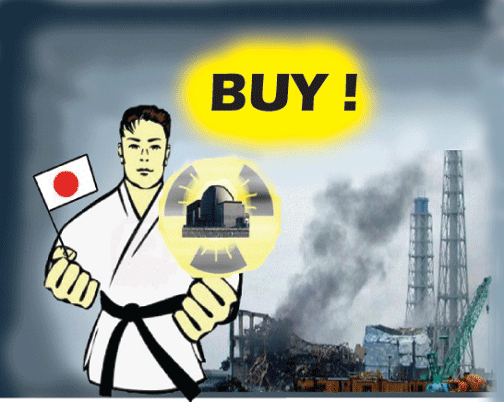 Japan’s nuclear export ambitions hit wall as Vietnam set to rip up reactor order Reiters, | TOKYO/HANOI, 17 Nov 16
Vietnam is poised to abandon plans for Japanese firms to build a multi-billion dollar nuclear power plant, damaging Prime Minister Shinzo Abe’s drive to begin exporting reactors after the Fukushima disaster left the industry in deep-freeze at home.
The Japanese government said in a statement this week that it had been informed by Vietnamese Deputy Prime Minister Trinh Dinh Dung that Hanoi was close to a decision to cancel the project. Japan’s Minister of Economy, Trade and Industry, Hiroshige Seko, described the move as “very regrettable.”
Vietnam’s decision, attributed to lower demand forecasts and rising costs as well as safety concerns, also deals a broader blow to the global nuclear business. Countries from Germany to Indonesia have decided to either pull out of nuclear energy or cancel development plans in the wake of the Fukushima nuclear disaster in 2011, the world’s worst since Chernobyl in 1986.
Though it has sought contracts for years, Japan has never led a nuclear project to completion overseas and Abe has lent his office’s prestige to attempts to win contracts, most recently in Turkey. The dented ambitions for exports come at a time when Japan is struggling to restart dozens of reactors shut down in the wake of Fukushima.
“This is a major blow to Japanese ambitions to, finally, export their first nuclear reactors,” said Schneider…….
DEMAND GROWTH EASING
Vietnam’s parliament is set next Tuesday to formally approve scrapping the Japanese deal, as well as the country’s first nuclear project, which was awarded to Russia’s Rosatom, according to state media. Rosatom said it would not comment until the Vietnam parliament formalized the decision.
The Japanese and Russian nuclear plants were supposed to have been located in central Ninh Thuan province…….. http://www.reuters.com/article/us-japan-vietnam-nuclearpower-idUSKBN13D0RK
1 This Month
26 September – International Day for the Total Elimination of Nuclear Weapons





PLEASE OPPOSE HR 8255 AND S.3639 – bills would accelerate satellite deployment, with no environmental review or safeguards – https://ncstd5li.quorum.us/campaign/169331/
To see nuclear-related stories in greater depth and intensity – go to https://nuclearinformation.wordpress.com
-
Archives
- September 2026 (323)
- August 2026 (330)
- July 2026 (355)
- June 2026 (287)
- May 2026 (306)
- April 2026 (356)
- March 2026 (251)
- February 2026 (267)
- January 2026 (308)
- December 2025 (358)
- November 2025 (359)
- October 2025 (375)
-
Categories
- 1
- 1 NUCLEAR ISSUES
- business and costs
- climate change
- culture and arts
- ENERGY
- environment
- health
- history
- indigenous issues
- Legal
- marketing of nuclear
- media
- opposition to nuclear
- PERSONAL STORIES
- politics
- politics international
- Religion and ethics
- safety
- secrets,lies and civil liberties
- spinbuster
- technology
- Uranium
- wastes
- weapons and war
- Women
- 2 WORLD
- ACTION
- AFRICA
- Atrocities
- AUSTRALIA
- Christina's notes
- Christina's themes
- culture and arts
- Events
- Fuk 2022
- Fuk 2023
- Fukushima 2017
- Fukushima 2018
- fukushima 2019
- Fukushima 2020
- Fukushima 2021
- general
- global warming
- Humour (God we need it)
- Nuclear
- RARE EARTHS
- Reference
- resources – print
- Resources -audiovicual
- Weekly Newsletter
- World
- World Nuclear
- YouTube
-
RSS
Entries RSS
Comments RSS

