U.S. electricity consumers could end up paying more than $2.5 billion for nuclear plants that never get built.

 Customers Could Pay $2.5 Billion for Nuclear Plants That Never Get Built http://www.bloomberg.com/news/articles/2016-08-08/customers-could-pay-2-5-billion-for-nukes-that-never-get-built, Mark Chediak markchediak August 9, 2016 —
-
Only two of 18 plants proposed since 2007 under construction
-
At least seven states allow billing before building starts
-
U.S. electricity consumers could end up paying more than $2.5 billion for nuclear plants that never get built.
Utilities including Duke Energy Corp., Dominion Resources Inc. and NextEra Energy Inc. are being allowed by regulators to charge $1.7 billion for reactors that exist only on paper, according to company disclosures and regulatory filings. Duke and Dominion could seek approval to have ratepayers pony up at least another $839 million, the filings show.
The practice comes as power-plant operators are increasingly turning to cheaper natural gas and carbon-free renewables as their fuels of choice. The growth of these alternatives is sparking a backlash from consumers and environmentalists who are challenging the need for more nuclear power in arguments that have spilled into courtrooms, regulatory proceedings and legislative agendas.
“Anything that hasn’t gotten off the ground yet isn’t getting built,” said Greg Gordon, a utility analyst at Evercore ISI, a New York-based investment advisory firm. “There is no economic rationale for it.” - Only two of 18 nuclear projects proposed since 2007 are under construction. Those units, being built by Southern Co. in Georgia and Scana Corp. in South Carolina, are billions of dollars over budget and years behind schedule. In the meantime, the price of natural gas has dropped 38 percent since 2010. It’s now used to generate more than a third of the nation’s power, up from 24 percent six years ago.
- Utilities that are moving forward with their nuclear plans say they want to preserve the option to build if market or regulatory conditions change. Nuclear power offers around-the-clock, carbon-free electricity that becomes more valuable if federal rules limiting greenhouse gases take hold, the utilities say.“One way to mitigate these risks is to spend money now, so that you have a license to build a nuclear plant if and when you need to,” said Richard Myers, vice president of the Nuclear Energy Institute, an industry trade group.
Critics of policies that allow utilities to bill for planned reactors say they’re likely unneeded, and the practice shifts upfront financial risks from shareholders to customers.
“The rich get richer and the ratepayers get poorer,” said Mark Cooper, a research fellow at Vermont Law School who submitted testimony in July opposing Dominion’s planned reactor in Virginia on behalf of the Virginia Citizens Consumer Council.
Duke fell 1 cent to $84.73 in New York. NextEra rose 8 cents to $126.07 and Dominion fell 26 cents to to $74.73.
-
Nuke Spending
Money collected from ratepayers so far has gone for items including federal licensing, permitting, land purchases, financing and equipment. Nuclear developers have sunk at least $1.2 billion of their own cash into proposals where they aren’t allowed or won’t ask to recover expenses from consumers, the disclosures and filings show.
At least seven states including Florida allow utilities to collect nuclear licensing and planning costs from customers before any construction begins.
In Virginia and Florida, utilities are seeing increased scrutiny of their plans. The Virginia attorney general has raised concerns about the rising expense of Dominion’s proposed new reactor at its North Anna facility, estimating the total cost at $19 billion.
“If Dominion proceeds on this ruinous path, it will extract $6 billion to $12 billion in needlessly higher energy bills,” said Irene Leech, president of the Virginia Citizens Consumer Council.
Shareholder Vote
In May, Dominion faced a shareholder resolution that would have required the company to analyze the financial risks of not getting regulatory approval for the new reactor. The proposal didn’t pass.
- Dominion intends to spend $647 million to get a federal nuclear license next year and $302 million of that has already been collected from ratepayers.“We’ve done a lot of work for licensing North Anna 3, which is prudent and valuable to our customers to maintain a diverse, carbon-free baseload source of electricity,” said Richard Zuercher, a Dominion spokesman.
- In Florida, multiple efforts in the state legislature to repeal a law that allows advanced collection of nuclear costs have failed.“I just never thought nuclear power plants made sense,” said Florida State Representative Michelle Rehwinkel Vasilinda, a Democrat, who has proposed bills to overturn the advance fee collection law.
In February, a federal lawsuit was filed on behalf of consumers that seeks to overturn the Florida statute and recover fees charged by Duke and NextEra for nuclear power plants that might not be completed. The suit alleges the companies overcharged customers for projects including Duke’s proposal for two reactors in Levy County and NextEra’s plan for two units at Turkey Point.
Legal Action
Duke and NextEra have asked a judge to dismiss the suit. Four other lawsuits challenging the state law have been rejected by Florida courts, said Rita Sipe, a Duke spokeswoman. The suits were filed on behalf of an environmental group and customers, according to court records.
As part of an agreement with Florida regulators in 2013, Duke was allowed to collect $926 million from customers to cover expenses including land and equipment purchases for its Levy facility, Sipe said. Duke also canceled its engineering, procurement and construction contract for the site in 2013.
- The company is pursuing a federal license for the plant but won’t charge customers for the costs of doing so, said Chris Fallon, vice president for nuclear development for Duke. The company sees the option to build as a hedge against pending environmental rules and possible natural gas price hikes, Fallon said.
Carolina Plants
Separately, Duke said it hasn’t decided if it will ask regulators for permission to collect $494 million in planning expenses for two proposed reactors in South Carolina.
Regulators have allowed NextEra to recoup $282 million of federal licensing costs for two new units at its Turkey Point facility, said Peter Robbins, a company spokesman. NextEra doesn’t see getting a license until the end of 2017 and will delay pre-construction work until at least 2020, Robbins said.
Critics say the issue is still whether companies should be allowed to bill for facilities that may never get finished.
“Customers can get stuck with the bill long before a single kilowatt of power is produced and may never recoup anything if the nuclear project is later abandoned,” said Jeremiah Lambert, an energy attorney and author of “The Power Brokers,” a history of the electric power industry.
Following $1 billion subsidy, Exelon buys failing Fitzpatrick nuclear station
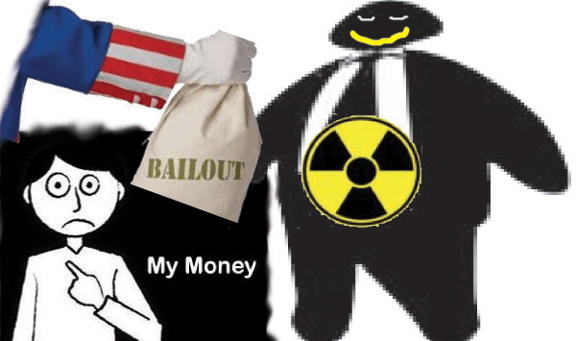 Exelon buys upstate New York nuclear plant http://thehill.com/policy/energy-environment/290879-exelon-buys-upstate-new-york-nuclear-plant Exelon Generation has agreed to buy an upstate New York nuclear power plant that seemed on the verge of closing just last year.
Entergy Corp. will sell its James A. FitzPatrick plant outside of Syracuse to Exelon for $110 million, officials announced on Tuesday. The companies expect regulatory approval by early next year, when Exelon plans to refuel the plant.
In a statement, Exelon President and CEO Chris Crane specifically thanked New York Gov.Andrew Cuomo (D) for his work on the Clean Energy Standard.
“We look forward to bringing Fitzpatrick’s highly-skilled team of professionals into the Exelon Generation nuclear program, and to continue delivering to New York the environmental, economic and grid reliability benefits of this important energy asset,” Crane said.
In a statement announcing the deal Tuesday, Cuomo said the deal is important for both the local economy and the state’s environmental policies.
“This state needs a clean energy policy that is realistic and can be implemented before we destroy this planet and I believe that nuclear plays an important rule in that clean energy policy,” he said, according to a video of his speech from the Syracuse Post-Standard. Entergy in November said it would be forced to close the 838-megawatt FitzPatrick plant by 2017, citing cheap natural gas and state policies that made nuclear plants expensive to operate.
Officials and the nuclear industry had looked for ways to keep the plant operating. The state’s Public Service Commission last week approved a clean energy standard requiring half the state’s electricity to come from renewable sources by 2030, and provided $1 billion over two years to subsidize FitzPatrick and two other nuclear plants in the state.
Exelon and Entergy have been negotiating a potential sale of the plant since last year. Regulatory agencies — including the Public Service Commission and the federal Nuclear Regulatory Commission — still need to sign off on the deal.
Horizon nuclear company funds college in Wales
 Wylfa Newydd nuclear firm funds Anglesey engineering centre 9 August 2016
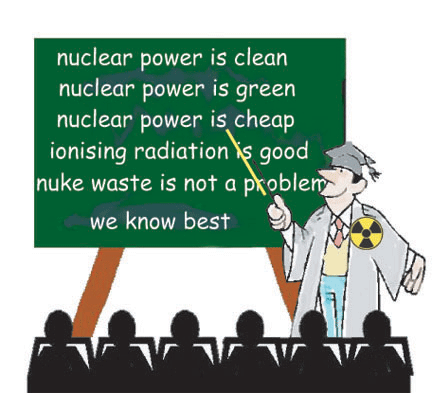
The company behind an £8bn nuclear power plant will pay £1m towards an engineering centre on Anglesey.
Horizon Nuclear Power, the firm behind Wylfa Newydd, will pay towards Grwp Llandrillo Menai’s Llangefni building…….
- Horizon will provide technical support to Coleg Menai, one of the colleges under Grwp Llandrillo Menai, and apprentices will move from the Bangor campus to Llangefni once the new centre is finished.
The Welsh Government pledged £5m to the centre in 2015.…..
- Duncan Hawthorne, Horizon’s chief executive officer, said: “I’m delighted to announce this landmark funding provision to Grwp Llandrillo Menai.
The Military Industrial Complex – death merchant of the world
 “We are the death merchant of the world”: Ex-Bush official Lawrence Wilkerson condemns military-industrial complex http://www.salon.com/2016/03/29/we_are_the_death_merchant_of_the_world_ex_bush_official_lawrence_wilkerson_condemns_military_industrial_complex/ The military-industrial complex “is much more pernicious than Eisenhower ever thought,” says the retired US colonel BEN NORTON Col. Lawrence Wilkerson is tired of “the corporate interests that we go abroad to slay monsters for.”
“I think Smedley Butler was onto something,” explained Lawrence Wilkerson, in an extended interview with Salon.
In his day, in the early 20th century, Butler was the highest ranked and most honored official in the history of the U.S. Marine Corps. He helped lead wars throughout the world over a series of decades, before later becoming a vociferous opponent of American imperialism, declaring “war is a racket.”
Wilkerson spoke highly of Butler, referencing the late general’s famous quote: “Looking back on it, I might have given Al Capone a few hints. The best he could do was to operate his racket in three districts. I operated on three continents.”
“I think the problem that Smedley identified, quite eloquently actually,” Wilkerson said, “especially for a Marine — I had to say that as a soldier,” the retired Army colonel added with a laugh; “I think the problem is much deeper and more profound today, and much more subtle and sophisticated.”
Today, the military-industrial complex “is much more pernicious than Eisenhower ever thought it would be,” Wilkerson warned. In his farewell address in 1961, former President Dwight D. Eisenhower famously cautioned Americans that the military and corporate interests were increasingly working together, contrary to the best interests of the citizenry. He called this phenomenon the military-industrial complex.
As a case study of how the contemporary military-industrial complex works, Wilkerson pointed to leading weapons corporations like Lockheed Martin, and their work with draconian, repressive Western-allied regimes in the Gulf, or in inflaming tensions in Korea.
“Was Bill Clinton’s expansion of NATO — after George H. W. Bush and [his Secretary of State] James Baker had assured Gorbachev and then Yeltsin that we wouldn’t go an inch further east — was this for Lockheed Martin, and Raytheon, and Boeing, and others, to increase their network of potential weapon sales?” Wilkerson asked.
“You bet it was,” he answered.
“Is there a penchant on behalf of the Congress to bless the use of force more often than not because of the constituencies they have and the money they get from the defense contractors?” Wilkerson continued.
Again, he answered his own question: “You bet.”
“It’s not like Dick Cheney or someone like that went and said let’s have a war because we want to make money for Halliburton, but it is a pernicious on decision-making,” the former Bush official explained. “And the fact that they donate so much money to congressional elections and to PACs and so forth is another pernicious influence.”
“Those who deny this are just being utterly naive, or they are complicit too,” Wilkerson added.
“And some of my best friends work for Lockheed Martin,” along with Raytheon, Boeing and Halliburton, he quipped.
Wilkerson — who in the same interview with Salon defended Edward Snowden, saying the whistle-blower performed an important service and did not endanger U.S. national security — was also intensely critical of the growing movement to “privatize public functions, like prisons.”
“I fault us Republicans for this majorly,” he confessed — although a good many prominent Democrats have also jumped on the neoliberal bandwagon. In a 2011 speech, for instance, Secretary of State Hillary Clinton declared, “It’s time for the United States to start thinking of Iraq as a business opportunity” for U.S. corporations.
Wilkerson lamented, “We’ve privatized the ultimate public function: war.”
“In many respects it is now private interests that benefit most from our use of military force,” he continued. “Whether it’s private security contractors, that are still all over Iraq or Afghanistan, or it’s the bigger-known defense contractors, like the number one in the world, Lockheed Martin.”
Journalist Antony Loewenstein detailed how the U.S. privatized its wars in Iraq and Afghanistan in another interview with Salon. There are an estimated 30,000 military contractors working for the Pentagon in Afghanistan today; they outnumber U.S. troops three-to-one. Thousands more are in Iraq.
Lockheed Martin simply “plans to sell every aspect of missile defense that it can,” regardless of whether it is needed, Wilkerson said. And what is best to maximize corporate interest is by no means necessarily the same as what is best for average citizens.
“We dwarf the Russians or anyone else who sells weapons in the world,” the retired Army colonel continued.
“We are the death merchant of the world.”
UK govt accidentally published list of preferred bidders for funding for Small Modular Nuclear Reactors
 Chinese firm with military ties invited to bid for role in UK’s nuclear future
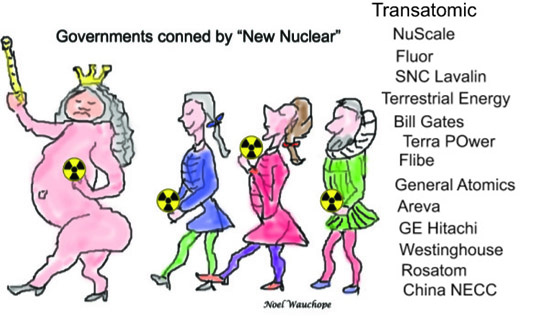
China National Nuclear Corporation on government list of preferred bidders for development funding for next-generation modular reactors, Guardian, Adam Vaughan, 8 Aug 16“……….The list of companies accepted for the competition was published briefly, apparently accidentally, on the website of the new Department for Business, Energy and Industrial Strategy on Friday before being deleted. It reads as a who’s-who of US, British, Japanese and Chinese industry players hoping to develop and build small modular reactors. These are much smaller than conventional nuclear plants with a capacity of less than 300MW – or a 10th of what Hinkley Point C should provide.
They are pitched by industry as a cheaper and quicker way to provide low-carbon energy capacity than conventional big nuclear plants because they could be built in a factory and transported to where their power is needed. The US and UK are racing to be the most attractive home for the first of the new designs to be commissioned.
Last November, George Osbornepromised £250m over five years for a nuclear research and development programme to “revive the UK’s nuclear expertise and position the UK as a global leader in innovative nuclear technologies”. An undisclosed amount of that sum is for a competition to find the best value SMR design for the UK, to “pave the way” towards building one in the UK in the 2020s.
CNNC sits alongside US companies such as NuScale; British ones including Rolls-Royce, Sheffield Forgemasters and Tokamak Energy; Japanese-owned Westinghouse; and the US-Japanese partnership GE-Hitachi, as participants the government considers eligible for phase one of its competition.
CNNC’s chief designer of small nuclear plants visited a conference in London last year to pitch a plan for cooperating with UK industry, and is already partnering with Rolls-Royce. It hopes to build the first SMR in the UK, with future ones sold around the world.
NuScale Power put itself forward for the competition in the spring. Its design, said its managing director, Tom Mundy, “answers the particular needs of the UK’s energy market and the wider UK economy, and we intend to participate fully in the government’s competition”.
The 33 participants will be whittled down in several phases, with the announcement of the eventual winners scheduled for late 2017……
When asked about the list published on Friday, a spokeswoman for the Department of Business, Energy and Industrial Strategy, said: “In March 2016, the government launched the first phase of a competition to identify the best value SMR for the UK. The ambition is to create an opportunity for the UK to become a world leader in SMRs.
“Those companies which are eligible to participate in the competition have been aware for over two months.” https://www.theguardian.com/environment/2016/aug/07/chinese-firm-with-military-ties-invited-to-bid-for-role-in-uks-nuclear-future
Economic and Public Health Impacts of Fukushima nuclear situation
 Fukushima: A Nuclear War Without A War: The Unspoken Crisis Of Worldwide Nuclear Radiation Fukushima Watch 1 Aug 16 “………Public Health Disaster. Economic Impacts What prevails is a well organized camouflage. The public health disaster in Japan, the contamination of water, agricultural land and the food chain, not to mention the broader economic and social implications, have neither been fully acknowledged nor addressed in a comprehensive and meaningful fashion by the Japanese authorities.
Japan as a nation state has been destroyed. Its landmass and territorial waters are contaminated. Part of the country is uninhabitable. High levels of radiation have been recorded in the Tokyo metropolitan area, which has a population of 39 million (2010) (more than the population of Canada, circa 34 million (2010)) There are indications that the food chain is contaminated throughout Japan:
Radioactive cesium exceeding the legal limit was detected in tea made in a factory in Shizuoka City, more than 300 kilometers away from the Fukushima Daiichi nuclear power plant. Shizuoka Prefecture is one of the most famous tea producing areas in Japan.
A tea distributor in Tokyo reported to the prefecture that it detected high levels of radioactivity in the tea shipped from the city. The prefecture ordered the factory to refrain from shipping out the product. After the accident at the Fukushima nuclear power plant, radioactive contamination of tea leaves and processed tea has been found over a wide area around Tokyo. (See 5 More Companies Detect Radiation In Their Tea Above Legal Limits Over 300 KM From Fukushima, June 15, 2011)
Japan’s industrial and manufacturing base is prostrate. Japan is no longer a leading industrial power. The country’s exports have plummeted. The Tokyo government has announced its first trade deficit since 1980.
While the business media has narrowly centered on the impacts of power outages and energy shortages on the pace of productive activity, the broader issue pertaining to the outright radioactive contamination of the country’s infrastructure and industrial base is a “scientific taboo” (i.e the radiation of industrial plants, machinery and equipment, buildings, roads, etc). A report released in January 2012 points to the nuclear contamination of building materials used in the construction industry, in cluding roads and residential buildings throughout Japan.(See FUKUSHIMA: Radioactive Houses and Roads in Japan. Radioactive Building Materials Sold to over 200 Construction Companies, January 2012)
A “coverup report” by the Ministry of Economy, Trade and Industry (May 2011), entitled “Economic Impact of the Great East Japan Earthquake and Current Status of Recovery“ presents “Economic Recovery” as a fait accompli. It also brushes aside the issue of radiation. The impacts of nuclear radiation on the work force and the country’s industrial base are not mentioned. The report states that the distance between Tokyo -Fukushima Dai-ichi is of the order of 230 km (about 144 miles) and that the levels of radiation in Tokyo are lower than in Hong Kong and New York City.(Ministry of Economy, Trade and Industry, Impact of the Great East Japan Earthquake and Current Status of Recovery, p.15). This statement is made without corroborating evidence and in overt contradiction with independent radiation readings in Tokyo (se map below). In recent developments, Sohgo Security Services Co. is launching a lucrative “radiation measurement service targeting households in Tokyo and four surrounding prefectures”.
“A map of citizens’ measured radiation levels shows radioactivity is distributed in a complex pattern reflecting the mountainous terrain and the shifting winds across a broad area of Japan north of Tokyo which is in the center of the of bottom of the map.”
“Radiation limits begin to be exceeded at just above 0.1 microsieverts/ hour blue. Red is about fifty times the civilian radiation limit at 5.0 microsieverts/hour. Because children are much more sensitive than adults, these results are a great concern for parents of young children in potentially affected areas.”
The fundamental question is whether the vast array of industrial goods and components “Made in Japan” — including hi tech components, machinery, electronics, motor vehicles, etc — and exported Worldwide are contaminated? Were this to be the case, the entire East and Southeast Asian industrial base –which depends heavily on Japanese components and industrial technology– would be affected. The potential impacts on international trade would be farreaching. In this regard, in January, Russian officials confiscated irradiated Japanese automobiles and autoparts in the port of Vladivostok for sale in the Russian Federation. Needless to say, incidents of this nature in a global competitive environment, could lead to the demise of the Japanese automobile industry which is already in crisis.
While most of the automotive industry is in central Japan, Nissan’s engine factory in Iwaki city is 42 km from the Fukushima Daiichi plant. Is the Nissan work force affected? Is the engine plant contaminated? The plant is within about 10 to 20 km of the government’s “evacuation zone” from which some 200,000 people were evacuated……….. http://fukushimawatch.com/2016-07-21-fukushima-a-nuclear-war-without-a-war-the-unspoken-crisis-of-worldwide-nuclear-radiation.html
AREVA- not making money from nuclear build, but cleaning up from waste cleanup?
New facility in Moyock makes massive spent nuclear fuel storage casks By Jeff Hampton The Virginian-Pilot MOYOCK, N.C., 7 Aug 16 Marlin Stoltz put on a hard hat and bright yellow vest before walking out into the four-acre work area of the Moyock Casting Facility, a new operation in the business of spent nuclear fuel storage.
A line of concrete cases, each 21 feet long and weighing 100 tons, rested along a rail spur, ready for shipment. Several men stood atop a steel form where hydraulic power vibrated and settled four truckloads of concrete for the next case. A concrete plant operated less than 100 yards away.
“This allows us to work very efficiently,” said Stoltz, supervisor of the Moyock Casting Facility and a deputy of the services business line for parent company Areva TN, a division of Areva, Inc, based in Charlotte.
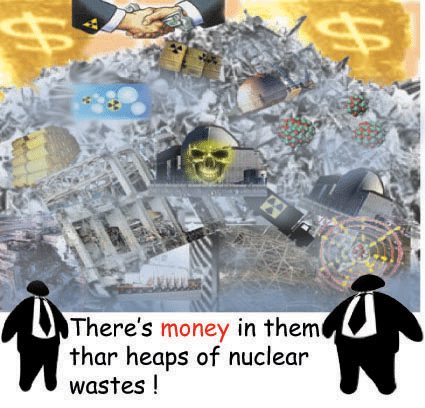
Areva, Inc. has operations within the entire nuclear cycle, including uranium mining.
The Moyock facility with 25 employees opened in January. It makes concrete modules that encase steel canisters containing spent nuclear fuel. From here, the modules head to nuclear plants elsewhere……
demand for spent fuel storage remains strong, Stoltz said. The Moyock plant means to deliver.
“The back end of the business is growing,” he said. http://pilotonline.com/news/local/new-facility-in-moyock-makes-massive-spent-nuclear-fuel-storage/article_82fb08bd-19f9-5c03-b976-47eeeb130604.html
Consumer-funded nuclear bail out will have an unprecedented impact on the nuclear power industry
Impacts of NY’s Nuclear Power ‘Bail Out’ and Solar, Wind Boost, Epoch Times, By Tara MacIsaac, Epoch Times | August 3, 2016
It includes what has been called a consumer-funded bail out of upstate New York’s struggling nuclear power plants.
Nuclear energy is treated in the state’s plan as a bridge to a renewable energy future. The commission said nuclear is necessary to maintain stability in the power grid as New York makes the transition toward the standard’s goal of 50 percent renewable energy by 2030.
By subsidizing nuclear power alongside solar and wind, the state is making a bold statement about the value of nuclear reactors as zero-emission energy sources. This could ripple to other states, inspiring similar initiatives to revive the sputtering nuclear industry.
Impacts of the clean energy plan on the nuclear, solar, and wind industries will affect New Yorkers in many ways………
How It Works
Electricity providers will be required to obtain a targeted number of renewable energy credits (RECs) and zero-emissions credits (ZECs) each year.
A REC is created each time 1 megawatt-hour (MWh) of electricity is generated by a renewable resource. RECs can then be sold and traded among providers. ZECs, on the other hand, are related solely to the nuclear plants. These credits are created when zero-emission nuclear power is generated.
So the state awards ZECs to the nuclear companies, which the energy providers must buy from them. The costs of the ZECs that electricity providers purchase will be passed on to the consumer, baked into the supply charges on consumers’ bills.
How It Will Affect Consumers
The nuclear industry is having trouble competing with low natural gas prices. ZECs essentially force state residents and businesses to pay above-market rates for nuclear energy.
But the governor’s office and Public Service Commission Chair Audrey Zibelman suggested a back door may be opened for New Yorkers opposed to supporting nuclear energy.
A press release from Cuomo’s office stated that consumers may be offered a 100 percent renewable energy option. The idea is that consumer demand for 100 percent renewable energy could naturally encourage the development of new renewable energy facilities.
“If it does that,” Zibelman said at the commission hearing on Aug. 1, “then I think it’s fair to say to those customers, if you truly don’t want to buy nuclear, we will allow you not to be required to contribute to that program.
“We’re asking staff to look at that and we’ll see how we can make that happen.”
In addition to providing various options for consumers, Zibelman said clear labeling will be important. “What I would like to know, as a consumer, [is] that if I’m … buying what is a ‘green product’ … are those megawatts really green,” she said. If it’s only 50 percent renewable, for example, the consumer will be told so in clear terms……..http://www.theepochtimes.com/n3/2130861-impacts-of-nys-nuclear-power-bail-out-and-solar-wind-boost/
Changing energy markets make it imperative for Britain to rethink Hinkley nuclear power plan
Why changing market forced re-think on UK nuclear power station http://www.afr.com/business/energy/nuclear-energy/changing-market-forces-rethink-on-uk-nuclear-power-station-20160804-gqligy 5 Aug 16 The UK government wants to do a rethink on the proposed rethink of Hinkley Point C nuclear power station because of a change in the structure of the UK energy market. Matt Cardy
Less than three years ago the British government struck a deal with EDF, a French state-owned utility, to subsidise the first new nuclear power station built in Britain since 1995: Hinkley Point C on the Somerset coast. The agreement was hailed by David Cameron, the then-prime minister, as “brilliant news”. But a lot has changed since then—and not just the incumbent at 10 Downing Street.
On July 28th, hours after EDF’s board narrowly endorsed a decision to go ahead with the £18 billion ($24 billion) Hinkley Point investment, the new government of Theresa May unexpectedly slammed the brakes on, launching a review of the project that it says it will finish by the autumn. It is understood to want to probe a deal with China General Nuclear Power, a Chinese state behemoth, which had offered to stump up one-third of the price tag in exchange for permission to build a nuclear-power station of its own at Bradwell, in Essex. The delay is the clearest sign that Mrs May is rethinking the open-door industrial policies of her predecessor.
Yet analysts say there is more to the delay than mere Sinophobia. Hinkley is “big and based on last-century technology, which is not what the UK’s power system needs for the future,” says Michael Grubb of University College London. A review of the assumptions prevailing when the government struck the deal reveals how flimsy the economic rationale was.
Price outlook changes Hinkley already operates as a nuclear power station. The plan was to expand with another reactor. But the changing demand for baseload power is now said to require a rethink. Andrew Matthews
In 2012 Britain’s energy boffins predicted that for the foreseeable future the price of non-nuclear fuels, such as natural gas, would be more than double where they are today. As a result, they estimated that wholesale electricity prices—the basis for determining the level of subsidy to EDF—would remain above £70 per megawatt hour. They are currently below £40. Last month the National Audit Office, a spending watchdog, said that forecasting error alone had almost quintupled the implied value of the subsidy, from £6 billion to almost £30 billion over 35 years.
At the time, the civil servants reckoned that by 2025, when Hinkley Point is due to open, the cost of producing electricity from a nuclear-power station would be lower than from a gas-fired one—and much lower than from wind farms and solar-power plants. They have since reversed those views (see chart). Since Hinkley became a serious proposal less than a decade ago, the cost of nuclear power has increased, that of renewables has fallen and the price of battery storage—which could one day disrupt the entire power system—has plummeted. What is more, EDF’s nuclear technology has failed to get off the ground in the two projects in Finland and France that have sought to use it. “When so much has changed, it would have been inappropriate not to pause,” says Professor Grubb.
Hinkley’s supporters counter that it would help to plug a looming gap in the country’s energy supply. Over the next 15 years, Britain plans to shut down its coal-fired power stations and decommission all but one of its ageing nuclear plants, losing 23 gigawatts (GW) of power-generating capacity. Hinkley Point C, with a capacity of 3.2GW, is intended to ensure there is enough clean energy to offset that, by kickstarting a broader revival of nuclear power in the country. It would also strengthen energy security, reducing reliance on Russian gas. And its power would be clean: without it, supporters say, Britain would fail to meet its obligation under the 2008 Climate Change Act to reduce greenhouse gases to 80% below their 1990 level by 2050.
Renewables have bigger share But these arguments fail to account for how quickly the energy landscape is changing. First, as their costs continue to drop, renewables are becoming a bigger part of the energy mix. They currently account for about one-quarter of Britain’s power output. But renewables are intermittent, generating little power on days that are calm or overcast. So they must be complemented by alternative sources of energy, which add to the total cost. Big power stations such as Hinkley Point cannot fill that role: nuclear power is hard to flex up and down. Combined-cycle gas turbines (CCGTs) are cheaper and more nimble. As a backup to renewables, they can enable Britain to “muddle along” at least for another 20 years, says Deepa Venkateswaran of Bernstein Research, a firm of analysts. That would buy time to assess the progress of other clean technologies, such as battery storage and carbon capture.
Smaller businesses are also jostling to step into the breach, offering standby power when shortages occur. One such firm, UK Power Reserve, uses small gas-fired generators that can be switched on and off quickly. It calls itself a “scalpel” compared with a CCGT “sledgehammer”. Another, Upside Energy, proposes selling to the grid surplus power stored in battery systems that back up everything from office computers to traffic lights. Others enable companies to shift their power consumption to times of lower demand, cutting their bills. Such options may not provide the bedrock of power or thousands of jobs that EDF promises at Hinkley Point, and may require more innovative policymaking. But in terms of value for money, they could beat it hands down.
Hinkley nuclear fiasco is a threat to French company EDF
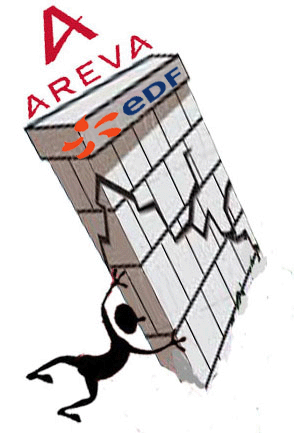 Nu Clear News No 87 5 Aug 16 EDF’s future threatened. Perhaps of more immediate concern is that a go-ahead for Hinkley could threaten the future of the company itself. EDF is a company in a very precarious financial situation. The ratings agency, S&P, postponed a decision to downgrade its credit rating when the UK Government announced the review. (7) EDF has €37 billion of debt. The collapse in energy prices has pushed earnings down 68% in 2015. The Company needs to spend €50 billion upgrading its network of 58 ageing reactors by 2025. It is scrambling to sell €4 billion of new shares and €10 billion of assets to strengthen its balance sheet. EDF is also expected to participate in the €5 billion bailout of Areva, the bankrupt developer of EPR technology, by taking a 75 per cent stake. (8) About the last thing it needs is a new €15 billion millstone around its neck.
Roy Pumfrey said “The EDF Board should take the opportunity presented by this pause to see that its Nuclear SatNav has taken the Company down a dead end; it’s only a matter of time before we hear that voice saying “At the next opportunity, turn round!”‘
He continues: “Perhaps most disappointing if not unexpected has been the reaction of the big UK Union leaders. Whilst confessing themselves ‘baffled’ by the government’s ‘bonkers’ decision, they should ask why the French union leaders representing EDF’s own workers were (and are) solidly and vocally opposed to HPC. This project involves a reactor which many of EDF’s own staff regard as unconstructable, selling off the family silver to fund it and putting EDF and therefore their own livelihoods at risk. UK unions do not seem to appreciate that the fantasy 25,000 jobs on HPC are a conjurer’s trick. Only 30% will be ‘local’, which means 90 minutes drive time from HPC, and with only 5,600 on site on any one day, a job with a particular skill set will only be good for two years at most. That’s assuming that
HPC can be built in an optimistic ten years, even that too long to keep the lights on.”
Over recent months several different alternative to building Hinkley Point C have been detailed (10) Most recently consultancy firm Utilitywise has described the proposed nuclear station as an “unnecessary expense” Energy efficiency measures could save the equivalent amount of electricity along with £12bn
Roy Pumfrey said: “This Government review of Hinkley Point C provides us with a wonderful opportunity to turn Somerset into a sustainable energy hub for England. The alternatives would be better for jobs, better for consumers, would reduce the mountain of dangerous waste we don’t know how to deal with and save Somerset from a decade of disruption caused by one of the biggest construction projects in the world The sooner EDF and the UK Government come to their senses the better. http://www.no2nuclearpower.org.uk/nuclearnews/NuClearNewsNo87.pdf
With UK and USA government help, NuScale hopes to go ahead with “mini” nuclear reactors
New Nuclear UK : fears Hinkley uncertainty will affect Wylfa, Moorside, Sizewell and Bradwell
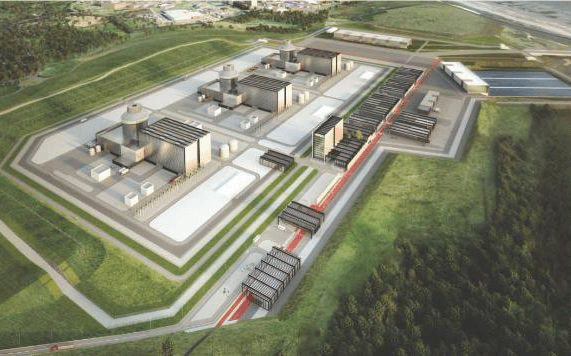 NucClear News No 87, 5 Aug 16 New Nuclear: Wylfa, Moorside, Sizewell and Bradwell. Horizon and NuGen are both insisting that their projects at Wylfa and Moorside are not dependent on EDF getting the go-ahead for Hinkley. But Industry experts have warned that confidence across the sector would be damaged if Theresa May pulls the plug, especially given the French energy giant has already invested £2.4bn in Hinkley with unstinting Government support until now. If Hinkley were cancelled without any reimbursement for EDF, this would “significantly undermine” other developers’ confidence and might prompt them to seek some sort of financial guarantee. (1)
Westinghouse to try to take over Nuclear Fuel Production In Ukraine

|
Westinghouse To Build Nuclear Fuel Production Unit In Ukraine, Oil PriceBy Zainab Calcuttawala – Aug 04, 2016 The American firm Westinghouse will be building a nuclear fuel production unit in Ukraine in order to help the country reduce its reliance on Russia, according to officials who announced the project on Thursday.Ukraine, which was formerly a Soviet Republic, has been trying to sever ties with Russia since the February 2014 revolution that tore the country apart. The Kremlin-backed president is now in self-imposed exile in Russia, while pro-European Union forces rule the country…….
Nasalyk visited the United States two months ago in an effort to find new sources of fuel and new forms of energy. Towards the end of his visit, he told reporters that Westinghouse would build a nuclear production factory in Ukraine in the future. Russia has argued in the past that American fuel would be unsafe for nuclear plants built by Soviet scientists who operated under their own guidelines and standards. “We have agreed to diversify our sources of fuel delivery to nearly half of our nuclear blocks,” Nasalyk said. “And we agreed (for Westinghouse Electric Sweden) to construct a nuclear fuel production facility on the territory of Ukraine.” Ukraine’s relationship with Russia has been falling apart further in recent days……http://oilprice.com/Latest-Energy-News/World-News/Westinghouse-To-Build-Nuclear-Fuel-Production-Unit-In-Ukraine.html |
GE Hitachi to provide human resources development program for nuclear energy, Malaysia
Hitachi-GE to launch nuclear energy course in Malaysia, WNN 04 August 2016 Japan’s Hitachi-GE Nuclear Energy has renewed an agreement with two Malaysian universities under which it will conduct a new international human resources development program to train workers for the nuclear power industry.
Hitachi-GE announced today that it has renewed an agreement with the National University of Malaysia (UKM) and the Universiti Tenaga Nasional (Uniten), a private university operated by Malaysia’s largest power company, Tenaga Nasional Berhad.
Under the agreement, Hitachi-GE will run an international human resources development program for nuclear energy, leveraging a course that the company has jointly conducted with Tokyo Institute of Technology (Tokyo Tech) for the past five years. So far the course has been held at venues in Southeast Asia and other regions and attended by more than 2000 students. For the new program, Hitachi-GE will work with Tokyo Tech, which has cooperation arrangements with UKM and Uniten……….http://www.world-nuclear-news.org/NN-Hitachi-GE-to-launch-nuclear-energy-course-in-Malaysia-0408164.html
Zero new nuclear builds so far in 2015 – report
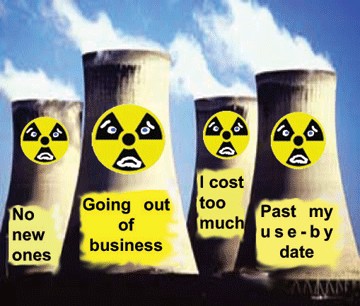 New nuclear reactor builds fall to zero in first half of 2016 – report http://in.reuters.com/article/nuclear-industry-decline-idINKCN0ZT0PV Jul 13, 2016 Construction starts for new nuclear reactors fell to zero globally in the first half of 2016 as the atomic industry struggles against falling costs for renewables and a slowdown in Chinese building, a report on the industry showed on Wednesday.
The last time there were no new reactors started over a full year was in 1995, according to the World Nuclear Industry Status Report 2016. The number of reactors under construction is in decline for a third year, with 58 being built by the end of June, down from 67 reactors at the end of 2013, the report said.
The latest figures highlight the struggles the nuclear sector is facing after the Fukushima atomic disaster in Japan five years ago, as higher costs and delays take their toll while other sources of energy become cheaper.
The nuclear industry faces a risk it “will not be easily protected from: the economic and financial risks from nuclear power being irreversibly out-competed by renewable power,” Tomas Kaberger, energy and environment professor at Chalmers University of Technology in Sweden, wrote in a forward in the report.
Kaberger is also a member of the board of state-owned Swedish utility Vattenfall, which owns 10 nuclear reactors, according to its website.
Construction started on six reactors in China in 2015, three times more than the rest of the world, while eight went into operation there last year, out of 10 globally, underlining how the world’s biggest energy user is a bright spot for the nuclear industry.
Three reactors have started up this year in China, with one in South Korea and another in the U.S., Watts Bar 2, which took 43 years to build, according to the report.
But even in China, renewables investment and capacity additions are outstripping nuclear, the report said.
New nuclear reactor builds fall to zero in first half of 2016 – report Renewables investments totalled $100 billion in China last year, more than five times the amount for new reactors, which was $18 billion.
Wind energy output totalled 185 terawatt hours (TWh) last year in China, compared with 161 TWh for nuclear. Solar power output totalled 39 TWh in 2015, up from 23 TWh the year before.
The report’s lead authors are industry analysts Mycle Schneider, based in Paris, and London-based Antony Froggatt. Both have advised European government bodies on energy and nuclear policy.
The report is available in full at:
-
Archives
- May 2026 (82)
- April 2026 (356)
- March 2026 (251)
- February 2026 (268)
- January 2026 (308)
- December 2025 (358)
- November 2025 (359)
- October 2025 (376)
- September 2025 (257)
- August 2025 (319)
- July 2025 (230)
- June 2025 (348)
-
Categories
- 1
- 1 NUCLEAR ISSUES
- business and costs
- climate change
- culture and arts
- ENERGY
- environment
- health
- history
- indigenous issues
- Legal
- marketing of nuclear
- media
- opposition to nuclear
- PERSONAL STORIES
- politics
- politics international
- Religion and ethics
- safety
- secrets,lies and civil liberties
- spinbuster
- technology
- Uranium
- wastes
- weapons and war
- Women
- 2 WORLD
- ACTION
- AFRICA
- Atrocities
- AUSTRALIA
- Christina's notes
- Christina's themes
- culture and arts
- Events
- Fuk 2022
- Fuk 2023
- Fukushima 2017
- Fukushima 2018
- fukushima 2019
- Fukushima 2020
- Fukushima 2021
- general
- global warming
- Humour (God we need it)
- Nuclear
- RARE EARTHS
- Reference
- resources – print
- Resources -audiovicual
- Weekly Newsletter
- World
- World Nuclear
- YouTube
-
RSS
Entries RSS
Comments RSS
 nuclear-news