Financially strapped French company AREVA gets a lifeline. EDF in dire financial straits, too.
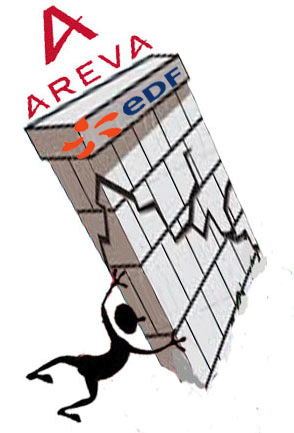 Areva receives offer for 10% stake in spun-off nuclear unit , Ft.com, 15 Dec 16
Deal would help recapitalise troubled French group Areva, the struggling French nuclear group, received a firm €500m offer for a 10 per cent stake in a new nuclear fuel company that will be split off from its parent in a wider reshaping of the French nuclear industry.
Areva is preparing to split off its uranium mining and nuclear fuel activities into NewCo as part of a government-backed rescue after the group was forced to the brink of collapse under the weight of its own debt this year.
Earlier this year it was agreed that the other half of Areva, the troubled reactor business, would be taken over by EDF, the larger French nuclear group, in a deal that values that part of the business at about €2.5bn.
EDF, the other major company in the sector, lost more than a tenth of its stock market value on Thursday after it warned of lower 2017 earnings becasue of an expected drop in power prices…….
Shares in EDF were down 12 per cent on Thursday. The stock has fallen 23 per cent over the past year after repeated warnings of weak profits. https://www.ft.com/content/4a1d5af6-c319-11e6-9bca-2b93a6856354
Divestment from fossil fuels has now reached $5.2 Trillion
Fossil Fuel Divestments Now Represent $5.2 Trillion, Climate Central December 12th, 2016 Investing heavy weights are moving their assets and funds out of fossil fuels at a record pace.
A network of local governments, pension funds, faith organizations, philanthropies and wealthy individuals representing $5.2 trillion in assets have committed to — and in some cases already started — divesting from fossil fuel companies, according to a report released on Monday. That’s a huge sum of money for a movement that started just four years ago on U.S. college campuses and its growth is likely to continue as the world strives to reach its climate goals.
“It’s pretty clear that the growth trajectory is enormous,” said Ellen Dorsey, the executive director of the Wallace Global Fund. In the past 15 months alone, the assets represented by the fossil fuel divestment movement have doubled. As of December 2016, there are 688 institutions and 58,400 individuals across 76 countries who are on board with divesting from fossil fuels, according to the report. The analysis was completed by Arabella Advisors, a philanthropy services firm.
Those divesting include Norway’s sovereign wealth fund, Germany-based financial services giant Allianz, and Amalgamated Bank, which in September became the first U.S bank to divest. Private businesses represent $4.6 trillion in assets being divested, nearly 90 percent of the overall total……
Another delay in South Africa’s troubled move towards new nuclear reactors
Nuclear RFI delayed once again Release postponed ‘to brief minister’. Money Web , Antoinette Slabbert / 15 December 2016 Moneyweb has just learnt that Eskom will not release the highly-anticipated nuclear Request for Information (RFI) on Thursday, despite widely-published undertakings by its acting CEO Matshela Koko to that effect.
According to South African Nuclear Energy Corporation (Necsa) chair Dr Kelvin Kemm, the documents were signed off by him and Eskom chair Dr Ben Ngubane on Thursday morning and were ready for release. A further cooperation agreement between Eskom and Necsa was also signed.
Eskom and Necsa have been tasked by government to jointly manage the procurement of the country’s 9 600 MW new nuclear build programme.
Kemm said Eskom’s shareholder representative, public enterprise minister Lynne Brown, however requested a personal briefing on the matter, since she has not been closely involved in the nuclear procurement planning……http://www.moneyweb.co.za/news/industry/breaking-nuclear-rfi-delayed-once-again/
Protecting Against Fatigued Nuclear Plant Workers
DAVE LOCHBAUM, DIRECTOR, NUCLEAR SAFETY PROJECT UCS DECEMBER 13, 2016, Disaster by Design/ Safety by Intent #62
The Nuclear Regulatory Commission (NRC) revised its regulations requiring nuclear plant workers to be fit for duty on March 31, 2008, to include measures intended to protect against mistakes made by workers impaired by fatigue. Specifically, Subpart I, “Managing Fatigue,” was added to 10 CFR Part 26, “Fitness for Duty Programs.”………http://allthingsnuclear.org/dlochbaum/protecting-against-fatigued-nuclear-plant-workers
India wants proof of efficiency of French and USA nuclear reactors
India seeks details of working nuclear reactors from US, French firms, Indian Express By PTI 11th December 2016 NEW DELHI: India has asked American and French nuclear companies, which propose to build atomic plants in the country, to furnish details of functional reactors designed by them as proof of their efficacy.
Sources said French company EDF and US firm Westinghouse are still not ready with fully operational “reference plants”, a pre-requisite before a final General Framework Agreement could be signed with these entities.
The EDF proposes to build six nuclear European Pressurised Reactors (EPR) of 1650 MW each in Jaitapur and Westinghouse another set of six AP1000 reactors in Kovadda in Andhra Pradesh with an individual capacity of 1000 MW.
A senior government official said designs presented by the two companies are new, so even the Department of Atomic Energy (DAE) wants to see how the technology works.
“We have told them to show a reference nuclear plant, which is functional and produces electricity. On paper, the designs of these companies look nice, but we should also know whether they work well or not. This will also help in getting clearance from the Atomic Energy Regulatory Board, the nuclear watchdog in the country,” the official said.
India specialises in Pressurised Heavy Water Reactors while the one which foreign companies are building are Light Water Reactors (LWRs) with some distinction from one another.
Interestingly, the Russian have built Kudankulam units one and two, a VVER technology.
The EDF, which is now negotiating with the Nuclear Power Corporation of India (NPCIL), said it had given Flamanville Nuclear Power Plant 3 as the reference plant.
The French government-owned company said the Flamanville plant with a capacity of 1630 MW should be operational by next year.
However, sources said it might take a tad longer for the plant to become operational……http://www.newindianexpress.com/nation/2016/dec/11/india-seeks-details-of-working-nuclear-reactors-from-us-french-firms-1547944.html
EDF’s financial crisis will leave french taxpayers with a huge nuclear bill
French taxpayers face huge nuclear bill as EDF financial crisis deepens, Ecologist, Paul Brown 8th December 2016
Nuclear giant EDF could be heading towards bankruptcy, writes Paul Brown, as it faces a perfect storm of under-estimated costs for decommissioning, waste disposal and Hinkley C. Meanwhile income from power sales is lagging behind costs, and 17 of its reactors are off-line for safety tests. Yet French and UK governments are turning a blind eye to the looming financial crisis.
Bankruptcy for EDF seems inevitable – and if such a vast empire in any other line of business seemed to be in such serious financial trouble, there would be near-panic in the workforce and in governments at the subsequent political fall-out.
But it seems that the nuclear-dominated EDF group is considered too big to be allowed to fail. So, to keep the lights on in western Europe, the company will have to be bailed out by the taxpayers of France and the UK.
The French government, facing elections next spring, and the British, struggling with the implications of the Brexit vote to leave the European Union, are currently turning a blind eye to the report by AlphaValue that EDF has badly under-reported its potential liabilities.
Ageing nuclear reactors
While EDF is threatening to sue people who say it is technically bankrupt, the evidence is that the cost of producing electricity from its ageing nuclear reactors is greater than the market price.
Coupled with the impossibility of EDF paying the full decommissioning costs of its reactors, it is inevitable that it is the taxpayers in France and the UK who will eventually pick up the bill. However this will not be easy due to the EU’s ‘state aid’ rules, which limit governments’ ability to support ailing companies.
There is also the ongoing thorny problem of disposing of the nuclear waste and spent fuel rods, which are building up in cooling ponds and stores on both sides of the Channel, with no disposal route yet in sight.
A looming problem for EDF, which already admits is has €37 billion of debt, is that 17 of its ageing fleet of nuclear reactors, which provide 70% of France’s electricity, are being retired.
According to AlphaValue, EDF has underestimated the liabilities for decommissioning these reactors by €20 billion. Another €33.5 billion should be added to cost of handling nuclear waste, the report says. Juan Camilo Rodriguez, an equity analyst who is the author of the report, says that a correct adjustment of nuclear provisions would lead to the technical bankruptcy of the company.
In a statement, EDF said it “strongly contests the alleged accounting and financial analyses by the firm AlphaValue carried out at the request of Greenpeace and relating to the situation of EDF”.
It says that its accounts are audited and certified by its statutory auditors, and that the dismantling costs of EDF’s existing nuclear power fleet have also been subject to an audit mandated by the French Ministry of the Environment, Energy and the Sea.
Even with its huge debts, EDF’s problems could be surmounted if the company was making big profits on its electricity sales, but the cost of producing power from its nuclear fleet is frequently greater than the wholesale price.
That creates a second problem – that unless the wholesale price of electricity rises and stays high, the company will make a loss on every kilowatt of electricity it sells. The new rightwing French presidential candidate, François Fillon, promises not to retire French reactors and to keep them going for 60 years. But this cannot be done without more cost.
This is the third problem: vast sums of capital are needed to refurbish EDF’s old nuclear fleet for safety reasons following the 2011 Fukushima nuclear disaster in Japan. …….
Repeated life extensions
Since the sale of UK nuclear plants to EDF in 2008 at a cost £12.5 billion, the company has continued to operate them, and has repeatedly got life extensions to keep them running.
But this cannot go on forever, and they are expected to start closing in the next ten years. Once this happens, the asset value of each station would become a liability, and EDF’s mountain of debt would get bigger.
So far, the French and UK governments, and the company itself, seem to be in denial about this situation. Currently 17 French reactors are shut down for safety checks, following the discovery of faulty safety-critical compenents including large, difficult to replace steel forgings like steam generators.
The company has issued reassuring statements that they will be back to full power after Christmas, however in so doing EDF is assuming that the safety checks will give the reactors a clean bill of health. In fact, there are three other possible outcomes:
- additional potentially time-consuming tests are needed that will create further months of downtime.
- remedial engineering works are required to make the reactors safe. These would probably be costly and time-consuming.
- key components at the heart of the reactors, for example steam generators, need to be replaced altogether. However this would be so costly that, for a nuclear plant already reaching the end of its lifetime, premature closure would be the only viable option.
Perhaps the most likely outcome is that some of the 17 reactors will fall into each of these four categories, creating as yet unquantifiable unbudgeted costs for the company.
Meanwhile, to make up the shortfall from the closed reactors, electricity is being bought from neighbouring countries, including the UK, to keep the lights on in France. The power shortage is temporarily causing an increase in wholesale prices – but one that EDF is unable to fully exploit because so many of its reactors are not generating.
The future remains unpredictable – but as long as there are no actual power cuts, no action is expected from governments. Despite official denials, however, the calculations of many outside the industry suggest that it is only a matter of time before disaster strikes.
The cost of producing electricity from renewables is still falling, while nuclear gets ever more expensive, and massive liabilities loom. Ultimately, the bill will have to be passed on to the taxpayers. http://www.theecologist.org/News/news_analysis/2988433/french_taxpayers_face_huge_nuclear_bill_as_edf_financial_crisis_deepens.html
Bulgaria pays compensation damages to Russia, for scrapping Belene nuclear plant
Bulgaria’s NEK settles arbitration damages for shelved Belene nuclear plant http://sofiaglobe.com/2016/12/09/bulgarias-nek-settles-arbitration-damages-for-shelved-belene-nuclear-plant/ Bulgaria’s state-owned electric utility NEK has paid 601.6 million euro in damages to Atomstroyexport, the foreign contracts subsidiary of Russia’s state nuclear corporation Rosatom, Energy Minister Temenouzhka Petkova said on December 9 during question time in Parliament.
The money was transferred into Atomstroyexport’s accounts on December 8, Petkova said.
In a statement, Atomstroyexport confirmed receipt of the funds and was satisfied with the fact that NEK disbursed its commitments in full under the terms of an agreement signed in October, which saw the Russian company drop the daily penalty interest as long as NEK paid the principal owed by December 15.
The accumulated amount of daily penalties would have reached 23.8 million euro by that date. NEK’s agreement with Atomstroyexport also saw the Russian company accept a 20.9 million euro deduction in the original amount of damages ordered by arbitration, following several objections raised by the Bulgarian side to the calculation methodology.
Atomstroyexport was picked to build two 1000MW nuclear reactors at Belene on the Danube River, a project that was shut down by Bulgaria in 2012. The Russian contractor filed for arbitration, asking for 1.2 billion euro in damages for equipment ordered for the nuclear power plant, which NEK never paid for, and won the court action in June, although it was awarded just over half of the amount it claimed.
NEK decided not to appeal the ruling in September after Parliament passed a bill on September 28 that authorised a cash injection from the state Budget to NEK to pay the damages awarded by the tribunal.
The delay in the disbursement was due to the fact that Bulgaria was waiting for the European Commission to rule on whether such a transfer was allowed under the EU’s state aid rules. The Commission gave its approval earlier this week, according to reports in Bulgarian media.
NEK will now take ownership of the equipment manufactured by Atomstroyexport, but uncertainty remains about what the company will do next. Bulgarian officials travelled to Iran earlier this year to discuss a possible sale of the equipment, but there has been no development in the months since then.
Speaking to reporters in Parliament on December 9, Petkova said the Belene assets – the site itself and the equipment from Atomstroyexport – could be spun off into a separate company that would be put up for privatisation.
“If there is [investor] interest, then the [Belene nuclear power plant] project could be carried out on a market basis. If there is no investor interest, we will go in another direction and seek other options,” she said, as quoted by Bulgarian National Radio.
France’s new nuclear reactors mired in debt
 French taxpayers face huge nuclear bill as EDF financial crisis deepens, Ecologist, Paul Brown 8th December 2016 “………New nuclear stations Even more money is required to finish new nuclear stations EDF is already committed to building. The first, Flamanville in northern France, is five years late and billions over budget. Questions over the quality of the steel in its reactor are still not resolved, and it may never be fully operational.
Add to that the need for €12 billion (or potentially considerably more) capital to complete the two nuclear stations EDF is committed to building at Hinkley Point in southwest England, and it is hard to see where all the money will come from.
To help the cash-strapped company, its ultimate owner, the French state, has already provided €3 billion in extra capital this year, and decided to forego its shareholder dividend. But that is a drop in the ocean.
Mycle Schneider, a Paris-based independent international consultant on energy and nuclear policy, says: “The French company overvalues its nuclear assets, and underestimates how much it will cost to decommission them.
“However, EDF’s biggest problem is the cost of producing power from these ageing power stations. The cost is greater than the wholesale price, so everything they sell is at a loss. It is impossible to see how they can ever make a profit.”
He says that is not the company’s only problem: France has not dealt with the problem of nuclear waste, and has badly underestimated the cost of doing so: “With German electricity prices going down and production increasing in order to export cheap electricity to France, it is impossible to see how EDF can ever compete. It is really staggering that no one is paying any attention to this.”
Even former EDF director Gérard Magnin agrees. He resigned from the board in July as he thought the Hinkley Point project too risky for the company because of its already stretched finances. Now he says that, with the reactors closed for safety checks, the French nuclear industry faces “its worst situation ever”.
The company’s troubles do not stop in France, as EDF also owns the UK nuclear industry. Ironically, it took over 15 reactors in the UK after British Energy went bankrupt in 2002 because the cost of producing the electricity was greater than the wholesale price – exactly the situation being repeated now in France.http://www.theecologist.org/News/news_analysis/2988433/french_taxpayers_face_huge_nuclear_bill_as_edf_financial_crisis_deepens.html
China’s global nuclear marketing drive -= now looking to Bulgaria
 China eyes nuclear project in Bulgaria http://www.euractiv.com/section/energy/news/china-eyes-nuclear-project-in-bulgaria/ A delegation from the China National Nuclear Corporation (CNNC), the country’s largest state energy company, visited Sofia and met with Bulgarian Prime Minister Boyko Borissov, to possibly resuscitate a shelved nuclear power plant project.The Belene nuclear power plant, situated near the Danube, was frozen in 2012, reportedly due to a lack of funds.
Australian uranium companies facing oblivion
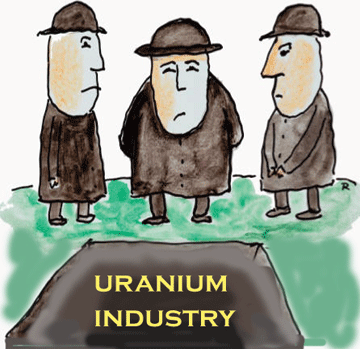 Writing on the wall for Paladin Energy Ltd, y Mike King – December 1, 2016 Uranium miner Paladin Energy Ltd (ASX: PDN) faces the prospect of being unable to repay US$212 million due in April 2017 and being forced into liquidation.
The troubled company has seen its share price slump more than 65% this year alone. The planned sale of 24% of its Langer Heinrich Mine (LHM) to CNNC Overseas Uranium Holdings (COUH) for US$175 million appears unlikely to complete before the end of 2016. Now Paladin has been forced to consider other ‘contingencies’ to repay the 2017 convertible bonds.
Not only that but Paladin also needs to raise working capital as it struggles to generate positive cash flow with uranium prices trading under US$20 per pound – the lowest prices in more than 12 years. As Paladin admits, that’s a level that no producer in the world can sustainably break even, and most producers are experiencing negative cash flows.
That’s a long way away from Paladin’s all-in cash expenditure of extracting uranium of US$38.75 per pound (lb). Even the company’s C1 cash costs of US$25.88/lb are well above the spot price of uranium. Paladin is forecasting all-in costs of around US$30/lb for the 2017 financial year, but it’s clear that even at that level, the company is going backwards.
Energy Resources of Australia Limited (ASX: ERA), majority owned by Rio Tinto Limited(ASX: RIO) faces a similar prospect to Paladin and is likely to shut up shop in 2021, once it has finished processing stockpiles at its Ranger uranium mine.
The problem for uranium miners around the world is that since the Fukushima nuclear incident in 2011, uranium prices have steadily fallen from above US$60/lb to its current price under US$20/lb……
Paladin faces the prospect of sinking into administration unless it can find a white knight willing to take a minority stake in its mine – or make an outright bid for the whole company.
That appears highly unlikely. http://www.fool.com.au/2016/12/01/writing-on-the-wall-for-paladin-energy-ltd/
Entergy’s troubled Palisades nuclear power plant for early shutdown
 Entergy strikes deal with Michigan utility, will shut Palisades nuke plant http://www.theadvocate.com/baton_rouge/news/business/article_40cc55e6-bd4d-11e6-b979-975dba92ca04.html ADVOCATE STAFF REPORT, DEC 8, 2016
Mitsubishi Heavy makes huge and risky investment in AREVA nuclear
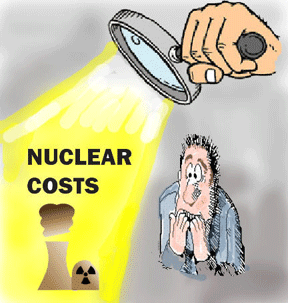
 Mitsubishi Heavy faces tough decisions in nuclear power business Orders dry up at home and abroad after Fukushima disaster, Nikkei Asian Review, 8 Dec 16, TOKYO –– Mitsubishi Heavy Industries and Japan Nuclear Fuel are putting the final touches on a plan to acquire a roughly 10% stake in the troubled French nuclear energy company Areva. But for Mitsubishi Heavy it is an agonizing decision.
Facing dim prospects for new domestic orders, both Mitsubishi Heavy and Japan Nuclear Fuel must find other ways to secure enough business to keep their equipment and workforces active.
Back in 2006, Mitsubishi Heavy partnered with Areva to develop a so-called Generation III+ pressurized-water reactor with state-of-the-art technologies. The team has been using the design to compete with the larger, older-generation pressurized-water systems promoted by two other groups: the team of Hitachi and General Electric, and the team of Toshiba and Westinghouse…….
The French government, which owns nearly 90% of Areva, is looking to cut its losses. Unprofitable businesses are being excised from Areva and a new company is being set up that will seek over 30% of its capital from Japan, China, and elsewhere. …
There are lingering worries inside Mitsubishi Heavy about this huge investment in Areva. To alleviate those concerns, Mitsubishi Heavy has voiced confidence that there will be another nuclear renaissance in 20 to 30 years……http://asia.nikkei.com/Business/Deals/Mitsubishi-Heavy-faces-tough-decisions-in-nuclear-power-business
Mitsubishi takes risk of investing in Areva , hoping to export nuclear reactors
 Mitsubishi Heavy, Japan Nuclear Fuel to invest in struggling Areva http://asia.nikkei.com/Business/Deals/Mitsubishi-Heavy-Japan-Nuclear-Fuel-to-invest-in-struggling-Areva, 7 Dec 16,
Japanese companies eye nuclear power plant exports amid low domestic demend TOKYO — Mitsubishi Heavy Industries and Japan Nuclear Fuel are finalizing plans to invest in French nuclear giant Areva, which is currently in the throes of restructuring.
The two companies will take stakes in Areva to a combined 10% by jointly injecting 40 billion yen to 50 billion yen ($352 million to $440 million) by January 2017.
Along with Mitsubishi Heavy and Japan Nuclear Fuel, China National Nuclear Corp. may also become an investor.
Mitsubishi Heavy has already revealed plans to invest in Areva and a subsidiary while holding talks with the French government and the struggling company over the deal.
Areva has booked significant losses following a series of delays and cancellations to plant-construction projects and now finds itself going through a financial crisis.
German court ruling means only limited scope for utilities to claim compensation
 E.ON sees limited scope for nuclear claims after ruling -Bernstein, Reuters, Dec 8 E.ON sees limited scope for compensation claims following a court ruling related to Germany’s nuclear exit that paves the way for utilities to try to reclaim money, its chief executive told brokerage Bernstein in an interview.
Germany’s highest court on Tuesday ruled that hastening the shutdown of nuclear plants after Japan’s Fukushima disaster violated some of the property rights of utility companies, allowing them to seek limited damages.
It said that utilities could claim back stranded investments made between December 2010 and March 2011 when the government decided to extend the life of nuclear plants. In 2011, the government’s position changed and it decided to shut down all stations by 2022.
E.ON said earlier this week it had invested several hundred million euros in 2010 in the expectation that the government’s nuclear policy would remain unchanged.
“Of this, a low triple digit million amount was likely incurred in the four month period between December 2010 and March 2011, which should be eligible for compensation,” Bernstein quoted CEO Johannes Teyssen as saying.
Germany’s environment minister Barbara Hendricks said this week the court ruling meant demands by utilities for billions of euros in compensation was off the table……http://www.reuters.com/article/germany-nuclear-e-on-idUSL5N1E31FC
Insurance companies losing ability to manage risks, as climate change brings extreme weather events
 Climate change threatens ability of insurers to manage risk Extreme weather is driving up uninsured losses and insurers must use investments to fund global warming resilience, says study,Guardian, Damian Carrington, 7 Dec 1, The ability of the global insurance industry to manage society’s risks is being threatened by climate change, according to a new report.
The report finds that more frequent extreme weather events are driving up uninsured losses and making some assets uninsurable.
The analysis, by a coalition of the world’s biggest insurers, concluded that the “protection gap” – the difference between the costs of natural disasters and the amount insured – has quadrupled to $100bn (£79bn) a year since the 1980s.
Mark Carney, the governor of the Bank of England, warns in the new report that: “Over time, the adverse effects of climate change could threaten economic resilience and financial stability [and] insurers are currently at the forefront.”
The ClimateWise coalition of 29 insurers, including Allianz, Aon, Aviva, Lloyd’s, Prudential, Swiss Re and Zurich, conclude that the industry must use more of its $30tn of investments to help fund increased resilience of society to floods, storms and heatwaves. The Bank of England warned in 2015 that insurance companies could suffer a “huge hit” if their investments in fossil fuel companies were rendered worthless by action on climate change and some insurershave already shed investments in coal.
The ClimateWise report, published on Wednesday, also says the industry must also use its risk management expertise to convince policymakers in both the public and private sector of the urgent need for climate action.
The industry’s traditional response to rising insurance risks – raising premiums or withdrawing cover – would not help deal with the rising risks of global warming, it said.
“The insurance industry’s role as society’s risk manager is under threat,” said Maurice Tulloch, chairman of global general insurance at Aviva and chair of ClimateWise. “Our sector will struggle to reduce this protection gap if our response is limited to avoiding, rather than managing, society’s exposure to climate risk.”
The report said that, since the 1950s, the frequency of weather-related catastrophes has increased sixfold. As climate-related risks occur more often and more predictably, previously insurable assets are becoming uninsurable, or those already underinsured are further compromised, it said.
The economic impact of these natural catastrophes is growing quickly, according to Swiss Re, with total losses increasing fivefold since the 1980s to about $170bn today. ……. https://www.theguardian.com/environment/2016/dec/07/climate-change-threatens-ability-insurers-manage-risk
1 This Month
26 September – International Day for the Total Elimination of Nuclear Weapons





PLEASE OPPOSE HR 8255 AND S.3639 – bills would accelerate satellite deployment, with no environmental review or safeguards – https://ncstd5li.quorum.us/campaign/169331/
To see nuclear-related stories in greater depth and intensity – go to https://nuclearinformation.wordpress.com
-
Archives
- September 2026 (323)
- August 2026 (330)
- July 2026 (355)
- June 2026 (287)
- May 2026 (306)
- April 2026 (356)
- March 2026 (251)
- February 2026 (267)
- January 2026 (308)
- December 2025 (358)
- November 2025 (359)
- October 2025 (375)
-
Categories
- 1
- 1 NUCLEAR ISSUES
- business and costs
- climate change
- culture and arts
- ENERGY
- environment
- health
- history
- indigenous issues
- Legal
- marketing of nuclear
- media
- opposition to nuclear
- PERSONAL STORIES
- politics
- politics international
- Religion and ethics
- safety
- secrets,lies and civil liberties
- spinbuster
- technology
- Uranium
- wastes
- weapons and war
- Women
- 2 WORLD
- ACTION
- AFRICA
- Atrocities
- AUSTRALIA
- Christina's notes
- Christina's themes
- culture and arts
- Events
- Fuk 2022
- Fuk 2023
- Fukushima 2017
- Fukushima 2018
- fukushima 2019
- Fukushima 2020
- Fukushima 2021
- general
- global warming
- Humour (God we need it)
- Nuclear
- RARE EARTHS
- Reference
- resources – print
- Resources -audiovicual
- Weekly Newsletter
- World
- World Nuclear
- YouTube
-
RSS
Entries RSS
Comments RSS

