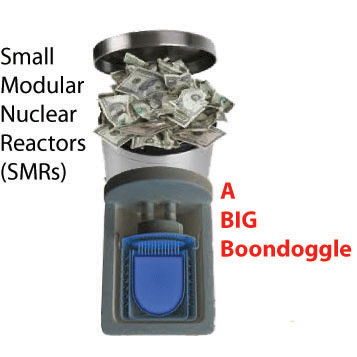
A bunch of American billionaires is trying to save the astronomically expensive nuclear industry – by getting taxpayers to pay for even more astronomically costly “little new nukes”.
Meanwhile in China, France UK, South Korea – and even in America, governments are desperately propping up the super costly “big old nukes’ .
In a world where charlatan Donald Trump can become USA President – the nuclear sales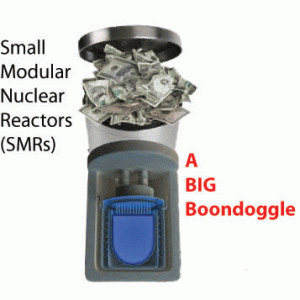 men might well think that any fraud can be perpetrated on the public.
But not for long.
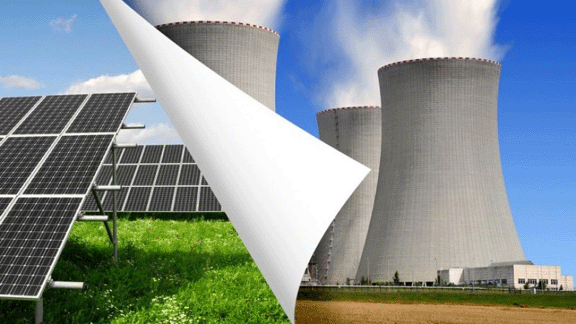
The genuinely clean energy transition is under way world-wide, and becoming ever cheaper.
The “peaceful” nuclear industry is intrinsically linked to the multi $billion nuclear weapons industry. Yet even the nuclear weapons industry is under threat, with the coming UN nuclear disarmament conference.
Even if concern for the public good does not stop the toxic nuclear industry – the unaffordable economic costs eventually will
January 21, 2017
Posted by Christina Macpherson |
business and costs, Christina's themes |
Leave a comment
6.4 million Americans now work in the traditional energy and the energy efficiency sector, which added more than 300,000 net new jobs in 2016, or 14 percent of the nation’s job growth.
“This report verifies the dynamic role that our energy technologies and infrastructure play in a 21st century economy,” said DOE Senior Advisor on Industrial and Economic Policy David Foster. “Whether producing natural gas or solar power at increasingly lower prices or reducing our consumption of energy through smart grids and fuel efficient vehicles, energy innovation is proving itself as the important driver of economic growth in America, producing 14 percent of the new jobs in 2016.”
The solar industry is particularly shining bright.
“Proportionally, solar employment accounts for the largest share of workers in the Electric Power Generation sector,” the report, released on Jan. 13, states. “This is largely due to the construction related to the significant buildout of new solar generation capacity.” Overall, the U.S. solar workforce increased 25 percent in 2016.
According to the report, solar—both photovoltaic and concentrated—employed almost 374,000 workers in 2016, or 43 percent of the Electric Power Generation workforce. This is followed by fossil fuels, which accounts for 22 percent of total Electric Power Generation employment, or 187,117 workers across coal, oil and natural gas generation technologies.
Wind generation is seeing growth in employment with a 32 percent increase since 2015. The wind industry provides the third largest share of Electric Power Generation employment with 102,000 workers at wind firms across the nation.
The reason behind this growth in the solar sector is due to the high capacity additions in both distributed and utility-scale photovoltaic solar, the report said. In fact, construction and installation projects represented the largest share of solar jobs, with almost four in ten workers doing this kind of work, followed by workers in solar wholesale trade, manufacturing and professional services.
In a sign of promise for the booming industry, solar employers reported that they expect to increase employment by 7 percent this year.
Solar is becoming the cheapest form of electricity production in the world, according to statistics from Bloomberg New Energy Finance. Last year was the first time that the renewable energy technology out-performed fossil fuels on a large scale.
January 20, 2017
Posted by Christina Macpherson |
employment, renewable, USA |
Leave a comment
 Toshiba shares crash as nuclear writedown crisis deepens Shares in Toshiba have dived 16% on reports that the embattled Japanese conglomerate faces bigger losses at its US nuclear power business. BBC News 19 Jan 17
It is feared Toshiba may have to write down the value of the unit by a larger-than-expected 700bn yen ($6.1bn; £5bn).
There are unconfirmed reports Toshiba is seeking aid from the government-backed Development Bank of Japan (DBJ).
Toshiba said the exact writedown figure was not finalised, and declined to comment on any DBJ approach.
The laptops-to-hydro power giant was plunged into crisis late last year when it emerged it faced huge cost overruns on projects handled by a newly-bought company that builds US nuclear power plants. ……. on 27 December Toshiba admitted that it faced writedowns of “several billion dollars”. The company later indicated that the size of the writedowns would be between $1bn and $4.5bn.
Toshiba’s nuclear services business brings in about one-third of the industrial giant’s revenue.
The share price, down 26% at one stage on Thursday, is now 50% lower than when the writedown revelations emerged amid fears that the company still has no firm grip on the final costs………http://www.bbc.com/news/business-38674697
January 20, 2017
Posted by Christina Macpherson |
business and costs, Japan |
Leave a comment
 “Our analysis suggests that solar could now infringe on gas’ market share and in some cases challenge its peak margins, and that gas and renewables collectively will continue to gain market share at the expense of coal and nuclear,”
Levelized cost of energy survey shows wind, natural gas cementing economic edge SNL, 06 January 2017 By Lucas Bifera
A survey of levelized cost of energy, or LCOE, studies illustrates that onshore wind and combined-cycle gas have secured their place as the lowest-cost energy resources, with utility-scale solar not far behind.
Often used as a barometer for estimating the cost at which certain generation technologies can be deployed on an economic basis, LCOE has become a mainstay for policymakers, analysts and industry groups as a reference when comparing costs and benefits of various technologies on the grid.
Incumbent technologies like combined-cycle gas, onshore wind, utility-scale solar photovoltaic, nuclear and coal are uniformly included in studies…….the emergence of a cluster around onshore wind and combined-cycle gas across the different studies indicates an economic consensus, one that highlights the cost effectiveness of renewables on an unsubsidized basis and role of combined-cycle gas as the preeminent baseload resource.
“The demands of a developed economy will continue to require both traditional and alternative energy sources as the technologies driving renewable energy evolve,” observed George Bilicic, vice chairman and global head of power, energy & infrastructure group at Lazard, an investment bank that releases a widely-cited LCOE study each year.
But on an unsubsidized basis, renewables remain competitive across all studies, and in the case of the Bloomberg New Energy Finance analysis, wind resources in Texas have become the cheapest source of power across North and South America, consistent with Lazard’s finding that wind has a low end range of $32/MWh in the Midwest and $36/MWh in Texas.
“Wind capital costs will go up because they are building higher towers, but LCOE values will fall because they have better capacity factors,” said Josh Rhodes, postdoctoral fellow at the Webber Energy Group and co-author of a study from The University of Texas at Austin’s Energy Institute.
“I think we will see a major deployment of solar and wind to come online by [the end of] 2019 in order to take advantage of the full ITC and PTC,” Rhodes noted, looking outward.
Onshore wind and utility-scale solar additions appear poised to outstrip additions of natural-gas fired ……… the Energy Information Administration’s recent 2017 Annual Energy Outlook, which projects that between 2018 and 2022, as much as 54.2 GW of wind could come online, in addition to 13.4 GW of solar photovoltaic capacity.
Combined, that projected capacity is more than 40 times the amount of projected advanced natural gas-fired capacity projected in the same study, which EIA estimates at 1.6 GW.
“Our analysis suggests that solar could now infringe on gas’ market share and in some cases challenge its peak margins, and that gas and renewables collectively will continue to gain market share at the expense of coal and nuclear,” Guggenheim added. http://www.snl.com/web/client?auth=inherit&mkt_tok=eyJpIjoiWlRsaU0yUXhZMkV3TnpjNCIsInQiOiJGZnRMT045UWllTkRYNzZsSDE1YWFJMXE0M0lQU2F1QnN6Z25jM2hoZlFpNDhwNFFSRzIyTnI1cDdyUW14c2hKXC9keStFV2JvenljcVVFT2Ztc3gxck12WElPXC9WMGVlQWNMbjNJcklpalltM01OTUN2ckRsQktyWlFLTFRcL0VrVyJ9#news/ar
January 14, 2017
Posted by Christina Macpherson |
business and costs, renewable, USA |
Leave a comment

 How Did 2016 Fare For U.S. Energy Employment?
According to the DOE’s second annual report tracking these employment trends, 6.4 million Americans now work in the “traditional energy and energy efficiency industries,” which added over 300,000 net new jobs in 2016 – representing 14% of the nation’s job growth. The report describes “traditional energy” jobs as those in “electric power generation and fuels” and “transmission, distribution and storage,” both of which include include “fossil, nuclear, and renewable energy sources and their value chains,” the report explains. In addition, “energy efficiency” jobs are described as those covering the “production of energy-saving products and the provision of services that reduce end-use energy consumption.” The report notes that energy efficiency jobs increased by 133,000 jobs for a total of 2.2 million.
The agency says its “2017 U.S. Energy and Employment Report (USEER)” uses information from surveys to over 30,000 employees in energy sectors and tracks “dramatic growth” in several key sectors of the U.S. economy in 2016. The report also uses secondary data from the U.S. Department of Labor.
For wind power specifically, the industry employs a total of 101,738 workers, which represents a 32% increase since 2015, the report says. The largest share of wind employment lies in construction, which accounts for 37% of the workforce. Manufacturing and wholesale trade follow at 29% and 14%, respectively.
“Wind means opportunity and job security for over 100,000 Americans,” comments Tom Kiernan, CEO of the American Wind Energy Association. “The Department of Energy’s new jobs data underscore the incredible impact of wind power in creating American jobs. Wind workers directly contribute to our nation’s energy independence and economic success story. We’re especially proud of helping America’s veterans find well paying jobs after their service – employing them at a rate that is 50 percent higher than the national average.”
For solar, the report says U.S. Department of Labor data does not adequately capture the true employment numbers: The data “dramatically underestimates” how many workers are employed in the solar sector, which, the DOE report says, includes 373,807 Americans who “spend some portion of their time working to install, distribute or provide professional services to solar technologies.” Like wind, construction/installation represents the biggest employment share, followed by “wholesale trade, manufacturing and professional services.”
“This report verifies the dynamic role that our energy technologies and infrastructure play in a 21st-century economy,” says David Foster, the DOE’s senior advisor on industrial and economic policy. “Whether producing natural gas or solar power at increasingly lower prices or reducing our consumption of energy through smart grids and fuel-efficient vehicles, energy innovation is proving itself as the important driver of economic growth in America, producing 14 percent of the new jobs in 2016.”
USEER examines four sectors of the economy – electric power generation and fuels; transmission, wholesale distribution and storage; energy efficiency; and motor vehicles – which cumulatively account for almost all of the U.S.’ energy production and distribution system and roughly 70% of U.S. energy consumption, according to the DOE.
By looking at such a wide portion of the energy economy, the agency says, USEER can provide the public and policymakers with a clearer picture of how changes in energy technology, systems and usage are affecting the economy and creating or displacing jobs……… The full report can be found here. http://nawindpower.com/how-did-2016-fare-for-u-s-energy-employment
January 14, 2017
Posted by Christina Macpherson |
employment, renewable, USA |
Leave a comment
 U.S. Nuclear Power Plants Continue To Close, Oil Price, By Nick Cunningham – Jan 12, 2017, “…….The situation is emblematic of an unfolding drama across the country as the nation’s nuclear power plants near retirement. The bulk of the 100 or so nuclear power plants in the U.S. were constructed in the 1960s and 1970s, all of which were granted a standard 40-year license to operate. Many of those have expired or are nearing expiration, and the bulk of them have been granted 20-year license extensions. With dozens of reactors now a decade or so away from hitting their 60-year birthdays, the U.S. is faced with a dilemma of whether to shut them down or extend their lifespans by yet another 20 years.
While the New York government supported reactors elsewhere in the state, they resisted Indian Point because of its proximity to the city. Entergy ultimately conceded, as the company is in the midst of ridding itself of nuclear reactors in the north and is instead focusing on regulated markets in the south.
In fact, Entergy disputed Gov. Cuomo’s influence, citing cheap natural gas as a significant factor in its decision to shut down the plant. But Gov. Cuomo and the state’s attorney general resisted granting Entergy a 20-year license extension on Indian Point. Entergy spent $200 million over the past decade in legal fees trying to obtain a new license, to no avail……..
Gov. Cuomo is now aggressively pushing offshore wind, and is targeting 2.4 GW of offshore wind capacity by 2030. The first down payment on that target is a 90-megawatt project off the coast of Long Island, which he is supporting. However, those projects will take years to come online even under the most optimistic circumstances, raising fears of a gap in power supply…..
Environmental groups are more confident. “Hats off to the Cuomo Administration and New York leaders for planning to shut down another nuclear plant and replacing it with clean energy,” Anna Aurilio, director of Environment America’s Global Warming Solutions Program, said in a statement. “There’s more than enough renewable energy projects in the pipeline to replace Indian Point.” Offshore wind could be complemented by onshore wind, solar, and energy efficiency. If New York fails to fill the gap left by Indian Point with renewables, the state can still import hydropower from Quebec.
Indeed, New York is unfazed. The state recently implemented a tighter renewable portfolio standard that requires utilities to source 50 percent of their electricity from renewable sources by 2030, one of the most aggressive in the nation. Gov. Cuomo also announced this week that New York will cut greenhouse gas emissions by an additional 30 percent below 2020 levels by 2030, tightening the requirements under the Regional Greenhouse Gas Initiative (RGGI), a regional cap-and-trade program between Mid-Atlantic and Northeastern states. Gov. Cuomo is going all-in on renewables in an effort that has raised questions regarding his presidential aspirations in 2020.
Indian Point is just one power plant, but it is indicative of the eroding position of nuclear power. Only a handful of new nuclear reactors are under construction, and despite the hype of a “nuclear renaissance,” even the newest models are facing lengthy delays and cost overruns, a longstanding problem for the industry. Meanwhile, existing nuclear reactors are getting picked off, one by one.
Whether it will be solar, wind or natural gas, the one thing that is clear is that nuclear power will increasingly give way to alternatives.http://oilprice.com/Alternative-Energy/Nuclear-Power/US-Nuclear-Power-Plants-Continue-To-Close.html
January 14, 2017
Posted by Christina Macpherson |
business and costs, USA |
Leave a comment
Nuclear power producers want government-mandated long-term contracts or other mechanisms that require customers to buy power from their troubled units at prices far higher than they would pay otherwise.
In California and in Nebraska, utilities plan to replace nuclear plants that are closing early for economic reasons almost entirely with electricity from carbon-free sources. Such transitions are achievable in most systems as long as the shutdowns are planned in advance to be carbon-free.
We should not rely further on the unfulfilled prophesies that nuclear lobbyists have deployed so expensively for so long.

 Should troubled nuclear reactors be subsidized? http://bangordailynews.com/2017/01/13/the-point/compete-or-suckle-should-troubled-nuclear-reactors-be-subsidized/ By Peter Bradford, The Conversation
Since the 1950s, U.S. nuclear power has commanded immense taxpayer and consumer subsidy based on promises of economic and environmental benefits. Many of these promises are unfulfilled, but new ones take their place and more subsidies follow.
Today, the nuclear industry claims that keeping all operating reactors running for many years, no matter how uneconomic they become, is essential in order to reach U.S. climate change targets.
Economics have always challenged U.S. reactors. After more than 100 construction cancellations and cost overruns costing up to $5 billion apiece, Forbes magazine in 1985 called nuclear power “the greatest managerial disaster in business history … only the blind, or the biased, can now think that most of the money [$265 billion by 1990] has been well spent.” U.S. Atomic Energy Commission Chair Lewis Strauss’ 1954 promise that electric power would be “ too cheap to meter” is today used to mock nuclear economics, not commend them.
As late as 1972, the Atomic Energy Commission forecast that the U.S. would have 1,000 power reactors by the year 2000. Today, we have 100 operating power reactors, down from a peak of 112 in 1990. Since 2012, power plant owners have retired five units and announced plans to close nine more. Four new reactors are likely to come on line. Without strenuous government intervention, almost all of the rest will close by midcentury. Because these recent closures have been abrupt and unplanned, the replacement power has come in substantial part from natural gas, causing a dismaying uptick in greenhouse gas emissions.
The nuclear industry, led by the forlornly named lobbying group Nuclear Matters, still obtains large subsidies for new reactor designs that cannot possibly compete at today’s prices. But its main function now is to save operating reactors from closure brought on by their own rising costs, by the absence of a U.S. policy on greenhouse gas emissions and by competition from less expensive natural gas, carbon-free renewables and more efficient energy use.
Only billions more dollars in subsidies and the retarding of rapid deployment of cheaper technologies can save these reactors. Only fresh claims of unique social benefit can justify such steps.
When I served on the U.S. Nuclear Regulatory Commission from 1977 through 1982, it issued more licenses than in any comparable period since. Arguments that the U.S. couldn’t avoid dependence on Middle Eastern oil and keep the lights on without a vast increase in nuclear power were standard fare then and throughout my 20 years chairing the New York and Maine utility regulatory commissions. In fact, we attained these goals without the additional reactors, a lesson to remember in the face of claims that all of today’s nuclear plants are needed to ward off climate change.
Nuclear power in competitive electricity markets
During nuclear power’s growth years in the 1960s and 1970s, almost all electric utility rate regulation was based on recovering the money necessary to build and run power plants and the accompanying infrastructure. But in the 1990s, many states broke up the electric utility monopoly model.
Now a majority of U.S. power generation is sold in competitive markets. Companies profit by producing the cheapest electricity or providing services that avoid the need for electricity.
To justify their current subsidy demands, nuclear advocates assert three propositions. First, they contend that power markets undervalue nuclear plants because they do not compensate reactors for avoiding carbon emissions or for other attributes such as diversifying the fuel supply or running more than 90 percent of the time.
Second, they assert that other low-carbon sources cannot fill the gap because the wind doesn’t always blow and the sun doesn’t always shine. So power grids will use fossil-fired generators for more hours if nuclear plants close.
Finally, nuclear power supporters argue that these intermittent sources receive substantial subsidies while nuclear energy does not, thereby enabling renewables to underbid nuclear even if their costs are higher.
Nuclear power producers want government-mandated long-term contracts or other mechanisms that require customers to buy power from their troubled units at prices far higher than they would pay otherwise.
Providing such open-ended support will negate several major energy trends that currently benefit customers and the environment. First, power markets have been working reliably and effectively. A large variety of cheaper, more efficient technologies for producing and saving energy, as well as managing the grid more cheaply and cleanly, have been developed. Energy storage, which can enhance the round-the-clock capability of some renewables is progressing faster than had been expected, and it is now being bid into several power markets — notably the market serving Pennsylvania, New Jersey and Maryland.
Long-term subsidies for uneconomic nuclear plants also will crowd out penetration of these markets by energy efficiency and renewables. This is the path New York has taken by committing at least $7.6 billion in above-market payments to three of its six plants to assure that they operate through 2029.
Nuclear power versus other carbon-free fuels While power markets do indeed undervalue low-carbon fuels, all of the other premises underlying the nuclear industry approach are flawed. In California and in Nebraska, utilities plan to replace nuclear plants that are closing early for economic reasons almost entirely with electricity from carbon-free sources. Such transitions are achievable in most systems as long as the shutdowns are planned in advance to be carbon-free.
In California, these replacement resources, which include renewables, storage, transmission enhancements and energy efficiency measures, will for the most part be procured through competitive processes. Indeed, any state where a utility threatens to close a plant can run an auction to ascertain whether there are sufficient low-carbon resources available to replace the unit within a particular time frame. Only then will regulators know whether, how much and for how long they should support nuclear units.
If New York had taken this approach, each of the struggling nuclear units could have bid to provide power in such an auction. They might well have succeeded for the immediate future, but some or all would probably not have won after that.
Closing the noncompetitive plants would be a clear benefit to the New York economy. This is why a large coalition of big customers, alternative energy providers and environmental groups opposed the long-term subsidy plan.
The industry’s final argument — that renewables are subsidized and nuclear is not — ignores overwhelming history. All carbon-free energy sources together have not received remotely as much government support as has flowed to nuclear power.
Nuclear energy’s essential components — reactors and enriched uranium fuel — were developed at taxpayer expense. Private utilities were paid to build nuclear reactors in the 1950s and early 1960s, and received subsidized fuel. According to a study by the Union of Concerned Scientists, total subsidies paid and offered to nuclear plants between 1960 and 2024 generally exceed the value of the power that they produced.
The U.S. government also has pledged to dispose of nuclear power’s most hazardous wastes — a promise that has never been made to any other industry. By 2020, taxpayers will have paid some $21 billion to store those wastes at power plant sites.
Furthermore, under the 1957 Price-Anderson Act, each plant owner’s accident liability is limited to some $300 million per year, even though the Fukushima disaster showed that nuclear accident costs can exceed $100 billion. If private companies that own U.S. nuclear power plants had been responsible for accident liability, they would not have built reactors. The same is almost certainly true of responsibility for spent fuel disposal.
Finally, as part of the transition to competition in the 1990s, state governments were persuaded to make customers pay off some $70 billion in excessive nuclear costs. Today, the same nuclear power providers are asking to be rescued from the same market forces for a second time.
Christopher Crane, the president and CEO of Exelon, which owns the nation’s largest nuclear fleet, preaches temperance from a bar stool when he disparages renewable energy subsidies by asserting, “I’ve talked for years about the unintended consequences of policies that incentivize technologies versus outcomes.“
But he’s right about unintended and unfortunate consequences. We should not rely further on the unfulfilled prophesies that nuclear lobbyists have deployed so expensively for so long. It’s time to take Crane at his word by using our power markets, adjusted to price greenhouse gas emissions, to prioritize our low carbon outcome over his technology.
Peter Bradford is a the former chair of the Maine’s Public Utilities Commission and former U.S. Nuclear Regulatory commissioner. He also is on the board of the Union of Concerned Scientists. This piece was originally published on TheConversation.com.
January 14, 2017
Posted by Christina Macpherson |
business and costs, politics, Reference, USA |
Leave a comment
 Russia extends $11.38 bln loan to Bangladesh to build nuclear power plant http://tass.com/economy/925025 January 13 Bangladesh will repay the actually spent loan in equal six-month installments over a twenty year period MOSCOW, January 13. /TASS/. Russia’s government has extended a $11.38 billion loan to Bangladesh to build the Rooppur nuclear power plant. The relevant document was published on the government’s website containing legal information.
According to the draft inter-governmental agreement, the loan will be used from 2017 to 2024. Bangladesh will repay the actually spent loan in equal six-month installments over a twenty year period. The first installment will be paid out on March 15, 2017.
Two units of the Rooppur nuclear power plant, with a capacity of 1,200 MW each, which are being built with Russia’s assistance, are planned to be put into operation in 2022 and 2023.
In mid-December 2015, Russia’s Rosatom State Atomic Energy Corporation signed an EPC contract for a nuclear power plant in Bangladesh.
The construction work is being done in accordance with the inter-governmental agreement on cooperation in building a nuclear power plant in Bangladesh, dated 2011. The nuclear power plant will be located on the eastern bank of the Ganges River, 160 kilometers from the country’s capital of Dhaka.
January 14, 2017
Posted by Christina Macpherson |
ASIA, marketing, Russia |
Leave a comment
EU clears French rescue of troubled nuclear firm Areva http://www.business-standard.com/article/pti-stories/eu-clears-french-rescue-of-troubled-nuclear-firm-areva-117011001343_1.html AFP | Brussels January 10, 2017 EU anti-trust regulators today cleared the French government’s massive restructuring of troubled state-owned nuclear reactor builder Areva.
Problem-prone Areva, which is 87-per cent owned by the French state, has faced severe difficulties since 2011, when the Fukushima disaster in Japan called nuclear power generation into question across the world.
In April, Paris notified the
EU Commission of an big restructuring plan to save the national champion that included a massive payout from public coffers.
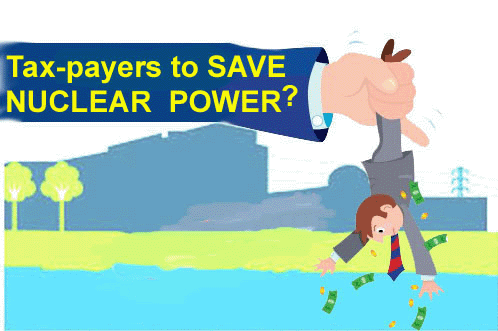
“The European Commission has concluded that French plans to grant a capital injection of 4.5 billion euros (USD 4.75 billion) to Areva are in line with EU state aid rules,” a statement said.
The Commission added that other regulatory decisions were still needed, including a greenlight by the EU on the buyout of Areva’s reactor business by EDF, the French state-owned electricity supplier. Areva’s woes were compounded by construction problems affecting its first EPR reactor in Finland — now expected to open nine years late in 2018 — putting company finances deep into the red.
In addition, Areva’s former CEO Anne Lauvergeon has been charged in a case linked to the company’s disastrous 2007 purchase of a Canadian uranium mining firm.
EDF, also majority-owned by the French state, agreed in June 2015 to purchase up to 75 per cent of Areva’s reactor unit at a valuation of around 2.7 billion euros, with the deal expected to be finalised in 2017.
France sees nuclear energy as a key national industry and the government has been closely involved in talks to restructure the sector.
The French state has already poured in billions to keep Areva afloat and thousands of French workers in their jobs.
January 14, 2017
Posted by Christina Macpherson |
business and costs, EUROPE, politics |
Leave a comment
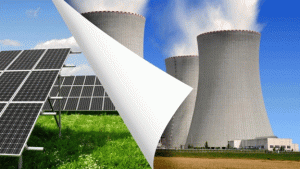
Delays of years in construction times and the doubling of costs, are the new normal, while the prices of low-carbon alternatives, wind and solar, which can be deployed in weeks rather than decades, have continued to fall. It is now clear that solar farms and wind turbines produce cheaper power than new nuclear will ever be able to. In some cases even old nuclear stations are so costly to run that new wind and solar are cheaper.
 Nuclear Revival Looks Bleak as Solar and Wind Costs Continue to Drop http://www.ecowatch.com/nuclear-revival-bleak-2188785870.html Climate News Network By Paul Brown, 12 Jan 17
The prospects for expansion of the nuclear industry worldwide look worse in 2017 than at any time since the first atom stations were built in the 1950s.
Toshiba, the giant Japanese company that owns the American reactor designer Westinghouse, is the latest company to face financial difficulties due to unforeseen cost overruns and delays that run into billions of dollars.
Westinghouse Electric’s troubles began after it bought construction contractor CB&I Stone & Webster and then had to write down the value of the acquisition by billions of dollars because of problems with building four new reactors for U.S. utilities.
Nuclear Problems
Électricité de France (EDF), the French company with ambitious plans to build four nuclear reactors in Britain, is in ever-deepening financial difficulties because it has failed to build new stations on time or on budget at Olkiluoto, Finland and Flamanville, in France. It is also embroiled in an ongoing scandal over faulty reactor parts.
Even Rosatom, the state-owned Russian company, keen to expand sales outside its own borders, is pegging back on its building plans at home. Alexander Lokshin, the first deputy director general, said on the company’s website that, because forecasts of energy use growth in Russia have proved to be inaccurate, the company had settled for life extensions of existing plants rather than a large program of building new ones.
While China and India continue to press ahead with nuclear projects, both countries are putting ever-greater effort into renewables, which provide much quicker returns. China has cut back on nuclear plans, but is continuing to build both its own home-grown designs and two reactors of EDF’s new design, which are still under construction although they should already be in operation.
South Korea seems to be the one bright spot for the industry. It now has 25 working reactors and is building more—including exporting four to be built at Barakah in the United Arab Emirates.
So while there are still plenty of reactors planned or under construction, they appear to be running late and over budget or are in countries where state ownership and subsidy props up the industry and disguises its flaws.
The industry is in most trouble in countries where nuclear has to compete on price with renewables and gas. Raising enough capital to build a nuclear station at market rates is no longer possible without state subsidy. In the European Union and the U.S., where a “free market” in electricity is supposed to prevail, government moves to boost the nuclear industry are increasingly controversial.
However, there are unlikely to be any bankruptcies. The governments of Japan, France and Britain will bail out these flagship companies because they employ far too many voters to let them fail. In addition, closing existing nuclear stations rapidly is technically difficult and would cause serious blackouts in France and possibly some neighboring countries.
But hopes of a nuclear renaissance now appear to be a pipe dream. This is partly because western companies have apparently failed to design new nuclear power stations that can be built on time and on budget.
Delays of years in construction times and the doubling of costs, are the new normal, while the prices of low-carbon alternatives, wind and solar, which can be deployed in weeks rather than decades, have continued to fall. It is now clear that solar farms and wind turbines produce cheaper power than new nuclear will ever be able to. In some cases even old nuclear stations are so costly to run that new wind and solar are cheaper.
Future of the Industry
The outcome of all this financial turmoil for the future of the industry is difficult to predict. It is probable that stations long under construction in the U.S., Finland, France and China, and due to be finished in the next two years, will be completed if no new technical problems arise. Starting them up will probably be a political rather than an economic decision.
But whether these companies embark on planned new constructions is the real issue. EDF continues with plans to build four European Pressurised Reactors in England, two at Hinkley Point in western England, which are supposed to be completed by 2025, and two more at Sizewell, east of London, where plans are still at the consultation stage. How the deeply indebted company will raise the finance for these projects is not clear.
Toshiba’s financial plight puts another British project, the plan to build three Westinghouse AP1000 reactors in north-west England, in jeopardy. With the company’s debts close to its value in equity, the company credit rating has been lowered. It is hard to see who will put up the enormous capital required to finance the building of three new reactors with designs that already have a dubious record on building times and cost overruns.
These seven giant reactor projects are the first of 10 planned for Britain. So far there has not been the slightest hint from either the companies or the UK government that the plans might need revision. Time will tell whether anyone will come up with the $50 billion in capital needed to build them.
January 13, 2017
Posted by Christina Macpherson |
2 WORLD, business and costs, renewable |
Leave a comment
 Global Photovoltaic Installation Market to Grow Nearly 11% through 2018 http://www.solarnovus.com/global-photovoltaic-installation-market-to-grow-nearly-11-through-2018_N10603.html 12 January 2017– Transparency Market Research announces the release of a new report titled “Solar Photovoltaic (PV) Installation Market Global Industry Analysis, Size, Share, Growth, Trends and Forecast, 2012 2018”. According to the report, the global solar photovoltaic installation market is anticipated to expand at a 10.70% CAGR from 2012 to 2018 to reach a value of US$145.9 bn by 2018.
Solar photovoltaic is an excellent source of renewable energy that presents higher efficiency output. This is a key factor driving the solar photovoltaic installation market. In addition, wide range of applications in different sectors, the rising awareness regarding the reduction of carbon footprint, government initiatives and schemes, low cost of installation and maintenance, and constantly evolving technologies have also driven the global solar photovoltaic installation market over the years. Asia Pacific presents strong potential for growth, according to the report. On the down side, limited life of batteries, wet climate in certain regions deteriorating the quality of solar panels, revised feed in tariffs, irregular intensities of solar radiations, and oversupply conditions in certain regions are some of the major challenges that the solar photovoltaic installation market faces.
In order to give readers a better understanding of the scope and dynamics of the solar photovoltaic installation market, the report studies the overall market by segmenting it on the basis of grid type, application, technology, and geography. Based on grid type, the solar photovoltaic installation market is bifurcated into off-grid solar PV and grid-connected solar PV. By technology, the market is segmented into thin film solar PV, crystalline silicon solar PV, and others such as organic solar PV and concentrator PV.
On the basis of application, the solar photovoltaic installation market is categorized into utility scale, commercial, and residential solar PV systems. The use of solar photovoltaic installations in the commercial and residential sectors has risen substantially over the past few years, with major installations in hotels, offices, and hospitals.Geographically, the global solar photovoltaic installation market is divided into Europe, the Middle East, and Africa (EMEA), Asia Pacific, North America, and the Rest of the World. Europe currently dominates the worldwide solar photovoltaic installation market. Asia Pacific is anticipated to witness considerable growth over the next three years owing to rising demand for solar PV systems in countries such as Japan, China, and India.
The research report features a detailed section on the competitive landscape of the solar photovoltaic installation market. Key players are identified and reviewed based on key criteria such as business overview, financial standing, recent developments, and business strategies. With the help of SWOT analysis, the strengths, weaknesses, opportunities, and threats of the major players are discussed. In addition, Porter’s Five Forces give readers a clear understanding of the impact of buyers, suppliers, competitors, substitutes, and new entrants on the overall vendor landscape.
The noteworthy players competing in the global solar photovoltaic installation market include Yingli Green Energy Holding Co. Ltd., Solar World AG, Trina Solar Ltd., Sun Power Corporation, Suntech Power Holding Co. Ltd., Jinko Solar Holding Company Ltd. Corporation, Schott Solar AG, Canadian Solar Inc., First Solar Inc., Solar Frontier Ltd., and Sharp Corporation.
January 13, 2017
Posted by Christina Macpherson |
2 WORLD, business and costs, renewable |
Leave a comment
Toshiba Loses Billions On U.S. Nuclear Write-Offs http://oilprice.com/Alternative-Energy/Nuclear-Power/Toshiba-Loses-Billions-On-US-Nuclear-Write-Offs.html By Leonard Hyman & William Tilles – Jan 11, 2017 As a sort of financial casino, Wall Street permits its customers to indulge in all sorts of financial risk. Short selling, for example, betting on a stock’s decline as opposed to its rise. If you short at $10 and it goes to $2? Awesome. If it instead goes the other way, from $2 to $10, you just lost 5 times your principal.
But how can you lose several billion dollars, or ten times your principal investment, on a U.S. asset that you bought for $220 plus million? That’s the question that Toshiba executives are asking themselves.
The goodwill write off triggering this financial commotion relates to cost overruns at two U.S. nuclear construction sites, V.C Sumner and Vogtle in Georgia.
Toshiba, a titan of Japanese industry and owner of Westinghouse Electric dropped a bombshell on the stock market at the end of December and its stock fell by one third. The bond agencies cut Toshiba’s ratings, analysts wondered if the company would have any equity left and sources claimed that Toshiba was thinking of selling its most valuable subsidiary in order to fill the hole in its balance sheet.
This announcement comes in the wake of a previous accounting scandal in which Toshiba was accused of inflating profits. After that, Toshiba seemed ready to raise more equity capital but held off. Now it looks as if the company will have to raise more money on even more dilutive terms for existing shareholders.
What prompted the sudden announcement and what does that announcement mean to the nuclear sector? Let’s go back to 2015. In that year, Toshiba’s Westinghouse subsidiary bought Stone & Webster (S&W), the nuclear construction and services company, from Chicago Bridge & Iron (CBI). It paid $229 million in cash for S&W, and estimated that goodwill, subject to writeoff, was under $87 million, with that number to be determined by December 31, 2016. Near the end of December, Westinghouse informed its corporate parent, Toshiba that “the cost to complete U.S. projects will far surpass the original estimates…leading to a possible recognition of goodwill far exceeding the original…estimate…current estimation shows a level of…several billion U.S. dollars….”
Toshiba is one of a handful of nuclear engineering and manufacturing firms in the world. Its Westinghouse unit produces one of the approved designs (AP 1000) for U.S. construction. Toshiba also owns one of the nuclear construction sites in the UK. If a firm of this size and expertise is surprised by the cost of nuclear construction, that is not a good sign.
But from a financial perspective, if a firm of Toshiba’s size, and one of the premier nuclear engineering firms in the world, is in financial straits due to nuclear overruns, just how big and how accurate in project costing does a firm need to be to take on the risks of nuclear construction? Due to the size of the projects, no small firm can ever take them on. But will the point come when not even large firms execute a nuclear project unless an even larger entity, such as the federal government or the ratepayers over a wide area, guarantees payment of all cost overruns?
Toshiba’s difficulties may reverberate beyond Tokyo’s financial district. They call into question the ability of the most expert of firms to evaluate the risks of what has become bespoke nuclear construction. That will raise costs for new nuclear power since paying a return “of and on” capital is still its biggest cost.
January 13, 2017
Posted by Christina Macpherson |
business and costs, Japan, USA |
Leave a comment
France, which owns 87% of Areva, said it would offer €4.5 per Areva SA share to minority investors which include Kuwait’s investment fund and French energy group Total Paris: France will buy out minority shareholders in Areva and delist the troubled nuclear group, the government said on Wednesday as talks with potential investors in a new nuclear fuel company being spun out of Areva neared a conclusion.
The state, which owns 87% of Areva, said it would offer €4.5 per Areva SA share to minority investors which include Kuwait’s investment fund, French utility EDF and French energy group Total.
Areva’s shares have fallen by as much as 90% from their 2007 highs as the group chalked up repeated losses. The stock was suspended on Tuesday at €5.2.
European Union (EU) antitrust regulators approved the French government’s plan to inject €4.5 billion ($4.8 billion) into Areva on Tuesday, saying the rescue would not unduly distort competition.
The ruling will allow Areva, whose capital has been wiped out by years of losses, to restart as a smaller firm focused on uranium mining and nuclear fuel production and recycling.
Legacy Areva SA—the firm left over after this split and the sale of Areva’s reactor unit to state-controlled EDF—will get a €2 billion capital increase and will hold the liabilities related to the troubled Olkiluoto 3 project in Finland, which has been hit by delays.
Areva said negotiations with unspecified investors in the new company were being finalised. It said last month that two investors have made a €500 million ($526.40 million) offer for a combined 10% stake in the new entity.
Paris: France will buy out minority shareholders in Areva and delist the troubled nuclear group, the government said on Wednesday as talks with potential investors in a new nuclear fuel company being spun out of Areva neared a conclusion.
The state, which owns 87% of Areva, said it would offer €4.5 per Areva SA share to minority investors which include Kuwait’s investment fund, French utility EDF and French energy group Total.
Areva’s shares have fallen by as much as 90% from their 2007 highs as the group chalked up repeated losses. The stock was suspended on Tuesday at €5.2.
European Union (EU) antitrust regulators approved the French government’s plan to inject €4.5 billion ($4.8 billion) into Areva on Tuesday, saying the rescue would not unduly distort competition.
The ruling will allow Areva, whose capital has been wiped out by years of losses, to restart as a smaller firm focused on uranium mining and nuclear fuel production and recycling.
Legacy Areva SA—the firm left over after this split and the sale of Areva’s reactor unit to state-controlled EDF—will get a €2 billion capital increase and will hold the liabilities related to the troubled Olkiluoto 3 project in Finland, which has been hit by delays.
Areva said negotiations with unspecified investors in the new company were being finalised. It said last month that two investors have made a €500 million ($526.40 million) offer for a combined 10% stake in the new entity.
A person familiar with the situation said the two investors are Japan’s Mitsubishi Heavy Industries and JNFL. Talks are continuing with China’s National Nuclear Corporation about also taking a minority stake.
“These talks are continuing and focus on governance issues, and on the issue of the balance between the different third-party investor parties,” French industry minister Christophe Sirugue told Reuters in an interview.
Sirugue, who said he had discussed the governance issue with Chinese vice-premier Ma Kai during his visit to France in November, added that the make-up of the board of the new company is another important issue in the talks. Reuters
January 13, 2017
Posted by Christina Macpherson |
business and costs, France, politics |
Leave a comment
 Generators call New York nuclear subsidies an ‘existential threat’ to wholesale markets, Utility Dive by Robert Walton @TeamWetDog 12 Jan 17
Dive Brief:
January 13, 2017
Posted by Christina Macpherson |
business and costs, Legal, USA |
Leave a comment
 China Is Building Britain ANOTHER Nuclear Reactor, Daily Caller ANDREW FOLLETT Energy and Science Reporter 12 Jan 17 Britain’s nuclear regulators are considering whether another Chinese-funded and designed nuclear reactor should be built in Bradwell, Essex.
The reactor would be funded and designed by the state-controlled China General Nuclear Power Corporation (CGN) and the French power company Électricité de France (EDF). It could take British authorities up to four years to formally approve or reject the new reactor.
“The robust independence of the UK’s regulators is seen across the world as a key strength for nuclear in Britain,” Zhu Minhong, General Manager of CGN in Britain, told Reuters. “CGN and EDF will bring to this enterprise their joint experience in China, Britain and France over many years.”
The U.K.’s previous attempt to build a nuclear power plant with the exact same Chinese company didn’t got well.
British Prime Minister Theresa May almost cancelled a previous China-backed nuclear power plant at Hinkley Point due to its high costs and environmentalist opposition. The U.S. charged the Chinese company behind the Hinkley Point plant with nuclear espionage in August.
A columnist for a Chinese state-run media outlet called May’s reluctance to approve of the Hinkley Point nuclear power project a result of “China-phobia.” CGN agreed to pay about $8 billion of the reactor’s $24 billion dollar cost.
China’s ambassador to Great Britain issued an ultimatum over the delay earlier in August, pointing out Chinese companies have invested more in the U.K. over the past five years than in France, Germany and Italy combined.
EDF agreed in July to build the Hinkley Point nuclear reactors by 2025 after years of delays. If the reactors aren’t built, U.K. taxpayers could be on the hook for $31.6 billion, according to documents released by the government. EDF is still planning to build the reactors, despite the company’s serious financial problems and the fact that the project is below investment grade.
EDF previously delayed making a decision about Hinkley Point several times before finally approving it after already investing $2.85 billion. EDF is more than $40 billion in debt and has a history of abandoning or delaying similar reactors in France……. http://dailycaller.com/2017/01/10/china-is-building-britain-another-nuclear-reactor/#ixzz4VZwv59yK
January 13, 2017
Posted by Christina Macpherson |
business and costs, China, politics, UK |
Leave a comment