The R Street Institute’s “sober assessment” of nuclear power costs
 Nordea Bank taps BNY Mellon as US debt, equity portfolios custodian, SNL, October 12, 2016
|
Nuclear power plant maintenance stoppages cause France’s electricity prices to rise
French winter forward power prices rally on fresh nuclear concerns Reuters By Vera Eckert and Bate Felix FRANKFURT/PARIS, Oct 18 French forward power prices hit fresh highs on Tuesday on persistent worries over further nuclear power reactor downtime in coming months at five plants, which could tighten European electricity supplies in winter.
Nuclear watchdog ASN has told state utility EDF to conduct tests on the five nuclear reactors before their scheduled maintenance period, potentially adding further pressure to the country’s already tight supply situation.
ASN said in a statement that the five reactors to be tested were: the 1,500 MW Civaux 1 (no maintenance date set); 900 MW Fessenheim 1, scheduled to go offline on Oct. 22; 900 MW Gravelines 4, scheduled for planned outage in April 2017; 900 MW Tricastin 4, scheduled for statutory outage on Oct. 22, and the 900 MW Tricastin 2 scheduled for outage in April 2017……..
Traders questioned France’s seemingly patchy outage reporting standards compared with their northwest European peers, who update the market of any slight changes in production outlook, especially since French power markets are exerting such a big pull over the broader European energy complex.
“Why is the market mover of all European commodities not saying a word about its own nuclear problems?,” a trader said.
French energy market regulator CRE said separately that it was paying attention to the reasons for the sharp rise in French forward power prices, and was paying particular attention to transparency obligations under European Union REMIT regulations. ($1 = 0.9098 euros) (Additional reporting by Oleg Vukmanovic and Geert De Clercq; Editing by Mark Potter and Adrian Croft) http://www.reuters.com/article/power-france-idUSL8N1CO4UV?feedType=RSS&feedName=utilitiesSector
Modi and Putin revive Cold War bond with lucrative agreements between two nations
 India-Russia ties boosted by defence, energy deals, Straits Times, OCT 16, 2016, Modi and Putin revive Cold War bond with lucrative agreements between two nations BENAULIM (India) • Indian Prime Minister Narendra Modi and Russian President Vladimir Putin signed a raft of lucrative defence and energy pacts yesterday following talks aimed at reinvigorating ties between the former Cold War allies.
Mr Modi hailed Mr Putin as an “old friend” after their meeting in the Indian state of Goa, where leaders of Brazil, Russia, India, China and South Africa (Brics) were gathering for a summit.
“Your leadership has provided stability and substance to our strategic partnership,” Mr Modi said alongside Mr Putin at a beachside resort, after officials signed up to 20 agreements between the two nations……..
They also signed an initial agreement on India’s purchase of Russia’s state-of-the-art S400 missile defence system, capable of shooting down multiple incoming missiles, although there were no details on a timeframe for delivery. The system would strengthen India’s defences along its borders with China and Pakistan……..
The leaders also signed a framework agreement to supply more reactors to a nuclear plant in Kudankulam in southern India, which is attempting to reduce its reliance on highly polluting coal for power. Mr Putin said that Russia would be able to build a dozen nuclear reactors in India over the next 20 years to back Mr Modi’s growth strategy for Asia’s third-largest economy, which continues to suffer power shortages………
Mr Modi was expected to hold talks with China’s President Xi Jinping late yesterday, also in the hope of boosting investment and trade. Relations, however, have been frustrated by Beijing’s decision so far to block New Delhi’s entry to a nuclear trade group, among other issues. http://www.straitstimes.com/asia/south-asia/india-russia-ties-boosted-by-defence-energy-deals
For auction – Abandoned nuclear reactor complex in Alabama
TVA sets auction date for Bellefonte nuclear power plant, Abandoned twin-reactor complex in Alabama to go on block Nov. 14, Times Free Press,
TVA said Friday it has set an auction date of Nov. 14 at 9 a.m. central time to sell its unfinished Bellefonte nuclear power plant. Concentric Energy Advisors Inc., a property consulting firm TVA hired this spring to market the 1,400-acre power plant site on the Tennessee River in Hollywood, Ala., will conduct the sale at the plant site.
TVA directors declared the unfinished nuclear plant to be surplus property earlier this year — 43 years after construction began on the twin-reactor complex. TVA said in a statement Friday the “primary goal in selling the site is to provide the best long-term economic return to the surrounding communities.” The minimum bid price is $36.4 million, which is the appraised value of the riverfront property, but the bids will be evaluated on both the price offered and the economic gains any sale would generate for the region.
TVA has invested more than $5 billion in capital and interest costs at Bellefonte since work began on two Babcock and Wilcox reactors in 1973. Work was suspended in the 1980s when TVA’s growth in power demand slowed and TVA determined it didn’t need either of the 1,200-megawatt units…….http://www.timesfreepress.com/news/business/aroundregion/story/2016/oct/14/tva-sets-bellefonte-nuclear-plant-auction-date-next-month/392167/
Germany’s leading utilities to start contributing to nuclear waste storage fund
German power firms to shift funds in landmark nuclear deal , Reuters 14 Oct 16
* Bill of 23.6 billion euros for waste storage – draft law
* Utilities can pay in instalments to 2026
* First payment must be 20 pct of total sum
* Shares in E.ON, RWE, EnBW rise on clarity (Recasts, adds funding breakup, details)
By Markus Wacket BERLIN, Germany’s leading utilities will start contributing next year to a 23.6 billion euro ($26.4 billion) fund as a condition for shifting liability for nuclear waste storage to the government, giving investors greater clarity over their future finances.
The new legislation, seen by Reuters on Friday, will remove uncertainty about the costs of storing waste — the most complex and costly aspect of nuclear decommissioning — which has been a major drag on German utility stocks.
The utilities will remain responsible for dismantling the country’s nuclear plants, the last of which will be shut down in 2022 as part of Germany’s abandonment of the technology, a decision triggered by Japan’s Fukushima disaster five years ago.
The German cabinet is set to approve the law on Oct. 19, bringing to an end lengthy negotiations between Berlin and the country’s four major energy groups — E.ON, RWE , EnBW and Vattenfall — on a waste storage deal proposed in April.
With a combined liability of about 16.7 billion euros, E.ON and RWE will have to stump up most of the funds. E.ON has said it might carry out a share sale to raise about 2 billion euros to help achieve this……..
The utilities had been pushing to get favourable terms from the government, arguing they have been hammered by plunging power prices, a shift towards renewable energy and Germany’s nuclear exit, which has taken its toll on their finances…….http://www.reuters.com/article/germany-nuclear-waste-idUSL8N1CK1X4
Cuomo’s nuclear plant bailout lets Exelon and Entergy rip off US taxpayers
 Cuomo wrong on nuclear plant bailout: View, Lohud.com Michael Shank October 12, 2016
New York state sets a trap with its plan to boost upstate nuclear plants by tacking on a fee to utility customers’ bills Bailouts are common in government — at the federal and state level and regardless of political party — and that’s what is happening now in New York for the nuclear industry.
New York’s nuclear bailout is merely the latest example of business getting off scot-free while taxpayers pick up multi-billion-dollar tabs. Gov. Andrew Cuomo is planning to bail out the aging and money-losing Ginna, FitzPatrick and Nine Mile Point nuclear plants, some of America’s oldest nuclear plants owned by Exelon and Entergy, with nearly $8 billion of New Yorkers’ hard-earned money (and another $2.8 billion if energy prices fall).
That decision was made after Exelon alone spent $430,000 in lobbying Albany over the past two years. In the same amount of time, Entergy spent $1.7 million lobbying New York state. Money talks…….
The New York nuclear bailout falls into the same trap that riddled financial industry and auto industry bailout schemes. There’s little corrective action that’s encouraged, or regulated, and so the industry is allowed to continue making the same mistakes — all at a significant cost to our economy. Nothing could be more inefficient. The most common nuclear industry bailout props up companies operating old plants — in desperate need of repair, emitting radioactive waste, leaking toxic material often and keeping cooling systems that kill massive amounts of marine life — with no conditions. And it’s done using taxpayer dollars to prop up companies — such as Fortune 100 Company Exelon with $34 billion in annual revenues — that aren’t in need of extra revenue……
Neither New York’s nuclear industry nor the utilities industry should be passing on these costs to taxpayers, nor should state governments be picking up the corporate tab. These are costs that companies should cover, not citizens. http://www.lohud.com/story/opinion/contributors/2016/10/12/cuomo-nuclear-plant-bailout/91945160/
Something not quite right about South Africa’s plan for Eskom to finance nuclear build?

 Eskom will finance South Africa’s R1 trillion nuclear plans: minister, Business Tech October 11, 2016 Energy minister Tina Joemat-Pettersson has told Parliament that South Africa’s ambitious and controversial nuclear energy plans will be entirely funded by Eskom, with no money coming from National Treasury.
The minister was briefing Parliament’s energy oversight committee on Tuesday.
The process around South Africa’s nuclear plans, which will see 9,600MW of nuclear power added to the grid, has been a mysterious one, where the DoE has not revealed any of the details surrounding the project – including its cost.
Conservative estimates have put the build at R500 billion, while experts have noted – taking into consideration the country’s much-delayed Medupi and Kusile power station builds – that costs may balloon to well over R1 trillion.
 According to Joemat-Pettersson, Eskom will fund the entire build off its own balance sheet, and the funding process will be handled in the same way as the Medupi and Kusile projects.
No funds will come from Treasury or the fiscus, she said, with Eskom turning to global markets to raise money it needs.
Eskom’s handling of Medupi and Kusile have drawn much criticism as both projects have seen massive delays, labour issues and come in billions of rands over budget………
DA shadow minister of energy, Gordon Mackay, said that Pettersson’s announcement “is nothing short of an elaborate sleight of hand aimed at muddying the water and subverting effective parliamentary oversight over the R1 trillion nuclear deal”.
Mackay said that in designating Eskom as the procuring agent for the nuclear new build the following must be considered:
- The tender will be subject to Eskom’s board tender committee, the very same tender committee found to be corrupt by the Supreme Court of Appeal.
- The tender will be subject to internal Eskom processes, effectively shielding the nuclear deal from direct parliamentary oversight.
- A nuclear deal not directly subject to parliamentary oversight will cost more and be subject to greater levels of corruption, in the same way as Kusile and Medupi have been with regard to their association with Hitachi.
- While tax payers will not be directly liable for the build costs of the new build programme – like the costs of Kusile and Medupi – they will be passed onto consumers via higher electricity prices. Higher energy costs will kill economic growth and jobs.
“Far from providing much needed clarity and assurance, the Minister has created greater uncertainty and has all but ensured that Zuma and his cronies will enrich themselves at South Africa’s expense,” the DA’s energy lead said. http://businesstech.co.za/news/energy/139651/eskom-will-finance-south-africas-r1-trillion-nuclear-plans-minister/
China going allout to market nuclear reactors to Asia, Europe, Africa and Middle East
 China’s nuclear plant makers seek new markets along the ancient Silk Road into Asia, Europe, Africa and Middle East SCMP, 04 April, 2016
‘One belt, one road’ policy for financing and support for infrastructure projects is helping nuclear plant constructors expand into overseas markets………The policy was first proposed in 2013 to promote infrastructure construction deals overseas along with goods and services trade along the ancient Silk Road from China to Europe and along the ancient maritime trade route linking China to southeast Asia, the Middle East and Africa. The state is offering financing at a time when China’s economy grew at the slowest rate in 25 years and its industry faces severe overcapacity problems.
Beijing has encouraged local firms to become involved in infrastructure projects in southeast Asia, Europe and Africa. Chinese nuclear reactor builders are a growing force in the global nuclear industry.
“The export of nuclear reactors will become one of the key pillars for executing China’s one belt, one road strategy,” Zheshang Securities analyst Zheng Dandan said………
Three Chinese state-backed firms are actively pursuing opportunities to export their reactor construction expertise, especially in developing nations that do not have their own construction capabilities.
Beijing-based projects developer China National Nuclear Corp (CNNC) chairman Sun Qin was quoted by state media China News Service last month as saying that 80 per cent of the up to 300 new reactors projected to be built by 2030 globally could be in ‘one belt, one road’ nations.
CNNC wants to build 30 reactors in such nations, and will use Argentina as a base to develop the South American market, Algeria for reaching out to the greater African market and Pakistan where it is building a project to develop the Asian market, Sun was reported as saying.
State Power Investment, formed via the merger of one of the nation’s “big five” power generators China Power Investment and general contractor State Nuclear Power Technology last year, is also pursuing overseas projects.
It has partnered with the US nuclear technology powerhouse Westinghouse to negotiate a potential deal to build a nuclear power project in Turkey. It has also pursued opportunities in South Africa.
Shenzhen-based projects developer China General Nuclear Power is working towards winning potential projects in Britain, Kenya and southeast Asia. It won one bid to build a plant in Romania.
The mainland leadership has made the globalisation of Chinese firms a key part of its economic reform plans, looking to establish the nation as a major provider of value-added and high-end goods and services. In a series of articles this week, the South China Morning Post examines the key industries targeting overseas expansion, beginning with the nuclear power industry.
India’s government seeking private investment for its costly Light Water Nuclear Reactors
Nuclear energy: Government to push for JVs in light water reactor projects, Economic Times By PTI | Oct 09, 2016, NEW DELHI: To meet the high cost of Light Water Reactors, the government has decided to bring in such projects, which currently involve foreign collaborators, as joint ventures (JVs)with public sector undertakings (PSUs).
Desperate times for the uranium industry, and no hope in sight
 Desperate uranium miners switch to survival mode despite nuclear rebound, Reuters, 7 OCT 16 LONDON “……..BULGING INVENTORIES Mining executives partly blame the slump on their customers’ wait-and-see attitude, as utilities believe that the uranium market’s over-capacity will persist for years and see no need to rebuild their dwindling stockpiles.
Demand for uranium is determined by the number of nuclear plants in operation worldwide, but supply and demand are disjointed by huge stocks and uranium’s long production cycle……..
In the five years before Fukushima, utilities worldwide bought about 200 million pounds of uranium per year, he said. Although Japan’s consumption averaged only around 25 million pounds per year, when it closed its reactors demand was cut far further, falling by half. European and U.S. utilities saw that the market was over-supplied and reduced inventories, buying less.
Mining firm Energy Fuels estimates global uranium stocks held by utilities, miners and governments are now at around 1 billion pounds. That is down from a peak around 2.5 billion pounds in 1990, but still many years’ worth of consumption.
Despite the plunge in uranium prices after the 2008 financial crisis and again after Fukushima, uranium production has doubled from 80-90 million pounds in the mid-1990s to about 160 million pounds last year, according to Energy Fuels data……
DESPERATE TIMES
With so much new supply, and demand sliding, prices have fallen to a level where most uranium miners operate at a loss.
“At today’s spot prices, the primary uranium mining industry is not sustainable,” US uranium producer Energy Fuels COO Mark Chalmers told the World Nuclear Association’s London conference last month.
He added that many legacy long-term supply contracts will expire in 2017-18, which will force many mines to close or throttle back even further than they already have.
Miners like Canada’s Cameco, France’s Areva and the uranium arms of global mining companies have closed or mothballed several mines and deferred new projects in order to cut back supply.
Paladin – the world’s second-largest independent pure-play uranium miner after Cameco and the seventh or eighth-largest globally – has production capacity of 8 million pounds of yellowcake uranium but produced just 4.9 million pounds last year at its Langer Heinrich mine in Namibia.
Molyneux said the firm will produce about 4 million pounds this year and will cut output further to about 3.5 million pounds next year if prices do not recover.
Paladin suspended production at its 2.3 million pounds per year capacity Kayelekera mine in northern Malawi in 2014 but maintains equipment so it can resume when prices recover.
Meanwhile it is trying to further reduce its debt, which already fell from $1.2 billion five years ago to $362 million.
Paladin has agreed to sell 24 pct of Langer Heinrich to the China National Nuclear Company and plans to use the expected proceeds of 175 million dollars to further reduce debt.
Bigger peer Cameco in April suspended production at its Rabbit Lake, Canada mine while also curtailing output across its U.S. operations, saying market conditions could not support the operating and capital costs needed to sustain production.
Cameco marketing head Tim Gabruch told the WNA conference that “desperate times call for desperate measures”.
Supply adjustments and producer discipline had not yet been sufficient to counter the loss of demand, he said.”As difficult as those decisions have been, we recognize that those actions may not be enough.”(Reporting by Geert De Clercq; editing by Peter Graff) http://www.reuters.com/article/us-uranium-nuclearpower-idUSKCN1230EF
5 October – an anniversary reminder of the nuclear industry’s poor record, and poor future
the real problem is that the nuclear industry lost its credibility almost at its inception, and has never recovered. It was hastily launched, endowed with the sort of government indulgence that breeds sloppiness, and has tried to conceal its faults through secrecy and legal bluster
GIL SCOTT HERON – WE ALMOST LOST DETROIT
50 years after ‘we almost lost Detroit,’ America’s nuclear power industry faces even graver doubts, LA Times, 5 Oct 16 Michael Hiltzik Contact Reporter The history of nuclear power in the United States has been marked by numerous milestones, many of them bad — accidents, construction snafus, engineering incompetence, etc., etc. One anniversary of an incident that has cast a long shadow over the nuclear power industry’s claim for safety will be marked this week. On Oct. 5, 1966 — that’s 50 years ago Wednesday — Detroit Edison’s Fermi-1 nuclear plant suffered a partial meltdown, caused by a piece of floating shrapnel inside the container vessel.
One anniversary of an incident that has cast a long shadow over the nuclear power industry’s claim for safety will be marked this week. On Oct. 5, 1966 — that’s 50 years ago Wednesday — Detroit Edison’s Fermi-1 nuclear plant suffered a partial meltdown, caused by a piece of floating shrapnel inside the container vessel. Continue reading
Russia spreading its influence, seeking lithium deal with Chile
Russian nuclear firm Rosatom eyes Chilean lithium | SANTIAGO 2 Oct 16 Russian state nuclear power plant giant Rosatom sent lobbyists to meet with the Chilean government and discuss “collaboration in possible lithium projects,” a government website revealed at the weekend.
Four representatives of the company met with Mining Deputy Minister Igancio Moreno in September, according to information published on the government’s lobbying transparent website.
Rosatom has signed billions of dollars worth of overseas contracts and is seen as a tool for Russia to wield political influence abroad.
This year, it signed a contract to build a nuclear research center in Chile’s neighbor Bolivia. It also has interests in several other Latin American countries.
Chile itself has no nuclear power plants and is not expected to build any, as it is one of the world’s most seismically active countries and is regularly shaken by strong earthquakes.
But Chile does have one of the world’s most plentiful supplies of lithium, a mineral used in rechargeable batteries and electronics that has seen rocketing interest and a sharp price rise in recent months on hopes of an electric vehicle boom.
Lithium also has applications for the nuclear industry. As a consequence, the Chilean government considers lithium a “strategic mineral,” leasing out rights and limiting its production.
Most lithium extraction projects involve partnership with the government and state copper miner Codelco [COBRE.UL] is expected to decide on a partner to develop its own lithium assets in the first quarter of next year.
Japan and India to make nuclear marketing deal in November
 Japan, India to sign nuclear cooperation deal in November – report http://www.firstpost.com/fwire/japan-india-to-sign-nuclear-cooperation-deal-in-november-report-reuters-3030874.html First Post 2 Oct 16 Reuters TOKYO Japan and India are likely to sign a civil nuclear cooperation pact during a visit to Japan by Indian Prime Minister Narendra Modi in mid-November, the Mainichi newspaper reported on Saturday.The governments of Asia’s second- and third-largest economies are leaning toward holding a summit meeting between Modi and his Japanese counterpart Shinzo Abe, the report said, citing unidentified diplomatic sources from both nations.The two leaders last December reached a basic agreement for cooperation in the peaceful use of nuclear energy, but they stopped short of signing the agreement, citing outstanding technical and legal differences.Japan, the only country to have suffered a nuclear attack, has been demanding additional non-proliferation guarantees from India, which has a nuclear weapons programme, before exporting nuclear reactors.
India and Japan have been negotiating the nuclear energy deal since Japan’s ally, the United States, opened the way for nuclear commerce with India, which has shunned the global Non-Proliferation Treaty (NPT).
The two countries have reached a basic agreement during the working level negotiations that Japan would halt cooperation immediately if India conducted a nuclear test, the report added.A final deal with Japan would benefit U.S. firms. India has already given land for nuclear plants to GE-Hitachi – which is an alliance between the U.S. and Japanese firms – and to Toshiba’s Westinghouse Electric Company.
(Reporting by Osamu Tsukimori; Editing by Christian Schmollinger)
Japan busting to market nuclear reactors to India, and busting the Nuclear Non-Proliferation Treaty
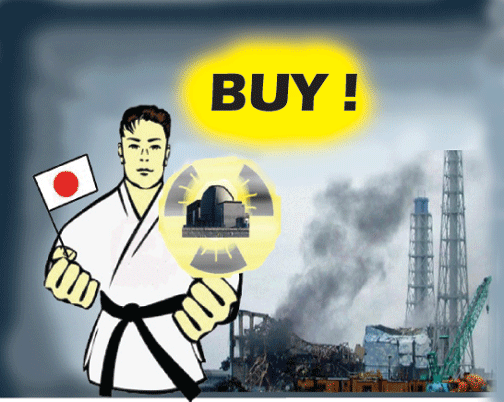 Abe, Modi look to ink civil nuclear pact at November meeting, Japan Times, KYODO, 30 Sept 16 A meeting between Prime Minister Shinzo Abe and his Indian counterpart Narendra Modi is set to be held in Tokyo in mid-November, with a civil nuclear cooperation pact likely to be signed, a source said Friday.
The pact would pave the way for Japan to export nuclear power plant technology to the fast-growing Asian economy. It would be Japan’s first signing of a civil nuclear cooperation pact with a country which has not joined the Nuclear Non-Proliferation Treaty…….
Earlier, other diplomatic sources said that under a provision in the pact, Japan will permit Indian power producers to reprocess spent fuel at designated facilities on the condition the country accepts comprehensive inspections by the International Atomic Energy Agency…….
Following the signing of the treaty, the Japanese government will seek swift approval from the Diet in a bid to promote Japanese companies’ participation in construction of such power plants in India……http://www.japantimes.co.jp/news/2016/09/30/national/japan-india-look-ink-civil-nuclear-pact-november-meeting/#.V-7jmIh97Gg
UK government admits the costs of Hinkley nuclear deal – gas would be cheaper

 Hinkley Point nuclear deal signed as Government admits gas would be cheaper, Telegraph, energy editor 29 SEPTEMBER 2016
The Hinkley Point C nuclear plant will saddle UK consumers with higher energy bills than building gas power stations, the Government has admitted, as it signed a legally-binding contract to subsidise the £18bn project.
An official assessment claimed the Franco-Chinese project to build Britain’s first nuclear plant in a generation represented “value for money”, despite being more expensive than gas, because it would help meet climate change targets.
A series of deals signed between the Government, France’s EDF and China’s state nuclear firm CGN at a ceremony in London marked the final go-ahead for the Somerset power plant and also fired the formal starting gun on Chinese efforts to build their own reactor in Essex………
Under a deal first agreed in 2013 Hinkley will be paid a fixed price of £92.50/MWh for the power it produces for 35 years, funded through levies on energy bills. The National Audit Office has said it could cost up to £30bn in subsidies.
Among hundreds of pages of documents issued on Thursday afternoon – some heavily redacted – ministers faced a series of questions over a cursory three-page assessment concluding that the deal would add £12 to energy bills in 2030 but was “value for money”.
The assessment said Hinkley was “cost-competitive to other options for delivering power” despite its own assessment that the “comparable cost” of new gas in the 2020s could be as low as £45/MWh, solar as low as £65/MWh and onshore wind as low as £49/MWh.
If Hinkley was delayed by three years and gas plants built instead then by 2030 the UK would be £3.2bn better off and energy bills would be “£6 cheaper per year”, it concluded……..
John Sauven, executive director of Greenpeace, accused the Government of obfuscation and providing “no evidence anywhere in the documents to back up their assumptions”.
“The numbers speak for themselves. In the unlikely event Hinkley is working sometime in the second half of the next decade, renewable energy will be much cheaper, yet British consumers will still be forced to pay over the odds for nuclear power,” he said.
Another document underlined the lasting impact the decision will have on UK energy policy for more than a century to come, forecasting that the spent fuel for the plant would not be disposed of until the year 2138.
EDF Energy said Hinkley would “kickstart Britain’s nuclear revival” and that it had “been shown to offer consumers value for money”.
The Government said the signing of the deal marked “a significant step forward for a new era of nuclear power in the UK”. http://www.telegraph.co.uk/business/2016/09/29/hinkley-point-nuclear-plant-gets-final-go-ahead-as-government-si/
-
Archives
- May 2026 (72)
- April 2026 (356)
- March 2026 (251)
- February 2026 (268)
- January 2026 (308)
- December 2025 (358)
- November 2025 (359)
- October 2025 (376)
- September 2025 (257)
- August 2025 (319)
- July 2025 (230)
- June 2025 (348)
-
Categories
- 1
- 1 NUCLEAR ISSUES
- business and costs
- climate change
- culture and arts
- ENERGY
- environment
- health
- history
- indigenous issues
- Legal
- marketing of nuclear
- media
- opposition to nuclear
- PERSONAL STORIES
- politics
- politics international
- Religion and ethics
- safety
- secrets,lies and civil liberties
- spinbuster
- technology
- Uranium
- wastes
- weapons and war
- Women
- 2 WORLD
- ACTION
- AFRICA
- Atrocities
- AUSTRALIA
- Christina's notes
- Christina's themes
- culture and arts
- Events
- Fuk 2022
- Fuk 2023
- Fukushima 2017
- Fukushima 2018
- fukushima 2019
- Fukushima 2020
- Fukushima 2021
- general
- global warming
- Humour (God we need it)
- Nuclear
- RARE EARTHS
- Reference
- resources – print
- Resources -audiovicual
- Weekly Newsletter
- World
- World Nuclear
- YouTube
-
RSS
Entries RSS
Comments RSS
 nuclear-news