 Energoatom expands cooperation with CNNP, NASA and IDOM Nuclear Services, WNN 08 November 2016 Ukrainian nuclear power plant operator Energoatom has agreed to enhance its cooperation with Chinese, Argentinian and Spanish companies – respectively, China National Nuclear Power (CNNP), Nucleoeléctrica Argentina SA (NASA) and IDOM Nuclear Services………
Energoatom, which is also state-owned, operates four nuclear power plants – Zaporozhe, Rovno, South Ukraine and Khmelnitsky – which comprise 15 nuclear reactors, including 13 VVER-1000s and two VVER-440s with a total capacity of 13,835 MWe. In July last year, the Ukrainian government approved a pilot project, named the “energy bridge”, to transfer electricity from unit 2 of the Khmelnitsky plant to the European Union.
November 11, 2016
Posted by Christina Macpherson |
China, marketing, Ukraine |
1 Comment
South Africa’s power utility wants to finance nuclear. This is a bad idea. , enca, Seán Mfundza Muller, Senior Lecturer in Economics, University of Johannesburg Sunday 6 November 2016 JOHANNESBURG – South Africa’s cabinet is to consider a proposal that a mooted nuclear power deal for the country be financed through the state-owned power utility Eskom. This is the latest twist in South Africa’s controversial efforts to expand its nuclear power capability by commissioning up to 9.6GW of energy from six nuclear power stations. The decision has been mired in controversy and still hangs in the balance and the offer by Eskom to foot the bill raises more questions than it provides answers.
Recent claims by Eskom’s management fail to adequately address any of the fundamental criticisms of the proposed nuclear programme.
Statements that Eskom can “finance nuclear on its own”, or absorb the risks from an incorrect decision, don’t add up economically or financially, and are misleading.
Furthermore, changes in Eskom’s rationale for justifying nuclear procurement over the last two years call into question the merits and motives of these arguments. Its claims about financing also raise serious questions about the arguments it presented to Parliament last year to justify a R23 billion cash injection and writing off a R60 billion loan.
The right decision would be for cabinet to defer further consideration of the programme for at least two years. In addition Eskom should account to Parliament on discrepancies in its statements about its financial situation.
THE FUNDAMENTAL FLAWS IN THE CASE FOR NUCLEAR
The three main problems with the case for nuclear procurement are well-established.
The actual power probably will not be needed. Recent trends in economic growth and electricity demand are much lower than the original forecasts on which the supposed need for nuclear power were based.
The programme is also likely to be very costly although there are still no credible, government cost estimates in the public domain. Many energy experts have argued that even if additional capacity was needed, other energy sources may be cheaper or more appropriate.
Finally, the combination of insufficient demand and costly supply means that nuclear poses a serious threat to the future stability of the country’s public finances and economic growth.
November 6, 2016
Posted by Christina Macpherson |
business and costs, politics, South Africa |
Leave a comment
Vietnam looks to delay Japan-, Russia-backed nuclear plants amid funds crunch, Japan Times, 6 Nov 16 KYODO HANOI – Vietnam’s ruling Communist Party in October instructed government authorities to revise plans to build nuclear power plants with Russian and Japanese assistance with a view to delaying them due to the government’s tight finances, it was learned Sunday from party and government sources.
The government is now working on a comprehensive revision of the plan and intends to submit a report to the National Assembly, according to the sources.
According to one of the sources, a considerable investment at the present time is “extremely difficult” given the financial situation of the government…….
some members of the Communist Party’s new leadership selected at a party congress in January have expressed concern over nuclear power plant construction while public debt remains high as well as over the safety of nuclear power.
At the fourth plenum of the 12th Party Central Committee in October, agreement was reached to reconsider the plan with a view to its postponement……http://www.japantimes.co.jp/news/2016/11/07/business/vietnam-looks-delay-japan-russia-backed-nuclear-plants-amid-funds-crunch/#.WB_SydJ97Gg
November 6, 2016
Posted by Christina Macpherson |
business and costs, politics, Vietnam |
Leave a comment
Nuclear plant operators find that money talks in turbulent times. Omaha.com By Cole Epley / World-Herald staff writer , 6 Nov 16
Even though a shuttered nuclear plant is no longer producing electricity, it remains highly regulated to maintain safety for employees and nearby communities. When employees start heading for the exits, plant owners risk seeing institutional knowledge leave with them.
That’s what happened earlier this year at the financially squeezed James A. FitzPatrick Nuclear Power Plant in central New York, after Louisiana-based Entergy Corp. announced plans in November 2015 to shut down the plant for good.
By the time jockeying by New York lawmakers and deal-making with nuclear juggernaut Exelon Corp. removed the plant from a list of doomed facilities in early August, more than 10 percent of FitzPatrick’s 615 workers had jumped ship.
A similar portion of Fort Calhoun’s workforce has followed suit, according to Mart Sedky, Omaha Public Power District’s division manager of human resources. Employees there began leaving as soon as word got out in May that the plant, the nation’s smallest, was on the chopping block, she said.
David Lochbaum, director of the Nuclear Safety Project for the Union of Concerned Scientists, a nonprofit group, said retention bonuses are a “guard against” such rushes for the exits.
“If people start bailing out because they see the writing on the wall and they want to protect themselves and their families, that poses a challenge to the plant owner,” he said.
Early estimates call for about $45 million worth of retention bonuses and separation packages to Fort Calhoun employees. That number doesn’t include salaries at the plant, which had a $71.2 million payroll in 2015.
A spokeswoman at Entergy would not comment on retention agreements at the FitzPatrick plant in New York. But the company committed approximately $55 million to $60 million in severance and employee retention payments to employees at its now-closed Vermont Yankee Nuclear Power Station in southern Vermont, according to a statement from Entergy announcing the plant’s closing in August 2013.
Nuclear operators elsewhere have also found that money talks in turbulent times. Retention agreements kept nuclear professionals in place at the Kewaunee Power Station in Wisconsin when that plant’s owner announced its closing in late 2012. A spokesman for Dominion Resources, which closed Kewaunee for good in May 2013, said financial details around retention agreements with the plant’s employees were proprietary.
Today there are fewer than 200 employees on-site, down from more than 600 when the plant was running at full-power status.
In testimony supporting a rate hike to the North Dakota Public Service Commission in August 2013, Xcel Energy’s Timothy O’Connor said the Minnesota company was thwarted in its attempts to attract employees from Kewaunee to its own struggling nuclear plant because of retention incentives.
“Employees without retention agreements are extremely vulnerable to other nuclear competitors and this is one reason why (Xcel) has lost a large experience base,” O’Connor, Xcel’s chief nuclear officer, said at the time.
Closer to home, such incentives helped Nebraska Public Power District’s Cooper Nuclear Station in Brownville turn the corner when that plant’s fate was uncertain……http://www.omaha.com/money/nuclear-plant-operators-find-that-money-talks-in-turbulent-times/article_13e3e48f-e955-5a0b-a6a3-ada5741accab.html
November 6, 2016
Posted by Christina Macpherson |
business and costs, USA |
Leave a comment
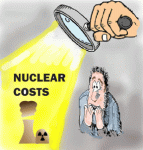
 Eskom’s nuclear energy offer doesn’t add up, Independent Online 3 November 2016, The power utility’s financial statements need scrutiny, writes Seán Mfundza Muller South Africa’s cabinet is to consider a proposal that a mooted nuclear power deal for the country be financed through the state-owned power utility Eskom. This is the latest twist in South Africa’s controversial efforts to expand its nuclear power capability by commissioning up to 9.6GW of energy from six nuclear power stations.
The decision has been mired in controversy and still hangs in the balance and the offer by Eskom to foot the bill raises more questions than it provides answers. Recent claims by Eskom’s management fail to adequately address any of the fundamental criticisms of the proposed nuclear programme. Statements that Eskom can “finance nuclear on its own” don’t add up and are misleading.
Changes in Eskom’s rationale for justifying nuclear procurement over the past two years call into question the merits of these arguments.
Its claims about financing also raise serious questions about the arguments it presented to Parliament last year to justify a R23 billion cash injection and write off a R60bn loan.
The right decision would be for the cabinet to defer further consideration of the programme for at least two years. In addition, Eskom should account to Parliament on discrepancies in its statements about its financial situation.
The three main problems with the case for nuclear procurement are well established.
The actual power probably will not be needed. Trends in economic growth and electricity demand are much lower than the original forecasts on which the supposed need for nuclear power were based.
The programme is also likely to be very costly although there are still no credible, government cost estimates in the public domain. Many energy experts have argued that even if additional capacity was needed, other energy sources may be cheaper or more appropriate.
Finally, the combination of insufficient demand and costly supply means that nuclear poses a serious threat to the future stability of the country’s public finances and economic growth.
An indicator of problematic motives is the way in which the arguments made for it keep shifting. Last year Eskom chief executive Brian Molefe told Parliament that procurement of nuclear was “urgent” and feasible. Molefe argued that nuclear costs were lower than critics implied and financing concerns reflected a “pedestrian” attitude.
Subsequent to this, Eskom decided on a new line of attack: trying to limit procurement of power from independent renewable energy producers………
It should therefore be clear that the case for proceeding with the procurement of nuclear power is fundamentally flawed. The rational and responsible decision by cabinet would be to halt it.
If economic growth and energy demand increases significantly over the next few years, the matter could be revisited based on an appropriately updated Integrated Resource Plan that uses credible forecasts of future energy needs. http://www.iol.co.za/dailynews/opinion/eskoms-nuclear-energy-offer-doesnt-add-up-2086209
November 4, 2016
Posted by Christina Macpherson |
business and costs, politics, South Africa |
Leave a comment
Xi says UK nuclear success is crucial, Shanghai Daily, Source: Agencies | November 1, 2016, PRESIDENT Xi Jinping said yesterday China and France should properly implement the Hinkley Point C nuclear project in Britain, the first new UK nuclear power plant for two decades.
Xi made the remarks when meeting with visiting French Foreign Minister Jean-Marc Ayrault.
Chinese and French companies signed the agreement to build an 18 billion pound (US$21.9 billion) nuclear power plant at Hinkley Point C during Xi’s state visit to Britain in October last year. The CGN-led Chinese consortium and French company EDF respectively take 33.5 percent and 66.5 percent stakes.
The Hinkley Point project finally got the go-ahead after Britain’s new prime minister Theresa May delayed the deal because of national security concerns.
As part of the agreement, EDF will help CGN to gain a license to build its own nuclear reactor, Hualong, in Britain, whose nuclear regulatory regime is seen as one of the most stringent in the world.
China is keen to establish itself as an exporter of nuclear expertise so successfully building a plant in the UK would open the door to other markets……..
France and China would set up a fund for joint investment in overseas projects, he said yesterday. “Hinkley Point is a very good example of what we’re going to do together, to win contracts in third markets and in all sectors.”
The project to build the UK nuclear power plant station was “a model that we support everywhere, including in Africa and Asia,” he said.
The new joint fund would be set up soon, he said, without giving further details……….
China and France also signed a social insurance agreement yesterday that will exempt company employees assigned to work in each other’s countries from the mandatory social insurance contributions. http://www.shanghaidaily.com/nation/Xi-says-UK-nuclear-success-is-crucial/shdaily.shtml
November 4, 2016
Posted by Christina Macpherson |
China, marketing |
Leave a comment
Russia, Myanmar launch working body for nuclear tech cooperation, Myanmar Times, By Aung Shin | Friday, 28 October
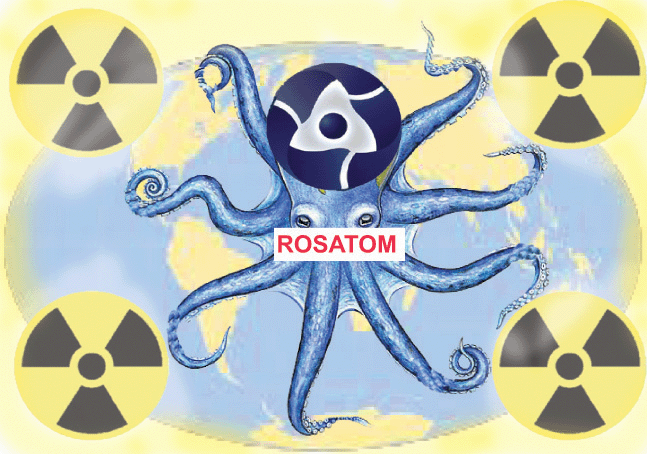
Russia and Myanmar this week established a working body for nuclear technology cooperation, according to officials.
Little is known about the bilateral taskforce, including who is involved or even how many members are included. The two countries signed a memorandum of understanding (MoU) to cooperate in nuclear technology for peaceful purposes in June last year.
According to a Ministry of Education official, the working body is another step in developing nuclear technology with the help of Russia.
Russian government officials are now in Nay Pyi Taw to discuss further steps for the MoU, said U Khin Maung Latt, director general of the Department of Technology Promotion and Coordination (DTPC) under the Ministry of Education.
“We have a roadmap of further steps for the MoU … We have discussed and agreed for further cooperation,” he said……..
Since 2007 Russia and Myanmar have had an inter-governmental agreement regarding nuclear technology and building a nuclear research centre, according to Rosatom.
Russia has trained more than 700 Myanmar students in nuclear and nuclear-related technologies in the past 10 years.
The Russian state firm is seeking potential investment opportunities in the Southeast Asian region, and is offering comprehensive nuclear technology and experience, said Rosatom officials. The company is building two nuclear power units in Vietnam, and has also won a tender for the preliminary design of a 10-megawatt reactor in Indonesia (see map).
Rosatom has two operating nuclear reactors in India and China, with two more in each country under construction. The Russian state-owned company has also won a project to construct a nuclear power plant in Bangladesh…….http://www.mmtimes.com/index.php/national-news/nay-pyi-taw/23368-russia-myanmar-launch-working-body-for-nuclear-tech-cooperation.html
October 29, 2016
Posted by Christina Macpherson |
ASIA, marketing, Russia |
Leave a comment
Japan’s Kansai, 3 others deny report of nuclear tie-up http://www.reuters.com/article/japan-nuclear-idUSL4N1CY1G0 Oct 28 Kansai Electric Power Co and three other energy utilities based in western Japan on Friday denied a report in the Nikkei newspaper that they are considering a tie-up in their nuclear businesses, which are struggling after the Fukushima disaster.
The Nikkei reported that Kansai Electric, Shikoku Electric Power, Chugoku Electric Power and Kyushu Electric Power were in talks to jointly rebuild old nuclear plants and run them together to cut costs. It did not cite sources.
The Nikkei added the moves could lead to a full merger of the companies’ nuclear operations as part of a realignment of Japan’s atomic power sector, which is all but shutdown nearly six years after the meltdowns at the Fukushima Daiichi plant, located in eastern Japan and run by Tokyo Electric Power .
“There is no truth to the report,” Kansai Electric said in a statement. Chugoku Electric and Shikoku Electric issued similar statements, while a Kyushu Electric spokesman also denied the report.
Japan’s industry ministry this week proposed spinning off the nuclear business of Tokyo Electric Power, as part of a possible reorganisation of the nuclear industry in the country.
Ten companies operate nuclear reactors in Japan but only two of 42 operable units are up and running, amid strong public scepticism towards nuclear power after Fukushima. Courts have also intervened to stop plants operating.
Over the years since Fukushima, the regional utilities have been hit by higher fuel costs, massive investments in upgrades to strengthen atomic plants and, since April, the opening of the retail electricity business to new competitors. (Reporting by Osamu Tsukimori; Editing by Aaron Sheldrick and Joseph Radford)
October 29, 2016
Posted by Christina Macpherson |
business and costs, Japan |
Leave a comment
Power plant closing just the start of decades-long process FORT CALHOUN, Neb. 25 Oct 16 – The nation’s smallest nuclear power plant permanently shuts down Monday after 43 years of service. The Omaha Public Power District’s board decided in June that the Fort Calhoun Nuclear Power Plant is no longer financially sustainable due to market conditions with consumers using less energy and low natural gas prices.
By ceasing operations, the district expects to save between $735 million and $994 million over the next 20 years.
The shutdown is just the first step in a decommissioning process that could stretch on for as long as 60 years and cost more than $1 billion. During that process, the utility will have to decontaminate and disassemble elements of the power plant north of Omaha.
October 27, 2016
Posted by Christina Macpherson |
business and costs, USA |
Leave a comment
Germany approves landmark nuclear waste deal with utilities: source http://www.businessinsider.com/r-germany-approves-landmark-nuclear-waste-deal-with-utilities-source-2016-10/?r=AU&IR=T BERLIN (Reuters) – The German cabinet approved a deal on Wednesday for its top utilities to start paying into a 23.6-billion-euro ($25.9 billion) fund next year in return for shifting liability for nuclear waste storage to the government, a source said.
The agreement removes uncertainty about the costs of storing interim and final waste and gives investors greater clarity over the future finances of E.ON, RWE, EnBW and Vattenfall [VATN.UL].
The utilities will remain responsible for dismantling the country’s nuclear plants, the last of which will be shut down in 2022 as part of Germany’s abandonment of the technology, a decision triggered by Japan’s Fukushima disaster five years ago.
(Reporting by Markus Wacket; Writing by Caroline Copley; Editing by Joseph Nasr)
Read the original article on Reuters.
October 22, 2016
Posted by Christina Macpherson |
business and costs, Germany, politics |
Leave a comment
India Dissatisfied With Costs of Nuclear Power Project With France / sandeepachetan
BUSINESS 19:11 21.10.2016 India sent a strong message to France that it will not go ahead with the project unless the costs of production for the Jaitapur nuclear power project would be affordable.
New Delhi (Sputnik) — India’s Atomic Energy Commission has made it clear that Western nuclear reactors will be welcomed only if it generates power at affordable rates.
………India signed Memorandum of Understanding with France for setting up six nuclear reactors at Jaitapur in March this year. Both countries decided to conclude the final agreement by end of 2016. Technical aspects of the deal have been resolved but expected costs of production have become a major hindrance for going ahead with the agreement……
https://sputniknews.com/business/201610211046596608-india-france-nuclear-project/
October 22, 2016
Posted by Christina Macpherson |
business and costs, India |
Leave a comment
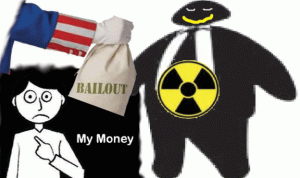 Proposed Agreement Would Reward Southern Company for Bungled, Massively Over Budget and 45-Month Delayed Plant Vogtle Reactors http://www.cleanenergy.org/2016/10/21/proposed-agreement-would-reward-southern-company-for-bungled-massively-over-budget-and-45-month-delayed-plant-vogtle-reactors/
Georgia Power customers would receive little protection or relief
Jennifer Rennicks, SACE, 865.235.1448 Atlanta, Ga. Late Thursday the Georgia Public Service Commission (PSC) Staff issued a proposed Stipulation Agreement that fails to protect Georgia Power customers for increased costs associated with the now 45-month delayed, over budget nuclear reactors under construction at Plant Vogtle near Waynesboro along the Savannah River. The estimated capital cost forecast has increased $1.262 billion for Georgia Power’s share of the project to $5.680 billion from the original $4.418 billion. The PSC press statement identified what appear to be only phantom savings to utility ratepayers while granting the Company guarantee of collection of billions of dollars in increased project costs.
Key items in the proposed Stipulation include:
- A defacto extension of the construction schedule from the current 39-month delay to 45 months with acknowledgement that it could be even further delayed, with nominal penalty for the Company.
- Capital costs up to $5.680 billion are considered reasonable and prudent thus no review in the future; despite the fact that $3.68 billion has been spent in capital costs as of the 15th Vogtle Construction Monitoring (VCM) report. This appears to represent approval of $2 billion in advance of those capital costs even being spent.
- The phantom cost savings to customers over the next four years appears to be due to merely slowing down the collection of financing costs versus actually denying the Company collection of these costs.
Below is a statement from Southern Alliance for Clean Energy’s High Risk Energy Choices Program Director Sara Barczak, an intervening party in the Vogtle Supplemental Information Review process, which the clean energy organization has criticized as an expedited, quasi-prudency review:
Halloween came early in Georgia given the clear treats offered to Southern Company (parent Company of Georgia Power) and the tricks doled out to utility customers. The proposed Stipulation is a major disappointment to consumers for many reasons.
Not one penny of construction costs associated with the construction delay was disallowed, including the $700 million in additional financing costs caused by the delay. Georgia Power will collect 100% of its financing costs. Most of the $325 million in phantom cost reduction to customers is only a delay in collecting financing charges. Georgia Power shareholders may see a tiny drop in their earnings but remain largely protected.
While Georgia Power has spent $3.68 billion on the Project to date, the Stipulation certifies $5.680 billion in construction costs as “prudent” and “reasonable” – essentially an advance approval of $2 billion dollars.
Finally, there is no public record to evaluate whether the PSC Staff negotiated a fair deal or rolled over to the utility company demands.
The proposed Stipulation clearly rewards Southern Company for their and their Contractors’ bungling of the troubled Vogtle nuclear construction project, which has been plagued with a plethora of serious design, engineering and construction problems from Day One that were identified by PSC Staff over years of testimony.
Georgia Power customers will realize little benefit should the Georgia Public Service Commissioners approve this proposal. It’s really sad to see yet another big power company receiving essentially a free pass for their mistakes that will cost families and businesses money.
Additional information: Originally Vogtle reactor Unit 3 was scheduled to come online April 1, 2016 and Unit 4 one year later. As of the 15th VCM report, schedule estimates were June 2019 and June 2020 respectively, a 39-month delay, with a cost estimate of $7.862 billion. The current certified cost for Georgia Power’s share of the project is approximately $6.113 billion. Customers are already paying an additional 9.4% on their monthly bills for the Nuclear Construction Cost Recovery (NCCR) costs due to anti-consumer state legislation passed in 2009 to incentivize building new reactors. Over $1.8 billion in pre-collected financing costs have been charged to ratepayers and the financing costs represent the largest share of the project’s cost overruns. The original approximately $14.1 billion Vogtle project is now estimated to cost well over $20 billion. Georgia Power is 45.7% owner in the project (remaining utility partners are Oglethorpe Power (30%), MEAG (22.7%) and the City of Dalton (1.6%)).
Find more information about Plant Vogtle’s expansion here.
October 22, 2016
Posted by Christina Macpherson |
business and costs, politics, USA |
Leave a comment
 S.Korea signs on to venture to operate UAE’s 1st nuclear power plant http://af.reuters.com/article/energyOilNews/idAFL3N1C32ZG
SEOUL Oct 20 (Reuters) – State-run utility Korea Electric Power Corp (KEPCO) agreed to invest $900 million in a company operating the first nuclear power plant in the United Arab Emirates, South Korea’s energy ministry said on Thursday.
KEPCO expects the deal to boost its revenue by nearly $50 billion over the next 60 years, according to a statement from the ministry.
KEPCO and Emirates Nuclear Energy Corp (ENEC) signed the deal to co-invest in the company managing and operating the UAE’s Barakah nuclear power plant for the next six decades, the ministry statement said.
In 2009, a KEPCO-led consortium won a contract to build the four 1,400 megawatt nuclear reactors that are being constructed at the Barakah plant to meet the UAE’s surging demand for electricity.
South Korea, the world’s fifth-biggest user of nuclear power, constructs and operates its reactors through KEPCO. (Reporting By Jane Chung; Editing by Tom Hogue)
October 22, 2016
Posted by Christina Macpherson |
marketing, South Korea, United Arab Emirates |
Leave a comment
Nation’s First Nuclear Reactor in 20 Years Starts Operation, Bloomberg, By Rebecca Kern Oct. 19 — The Tennessee Valley Authority’s Watts Bar Unit 2 reactor near Spring City, Tenn., officially began commercial operation Oct. 19, making it the first new commercial nuclear reactor to go online in the U.S. in the last 20 years.
The reactor has been more than 40 years in the making and cost approximately $6 billion to complete, not adjusting for inflation.
Watts Bar Unit 2 is one of five reactors in the U.S. expected to open in the next five years. However, cost overruns and delays are leading critics to question whether new nuclear plants will be built in the future.
Construction on Watts Bar Units 1 and 2 began in 1973. Work stopped on Unit 2 in 1985 due to deficiencies at the plant. Unit 1 began operation in 1996. In 2007, the TVA began efforts again to complete Unit 2, submitting an updated license application to the Nuclear Regulatory Commission in 2009 and received its operating license in October 2015. Unit 2 is the first new reactor in the U.S. since its sister plant started operations.
The Unit 2 startup comes at a time when nuclear operators have shut down—or announced plans to shut down—10 reactors in five states due to difficulty competing against low natural gas prices, according to the Nuclear Energy Institute, which represents the nuclear industry. The group predicts that an additional 15 to 20 nuclear reactors are at risk of premature closure in the coming years.
Marvin Fertel’s, NEI’s president and CEO, praised TVA’s completion of the plant……..
Mark Cooper, a senior research fellow for economic analysis at the Vermont Law School, said it is no longer financially viable to build new reactors in the U.S. Watts Bar Unit 2 “is not a monument to the future nuclear power, it’s a mausoleum for the future of nuclear power,” he told Bloomberg BNA Oct. 19.
Watchdogs Say Building Nuclear Too Costly
The TVA estimates that it spent $1.3 billion originally on the project. Work resumed after the board of directors approved $4 billion to $4.5 billion to complete the reactor in 2012, and then later approved an additional $200 million in 2016, bringing total estimated costs to $6 billion.
Critics say that the $6 billion price tag to complete Watts Bar Unit 2 is a reminder of the expense of building nuclear reactors today.
Tim Judson, executive director of the Nuclear Information and Research Service, a information center for environmentalists concerned about nuclear power and radioactive waste, said he would estimate Watts Bar Unit 2 cost between $7 billion and $8 billion when adjusted for inflation.
“As an economic enterprise, they are doomed,” Cooper said of nuclear reactors in the U.S………
To contact the reporter on this story: Rebecca Kern in Washington atrKern@bna.com
To contact the editor responsible for this story: Larry Pearl atlpearl@bna.com https://news.google.com/news/story?ncl=dD89j-wHhzuijvMA6PD5gUuZYagbM&q=nuclear&lr=English&hl=en&sa=X&ved=0ahUKEwiI5uq6k-rPAhWrqlQKHfGrApMQqgIIIjAB
October 21, 2016
Posted by Christina Macpherson |
business and costs, USA |
Leave a comment




 nuclear-news