Toshiba’s nuclear mess: shareholders hurl abuse at Toshiba managers
 ‘You’re trash’: Investors hurl abuse at Toshiba managers after nuclear debacle, SMH, Pavel Alpeyev and Takako Taniguchi, 31 Mar 17, Toshiba shareholders have lashed out at management and lamented the downfall of the Japanese icon before approving the sale of its memory chips division to cover the billion-dollar costs resulting from its disastrous foray into nuclear energy.
Incensed investors took turns to hurl abuse at executives during a Thursday meeting convened to take a vote on the intended disposal of its prized semiconductor business. Toshiba is looking to sell a majority stake in the unit to mend a balance sheet ravaged by billions of dollars in writedowns related to cost overruns at its nuclear subsidiary Westinghouse Electric.
Westinghouse, which Toshiba bought for $US5.4 billion in 2006, filed for bankruptcy protection on Wednesday. The Japanese company said it may now book a loss of as much as 1.01 trillion yen ($11.8 billion) in the year ending March, a record for a Japanese manufacturer.
“Toshiba is now a laughing-stock to the whole world,” one shareholder said during a question-and-answer section, raising his voice. “I think all of you are incompetent as managers. Do you even know what’s happening?”
Another shareholder addressed the executives as “trash.”……. http://www.smh.com.au/business/world-business/youre-trash-investors-hurl-abuse-at-toshiba-managers-after-nuclear-debacle-20170330-gvah2j.html
Financial disaster looms for Georgia and S Carolina’s new nuclear stations, after Westinghouse bankruptcy
 Westinghouse bankruptcy leaves costly nuclear mess for Southern utility customers https://www.facingsouth.org/2017/03/westinghouse-bankruptcy-leaves-costly-nuclear-mess-southern-utility-customers March 31, 2017 Federal and state officials who oversee nuclear power can’t say they weren’t warned that financial disaster was a very real possibility should they approve plans for new nuclear reactor construction projects at Southern Company/Georgia Power’s Plant Vogtle near Waynesboro, Georgia, and SCANA/SCE&G’s Summer Plant near Jenkinsville, South Carolina.
Clean energy and consumer watchdog groups were outspoken in opposition to the projects, which involved a new type of reactor known as the AP1000. The Southern Alliance for Clean Energy (SACE) testified extensively with expert witnesses before the Georgia Public Service Commission to warn about the high risks of investing in expensive new nuclear power and to encourage turning instead to clean, affordable alternatives like energy efficiency, and SCE&G ratepayers intervened to try to block construction in South Carolina.
But in 2009, federal and state regulators approved two AP1000 reactors for each of the sites. While the Obama administration offered $8.3 billion in taxpayer-backed loan guarantees to help finance the construction of the Vogtle reactors, the Georgia legislature passed a law allowing Southern Company to finance them through a scheme called “construction work in progress” that forces ratepayers to pay in advance, with a charge of about $10 on the average customer’s monthly bill. South Carolina also has a law in place allowing prepayment; as a consequence SCE&G customers have faced nine rate hikes since 2009 driven in large part by the project.
Construction got underway at the two sites — but then came the predicted delays and cost overruns. With the first new reactors initially set to come online this year, the Vogtle project is only about 36 percent complete, and construction at Summer is only about one-third complete. And while state regulators have approved costs of around $14 billion for each project, Morgan Stanley has estimated the final bill at about $19 billion for the Georgia reactors and $22 billion for the South Carolina project. Ratepayers in Georgia have already forked over about $3.9 billion for the reactors, while those in South Carolina have paid about $4.5 billion. Meanwhile, the utilities are guaranteed a 10 percent return in profits, even in the case of cost overruns.
Now this week Westinghouse — the Pittsburgh-based division of Japanese tech conglomerate Toshiba and the reactors’ main contractor — cited those massive cost overruns in declaring bankruptcy. The move leaves the projects in limbo and utility customers in Georgia and South Carolina facing one of two unpleasant scenarios: paying billions for nothing, or continuing to pay even more for reactors whose completion remains uncertain.
Critics are reminding regulators that they should have seen this coming. “Time and time again, our legitimate concerns and consumer-protecting recommendations were ignored,” said SACE Director Dr. Stephen Smith. “Now there is a lot of wringing of hands and surprise by those with the power to protect utility customers claiming that no one could have predicted this. The reality is, they shouldn’t have ignored the predictions they were presented over and over again, and they should not ignore the predictions now.”
‘No option that doesn’t affect rates’
At the time the projects were first proposed, worried consumer advocates pointed to the nuclear power debacle of the 1970s and 1980s, when utilities nationwide canceled about 100 planned reactors due to cost overruns. In the end, ratepayers and taxpayers shelled out about $40 billion for those abandoned projects — over $200 billion in today’s dollars. Forbes magazine called it “the largest managerial disaster in business history, a disaster on a monumental scale.”
What will happen next in Georgia and South Carolina remains uncertain.. On a conference call this week, SCANA told investors that 5,000 workers would continue working on the Summer site for 30 days while the company considered its options. SCANA CEO Kevin Marsh said the company’s “preferred option” is to finish the reactors while its “least preferred option is abandonment.” Meanwhile, Georgia Power said it is looking at “every option.”
During a SACE conference call this week about the implications of the Westinghouse bankruptcy, Peter Bradford, a former member of U.S. Nuclear Regulatory Commission and adjunct professor at Vermont Law School, said Georgia and South Carolina utility customers should expect another rate hike if the reactors eventually go into service — or if they are abandoned.
Liz Coyle, executive director of the consumer advocacy group Georgia Watch, pointed out on the call that the costs ratepayers are being forced to bear for the unfinished reactors present a “tremendous burden” for low-income households — one that is unlikely to ease any time soon.
“We see no option ahead that doesn’t affect rates customers will be paying,” she said.
Smith, Coyle and others are calling on utility regulators in Georgia and South Carolina to conduct a careful, transparent analysis of what’s in the best interest of ratepayers and proceed accordingly — and to remain unswayed by corporate interests that want to press ahead at any cost. If the companies and regulators do decide to proceed with construction, Smith said, ratepayers’ financial exposure should be capped.
Smith is also urging regulators to ground all future decisions in a basic concept of fairness: that no utility customer should be forced to pay for any facility for which a company cannot offer a reliable price estimate and timetable.
“If companies choose to build electric generation facilities with unknown costs and schedules, they should have shareholders carry the risk,” Smith said. “We must call on regulators to do their job and look out for customers’ interests.”
UK nuclear power plans thrown into doubt by Westinghouse bankruptcy
 Westinghouse Bankruptcy Could Stall UK Nuclear Plans, Oil Price,
Toshiba was planning to build three Westinghouse-designed AP 1000 reactors at Moorside in Cumbria (UK). Government officials said these plants were expected to provide about 7 percent of the UK’s energy needs when they come on line around the year 2030. Toshiba owns 60 percent of the project along with French partner, Engie, which owns the balance. (Engie, formerly GDF Suez, is one of the largest generating companies in the world.)
Given the possibility of a Westinghouse bankruptcy, as well as related financial woes, Toshiba has been seeking to offload its interest in the Moorside project. The CEO of Korea Electric Power Company (KEPCO) initially sounded enthusiastic about assuming Toshiba’s Moorside stake stating publicly he was ready to “jump in” after questions of the project’s debt and equity were clarified. KEPCO, however, later ruled out buying Westinghouse.
Nowhere in various press report, though, did we see KEPCO officials embrace the Toshiba/Westinghouse AP1000 reactor design.The Koreans have their own nuclear reactor designs which they have had some success exporting. Actually, they have two of them; the OPR 1000 and the larger APR 1400….
Why does this matter?
It could take the UK’s nuclear regulator, the Office for Nuclear Generation (ONR), at least four years to certify a new reactor design. The ONR’s latest Generic Design Assessment is almost complete for Westinghouse’s AP 1000.
As sophisticated designers and builders of new nuclear facilities, with their own proprietary technology, we believe there is little likelihood the Koreans will take on the AP 1000 design. Building with a new and unfamiliar design would add to their risk.
If the Koreans assume Toshiba’s Moorside stake and pursue their home-grown reactor design, this will add years to the plant’s estimated in service date. The only good news, here, is that Britain’s electricity demand has fallen so much that maybe the delay would be a blessing in disguise.
Once again, though, we wonder if the UK’s nuclear policymakers have a plan B. They never had one before. http://oilprice.com/Energy/Energy-General/Westinghouse-Bankruptcy-Could-Stall-UK-Nuclear-Plans.html
EDF starts pouring concrete at £18bn Hinkley Point nuclear power plant

 Hinkley Point construction gets under way, EDF starts pouring concrete at £18bn nuclear power plant,
Ft.com by: Andrew Ward, Energy Editor , 31 Mar 17, Construction has begun of the first permanent structures at the Hinkley Point nuclear power station in Somerset, marking an important step towards Britain’s first new nuclear plant since the 1990s. EDF, the French utility leading the £18bn project, said it had started pouring concrete after receiving its first go-ahead for construction work from Britain’s nuclear regulator………
Japan’s ambitions to export nuclear technology have been dimmed by Toshiba’s U.S. unit bankruptcy
Toshiba’s U.S. unit bankruptcy dims Japan’s nuclear ambitions, Japan Times, BY AKIKO YASUHARA, KYODO , 31 Mar 17, The bankruptcy filing by Toshiba Corp.’s U.S. nuclear unit highlights the tough business climate in the sector and the scale of the challenge Japan faces in seeking to sell its nuclear technology abroad.
Westinghouse Electric Co. filed for Chapter 11 bankruptcy protection on Wednesday as its Japanese parent rushed to plug huge losses related to the nuclear business and pull out of the sector overseas.
Toshiba bought the U.S. nuclear energy company in 2006 for about ¥600 billion ($5.4 billion), aiming to expand its nuclear power business abroad as one of its core operations.
Such efforts by Japanese nuclear businesses to push exports have been taken up by Prime Minister Shinzo Abe as part of a growth strategy to revitalize the deflation-hit domestic economy…..
However, the nuclear business environment has changed dramatically since the 2011 Fukushima nuclear crisis. Stricter safety regulations introduced after the disaster have raised costs to construct plants and some countries have become more cautious about new reactors……
“It’s a high-risk business. It always has been,” Tadahiro Katsuta, a professor specializing in atomic mechanics at Meiji University in Tokyo, said. “Even before the Fukushima crisis, the nuclear business had been struggling. It’s not something one company can do on its own or can easily export like cars in terms of safety concerns.”
Toshiba said Wednesday it could post a group net loss of ¥1.01 trillion ($9.13 billion) for the fiscal year ending March 31, with massive costs related to the Chapter 11 filing. Westinghouse has $9.8 billion in total liabilities, much of which must be shouldered by Toshiba under a debt guarantee for the U.S. unit.
With the do-or-die decision on the filing, Toshiba will make all-out efforts to move out of its financial woes, Toshiba President Satoshi Tsunakawa told a news conference in Tokyo Wednesday evening.
“We are almost risk-free as we are pulling out of overseas nuclear operations, the biggest problem,” he said…….
The nuclear climbdown is not a problem specific to Toshiba.
Hitachi Ltd., another major nuclear company, said last week it will book an estimated ¥65 billion write-down for fiscal 2016 related to a laser uranium enrichment joint venture with General Electric in the United States. The company said demand for nuclear fuel in the country was unlikely to grow as strongly as it had expected…….
The nuclear climbdown is not a problem specific to Toshiba.
Hitachi Ltd., another major nuclear company, said last week it will book an estimated ¥65 billion write-down for fiscal 2016 related to a laser uranium enrichment joint venture with General Electric in the United States. The company said demand for nuclear fuel in the country was unlikely to grow as strongly as it had expected……
Mitsubishi Heavy and Japan Nuclear Fuel Ltd. said in February they will invest in Areva, which is a partner of Mitsubishi in a joint venture to develop nuclear plants.
Still, the dynamics in the energy sector have been changing drastically……..http://www.japantimes.co.jp/news/2017/03/31/business/corporate-business/toshibas-u-s-unit-bankruptcy-dims-japans-nuclear-ambitions/#.WN7B-kWGPGg
With New York subsidy to FitzPatrick Nuclear Power Plant, Exelon has now bought this struggling station
Sold! FitzPatrick acquisiton complete, WRVO, 1 Apr 17, By PAYNE HORNING The transfer of the FitzPatrick Nuclear Power Plant to its new owner is officially complete. Exelon, which owns and operates the nearby Nine Mile Point Nuclear Facility Exelon, announced Friday that its negotiations with Entergy are done. The company bought the Oswego County plant last summer for $110 million.
FitzPatrick had been hemorrhaging money because of competition from natural gas. Entergy said the plant was losing the company about $60 million annually, so they moved to decommission it. But New York regulators stepped in to prevent its closure, passing a comprehensive clean energy plan that will the state’s financially struggling nuclear plants, including FitzPatrick, with subsidies that are scheduled to kick in tomorrow. …….
the subsidy program supporting the deal may be in jeopardy. The New York State Assembly has proposed a one-house budget that would halt the program until they can hold a hearing with state officials. And several pending lawsuits also threaten the plan.http://wrvo.org/post/sold-fitzpatrick-acquisiton-complete
Is the nuclear game up, at last? Toshiba’s nuclear flagship goes bust after $10 billion losses
 It’s now looking increasingly probable that the [British] Moorside project, given the state of the Nugen consortium and the massive failure of the AP1000 design, may never progress to construction.
nuclear utilities Areva and EDF. The French nuclear industry is in its “worst situation
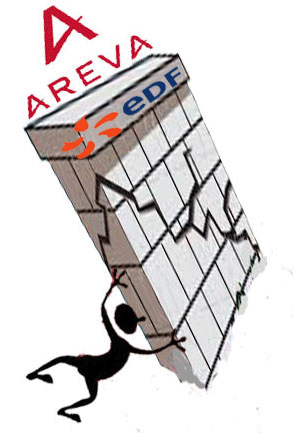 ever” according to former EDF director Gérard Magnin.
The crisis-ridden US, French and Japanese nuclear industries account for half of worldwide nuclear power generation. Other countries with crisis-ridden nuclear programs or nuclear phase-out policies account for more than half of worldwide nuclear power generation.
Meranwhile renewable energy generation doubled over the past decade and strong growth, driven by sharp cost decreases, will continue for the foreseeable future.
 Toshiba’s nuclear flagship goes bust after $10 billion losses http://www.theecologist.org/News/news_round_up/2988820/toshibas_nuclear_flagship_goes_bust_after_10_billion_losses.html, Jim Green, 30th March 2017 News that one of the world’s biggest nuclear power constructors, Westinghouse, has filed for bankruptcy in with debts of over $10 billion has put the entire sector on notice and issued a dire warning to nuclear investors everywhere, writes Jim Green. Among the likely casualties: the UK’s Moorside nuclear complex in Cumbria.
The rapidly-evolving nuclear power crisis escalated dramatically yesterday when US nuclear giant Westinghouse, a subsidiary of Japanese conglomerate Toshiba, filed for bankruptcy.
The Chapter 11 filing took place in the US Bankruptcy Court for the Southern District of New York in New York City.
Westinghouse and its parent Toshiba are in crisis because of massive cost overruns building four ‘AP1000’ nuclear power reactors in the southern US states of Georgia and South Carolina.
The combined cost overruns for the four reactors now amount to about $1.2 billion and counting. And it has now emerged that they may never be finished at all. Whether the four reactors will be completed is now subject to an “assessment period”, according to Westinghouse.
The corporate mishap may also signal the end of new nuclear power in the US. No other reactors are under construction in the country and there is no likelihood of any new reactors in the foreseeable future. The US reactor fleet is one of the oldest in the world, with 44 out of its 99 reactors having been operated for four decades or more.
A $10 billion financial hole – and it’s getting deeper!
Toshiba says Westinghouse had debts totalling US$9.8 billion. Plans for new Westinghouse reactors in India, the UK and China are in jeopardy and will likely be cancelled. Bloomberg noted yesterday: “Westinghouse Electric Co., once synonymous with America’s industrial might, wagered its future on nuclear power – and lost.”
The same could be said about Toshiba, which is selling profitable businesses to stave off bankruptcy. Toshiba said yesterday it expects to book a net loss of $9.1 billion for the current fiscal year, which ends on Friday – a record loss for a Japanese manufacturer.
That projected loss is also well over double the estimate provided just last month, raising investor fears that the final figure may be greater still. “Every time they put out an estimate, the loss gets bigger and bigger”, said Zuhair Khan, an analyst at Jefferies in Tokyo. “I don’t think this is the last cockroach we have seen coming out of Toshiba.”
The BBC noted that Toshiba’s share-price has been in freefall, losing more than 60% since the company first unveiled the problems in December 2016. Toshiba president Satoshi Tsunakawa said at a news conference yesterday: “We have all but completely pulled out of the nuclear business overseas.”
Westinghouse is the major member of the Nugen consortium that’s set to build a massive three-reactor AP1000 nuclear complex at Moorside in the UK, next to the Sellafield site. The company has already stated that while it intends to progress the project through planning stages, it is unable to take on financing or construction and intends to sell its share.
Nugen’s other member, the French energy company Engie (formerly GDF Suez) has also gone on record as wanting to extricate itself from the Moorside project in favour of the ‘new energy’ economy based on renewable, storage and smart grid technologies.
It’s now looking increasingly probable that the Moorside project, given the state of the Nugen consortium and the massive failure of the AP1000 design, may never progress to construction.
The good news for the nuclear industry? The UK’s Office of Nuclear Regulation (ONR) today – with impeccable timing – accepted the AP1000 design as “suitable for construction in the UK“ and issued Westinghouse a Design Acceptance Certificate.
Is the nuclear game up at last?
A similar crisis is unfolding in France, which has 58 power reactors but just one under construction. French ‘EPR’ reactors under construction in France (Flamanville) and Finland are three times over budget – the combined cost overruns for the two reactors amount to about €12.7 billion and counting.
The French government is selling assets so it can prop up its heavily indebted nuclear utilities Areva and EDF. The French nuclear industry is in its “worst situation ever” according to former EDF director Gérard Magnin.
Meanwhile a simple comparison of decommissioning provision between France and Germany indicates that EDF has massively under-budgetted for its liabilities. Germany has set aside €38 billion to decommission its 17 nuclear reactors (€2.2 billion each), but France has set aside only €23 billion to decommission its 58 reactors (€0.4 billion each).
When the real costs, for which EDF will be liable, come in, they could easily bankrupt the company. This in turn puts the UK’s Hinkley Point double EPR nuclear project, in which EDF is the main partner, in doubt.
The crisis-ridden US, French and Japanese nuclear industries account for half of worldwide nuclear power generation. Other countries with crisis-ridden nuclear programs or nuclear phase-out policies account for more than half of worldwide nuclear power generation.
Meranwhile renewable energy generation doubled over the past decade and strong growth, driven by sharp cost decreases, will continue for the foreseeable future.
Shock to global nuclear industry as Westinghouse goes bankrupt
The filing comes as the company’s corporate parent, Toshiba of Japan, scrambles to stanch huge losses stemming from Westinghouse’s troubled nuclear construction projects in the American South. Now, the future of those projects, which once seemed to be on the leading edge of a renaissance for nuclear energy, is in doubt.
“This is a fairly big and consequential deal,” said Richard Nephew, a senior research scholar at the Center on Global Energy Policy at Columbia University. “You’ve had some power companies and big utilities run into financial trouble, but this kind of thing hasn’t happened.”
Westinghouse, a once-proud name that in years past symbolized America’s supremacy in nuclear power, now illustrates its problems…..Slowing demand for electricity and tumbling prices for
natural gas have eroded the economic rationale for nuclear power, which is extremely costly and technically challenging to develop. Alternative-energy sources like wind and solar power are rapidly maturing and coming down in price. The 2011 earthquake in Japan that led to the nuclear disaster at the Fukushima Daiichi plant renewed worries about safety. Westinghouse’s problems are already reducing Japan’s footprint in nuclear power, an industry it has nurtured for decades in the name of energy security. Even before the filing, Toshiba had essentially retired Westinghouse from the business of building nuclear power plants. Executives said they would instead focus on maintaining existing reactors — a more stable and reliably profitable business — and developing reactor designs.
That has made the already small club of companies that take on the giant, expensive and complex task of nuclear-reactor building even smaller. General Electric, a pioneer in the field, has scaled back its nuclear operations, expressing doubt about their economic viability. Areva, the French builder, is mired in losses and undergoing a large-scale restructuring………..Toshiba said Westinghouse had total debt of $9.8 billion. The Chapter 11 bankruptcy filing was made in federal bankruptcy court for the Southern District of New York.
A decade ago, Toshiba was dreaming of a big global expansion when it bought Westinghouse for a surprisingly high $5.4 billion and made plans to install 45 new reactors worldwide by 2030…….In its bankruptcy filing, Westinghouse said that its top 30 unsecured creditors held over $508 million in claims. Among those creditors are big engineering and construction companies like Fluor and CB&I, and Nuclear Fuel Services, a fuel supplier.
To shepherd its case through Chapter 11, Westinghouse has hired a number of advisers, including the investment bank PJT Partners, the law firm Weil, Gotshal & Manges, and the consulting firm AlixPartners.
Westinghouse also said in its bankruptcy filing that it had taken out an $800 million loan from a group led by Citigroup to support itself through the bankruptcy process.
Toshiba’s record loss: shares plummet due to nuclear failures
 Toshiba Projects Record Loss as Nuclear Unit Files for Bankruptcy, Bloomberg, by Dawn McCarty and Pavel Alpeyev March 29, 2017,
-
Toshiba warns full year loss may widen to 1.01 trillion yen
-
Japanese company trying to sell memory chips division
-
Toshiba Corp. projected its annual loss could more than double to a record 1.01 trillion yen ($9.1 billion) as its U.S. nuclear unit Westinghouse Electricfiled for Chapter 11 bankruptcy.
The collapse of Westinghouse, once the linchpin of Toshiba’s plans to diversify away from consumer electronics, caps a disastrous run for the Japanese conglomerate as project delays crippled earnings from the nuclear plant business. The company has now put its prized memory chip unit up for sale just as it was recovering from a profit-padding scandal that claimed the scalps of senior executives……
- Toshiba listed as much as $10 billion debt for Westinghouse and another entity. The nuclear unit filed in U.S. Bankruptcy Court for the Southern District of New York and proposed to appoint Weil, Gotshal & Manges LLP as legal adviser, AlixPartners LLP as financial adviser, and PJT Partners Inc. as investment banker, subject to court approval.
Toshiba said last month it expected to write down 712.5 billion yen in its nuclear-power business, citing cost overruns and diminishing prospects for atomic-energy operations. The company has twice delayed its earnings report, with results for the December quarter now due on April 11.
- “There were warning signs when Toshiba delayed releasing financials earlier this year,” said Emmanuel Chua, senior associate at Herbert Smith Freehills in Singapore. “The big question mark is whether the restructuring plan and process presents real opportunities for a turnaround, or whether it is simply an exercise of ‘kicking the can down the road.”’
Shares of Toshiba have slumped 23 percent this year after advancing 13 percent in 2016. The loss forecast was announced after the close of trading on Wednesday.
Expectations that the company may be too big to fail for the Japanese government, and the likelihood that it will get state support is bolstering its bonds. Toshiba’s 20 billion yen of December 2020 bonds were little changed at 88 percent of face value, according to data compiled by Bloomberg……
Scana and Southern could end up facing billions of dollars in additional costs, according to Morgan Stanley. Scana faces as much as $5.2 billion in higher costs that could drag its shares down 5 percent, analysts at the bank including Stephen Byrd said in a March 22 research note, while cost overruns for utility owner Southern could reach $3.3 billion……https://www.bloomberg.com/news/articles/2017-03-29/toshiba-s-u-s-nuclear-unit-westinghouse-files-for-bankruptcy
Will Westinghouse be able to complete any of its nuclear projects?
Westinghouse files for bankruptcy in blow to nuclear power, NYT, 30 Mar 17 “……..Bankruptcy will make it harder for Westinghouse’s business partners to collect money they are owed by the nuclear-plant maker. That mostly affects the American power companies for whom it is building reactors, analysts say. Now, it is unclear whether the company will be able to complete any of its projects, which in the United States are about three years late and billions over budget.
The power companies — Scana Energy in South Carolina and a consortium in Georgia led by Georgia Power, a unit of Southern Company — would face the possibility of new contract terms, long lawsuits and absorbing losses that Toshiba and Westinghouse could not cover, analysts say. The cost estimates are already running $1 billion to $1.3 billion higher than originally expected, according to a recent report from Morgan Stanley, and could eventually exceed $8 billion over all.
Dennis Pidherny, a managing director at Fitch Ratings who is sector head of the United States public power group, said that it was possible that the company’s bankruptcy filing could terminate the contracts and that it could be difficult for the utilities to find another builder to take them over.
“There’s still quite a bit of work that needs to be completed,” he said. “The biggest challenge there is quite simply finding another suitable contractor who can complete the contract and have it completed at a quote-unquote reasonable cost.”
That is, if they are constructed at all. Stan Wise, chairman of the Georgia Public Service Commission, said the utilities developing the Alvin W. Vogtle generating station in the state would have to evaluate whether it made sense to continue.
“It’s a very serious issue for us and for the companies involved,” Mr. Wise said. “If, in fact, the company comes back to the commission asking for recertification, and at what cost, clearly the commission evaluates that versus natural gas or renewables.”
In a statement on Wednesday, Toshiba said Westinghouse and affiliated companies were “working cooperatively” with the owners to arrange for construction to continue. In recent days, the affected companies issued statements saying they were monitoring the situation and exploring their options, as did the Energy Department, which has authorized $8.3 billion in federal loan guarantees for the Georgia project.
“We are keenly interested in the bankruptcy proceedings and what they mean for taxpayers and the nation,” said Lindsey Geisler, a Department of Energy spokeswoman. “Our position with all parties has been consistent and clear: We expect the parties to honor their commitments and reach an agreement that protects taxpayers, promotes economic growth, and strengthens our energy and national security.”https://www.nytimes.com/2017/03/29/business/westinghouse-toshiba-nuclear-bankruptcy.html?_r=0
Bankruptcy doesn’t make liabilities vanish – Toshiba wan’t be saved by Westinghouse bankruptcy
 Westinghouse Bankruptcy Won’t Save Toshiba, Bloomberg Gadfly, https://www.bloomberg.com/gadfly/articles/2017-03-29/a-westinghouse-bankruptcy-won-t-save-toshiba By David Fickling, 29 Mar 17, From the outside, Chapter 11 bankruptcy can look like an almost magical process. A company previously laden down with borrowings gets to discharge its liabilities and emerge seemingly unscathed.
U.S. miner Arch Coal Inc. had $4.5 billion in net debt and a market capitalization of just a few million dollars when it filed for Chapter 11 in January 2016. After emerging from a nine-month gestation in the courts, it’s now worth $1.73 billion and is debt free, with net cash of $31 million.
Toshiba Corp. shareholders appear to hope the same rule will hold true for Westinghouse Electric Co., the nuclear unit that’s dragged one of Japan’s oldest industrial conglomerates to the brink of insolvency. The stock has rallied 20 percent in a week, after Toshiba said Westinghouse’s board was considering bankruptcy. The unit has filed for Chapter 11 protection in New York, court documents showed Wednesday.
If the courts are about to give Westinghouse a get-out-of-jail-free card, someone ought to tell the credit markets.
Compare Toshiba’s own credit-default swaps to those on Southern Co. and Scana Corp., the two U.S. electric utilities for whom Westinghouse is under contract to build four reactors, and it’s clear that investors expect one of the three players to suffer most of the costs. Insuring $10 million of Toshiba’s debt against default for five years would set you back about $423,000, compared to $78,000 for Scana and $64,000 for Southern.
Toshiba faces a bewildering array of potential hits to its balance sheet from its nuclear foray, but most of them are either relatively small (such as its 34.6 billion yen ($311 million) in decommissioning and environmental liabilities), or already factored in (like the 713 billion yen goodwill writedown that will leave it with negative shareholders’ equity once it reports annual results).
The deal with Southern and Scana is different. Payment guarantees to subsidiaries of the two utilities constitute 90 percent of the 794 billion yen in parent-company guarantees for which Toshiba has promised to indemnify Westinghouse. Put into English: If Westinghouse fails to build the reactors on time and on budget, Toshiba is on the hook for a sum not much less than the 768 billion yen value of all its factories, machinery and land.
Aside from a bailout by the Japanese government, the sliver of hope for Toshiba shareholders is that the messy bankruptcy process will allow some of those liabilities to be taken on by other players. The U.S. government, for instance, has made an $8.3 billion loan guarantee to the owners of Southern’s reactors. That may complicate the process, the Nikkei reported earlier this month. Moody’s Investors Service and S&P Global Ratings in recent weeks have put shareholders in the plants, including Southern and Scana and associated units, on negative ratings outlooks on the possibility they will have to bear some costs.
Creditors of the two utilities seem unconcerned. It’s been more than a year since Scana’s 4.125 percent bonds due February 2022 last dipped below par, while the Southern unit that will be the main shareholder in its nuclear plant project, Georgia Power Co., managed to raise fresh debt just last month. Its $400 million of 3.25 percent notes due 2027, sold at a modest 0.113 cent discount to par, are trading at 98.56 cents on the dollar.
That should be worrying for Toshiba, because there’s no magic spell behind Chapter 11. Bankruptcy doesn’t make liabilities vanish outright. For the most part, it just reorganizes them, imposes haircuts on junior creditors, and converts a portion from the most stringent form — debt — to a milder alternative, equity. If bondholders at Westinghouse’s customers are feeling confident, Toshiba shareholders should prepare for a troublesome chain reaction.
South Carolina, Georgia nuclear projects under the cloud of Westinghouse’s troubles
 Westinghouse troubles loom over South Carolina, Georgia nuclear projects, Denver Post, By THE ASSOCIATED PRESS March 29, 2017 Westinghouse Electric Co., the U.S. nuclear unit of Japan’s Toshiba Corp., filed for bankruptcy protection Wednesday, calling into question the future of a number of billion-dollar nuclear projects under construction, including two in the U.S.
Westinghouse said in a statement that it filed the Chapter 11 petition in U.S. Bankruptcy Court in New York. The move had been largely expected.
The troubles at a company long associated with nuclear power add to the industry’s problems. ….. the four nuclear reactors Westinghouse is helping to build in South Carolina and Georgia are behind schedule and billions of dollars over budget…….
Toshiba acquired Westinghouse in 2006 with much fanfare, making nuclear power an important part of its business strategy. Instead, Westinghouse has saddled the Japanese company with mounting losses. Toshiba said Westinghouse had racked up debt of $9.8 billion. Wednesday, Toshiba said it could post a loss as big as 1 trillion yen ($9 billion) for the fiscal year ending March 31. It previously said Westinghouse lost 712.5 billion yen ($6.2 billion) from April to December of last year.
In South Carolina, Westinghouse is a partner with state-owned utility Santee Cooper and publicly-traded SCANA Corp. on the construction of two reactors at the V.C. Summer Nuclear Station near Jenkinsville. SCANA said in September that the cost of building the reactors had increased nearly $3 billion from the original $11 billion estimate in 2009. The first reactor was supposed to open in 2017, but has been delayed at least two years.
SCANA officials told investors on a conference call Wednesday that all options remain on the table, from finishing both reactors, to finishing one reactor and delaying completion of the other or abandoning the project altogether. The company said it will spend at least the next 30 days reviewing its options.
The Plant Vogtle project in eastern Georgia was more than three years behind schedule and more than $3 billion over its original budget as of the end of 2016. Oglethorpe Power, one of the partners in the project, said in a regulatory filing this week that “the revised in-service dates of December 2019 and September 2020” for the two reactors it’s building “do not appear to be achievable.”
Georgia Power, a subsidiary of Southern Co. and holder of a 46-percent stake in the Vogtle project, said in a statement that it “will continue to take every action available to us to hold Westinghouse and Toshiba accountable for their financial responsibilities.” Southern Co. and the other partners have a $920 million letter of credit from Westinghouse obtained in 2015……http://www.denverpost.com/2017/03/29/westinghouse-troubles-loom-over-nuclear-projects/
Westinghouse financial crisis impacts Britain’s nuclear power plans
UK nuclear plans could be hit by Westinghouse financial crisis https://www.theguardian.com/business/2017/mar/28/uk-nuclear-westinghouse-bankruptcy-toshiba-us
Toshiba’s US subsidiary, which has technology in about half world’s reactors, expected to file for bankruptcy protection, Guardian, Adam Vaughan, 29 Mar 17, A financial crisis at a major nuclear energy business is threatening to deal a blow to the UK’s atomic energy programme.
Toshiba’s US nuclear subsidiary Westinghouse Electric is believed to be on the brink of filing in the US for bankruptcy protection from creditors. A UK expert said the collapse would leave a considerable hole in Britain’s new nuclear ambitions as Toshiba is a key player behind plans for a new power station at Moorside in Cumbria.
Westinghouse is a behemoth in the world of nuclear vendors, with its technology in about half the world’s reactors. But it is facing a writedown of billions of dollars over its acquisition of a nuclear construction and services business. In 2015 Toshiba bought CB&I Stone & Webster, the company managing the construction of new reactors Plant Vogtle in Georgia and Virgil C Summer in South Carolina, both of which are over budget and behind schedule.
Westinghouse filing for Chapter 11 protection would potentially limit future losses for its owner Toshiba. The move will also trigger complex negotiations between the Japanese conglomerate, its American unit and creditors, and could embroil the US and Japanese governments, given the scale of the collapse and US government loan guarantees for new reactors.
The US utilities that operate the two nuclear plants are among Westinghouse’s biggest creditors, owed for work that has yet to be completed and potential penalties, sources have said. The bankruptcy filing will allow Westinghouse to renegotiate or break the construction contracts, although the utilities that own the projects would likely seek damages.
Anti-nuclear campaigners said the episode showed the world should build renewable energy rather than new nuclear. Doug Parr, policy director at Greenpeace UK, said: “The world is watching the meltdown of a major corporation and questioning the cost of new nuclear. Declaring bankruptcy in the USA might shield Toshiba from Westinghouse’s debt, but as Toshiba’s share price ricochets and its multibillion-dollar losses escalate, the beleaguered nuclear industry is being shaken to the core again.”
Kecpo last week ruled out buying Westinghouse but said it was in talks to take a stake in NuGen. However, Dorfman said: “While Kepco may wish to buy into NuGen they may find it both legally and financially problematic.”
He added that any unravelling of Nugen as a result of Westinghouse filing for bankruptcy would “leave a considerable hole in UK nuclear plans”.
The AP1000 reactor design of the two US plants is the same as the three planned for the Moorside power station. Within days the UK nuclear regulator is expected to approve a “generic design assessment” for the AP1000, the end of a four-year approval process.
This year Toshiba has twice delayed publishing its financial results for the third quarter of 2016, which will reveal the scale of the impairment it faces with regards to CB&I Stone & Webster. In January, chief executive Satoshi Tsunakawa said that while Toshiba would continue to maintain and operate its existing nuclear plants: “It is unlikely that we will carry out construction work for future nuclear power plant projects, in order to eliminate risk.”
But NuGen has said that while Toshiba may not build Moorside, the Japanese corporation was still committed to developing the Moorside power station. The possibility of a Westinghouse bankruptcy also raises questions over its impact on the Springfields nuclear fuel plant in Lancashire. The company owns the site on a 150-year lease from the UK government’s Nuclear Decommissioning Authority.
In the US, the reactors that Westinghouse is building are due to be completed within the next three years.
Babcock company down £800m after ending nuclear decommissioning contract
 Babcock to take £800m hit after ending nuclear decommissioning contract, Belfast Telegraph, March 27 2017 Engineering services firm Babcock has said it will take an £800 million hit after terminating a major Government contract to decommission and manage 12 UK nuclear sites.
Despite the turmoil in the nuclear industry, Dominion Energy forges on with new nuclear plans
Amid nuclear industry turmoil, Dominion forges ahead with new nuclear reactor http://www.utilitydive.com/news/amid-nuclear-industry-turmoil-dominion-forges-ahead-with-new-nuclear-react/439122/, Robert Walton March 28, 2017
Dive Brief:
- Dominion Energy continues to advance plans for a proposed third nuclear reactor at its Santa Anna facility in Virginia, even as financial difficulties have imperiled construction of other projects in the region.
- Southeast Energy News reports federal regulators last week determined that with some “structural changes” to guard against earthquake damage, the proposed reactor could be approved.
- Dominion’s interest in constructing a new nuclear reactor comes as Westinghouse Electric Co., the nuclear engineering firm overseeing construction facilities in Georgia and South Carolina, prepares to file for bankruptcy at the end of this month.
-
Dive Insight:
Dominion has not committed to building a third unit at North Anna—so far the utility appears to be keeping its options open in pursuing the license—but despite uncertainty in the industry and objections from clean energy advocates, the project is chugging along.
But recent bad news within the nuclear sector shows signs of upheaval and uncertainty.
Toshiba recently announced a $6 billion writedown at its Westinghouse subsidiary, which is managing construction of new nuclear generation at the Vogtle plant in Georgia and V.C. Summer in South Carolina. Reuters reports Westinghouse could file for bankruptcy as early as today.
MIT Technology Review believes a Westinghouse bankruptcy means an end to new nuclear construction in the United States. The news outlet also reports analysts doubt Toshiba will find a buyer for its stake in Westinghouse, nor any construction partners willing to forge ahead with the nuclear plants it planned to build.
- The Vogtle and VC Summer plants are years behind schedule and costs are mounting. Development of those plants will likely continue, but within the industry there has been speculation that if Westinghouse fails, it will likely spell the end of new nuclear development for the time being.
In Virginia, Dominion is spending upwards of $600 million to obtain approval from the federal government. Long-term costs could exceed $19 billion, with the project possibly taking until 2029 to complete. The utility could spend $2 billion in just the planning stages alone. Dominion would use a new kind of nuclear design developed by GE Hitachi Nuclear Energy.
-
Archives
- May 2026 (62)
- April 2026 (356)
- March 2026 (251)
- February 2026 (268)
- January 2026 (308)
- December 2025 (358)
- November 2025 (359)
- October 2025 (376)
- September 2025 (257)
- August 2025 (319)
- July 2025 (230)
- June 2025 (348)
-
Categories
- 1
- 1 NUCLEAR ISSUES
- business and costs
- climate change
- culture and arts
- ENERGY
- environment
- health
- history
- indigenous issues
- Legal
- marketing of nuclear
- media
- opposition to nuclear
- PERSONAL STORIES
- politics
- politics international
- Religion and ethics
- safety
- secrets,lies and civil liberties
- spinbuster
- technology
- Uranium
- wastes
- weapons and war
- Women
- 2 WORLD
- ACTION
- AFRICA
- Atrocities
- AUSTRALIA
- Christina's notes
- Christina's themes
- culture and arts
- Events
- Fuk 2022
- Fuk 2023
- Fukushima 2017
- Fukushima 2018
- fukushima 2019
- Fukushima 2020
- Fukushima 2021
- general
- global warming
- Humour (God we need it)
- Nuclear
- RARE EARTHS
- Reference
- resources – print
- Resources -audiovicual
- Weekly Newsletter
- World
- World Nuclear
- YouTube
-
RSS
Entries RSS
Comments RSS
 nuclear-news
