 China’s nuclear export ambitions run into friction https://www.ft.com/content/84c25750-75da-11e7-90c0-90a9d1bc9691 by: Matthew Cottee , 3 Aug 17,China is using infrastructure exports to build strategic relationships with a range of countries in Asia, eastern Europe, the Middle East and Latin America. As part of its One Belt One Road (OBOR) policy, Beijing has pledged more money than went into the postwar Marshall plan on high-speed rail schemes around the world in an effort to secure diplomatic allies and develop new markets. The economic and diplomatic impact of its massive investment, however, remains questionable.
By providing technology, Beijing seeks to develop alliances with key states in a variety of regions. It aims to provide long-term contracts to construct, operate, maintain, provide fuel, train staff, and develop infrastructure while establishing links to high-level government representatives. But will nuclear exports prove any more influential and successful than high-speed rail?
The combined cost of cancelled rail projects equates to roughly a third of the estimated $143bn in total planned investment for projects involving Chinese contractors. As the FT highlights, some of the cancellations are the result of factors beyond China’s control, such as civil war in Libya. Other cases have been caused by a lack of transparency on the part of Chinese companies, the inability of recipients to manage large amounts of debt, and alternative models of government that delay decision making. Factors beyond Beijing’s control may also influence the success of its nuclear export strategy. Global interest in nuclear energy is experiencing a lull, prompting valid questions about China’s decision to invest in such technology as a long-term export market. Environmental consciousness is one reason for reducing reliance on nuclear energy. Political decisions in South Korea and France — two key proponents of nuclear energy — highlight this evolving trend. In Seoul, President Moon Jae-in has decided to phase out domestic electricity production from nuclear power plants. Nicolas Hulot, France’s minister of ecological and social transition, has also mooted efforts to cut the share of nuclear in its energy mix to 50 per cent by 2025, as required by a 2015 law.
The significant costs of nuclear energy mirror the issues highlighted by rail projects. Many existing nuclear projects are dependent on Chinese financing; China’s Exim Bank is bankrolling 82 per cent of the cost of Pakistan’s new reactors and is thought to be contributing to the construction of reactors in Romania alongside the Industrial and Commercial Bank of China. In November 2015, China National Nuclear Corporation invested $4.7bn in Argentina’s Nucleoelectrica. In the UK, China is to provide 33 per cent of the estimated £20bn for the Hinkley Point C project. In exchange, Beijing has been promised the opportunity to build its indigenously developed nuclear technology in Essex. The open question is whether such investment will eventually pay off. The current leader in the nuclear export market, Russia’s Rosatom, is reportedly shifting focus to hydropower and wind turbines rather than its usual reactor business. Speaking at the ‘Technoprom-2017’ conference in Novosibirsk, the deputy general director of Rosatom, Vyacheslav Pershukov, suggested that the export market for nuclear reactors has been exhausted.
The various setbacks to traditional nuclear energy providers, namely Areva, Toshiba and Westinghouse, suggest that market competition is dwindling. South Korea’s proposed diversification away from nuclear will also have significant ramifications for its nuclear export industry, given the key role government support plays in getting contracts agreed. Time will tell whether these developments represent an opportunity or a forewarning for China’s grand nuclear ambitions. Beijing is committed to sustained development of nuclear energy domestically but will hope that the nuclear vision remains bright in the untapped international markets with which it has signed exploratory agreements. As long-time proponents of nuclear are questioning its future role, and seasoned nuclear exporters are seeking to diversify, however, China’s nuclear efforts could be destined to go down the same track as its high-speed rail strategy. Dr Matthew Cottee is research associate, Non-Proliferation and Nuclear Policy Programme at the International Institute for Strategic Studies
August 4, 2017
Posted by Christina Macpherson |
business and costs, China |
Leave a comment
 BY SAMMY FRETWELL, sfretwell@thestate.com, AUGUST 02,2017COLUMBIA, SC Even though SCE&G won’t finish a multi-billion dollar nuclear expansion project in Fairfield County, customers will continue paying about one-fifth of their monthly power bills for the work.
Rates that customers now are charged for the project already are in the company’s rate base and “will remain so moving forward,’’ SCE&G spokesman Eric Boomhower said in an email Wednesday night.
The company has hit customers with nine power bill increases to finance the project in less than a decade.
SCE&G abandoned the nuclear project this week, but under a 2007 state law, can continue charging customers for the work unless the state Public Service Commission says otherwise.
Collectively, SCE&G and partner Santee Cooper have spent about $9 billion for the reactor project. As an investor owned-utility, SCE&G will seek to recover its share of the amount it has already spent, which was about $5 billion.
Customers of SCE&G have paid about $1.4 billion as a result of company rate increases to fund the two new reactors at the V.C. Summer plant northwest of Columbia. They’re paying, on average, about 18 percent of their monthly power bills for the nuclear work.
Officials with the state Office of Regulatory Staff said they don’t expect the state Public Service Commission to change any rates this year for the SCE&G project in Jenkinsville…… http://www.thestate.com/news/state/article165119542.html
August 4, 2017
Posted by Christina Macpherson |
business and costs, USA |
Leave a comment
 Tests show Hanford workers inhaled radioactive plutonium, Susannah Frame, KING 5 August 03, 2017 On June 8 approximately 350 Hanford workers were ordered to “take cover” after alarms designed to detect elevated levels of airborne radioactive contamination went off. It was quickly determined that radioactive particles had been swept out of a containment zone at the plutonium finishing plant (PFP) demolition site. The work is considered the most hazardous demolition project on the entire nuclear reservation.
At the time Hanford officials called the safety measure “precautionary.” Officials from the U.S. Dept. of Energy, which owns Hanford, and the contractor in charge of the demolition, CH2M Hill, downplayed the seriousness of the event with statements including, it appeared “workers were not at risk”, “(the alarm went off) in an area where contamination is expected” and there was “no evidence radioactive particles had been inhaled” by anyone.
The KING 5 Investigators have discovered those statements are incorrect. An internal CH2M Hill email sent to their employees on July 21 was obtained by KING. It states that 301 (test kits) have been issued to employees and of the first 65 workers tested, a “small number of employees” showed positive results for “internal exposures” (by radioactive plutonium).
Sources tell KING the “small number of employees” is twelve. Twelve people out of 65 is 20 percent. Still outstanding are 236 tests. A communication specialist with CH2M Hill sent a statement that more positive results are expected. “We expect additional positive results because analytical tests like a bioassay can detect radiological contamination at levels far lower than what field monitoring can detect,” said Destry Henderson of CH2M Hill Plateau Remediation Company.
Several veteran Hanford workers were surprised by the number of people with internal contamination from a single event.
“I’ve worked there for 27 years and I’ve never seen this many people contaminated internally,” said one employee with radiation expertise who did not want to be identified………
Hanford workers said they are not concerned about the small dose of radiation detected, but about the contamination inside the body from plutonium. All radiation is not created equal.Radiation from an x-ray, air flight or a microwave are different and far less dangerous types than the kind emitted by plutonium inside the body. Unlike x-rays, air travel or microwaves, plutonium emits alpha radiation, which is the most destructive type to inhale or ingest.
“Alpha particles damage or destroy DNA and can cause cancer,” said Kaltofen.
“If I get a chest x-ray or CT scan, that’s a different type of radiation,” said Dr. Erica Liebelt, Medical and Executive Director of the Washington Poison Center. “These people’s risk could be quite low because that number was very very small. (But) you have concerns about (alpha) radiation disrupting the cells and causing genetic disruption in the cells and cellular damage. And that’s what causes the increased risk for cancers in three organs: lungs, liver, and bone,” said Liebelt, who is also a board certified toxicologist……http://www.king5.com/news/local/hanford/tests-show-hanford-workers-inhaled-radioactive-plutonium/461574180
August 4, 2017
Posted by Christina Macpherson |
employment, health, USA |
Leave a comment
Reuters 31st July 2017, Japan’s Mitsubishi Heavy Industries (MHI) will buy a 19.5 percent stake in nuclear reactor builder Areva New NP as part of the sale of the Areva unit to utility EDF, MHI said in a statement.
MHI confirmed it is also scheduled to acquire a 5 percent stake in nuclear fuel group New Areva Holding, formerly referred to as “NewCo”, by the end of this year. http://af.reuters.com/article/commoditiesNews/idAFL5N1KM4MU
August 4, 2017
Posted by Christina Macpherson |
business and costs, Japan |
Leave a comment
 In Cumbria 2nd Aug 2017, Toshiba, the owner of the company with plans for a £10bn Cumbrian nuclear new build, has been demoted to the second tier of the Tokyo Stock Exchange.
The Japanese giant- which has taken full control of NuGen, which is behind proposals for a power station at Moorside, near Sellafield – has also seen its share price drop following the move. It will no longer feature in the Nikkei 225 index of Japan’s top public companies also faces the prospect of being delisted from the stock exchange altogether.
This switch has happened because Toshiba’s liabilities exceeded its assets by several billion yen
following a write-off for its American nuclear division Westinghouse Electric, due to provide three AP1000 reactors for Moorside. http://www.in-cumbria.com/Cumbria-nuclear-backer-Toshiba-sees-stock-exchange-demotion-82f05225-a586-4022-adf6-90d8e015c62b-ds
August 4, 2017
Posted by Christina Macpherson |
business and costs, Japan, UK |
Leave a comment
 U.S. Nuclear Comeback Stalls as Two Reactors Are Abandoned, NYT 31 July 17 By BRAD PLUMER JULY 31, 2017, In a major blow to the future of nuclear power in the United States, two South Carolina utilities said on Monday that they would abandon two unfinished nuclear reactors in the state, putting an end to a project that was once expected to showcase advanced nuclear technology but has since been plagued by delays and cost overruns.
August 2, 2017
Posted by Christina Macpherson |
business and costs, USA |
Leave a comment
Fate of U.S. Nuclear Now Hinges on One Utility in Georgia,Bloomberg, By Jim Polson
August 2, 2017
With a multibillion-dollar nuclear project in South Carolina dead, the fate of America’s nuclear renaissance now rests on one utility:
Southern Co. Scana Corp.
dropped plans for two reactors Monday, leaving the two that Southern is building at the Vogtle plant in Georgia as the only ones under construction in the U.S. And even they are under threat: The utility had to take over management of the project from its bankrupt contractor
Westinghouse Electric Co., and the plant is still years behind schedule and billions over budget. Now it must decide whether to finish them.
Southern calling it quits could prove to be the final nail in the coffin for the long-awaited U.S. nuclear renaissance that has failed to materialize in the aftermath of Japan’s Fukushima nuclear accident. In 2012, Southern and Scana became the first companies to gain approval to build U.S. reactors in more than 30 years — only to find themselves in troubling times for the industry.
On top of construction setbacks and ballooning costs, nuclear plants are reeling under intense competition from cheap natural gas and renewables that have spurred states led by New York to go as far as offering subsidies for existing reactors to keep them open……. https://www.bloomberg.com/news/articles/2017-08-01/fate-of-new-nuclear-in-u-s-now-rests-on-one-utility-in-georgia
August 2, 2017
Posted by Christina Macpherson |
business and costs, USA |
Leave a comment
Climate News Network 30th July 2017, Shares in major oil and gas companies are expected to plunge in value in
the next three to five years because of climate change-related financial
risks, meaning more investors will spurn fossil fuels.
This is the verdict of British asset managers who control billions of pounds of investments in
stock markets.
It could have serious consequences for many thousands of
people whose pension funds have invested in these companies, as well as
many institutions and charities which rely on dividends for their income,
according to a report by the Climate Change Collaboration (CCC), a group of
four UK charitable trusts.
http://climatenewsnetwork.net/more-investors-will-spurn-fossil-fuels/
July 31, 2017
Posted by Christina Macpherson |
business and costs, climate change, UK |
Leave a comment
 Public deserves truth about nuclear bailout http://www.timesunion.com/opinion/article/
 Commentary-Public-deserves-truth-about-nuclear-11717763.php, By Blair Horner, July 29, 2017
It’s been one year since Gov. Andrew Cuomo quietly foisted an estimated $7.6 billion electric utility rate hike on the people of New York to bail out three aging, upstate nuclear power plants. Since then, we’ve learned a lot about how bad that deal was, but we still don’t know much about how the administration cooked it up.
Here’s what we know: The deal is the result of an astonishingly secretive process. True, some hearings were held, but on a proposed bailout ranging from $59 million to $660 million. After the process wrapped up, the administration jacked up the price into the billions, without any meaningful public process to debate its merits.
The Cuomo administration didn’t release an estimate for the entire cost of the 12-year plan, so the independent Public Utility Law Project crunched the numbers and found it could be as much as $7.6 billion. That stunning transfer of wealth to the single corporation owning the plants may well be the largest in New York’s history.
The first two years of the bailout are estimated to cost ratepayers $964,900,000, an average of more than $1.3 million per day.
Since the bailout hit utility bills on April 1, New Yorkers have paid nearly $163 million extra to prop up these plants. That’s a huge amount of money in a state like New York, already burdened with some of the highest utility rates in the country, and where 800,000 ratepayers are behind on their utility bills.
Included in that $163 million is close to $10 million in extra charges being footed by Niagara Mohawk residential ratepayers, based on the PULP analysis.
No one with a utility bill is immune. School districts, hospitals, businesses and municipalities are now grappling with higher utility rates because of a deal that was hammered out with virtually no public input.
Albany County, for example, is slated to pay up to $225,543 more per year for the bailout. Albany’s school district may pay up to $87,552 more per year and Albany Medical Center up to $537,843 per year.
Despite the massive scale of the bailout, New Yorkers still don’t know what alternatives the Cuomo administration considered to meet our energy needs. But there are clearly other paths to study. For example, the analysis released this month by energy expert Amory Lovins, which criticizes the growing trend toward subsidizing costly, uneconomical nuclear power plants.
Lovins, once named one of Time Magazine’s 100 Most Influential People, found that bailouts like the kind New York just implemented could be avoided by closing unprofitable nuclear plants and reinvesting their operating costs into energy efficiency, such as better insulation, windows, and appliances.
Because energy efficiency reduces demand and is so much cheaper per kWh than the energy produced by a nuclear plant, it could replace the power generated by the nuclear plant and replace some of the power generated by coal or gas, all for the same price as one kWh of nuclear energy.
Lovins’ independent analysis contradicts the Cuomo administration’s assertions that the bailout is the only way New York can reduce carbon emissions and meet its energy needs.
To “celebrate” the one-year anniversary of the bailout, let’s hope the administration finally conducts a comprehensive public review of all the alternatives to spending billions to keep old, unprofitable nuclear power plants running.
It’s not too late to reverse course and invest in 21st-century, clean, efficient power sources. New York ratepayers deserve to have their money bankroll job-creating technologies that help attack the problem of energy pollution, not kick the can 12 years down the road.
Blair Horner is executive director the New York Public Interest Research Group.
July 31, 2017
Posted by Christina Macpherson |
business and costs, politics, USA |
Leave a comment
 Guarantee may not be enough to save troubled V.C. Summer nuclear project, Jul 27, 2017, John Downey,Charlotte Business Journal
 Toshiba Corp. has agreed to pay S.C. Electric & Gas and
Santee Cooper almost $2.2 billion in guarantees for their spending on the V.C. Summer Nuclear Station expansion.
But that will not be enough to cover the expected increase in costs for completing the troubled project, the two utilities say. So while observers call the settlement encouraging, there are deepening questions about whether it will be economically feasible to finish the expansion.
That decision — which now appears to involve a more-than-$16-billion question — could come as early as next week…….
it is also clear that the costs to complete the project are going to be very high. The joint statements says “the additional cost to complete both units … will materially exceed prior (Westinghouse) estimates as well as the anticipated guarantee settlement payments from Toshiba.”
If the price is beyond the $14 billion estimate in 2015 and the $2.2 billion in the guarantees, it puts the total cost north of $16 billion.
In order for the companies to decide to complete the project, they will need to determine that it would cost more to abandon the project now and build an alternative power plant (or plants) to replace the electricity that would have been produced by Summer.
The joint statement also notes that the utilities stand to lose an important tax break — which makes a $2 billion difference in costs to customers —if the projects are not completed by Jan. 1, 2021.
“At this point, the project owners believe that the units could not be brought online until after this date,” the companies say…..https://www.bizjournals.com/charlotte/news/2017/07/27/toshiba-guaranty-may-not-be-enough-to-save-the.html
July 31, 2017
Posted by Christina Macpherson |
business and costs, USA |
Leave a comment
Amec Foster Wheeler To Lead UK Government’s Nuclear Reactor Research, Alliance News , By Joshua Warner; joshuawarner@alliancenews.com; @JoshAlliance, 28th Jul 2017 LONDON – Amec Foster Wheeler PLC on Friday said it has handed a GBP2.9 million contract from the UK government to lead a “key” research programme that aims to use developments in digital technology to optimise the next generation of nuclear reactors……
 The project is part of a broader effort to put UK industry at the forefront of developing Generation IV and small modular reactors…….
Amec Foster Wheeler is being supported by partners and sub-contractors from industry, academia and science, including the University of Liverpool’s  Virtual Engineering Centre, the Hartree Centre, National Nuclear Laboratory, Rolls-Royce Holdings PLC, EDF Energy, the University of Cambridge and Imperial College London.
Professor Eann Patterson from the University of Liverpool, also partnering on the project, will be the lead academic of the research programme……..
The contract award comes as Amec Foster Wheeler is in the midst of merging with peer John Wood in a GBP2.20 billion deal that is expected to take place in the fourth quarter. Amec Foster Wheeler only last month made a decision to retain its European nuclear business after consulting John Wood, but is still pushing to offload its North American nuclear unit.
The North American nuclear operations are nominal within the wider company, adding a trading profit of just GBP1.0 million and revenue of GBP83.0 million to Amec Foster Wheeler’s 2016 results.
What’s more, Amec Foster Wheeler is being investigated by the UK Serious Fraud Office about possible offences related to corruption and bribery related to its past relationship with Monaco-based Unaoil SAM, which has been being probed by the SFO for suspected fraud, bribery and money laundering since July 2016.
That probe into Unaoil also hit oil services provider Petrofac Ltd, forcing the resignation of its chief operating officer. http://www.lse.co.uk/AllNews.asp?code=w955wuya&headline=Amec_Foster_Wheeler_To_Lead_UK_Governments_Nuclear_Reactor_Research
July 29, 2017
Posted by Christina Macpherson |
business and costs, politics |
Leave a comment
 Seeking Alpha, Jul. 28, 2017 Includes: BBL, BHP, CCO, EGRAF, NXE, RIO, URA Caiman Valores Contrarian, long-term horizon, research analyst, value
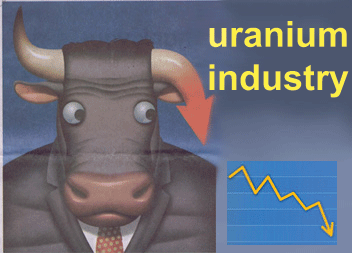
- Uranium is caught in a protracted slump that is sharply impacting uranium miners.
- Despite claims that prices will rise sentiment towards nuclear power has turned unfavorable.
- Demand growth for uranium remains muted which along with growing supplies will keep pressure on prices.
- There is no indication of a sustainable recovery in sight making uranium miners value traps.
There has been a surge in interest in uranium explorers and miners in recent months because of growing optimism surrounding the outlook for the radioactive metal. This has sparked a rash of upgrades for a number of uranium miners and explorers including Cameco Corp……
The marked uptick in the outlook for uranium is long over due with the radioactive metal caught in prolonged slump that now sees it trading at less than a sixth of its 2007 high………
Despite the proclamations of some analysts and market pundits there are distinct signs that point to a sustained recovery in uranium being unlikely and that the long-term prognosis for the fuel is poor.
What is driving this positive outlook? The progressively positive outlook for uranium mining stems from a belief that the current global supply glut which has been weighing heavily on uranium prices will be eliminated over the next two-years.
There is also the expectation among market pundits that as demand for the radioactive metal begins to grow global supplies will diminish. This is because the prolonged slump according to those pundits has led to a dearth in investment in exploration and mine development which will impact uranium production in coming months.
Furthermore, uranium miners have been forced to shutter high cost production because it was uneconomic at current prices. The slump in uranium particularly in the wake of the Fukushima disaster sent one of the world’s largest uranium miners Energy Resources of Australia (OTCPK:EGRAF) also known as ERA, which at its peak was supplying 10% of the world’s yellow cake, into terminal decline……(registered readers only) https://seekingalpha.com/article/4091999-death-spiral-nuclear-energy-demise-uranium-miners
July 29, 2017
Posted by Christina Macpherson |
2 WORLD, business and costs, Uranium |
Leave a comment
 Toshiba reaches $2.2 billion deal over SCANA’s South Carolina nuclear project http://www.reuters.com/article/us-toshiba-accounting-westinghouse-scana-idUSKBN1AC3DN (Reuters) – Toshiba Corp has agreed to pay $2.168 billion to walk away from two unfinished nuclear reactors in South Carolina being built by its Westinghouse subsidiary, according to a statement by the owners of project.
SCANA Corp (SCG.N) and its partner, state-owned utility Santee Cooper, said Toshiba will make the payments in installments beginning in October and ending in September 2022.
Toshiba’s Westinghouse Electric Co filed for bankruptcy in March, overwhelmed by the cost overruns at the VC Summer plant in South Carolina and a similar unfinished nuclear project known as Vogtle in Georgia. The projects are years behind schedule.
The agreement allows Toshiba and its Westinghouse unit to exit the nuclear construction business and caps Toshiba’s liability for guaranteeing that Westinghouse complete the VC Summer contract.
Toshiba reached a similar agreement for $3.7 billion in June with the utilities, led by a unit of Southern Co (SO.N), that own the Vogtle project.
Toshiba has warned that losses from Westinghouse threaten its future and it is considering bids for its flash memory chip unit, worth around $18 billion, to raise capital.
The owners of the VC Summer project said on Thursday they expect the cost of completing the project will “materially exceed” Westinghouse’s estimates and the payments due from Toshiba. They said they hope to decide soon whether they will continue with the two projects, modify them or abandon them.
Westinghouse is expected to deliver this week a five-year business plan to its lender, an affiliate of Apollo Global Management (APO.N). That plan will help shape bids for Westinghouse, which has attracted the interest of U.S. private equity firms.
As part of that plan, Westinghouse is expected to reach an agreement with SCANA under which it will continue to provide engineering and other services. Westinghouse has a similar agreement in place with the owners of the Vogtle plant.
Westinghouse asked the U.S. Bankruptcy Court in Manhattan, New York, on Wednesday to give it until Dec. 6 to file a plan of reorganization. The company said it needed more time in part due to talks with SCANA.
The request will be heard by the court on Sept. 7.
The Georgia and South Carolina plants were the first new nuclear power projects in the United States in three decades.
However, the projects have been dogged by design problems, disagreements with regulators and poor quality work by Westinghouse’s partners.
July 29, 2017
Posted by Christina Macpherson |
business and costs, Japan, USA |
Leave a comment

 EDF profits dented by nuclear woes,Telegraph, Jillian Ambrose 28 JULY 2017
Earnings at energy giant EDF have plummeted by a fifth in the first half of this year due to ongoing woes in its French fleet of nuclear reactors and lower profits from those in the UK.
The French state-backed group behind the UK’s first new nuclear plant in a generation, Hinkley Point C, has suffered a major setback to its domestic reactors, some of which have been closed for safety checks since October.
French nuclear power output fell by 3.9pc from the first half of last year to 197.2TWh in the six months to June 30, the group said. Despite a 4.2pc rise in UK EDF’s nuclear generation to 32.2TWh, the fleet of reactors were still a drain on earnings due to the weaker market price for electricity.
The slump in its two core markets wiped more than 20pc from its underlying earnings before interest, tax, debt and amortisation to €7bn (£6.3bn) but the group has assured investors that it remains on track to meet its guidance of between €13.7bn to €14.3bn for the year.
Jean-Bernard Lévy, EDF’s chairman and chief executive, underlined the “unfavourable market context” but said the group’s move towards renewable energy was accelerating……http://www.telegraph.co.uk/business/2017/07/28/edf-profits-dented-nuclear-woes/
July 29, 2017
Posted by Christina Macpherson |
business and costs, France |
Leave a comment
 FirstEnergy nuclear charges crucial to operating or selling Davis-Besse, Perry, says CEO, Cleveland.com 28 July 17 , By John Funk, The Plain Dealer, AKRON — FirstEnergy’s top executive says the company will continue to press Ohio lawmakers for new customer-paid subsidies for its nuclear power plants even though it may not own them in the future……
Chuck Jones, president and CEO, also revealed that FirstEnergy is preparing to talk to creditors of its subsidiary, FirstEnergy Solutions, the company that owns the corporation’s old, uncompetitive power plants, which have been losing money.
FirstEnergy Solutions’ debt and the declining value of its power plants has made it a potential liability as it negotiates with its creditors amidst rumors of an eventual bankruptcy, and FirstEnergy has tried to distance itself from the subsidiary……
As for the special, customer-paid charges to help Davis-Besse, Perry and Beaver Valley, Pa., nuclear power plants, Jones said he doubted anybody could operate them without special subsidies. The problem is that they cannot compete with gas turbine plants and, at times, with wind power.
“I’m not sure [they] will run unless there is something done either federally or by the state of Ohio to ensure they get a different financial return model,” Jones said.
The company previously said the nuclear charges would increase customer bills by about 5 percent. Subject to periodic review by state regulators, the charges would run for 17 years.
Selling the nuclear plants is part of the company’s overall plan “to exit the commodity-exposed generation business,” Jones said. In other words, if the company cannot have its power prices set by a state utility commission, it does not want to be in the generating business. ……
Jones also made it clear during the conference that FirstEnergy’s campaign to persuade Ohio lawmakers to approve a nuclear plant subsidy would continue no matter what the U.S. Department of Energy recommends.
The Trump administration in April asked the DOE to figure out whether wind, solar and natural gas power plants are forcing the premature retirement of very large old coal and nuclear power plants, and whether those closings might de-stabilize the nation’s high-voltage power grid……. http://www.cleveland.com/business/index.ssf/2017/07/firstenergy_nuclear_charges_cr.html
July 29, 2017
Posted by Christina Macpherson |
business and costs, politics, USA |
Leave a comment
















Chuck Jones, president and CEO, also revealed that FirstEnergy is preparing to talk to creditors of its subsidiary, FirstEnergy Solutions, the company that owns the corporation’s old, uncompetitive power plants, which have been losing money.
FirstEnergy Solutions’ debt and the declining value of its power plants has made it a potential liability as it negotiates with its creditors amidst rumors of an eventual bankruptcy, and FirstEnergy has tried to distance itself from the subsidiary……
As for the special, customer-paid charges to help Davis-Besse, Perry and Beaver Valley, Pa., nuclear power plants, Jones said he doubted anybody could operate them without special subsidies. The problem is that they cannot compete with gas turbine plants and, at times, with wind power.
“I’m not sure [they] will run unless there is something done either federally or by the state of Ohio to ensure they get a different financial return model,” Jones said.
The company previously said the nuclear charges would increase customer bills by about 5 percent. Subject to periodic review by state regulators, the charges would run for 17 years.
Selling the nuclear plants is part of the company’s overall plan “to exit the commodity-exposed generation business,” Jones said. In other words, if the company cannot have its power prices set by a state utility commission, it does not want to be in the generating business. ……
Jones also made it clear during the conference that FirstEnergy’s campaign to persuade Ohio lawmakers to approve a nuclear plant subsidy would continue no matter what the U.S. Department of Energy recommends.
The Trump administration in April asked the DOE to figure out whether wind, solar and natural gas power plants are forcing the premature retirement of very large old coal and nuclear power plants, and whether those closings might de-stabilize the nation’s high-voltage power grid……. http://www.cleveland.com/business/index.ssf/2017/07/firstenergy_nuclear_charges_cr.html