nuclear-news

The News That Matters about the Nuclear Industry Fukushima Chernobyl Mayak Three Mile Island Atomic Testing Radiation Isotope

FirstEnergy Solutions could go bankrupt. First Energy pleads for tax-payer subsidies

FirstEnergy CEO Discusses Possible Bankruptcy For Generation Company http://wvxu.org/post/firstenergy-ceo-discusses-possible-bankruptcy-generation-company#stream/0 The CEO of one of Ohio’s largest energy providers made a rare appearance before state lawmakers, pleading for nuclear plant subsidies. This push comes as the company is nearing a major decision

FirstEnergy CEO Chuck Jones personally went before the Ohio Senate, saying subsidies would prop up their two struggling nuclear plants.

If passed, FirstEnergy customers would see about a $5 increase to their monthly electric bills.

Time might be running out to save these plants. As Jones explains, the subsidiary FirstEnergy Solutions which controls all the power generation could soon declare bankruptcy.

“They’re looking at that right now. That decision could happen anywhere between today and six months from now.”

Jones pointed out that he does not make decisions for FirstEnergy Solutions.

The nuclear credits bill has stalled in the House and Senate and will likely not come back up until the fall.

May 20, 2017 Posted by | business and costs, politics, USA | Leave a comment

Delay for Finland’s Fennovoima nuclear project

Fennovoima nuclear project faces delays over safety clearance, building permit  yle uutiset , 19 May 17The Finnish Radiation and Nuclear Safety Authority STUK will not deliver a safety assessment and related building permit for the Fennovoima nuclear project slated for Pyhäjoki in northwest Finland this year. According to the daily Kaleva, the nuclear watchdog has said that the evaluation and permit will be delayed by one year to the end of 2018.

Finland’s nuclear safety watchdog STUK will not provide a safety assessment and building permit this year for the Fennovoima nuclear power plant to be built by Russian state-owned nuclear contractor Rosatom in northwest Finland, reports the daily Kaleva. Rosatom also owns 34 percent of the venture.

Finland’s Ministry of Economic Affairs originally hoped that STUK would be able to provide the clearances this year. However the authority now says that it won’t be able to deliver them before the end of 2018. It noted that completing the safety assessment depends on factors such as Fennovoima’s ability to update information about the project’s delivery timetable. STUK’s ability to furnish the approvals will also depend on the adequacy and comprehensiveness of the information provided……..

Investor haemorrhage

Meanwhile on Wednesday, the Helsinki city council launched moves to disconnect Vantaa Energy – in which it owns 40 percent of shares — from the Fennovoima nuclear power plant. However, Vantaa Energy chief executive Pertti Laukkanen said that the city of Vantaa, which owns the remaining 60 percent of the power company, is not likely to support selling off its holdings in the project.

A number of other Finnish investors have also bailed on the project over the years. The German-based power behemoth E.ON as well as duopolist retailer S Group both shed their stake in the project in 2012. Later in 2013, 15 members of the power consortium Voimaosakeyhtiö SF pulled out of the venture, while a subsidiary of the other duopolist retailer K Group left in 2014. Meanwhile local dairy giant Valio exited in 2015 during a rocky period caused by losses over western sanctions applied against Russia, one of its main markets.

Financing controversy

The Fennovoima nuclear power plant has faced a rocky road since it received a decision-in-principle for construction during the administration of ex-PM Matti Vanhanen back in 2010. The contentious project also saw the departure of the Green Party from Alexander Stubb’s coalition government in 2014, when it decided to proceed with the proposed plant.

The project also stirred up controversy over financing arrangements when a murky Croatian firm – later found to be a front for Russian investors — emerged as a backer to help Fennovoima make up the 60-percent domestic- EU ownership required by the Finnish government. There was also speculation that state energy giant Fortum had been pressured to come forward as an investor following initial resistance to the project.

The project has faced opposition from environmentalists in Finland and Sweden and has also come under intense scrutiny over concerns about Finland’s energy dependence on Russia. http://yle.fi/uutiset/osasto/news/daily_fennovoima_nuclear_project_faces_delays_over_safety_clearance_building_permit/9622096

May 20, 2017 Posted by | business and costs, Finland | Leave a comment

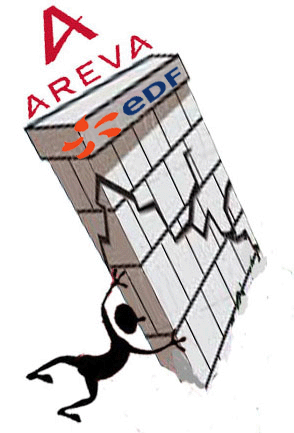
European Commission scheduled to decide on EDF to gain controlling stake in AREVA nuclear corporation

EDF set to win EU approval for Areva nuclear reactor deal – source , Reuters, By Foo Yun Chee | BRUSSELS, 19 May 17,   French utility EDF (EDF.PA) is set to gain unconditional approval from the EU competition authorities for its plan to acquire a controlling stake in ailing nuclear power engineering group Areva’s (AREVA.PA) reactor business, a person familiar with the matter said on Friday.

State-controlled EDF wants to acquire 51 to 75 percent of Areva NP, which designs, manufactures and services nuclear reactors and is worth about 2.5 billion euros ($2.8 billion).

The deal is crucial for France, which has Europe’s largest network of nuclear plants, and uses EDF and Areva to spearhead its export efforts against competition from Russia’s Rosatom and Japan’s Hitachi Ltd (6501.T).

The European Commission, which is scheduled to decide on the deal by May 29, declined to comment. EDF and Areva had no immediate comment….http://www.reuters.com/article/us-areva-m-a-edf-eu-idUSKCN18F23I

May 20, 2017 Posted by | business and costs, France, politics international | Leave a comment

AREVA and EDF pin their hopes on delayed, super-costly, Olkiluoto-3 nuclear project

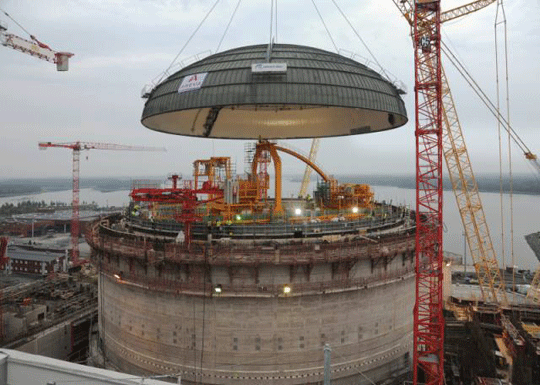
Nuclear plant nears completion after huge delays, Western Europe’s first atomic power station in 15 years is test of Areva technology FT.COM 18 MAY 17  by: , Energy Editor  On the shores of the Baltic Sea, beneath the big azure sky of a Nordic spring, Finland’s Olkiluoto-3 nuclear plant looks almost complete.

A team of painting contractors streaming out of the red reactor building at the end of their shift are the only external sign that this is still a work in progress. Yet, as the final touches are made to western Europe’s first new nuclear power station for 15 years, its owners have a blunt assessment of progress. “If the nuclear industry wants to have a future it cannot afford more projects like this,” says Pekka Lundmark, chief executive of Fortum, the Finnish power company which owns a 26 per cent stake in TVO, the consortium behind Olkiluoto-3.

Areva, the French reactor manufacturer, began building Olkiluoto in 2005 with a target for completion by 2009 at a cost of €3.2bn. The latest timetable would see it open almost a decade late at the end of 2018 and nearly three times over budget at €8.5bn. The project is the most extreme example of the delays and cost overruns which have become commonplace in the nuclear industry, plunging reactor companies such as Areva and Toshiba’s Westinghouse subsidiary into financial crisis………

Olkiluoto is entering a crucial phase with “cold functional testing”, the first operational trials of the reactor system, due to start in June. Several further important milestones must be cleared in the months ahead before the Finnish nuclear regulator can issue an operating licence…….

TVO facing an awkward balancing act, between co-operating with Areva to finish the project while simultaneously pursuing the French company and its former partner, Siemens, for billions of euros of compensation for the delays.

Talks aimed at a settlement broke down a year ago and the International Court of Arbitration made a “partial award” last November in favour of TVO. It has yet to rule how much Areva and Siemens, which exited the consortium in 2009, must pay. Olkiluoto liabilities were among the main factors which led the French government to arrange a €5bn bailout of Areva, 87 per cent owned by the state, and force it into a tie-up with EDF, the French utility, due for completion this year. Responsibility for Olkiluoto will remain in a separate “old Areva” to protect state-controlled EDF from TVO’s compensation claim, which would ultimately be borne by French taxpayers. The restructuring has raised alarm in Finland that Areva might neglect Olkiluoto in favour of projects at Flamanville in France and Hinkley Point in the UK which are both led by EDF. All three projects involve the European Pressurised Reactor, technology conceived by French and German engineers in the 1990s that was supposed to herald a new era of international growth for the French nuclear industry. Instead, it has turned into a nightmare as construction problems, along with renewed safety fears after the meltdown in 2011 at Japan’s Fukushima nuclear plant, have combined to curb demand.

The EPR was designed with safety as the top priority after the Chernobyl meltdown in Ukraine a decade earlier spewed radioactive fallout across Europe. But extra safeguards, such as a concrete dome over the reactor strong enough to withstand an aircraft strike, have proved ruinously expensive to build.

……..The Flamanville plant is six years late and €7bn over budget, with the risk of further delays beyond the current 2018 opening target as French regulators scrutinise potential faults with reactor components…….

EDF and Areva are hoping for a smoother experience at Hinkley Point, where concrete was poured for the first permanent structures in March…..
After heavy losses elsewhere, EDF and Areva desperately need to make money from Hinkley’s two reactors. The £18bn project has been criticised in Britain for the £92.50 per megawatt hour price guaranteed to EDF for electricity from the plant, rising with inflation for 35 years. That is more than twice the current wholesale price, but it will only prove a good deal for EDF if it can control construction costs better than has been the case at Flamanville and Olkiluoto……..https://www.ft.com/content/36bee56a-3a01-11e7-821a-6027b8a20f23 

May 19, 2017 Posted by | business and costs, Finland | Leave a comment

Nuclear companies EDF and AREVA create a new nuclear company EDVANCE

Global News Wire 17th May 2017 EDF Group’s Board of Directors has approved the creation of the company EDVANCE which brings together EDF and AREVA NP engineers. This is a significant milestone in the reconstruction of the nuclear industry, announced in June 2015.
EDVANCE will be in charge of the basic design and implementation (studies, procurement support, assembly and commissioning) for projects involving nuclear islands and control systems for new reactors being built, both in France and around the world.
EDF will own 80% of the company’s capital, while AREVA NP will own 20%. This new company is set up independently from EDF’s acquisition of the exclusive control over NEW AREVA NP, planned for the end of 2017. http://globenewswire.com/news-release/2017/05/17/987156/0/en/EDF-EDF-Board-of-Directors-approves-the-creation-of-EDVANCE-a-significant-milestone-in-the-reconstruction-of-the-French-nuclear-industry.html

May 19, 2017 Posted by | business and costs, France | Leave a comment

NuGen’s Moorside nuclear project in limbo – unstable and unsustainable.

CORE 17th May 2017, Plans to build the £2.8Bn power transmission line connecting NuGen’s delayed Moorside project have been put on hold by National Grid so that it can align its plans with those of developer NuGen which have already been put on-hold.

NuGen has been forced to undertake a ‘strategic review of options’ following the financial meltdown of Moorside’s sole investor Toshiba and the bankruptcy of its subsidiary Westinghouse who was to supply the AP1000 reactors for the project.

Another casualty of NuGen’s faltering progress are the 1200 respondents to its Stage 2 public consultation which finished at the end of July 2016. Today, almost 10 months later, the consultation feedback report promised by NuGen for ‘Autumn 2016’ has still not materialised and neither has NuGen indicated that it will hold the further consultation called for by CORE, local authorities and others to make up for the lack of detailed information provided in the Stage 2 consultation documents.

These failures, in tandem with NuGen’s current Strategic Review of options, designed ‘to provide a more robust, stable and sustainable platform to meet its commitment to deliver the next generation of nuclear power’ has left those respondents not only in a NuGen no-man’s land but also questioning the merit of having already spent time and effort on responding to a project that now appears not only less than robust but also unstable and unsustainable. ..  http://corecumbria.co.uk/briefings/nugens-investment-turmoil-sparks-pylon-delay-for-moorside-new-build/

May 19, 2017 Posted by | business and costs, UK | Leave a comment

Ohio House Public Utilities Committee suspends further hearings on FirstEnergy’s special nuclear customer charges

FirstEnergy nuclear hearings suspended in Ohio House, Cleveland.com  By John Funk, The Plain 
 May 17, 2017  CLEVELAND, Ohio — The chairman of the Ohio House Public Utilities Committee has suspended further hearings — and a vote — on a proposed bill allowing FirstEnergy to create a special customer charge to subsidize its nuclear power plant fleet.

“We have heard over 10 hours of testimony on this bill [House Bill 178]. I have given proponents and opponents a chance to make their case,” said William Seitz, a Cincinnati Republican who chairs the committee.

“I am not sensing a keen desire on the part of the House members to vote on this and doubt that we will have more hearings in the near future unless something cataclysmic should happen.”

Cataclysmic events might include a decision by FirstEnergy Solutions to seek bankruptcy protection from its creditors or a decision by the company to immediately close its four nuclear power plants.

FirstEnergy Solutions, the unregulated subsidiary of FirstEnergy, is legally the owner of all of the company’s power plants. FirstEnergy Solutions has been operating with junk bond ratings for some time.

Its parent has tried to distance itself from the company, even creating a separate board of directors, which includes two FirstEnergy employees. But FirstEnergy recently had to guarantee a cash settlement between FirstEnergy Solutions and several railroad companies claiming breach of contract when FirstEnergy Solutions closed coal-fired power plants along Lake Erie and declined further deliveries…….http://www.cleveland.com/business/index.ssf/2017/05/firstenergy_nuclear_hearings_s.html

May 19, 2017 Posted by | business and costs, politics, USA | Leave a comment

Global nuclear lobby very upset at election of South Korea’s President Moon Jae-in

New South Korean President Seen Hindering Nuclear Ambitions, Bloomberg by Stephen Stapczynski

May 16, 2017, 
  • Moon Jae-in campaigned to block new reactor construction
  • Kepco shares fell 5.8% on May 10 following election results

“… South Korea’s Moon Jae-in promised during his successful presidential campaign to scrap or suspend new atomic plants.

Now that Moon is president, that anti-nuclear stance is seen as a threat to South Korea’s ambitions to become a bigger exporter of nuclear equipment and technology — a market valued at as much as $740 billion over the next 10 years.

“If the new government withdraws its support for nuclear development in South Korea, this could send a negative signal to foreign countries looking to purchase reactors,” Kerry-Anne Shanks, a Singapore-based analyst at Wood Mackenzie Ltd., said by email. “An anti-nuclear stance could challenge Korea’s ambitions to export nuclear technology to other countries.”………

Besides the curbs on new nuclear facilities, Moon also campaigned to cancel any lifetime extensions for existing nuclear plants and to develop a roadmap to eventually rid the nation of atomic power altogether. In nuclear’s place, Moon would place greater emphasis on natural gas and renewables. On Monday, the new president ordered the shutdown for the month of June of 10 coal-fired power plants that have been operating for more than 30 years to cut pollution…..

“Exporting nuclear power plants requires substantial up-front financial support from the vendor and its home government,” said Rod Adams, publisher of Atomic Insights, an industry news website. “There is already some evidence suggesting that the anti-nuclear stance of President Moon Jae-in will make it more difficult for South Korea to export nuclear reactors.”…..

May 17, 2017 Posted by | business and costs, politics international, South Korea | Leave a comment

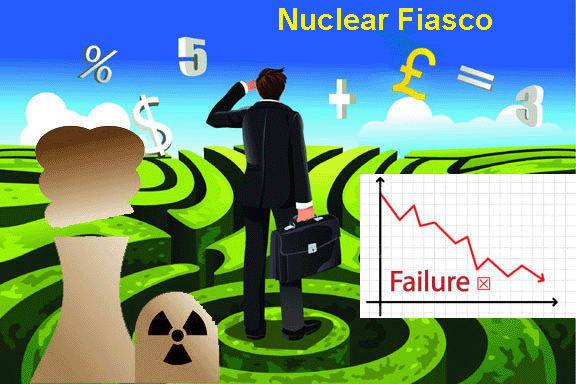
The nuclear industry in financial meltdown

This is no short-term trend.  While gas and renewables get cheaper, the price of nuclear power only rises. 

Most environmentalists are ardent opponents of the nuclear industry. For many the prime concern is its poor safety record. Others recoil at the inescapable technological link to nuclear weapons production and at nuclear’s many unresolved problems

Industry Meltdown: Is the Era of Nuclear Power Coming to an End?, Yale Environment 360  From Europe to Japan to the U.S., nuclear power is in retreat, as plants are being shuttered, governments move toward renewables, and key companies face financial troubles. Even some of the industry’s biggest boosters believe nuclear is on the way out.   Is the nuclear power industry in its death throes?  Even some nuclear enthusiasts believe so. With the exception of China, most nations are moving away from nuclear — existing power plants across the United States are being shut early; new reactor designs are falling foul of regulators, and public support remains in free fall. Now come the bankruptcies.

In an astonishing hammer blow to a global industry in late March, Pittsburgh-based Westinghouse — the original developer of the workhorse of the global nuclear industry, the pressurized-water reactor (PWR), and for many decades the world’s largest provider of nuclear technology — filed for bankruptcy after hitting big problems with its latest reactor design, the AP1000.

Largely as a result, its parent company, the Japanese nuclear engineering giant Toshiba, is also in dire financial straits and admits there is “substantial doubt” about its ability to continue as a going concern.

Meanwhile, France’s state-owned Électricité de France (EDF), Europe’s biggest builder and operator of nuclear power plants, is deep in debt thanks to its own technical missteps and could become a victim of the economic and energy policies of incoming President Emmanuel Macron.

Those three companies account for more than half of all nuclear power generation worldwide. Their “looming insolvency … has set off a chain reaction of events that threatens the existence of nuclear power in the West,” says Michael Shellenberger, president of the pro-nuclear NGO, Environmental Progress.

“The nuclear industry as we have known it is coming to an end,” says Ted Nordhaus of the Breakthrough Institute, a California eco-modernist think tank that advocates for nuclear power.

Can this be true?

The U.S. remains the world’s largest producer of nuclear power, with about 100 commercial reactors in operation. New construction virtually shut down after the near-meltdown at Three Mile Island in Pennsylvania in 1979. Recently, a stuttering renaissance has been under way.  Westinghouse has been building four new reactors at Waynesboro, Georgia, and Jenkinsville, South Carolina.

But those reactors have hit regulatory holdups and technical problems that have pushed cost overruns to an estimated $13 billion. And with Westinghouse in financial meltdown, it is now far from clear that they ever will be finished.

Meanwhile across the country, utilities are shutting existing plants from California to Wisconsin to Vermont, often long before the end of their design life, because they cannot compete with cheap fracked gas or, increasingly, with wind and solar power. Fourteen power reactors have shut since 2012.

This is no short-term trend.  While gas and renewables get cheaper, the price of nuclear power only rises. This is in large part to meet safety concerns linked to past reactor disasters like Chernobyl and Fukushima and to post-9/11 security worries, and also a result of utilities factoring in the costs of decommissioning their aging reactors.  ……..

Shellenberger suggests that an Asian takeover might be a good thing for the West. A beaten and bankrupt industry built on high-cost, bespoke construction could be ripe for annexation by companies that have learned to mass-produce reactors based on old Westinghouse PWR designs and that have replaced nuclear scientists with engineers and experimentation with replication. “What makes nuclear plants safer and cheaper to build and operate is experience, not new designs,” Shellenberger says……..

Most environmentalists are nonetheless ardent opponents of the nuclear industry. For many the prime concern is its poor safety record. Others recoil at the inescapable technological link to nuclear weapons production and at nuclear’s many unresolved problems with waste disposal and decommissioning; they also see nuclear as a rival for investment in renewables, their preferred choice for a low-carbon future. They would happily consign nuclear power to the dustbin of history……..

the industry is in crisis. It looks ever more like a 20th- century industrial dinosaur, unloved by investors, the public, and policymakers alike. The crisis could prove terminal. http://e360.yale.edu/features/industry-meltdown-is-era-of-nuclear-power-coming-to-an-end

May 17, 2017 Posted by | 2 WORLD, business and costs | Leave a comment

Owners of unfinished Vogtle nuclear power plant to cap Toshiba’s liabilities

Power plant owners limit Toshiba’s Westinghouse liabilities: sources, Reuters, By Tom Hals and Jessica DiNapoli , 15 May 17  WILMINGTON, DEL/NEW YORK The owners of the unfinished Vogtle power plant in Georgia led by Southern Co (SO.N) agreed to cap Toshiba Corp’s (6502.T) responsibility for its guarantees on the much-delayed nuclear project, helping ease the Japanese electronics maker’s financial stress, people familiar with the matter said on Sunday.

The agreement pegs Toshiba’s guarantees for the unfinished Vogtle plant at about $3.6 billion, payable over at least three years, the people said, adding the deal was not yet final.

The deal is also contingent on the owners of the incomplete V.C. Summer power plant in South Carolina, including utility company SCANA Corp (SCG.N), coming to a similar agreement with Toshiba, said the people, who could not be identified because the talks are not public………http://uk.reuters.com/article/us-toshiba-accounting-southern-co-idUKKCN18A120

May 17, 2017 Posted by | business and costs, USA | Leave a comment

France’s nuclear company EDF buys majority stake in wind power developer

Energy Live News 15th May 2017, EDF’s renewable arm has confirmed plans to buy a majority stake in an onshore wind power developer. EDF Energies Nouvelles said it has reached a full and final agreement with the shareholders of FUTUREN to buy a 67.2% interest in the company. FUTUREN has operations in France, Germany, Italy and Morocco and currently operates around 745MW of assets in those countries….. http://www.energylivenews.com/2017/05/15/edf-to-buy-majority-stake-in-onshore-wind-developer/

May 17, 2017 Posted by | business and costs, renewable | Leave a comment

UK National Grid halts plan for Moorside nuclear plant connection

Utility Week 15th May 2017, National Grid hits pause on Moorside connection. Plans shelved for “biggest new power line since electricity network was built”. Plans to build a 102-mile power line connecting the proposed Moorside nuclear plant in Cumbria to the transmission network have been placed on hold, National Grid has revealed.

The news comes after developer NuGen confirmed earlier this month that it was conducting a “strategic review of its options” following reports that its main shareholder, Toshiba, may mothball the Moorside project.
http://utilityweek.co.uk/news/National-Grid-hits-pause-on-Moorside-connection/1302702

May 17, 2017 Posted by | business and costs, politics, UK | Leave a comment

Japan’s Toshiba Corporation expects net loss of JPY950 billion ($8.4 billion) for the 2016-2017 financial year

World Nuclear News 15th May 2017, Japan’s Toshiba Corporation expects to report a consolidated net loss of
JPY950 billion ($8.4 billion) for the 2016-2017 financial year, ending 31
March, according to unaudited results it released today. Last month, the
company warned of a net loss for the full year of about JPY1 trillion….  http://www.world-nuclear-news.org/C-Toshiba-projects-JPY950-billion-loss-for-FY2016-1505175.html

May 17, 2017 Posted by | business and costs, Japan | Leave a comment

BMO Global Asset Management dumps BHP Billiton and other fossil fuel shares

Guardian 15th May 2017, Archbishop of Canterbury plays crucial role in BMO Global Asset Management’s decision to dump £20m of shares in firms such as BHP Billiton  One of Britain’s biggest managers of ethical funds is to dump £20m of shares in fossil fuel companies in one of the biggest divestments so farbecause of climate change.

Shares in BHP Billiton, the Anglo-Australian mining giant, will be among those sold by BMO Global Asset Management’s range of “responsible” funds, which manage £1.5bn of assets. They were previously known as the “stewardship” funds, the first ethical funds launched in Britain. The archbishop of Canterbury, Justin Welby, played a crucial role in the divestment, as president of BMO’s responsible investment council. The Church of England has already pulled out of investing in companies that make more than 10% of its revenues from thermal coal or oil from tar sands….. https://www.theguardian.com/environment/2017/may/15/top-uk-fund-manager-divests-from-fossil-fuels

May 17, 2017 Posted by | business and costs, climate change, UK | Leave a comment

Energy utility Southern Co calls on Trump for help, as it takes over Vogtle nuclear station construction

Southern to Take Over Westinghouse Georgia Nuclear Project https://www.bloomberg.com/news/articles/2017-05-13/southern-to-take-over-georgia-reactor-projects-from-westinghouse by 

Stephen Cunningham and Tiffany Kary  May 14, 2017, 
  • Westinghouse bankruptcy threw fate of reactors into question
  • Southern has appealed to Trump administration for help
  • Utility owner Southern Co. has agreed to take the lead on building two nuclear reactors at its Vogtle power plant in Georgia from bankrupt contractor Westinghouse Electric Co. as soon as next month.

    The Atlanta-based utility owner said in a statement late Friday that an interim contract with Westinghouse will be extended to June 3 while the companies finalize and gain approval for a new service agreement. Just last week, Southern Chief Executive Officer Thomas Fanning said Toshiba Corp.’s Westinghouse unit had “given every indication” it wanted out of the pact to build reactors but was refraining from a decision under the contract that was due to expire Friday.

  • Westinghouse’s bankruptcy in March threw into question the fate of four U.S. nuclear reactors — the two at Southern’s Vogtle plant and another two being built at Scana Corp.’s V.C. Summer station in South Carolina. The projects were the first to gain U.S. approval for construction in more than 30 years and were once seen as ushering in a new wave of nuclear generation in the country. Fanning has said his company could take over the work at Vogtle if Toshiba provides $3.7 billion to finish it as promised. The deal is said to also depend in part on Scana agreeing to follow suit, so the two companies will be able to share resources.
  • The companies reached an agreement in principle that “allows for the transition of project management from Westinghouse” to Southern once their current engineering and construction contract is rejected in Westinghouse’s bankruptcy case, Southern said in its statement. “During this time, work will continue at the site and an orderly transition of project management will begin.”
  • Westinghouse has meanwhile already laid out plans to ditch the money-losing business of building reactors and instead focus on servicing and decommissioning work. It set up agreements with both Southern and Scana to give them more time to decide whether they wanted to continue construction.

    In March, less than 24 hours after Westinghouse filed for bankruptcy, Southern’s Fanning said in a Bloomberg Television interview that he flewto Tokyo just to “look the CEO of Toshiba in the eye” and remind him that his company had a “moral commitment” to getting the Vogtle project done. Both Fanning and Georgia regulators have appealed to the Trump administration for help in finishing the project.

  • In April, Scana and Westinghouse agreed to extend a review of the V.C. Summer nuclear project until June 26.

    In Westinghouse’s bankruptcy, the most significant debts are held by Apollo Global Management LLC, which financed an $800 million operating loan, and parent Toshiba. The Chapter 11 case has moved slowly, with Westinghouse recently asking for a two-week delay until May 26 to file a full schedule of its assets and debts.

May 15, 2017 Posted by | business and costs, politics, USA | Leave a comment