Sellafield chairman to step down, The Mail, 22 September 2017
THE boss of a nuclear decommissioning site will be stepping down from his role later this month, sparking a search for his replacement.
Tony Fountain will exchange his role as chair at Sellafield after completing only half of his three year tenure in the plant’s hot seat, in favour of the international company Essar Oil.
Mr Fountain first took up the role in April last year when Sellafield Ltd became a wholly owned subsidiary of the Nuclear Decommissioning Authority (NDA), taking the management of the site away from international consortium Nuclear Management Partners.
Guardian 21st Sept 2017,The UK’s first new nuclear power plant for 20 years could be delayed
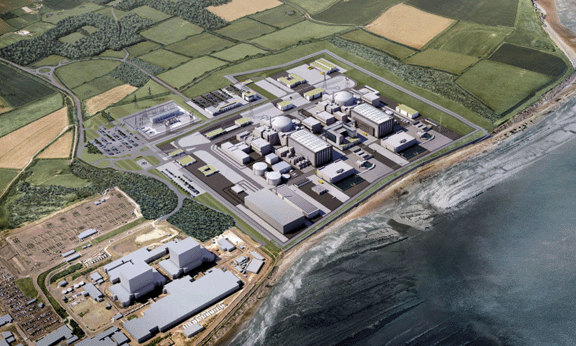
again, after trade unions for construction staff working on the £20bn
Hinkley Point C project announced a ballot for strike action in a dispute
over pay. More than 95% of members balloted by GMB and Unite rejected a pay
increase offered by the French energy company EDF and its contractor Bylor
after months of discussions. Any extension of the labour dispute risks
further time and cost overruns for Europe’s largest construction project,
which is already behind schedule and over budget. https://www.theguardian.com/uk-news/2017/sep/21/hinkley-point-c-fresh-strike-threat-over-pay-dispute-delays
FT 17th Sept 2017, Westinghouse will emerge from bankruptcy protection “very soon” but its
future ownership remains shrouded in doubt as Toshiba mulls a potential
sale of its US nuclear business. José Gutiérrez, chief executive of
Westinghouse, said the company “was in a much better situation” than
many people imagined and hoped to emerge from the US Chapter 11 process
once a restructuring plan was agreed “in the next few months”.
However, he acknowledged that Toshiba must first decide what it wants to do with the
company, with options including a sale of the whole business or parts of
it. Toshiba has said it is “actively considering” a sale of
Westinghouse as it battles to prevent the business from dragging down the
rest of the Japanese conglomerate.
Analysts say political barriers will narrow down an already limited field of potential buyers, with Chinese and
Russian companies almost certainly unacceptable to Washington. Europe’s
biggest nuclear companies, Areva and EDF of France, are facing their own
financial turmoil and competitors such as General Electric in the US,
Hitachi in Japan and Kepco in South Korea are not rushing to rescue their
rival. https://www.ft.com/content/a9bb6e08-9a19-11e7-b83c-9588e51488a0
The Japanese conglomerate is on the hunt for a project partner to safeguard Europe’s largest planned new nuclear plant after France’s Engie abandoned its support of the venture in the wake of Toshiba’s spiralling financial woes.
China General Nuclear (CGN) confirmed that it is in the running to shore up the 3.8GW project in exchange for an equity share, in a move which would also deepen its stake in the UK’s nuclear ambitions. “We are willing to utilise our experience in nuclear design, construction and operation for more than 30 years to support the development of Britain’s nuclear industry,” CGN confirmed in a statement to Reuters.
The South Korean state-backed utility has harboured an interest in Moorside since 2013, but said it would want to use its own nuclear design rather than one made by Toshiba’s Westinghouse nuclear business.
Westinghouse plunged into Chapter 11 bankruptcy in the US earlier this year after amassing losses of $9bn (£6.6bn) for Toshiba due to a string of struggling US projects.The deal would hand CGN access to a fourth nuclear project in the UK. It has already teamed up with EDF Energy to finance a third of the Hinkley Point C project and a fifth of its Sizewell B nuclear plans.
In the future CGN also plans to lead the plans to build the Bradwell C nuclear plant in Essex with a 66pc stake in the venture.
At Moorside CGN is also likely to want to use its own reactor design, in order to prove its mettle to other prospective new markets. However, it will take at least four years before CGN’s reactor design could be approved by the nuclear authority for use in the UK.
A lengthy approval process would also be required of a Kepco reactor design which could derail the 2025 startdate by at least two years in a further blow to the UK’s new nuclear ambitions.
EDF admitted earlier this year that the start-up date for Hinkley Point C is likely to be two years later than first thought at 2027 and pile a further €1bn (£870m) to €3bn euros on to the construction costs of the £18bn project.
The delays to new nuclear projects raises questions over the UK’s energy supplies in the middle of the next decade. More than two thirds of the country’s power generation capacity will have retired between 2010 and 2030.
Renewable Energy Industry Hotting Up as World Goes Cold on Nuclear Power https://sputniknews.com/environment/201709151057423093-nuclear-energy-industry-decline/Nuclear power is on its way out the world over, with its global share of energy generation declining and construction of just one new nuclear reactor being undertaken in 2017. Renewable energy seems poised to take its place as the energy source of the future.
Nuclear power is in a state of terminal decline, with construction of just one new nuclear reactor being undertaken in 2017, according to the World Nuclear Industry Report, an annual study of the sector that analyzes data on capacity, production and construction of nuclear reactors around the world.
Once vaunted as the future of energy production, nuclear power has suffered an unceremonious fall from grace since the 1960s — to the point the report suggests it will be phased out entirely in due course.
The number of nuclear reactors under construction has diminished for the fourth consecutive year, falling from 68 in 2013 to 53 in 2017 — and the report’s authors suspect projects are often ongoing purely because of uncertainty and inertia in the industry.
Russia and the US shut down reactorsin 2016, while Sweden and South Korea both closed their oldest units in the first half of 2017. There are 37 reactor constructions behind schedule, of which 19 reported further delays over the past year — eight projects have been under construction for a decade or more, of which three for over 30 years. In January, there were 17 reactors scheduled for startup before the end of the years, although as of mid-2017, but two of these units had started up and 11 were delayed until at least 2018.
The industry’s financial crisis may play a role in the failure of projects to get off the ground on schedule — after the discovery of massive losses over its nuclear construction projects, Toshiba filed for bankruptcy of its US subsidiary Westinghouse, the largest nuclear power builder in history, and industry giant AREVA has accumulated US$12.3 billion in losses since 2011.
Nonetheless, nuclear power’s global share of electricity generation has only declined meagerly (-0.2 percent), to 10.5 percent in 2017, with five countries producing 70 percent of total nuclear energy in the world — although in 1996, this figure stood at 18 percent. The two largest producers, the US and France, account for half total production.
By contrast, wind power output grew by 16 percent and solar by 30 percent in 2016. Wind power increased generation by 132 TWh, solar by 77 TWh, respectively 3.8 times and 2.2 times more than nuclear’s 35 TWh. Renewables represented 62 percent of global power generating capacity additions, and rnewable energy auctions achieved record low prices at and below US$30/ MWh in Chile, Mexico, Morocco, United Arab Emirates, and the US. Average generating costs of amortized nuclear power plants in the US were US$35.5 in 2015.
The fall in costs for renewable energies has attracted significant investment, with over US$240 billion invested in renewable energies compared to only about US$10 billion in the nuclear sector.
Look East
Nonetheless, the report highlights that China is a notable exception to the overall anti-nuclear trend — in 2016, the world’s nuclear production increased by 1.4 percent due to a 23 percent increase in Beijing’s production, and China is “the only country” to persist in building a “significant number” of nuclear reactors. Of the world’s remaining nuclear reactors under construction, 20 are sited in China, although 11 are behind schedule.
Still, the Chinese exception could also be nearing its end, given in 2017 no nuclear reactor was built in the country, although the report acknowledges it’s “too early” to draw concrete conclusions.
The two biggest issues with nuclear energy are set-up costs for production, and dealing with resultant waste. Every few years, a portion of a nuclear power station’s spent fuel — composed of uranium that failed to fission, the products of fission, and plutonium — is removed from the reactor to be stored in water, which both cools it and blocks its radiation. This decay can take up to hundreds of thousands of years, however.
World Nuclear Industry Status Report 12th Sept 2017, The World Nuclear Industry Status Report 2017 (WNISR2017) provides a comprehensive overview of nuclear power plant data, including information
on operation, production and construction. The WNISR assesses the status of
new-build programs in current nuclear countries as well as in potential
newcomer countries.
The WNISR2017 edition includes a new assessment from an
equity analyst view of the financial crisis of the nuclear sector and some
of its biggest industrial players. The Fukushima Status Report provides not
only an update on onsite and offsite issues six years after the beginning
of the catastrophe, but also the latest official and new independent cost
evaluations of the disaster.
Focus chapters provide in-depth analysis of
France, Japan, South Korea, the United Kingdom and the United States. The
Nuclear Power vs Renewable Energy chapter provides global comparative data
on investment, capacity, and generation from nuclear, wind and solar
energy. Finally, Annex 1 presents a country-by-country overview of all
other countries operating nuclear power plants. https://www.worldnuclearreport.org/-2017-.html
SA could start nuclear procurement process again as soon as next month
The chairperson of the Necsa, speaking at the World Nuclear Association conference in London, says the politicians just have ‘to press the re-start button’ Business Live 15 SEPTEMBER 2017 ALEXANDER WINNING LONDON —SA could re-start a procurement process for its nuclear expansion project as soon as next month, but the government still has to determine the exact timing, the chairperson of the South African Nuclear Energy Corporation (Necsa) said on Friday.
SA is planning to build several new nuclear reactors with a combined capacity of 9,600MW, which could be one of the world’s biggest nuclear deals in decades. The plans aim to help resolve the country’s chronic power shortages.
The plans were disrupted this year when SA’s High Court ruled that a nuclear co-operation pact with Russia was unlawful, after which the government started to draw up new pacts with countries with nuclear expertise. South African officials have made progress on the nuclear project since the court ruling, selecting potential sites for the new power stations, Necsa chairperson, Kelvin Kemm told Reuters.
Speaking on the sidelines of the World Nuclear Association conference in London, he said Eskom and Necsa were ready to proceed. “All that needs to happen is for the politicians to press the re-start button.”…….
Nuclear reactor makers, including Russia’s Rosatom, South Korea’s Kepco, France’s EDF and Areva, Toshiba-owned Westinghouse and China’s CGN are eyeing the South African project, which could be worth tens of billions of dollars.
A senior executive from Russian state firm Rosatom told Reuters on Thursday his firm was keen to win the contract and was ready to use a business model suitable to SA…….
Zuma’s opponents have said the project could be used as a conduit for corruption, a charge the president and officials deny. Some investors say the project is too big and expensive for a developing economy, such as SA.
Nuclear power is phasing out but hasn’t disappeared yet. According to the World Nuclear Industry 2017 report, the annual study of the sector conducted by Mycle Schneider, the expansion of nuclear power plants seems concluded.
Inertia-driven sector
But the sector’s inherent inertia means that despite the slowdown, some projects are still being developed.
“The nuclear sector’s inertia means that projects launched before the Fukushima disaster five years ago are still running”, explains Schneider.
“How is it possible that despite increasing costs and the Fukushima disaster, nuclear power has not been abandoned as a source of energy?”, asked German Green MEP Rebecca Harms.
The World Nuclear Industry report, financed by the European Green Party (EGP), analysed data on the capacity, production and construction of nuclear reactors around the world.
Data in the 2017 edition of this report signal to a phase out of the sector. The number of nuclear reactors under construction has diminished for the fourth consecutive year, going from 68 in 2013 to 53 in 2017.
In 2016, the world’s nuclear production has increased by 1.4% thanks to a 23% increase in China’s production.
Globally, the share of nuclear power in electricity generation (10.5% in 2017) has declined only very slightly (-0.2%).
Today five countries produce 70% of total nuclear energy in the world. The two largest producers, the US and France, account for half of total production. China’s exception
Yet in recent years “China is the only country to keep building a significant number of nuclear reactors,” highlights the report.
The Chinese exception could also be nearing its time, given that in 2017 no nuclear reactor was built in China. But “it is too early to say” whether this is the end of China’s nuclear expansion according to Schneider.
Renewables on the rise
In 2016, the energy generating capacity of the nuclear sector has increased by 9 GW compared to 2015. By comparison, solar has risen by 75% and wind energy by 55 GW. The fall in costs for renewable energies has increased the sector’s competitiveness on the energy market, attracting significant investment.
According to the report, in 2016, more than “$240 billion [€202 billion] was invested in renewable energies compared to about $10 billion [€8.4 billion] in the nuclear sector”, according to Andreas Rüdinger, a researcher at the sustainable development and international relations Institute (IDDRI) in Paris.
The Brokdorf nuclear power station, located in northern Germany, was taken offline in February after maintenance showed its reactor’s fuel rods had begun to unexpectedly oxidise.
A regional nuclear supervisory body has now ruled that the plant can be booted back up but only in “safe mode”, according to Schleswig-Holstein’s energy transition minister.
State Minister for Energy Robert Habeck (Greens) added that the power plant’s output should not be increased or decreased at short notice to adapt to the supply of renewable energies on the electricity grid. The minister warned that “atomic energy is not a bridging technology”.
A 2011 study by Greenpeace also concluded that renewables and nuclear are not compatible and that fuel rod damage is a possible consequence.
Kiel’s nuclear supervisory authority explained that the corrosion of Brokdorf’s fuel rods was a result of the reactor’s capacity being increased from 1,440 MW to 1,480 MW in 2006.
The investigation also concluded that the decision to run the plant as a load-following power station, where output was tailored to grid fluctuations, contributed to the damage.
“According to our findings, this stress has contributed to the unexpected oxidisation of the upper parts of some of the fuel rods,” Habeck explained.
The practice of quickly increasing or decreasing electricity generation to compensate for excessive or reduced renewable output has been particularly prevalent since 2015.
In 2015, the cost of switching off wind turbines in the northern German region, when electricity networks had reached their capacity, was particularly high.
The damage at Brokdorf was discovered in February when the plant was shut down for an inspection. Oxidisation that exceeded safety levels was recorded on ten fuel rods across three fuel elements. However, evidence of increased corrosion has been present since 2011, according to Habeck’s ministry.
Brokdorf’s period of inactivity has cost plant owner EON more than €100 million, according to reports by Bloomberg.
The shutdown came at a delicate time for the company, which at the beginning of this month transferred €24 billion to the German government, as part of an agreed contribution to decommissioning costs for the country’s nuclear plants.
Operating company PreussenElektra has a soft spot for Brokdorf, which was brought online in 1986, and its website boasts that up to 90% of Schleswig-Holstein’s electricity demands can be met by the nuclear plant. Brokdorf is due to be decommissioned in 2021 as part of Germany’s divorce from atom smashing.
The operator’s own investigation suggested that the material sheathing the fuel rods could have contributed to the oxidisation problem. But the supervisory body’s report dismissed these findings. The German Greens’ nuclear policy spokesperson, Sylvia Kotting-Uhl, warned that Berlin’s environment ministry should share the findings from Brokdorf with the Swiss nuclear authority.
Switzerland’s Leibstadt facility is located on the German border and reportedly has the same problems as its northern German cousin. Kotting-Uhl accused Bern of “closing its eyes and leaving Leibstadt on, even though the problems are not solved”.
The German lawmaker insisted that the Swiss power plant is temporarily switched off “until complete clarity prevails”.
The 2011 Fukushima nuclear disaster prompted Germany to announce it will phase out nuclear power by 2022. Berlin has so far shut down eight of its 17 reactors.
As a result, Germany has moved to secure its energy security by prioritising capacity mechanisms, in order to take advantage of its large-scale renewable generation capabilities.
However, in April 2017, the European Commission started an investigation into whether Berlin’s plans to set up an electricity capacity reserve comply with EU state aid rules.
Reuters 12th Sept 2017, Taxpayers will not be on the hook for any additional costs incurred in the building of the new $24 billion Hinkley Point nuclear plant, British
finance minister Philip Hammond said. A British parliamentary watchdog said
in June that the deal to construct the nuclear power station, which is
being built by French state-owned utility EDF, was risky.
Big failure doesn’t merit big payouts The Times and Democrat 10 Sept 17“…… there are stories within the nuclear story that make South Carolinians angry. One is the eye-popping sums of money doled out to executives at the two utilities while ratepayers are being asked to pay for failure.
The two companies were warned about serious problems plaguing the nuclear project, an independent analysis by Bechtel Corp. shows. Santee Cooper and SCE&G (whose parent company is Scana) were advised to hire someone to enforce contractor accountability.
In the report dated February 2016, Bechtel wrote the project suffers from “major project management issues that must be resolved for project success.”
But there was no resolution – even as executives with Scana were reaping rewards for their roles in the project.
Filings with the U.S. Securities and Exchange Commission show Scana paid executives more than $21 million in performance bonuses over the past decade, including money for work on the nuclear project. The filings do not say exactly how much of the $21 million was based on the failed project.
Last year, Scana’s top five executives received $3.3 million in performance-based pay, according to the federal filings examined by The State newspaper of Columbia.
Nearly half of last year’s performance pay went to Scana chief executive Kevin Marsh and represents about a quarter of his $6 million in total compensation.
The filings said Marsh’s $1.4 million performance-based bonus for 2016 was paid, in part, because of his “oversight and support of our nuclear construction activities.”
Meanwhile, Santee Cooper President Lonnie Carter became the first utility executive to depart after the nuclear project was abandoned. He won’t suffer in retirement for doing so, with his severance package being more lucrative than the $540,929 paid to him annually as a state employee.
The Bamberg County native will get $1 million in the first year of retirement, $800,000 annually for the next two decades and then $345,000 yearly for the rest of his life. He is 58.
No matter how the world of big finance works, don’t ask a South Carolinian to understand this…… In the world of the S.C. nuclear project and the two utilities, it appears those at the top are being paid in excess – even when the end result is failure.
Amid nuclear setbacks, Virginia utility pauses plans for new reactor, SOUTH EAST ENERGY NEWS BY, Jim Pierobon, September 6,
Dominion Energy has paused development activities on a fifth reactor at a Virginia nuclear power plant, according to a company spokesperson.
The move comes amid ever-growing scrutiny now that construction on two reactors in South Carolina has stopped and plans for others in the region have been scrapped…….
“Dominion is clearly realizing its bet on more nuclear in Virginia was a colossal mistake and waste of ratepayer subsidies,” said Mike Tidwell, Executive Director of the Chesapeake Climate Action Network and an outspoken opponent of additional reactors in Virginia.
Jim Little, a consultant who represents the industry on South Carolina’s Nuclear Advisory Council and chairs the Carolinas Nuclear Cluster, cut to the chase in a primer on the industry’s status for an executive conference in early August.
“Would you be willing to continue investing in an established business with flat revenues (and) increasing costs (electricity) while competing against an agile field of competitors (renewables and natural gas) who enjoy market advantage of lower costs, quicker deployment schedules, support of government subsidies and favorable public opinion?”
……Dominion’s choice of GE Hitachi Nuclear Energy and their Economic Simplified Boiling Water Reactor technology for North Anna 3, or NA3 as it’s known, is viewed by critics as a major risk because such a reactor has never been built in the U.S. The higher estimated cost of $19 billion alone is a hurdle all its own.
Little and Adams agreed that neither GE nor Hitachi has a program underway to foster the size and depth of a supply chain for the pipes, valves, pressure vessels and other parts, along with the engineering skills, needed to complete one of its reactors on time and on budget. The ever-shrinking U.S. nuclear construction supply chain along with an aging workforce pose a significant obstacle to on-time, and on-budget construction, according to industry veterans.
Will ratepayers pick up the bill?
Perhaps the most salient question facing Dominion is whether it will be permitted to charge ratepayers for all of its development work to date.
“The State Corporation Commission has repeatedly warned Dominion not to expect to be granted the right to charge ratepayers for continuing development of NA3,” said Ivy Main, a frequent critic of Dominion and active member of the Sierra Club.
“Three years ago Dominion persuaded the General Assembly to allow them to charge ratepayers for the majority of its development costs to that point, about $500 million,” Main said. “So Dominion may feel it can always allow them to recover development costs even when the SCC turns them down. We hope this time our legislators stand up for their constituents and say no.”
No2NuclearPower 5th Sept 2017, Steve Thomas, Emeritus Professor of Energy Policy at the University of Greenwich, says many of the issues that arise with Hinkley Point C (HPC)
that might derail it apply equally to the whole Government programme.
He says we are probably at the point where we are looking at a public spending
disaster. Financing HPC will stretch EDF Energy to the limit and maybe
beyond.
He thinks there is no possibility of Sizewell C being built on the
timetable that the Government is looking at. He says we are in a surreal
situation where we are planning the two largest construction projects ever
built on UK soil – HPC and Moorside – and we are contemplating buying
the equipment from bankrupt and disgraced companies using technologies that
have abjectly failed wherever they have been built.
None of the three consortia (excluding Bradwell which is further off in the future) are
financeable in their present state. Here we look at the evidence presented
by Steve Thomas and others which questions whether any of these projects
will ever be successfully completed. On the other hand continuing with
these projects will seriously damage renewable and energy efficiency
programmes and delay real action to combat climate change. http://www.no2nuclearpower.org.uk/recent-additions/uk-nuclear-policies-recent-changes-and-likely-developments/