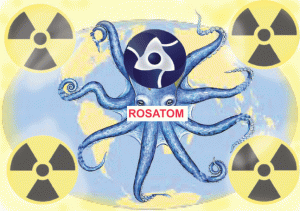
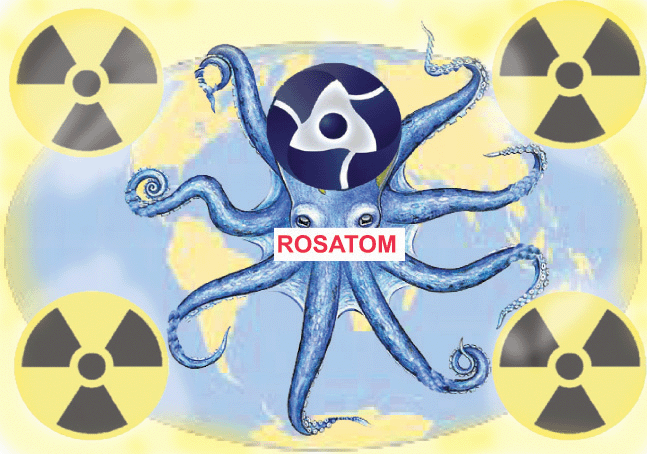
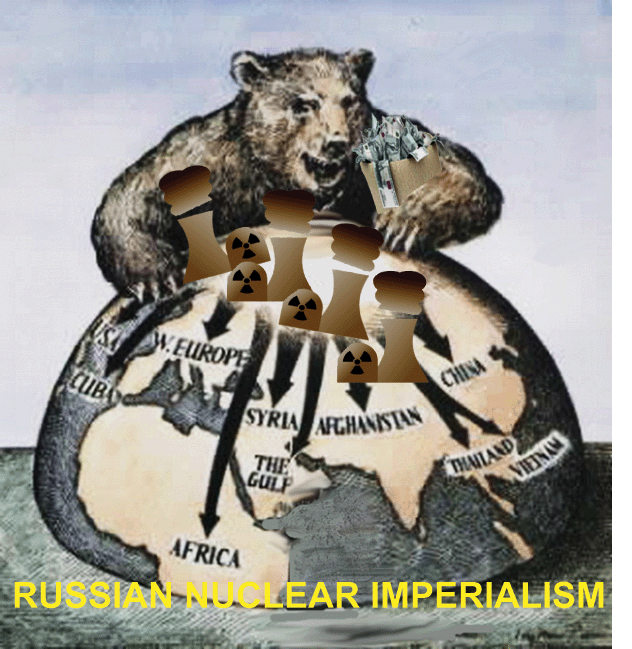
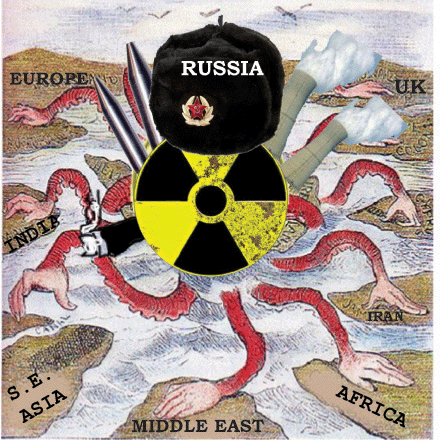
 Uganda Could Become The First African Country To Develop Nuclear Power http://www.konbini.com/ng/lifestyle/uganda-could-become-the-first-african-country-to-develop-nuclear-power/ by Odunayo Eweniyi , 22 June 17 Like there’s not enough wrong in Africa right now, Uganda has signed a deal with Russia to develop uranium into nuclear power for peaceful purposes. Not to mention that it’s really suspicious that Russia seems intent on handing nuclear power to anyone and everyone who will take it. But let’s not worry, they said it’s for peaceful purposes.
June 23, 2017
Posted by Christina Macpherson |
AFRICA, marketing, Russia |
Leave a comment
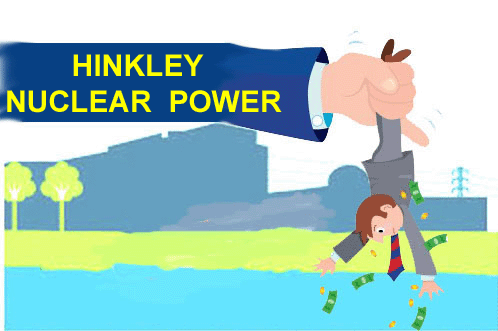
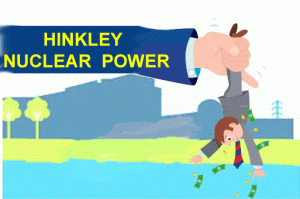 Hinkley Point deal ‘risky and expensive’, 23 June 2017
June 23, 2017
Posted by Christina Macpherson |
business and costs, UK |
Leave a comment
 Duterte dials Russia for nuclear power future, Joel Guinto, ABS-CBN News, Jun 19 2017 “…….President Rodrigo Duterte is bringing the Philippines closer to tapping nuclear power than any of his immediate predecessors by dialing Russia, which is offering its technology to the world. Duterte’s government forged an agreement with the Russian State Atomic Energy Corp. (ROSATOM) for the possible development of nuclear infrastructure, personnel training, and courting public support for the technology following his visit to Moscow last month.
Russia also offered to supply the Philippines with nuclear power barges and capsules.
ROSATOM on Monday opened an showcase of Russian nuclear technology, hoping to attract new clients from around the world, including the Philippines.
“We want to cooperate and be partners” said Sergey Kirienko, first deputy chief in the office of Russian President Vladimir Putin……
Project financing is the biggest concern of developing economies that seek to tap nuclear power, said Iliya Rebrov, economic and finance director at ROSATOM.
Rebrov said ROSATOM helps its clients secure funding from various sources, including loans.
“The key competitive factor is the ability of the contractor to arrange financing,” Rebrov said, citing a recent wind-farm project in southern Russia that was financed with Gazprombank.
ROSATOM is “very confident” in the world market as it diversifies its offerings to meet growing demand, said Kirill Komarov, the company’s First Deputy Director general for corporate development and international business. http://news.abs-cbn.com/focus/06/19/17/duterte-dials-russia-for-nuclear-power-future
June 21, 2017
Posted by Christina Macpherson |
marketing, Philippines, Russia |
Leave a comment
The head of one of Britain’s top utilities said on Monday that EDF’s
planned nuclear power station at Hinkley Point is likely to be the only one
to go ahead in the UK.
Alistair Phillips-Davies, chief executive officer of
SSE – an energy supplier and a former investor in new nuclear plants – said
that nuclear power has a role to play in reducing carbon emissions, but
that existing technologies may not be the right ones. “The bottom line in
nuclear is that it looks like only Hinkley Point will get built and
Flamanville needs to go well for that to happen,” Phillips-Davies told
Reuters at the Eurelectric utilities conference in Estoril.
French nuclear regulator ASN is set to give a provisional ruling next month on whether
Flamanville can start up as planned in 2018, despite potential weak spots
in its reactor vessel.
In an opinion piece published last year, Phillips-Davies said Britain does not need EDF’s Hinkley Point C nuclear
plant to ensure the lights will stay on because alternative projects like
new gas plants will be able to fill the gap. Asked whether the Toshiba-led
NuGen and Hitachi-led Horizon consortia, which also plan to build nuclear
power stations in Britain, would go ahead despite the bankruptcy of
Toshiba-owned reactor builder Westinghouse, Phillips-Davies said “just
looking from the outside, it looks tricky”. “Toshiba looks like it has a
lot of problems and whether Hitachi will view that as meaning that they do
not want to have a go either, I think that is quite likely. I would not
expect them to get done any time soon,” he said.
New York Times 19th June 2017
https://www.nytimes.com/reuters/2017/06/19/business/19reuters-britain-nuclear.html
City AM 19th June 2017
http://www.cityam.com/266971/sse-boss-hinkley-point-likely-uks-only-nuclear-new-build
Reuters 19th June 2017
http://uk.reuters.com/article/uk-britain-nuclear-idUKKBN19A2KF?rpc=401&
June 21, 2017
Posted by Christina Macpherson |
business and costs, UK |
Leave a comment

 Sudan and Russia Sign MOU for Cooperation Nuclear Power for Peaceful Uses, 20 June 17 Khartoum — Sudan and Russia signed in Moscow Monday a memo of understanding for cooperation in the field of nuclear power for peaceful uses, which was signed by the State Minister at the Ministry of Water Resources, Irrigation and Electricity, Engineer Yousif Hamza, and the General Director of the Russian Nuclear Power Agency for the Russian side.
Engineer Yousif said that implementation of the programs included in agreement will result in the signing of an agreement between the Sudanese and Russian sides in the field of atomic power for peaceful uses by the end of the year 2017…..http://allafrica.com/stories/201706200480.html
June 21, 2017
Posted by Christina Macpherson |
AFRICA, marketing |
Leave a comment
 Rosatom may start building new nuclear power plants in India and Bangladesh http://tass.com/economy/952448 June 20, MOSCOW, Rosatom plans to initiate main activities for construction of the second stage of Kudankulam Nuclear Power Plant (NPP) in India, start building Ruppur NPP in Bangladesh ad commission power units at Tianwan NPP in China and two NPPs in Russia, First Deputy Chief Executive Officer of Russian nuclear corporation Rosatom Kirill Komarov said on Tuesday.
“We have serious ambitious plans on new starts this year because the third unit of Tianwan [NPP] in China and the fourth unit of Rostov NPP in Russia should start this year. We endeavor to start the first unit of Leningrad NPP-2 this year,” Komarov said. “We expect concreting start for the third and the fourth units of Kudankulam NPP in India this summer. We also expect concreting start on Ruppur site in Bangladesh, where we are building a two-unit NPP,” he added.
Rosatom has many plans for projects in Europe during this year, Komarov said.
Rosatom has reached agreements on construction of 34 power units across the globe to date.
June 21, 2017
Posted by Christina Macpherson |
ASIA, India, marketing, Russia |
2 Comments
Russia’s Rosatom to review opportunity of nuclear power plant building in Zambia http://tass.com/economy/952152 June 19 MOSCOW, Russian state nuclear corporation Rosatom will prepare a preliminary feasibility study for construction of a nuclear power plant (NPP) in Zambia. A relevant agreement was signed between the parties within the Atomexpo 2017 exhibition framework, TASS reports on Monday.
This document signifies the first stage of the project execution prior to making an investment decision on NPP construction in Zambia, Rosatom says.
A contract for services of assessment and development of the nuclear infrastructure in Zambia, a contractor for preliminary engineering survey in Zambia by Rosatom’s affiliate Atomstroiexport and an agreement on setup of a nuclear science and technology center in Zambia were signed also.
Memoranda of understanding and cooperation in peaceful use of nuclear energy with Uganda, Sudan and Ethiopia were also signed within the forum framework.
June 21, 2017
Posted by Christina Macpherson |
AFRICA, marketing, Russia |
Leave a comment
FT 16th June 2017, The Bank of England will probe banks’ exposure to climate change as it
steps up efforts to tackle what it says are “significant” financial threats
posed by global warming. Climate change experts said the BoE’s decision to
do an internal review of the banking sector, which the central bank
revealed on its website on Friday, marked a first. “This is
ground-breaking,” said Ben Caldecott, director of the sustainable finance
programme at Oxford University’s Smith School of Enterprise and the
Environment. “This is the first time a financial regulator has looked at
climate risk in such a comprehensive way and at the banking sector in
particular.” https://www.ft.com/content/ec4d3446-52a1-11e7-a1f2-db19572361bb
June 21, 2017
Posted by Christina Macpherson |
business and costs, climate change, UK |
Leave a comment

 China Daily 15th June 2017, China’s CGN a step closer to bringing its nuclear technology to UK: China’s
goal of boosting its nuclear technology sector took a big step forward on Wednesday with the creation of three new companies in the UK by China General Nuclear Power Corporation. The new entities are: Bradwell Power
Corp, which will be responsible for the 100 percent Chinese-built Bradwell B nuclear plant; General Nuclear System Ltd, which will shepherd China’s Hualong technology through the exacting five-year UK approval process; and General Nuclear International, which will manage CGN’s projects in the UK.
He Yu, CGN chairman, said: The unveiling of three companies is a solid step forward for CGN to expand its operation in the UK. With its new subsidiaries unfolding, the company is confident that it will grow steadily in the field of nuclear technology in Britain.”
The United Kingdom will formally assess the Hualong One technology as part of a deal reached last year, in which Chinese investment will help build the Hinkley Point C nuclear plant, in which France’s EDF is a major participant, and which will
feature French technology. CGN and EDF have been working together for more than 30 years on nuclear development and construction in China.
Under last year’s agreement, CGN and EDF will collaborate on three UK nuclear plants: Hinkley Point C, in Somerset; Sizewell C, in Suffolk; and Bradwell, in Essex.
CGN intends to use Hualong One technology at Bradwell, which could be the first nuclear plant in a developed economy to use Chinese technology. The companies will seek to get the Hualong One technology approved in the UK via an assessment known as the Generic Design Assessment process. It usually takes about five years to complete.
China hopes that UK approval of its technology will open the door to its use in other countries because the UK’s appraisal regime is considered by industry experts to be the strictest in the world. The proposed Bradwell project is in an early
pre-planning stage, something that is likely to continue for many years, via investigative work and public consultation, before detailed proposals will be produced, allowing a planning application to be made.
http://europe.chinadaily.com.cn/world/2017-06/15/content_29748140.htm
June 19, 2017
Posted by Christina Macpherson |
China, marketing, UK |
Leave a comment
 Morning Star 16th June 2017, Ian Fairlie: THE Labour Party’s recent election manifesto says a Labour
government would support nuclear power as part of a low-carbon energy mix and that it would continue to support Hinkley C. The reason is that Jeremy Corbyn needs trade union support and some major unions think that nuclear
power will furnish many jobs.
But this is a myth, a shibboleth. The real situation is that renewable energy already provides far more jobs than
nuclear does now, and will provide far more jobs more quickly than nuclear ever would — even if current government plans were to succeed. The problem is that promoting nuclear power diminishes the prospects of creating new jobs in renewable energy industries — eg in establishing a large offshore wind manufacturing base.
Let’s look at the Hinkley C site, for example. Although about 4,500 jobs would exist each year during the
main phase of construction, EDF has admitted most would be temporary and filled by overseas workers. And if it were ever completed, it would only employ 900 workers. In fact, Hinkley C would be a remarkably poor bet for Britain and British unions, as industry insiders expect 90 per cent of the work at Hinkley, and all high-tech work, would go to French firms. For example, in 2013, EDF Energy completed a very large gas-fired power station at West Burton in Nottinghamshire where 100 per cent of the engineering contracts — even the concrete — went to French firms.
http://www.morningstaronline.co.uk/a-b8c7-Does-nuclear-power-really-provide-jobs
June 19, 2017
Posted by Christina Macpherson |
employment, UK |
Leave a comment
The main stumbling block that leads policy makers to twist their logic into pretzels is economic growth. Remove the requirement for growth, and it’s barely possible (not easy, but possible) to reconcile carbon reserves, emissions, energy sources, and warming targets—if governments somehow dedicate enough money and policy effort to the job.
If we’re smart, we will recognize that deeper trend and adapt to it in ways that preserve the best of what we have accomplished, and make life as fulfilling as it can be for as many people as possible, even while the amount of energy available to us ratchets downward. We’ll act to rein in population growth and aim for a gradual overall population decline, so that per capita energy use does not have to decline as fast as total use. We’ll act to minimize ecological disruption by protecting habitat and species. We’ll make happiness, not consumption, the centerpiece of economic policy.
If we’re not so smart, we’ll join the dinosaurs.

 Coal Is a Dinosaur and so is the growth economy, Post Carbon Institute, Richard Heinberg, June 15, 2017 “……Every few years, the IPCC issues a major new “assessment” crammed with data and models, aimed at informing policy makers. Unfortunately, these assessments are also filled with what Oliver Gedens has called “magical thinking……
The only realistic solution to our climate crisis is not to put so much carbon in the atmosphere in the first place. But that path runs counter to expectations about economic growth—which requires energy. And that is almost surely at the root of the IPCC’s assumptions about future fossil fuel consumption (regardless of whether those fossil fuels are actually available to be consumed).
So far humanity has increased the global atmospheric CO2 concentration from 280 parts per million to over 400 ppm—an already dangerous level. David Hughes figures burning our remaining realistic reserves of coal, oil, and natural gas would send us to about 550 ppm. There’s an easy way of not getting to 550 ppm: leave most of those fossil fuel reserves in the ground. But that would sink the economy, unless we very rapidly develop alternative energy sources (nuclear, which is expensive and risky; or solar and wind, which are more realistic alternatives).
Is it even possible to make the energy switch so quickly and completely as to avoid major bumps along the road? Building alternative energy infrastructure will itself require energy, and during the crucial early stages of the transition most of that energy will have to come from fossil fuels. There’s no way to bootstrap the energy transition process with energy from, say solar panels and wind turbines, because wind, and especially solar, technologies take years to energetically pay for their own manufacture and installation. So to avert burning even more fossil fuels than we otherwise would (in order to build all those solar panels, wind turbines, electric cars, heat pumps, and so on), resulting in a big pulse of carbon emissions, we would have to severely curtail the use of fossil fuels for current purposes—the maintenance of business as usual. That would also imperil economic growth. And we are talking about a remarkably small time window available for the shift, compared with the decades required for past energy transitions. It’s all so complicated that one can get a headache just thinking about it.
The main stumbling block that leads policy makers to twist their logic into pretzels is economic growth. Remove the requirement for growth, and it’s barely possible (not easy, but possible) to reconcile carbon reserves, emissions, energy sources, and warming targets—if governments somehow dedicate enough money and policy effort to the job. However, with further economic growth as an absolute requirement, the resulting climate models fester with internal contradictions and with assumptions about speculative technologies that very few people believe can be scaled up sufficiently, and that may have economic, environmental, and political repercussions that no one is prepared to deal with.
We cannot afford to hide the implications of realistic fossil fuels reserves estimates behind magical thinking. Perhaps the most important of those implications is that the world is probably just about at peak energy right now, give or take a decade. If we act immediately and strongly to rein in climate change, then a peak in world energy usage will likely occur more or less immediately. If we don’t act, then we may have another decade before fossil fuel depletion results in peak energy anyway…Renewables will contribute a larger share, depending on investment levels and policy supports, but cannot realistically expand far enough, fast enough, to maintain energy growth and therefore economic growth….
So overall, one way or the other, we have just about hit the maximum burn rate our civilization is likely to achieve, and it’s mostly downhill from here. That has implications for robust economic growth (it’s essentially over), and hence for war and peace, inequality, political stability, and further population expansion. Dealing with the end of energy growth, and therefore economic growth, is the biggest political and social challenge of our time—though it’s unlikely to be recognized as such. (Our biggest ecological challenges consist of climate change, species extinctions, and ocean acidification.) The impacts of the end of growth will likely be masked by financial crashes and socio-political stresses that will rivet everyone’s attention while a quiet trend churns away in the background, undoing all our assumptions and expectations about the world we humans have constructed over the past couple of centuries.
If we’re smart, we will recognize that deeper trend and adapt to it in ways that preserve the best of what we have accomplished, and make life as fulfilling as it can be for as many people as possible, even while the amount of energy available to us ratchets downward. We’ll act to rein in population growth and aim for a gradual overall population decline, so that per capita energy use does not have to decline as fast as total use. We’ll act to minimize ecological disruption by protecting habitat and species. We’ll make happiness, not consumption, the centerpiece of economic policy.
If we’re not so smart, we’ll join the dinosaurs. http://www.postcarbon.org/coal-is-a-dinosaur-and-so-is-the-growth-economy/
June 16, 2017
Posted by Christina Macpherson |
ANTARCTICA, business and costs |
Leave a comment
Turkey gives Rosatom go ahead to build nuclear plant, Reuters, 15 June 17,
Russia’s State Atomic Energy Corporation (Rosatom) won approval from Turkey’s energy watchdog on Thursday to go ahead with building its $20 billion Akkuyu nuclear power plant in southern Turkey.
The project to construct four nuclear reactors has repeatedly run into delays, including being briefly halted after Turkey downed a Russian jet near the Syrian border in November 2015. Ties have since normalised between the two countries and work on the plant has resumed……
Rosatom has sold several nuclear reactors to developing countries under a model by which Russia finances, builds and operates the nuclear plant and sells power to its customer – a model that has also raised questions about Russia using energy policy as a means to political ends.
EPDK said it had given Rosatom’s project company Akkuyu Nukleer AS a 49-year production license.
Dependant on imports for almost all of its energy, Turkey has embarked on an ambitious nuclear programme, commissioning Rosatom in 2013 to build the four 1,200 megawatt (MW) reactors…..https://www.reuters.com/article/turkey-energy-nuclear-idUSL8N1JC3FL
June 16, 2017
Posted by Christina Macpherson |
marketing, politics international, Russia, Turkey |
Leave a comment
 U.S. Experiences Sixth Nuclear Retirement Announcement in Seven Years, Power Engineering Jun 13, 2017 With Exelon’s announced intentions to retire the Three Mile Island Nuclear Generating Station, the United States now has six nuclear plants in the country that are operating but will soon retire, the Energy Information Administration reported.
There are now 99 nuclear reactors at 60 nuclear stations in operations in the United States. Since the first reactor came online in 1957, more than 30 nuclear reactors have retired, including some that were test projects or experimental designs……
The six plants now slated to retire in the next nine years include four that have retirement dates more than a decade before their operating licenses expire — Palisades, Pilgrim, Oyster Creek, and Three Mile Island. New nuclear plants receive 40-year operating licenses, though 90 percent of operating nuclear facilities received license extensions for another 20 years.
Indian Point’s license extension was challenged by the state of New York, and owner Entergy subsequently chose to retire the plant. Pacific Gas & Electric chose not to seek a license renewal for Diablo Canyon.
Exelon has said that Three Mile Island has not been profitable for the past five years, and is seeking subsidies from Pennsylvania to keep it open. http://www.power-eng.com/articles/2017/06/u-s-experiences-sixth-nuclear-retirement-announcement-in-seven-years.html
June 14, 2017
Posted by Christina Macpherson |
business and costs, USA |
Leave a comment
Deutsche Welle 12th June 2017, Japan’s nuclear energy sector is riven by poor management, is overly
bureaucratic and staffed by people who no longer have any pride in their
jobs. So accidents are inevitable, say critics.
The Japan Atomic Energy Agency (JAEA) issued a statement on Saturday, June 10, claiming that none
of the five workers at a nuclear research facility that it had previously
reported had suffered serious internal radiation exposure after an accident
on June 7 have plutonium in their lungs.
The agency’s report contradicts the initial claim that one of the workers had suffered internal exposure to
22,000 Becquerels of plutonium after a canister that had been in a storage
unit at the Oarai Research and Development Center for 26 years was opened
and bags holding the material burst.
Japan’s Asahi Shimbun newspaper has described the JAEA as “an organization that has been accused of gross
bungling in the past” and said the confusion over the workers’ exposure was
caused by high levels of plutonium on the men’s skin, not in their lungs.
“It’s just another example of poor management in these organizations,” said
Aileen Mioko Smith, an anti-nuclear campaigner with Kyoto-based Green
Action Japan, an NGO.
“I think these organizations have become overly
bureaucratic, there is no longer any pride among the workforce in what they
are doing – either at these sites or in management – and far too much work
is subcontracted out because that is the easiest way for them to save
money,” she told DW. http://www.dw.com/en/japans-nuclear-mishap-underlines-industry-malaise/a-39209569
June 14, 2017
Posted by Christina Macpherson |
business and costs, Japan |
Leave a comment
 The Nuclear Industry Is in Financial Meltdown, http://www.globalresearch.ca/the-nuclear-industry-is-in-financial-meltdown/5594253 By Ian Fairlie, Global Research, June 11, 2017 The Ecologist 9 June 2017 Most British politicians – waking up after a General Election which sent a strong message that the UK electorate don’t want railroading by its leaders – sail along blissfully innocent of nuclear’s impending denouement, not only in the rest of the world but in the UK too, writes IAN FAIRLIE.
The UK political situation on nuclear power is pretty uninspiring, apart from the Greens. Few political supporters of nuclear power appear to be aware that nuclear power is in free-fall around the world – especially in Western Europe and in the US, where many reactors are being closed without replacement.
Few seem aware of the legal, technical, regulatory, and economic difficulties faced by utilities in building the handful of new reactors and of the crippling costs of shutting down the many old ones. None appears aware of nuclear’s financial meltdown across the globe.
In a perceptive new article published by a prestigious US Ivy League University, Is Nuclear Power Coming To An End? Fred Pearce, a distinguished UK science writer, wrote:
“Now come the bankruptcies. In an astonishing hammer blow to a global industry in late March 2017, Westinghouse – the original developer of the workhorse of the global nuclear industry, the pressurized-water reactor (PWR), and for many decades the world’s largest provider of nuclear technology -filed for bankruptcy after hitting big problems with its latest reactor design, the AP1000.
“Largely as a result, its parent company, the Japanese nuclear engineering giant Toshiba, is also in dire financial straits and admits there is ‘substantial doubt’ about its ability to continue as a going concern.
“Meanwhile, France’s state-owned Électricité de France (EDF), Europe’s biggest builder and operator of nuclear power plants, is deep in debt thanks to its own technical missteps and could become a victim of the economic and energy policies of incoming President Emmanuel Macron.
“This is no short-term trend. While gas and renewables get cheaper, the price of nuclear power only rises. This is in large part to meet safety concerns linked to past reactor disasters like Chernobyl and Fukushima and to post-9/11 security worries, and also a result of utilities factoring in the costs of decommissioning their aging reactors.”
Pearce concludes by stating
“…the industry is in crisis. It looks ever more like a 20th-Century industrial dinosaur, unloved by investors, the public, and policymakers alike. The crisis could prove terminal.”
Most British politicians sail along blissfully innocent of nuclear’s impending denouement, not only in the rest of the world but in the UK too. The Government’s nuclear plans at Hinkley, Wylfa and Moorside are doubtful at best and moribund at worst.
First Anti-Nuclear Conference in 30 Years
We might shake our heads at the ignorance and irrationality of some of our senior politicians. However we should perhaps not despair too much, because on 17th June, CND is convening a one-day National Conference in London with a stellar array of speakers. No Need For Nuclear Conference
The Conference will explicitly discuss the incoherence and irrationality of the nuclear policies adopted by the main parties. Apart from Chernobyl or Fukushima anniversaries, this is the first anti-nuclear conference in the UK in about 30 years. As such, it marks the long overdue re-emergence of an important issue.
The UK anti-nuclear groups are relatively weak, under-resourced and fragmented, which means there has been little recent opposition to the Government’s irrational energy policies.
Perhaps this conference will help change that. No Need for Nuclear Conference booking:
Dr Ian Fairlie is an independent consultant on environmental radioactivity. He was formerly a senior scientist in the Civil Service and worked for the TUC as a researcher between 1975 and 1990.
June 12, 2017
Posted by Christina Macpherson |
business and costs, UK, USA |
Leave a comment







 nuclear-news