SMR Supply Chains, Costs, are Focus of Key Developments, Neutron Bytes, Dan Yurman October 4, 2017
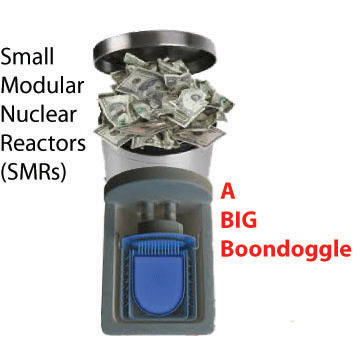
Small modular reactors won’t be able to compete with natural gas plants combined with renewables unless and until they get enough orders to justify building factories to manufacture them in a mass production environment.
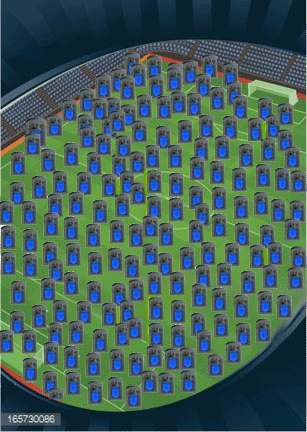
Holtec Opens SMR Manufacturing Center in New Jersey
In September Holtec announced the grand opening of a $360M, 50 acre SMR manufacturing center in Camden, N.J. The firm was incentivized by the State of New Jersey to locate there with $260M in tax breaks. According to Holtec the Camden plant will eventually employ up to 1,000 people……….
Dr. Singh, Holtec’s President and CEO, declared the factory to be “Ground Zero” for the renaissance of nuclear energy and heavy manufacturing in America.
“It will serve as the launching pad for the regeneration of manufacturing in the United States.”
He added, “We will build nuclear reactors here, and they will sail from the port of Camden to hundreds of places around the world.”
Is Holtec Headed for Ukraine to Manufacture SMRs for Europe & Asia?
The maturing of an American supply chain to support mass production of components for SMRs might develop, but not all of it may be in the U.S. Holtec International, is reportedto be in talks about planning to arrange the production of small modular reactors (SMRs) for nuclear power plants in Ukraine, and for export to Europe and Asia.
The Interfax wire service report, which was not confirmed by Holtec, comes on the heels of the firm’s grand opening of a $360M nuclear energy component manufacturing center in Camden, NJ. It is the second report in three months providing details of Holtec International’s discussions with Energoatom. However, a spokesperson for Holtec declined to comment on these discussions as reported by Interfax.
The Intefax report quotes Energoatom National Nuclear Energy Generating Company of Ukraine President Yuriy Nedashkovsky who said,
“There is a very interesting offer made by Holtec International CEO Kris Singh to President of Ukraine Petro Poroshenko – to create a hub in Ukraine, distributing small modular reactors to Europe, Asia and Africa, with the localization of production and a large number of equipment at Ukrainian enterprises.”
According to Nedashkovsky, Ukraine’s Turboatom has already been involved in the project, as it has the required turbines in its production line.
“This project has already been developed conceptually. The launch of licensing procedures (in the U.S.) is expected next year, and an active phase of construction – approximately in 2023.” Nedashkovsky added.
Talking of the long-term prospects, Nedashkovsky noted that the demand for small modular reactors after 2025 was estimated to grow over time.
Is the Ukraine SMR Story Ahead of Holtec’s Headlights?
What’s unclear is whether Nedashkovsky was speaking off-the-top-of-his-head, commenting officially on behalf of Holtec International, Continue reading →
Japan nuclear stocks down on opposition party’s phase-out plans, https://www.ft.com/content/1d201ea0-a9a9-3ead-b6e5-b430b59ccedc by Edward WhiteJapanese nuclear power companies were losing ground on Friday after the opposition party affirmed its intention to phase out nuclear energy by 2030. Kansai Electric was the biggest loser, down 1.1 per cent, followed by Tokyo Electric, which was down 0.8 per cent. Kyushu Electric and Chugoku Electric Power lost 0.5 per cent and 0.3 per cent respectively.
That saw that utilities segment drop 0.6 per cent, dragging on the broader Topix index which was up 0.2 per cent in morning trading. Those same stocks had fallen around 5 per cent in late September in response to Tokyo governor Yuriko Koike, whose Party of Hope will challenge prime minister Shinzo Abe’s Liberal Democratic Party in the upcoming snap election, declaring her support for phasing out nuclear energy by 2030.
That anti-nuclear policy was listed as part of a campaign platform released on Friday by the Party of Hope. Fifty nuclear reactors were shut down in Japan after the 2011 Fukushima disaster. Despite public concern, Japan’s nuclear safety watchdog on Wednesday issued an initial approval to restart two reactors at Kashiwazaki-Kariwa, the world’s largest nuclear generating site.
SMR Supply Chains, Costs, are Focus of Key Developments, Neutron Bytes, Dan Yurman October 4, 2017 “…….Westinghouse Says It Remains Committed To UK SMR Development
(NucNet) Westinghouse Electric Company said last week it remains committed to developing a 225-MW small modular reactor (SMR) that the company believes will allow the UK to move from buyer to global provider of SMR technology.
The company said in a statement that more than 85% of its SMR’s design, license and procurement scope can be delivered by the UK. The fuel would be manufactured at its Springfields facility in northern England.
“This is a special offering that only Westinghouse, with UK partners, can deliver,” the statement said.
Media reports in the UK have suggested that ministers are ready to approve the development of a fleet of SMRs to help guard against electricity shortages as older nuclear power stations are decommissioned………
Westinghouse said it filed for bankruptcy protection in the US to protect its core businesses and give the company time to restructure for continuing operation.
Rick Perry’s new coal subsidy could wreck America’s power markets, The Hill, BY HAL HARVEY, — 10/05/17 When old, established industries are threatened by new, better technologies, they often go running to Washington for special protections. It is an old practice, generally taxing the common good for private interests. Unfortunately, the U.S. Department of Energy has set a new record for gall in this practice in a fairly stunning move that would impose a new tax on electricity consumers and roil America’s power markets for years to come.
Here’s the story: Renewable energy — especially wind and solar — has plummeted in price. Today a new wind farm, for example, is often cheaper than just the operating costs of an old coal power plant. Cheap natural gas creates additional price threats to existing coal or nuclear. And these favorable economics for renewables and gas don’t even count the public benefits they create through clean air, reduced greenhouse gas emissions and avoided fuel price spikes.
This transition motivated DOE’s recent study of grid reliability, after coal and nuclear owners warned that closing their plants and adding renewables would cause blackouts. It turns out, though, even DOE’s study found this wasn’t the case, and that clean energy works just fine on our grid.
So, across the country, in power grids where economic dispatch reigns, renewables are booming, and coal plants are shutting down. This is not a “war on coal” nor is this reality susceptible to change through political pro-coal statements. It is free-market economics, plain and simple.
What can the owners of these old power plants do? They posit changing the rules, so instead of simply being paid for electricity, they get paid for “other attributes” as well, including a novel term among utilities, “fuel-secure power plants.” The idea is that having a pile of coal next to your uneconomical power plant should be richly rewarded, bringing your 1970s technology back into the black.
At first blush, this may seem sensible. Surely having a deep inventory of on-site fuel, be it a pile of coal, nuclear fuel or water behind the dam benefits the grid? Well, it turns out that reliable power is better delivered by a diversity of sources, rather than a few huge power plants. It also turns out that wind, for example, is often more reliable than coal. ……..
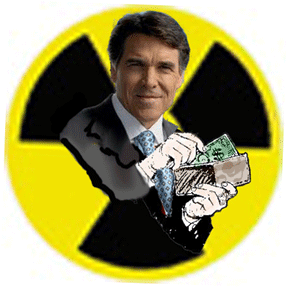
Energy Secretary Rick Perry has ignored this evidence, and proposed a rule to the Federal Energy Regulatory Commission to subsidize the oldest power plants on the grid. His request is anti-innovation, anti-economy, and anti-environment. It is a wholesale repudiation of the free market. And it flatly contradicts Texas’ experience………
Rick Perry’s plan to subsidize coal and nuclear plants is bonkers, By keeping uncompetitive plants open, it would blow up energy markets. VOX by David Roberts@drvoxdavid@vox.comThe Trump administration has not typically put a premium on transparency or fealty to empirical fact. So it was somewhat puzzling when the Department of Energy released its long-awaited study of power grid reliability in August and it looked … mostly normal.
By all accounts, DOE’s experts were allowed to work on it unimpeded. Its conclusions lined up with the broad consensus in the energy field: The loss of coal plants has not diminished grid reliability; in fact, the grid is more reliable than ever. Reliability can be improved further through smart planning and a portfolio of flexible resources. Regulators should work on ways to better compensate reliability in competitive energy markets.
The summary bits of the report added a bit of political spin, but the analytic work and core conclusions were solid — and very much not in line with the administration’s position, which is that reliability is immediately threatened and coal and nuclear plants are necessary to preserve it.
Where, wondered the more cynical observers [waves], was the hackery? Where was the political interference to prop up a favored industry, the blithe disregard of expert knowledge? This is not the Trump administration we’ve come to know and … know.
Well, it turns out, we just needed a little patience. The hackery has landed. Repeat: The hackery has landed.
Unfortunately, the hackery comes obscured by a thick cloak of acronyms — it’s an NOPR from DOE about ISOs that contradicts NERC, FFS — so it takes a little unpacking.
Here’s the short summary: Perry wants utilities to pay coal and nuclear power plants for all their costs and all the power they produce, whether those plants are needed or not.
That may sound a little blunt and ridiculous to you, but don’t worry. Once you understand some of the background and the technical details, you will see that it is in fact more blunt and ridiculous than you could have imagined.
DOE has lurched, on this subject, from minimum to maximum hackery. Even in our new Trumpian world, it is astounding.
Let’s walk through it.
DOE to FERC: address a crisis we determined does not exist
Remember, the administration’s position is that, as Perry put it in his memo requesting a grid study, “regulatory burdens, as well as mandates and tax and subsidy policies, are responsible for forcing the premature retirement of baseload power plants.”
Suffice it to say, he’s not referring to the regulations, mandates, tax, and subsidy policies that benefit coal and nuclear plants. He means renewable energy subsidies, which he says “create acute and chronic problems for maintaining adequate baseload generation and have impacted reliable generators of all types.”
Putting it more explicitly, the administration’s claim is twofold: First, that power plants with large amounts of fuel on-site — coal and nuclear, basically — are necessary to grid reliability, and second, that those plants are unfairly being driven out of business by subsidies to renewable energy.
The problem is, neither claim is true, which poses something of a dilemma for Perry, who has been put in charge of an agency filled with genuine technical experts. And sure enough, DOE’s grid study found, as many other studies before it have, that a) the loss of coal and nuclear plants has not diminished reliability, and b) it is cheap natural gas, not renewable energy subsidies, that has driven coal and nuclear out of business.
Whether through ignorance or cleverness, Perry stumbled on a different communications strategy. He seems to have realized that he didn’t need to mess with the study at all. Why bother? He could simply pretend that it supported the administration’s position. The media would he-said, she-said it for a day or two and then move on. He simply behaved as though the study had confirmed his claims.
Which brings us to last Friday, when DOE proposed a new rule for the electricity system, premised on the very suppositions its own grid study disproved. To wit:
The resiliency of the nation’s electric grid is threatened by premature retirements of power plants that can withstand major fuel supply disruptions caused by natural or man-made disasters and, in those critical times, continue to provide electric energy, capacity, and essential grid reliability services. These fuel-secure resources are indispensable for the reliability and resiliency of our electric grid — and therefore indispensable for our economic and national security. It is time for the Commission to issue rules to protect the American people from energy outages expected to result from the loss of this fuel-secure generation capacity.
Again, this is all wrong. Having fuel on-site does little for resilience. The plants are not indispensable. No one expects energy outages if baseload plants continue closing.
Nonetheless, based on these faulty premises, DOE issued a Notice of Proposed Rulemaking (NOPR) to the Federal Regulatory Energy Commission (FERC), suggesting that FERC adopt a rule forcing utilities in competitive energy markets to pay the full cost of plants that have 90 days’ worth of fuel on-site.
This is a deeply messed-up thing to do, on so many levels it’s difficult to know where to begin. It is the crudest imaginable intervention on coal’s behalf.
But let’s start with a quick note on the authorities involved here.
FERC will determine the fate of this monstrosity
When Congress consolidated various agencies into DOE with the Department of Energy Organization Act of 1977, it deliberately maintained a separate regulatory authority (the Federal Power Commission, renamed FERC).
A quirk of the law allows DOE to propose rules to FERC — an authority is has used only rarely, and for fairly small matters.
But FERC is independent. It is not under DOE’s authority and does not have to do what DOE proposes.
It is highly unlikely to adopt this rule as-is. (It would effectively be impossible, for reasons we’ll discuss.) But it’s also unlikely to ignore the NOPR. These are, after all, both Trump administration agencies, run by Trump appointees.
So what exactly FERC does with the NOPR — what balance of expertise and hackery it brings to bear — will determine the actual impacts of this thing.
Behind the Backlash to Energy Secretary Rick Perry’s Demand for Coal-Nuclear Market Intervention, Almost everyone outside the coal and nuclear industries wants FERC to turn down DOE’s grid market rule. Here’s why.
Greentech Media, by Jeff St. John , October 05, 2017 Energy Secretary Rick Perry’s demand for market-disrupting price supports for coal and nuclear power plants has broken multiple rules for how energy policy is made, from upending the facts to subverting regular order. And it’s being pushed through on a hyper-fast, 60-day review period that’s not only unjustified by the Department of Energy report it cites as justification, but “practically and legally impossible” to meet.
This is a collection of the critiques that have emerged since Friday’s shock DOE filing with the Federal Energy Regulatory Commission. In a rarely used notice of public rule making (NOPR), DOE asked FERC to create market rules to provide compensation for power plants that, among other features, have a 90-day supply of fuel on hand — something that only coal and nuclear power plants can do.
The NOPR cited the grid reliability study ordered by Perry in April to argue that baseload power plants need compensation to shore up grid reliability. But as we covered when it was released in July, the report doesn’t actually support that conclusion, stealing some of the thunder from clean energy and environmental groups’ arguments that the report was a Trojan horse for pro-coal and nuclear power policies all along.
Nuclear expansion expected to slow in the coming years, IAEA report says https://dailyenergyinsider.com/news/8285-nuclear-expansion-expected-slow-coming-years-iaea-report-says/October 05, 2017 by Alex Murtha While nuclear power’s global potential up to the year 2050 remains high, its expansion is expected to slow in the coming years, according to a recently published report on energy and electricity projections by the International Atomic Energy Agency (IAEA).
The report, titled Energy, Electricity and Nuclear Power Estimates for the Period up to 2050, also stated that interest in nuclear power remains particularly strong within the developing world. However, compared to the prior year’s projections for 2030, estimates were reduced by 45 gigawatts (GW) in both high and low cases.
In the short term, the impact of renewable energy sources on electricity prices, the low price of natural gas and country-specific nuclear policies following the 2011 Fukushima Daiichi Nuclear Power Plant disaster are all expect to affect nuclear growth prospects, the report said.
Compared to 2016 levels, high projections indicate an increase by 42 percent in 2030, by 83 percent in 2040 and by 123 percent in 2050. Yet, the low projections indicate a decline in capacity by 12 percent in 2030, 15 percent in 2040 before rebounding to current levels by 2050.
According to the IAEA, the wide range of the projections is also due to the considerable number of reactors scheduled to be retired by approximately 2030 and beyond, particularly in North America and Europe, along with whether or not new nuclear capacity would be built to replace retired reactors.
U.S. PREPARES NEW MISSILES FOR JAPAN AFTER NORTH KOREA THREATENS NUCLEAR WAR, newsweek BY TOM O’CONNORThe U.S. has moved closer to selling dozens of state-of-the-art missiles to Japan as part of President Donald Trump’s pledge to boost military support for Pacific allies opposed to nuclear-armed North Korea.
The State Department’s Defense Security Cooperation Agency said Wednesday it would back the Japanese government’s request for up to 56 AIM 120C-7 Advanced Medium Range Air-to-Air Missiles (AMRAAMs). The sale, which is estimated at $113 million and requires congressional approval, would also reportedly include various logistical, technical, engineering and weapons support services. It comes as Japan reconsiders its traditionally pacifist post-World War II stance on defense in the face of threats from North Korea, which has shot two missiles over Japanese territory in the past two months.
The proposed sale will provide Japan a critical air defense capability to assist in defending the Japanese homeland and U.S. personnel stationed there,” the agency said in a statement.
“Japan will have no difficulty absorbing these additional munitions into the Japan Air Self-Defense Force,” it added…….
Les Echos 4th Oct 2017 [Machine Translation]Members of the board of directors of EDF and the
executive committee – met Tuesday in Hinkley Point, south-west England, for
a “delocalized strategic seminar” and to visit the site of the two EPRs.
Because of its location, project governance is much more complex than that
of the EPR project in Flamanville (Manche). Three teams are at work, with
about 700 people in Montrouge (France), 850 in Bristol (Great Britain) and
construction teams in Hinkley Point.
It is also necessary to integrate
Areva’s teams into Edvance, the new engineering structure resulting from
the restructuring of the nuclear industry. “There are many issues to be
discussed on the connection between EDF and NNB units in England,” said a
member of EDF’s board of directors before the summer. A site for Simone
Rossi, who will take over the management of EDF Energy on November 1, to
replace Vincent de Rivaz. https://www.lesechos.fr/industrie-services/energie-environnement/030655436090-edf-une-nouvelle-direction-pour-les-epr-anglais-2119323.php
After the mass shooting in Las Vegas, the NRA is pulling ads supporting Republican candidates in Virginia, but not for long. The NRA is cynically pulling campaign ads in the wake of the mass shooting in Las Vegas — but only temporarily.
The gun extremists appear to believe that the country only needs eight days to forget about the worst mass shooting in modern American history, allowing them to exploit the gun issue to assist an ally.
According to Medium Buying, a firm that tracks ad spending, the NRA’s Political Victory Fund has postponed running ads that it planned to run in Virginia. Instead, the NRA will begin running its advertising on Oct. 10.
The group has endorsed Republican Ed Gillespie for Governor, along with his running mate Jill Vogel. The NRA is also backing John D. Adams, the Republican candidate for Attorney General.
The NRA praised Gillespie in an endorsement release in August, hailing him as “a leader in the growing national movement to expand our Second Amendment freedoms.”
Ralph Northam, the Democrat in the governor’s race, is an Army veteran and a hunter who has described himself as “a staunch advocate for commonsense gun safety laws.”
The NRA has often gone silent after mass shootings, as it has this time, with the hopes that it can wait out grief after the tragedy. Then, when the conditions are more favorable for its violent messages, the NRA promotes advertising that calls on gun owners to confront protesters with a “clenched fist.”
As the NRA cowers and tries to wait out the situation, groups like Moms Demand Action for Gun Sense In America are stepping up. Founder Shannon Watts released a statement on the shooting.
“I am sickened and heartbroken that, once again, American families will be torn apart by gun violence,” she said. “My thoughts are with the victims and their loved ones, whose lives will never be the same.”
She added, “While details are still unfolding, one thing is for sure: It doesn’t have to be this way. Americans should be able to go to concerts, to night clubs, to elementary schools and movie theaters without worrying about the threat of gun violence. While we grieve for the 50 people shot and killed and the more than 400 who are hospitalized, we must also act in their honor. Gun violence is preventable.”
The NRA doesn’t want anything done about gun violence in America because their ideal world is one in which the country is awash in firearms, no matter the risk to children and families. They go silent while still intending to back candidates who will enact their agenda unquestioningly.
But millions of Americans want something to be done, to stop attacks like the ones in Las Vegas, Charleston, Newtown, and so many other American cities and towns. And they will not be silenced.
Ft.com 2 Oct 17Within the next month Simone Rossi will take over as the chief executive of EDF Energy in the UK. With the job comes responsibility for Britain’s first (and according to one of the energy industry’s leading players, perhaps last) new nuclear plant, Hinkley Point C. The plant is set to be one of the most expensive structures ever built, with the costs estimate pushed up again in July to £19.6bn. HPC is least eight years behind schedule (it was originally supposed to be providing the power to cook our Christmas turkeys this year) but is not expected to be commissioned before 2025, with the possibility that even that target won’t be met. Mr Rossi could be thought to have the most thankless job in the world. HPC is unloved and unwanted, a project which gives dinosaurs a bad name. That is true in Britain where the decision to proceed last year was only taken because the prime minister’s staff could not identify an alternative source of power – they should have asked more widely and not relied on those already fully committed to one outcome. Instead they gave EDF the go-ahead but placed the entire construction risk on EDF. Since the company is state owned the ultimate burden rests with French taxpayers. Unsurprisingly HPC is as unpopular in Paris as it is in the UK.
At an intriguing conference on the “Global Positive Future” held under the “high patronage” of President Emmanuel Macron at the beginning of September there was no mention of nuclear power. If Mr Macron accepts the tighter financial discipline implied by the proposed eurozone reforms, repeated payments to EDF will become impossible. Many in EDF, once a great company at the heart of the post-1945 reconstruction of France, see the project as an albatross. Control over EDF’s activities in the UK has been moved back to Paris.
Despite all this Mr Rossi could still emerge as a hero. As a new arrival he can look again at the project and decide that instead of throwing good money after bad, it is time to call a halt and look for lower cost solutions. Price has become the key issue since the original deal on HPC was agreed in 2013. A price of £92.50 per megawatt hour, index linked for 35 years from whenever the project is commissioned, was ridiculous then and is even more so now. Given the inflation we have seen since 2013 that starting price is now over £100 per MWh. The deal symbolised the inability of well intentioned but inexperienced ministers and civil servants to negotiate complex commercial deals. The deal involved no competition and no provision for review if market circumstances changed. The decision demonstrated the unaccountable power of well funded lobbyists.
Circumstances have changed. Over the last four years the price of every available alternative has declined. The cost of offshore wind has fallen to below £60 per MWh in the UK and to just €43 per MWh in Spain. Gas is plentiful and there is no reason to think that a balanced mixture of wind power and natural gas cannot meet future energy needs. …….
growth in China and India likely won’t be enough to save the global nuclear industry. A report by S&P Global Ratings estimates half of the 99 nuclear reactors currently operating in the United States could be taken offline in the next 17 years. That’s the equivalent of shutting all nuclear reactors in France or Japan — the second- and third-largest atomic powered countries, respectively, by installed capacity. The report thinks America could be nuclear-free by 2055.
Worse, changing political tides in Japan don’t look favorable for nuclear power.
While there’s much uncertainty about where Cameco will be in five years, the current trend doesn’t look very favorable.Investors beware.
Where Will Cameco Corporation Be in 5 Years? Most of the uranium miner’s supply contracts expire by 2021. What happens after that?, The Motley Fool Maxx Chatsko, Oct 3, 2017 The world’s largest uranium miner has been reeling in a long, drawn-out state of misery since the Fukushima nuclear disaster in 2011. Many industrialized nations have revisited their long-term power-generation strategies to include a future without atomic energy. The rise of emission-free wind and solar energy, which continues to outpace even the most optimistic projections, makes it even easier to envision a world with diminishing reliance on nuclear power.
None of that has stopped Cameco Corp (NYSE:CCJ) bulls or management from predicting a brighter future ahead. The company has slashed operations and kept a remarkably healthy balance sheet throughout uranium’s multiyear slide as a global commodity. While it appears to be making all of the right moves today, every day the company inches closer to an existential line in the sand: the year 2021.
That is the year most of its supply contracts expire. Given the current uncertainty surrounding nuclear power, investors shouldn’t be so sure the next round of renewals will be executed in a shareholder-friendly manner. That leads us to ask, where will Cameco Corp be in five years?
The coming contract cliff
Historically speaking, Cameco has managed its portfolio of long-term supply contracts very well. That has insulated the company from the recent downturn in uranium selling prices. For instance, while spot prices are at 12-year lows today, the uranium miner realized a 60% premium to that for every pound sold last year.
The reason is simple: Power companies were locked into higher prices when current contracts were signed. Although fortuitous today, these same forces may also prove problematic moving forward. Why? Uranium prices have trended down, while the uncertainty surrounding the future of nuclear power has trended up. The result: Power companies are hesitant to sign new contracts today out of fear they’ll be locked into higher-than-market prices in future periods……..
all of the projections on which Cameco bases its argument could prove disastrously incorrect. Unfortunately for shareholders, every new data point that comes in seems to hint that may be closer to reality……
growth in China and India likely won’t be enough to save the global nuclear industry. A report by S&P Global Ratings estimates half of the 99 nuclear reactors currently operating in the United States could be taken offline in the next 17 years. That’s the equivalent of shutting all nuclear reactors in France or Japan — the second- and third-largest atomic powered countries, respectively, by installed capacity. The report thinks America could be nuclear-free by 2055.
Worse, changing political tides in Japan don’t look favorable for nuclear power. Prime Minister Shinzo Abe recently dissolved the nation’s lower parliament in an effort to maintain his party’s majority after the general election scheduled for October 22. But in a surprise move, the two largest opposition parties merged into one. A major talking point of the “new” party: making Japan nuclear-free by 2030. Depending on the outcome of the election, the market may know the fate of atomic energy on the island nation well before 2021 — bad news for Cameco’s efforts to renew supply contracts.
Taken together, closing half of American nuclear reactors and all of those in Japan by about 2030 would remove roughly 104 nuclear reactors from operation. Add Germany’s eight nuclear reactors that will be shuttered by 2022, and the world could lose 25% of its nuclear power capacity in the next two decades. Planned additions from China, India, and the rest of the world wouldn’t come close to offsetting the losses……
given the global rise of wind, solar, and liquefied natural gas (LNG) — the last of which is increasingly important to Japan — the days of nuclear power certainly seem to be numbered. Forces both economic and political will be difficult for the industry to overcome.
If additional announcements are made for closures in America or Japan in the near future, it could jeopardize the company’s efforts to sign new long-term supply contracts to replace those that expire in 2021. While there’s much uncertainty about where Cameco will be in five years, the current trend doesn’t look very favorable. Investors beware. https://www.fool.com/investing/2017/10/03/where-will-cameco-corporation-be-in-5-years.aspx
Top investment groups push for action on climate risks, Ft.com 2 Oct 17 by Ed Crooks in New York and Attracta Mooney in London
BlackRock and others demand disclosure at US energy companies, analysis shows
Large investment groups including BlackRock and Vanguard have stepped up pressure on US energy companies to address the risks associated with climate change, despite the Trump administration’s lack of action to address the threat.
An analysis of shareholder votes at this year’s annual meetings showed investors have taken a more active role in pushing for information on climate risks, often voting for improved disclosure against company board recommendations. In votes at seven of the largest US energy companies this year, the 30 largest investors switched their votes to support disclosure on climate risk a total of 38 times, having opposed similar resolutions in 2016, according to ShareAction, a campaign group.
The data came from regulatory filings compiled by Proxy Insight, an information service. The increasingly assertive position taken by large investors had its most significant impacts at ExxonMobil and Occidental Petroleum, two of the largest US oil groups. There was majority support for proposals calling on the companies to publish regular reports on the possible impact on their businesses of policies to address the threat of climate change. In both cases, BlackRock and Vanguard, the world’s two largest fund managers, voted to support the proposals. …….
Edward Kamonjoh, executive director of the 50/50 Climate Project, said he expected investors to seek better explanations from fund managers when they decide not to support climate-related resolutions. “Large fund managers with poor voting records on climate risk can expect public challenges on the dichotomy between their engagement priorities and voting practices,” he said.https://www.ft.com/content/48ad5476-a6aa-11e7-ab55-27219df83c97
Russian Nuclear Company Sees Success in Latin America, 1 October 2017New branches of the company will be constructed in El Alto, Bolivia and should be in operation by 2020.
Two years since its move to Latin America, Rosatom, Russia’s main nuclear power company, has seen great success, the company’s Latin American representative, Ivan Dybov, said.
“Rosatom has several projects in Latin America, but the main one is in Bolivia. Last September 19 we signed the contract for the construction of the Center for Research and Development in Nuclear Technology,” Dybov said.
Nuclear bomb shelter sales are soaring due to North Korean threats, Yahoo Finance Daniel Howley Technology Editor, the saber rattling, coupled with North Korea’s stated objective of developing a nuclear-tipped missile capable of reaching the U.S. mainland, have plenty of people on edge.
And nowhere is that clearer than in the number of nuclear fallout shelters being purchased here in the U.S.
“We’re probably upwards of 1,000% from this time last year,” Gary Lynch, general manager of Rising S Company said of the number of bunkers his company has sold in 2017.
A size for everyone (sort of)
Texas-based Rising S Company, whose tagline is “Safe until the rising sun,” a nod to the Christian belief that the Second Coming of Christ will precede the end of the world, offers bunkers in a variety of price ranges. The base model is an 8 x 12-foot mini bunker for $39,500 while the top-of-the-line “The Aristocrat” luxury bunker, which features a bowling alley, gym, gun range, green house, pool and garage, goes for $8,350,000.
Sharon Packer, CEO of Utah-based Underground Shelters USA, says her company has seen sales of bunkers triple this year, with a significant increase taking place in the last six months. Packer, a nuclear engineer, says her company’s shelters can survive being within 1/4 of a mile from the blast crater of a 1-megaton nuclear bomb.
Underground’s best-selling shelter costs about $70,000 and gets you about 32 x 10 feet of space. Packer says you’d be able to stay in one of her company’s shelters for as long as you have access to clean water.
Brian Duvaul, sales manager with American Safe Room, a bunker company based in Oregon, explained that sales generally slow down around fall and winter as the ground becomes difficult to dig, but that so far this fall, sales are looking up…….