Amec Foster Wheeler To Lead UK Government’s Nuclear Reactor Research, Alliance News , By Joshua Warner; joshuawarner@alliancenews.com; @JoshAlliance, 28th Jul 2017 LONDON – Amec Foster Wheeler PLC on Friday said it has handed a GBP2.9 million contract from the UK government to lead a “key” research programme that aims to use developments in digital technology to optimise the next generation of nuclear reactors……
 The project is part of a broader effort to put UK industry at the forefront of developing Generation IV and small modular reactors…….
Amec Foster Wheeler is being supported by partners and sub-contractors from industry, academia and science, including the University of Liverpool’s  Virtual Engineering Centre, the Hartree Centre, National Nuclear Laboratory, Rolls-Royce Holdings PLC, EDF Energy, the University of Cambridge and Imperial College London.
Professor Eann Patterson from the University of Liverpool, also partnering on the project, will be the lead academic of the research programme……..
The contract award comes as Amec Foster Wheeler is in the midst of merging with peer John Wood in a GBP2.20 billion deal that is expected to take place in the fourth quarter. Amec Foster Wheeler only last month made a decision to retain its European nuclear business after consulting John Wood, but is still pushing to offload its North American nuclear unit.
The North American nuclear operations are nominal within the wider company, adding a trading profit of just GBP1.0 million and revenue of GBP83.0 million to Amec Foster Wheeler’s 2016 results.
What’s more, Amec Foster Wheeler is being investigated by the UK Serious Fraud Office about possible offences related to corruption and bribery related to its past relationship with Monaco-based Unaoil SAM, which has been being probed by the SFO for suspected fraud, bribery and money laundering since July 2016.
That probe into Unaoil also hit oil services provider Petrofac Ltd, forcing the resignation of its chief operating officer. http://www.lse.co.uk/AllNews.asp?code=w955wuya&headline=Amec_Foster_Wheeler_To_Lead_UK_Governments_Nuclear_Reactor_Research
July 29, 2017
Posted by Christina Macpherson |
business and costs, politics |
Leave a comment
 Seeking Alpha, Jul. 28, 2017 Includes: BBL, BHP, CCO, EGRAF, NXE, RIO, URA Caiman Valores Contrarian, long-term horizon, research analyst, value
- Uranium is caught in a protracted slump that is sharply impacting uranium miners.
- Despite claims that prices will rise sentiment towards nuclear power has turned unfavorable.
- Demand growth for uranium remains muted which along with growing supplies will keep pressure on prices.
- There is no indication of a sustainable recovery in sight making uranium miners value traps.
There has been a surge in interest in uranium explorers and miners in recent months because of growing optimism surrounding the outlook for the radioactive metal. This has sparked a rash of upgrades for a number of uranium miners and explorers including Cameco Corp……
The marked uptick in the outlook for uranium is long over due with the radioactive metal caught in prolonged slump that now sees it trading at less than a sixth of its 2007 high………
Despite the proclamations of some analysts and market pundits there are distinct signs that point to a sustained recovery in uranium being unlikely and that the long-term prognosis for the fuel is poor.
What is driving this positive outlook? The progressively positive outlook for uranium mining stems from a belief that the current global supply glut which has been weighing heavily on uranium prices will be eliminated over the next two-years.
There is also the expectation among market pundits that as demand for the radioactive metal begins to grow global supplies will diminish. This is because the prolonged slump according to those pundits has led to a dearth in investment in exploration and mine development which will impact uranium production in coming months.
Furthermore, uranium miners have been forced to shutter high cost production because it was uneconomic at current prices. The slump in uranium particularly in the wake of the Fukushima disaster sent one of the world’s largest uranium miners Energy Resources of Australia (OTCPK:EGRAF) also known as ERA, which at its peak was supplying 10% of the world’s yellow cake, into terminal decline……(registered readers only) https://seekingalpha.com/article/4091999-death-spiral-nuclear-energy-demise-uranium-miners
July 29, 2017
Posted by Christina Macpherson |
2 WORLD, business and costs, Uranium |
Leave a comment
 Toshiba reaches $2.2 billion deal over SCANA’s South Carolina nuclear project http://www.reuters.com/article/us-toshiba-accounting-westinghouse-scana-idUSKBN1AC3DN (Reuters) – Toshiba Corp has agreed to pay $2.168 billion to walk away from two unfinished nuclear reactors in South Carolina being built by its Westinghouse subsidiary, according to a statement by the owners of project.
SCANA Corp (SCG.N) and its partner, state-owned utility Santee Cooper, said Toshiba will make the payments in installments beginning in October and ending in September 2022.
Toshiba’s Westinghouse Electric Co filed for bankruptcy in March, overwhelmed by the cost overruns at the VC Summer plant in South Carolina and a similar unfinished nuclear project known as Vogtle in Georgia. The projects are years behind schedule.
The agreement allows Toshiba and its Westinghouse unit to exit the nuclear construction business and caps Toshiba’s liability for guaranteeing that Westinghouse complete the VC Summer contract.
Toshiba reached a similar agreement for $3.7 billion in June with the utilities, led by a unit of Southern Co (SO.N), that own the Vogtle project.
Toshiba has warned that losses from Westinghouse threaten its future and it is considering bids for its flash memory chip unit, worth around $18 billion, to raise capital.
The owners of the VC Summer project said on Thursday they expect the cost of completing the project will “materially exceed” Westinghouse’s estimates and the payments due from Toshiba. They said they hope to decide soon whether they will continue with the two projects, modify them or abandon them.
Westinghouse is expected to deliver this week a five-year business plan to its lender, an affiliate of Apollo Global Management (APO.N). That plan will help shape bids for Westinghouse, which has attracted the interest of U.S. private equity firms.
As part of that plan, Westinghouse is expected to reach an agreement with SCANA under which it will continue to provide engineering and other services. Westinghouse has a similar agreement in place with the owners of the Vogtle plant.
Westinghouse asked the U.S. Bankruptcy Court in Manhattan, New York, on Wednesday to give it until Dec. 6 to file a plan of reorganization. The company said it needed more time in part due to talks with SCANA.
The request will be heard by the court on Sept. 7.
The Georgia and South Carolina plants were the first new nuclear power projects in the United States in three decades.
However, the projects have been dogged by design problems, disagreements with regulators and poor quality work by Westinghouse’s partners.
July 29, 2017
Posted by Christina Macpherson |
business and costs, Japan, USA |
Leave a comment

 EDF profits dented by nuclear woes,Telegraph, Jillian Ambrose 28 JULY 2017
Earnings at energy giant EDF have plummeted by a fifth in the first half of this year due to ongoing woes in its French fleet of nuclear reactors and lower profits from those in the UK.
The French state-backed group behind the UK’s first new nuclear plant in a generation, Hinkley Point C, has suffered a major setback to its domestic reactors, some of which have been closed for safety checks since October.
French nuclear power output fell by 3.9pc from the first half of last year to 197.2TWh in the six months to June 30, the group said. Despite a 4.2pc rise in UK EDF’s nuclear generation to 32.2TWh, the fleet of reactors were still a drain on earnings due to the weaker market price for electricity.
The slump in its two core markets wiped more than 20pc from its underlying earnings before interest, tax, debt and amortisation to €7bn (£6.3bn) but the group has assured investors that it remains on track to meet its guidance of between €13.7bn to €14.3bn for the year.
Jean-Bernard Lévy, EDF’s chairman and chief executive, underlined the “unfavourable market context” but said the group’s move towards renewable energy was accelerating……http://www.telegraph.co.uk/business/2017/07/28/edf-profits-dented-nuclear-woes/
July 29, 2017
Posted by Christina Macpherson |
business and costs, France |
Leave a comment
 FirstEnergy nuclear charges crucial to operating or selling Davis-Besse, Perry, says CEO, Cleveland.com 28 July 17 , By John Funk, The Plain Dealer, AKRON — FirstEnergy’s top executive says the company will continue to press Ohio lawmakers for new customer-paid subsidies for its nuclear power plants even though it may not own them in the future……
Chuck Jones, president and CEO, also revealed that FirstEnergy is preparing to talk to creditors of its subsidiary, FirstEnergy Solutions, the company that owns the corporation’s old, uncompetitive power plants, which have been losing money.
FirstEnergy Solutions’ debt and the declining value of its power plants has made it a potential liability as it negotiates with its creditors amidst rumors of an eventual bankruptcy, and FirstEnergy has tried to distance itself from the subsidiary……
As for the special, customer-paid charges to help Davis-Besse, Perry and Beaver Valley, Pa., nuclear power plants, Jones said he doubted anybody could operate them without special subsidies. The problem is that they cannot compete with gas turbine plants and, at times, with wind power.
“I’m not sure [they] will run unless there is something done either federally or by the state of Ohio to ensure they get a different financial return model,” Jones said.
The company previously said the nuclear charges would increase customer bills by about 5 percent. Subject to periodic review by state regulators, the charges would run for 17 years.
Selling the nuclear plants is part of the company’s overall plan “to exit the commodity-exposed generation business,” Jones said. In other words, if the company cannot have its power prices set by a state utility commission, it does not want to be in the generating business. ……
Jones also made it clear during the conference that FirstEnergy’s campaign to persuade Ohio lawmakers to approve a nuclear plant subsidy would continue no matter what the U.S. Department of Energy recommends.
The Trump administration in April asked the DOE to figure out whether wind, solar and natural gas power plants are forcing the premature retirement of very large old coal and nuclear power plants, and whether those closings might de-stabilize the nation’s high-voltage power grid……. http://www.cleveland.com/business/index.ssf/2017/07/firstenergy_nuclear_charges_cr.html
July 29, 2017
Posted by Christina Macpherson |
business and costs, politics, USA |
Leave a comment

 Russia’s $70 Billion ‘Secret’ Spending Lets Money Do the Talking, Bloomberg By
Evgenia Pismennaya and Anna Andrianova, — With assistance by Zoltan Simon, July 26, 2017 As state secrets go, Russia’s program of export finance and loans to other nations might be one of the worst kept.
While discussions about aiding cash-strapped allies frequently spill into the open, the Finance Ministry’s debt chief Konstantin Vyshkovsky says information about individual loans isn’t public and a budget addendum on state financial and export credit is classified as “secret.” But, speaking in an interview at his office a short walk from the Kremlin, Vyshkovsky said Russia has committed about $70 billion in total to such loans, a figure that hasn’t been disclosed before. …..
Russia doesn’t make much effort to keep the spending under wraps, using it to grease political ties and pave the way for projects from China to Hungary for its nuclear energy agency, Rosatom. Some loans also go bad, keeping the subject in the public eye. Most recently, crisis-stricken Venezuela failedto make payments on its debt, opening a 53.9 billion ruble ($900 million) hole in Russia’s expected government revenue this year…….
The vast majority of money made available by the government covers export finance, with the borrower getting Russian products and services and a domestic company receiving the funds. Nuclear projects account for 90 percent of the $70 billion total in state loans, followed by the defense industry and civil aviation, according to Vyshkovsky…….
Unlike most nations that offer guarantees in the form of export insurance for loans made out by commercial banks, what makes Russia’s approach unique is that it provides the funding directly from the budget.
As the example of Hungary’s “deal of the century” shows, money talks. A member of the European Union, it scrapped bids for the expansion of its nuclear plant in 2014 and handed the contract to Rosatom after Russia offered to pre-finance much of the project in the form of a 30-year, 10 billion-euro ($11.7 billion) loan that covered 80 percent of the total cost. At the time, the government, still paying higher borrowing costs because of its junk sovereign credit status, said it had secured a loan at “below-market” rates.
While Rosatom has had less luck in countries like Bulgaria, it’s also involved in building a nuclear plant in Turkey valued at some $20 billion. When it comes to such costly projects, few rivals can match the financial muscle of Russia, which is additionally drawn to offer government backing because politics come into play.
“These are major, long-term loans,” said Vladimir Salnikov, deputy director of the Center for Macroeconomic Analysis and Short-Term Forecasting in Moscow. “The presence of not just economic but also political considerations naturally translates into the state’s increased role in giving such projects financial support.” https://www.bloomberg.com/news/articles/2017-07-25/russia-s-70-billion-secret-spending-lets-money-do-the-talking
July 28, 2017
Posted by Christina Macpherson |
marketing, Russia |
Leave a comment
Longtime critics of the program’s administration point to numerous examples not only of claimants dying after years of waiting for their compensation but of spouses who refiled for survivorship claims dying while waiting for their compensation awards.
 Labor Department Whistleblower: Agency Officials Intentionally Denied or Delayed Pay-Outs to Nuclear Workers in Hopes They Would Die Government attorney who raised red flags said Perez, other Obama officials ignored his complaints about hostility toward nuclear-worker claims, Washington Free Beacon Susan Crabtree, 21 July 17,
A senior attorney at the Labor Department is accusing agency officials of writing and manipulating regulations to intentionally delay and deny congressionally mandated compensation to nuclear-weapons workers who suffered from sicknesses—and in some cases died—as a result of their work building the nation’s Cold War nuclear arsenal.
The attorney, Stephen Silbiger, says Labor Department leadership under former Labor Secretary Tom Perez ignored years of his complaints about the “open hostility” he said some officials exhibited toward claimants, many of whom are too poor and sick to fight the agency’s denials and red tape in federal court.
When Congress passed the law creating the compensation program in 2000, a bipartisan group of lawmakers promised these nuclear workers a claimant-friendly path to compensating them or their families for illnesses related to the country’s nuclear build-up and their exposure to toxins at bombing-making facilities.
Under the law, the Energy Employees Occupational Illness Compensation Program Act (EEOICPA), qualified workers or their survivors who were diagnosed with certain types of cancer or other diseases from exposure to toxic substances at covered facilities are entitled to between tens of thousands and hundreds of thousands of dollars in compensation to help pay medical bills and loss of wages due to their illnesses, with a cap of $400,000.
However, Silbiger and other critics say government officials often purposely thwarted workers’ attempts to seek the compensation by writing regulations that made qualification much more stringent than Congress intended, failing to disclose all the application rules, changing eligibility rules midstream, and delaying compensation for years until the sick workers died.
“There’s explicit hostility toward claimants, and this has become a game for bureaucrats to see how clever they can be in manipulating the statute and the regs to deny benefits to indigent claimants,” Silbiger told the Washington Free Beacon in his first public complaint about the program’s administrators.
Silbiger says the problems with the compensation program parallel some of those at the heart of decades of Veterans Affairs Department corruption and abuse.
“The problem in the VA is that nobody would confront these people [poorly administrating the VA medical service]—it’s very similar,” he said. “Nobody really cares about the program—these people have no real constituency. They’re rural, they’re elderly, they have no political clout, so they’re ignored.”
Silbiger, an attorney in the Labor Department’s Solicitor’s Office, which is charged with meeting the agency’s legal service demands, says that President Donald Trump and Labor Secretary Alexander Acosta now have a chance to fix the problems.
Two Labor Department spokesman did not respond to repeated emails seeking answers to a list of Free Beacon questions about the program, including whether there is a current claimant backlog, exactly how many claimants have received compensation versus how many have filed for it, and why top officials never took action in response to Silbiger’s complaints.
The Democratic National Committee, which Perez now chairs, also did not respond to a request for comment after acknowledging receipt of the questions……….
Longtime critics of the program’s administration point to numerous examples not only of claimants dying after years of waiting for their compensation but of spouses who refiled for survivorship claims dying while waiting for their compensation awards.
Some of Silbiger’s complaints echo recent allegations from the Alliance of Nuclear Workers Advocacy Groups (ANWAG), although the two parties said they do not know each other and have not conferred on the topic or anything else.
In a letter to the Labor Department Inspector General Scott Dahl dated July 12, ANWAG called for an immediate and full investigation into the administrators’ handling of the claims “to determine if unethical or illegal regulatory procedures occurred which may have resulted in unjustified denial of claims.”………
ANWAG, however, remains deeply concerned about other recent eligibility rules changes, they say make it more difficult to qualify for compensation. In its July 12 letter to the Labor Department’s inspector general, ANWAG argued that that changes to the rules EEOIC program administrators made earlier this year are illegal because they were never formally adopted through the rulemaking process and were used to deny claims months and even years before officially proposed.
“We do not take this step lightly,” ANWAG stated in its letter, noting that it represents more than 100 advocates across the country helping sick nuclear workers and their survivors receive compensation Congress promised them.
“We believe government employees responsible for implementing EEOICPA have abused their power, ignored the laws of the land [and] failed to comply with executive orders requiring that agencies operate in a transparent manner,” ANWAG wrote, noting that the Labor Department received nearly 500 comments during the rulemaking promise with many commenters voicing their objection to the proposed changes, including those dealing with changes to eligibility for wage-loss compensation.
The new rules require that a worker must identify the “trigger month” in which he first became disabled and that the worker must be employed during that “trigger month” to receive any wage-loss compensation.
ANWAG argued that the new rule did not take into account that the symptoms of the illness could have begun long before a worker left their position and long before reaching a definitive doctor diagnosis of their illness.
“Since DOL regulations accepts [sic] that a worker was injured the last day he or she worked at a facility, it seems logical that DOL would only need to review the medical records they relied upon to accept a disease and compare those records (such as date of diagnosis or documentation of symptoms consistent with the disease before a formal diagnosis was rendered) to the Social Security Administration’s quarterly wages to determine when the worker first lost wages due to [a] covered disease,” the organization wrote.
To make matters worse, the Labor Department revised the rule for wage-loss claims to reflect this more stringent standard in July 2015, four months before they issued proposed rules to do so, the group said. It cited a case in which EEOICP administrators used the same language about the new “trigger month” requirement.
ANWAG also cited a case of the EEOICP officials using this “unauthorized wording” to deny a wage-loss claim seven years ago, in February 12, 2009.
The group also referred to the Lucero decision to back up their argument that the Labor Department is narrowly and illegally interpreting the law Congress passed to compensate nuclear workers for their illnesses in a timely and even-handed way.
“It is ANWAG’s position that DEEOIC has, at least in the changes made for wage-loss claims, overstepped their authority by restricting the ability to claim loss of wages to a very narrow time period,” Barrie wrote.
“Congress understood that many workers suffered from occupational disease which went often not correctly diagnosed for months after the symptoms appeared,” she argued.
“The statute clearly lays out the manner for which DEEOIC is to figure out amount of wage loss. It does not give DEEOIC the authority to limit wage loss to only workers who were employed during the same month they were diagnosed with a covered condition.” http://freebeacon.com/issues/labor-department-whistleblower-agency-officials-intentionally-denied-or-delayed-pay-outs-to-nuclear-workers-in-hopes-they-would-die/
July 28, 2017
Posted by Christina Macpherson |
employment, health, Legal, USA |
Leave a comment
 CGN eyes Poland for China’s nuclear exports By Zheng Xin | China Daily : 2017-07-26 China General Nuclear Power Corp is eyeing Poland as a potential destination for nuclear exports, as part of its expansion in Europe apart from the United Kingdom, the Czech Republic and Romania.
Polish authorities have been consulting with CGN, China’s largest nuclear operator, on cooperating and building the country’s first nuclear power station, according to a statement on the CGN website on Monday.
“CGN attaches substantial significance to the Polish nuclear power market and is willing to become a long-term strategic partner of the country,” said Shu Guogang, vice-president of CGN.
The two parties signed a Memorandum Of Understanding on cooperation on civil nuclear energy use earlier this month, which Shu said would bring mutual benefits to both countries.
According to Poland’s Energy Ministry, the visit to China earlier this month was to explore the possibility of cooperation between the Polish and Chinese nuclear sectors……..
The Memorandum Of Understanding is yet more evidence that the drive by Chinese electric power industry to diversify abroad is gradually expanding, said Joseph Jacobelli, a senior analyst of Asian utilities and infrastructure at Bloomberg Intelligence.
“CGN’s experience and financing capability and capacity means the company should be able to lock in one or more overseas deals in the next few quarters, despite the fact that whether the company can nail more deals in Eastern Europe is difficult to say at this stage because of the complex nature,” said Jacobelli.
“Nuclear investments take a long time to complete as they are more complex, while projects may also create local social backlashes and have security considerations.”
According to Jacobelli, CGN’s cooperation with the British government is more of a springboard for the company to reach other destinations in the European continent.
CGN signed an agreement on the Hinkley Point C power plant with French utility EDF and the British government last September, which has been hailed as a gateway to promote Chinese nuclear technology.
“The UK is the perfect base from a logistics perspective. It is a perfect springboard for development,” he said. http://www.chinadaily.com.cn/business/2017-07/26/content_30248171.htm
July 28, 2017
Posted by Christina Macpherson |
China, marketing |
Leave a comment
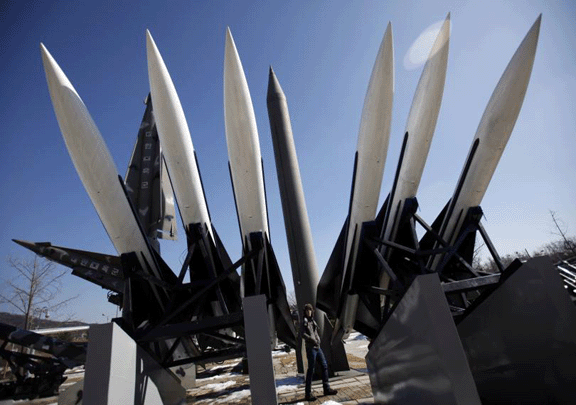
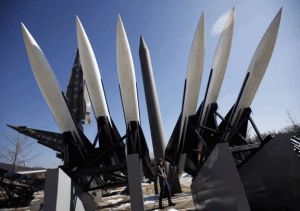 Why The U.S. Must Get Rid Of Its Land-Based Nuclear Missiles, Foxtrot Alpha, Terrell Jermaine Starr, 7/18/17 The Cold War is over. And so is the need for America’s land-based Intercontinental Ballistic Missiles. Not only are the costs of maintaining 450 Minuteman-III missiles unsustainable, keeping them in the nuclear arsenal is hardly practical. Maintaining hundreds of outdated, budget-draining Minuteman-IIIs when the Pentagon has the more accurate, multi-dimensional Trident II that can be shot from Ohio-class submarines that are virtually undetectable makes little sense.
July 26, 2017
Posted by Christina Macpherson |
business and costs, USA, weapons and war |
Leave a comment
 Reuters 24th July 2017, South Korea’s new energy minister on Monday said he plans to support the
country’s push to sell nuclear reactors overseas, even as the nation curbs
nuclear power at home. State-run Korea Electric Power Corp (KEPCO) is
building the first of four nuclear plants in the United Arab Emirates in an
$18.6 billion deal, and is scouting for more business in Britain and other
countries.
But that comes as South Korea, Asia’ fourth-largest economy, has
been looking to steer its domestic energy policy away from its current
heavy dependence on coal and nuclear, with large chunks of the public
skeptical about the safety of atomic power. http://www.reuters.com/article/us-southkorea-nuclear-minister-idUSKBN1A90N6
July 26, 2017
Posted by Christina Macpherson |
marketing, South Korea |
Leave a comment
Koreans target £10bn Welsh nuclear plant, John Collingridge July 23 2017, The Sunday Times A Korean state-owned power giant is drawing up plans to buy a slice of a new £10bn nuclear plant in north Wales.
July 24, 2017
Posted by Christina Macpherson |
marketing, South Korea, UK |
Leave a comment
ROSATOM SAYS IT HAS PLANS TO DEVELOP NUCLEAR CLUSTER IN SA http://ewn.co.za/2017/06/19/rosatom-says-it-has-plans-to-develop-nuclear-cluster-in- sa In April, the Western Cape High Court ruled that government’s decision to call for proposals for the procurement of 9.6 gigawatts of nuclear energy was unlawful and unconstitutional.Tara Penny JOHANNESBURG – Russia’s Rosatom has confirmed it is in contact with South African authorities on plans concerning the civilian use of nuclear energy.
The CEO of Rosatom’s foreign unit, Anastasia Zoteyeva made the comment while answering questions on the sidelines of a conference in Moscow on Monday morning.
She also told reporters that the Russian state nuclear corporation is proposing to develop a whole nuclear cluster in South Africa.
In April, the Western Cape High Court ruled that government’s decision to call for proposals for the procurement of 9.6 gigawatts of nuclear energy was unlawful and unconstitutional.
Earthlife Africa, which brought the case, said the judgment vindicates its argument that the process government has followed was unlawful because it failed to consult the public about its decision.
The case was first brought in October 2015, when Earthlife Africa Johannesburg and the Southern African Faith Communities’ Environment Institute argued that former Energy Minister Tina Joemat-Pettersen had not consulted the public nor Parliament before deciding to procure 9.6 gigawatts of nuclear power.
The judgment meant all deals that government had pursued with Russia and the United States were not valid.
July 22, 2017
Posted by Christina Macpherson |
marketing, politics international, Russia, South Africa |
Leave a comment
 All approvals in place, Japan nuclear deal comes into force http://economictimes.indiatimes.com/news/economy/policy/all-approvals-in-place-japan-nuclear-deal-comes-into-force/articleshow/59690053.cms, By Dipanjan Roy Chaudhury, ET Bureau| Jul 21, 2017 NEW DELHI: The landmark Indo-Japanese civil nuclear deal signed in November 2016 came into force from Thursday that would enable Japan to export nuclear power plant technology as well as provide finance for nuclear power plants in India.
Japan would also assist India in nuclear waste management and could undertake joint manufacture of nuclear power plant components under the Make in India initiative, persons familiar with the development told ET.
Japanese PM Shinzo Abe is expected to visit India this September and growing civil nuclear ties will be highlighted as one of the key elements of Indo-Japan strategic partnership.
Japanese industrial conglomerate Toshiba — which owns Westinghouse — will have a major role when US nuclear major supplies technology for the pair of six reactors in Andhra Pradesh. Since June, this will be the third major development in India’s civil nuclear outreach beginning with pacts with Russia for Units 5 & 6 for Kudankulam Nuclear Power Plant an
d first uranium shipment from Australia.
Last November India and Japan signed a landmark civil nuclear cooperation deal — upgrading MoU at the 2015 Annual summit. Subsequently, the Japanese government got approval from the Diet for the nuclear deal with India. The two countries had reached a broad agreement for cooperation in civil nuclear energy sector during Abe’s visit to India in December 2015. Hitachi, also from Japan, has stakes in GE, which has also proposed to set reactors in India.
India is the only non-NPT signatory with which Japan has entered into a civil nuclear deal in what can be described as a recognition for Delhi’s impeccable non-proliferation record, said a person familiar with the matter. American nuclear major
July 21, 2017
Posted by Christina Macpherson |
India, Japan, marketing |
Leave a comment
 Report: Summer nuke could cost up to $10B more, should be abandoned, Utility Dive Peter Maloney@TopFloorPower July 20, 2017
Dive Brief:
- A report by Institute for Energy and the Environment at Vermont Law School finds that continuing construction on the V.C. Summer nuclear project could add as much as $10 billion to South Carolina ratepayers’ bills.
- The report argues for the abandonment of the project, saying that even though $9 billion has already been spent or committed, dropping Summer now would save significant amounts of money. The paper provides a preview of the testimony the Sierra Club and Friends of the Earth plan to present to the South Carolina Public Service Commission in October.
- A separate report filed with regulators by plant owners Santee Cooper and South Carolina Electric & Gas last year found that Santee’s reserve margin could reach up to 44% once the reactors are completed, and SCE&G’s could hit 27% before declining, according to The State.
Dive Insight:
The V.C. Summer nuclear project being built by South Carolina Electric & Gas and Santee Cooper was already over budget and behind schedule when Westinghouse Electric, the project’s equipment supplier and contractor, went bankrupt.
The owners now face the tough decision of whether or not to push ahead with project.
The report from the Vermont Institute, “The Failure of the Nuclear Gamble in South Carolina,” argues that the project should be abandoned and ratepayers should be issued refunds because of imprudence on the part of SCE&G…….http://www.utilitydive.com/news/report-summer-nuke-could-cost-up-to-10b-more-should-be-abandoned/447482/
July 21, 2017
Posted by Christina Macpherson |
business and costs, USA |
Leave a comment
Inaction on climate change risks leaving future generations $530 trillion in debt, The Conversation., July 19, 2017 By continuing to delay significant reductions in greenhouse gas emissions, we risk handing young people alive today a bill of up to US$535 trillion. This would be the cost of the “negative emissions” technologies required to remove CO₂ from the air in order to avoid dangerous climate change.
These are the main findings of new research published in Earth System Dynamics, conducted by an international team led by US climate scientist James Hansen, previously the director of NASA’s Goddard Institute for Space Studies.
The Paris Agreement in 2015 saw the international community agree to limit warming to within 2°C. The Hansen team argue that the much safer approach is to reduce atmospheric concentrations of CO₂ from the current annual average of more than 400ppm (parts per million) back to 1980s levels of 350ppm. This is a moderately more ambitious goal than the aspiration announced in Paris to further attempt to limit warming to no more than 1.5°C. Many climate scientists and policymakers believe that either the 2°C or 1.5°C limits will only be possible with negative emissions because the international community will be unable to make the required reductions in time…….https://theconversation.com/inaction-on-climate-change-risks-leaving-future-generations-530-trillion-in-debt-81134
July 21, 2017
Posted by Christina Macpherson |
2 WORLD, business and costs, climate change |
Leave a comment














 nuclear-news
Chuck Jones, president and CEO, also revealed that FirstEnergy is preparing to talk to creditors of its subsidiary, FirstEnergy Solutions, the company that owns the corporation’s old, uncompetitive power plants, which have been losing money.
FirstEnergy Solutions’ debt and the declining value of its power plants has made it a potential liability as it negotiates with its creditors amidst rumors of an eventual bankruptcy, and FirstEnergy has tried to distance itself from the subsidiary……
As for the special, customer-paid charges to help Davis-Besse, Perry and Beaver Valley, Pa., nuclear power plants, Jones said he doubted anybody could operate them without special subsidies. The problem is that they cannot compete with gas turbine plants and, at times, with wind power.
“I’m not sure [they] will run unless there is something done either federally or by the state of Ohio to ensure they get a different financial return model,” Jones said.
The company previously said the nuclear charges would increase customer bills by about 5 percent. Subject to periodic review by state regulators, the charges would run for 17 years.
Selling the nuclear plants is part of the company’s overall plan “to exit the commodity-exposed generation business,” Jones said. In other words, if the company cannot have its power prices set by a state utility commission, it does not want to be in the generating business. ……
Jones also made it clear during the conference that FirstEnergy’s campaign to persuade Ohio lawmakers to approve a nuclear plant subsidy would continue no matter what the U.S. Department of Energy recommends.
The Trump administration in April asked the DOE to figure out whether wind, solar and natural gas power plants are forcing the premature retirement of very large old coal and nuclear power plants, and whether those closings might de-stabilize the nation’s high-voltage power grid……. http://www.cleveland.com/business/index.ssf/2017/07/firstenergy_nuclear_charges_cr.html