Russia’s Rosatom hopes to win Saudi nuclear plants’ tender, DANANG, Vietnam, Nov 10 (Reuters) – Russian state nuclear company Rosatom hopes to win a tender announced by Saudi Arabia to build nuclear plants in the kingdom, Alexei Likhachyov, head of Rosatom, told reporters.
“As far as I understand, they (Saudi Arabia) should make a decision next year about the construction and a constructor. We hope it will be us,” he said.
Rosatom has sent initial proposals to Saudi Arabia for nuclear power generation and would make a bid if a tender is announced, the company said earlier this month.
Saudi Arabia is considering building 17.6 gigawatts of nuclear capacity by 2032, the equivalent of about 17 reactors, making it one of the biggest prospects for an industry struggling after the 2011 nuclear disaster in Japan. (Reporting by Denis Pinchuk; writing by Katya Golubkova; editing by Vladimir Soldatkin)DANANG, Vietnam, Nov 10 (Reuters) – Russian state nuclear company Rosatom hopes to win a tender announced by Saudi Arabia to build nuclear plants in the kingdom, Alexei Likhachyov, head of Rosatom, told reporters.
“As far as I understand, they (Saudi Arabia) should make a decision next year about the construction and a constructor. We hope it will be us,” he said.
Rosatom has sent initial proposals to Saudi Arabia for nuclear power generation and would make a bid if a tender is announced, the company said earlier this month.
Saudi Arabia is considering building 17.6 gigawatts of nuclear capacity by 2032, the equivalent of about 17 reactors, making it one of the biggest prospects for an industry struggling after the 2011 nuclear disaster in Japan. (Reporting by Denis Pinchuk; writing by Katya Golubkova; editing by Vladimir Soldatkin)
End may be nearing for Diablo Canyon nuclear plant SF Chronicle, By David R. Baker,: November 9, 2017 California’s last nuclear power plant — Diablo Canyon — may be one step closer to closing, despite a vocal campaign to save it.
The California Public Utilities Commission on Wednesday issued a proposed decision that would approve plans by Diablo Canyon’s owner, Pacific Gas and Electric Co., to shut it down when the plant’s operating licenses expire, in 2024 and 2025.
A majority of the commission’s five voting members must approve the plan for it to take effect. A vote could come as early as Dec. 14.
Diablo Canyon, which sits on a coastal bluff near San Luis Obispo, has been the focus of protests since long before it started operations in 1985. A maze of earthquake faults, all of them discovered after construction began, nearly surrounds the plant.
Africa buys into nuclear dream, Mail and Guardian, Lynley Donnelly
Risky: Nigeria has oil but infrastructure maintenance is poor. It is considering the nuclear option. (Akintunde Akinleye, Reuters)
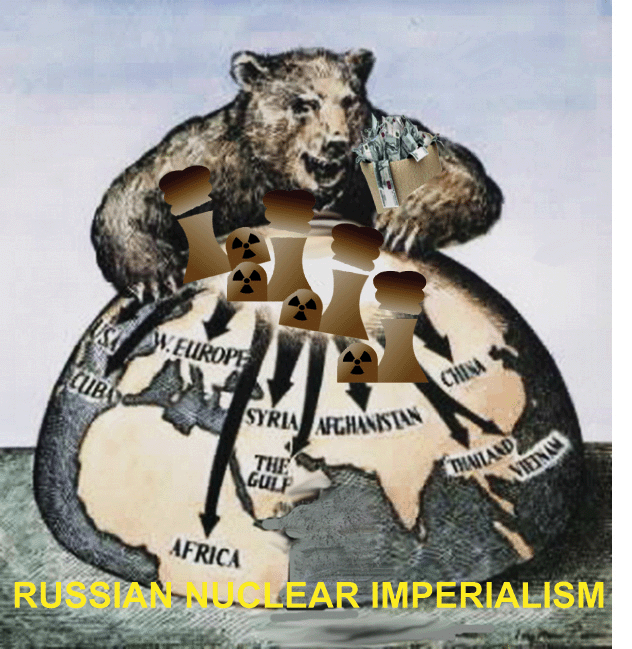
While questions swirl around the progress of South Africa’s nuclear plans, Russia’s state nuclear agency Rosatom is losing no time in selling the atomic dream to other African countries.
Last week the company signed project-development agreements with the Nigerian government for the construction and operation of a nuclear power plant and research centre housing a multipurpose research reactor.
Nigeria has extensive oil and gas reserves but suffers from chronic electricity shortages.
Media reports suggest the deal could cost about $20-billion, but Rosatom said the costs have yet to be determined.
The agreements were signed in order to adopt the appropriate approach and establish the project’s implementation details, a Rosatum official said. “Cost estimations and project specifications will be evaluated in accordance to this agreement,” the official said.
Struggling Toshiba logs $436 mil. loss in 1st half, Japan News, 8 Nov 17After the announcement, Toshiba shares dropped 2.49 percent to ¥313 after spending most of the day hovering near the previous day’s close.
In its earnings statement, Toshiba also continued to warn the market about its “ability to continue as a going concern,” following the disastrous acquisition of U.S. nuclear energy firm Westinghouse, which racked up billions of dollars in losses before being placed in bankruptcy protection.
Those losses came to light as the group was still reeling from revelations that top executives had pressured underlings to cover up weak results for years after the 2008 global financial meltdown…..
After the announcement, Toshiba shares dropped 2.49 percent to ¥313 after spending most of the day hovering near the previous day’s close.
In its earnings statement, Toshiba also continued to warn the market about its “ability to continue as a going concern,” following the disastrous acquisition of U.S. nuclear energy firm Westinghouse, which racked up billions of dollars in losses before being placed in bankruptcy protection.
Those losses came to light as the group was still reeling from revelations that top executives had pressured underlings to cover up weak results for years after the 2008 global financial meltdown…..http://the-japan-news.com/news/article/0004057312
Cost of wind keeps dropping, and there’s little coal, nuclear can do to stop it, An annual look at the costs of generating power. Ars Technica MEGAN GEUSS – Though a lot has changed since 2016, not much has changed for energy economics in the US. The cost of wind generation continues to fall, solar costs are falling, too, and the cost of coal-power energy has seen no movement, while the cost of building and maintaining nuclear plants has gone up. And none of those conclusions reflect subsidies and tax credits applied by the federal government.
The conclusions come from Lazard (PDF), an asset management company that publishes cost estimates for various types of electricity-generation assets each year. Lazard’s numbers reflect the Levelized Cost of Energy (LCOE), which averages the estimated costs of construction, maintenance, and fuel for electricity-generating assets over the number of megawatt-hours that each asset is expected to produce over its lifetime. In other words, the LCOE is the lifetime cost of a turbine divided by the amount of energy that turbine will produce over its lifetime. LCOE is a good way of comparing electricity generation sources that vary dramatically in cost to build and cost to maintain.
The result, tracked over years, is one way of gauging how the US energy mix is changing and could change in the coming year. Though the new presidential administration was expected (and still is expected) to be a boon to coal and nuclear energy, those efforts are still mired in the political process. And even if they succeed, thwarting the cost advantages of wind and solar energy while propping up coal and nuclear power will require not-inconsiderable amounts of intervention from the US government.
According to Lazard, in the last year, the cost of onshore wind has fallen six percent and the cost of utility-scale solar has fallen six percent, too. Those cost reductions are slower than reductions in previous years, but the cost of coal-fired generation remained stagnant in 2017…….. The cost of building and maintaining nuclear plants has actually increased in the last six years as well. Lazar wrote that “the estimated levelized cost of energy for nuclear generation increased [approximately] 35 percent versus prior estimates, reflecting increased capital costs at various nuclear facilities currently in development.” Facilities like the
Rick Perry’s Coal And Nuclear Subsidy Could Cost The U.S. Economy $10.6 Billion Per Year, Forbes, Silvio Marcacci, 6 Nov 17, The U.S. Department of Energy’s Notice of Proposed Rulemaking (NOPR) directing the Federal Energy Regulatory Commission (FERC) to subsidize coal and nuclear generation is opposed by nearly every side of America’s electricity industry – from market operators and conservative analysts to a bipartisan group of former FERC commissioners – except for those who would directly benefit from it.
Reasons for opposing the NOPR range from potentially destroying wholesale power markets, to free trade principles, or insufficient review time, but beyond Rick Perry suggesting the proposal’s price was equal to “the cost of freedom,” DOE hasn’t quantified the NOPR’s economic impact or which plants it would subsidize.
FT 7th Nov 2017,British ministers are preparing to revive the UK’s faltering effort to
create a new generation of small-scale nuclear power plants in spite of an
official analysis that cast doubt on the economic case for the technology.
Talks have intensified in recent weeks between government officials and
companies including Rolls-Royce, the UK engineering group, over potential
public funding to support development of so-called small modular reactors
(SMRs).
Greg Clark, business secretary, is keen to put the UK at the
forefront of technology seen as a more affordable alternative to
large-scale nuclear reactors such as those under construction at the £20bn
Hinkley Point C plant in south-west England.
Development of SMRs is regarded as crucial to the future of the nuclear industry as it struggles
to remain competitive against the rapidly falling cost of renewable wind
and solar power. The UK faces competition from the US, Canada and China in
its effort to establish a leading position in the technology.
Support for SMRs is expected to be part of a wider commitment to nuclear engineering in
a new industrial strategy to be unveiled by the government this month.
However, the enthusiasm has been complicated by a technology assessment, commissioned by the business department and carried out by EY, the accounting firm, which reached a negative verdict on the cost-effectiveness of SMRs. The findings are expected to be published in the coming weeks and
will confront the government with awkward questions about why public money
should be used to help commercialise the unproven technology. https://www.ft.com/content/bddfda80-c314-11e7-b2bb-322b2cb39656
$25 million a year decommissioning fee proposed for Pilgrim nuclear plant Andy Metzger, State House News Service, Nov 6, 2017 BOSTON — Without sufficient funds for safely decommissioning the Pilgrim Nuclear Power Station, the state could be left holding the proverbial (glowing) bag once the plant ceases operations, environmental activists warned lawmakers Monday, asking them to impose a $25 million annual fee on the station if it misses deadlines.
The plant is set to close in a year and a half and its owner, Entergy, said the timetable for completing the decommissioning five years after closing is unrealistic.
“Physically it’s impossible to decommission in five years,” Tom Joyce, a lobbyist for Entergy, told the Committee on Telecommunications, Utilities and Energy. The fuel that was delivered to the power plant on the Plymouth coast about six months ago is “very hot and being used now to fuel the reactor and produce electricity, which will stay in the pool and can’t be touched for five years,” Joyce said.
Pilgrim went into operation in 1972, and it has been a source of major safety concern for residents of the South Shore and Cape Cod, especially after the meltdown in Fukushima, Japan, demonstrated the devastation that can follow a nuclear disaster……..
The plant, which is rated one notch above the Nuclear Regulatory Commission’s ranking of unacceptable, is set to close at the end of May 2019, and federal regulators will oversee the decommissioning process.
Pilgrim has a fund to pay for decommissioning that Joyce said stands at around $1 billion and anti-Pilgrim activists said was recently priced at about $960 million. Activists say that amount won’t be enough to cover the cost of safely securing the spent fuel and other decommissioning responsibilities.
Decommissioning Vermont Yankee, a smaller plant, had an estimated cost of $1.23 billion, according to Claire Miller, a community organizer for Toxics Action Center.
“If there’s not enough money the reactor could be mothballed for 60 years, and during that time obviously the workforce would be reduced to a skeleton [crew], offsite emergency planning would be eliminated, and offsite environmental monitoring eliminated or reduced,” Miller told the committee. “If Entergy … skips town, we are left holding the bag, along with lots of radioactive waste.”
Legislation filed by Plymouth Republicans Sen. Vinny deMacedo and Rep. Mathew Muratore would establish a Nuclear Power Station Post-Closure Trust Fund financed with $25 million annual payments by any nuclear plant that is not completely decommissioned five years after it stops making electricity. Pilgrim is the only remaining nuclear plant in Massachusetts.
“We have not yet drawn on the Russian loan, but this will change in the coming hours,” Aszodi told an energy conference organized by financial news website portfolio.hu.
Russian company Rosatom will build two nuclear reactors in Hungary in a 12.5 billion euro project that has been delayed by at least a year as Hungary ironed out regulatory and financing issues with European regulators.
Renew Economy 7th Nov 2017, The latest energy auction in Chile has set a new record low for solar PV,
with one bid by the local subsidiary of Italian outfit, Enel, coming in at
just $US21.48/MWh The result beats the previous record low of $US24.20 set
in the United Arab Emirates earlier this year, although it could be beaten
by Saudi Arabia’s first auction, should the early results of a tender
that secured an offer of $US17.90/MWh be verified later this month. Either
way, the Chile government is happy with the result, which secured an
average price of $US32.5/MWh for 600MW of solar and wind capacity, expected
to produce around 2,200GWh. This is a 75 per cent fall since its auction
program began in 2015. The Chile government says it will mean consumer
prices fall by nearly 50 per cent once all the new projects are completed
and online in 2024. http://reneweconomy.com.au/chile-solar-auction-sets-new-record-low-for-solar-pv-85114/
Financing for Eskom to develop nuclear program was discussed
Talks also included options to assist South African Airways
South Africa’s Finance Minister Malusi Gigaba met with representatives of the World Bank last week to discuss financing for development of a nuclear power program in the country, according to two people familiar with the meeting.
Gigaba met with the bank on Friday to discuss funding options available to state-owned power utility Eskom Holdings SOC Ltd. for the program, said the people, who asked not to be identified because the information is not public. South African Airways, the national airline that is struggling to meet debt obligations, was also discussed at the meeting, said one of the people.
Eskom last year began a process to add 9,600 megawatts of nuclear power capacity beyond its single existing plant by issuing a request for information from vendors. There were 38 responses to the notice, Kelvin Kemm, chairman of the South African Nuclear Energy Corp., told lawmakers in Cape Town on Tuesday.
South Africa’s nuclear investment plans have become a focal point for critics of President Jacob Zuma’s policies. The affordability of the program was a key point of dispute between Zuma and former Finance Minister Pravin Gordhan and the procurement process stalled in April after a provincial court ruled that the government didn’t follow the correct procedure in pursuing the nuclear program.
Gigaba declined to comment on Tuesday when asked about the meeting. The World Bank didn’t immediately respond to questions sent by email but confirmed receipt.
Gigaba said Oct. 26 that South Africa can’t afford to build new reactors for at least five years and that it doesn’t need more baseload, or continuous, power capacity. Nuclear still remains a part of the energy plan and the government will look at it as an option when needed and when it can afford it, he said.
South Africa Energy Minister David Mahlobo, who was appointed last month, said on Oct. 23 that a legal procurement process would be followed for a nuclear program, noting the Western Cape High Court decision.
The World Bank has previously supported energy projects through Eskom. However, an inspection panel from the organization in 2012 found instances of non-compliance in its award of a $3.75 billion loan to the utility for construction of the Medupi coal-fired power plant. The impacts and risks for other local water users weren’t properly considered and the project would place strain on water resources in an area already suffering from scarcity, it said at the time.
The discussions between Gigaba and the World Bank also included options to assist South African Airways, according to one of the people.
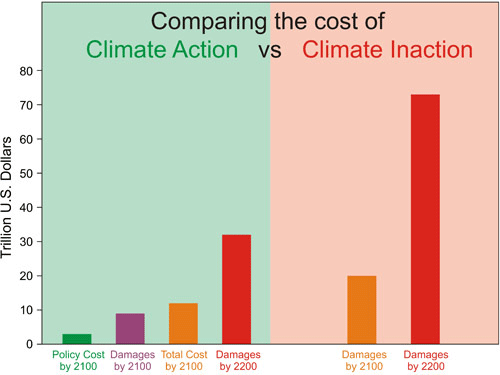
Nations may focus on human and economic losses at climate talks, Economic Times By Urmi Goswami, ET Bureau, Nov 06, 2017, BONN: As officials from 196 countries gather in Bonn to work on a collective plan to slow down global warming at the 23rd round of UN-sponsored climate talks, developing countries are highlighting the urgent need to step up efforts to address the serious human and economic losses already taking place due to climate change. Developing countries are calling for the urgent need to secure long-term finance flows to help poor countries take the measures required to tackle climate change and deal with .
Developing countries are suggesting that a quantified goal for long-term finances, beyond the $100 billion by 2020, be agreed on to help poor countries.
The G-77 and China, the negotiating group comprising 132 developing countries, is planning to focus on the need to proactively address the clear impact that climate change is already having. Their focus will be on ensuring the flow of finance, technology, and building capacities in developing countries to deal with climate change. The group will also push for increased discussions of adaptation that will help countries to adjust to changes that are already underway. The G-77 will focus on the extreme weather events in the past year to make its case at the opening assembly on Monday.
Sources indicated that in its address to the opening assembly, the G-77 and China will focus on extreme weather events in the past year to make its case at the opening assembly on Monday. The developing countries group, represented by Ecuador, is expected to draw attention to the “serious human and economic losses” to urge greater focus on efforts by countries, particularly industrialised ones, in the period before 2020. Climate change impact, the G-77 stressed, will not wait until 2020, when the Paris Agreement with its national climate action plans come into effect. This year’s meeting is taking place in the shadow of extreme weather events— hurricanes, floods, droughts, and forest fires— across the globe. These drive home the message that the impact of climate change is no longer in the future and instead are a clear and present danger.
A recent Congressional Budget Office (CBO) estimate puts the bill for modernization of the nuclear weapons complex and arsenal at $1.2 trillion over 30 years. This new estimate—a significant increase over previous suggestions of the cost for rebuilding the US triad of land, submarine, and bomber-based nuclear forces—has drawn much comment. But the CBO estimate avoids including funds for environmental restoration and waste management of the Energy Department’s nuclear weapons complex—funding that is also in the Congressional Atomic Defense Activities Account that supports the department’s nuclear weapons activities. If these legacy costs are included, then the total price tag goes to $1.74 trillion over three decades. (See figure 1.)
Figure 1
An analysis of the annual costs for nuclear warhead services and systems from fiscal years 2003 2018 (in 2017 dollars) shows that over the past 15 years, the United States has spent nearly $33 billion a year on a dwindling nuclear stockpile. Even though the U.S. Nuclear weapons stockpile has shrunk by 60 percent since 2003, the annual per-warhead cost has increased by about 422 percent. (See figure 2.)
Figure 2
These estimated costs for environmental cleanup are likely on the lower end of the eventual tab, because the Energy Department’s large infrastructure of abandoned facilities has been ignored for decades. Abandoned and antiquated structures constitute a fast-growing overhead expense for the weapons complex, which must pay for building collapses, flooding, and fires, and for preventive work that, for example, keeps roofs on vacant buildings from falling in. In 2015, the Energy Department inspector general warned that, “delays in the cleanup and disposition of contaminated excess facilities expose the department, its employees and the public to ever-increasing levels of risk [and] lead to escalating disposition costs.”
For instance, the Y-12 nuclear weapons site Oak Ridge,Tenn., has abandoned contaminated structures, mostly built in the 1940’s, that inhabit a footprint 2.5 times larger than the Pentagon building. In December 2016, the cost to get rid of 2,349 Energy Department abandoned facilities over the next 10 years was roughly estimated at $32 billion.The Energy Department reports that among those buildings are 203 unattended “high risk” facilities, estimated to cost $11.6 billion to deal with. And sometimes the risk becomes reality, the most recent example being the collapse of the PUREX Tunnel at the Hanford Site in Washington State; the tunnel holds an enormous amount of radioactive waste, and its collapse forced workers to seek cover at at the Hanford site. The Energy Department estimates that another 1,000 abandoned facilities will be added to the list of those needing cleanup over the coming decade. Disposition costs for the large amounts of hazardous wastes in the abandoned structures are not included in the department’s 2016 estimate and are likely to add several billion dollars more to the ultimate bill.
To be sure, these legacy costs are not specifically related to nuclear modernization. But so long as the United States continues to support and, perhaps, rebuild a large nuclear weapons complex, the costs of the complex as a whole will continue—and continue to increase. Decisions on modernization need to take these legacy costs into account because they will inevitably affect the amount of money available to the US defense effort, and, very importantly, to the protection of the health and safety of workers in the weapons complex, and the American public.
China calls for stronger co-op with US in next-generation nuclear technology
The announcement came from Chinese premier Li Keqiang ahead of US President Donald Trump’s visit to China. Trump is scheduled to hold talks with President Xi Jinping. Hindustan Times Nov 05, 2017 Press Trust of India, Beijing
China wants joint cooperation with the US in developing next-generation nuclear power technology, Chinese premier Li Keqiang said, ahead of President Donald Trump’s visit to Beijing this week.Trump will be in China from Wednesday to Friday. He would hold talks with Chinese President Xi Jinping.
In his meeting on Friday with Bill Gates, co-founder of Microsoft and chairman of TerraPower, Li has called for closer China-US cooperation in developing the next-generation nuclear power technology.
Speaking highly of the China-US partnership in this field, Li said companies of the two countries have set up a joint venture with each holding half of shares and agreeing to share the intellectual property rights, state-run Xinhua news agency reported.
China’s nuclear power play falters in Britain http://www.atimes.com/article/chinas-nuclear-power-play-falters-britain/ Beijing’s planned investment in UK’s civil nuclear program, part of its One Belt One Road initiative, is on increasingly shaky ground,By RICHARD COOKNOVEMBER 4, 2017 When it recently emerged that China General Nuclear Power Corporation (CNG) had refused to give a visiting team of UK government inspectors the security details for one its reactors, a slew of negative headlines followed in UK media about Chinese involvement in Britain’s power supply.
The inspectors, from the UK’s Office for Nuclear Regulation, had traveled to China to examine Fangchenggang’s Unit 3 nuclear power plant and its Hualong One third-generation pressurized reactor.
The Hualong One design is earmarked for a planned Chinese-built nuclear power plant at Bradwell on England’s east coast and the inspectors were in China to start a complex four-year Generic Design Assessment [GDA] process that will end, the Chinese hope, with the reactor’s approval for use in Britain.
China is the world’s fastest expanding nuclear power producer and has been clear about its desire to be a leading exporter, too. Exporting nuclear power is an objective of Xi Jinping’s Belt and Road initiative and nuclear is included as a core energy component in the country’s latest Five-Year Plan. At the center of this ambition is the Hualong One.
Developed though a state-led agglomeration of China’s main industry players and initially adapted in the 1990s from a French design, the Hualong One has since 2014 been packaged — along with a package of enticements comprising construction expertise, training support, competitive pricing and financing options — as China’s flagship power brand.
CNG says more than 20 countries have shown interest in the nuclear plant. While the first working Hualong One reactors will be in China, in what are revealingly described as “demonstration units,” two are currently under construction in Pakistan while an Argentinian one reported to be worth US$9 billion is due in 2020. After that should come Bradwell.
The UK has not commissioned a nuclear power station for almost 30 years, but now has plans for six sites. China currently has involvement in three, but that could become four after the bankruptcy of Toshiba’s nuclear arm.
The first two, Hinkley Point C and Sizewell, only saw Chinese involvement after the French state-owned Électricité de France (EDF) voiced concern about growing costs. China agreed to help with finance as long as it got to build a Hualong One at Bradwell, which will be the first wholly Chinese-designed reactor to be built in a western country.
Is this a good investment for China?” asks nuclear risk expert Jerzy Grynblat. “It is very hard to say because, as it comes from the Chinese government, some of the sums will remain hidden. But what is perhaps more important to ask is why the Chinese state wants to invest when no western government will?”
For Grynblat – who, before retiring in early 2017, was Nuclear Business Director at safety assurance consultancy Lloyd’s Register – it is “purely an expansion of political power.”
Grynblat explains that the UK is currently the only western country with a nuclear power program. “They needed to add capacity and replace existing capacity… In terms of power security, the UK was in a bad position and they had to do something.” That gave China an opportunity, says Grynblat. “Bradwell presented the Hualong One with an important foothold in the West.”
The design of the Hualong One, Grynblat believes, is reminiscent of a Swedish reactor from the 1980s. “It surprised me a little,” he says. “It really is quite old fashioned. I am not saying this makes it unsafe, certainly not, but what it does is make use of well known technology. And this makes approvals more straightforward… And the GDA process that they are starting now in the UK is crucial to them. They will be able use this all over the world.”
Antony Froggatt, senior research fellow at think-tank Chatham House and co-author of The World Nuclear Industry Status Reports, agrees. “It’s a first” says Froggatt. “It creates an important benchmark for China and it’s an important sales pitch. The GDA process alone brings kudos.”
Yet Froggatt is not convinced that Bradwell itself will be built. “The industry is changing rapidly. Even since China first got involved in the UK in 2015, the price of offshore wind and solar has got much cheaper. There is also recognition in the UK government that the Hinkley contract cannot be repeated at Sizewell because it has made the cost of the power so expensive… Hinkley is happening but very slowly. They originally said it would be built by 2018. Now they are saying 2025… As such, I am now thinking that Sizewell will not happen.”
“And Bradwell,” says Froggatt, “is a different story again…. It is a new reactor, it’s Chinese and there are the security issues.” He asks: “Will the Chinese ever be able to open up the design specifications?”
The UK’s inspectors were quick to brush off their access issues in China and instead praised CNG’s “high level of expertise and commitment.” But it is not the first time there has been negativity around the China-UK power deal.
Last year, amid rising public opposition, Prime Minister Teresa May felt compelled to suspend the Hinkley project while a “security review” was carried out. Nick Timothy, May’s joint chief of staff at the time, had bluntly warned that the Chinese might be able to “build weaknesses into computer systems which will allow them to shut down Britain’s energy production at will.”
There is a lot at stake here, for both China and the UK. And, much like a nuclear reactor, it looks like this story will run and run.