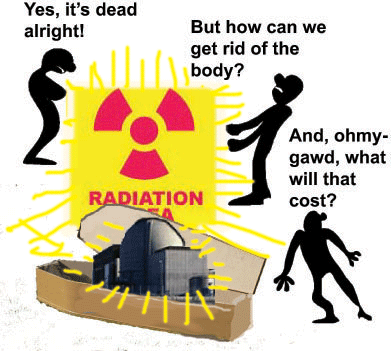
Nucnet 1st March 2018, The Nuclear Decommissioning Authority (NDA) completely failed in both the procurement and management of a contract to clean up the UK’s Magnox
nuclear reactor and research sites, a report by the Public Accounts
Committee says.
The report, released on 28 February 2018, says this
disrupted an important component of vital nuclear decommissioning work and
cost the taxpayer upwards of £122m (€137m, $167m). The £6.2bn contract
— one of the largest awarded by the UK government — was to dismantle 12
first-generation Magnox nuclear sites.
It was awarded to Cavendish Fluor Partnership, a joint venture between UK-based Babcock International and
Fluor of the US. The committee, which oversees government expenditure,
said: “The NDA ran an overly complex procurement process, resulting in it
awarding the contract to the wrong bidder, and subsequently settling legal
claims from a losing consortium to the tune of nearly £100m.”
The committee also said the NDA, a public body established in 2004 to oversee
the clean-up of the UK’s nuclear legacy, “drastically
under-estimated” the scale of the work needed to decommission the sites
at the time it let the contract – a failure which ultimately led to the
termination of the Magnox contract nine years early.
The NDA did not have sufficient capability to manage the procurement or the complex process of
resolving differences between what the contractor was told to expect on the
sites and what it actually found, the committee concluded.
The NDA will now have to spend even more effort and money to find a suitable way of managing
these sites after the contract comes to an official end in September 2019,
the committee said. The NDA may have further wasted taxpayers’ money by
paying its previous contractor for work that was not done. The NDA cannot
fully account for £500m of the £2.2bn increase in the cost of the
contract between September 2014 and March 2017. In particular, it does not
know whether the £500m cost increase was due to its incorrect assumptions
about the state of the sites when it let the contract or underperformance
by the previous contractor. https://www.nucnet.org/all-the-news/2018/03/01/accounts-committee-says-nda-completely-failed-with-6-2-billion-uk-magnox-contract
PSEG canceling nuclear plant spending due to stalled bailout, By: MICHAEL CATALINI, Associated Press
Public Service Enterprise Group said in a Securities and Exchange Commission filing dated Wednesday that it will halt the projects at the Salem nuclear plant in southern New Jersey. A spokesman said the spending covered efficiency and reliability maintenance.
PSEG says the decision comes after “recent postponements” of a vote on legislation to provide the financial rescue. The bill, which has undergone several changes and was held during a recent session, includes clean-energy requirements that lawmakers say were sought by Democratic Gov. Phil Murphy.
Santee Cooper execs get big bonuses, pay hikes, while nuclear debt mushrooms, The Nerve, February 27, 2018, By RICK BRUNDRETT
As state-owned utility Santee Cooper was racking up billions in debt – which ratepayers are expected to shoulder – for the failed V.C. Summer nuclear project, the company’s top executives were raking in huge bonuses and salary hikes.
More than $4 billion in bonds that were sold to finance the biggest financial flop in the Berkeley County-based utility’s history will have to be paid back with interest over years – to the tune of $200 million to $300 million annually.
But those I.O.U.’s are only part of the company’s overall debt load, which company records show stands at more than $15 billion. That tab will be paid back over 40 years, starting last year with payments totaling nearly a half-billion dollars.
And that means Santee Cooper’s customers likely will face rate hikes – how much is unknown – in the coming years.
Meanwhile, from 2009 through 2016 as the V.C. Summer project costs were escalating and construction deadlines were missed, the utility paid out a total of $5.6 million in bonuses to 15 executives, company records show.
Of the total bonus pool, $70,648 over the eight-year period was directly tied to the nuclear project, more than half of which was paid to recently retired president and CEO Lonnie Carter.
Carter received the highest total annual bonuses; in 2015 and in 2016 he was paid more than $330,000 in bonuses, which represented more than 60 percent of his salary for those years. During the 2009-16 period in which the V.C. Summer project was active, his yearly salary jumped 34 percent, from $404,756 to $540,929.
Besides bonuses, Santee Cooper’s top executives also received, according to a company spokeswoman, annual car allowance and life insurance benefits, which made up their total compensation. The additional perks brought Carter’s total 2016 total compensation to $894,369, a hike of about $377,000 from his 2009 compensation.
The total compensation of seven other top executives in 2016 ranged from $282,811 to $552,133, with nearly all of them receiving increases from the previous year, records show.
And Carter also received a golden parachute with his retirement last year: In addition to receiving $344,572 for life from the state retirement system, he will be paid up to $455,192 annually for 20 years through a separate executive retirement plan with the company, plus had had $858,577 in a 401(k)-type retirement plan through Santee Cooper, according to media reports…….https://thenerve.org/santee-cooper-execs-get-big-bonuses-pay-hikes-while-nuclear-debt-mushrooms/
Japan’s Mitsubishi acquires 5% stake in French nuclear power firm Orano for $306m, Deal Street Asia, Mars Woo February 28, 2018 Tokyo-headquartered Mitsubishi Heavy Industries (MHI) has completed its acquisition of a 5 per cent interest in Orano, a French multinational group specialising in nuclear power and renewable energy, for €250 million ($306 million).
In a statement on Wednesday, MHI said the completion of the investment, which was agreed upon in March 2017, would enhance technological and business cooperation between the two companies and strengthen global value chain for nuclear energy…….
Orano primarily focuses on the fuel cycle business, including uranium mining, enrichment, and conversion and processing of spent fuel. MHI had in 1991, partnered with Areva, now an Orano subsidiary, to form a joint venture in the fuel cycle business for the manufacture and sale of a full range of reprocessing equipment. The company said it aims to play an important role in forging stronger links between the Japanese and French nuclear energy industries, as confirmed by the two countries’ governments in October 2015.
The company said it aims to play an important role in forging stronger links between the Japanese and French nuclear energy industries, as confirmed by the two countries’ governments in October 2015. “By strengthening the relationship between manufacturers in Japan and France, every effort will be made to expand and improve structurally as a comprehensive manufacturer capable of supporting the global nuclear power generation business in all aspects; from production of nuclear fuel to plant design, construction and maintenance, and reprocessing of spent fuel,” MHI said in a statement. https://www.dealstreetasia.com/stories/japans-mitsubishi-acquires-5-stake-french-nuclear-power-firm-orano-306m-93291/
Reforging its core business to return to competitiveness after record losses of €4.83 billion in 2014, French nuclear firm AREVA has split its five operational business units and rebranded them—again. All its assets related to the design and manufacture of nuclear reactors and equipment, fuel design and supply, and services to existing reactors now fall under Framatome, which until January 4 was known as New NP. Operations related to the nuclear fuel cycle will be undertaken by Orano, which until January 23 was known as NewCo.
Creation of the AREVA group itself was an overhaul effort. The company was formed in 2001 with the merger of Framatome, Cogema, a nuclear business of German giant Siemens, and French propulsion and research reactor arm Technicatome. Framatome—short for Franco-Américaine de Constructions Atomiques—was created in 1958 by Schneider, Merlin Gerin, and Westinghouse Electric to exploit the emerging pressurized water reactor (PWR) market.
. By 1975, the company had become the sole manufacturer of nuclear power plants in France, equipping French state-owned utility EDF with 58 PWRs, and gradually taking on more projects overseas, building reactors like South Africa’s Koeberg, South Korea’s Ulchin, and China’s Daya Bay and Ling-Ao. In 1989, Framatome and Siemens created a joint company called Nuclear Power International to develop the EPR, a third-generation reactor that complied with both French and German nuclear regulations. The companies eventually merged in 2001, retiring the Framatome name and giving birth to AREVA.
One of the company’s most prominent contract wins came in 2003 from Finnish utility Teollisuuden Voima Oy (TVO) for construction of the world’s first EPR, Olkiluoto 3, in southern Finland. In 2007, AREVA also signed a contract with EDF for an EPR in Flamanville, France, and separately with Taishan Nuclear Power Co., a joint venture 70% held by China Guangdong Nuclear Power Holding Corp. and 30% by EDF. Two years later, Siemens withdrew its capital in Areva NP—AREVA’s specialized nuclear steam supply system arm—citing a “lack of exercising entrepreneurial influence within the joint venture” as the reason behind the move, and transferred its 34% stake to the AREVA group.
But plagued by delays and cost overruns at Olkiluoto 3 (Figure 3) and Flamanville 3, as well as at a research reactor construction project, and financially hemorrhaging from renewable energy contracts, AREVA’s finances began to fall into disarray, reaching record losses in 2014. In 2015, EDF moved to snap up between 51% and 75% of the troubled nuclear giant’s reactor business, encouraged by the French government’s attempts to address a rivalry between the two majority state-owned companies.
In November 2016, AREVA and EDF signed a contract conferring to EDF exclusive control of a new entity—New NP—that oversaw AREVA’s reactor design and equipment manufacturing, fuel design and assemblies manufacturing, and reactor services. Closure of the sale was completed in December 2017, and EDF became the majority owner (holding 75.5% of shares) of New NP, while Mitsubishi Heavy Industries took on 19.5%, and Paris-based international engineering firm Assystem held 5%.
Then in January 2018, the companies rebranded New NP, reviving the Framatome name in a move to harken to its celebrated legacy. Staffed by 14,000 employees worldwide, Framatome today has an “existing global fleet of some 440 reactors representing output of around 390 GWe in 31 countries, and with new nuclear capacity on its way, the nuclear market presents opportunities in the areas of components, fuel, retrofits and services,” the company noted in January.
The name’s luster has this year already been burnished by two significant developments for the company. On January 25, the French Nuclear Safety Authority (Autorité de Sûreté Nucléaire [ASN]) gave Framatome and EDF the green light to resume manufacture of forgings for the French nuclear fleet at its 2006-purchased Le Creusot site (Figure 4), which was taken offline following the French regulator’s 2015 discovery of an anomaly in the composition in certain zones of the Flamanville EPR pressure vessel head and bottom head. In 2016, a quality audit identified “irregularities” in paperwork on nearly 400 plant components produced at the forge since 1965. Preventative measures ordered by ASN stemming from that debacle in December 2016 shut down more than half of France’s reactor fleet, sending contract prices across Europe soaring.
Also, on January 25, Framatome finalized and launched Enfission, a 50-50 joint venture with Lightbridge Corp., to commercialize the U.S. fuel technology developer’s metallic fuel. Lightbridge says that the “seed-and-blanket” design can safely operate at increased power density compared to standard uranium oxide fuel. For Framatome, which provides next-generation fuel assembly designs to more than 100 of about 260 light water reactors around the world, the partnership will strengthen its position in the global fuel market.
As part of restructuring efforts in June 2016, meanwhile, AREVA also created a separate company focused on the nuclear cycle, which it called, simply, “New Company” (NewCo). On January 23, that company was renamed “Orano.” The name is derived from Ouranos, a Greek god who personifies the heavens and was father of the Titans, and who in Roman mythology became “Uranus.” In 1789, German chemist and mineralogist Martin Heinrich Klaproth named his newly discovered rare metallic element “uranium” for the planet Uranus, which had also been recently found.
For Orano, the name is important because it “symbolizes a new start,” said CEO Philippe Knoche in January. “We have big ambitions for Orano, namely for it to become the leader in the production and recycling of nuclear materials, waste management, and dismantling within the next ten years.” Knoche also said, however, that the company’s name is written in lower case because the prospect of rebuilding a profitable operation will be done “with humility.” For now, the company’s operations will bank on reprocessing and nuclear growth in Asia rather than investing in new mines, owing to low prices of uranium, which have slipped 80% over the last decade as the nuclear sector sees a general slowdown.
India, Russia, Bangladesh sign tripartite pact for civil nuclear cooperation, By Dipanjan Roy Chaudhury, ET Bureau| Mar 01, 2018, NEW DELHI: In a landmark development India for the first time signed a tripartite agreement on Thursday with foreing partners — Russia & Bangladesh — for civil nuclear cooperation.
Nuclear Power Cooperation of India Limited (NPCIL) will play a key role in building a nuclear power plant on foreign soil with the proposed supply of equipment and material for the power station being built by Russia in Bangladesh. India is also extending support for capacity building and has been training Bangladeshi nuclear scientists for the project.
The agreement was signed in Moscow on Thursday by Deputy Director General of Rosatom (Russia’s Alex civil nuclear body) Nikolay Spassky, Ambassador of Bangladesh in Russia S.M. Saiful Hoque and Indian Ambassador to Russia Pankaj Saran.
Rosatom is constructing nuclear power plant in Bangladesh on a turnkey contract basis. The scope of work includes design, production and supply of equipment, construction, installation, pre-commissioning and commissioning, according to Rosatom officials.
Talks come as U.S. considers allowing Saudi uranium enrichment
· Energy Secretary Perry delays India trip for visit to London
Energy Secretary Rick Perry will travel to London to discuss nuclear energy with officials from Saudi Arabia on Friday as the Trump administration pursues a deal to build reactors in the kingdom, according to two people familiar with the plans.
Perry scrapped a trip to New Delhi to accommodate meetings at the White House this week, creating an opening for him to lead an inter-agency delegation to London, said the people, who asked not to be named to discuss administration strategy.
The administration is considering permitting Saudi Arabia to enrich and reprocess uranium as part of a deal that would allow Westinghouse Electric Co. and other American companies to build nuclear reactors in the Middle East kingdom.
The meetings in London between Perry and Saudi Arabia’s Minister of Energy and Industry Khalid Bin Abdulaziz Al-Falih are seen as a critical step in months of ongoing discussions over a potential nuclear cooperation agreement, bringing together key deal makers from each country.
Some American agreements with other countries have prohibited the enrichment and reprocessing of uranium in exchange for the use of nuclear technology, and that had scuttled negotiations for Saudi projects during the Obama administration.
16 Power Plants
The administration is mulling whether to ease that requirement now as a way to help Westinghouse and other companies win Saudi contracts. Saudi Arabia plans to construct 16 nuclear power reactors over the next 20 to 25 years at a cost of more than $80 billion, according to the World Nuclear Association.
The Energy Department confirmed the cancellation of Perry’s India trip but a spokesman did not reply to a question about the London talks.
Any agreement they reach must be approved by Congress, which will have 90 days to weigh in. The potential deal has drawn opposition from anti-nuclear proliferation advocates and some lawmakers, such as Senator Ed Markey, a Massachusetts Democrat.
On Monday, Markey asked the Trump administration to detail its efforts to sign a nuclear cooperation agreement with the Saudis and share information about U.S. negotiations with the country.
“Congress remains in the dark about what exactly is being considered, why we may be re-evaluating our nonproliferation objectives and standards, and how and when this information is being conveyed to Saudi Arabia and other countries around the world,” Markey said in a letter to Perry and Secretary of State Rex Tillerson.
Saudi Arabia’s Crown Prince Mohammed Bin Salman is expected to visit the U.S. in March.
Rosatom stakes out wind power to gird against blustery nuclear futures, Russia’s state nuclear corporation unveiled plans this week to build up to 600 megawatts of wind energy in the Krasnodar region in southern Russia in what appears to be part of the company’s tentative diversification within renewable energy. Bellona, by Charles Digges
“…….. the new wind farm and several battery production ventures the company is pursuing come as an evident bow to declining global demand for the nuclear power plant builds on which until recently the company had staked its future growth.
The new wind plant will be built by VetroOGK, a subsidiary of Rosatom, and will comprise a 150 megawatt park in the Shovgenovsky and Giaginsky districts of the southerly Republic of Adygea using equipment supplied by Dutch wind turbine maker Lagerwey, according to a Rosatom release. It expects to obtain construction permits for the project in March or April, while commissioning is scheduled for December 2018 or January 2019.
The VetroOGK had likewise inked a letter of intention to install another 200 megawatts of wind power in the Krasnodar Region at a wind park the company says it will open by the end of 2018. For the two parks Rosatom has invested $364 million, though its release also anticipates further funding for a 300 megawatt wind park in the Rostov Region, though the start date for that project remains unclear.
Though it would be a stretch to suggest that the wind projects could financially buoy the consolidated bulk of Russia’s monolithic nuclear monopoly, they nonetheless acknowledge sour facts about the company’s prospects for building its AES-2006, or VVER-1200, reactor package on the foreign market.
Speaking last summer at Novosibirsk’s Tekhnoprom-2017 technical trade conference, the company’s deputy director, Vyacheslav Pershukov said Rosatom’s international nuclear market was “exhausted” – the starkest acknowledgment yet from the company that its marquee product was selling poorly. …….
No to a permissive US-Saudi nuclear deal, Bulletin of the Atomic Scientists, Victor Gilinsky, Henry Sokolski , 22 Feb 18,
A US-Saudi nuclear agreement is said to be in the works. The reported deal would allow Saudi Arabia to buy US nuclear power reactors and—because of Saudi resistance to stricter terms—would be “flexible” on Saudi uranium enrichment and on reprocessing of spent reactor fuel. The trouble with flexibility regarding these critical technologies is that it leaves the door open to production of nuclear explosives.
More disappointing, although perhaps not surprising, is that the proposed agreement has the support of more than a few nuclear policy experts outside government. They make a familiar argument regarding nuclear exports: If the United States insists on stricter terms—terms that bar enrichment and reprocessing—the Saudis will turn to Russia or China for nuclear technology, granting these countries greater influence in the Middle East. The United States has been down this road before, in the cases of Iran and India, and it didn’t turn out well. A permissive US-Saudi nuclear agreement would be strategically dangerous for the United States and the region. Congress should not approve such a deal.
What’s driving the administration to cut such an agreement? Let’s set aside the Energy Department’s claims that the Saudis need nuclear power plants and that Westinghouse has a chance to get the business for the United States. First, the Saudis have cheaper energy options—natural gas and renewables. This is clear from the decision of the similarly situated United Arab Emirates not to build more nuclear plants beyond four reactors already planned or under construction. Second, Westinghouse—now bankrupt—has no chance to get the business, and in any case it is no longer a US-owned company. The Saudis, if they did go forward with developing nuclear energy, would do business with the South Koreans, who are successfully completing a proven reactor design next door in the United Arab Emirates.
If buying American is not the key driver of this deal, what is? The Saudis, to maintain theoption of using in its plants US parts whose export is controlled by law, want an umbrella agreement. But they obviously have more in mind than nuclear energy. They compete with Iran for influence in the Middle East, and they are obsessed with this rivalry. They are convinced that they need to match Iran’s nuclear potential. That means being within arm’s reach of a Bomb. These circumstances shouldn’t surprise anyone, and in fact one of the main reasons to restrain Iran is precisely to avoid such a scenario. If Saudi Arabia opts for nuclear weapons, Turkey and Egypt may be close behind. Taking into account Israel’s nuclear arsenal, the Middle East could turn into a nuclear cauldron.
One must also consider the longer-term consequences of allowing “flexibility” in a nuclear deal with Saudi Arabia. Nuclear plants proposed for the Middle East, or now being built, will last many decades. But will governments in the region last that long? The Saudi kingdom—despite recent, overhyped steps toward modernity such as allowing women to drive—is an anachronism. However firmly entrenched the kingdom appears in the person of Crown Prince Mohammad bin Salman, it could disappear overnight, as almost happened in the fundamentalist attack on the Grand Mosque in 1979.
Santee Cooper will pay $19 million a year to preserve site of failed S.C. nuclear project, Post and Courier, By Thad Moore tmoore@postandcourier.com, Santee Cooper will preserve the site of South Carolina’s abandoned nuclear project at least temporarily, taking control of the unfinished power plant months after its partner decided to walk away for good.
That’s according to a letter sent Wednesday from Santee Cooper’s board chairman to Gov. Henry McMaster, who had called for the partially built reactors to be maintained.The letter indicates that it will cost Santee Cooper $16 million a year to maintain the reactors and the enormous stockpile of equipment purchased for the project. It’ll cost another $3 million to buy insurance and lease warehouses to store parts………..
Santee Cooper has been under pressure from state lawmakers to keep up the site ever since the project’s majority owner, South Carolina Electric & Gas, decided it was abandoning the site permanently. SCE&G says it can claim a tax write-off worth billionsby letting the reactors rust away.
At the end of last year, Flemish nationalists spoke publicly against the withdrawal of nuclear power endorsed by the Energy Pact project that was designed by the country’s four ministers for energy on the basis of the cost for households and companies. The Plan Office and Professor Johan Albrecht have been asked to evaluate the cost evolution of power in Belgium in the years to come, taking various scenarios into consideration.
The extra cost for households would come to 15 euros plus VAT as of 2025, the planned date for the phasing-out of nuclear power. It includes the producers’ investment in gas power plants, the price of gas necessary for the production of electricity, as well as the federal government’s subsidies for plants. This figure, however, does not take into account the cost of the plants’ dismantlement or the nuclear waste reprocessing, and it only covers the expenses which fall within the federal competence. The support cost for the sustainable, therefore, is not included.
For the companies, the situation will be “slightly more complicated,” according to the minister. Discounts to be discussed with partners of the majority could be granted to companies competing with foreign offers, she indicated.
As with other commodity markets, the uranium market is a curious beast at the best of times ‒ keen to spot a bargain, investors get more and more excited the further the uranium price and company stock prices fall. They’ve had plenty to get excited about in recent years.
These days, the market exhibits multiple levels of weirdness, all stemming from the growing acknowledgment that nuclear power and the uranium industry face a bleak future.
The uranium market has a “subdued outlook” and Cameco’s uranium is now “more valuable in the ground” according to Warwick Grigor from Far East Capital, because the cost of production is higher than the prices currently being offered. Cameco CEO Tim Gitzel agrees, saying in January 2018 that at current prices “our supply is better left in the ground.” So uranium industry executives and market analysts are finally coming around to rallying cry of the anti-uranium movement: Leave it in the ground!
Lizards Revenge, Olympic Dam, 2012.
We’ve also had the odd situation over the past year of nuclear lobbyists arguing repeatedly that the nuclear power industry is in “crisis” and wondering what if anything can be salvaged from “the ashes of today’s dying industry“. Usually such claims come from the anti-nuclear movement ‒ sometimes more in hope that expectation.
And we’ve had the odd situation of industry bodies (such as the US Nuclear Energy Institute) and supporters (such as former US energy secretary Ernest Moniz) openly acknowledging the connections between nuclear power and weapons ‒ connections they have strenuously denied for decades.
Such arguments are now being used in an effort to secure preferential treatment for uranium mining companies in the US. Ur-Energy and Energy Fuels have lodged a petition with the Department of Commerce seeking a mandated requirement for US power utilities purchase a minimum 25% of their requirements from US mines. Uranium is “the backbone of the U.S. nuclear deterrent and fuels ships and submarines in the U.S. Navy”, the companies state.
The arguments might appeal to President Trump and they would dovetail neatly with his silly conspiracy theory about Hillary Clinton threatening national security by allowing the sale of a uranium mining company with US interests to Russia’s Rosatom. But the arguments don’t appear to enjoy any support from the US nuclear weapons complex and they certainly don’t enjoy any support from power utilities. According to market analysts FNArena, the petition lodged by Ur-Energy and Energy Fuels “brought the uranium market to a screaming halt” and US power utilities warned that a quota would force the early shutdown of some nuclear plants.
Another miserable year for the uranium industry
Nuclear power has been stagnant for the past 20 years. Although power reactors account for an overwhelming majority of uranium demand, uranium production ‒ and prices ‒ have been up and down and all over the place.
Uranium mine production increased by 50% from 2007 to 2016. The increase was driven, initially at least, by expectations of the nuclear renaissance that didn’t eventuate. Mine production plus secondary sources (e.g. stockpiles and ex-military material) have consistently exceeded demand ‒ 2017 was the eleventh consecutive year of surplus according to the CEO of uranium company Bannerman Resources.
Stockpiles (inventories) have grown steadily over the past decade to reach enormous levels ‒ enough to keep the entire global reactor fleet operating for around eight years. Supply from mines and secondary sources in recent years has exceeded demand by about 18%.
Those dynamics have put downward pressure on prices. After six years of steady decline, uranium prices were flat in 2017. The spot price as of 1 December 2017 was less than one-third of the pre-Fukushima price and the long-term contract price less than half the pre-Fukushima price.
Countless would-be uranium mining companies have given up, some trying their luck in other areas such as property development or growing dope. Some mines have closed, others have been put into care-and-maintenance, and others have reduced output. But supply has continued to exceed demand ‒ and to exert downward pressure on prices.
Very few mines could operate at a profit at current prices. Some mines are profitable because earlier contracts stipulated higher prices, while many mines are operating at a loss. Many companies have been loathe to close operating mines, or to put them into care-and-maintenance, even if the only other option is operating at a loss. They have been playing chicken, hoping that other companies and mines will fold first and that the resultant loss of production will drive up prices. “We have to recognise that we over-produce, and we are responsible for this fall in the price,” said Areva executive Jacques Peythieu in April 2017.
Current prices would need to more than double to encourage new mines ‒ a long-term contract price of about US$70–$80 is typically cited as being required to encourage the development of new mines.
The patterns outlined above were repeated in 2017. It was another miserable year for the uranium industry. A great year for those of us living in uranium producing countries who don’t want to see new mines open and who look forward to the closure of existing mines. And a great year for the nuclear power industry ‒ in the narrow sense that the plentiful availability of cheap uranium allows the industry to focus on other problems.
Cut-backs announced
The patterns that have prevailed over the past five years or so might be changed by decisions taken by Cameco and Kazatomprom (Kazakhstan) in late 2017 to significantly reduce production. Canada closed McArthur River in Canada in January and plans to keep it closed for around 10 months ‒ it had been producing more uranium than any other mine in the world. Kazakhstan has been producing almost 40% of world supply in recent years and plans to reduce production by 20% from 2018‒2020.
Previous cut-backs in Canada and Kazakhstan have had little or no effect, and so far the late-2017 announcements have only resulted in a small, short-lived upswing in uranium prices. But the cut-backs are significant and their impact might yet be felt.
A late-2017 report by Cantor Fitzgerald equity research argued that the decisions by Cameco and Kazatomprom could result in a “step change” for uranium prices. But Warwick Grigor from Far East Capital was downbeat about Cameco’s announcement. “I don’t see this as a turnaround for the uranium price; at best they will stay where they are, but it doesn’t signal a boom in price,” he said in November 2017.
BHP marketing vice-president Vicky Binns said in December 2017 that uranium markets would remain oversupplied for close to a decade, with downward pressure remaining on uranium prices despite Cameco’s production cuts. She said that demand for uranium could outstrip supply by the late 2020s but that could change if developed nations close their nuclear reactors earlier than expected, or if renewables take a larger than expected market share.
Equally downbeat comments have been made by other industry insiders and analysts in recent years. Former Paladin Energy chief executive John Borshoff said in 2013 that the uranium industry “is definitely in crisis” and “is showing all the symptoms of a mid-term paralysis”. Former World Nuclear Association executive Steve Kidd in May 2014 predicted “a long period of relatively low prices”. Nick Carter from Ux Consulting said in April 2016 that he did not see a supply deficit in the market until “the late 2020s”.
Perhaps a uranium price increase is on the way but it will do little to salvage Australia’s uranium industry. Apart from BHP’s Olympic Dam mine in SA, the only other operating uranium mine in Australia is Beverley Four Mile in SA. At Ranger in the NT, mining has ceased, stockpiles of ore are being processed, and ERA is planning a $500 million project to decommission and rehabilitate the mine site.
Meanwhile, Mirarr Traditional Owners in the NT and their many supporters are celebrating the 20th anniversary of the mass movement that defeated the plan to mine the Jabiluka uranium deposit. South Australians are celebrating the successful campaign to stop the state being turned into the world’s high-level nuclear waste dump. The Aboriginal-led Australian Nuclear Free Alliance recently celebrated 20 years of ‘radioactive resistance’.
And with the cost of a single power reactor climbing to as much as $20 billion, proposals to introduce nuclear power to Australia seem more and more quixotic and are now largely limited to the far right ‒ in particular, Australians Conservatives’ luminary Senator Cory Bernardi and the Minerals Council of Australia.
Even Dr Ziggy Switkowski ‒ who used to be nuclear power’s head cheerleader in Australia and was appointed to lead the Howard government’s review of nuclear power ‒ recently said that “the window for gigawatt-scale nuclear has closed”. He said nuclear power is no longer cheaper than renewables and the levelised cost of electricity is rapidly diverging in favour of renewables.
Dr Jim Green is the national nuclear campaigner with Friends of the Earth Australia and editor of the Nuclear Monitor newsletter produced by the World Information Service on Energy and the Nuclear Information & Resource Service.
Supporters of nuclear power hope that small nuclear reactors, unlike large plants, will be able to compete economically with other sources of electricity. But according to M.V. Ramana, a Professor at the University of British Columbia, this is likely to be a vain hope. In fact, according to Ramana, in the absence of a mass market, they may be even more expensive than large plants.
In October 2017, just after Puerto Rico was battered by Hurricane Maria, US Secretary of Energy Rick Perry asked the audience at a conference on clean energy in Washington, D.C.: “Wouldn’t it make abundant good sense if we had small modular reactors that literally you could put in the back of a C-17, transport to an area like Puerto Rico, push it out the back end, crank it up and plug it in? … It could serve hundreds of thousands”.
As exemplified by Secretary Perry’s remarks, small modular reactors (SMRs) have been suggested as a way to supply electricity for communities that inhabit islands or in other remote locations.
In the past decade, wind and solar energy have become significantly cheaper than nuclear power
More generally, many nuclear advocates have suggested that SMRs can deal with all the problems confronting nuclear power, including unfavorable economics, risk of severe accidents, disposing of radioactive waste and the linkage with weapons proliferation. Of these, the key problem responsible for the present status of nuclear energy has been its inability to compete economically with other sources of electricity. As a result, the share of global electricity generated by nuclear power has dropped from 17.5% in 1996 to 10.5% in 2016 and is expected to continue falling.
Still expensive
The inability of nuclear power to compete economically results from two related problems. The first problem is that building a nuclear reactor requires high levels of capital, well beyond the financial capacity of a typical electricity utility, or a small country. This is less difficult for state- owned entities in large countries like China and India, but it does limit how much nuclear power even they can install.
The second problem is that, largely because of high construction costs, nuclear energy is expensive. Electricity from fossil fuels, such as coal and natural gas, has been cheaper historically ‒ especially when costs of natural gas have been low, and no price is imposed on carbon. But, in the past decade, wind and solar energy, which do not emit carbon dioxide either, have become significantly cheaper than nuclear power. As a result, installed renewables have grown tremendously, in drastic contrast to nuclear energy.
How are SMRs supposed to change this picture? As the name suggests, SMRs produce smaller amounts of electricity compared to currently common nuclear power reactors. A smaller reactor is expected to cost less to build. This allows, in principle, smaller private utilities and countries with smaller GDPs to invest in nuclear power. While this may help deal with the first problem, it actually worsens the second problem because small reactors lose out on economies of scale. Larger reactors are cheaper on a per megawatt basis because their material and work requirements do not scale linearly with generation capacity.
“The problem I have with SMRs is not the technology, it’s not the deployment ‒ it’s that there’s no customers”
SMR proponents argue that they can make up for the lost economies of scale by savings through mass manufacture in factories and resultant learning. But, to achieve such savings, these reactors have to be manufactured by the thousands, even under very optimistic assumptions about rates of learning. Rates of learning in nuclear power plant manufacturing have been extremely low; indeed, in both the United States and France, the two countries with the highest number of nuclear plants, costs rose with construction experience.
Ahead of the market
For high learning rates to be achieved, there must be a standardized reactor built in large quantities. Currently dozens of SMR designs are at various stages of development; it is very unlikely that one, or even a few designs, will be chosen by different countries and private entities, discarding the vast majority of designs that are currently being invested in. All of these unlikely occurrences must materialize if small reactors are to become competitive with large nuclear power plants, which are themselves not competitive.
There is a further hurdle to be overcome before these large numbers of SMRs can be built. For a company to invest in a factory to manufacture reactors, it would have to be confident that there is a market for them. This has not been the case and hence no company has invested large sums of its own money to commercialize SMRs.
An example is the Westinghouse Electric Company, which worked on two SMR designs, and tried to get funding from the US Department of Energy (DOE). When it failed in that effort, Westinghouse stopped working on SMRs and decided to focus its efforts on marketing the AP1000 reactor and the decommissioning business. Explaining this decision, Danny Roderick, then president and CEO of Westinghouse, announced: “The problem I have with SMRs is not the technology, it’s not the deployment ‒ it’s that there’s no customers. … The worst thing to do is get ahead of the market”.
Delayed commercialization
Given this state of affairs, it should not be surprising that no SMR has been commercialized. Timelines have been routinely set back. In 2001, for example, a DOE report on prevalent SMR designs concluded that “the most technically mature small modular reactor (SMR) designs and concepts have the potential to be economical and could be made available for deployment before the end of the decade provided that certain technical and licensing issues are addressed”. Nothing of that sort happened; there is no SMR design available for deployment in the United States so far.
There are simply not enough remote communities, with adequate purchasing capacity, to be able to make it financially viable to manufacture SMRs by the thousands
Similar delays have been experienced in other countries too. In Russia, the first SMR that is expected to be deployed is the KLT-40S, which is based on the design of reactors used in the small fleet of nuclear-powered icebreakers that Russia has operated for decades. This programme, too, has been delayed by more than a decade and the estimated costs have ballooned.
South Korea even licensed an SMR for construction in 2012 but no utility has been interested in constructing one, most likely because of the realization that the reactor is too expensive on a per-unit generating-capacity basis. Even the World Nuclear Association stated: “KAERI planned to build a 90 MWe demonstration plant to operate from 2017, but this is not practical or economic in South Korea” (my emphasis).
Likewise, China is building one twin-reactor high- temperature demonstration SMR and some SMR feasibility studies are underway, but plans for 18 additional SMRs have been “dropped” according to the World Nuclear Association, in part because the estimated cost of generating electricity is significantly higher than the generation cost at standard-sized light-water reactors.
No real market demand
On the demand side, many developing countries claim to be interested in SMRs but few seem to be willing to invest in the construction of one. Although many agreements and memoranda of understanding have been signed, there are still no plans for actual construction. Good examples are the cases of Jordan, Ghana and Indonesia, all of which have been touted as promising markets for SMRs, but none of which are buying one.
Neither nuclear reactor companies, nor any governments that back nuclear power, are willing to spend the hundreds of millions, if not a few billions, of dollars to set up SMRs just so that these small and remote communities will have nuclear electricity
Another potential market that is often proffered as a reason for developing SMRs is small and remote communities. There again, the problem is one of numbers. There are simply not enough remote communities, with adequate purchasing capacity, to be able to make it financially viable to manufacture SMRs by the thousands so as to make them competitive with large reactors, let alone other sources of power. Neither nuclear reactor companies, nor any governments that back nuclear power, are willing to spend the hundreds of millions, if not a few billions, of dollars to set up SMRs just so that these small and remote communities will have nuclear electricity.
Meanwhile, other sources of electricity supply, in particular combinations of renewables and storage technologies such as batteries, are fast becoming cheaper. It is likely that they will become cheap enough to produce reliable and affordable electricity, even for these remote and small communities ‒ never mind larger, grid- connected areas ‒ well before SMRs are deployable, let alone economically competitive.
Editor’s note:
Prof. M. V. Ramana is Simons Chair in Disarmament, Global and Human Security at the Liu Institute for Global Issues, as part of the School of Public Policy and Global Affairs at the University of British Columbia, Vancouver. This article was first published in National University of Singapore Energy Studies Institute Bulletin, Vol.10, Issue 6, Dec. 2017, and is republished here with permission.
Pentagon’s New Nuclear Strategy Is Unsustainable And A Handout To Defense Industry Considering the arsenal we have is extremely costly to maintain not to mention update, expanding it will be fiscally unsustainable in the long run. The Drive, BY TYLER ROGO, WAYFEBRUARY 21, 2018
I had high hopes that the Pentagon’s Nuclear Posture Review would lay out a creative new strategy that would save money when it comes to sustaining and modernizing America’s hideously expensive nuclear arsenal. It ended up doing just the opposite.
Basically an “and the kitchen sink too” document, it not only maintains and modernizes the current nuclear triad, but also expands upon it with calling for new iterations of established delivery systems as well as a developing a whole new one as well. Most controversially it looks to field more “usable” nuclear weapons in some nebulous attempt to deter an enemy’s own use of low-yield tactical nukes during a limited conflict. This is sometimes referred to as “escalate to de-escalate,” but regardless of the tactics involved, really this document represents a handout to defense contractors of monumental proportions and above all else, a unsustainable and highly expensive strategy overall.
Just modernizing the nuclear arsenal we have today was slated to cost roughly $1.5T with inflation over the next 30 years and that is without the new initiatives laid out by the Strategic Posture Review. These include the introduction of low-yield warheads for the D5 Trident submarine-launched ballistic missile, the reintroduction of a nuclear-tipped naval cruise missile, and the development of nuclear-armed hypersonic weapons that will become a whole new medium of delivery in the coming decades. ……….
In the end, substantially increasing the number of America’s nuclear delivery systems and making nuclear weapons “easier to use” is a reckless and extremely costly path to go down, especially without giving up something in return. And the cold hard truth is that $700B defense budgets are notsustainable. As America is forced to confront its reckless spending habits in the years to come, sustaining the nuclear arsenal we already have will become fiscally challenging—doing so with an expanded arsenal will be all but impossible. ……….
So who wins in all this? Defense contractors, and in a huge way. Nuclear weapons contracts are extremely expensive and the secrecy surrounding them helps with limiting public ridicule and even congressional oversight.
But don’t blame the contractors, blame those who are making these decisions. Just going on a nuclear shopping spree while the dollars are many sets the Pentagon up for some tough, if not embarrassing triaging of fiscal priorities down the road. As such, the chances are very high that these initiatives will end up being viewed as highly wasteful and nearsighted in the not so distant future, and even integrating them into existing arms treaties is a whole other issue altogether.
Centrica to cut 4,000 jobs and sell UK nuclear holdings Beleaguered British Gas owner, lost 1.4 million customers last year The Week, UK Feb 22, 2018
Centrica, the owner of British Gas, is cutting 4,000 jobs and sellings its nuclear holdings amid plummeting profits and customer numbers.
The energy supplier says group profits across operations in the UK, Ireland and North America fell by 17% to £1.25bn for the year ended December 2017. ……..
Centrica, which lost a total of 1.4 million customer accounts last year, is also looking to sell its stake in Britain’s nuclear power stations by 2020. The company bought a 20% share in Electricite de France SA’s UK nuclear operations in 2009 as an investment. This stake is to be divested, “subject to ensuring alignment with our partner and being sensitive to Government interests”, Centrica said in a statement. ……http://www.theweek.co.uk/centrica/91834/centrica-to-cut-4000-jobs-and-sell-uk-nuclear-holdings

















As state-owned utility Santee Cooper was racking up billions in debt – which ratepayers are expected to shoulder – for the failed V.C. Summer nuclear project, the company’s top executives were raking in huge bonuses and salary hikes.
More than $4 billion in bonds that were sold to finance the biggest financial flop in the Berkeley County-based utility’s history will have to be paid back with interest over years – to the tune of $200 million to $300 million annually.
But those I.O.U.’s are only part of the company’s overall debt load, which company records show stands at more than $15 billion. That tab will be paid back over 40 years, starting last year with payments totaling nearly a half-billion dollars.
And that means Santee Cooper’s customers likely will face rate hikes – how much is unknown – in the coming years.
Meanwhile, from 2009 through 2016 as the V.C. Summer project costs were escalating and construction deadlines were missed, the utility paid out a total of $5.6 million in bonuses to 15 executives, company records show.
Of the total bonus pool, $70,648 over the eight-year period was directly tied to the nuclear project, more than half of which was paid to recently retired president and CEO Lonnie Carter.
Carter received the highest total annual bonuses; in 2015 and in 2016 he was paid more than $330,000 in bonuses, which represented more than 60 percent of his salary for those years. During the 2009-16 period in which the V.C. Summer project was active, his yearly salary jumped 34 percent, from $404,756 to $540,929.
Besides bonuses, Santee Cooper’s top executives also received, according to a company spokeswoman, annual car allowance and life insurance benefits, which made up their total compensation. The additional perks brought Carter’s total 2016 total compensation to $894,369, a hike of about $377,000 from his 2009 compensation.
The total compensation of seven other top executives in 2016 ranged from $282,811 to $552,133, with nearly all of them receiving increases from the previous year, records show.
And Carter also received a golden parachute with his retirement last year: In addition to receiving $344,572 for life from the state retirement system, he will be paid up to $455,192 annually for 20 years through a separate executive retirement plan with the company, plus had had $858,577 in a 401(k)-type retirement plan through Santee Cooper, according to media reports…….https://thenerve.org/santee-cooper-execs-get-big-bonuses-pay-hikes-while-nuclear-debt-mushrooms/