Japan to support firms that export nuclear power technology
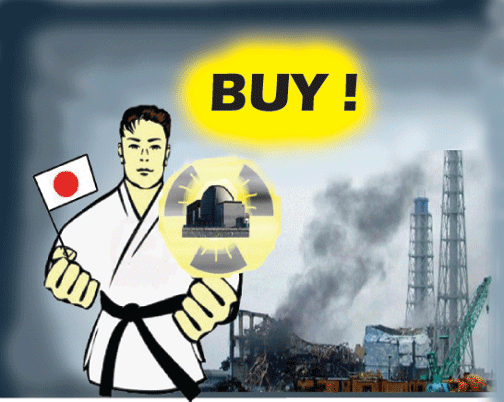 Japan to resume aid for firms’ nuclear power plant exports, Japan Times, 20 Feb 18 Two government-affiliated bodies plan to resume financial support for Japanese companies’ nuclear power plant exports in fiscal 2018 at the earliest, according to informed sources.
The Japan Bank for International Cooperation and Nippon Export and Investment Insurance effectively suspended the provision of loans and trade insurance for nuclear plant export deals following the March 2011 disaster at the Fukushima No. 1 nuclear plant.
The planned resumption is in line with the government’s policy of facilitating nuclear plant exports, despite lingering concerns of whether the safety of nuclear power projects will be examined appropriately…….https://www.japantimes.co.jp/news/2018/02/20/business/japan-resume-aid-firms-nuclear-power-plant-exports/#.WoyAk1pubGg
What are the trends in nuclear power construction?
A year in review: the trends in nuclear construction http://www.constructionglobal.com/infrastructure/year-review-trends-nuclear-construction .
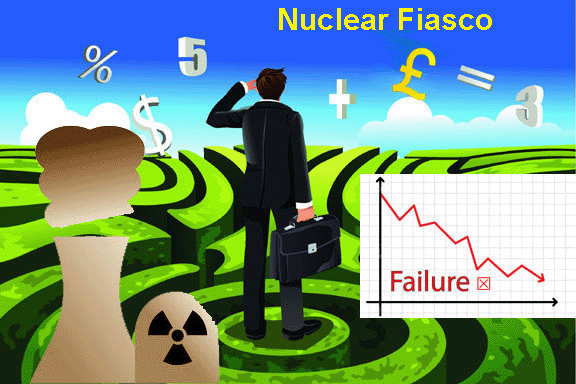 We look back on a mixed year for construction in the nuclear industry with the delivery of further nuclear power plants (NPPs) under threat from both the rise in renewable energy and the global trend for decommissioning in the prolonged aftermath of 2011’s Fukushima disaster.
According to the latest findings of the annual World Nuclear Report, as of January 2018, there are 52 reactors currently under construction worldwide. Four NPPs began the long-term process of construction in 2017 – one each in Bangladesh, China, India and South Korea.
The Chinese project, a pilot fast reactor, was launched on Christmas Day last year at the Xiapu site in Fujian province, but there were no other new NPP projects or construction starts announced in the country. Analysts suggest it’s a sign of a major shift or slowdown in Chinese nuclear policy, following the country’s domination of world nuclear construction for the past decade when it contributed over 60% of all new global sites since 2008.
The sector is experiencing profound structural change. The introduction of renewable energy at scale, thanks to declining costs driven by technological advances, has increased renewable power output at the expense of conventional technologies such as coal and nuclear. Though an operating NPP can provide up to nine times more electricity per installed kilowatt than a photovoltaic plant, the challenge to the industry from renewables is tangible. China’s massive rates of solar capacity deliver over 50GW to its grid. Even when taking into account lower productivity per installed GW from solar, research shows new solar plants in China alone in 2017 will generate significantly more power than all nuclear reactors started up (four) in the same year in the entire world.
Construction delays are common due to a number of factors, including political upheaval (the US embargo caused a 15-year delay to Iran’s first NPP in Bushehr before construction resumed in 1995) and the type of prolonged protest experienced during the delivery of India’s largest NPP. The progress of the Kundankulam NPP (KNPP) was besieged by various activist groups over potential radiation threats and issues related to nuclear waste disposal, with the anti-Kudankulam campaign intensifying following the Fukushima nuclear incident in Japan in 2011.
Decommissioning is also a factor in construction slowdown. Globally, three reactors were permanently closed in 2017. In Germany, Gundremmingen-B was closed in December as part of the country’s nuclear phase-out policy. South Korea and Sweden both shut down their oldest units – Kori-1 and Oskashamn-1. In addition, two more Japanese reactors, Ohi-1 and -2 were officially closed after the operator abandoned plans for restart and lifetime extension.
The past 20 years has seen the industry place more emphasis on sustainability and focus on the potential for extending the operating life of NPPs. It’s often more economical than building a new one, and why many plant operators, particularly in the US, are seeking licence renewals. “It is very important for us as a world community to care how electricity is produced,” reckons Maria Korsnick, President and CEO of the Nuclear Energy Institute (NEI), who offers hope for NPP construction specialists nervous about the rise of renewables. “You can produce electricity of an intermittent nature, like wind and solar, but you are going to also need 24/7 baseload energy supply that is still kind to the environment, and nuclear is just that.”
Utilising guidance from the International Atomic Energy Agency (IAEA – the world’s central intergovernmental forum for scientific and technical co-operation in the nuclear field) the US Nuclear Regulatory Commission (NRC) issues licences for NPPs to operate for up to 40 years with subsequent renewals of up to 20 years. Following a round of previous renewals, around 90% of American plants will soon reach the end of their 60-year term, prompting the NRC to look at the way it handles regulation when reviewing a NPP’s system metals, welds and piping, concrete, electrical cables and reactor pressure vessels. It must also evaluate potential impact on the environment, so speedier processes have been called for. “In the beginning, an NRC review took years to complete,” recalls Korsnick. “Now that the process is better understood, we are just under two years. For subsequent licence renewal, we will probably get the process down to 18 months.”
Small Modular Reactors (SMRs) and other kinds of so-called ‘advanced reactors’ continue to be positioned as a solution to the problems confronting nuclear power and the still costly renewal requirements of monolithic reactors. SMRs are nuclear power reactors with an electrical output below 300MWe and distinguishable from large reactors by modular design, with prefabrication in offsite factories and the potential for multiple reactors to be deployed at the same site to create bigger power plants. Proponents claim they will be faster, cheaper and less risky to build while safer to operate than large nuclear plants.
NuScale has claimed that “once approved, global demand for SMR plants will create thousands of jobs during manufacturing, construction and operation” and “re-establish US global leadership in nuclear technology, paving the way for NRC approval and subsequent deployment of other advanced nuclear technologies”. It predicts “about 5,575GWe of global electricity will come from SMRs by 2035, equivalent to over 1,000 NuScale Power Modules”.
However, Danny Roderick, former president and CEO of (now bankrupt nuclear services market leader) Westinghouse, once countered: “The problem I have with SMRs is not the technology, it’s not the deployment – it’s that there’s no customers… The worst thing to do is get ahead of the market.” Currently there are no operational NPPs in the world that can be considered fully-fledged SMRs. Several countries and companies are at different stages in the development of SMR technologies. NuScale is the frontrunner to deliver a SMR in Idaho with the initial operational date of 2024. Meanwhile, mPower (another previous beneficiary of Department of Energy funding to the tune of $80m per year) has been struggling to advance a similar project mooted in Tennessee which was terminated in March last year. Elsewhere, South Korea’s System-Integrated Modular Advanced Reactor (SMART) is the first land based SMR to receive regulatory approval anywhere in the world. However, SMR’s are often found to be too expensive on a per-unit generating-capacity basis which has led to this project being shelved. The words of incoming South Korean premier President Moon echo the sentiments of many world leaders now exploring other forms of energy creation: “We will scrap the nuclear-centred policies and move toward a nuclear-free era. We will eliminate all plans to build new nuclear plants.”
Sam Friggens is an energy economist with engineering and development consultancy Mott MacDonald, experts in the nuclear sector. He suggests that emerging innovations in renewables, power storage, efficiency and smart technologies, driven by fast manufacturing cycles, are yielding rapid cost reductions and improving performance, which means that by the time SMRs are ready for mass deployment in the 2030s the market may have disappeared.
He adds: “Will SMRs be acceptable to the public? The closest-to-market SMR technologies produce the same waste as current large reactors and will need refuelling every few years. New sites closer to demand may be attractive from an energy system perspective, but perhaps not to residents of the cities in question. Overall the challenges associated with SMR deployment are likely to be of similar magnitude to those faced by carbon capture and storage. At the same time, recent work suggests that if these challenges can be overcome then smaller, flexible nuclear technologies could still play an important role in future energy systems in countries like the UK.” In any case, it appears SMR construction projects would need the support of major government funding to play a role in tomorrow’s electricity generating business.
These are uncertain times for the industry which saw Westinghouse suffer a spectacular fall from grace in 2017. Its owner Toshiba recently agreed to sell off the US nuclear business for $4.6bn. The Japanese conglomerate made the decision after heavy delays to two Westinghouse nuclear projects drove the troubled engineering group to file. On top of the economic fallout and challenging ageing issues, nuclear operators are struggling with low electricity prices and the consistently dropping costs of their main competitors, wind and solar in particular. In countries like the United States, many nuclear power plants have continued to operate only because of massive subsidies. Despite this, the World Nuclear Association notes that, thanks to the planet’s voracious appetite for power, 160 power reactors (with a total gross capacity of some 160,000MWe) are on order or planned, and over 300 more are proposed.
Nuclear corporation EDF ‘s profits fall in UK,- low prices, and rising energy efficiency – lower consumption
Profits in the UK division, which includes EDF Energy, slumped by a third to €1.035 (£920m) as sales dwindled by €579m to €8.68bn, partly because UK customers pay their bills in pounds but the company reports its results in euros.
EDF said the decline of the pound against the euro had cost it €608m.
The company has faced criticism over delays and the cost of its £20bn Hinkley Point C nuclear power plant. However, it has blamed a 12% fall in nuclear energy prices in the UK, where it is the market leader.
Revenues were depressed by lower home energy consumption among customers, with usage falling 1.9% due to “milder weather and rising energy efficiency”.
It said group results had declined due to lower prices in almost all of the regions where it operates and an exodus of nearly 1 million customers.
It was also affected by lower nuclear and hydroelectric output in its domestic market, where it is the dominant supplier with more than 85% market share.
Last year the company had unplanned outages at some of its 58 French nuclear plants, where reactors had to be shut down for safety reasons.
It lost 960,000 customers, shaving €341m off profits, blaming the exodus on heightened competition, including in the UK.
Chief executive and chairman Jean-Bernard Levy said the group’s profitability in the face of a “difficult market context” was evidence of EDF’s financial strength, adding that he expects a “rebound” in 2018.
He said the company would launch an “unprecedented” ramp-up of renewable energy this year, as France looks to reduce nuclear’s share of power generation from 75% to 50% by 2025.
Russia marketing nuclear power to Congo
 Russia and Congo to cooperate in nuclear power, WNN, 14 February 2018 Rosatom and the Ministry of Scientific Research and Technological Innovations of the Republic of Congo have signed a Memorandum of Understanding (MoU) on cooperation in the peaceful uses of nuclear energy.
The document was signed yesterday in Moscow by the Russian state nuclear corporation’s deputy director general for international relations, Nikolay Spassky, and the ambassador extraordinary and plenipotentiary of the Republic of the Congo in Russia, David Maduka.
The document establishes a legal basis for the implementation of bilateral cooperation in a wide range of areas, Rosatom said. These include the development of nuclear infrastructure in the Republic of Congo and programmes aimed at increased awareness of nuclear technologies and their applications…..http://www.world-nuclear-news.org/NP-Russia-and-Congo-to-cooperate-in-nuclear-power-14021801.html
Collaboration to try and market Small Modular Nuclear Reactors (SMRs)

“We are excited to leverage the experience and capabilities of world class nuclear companies like GEH and GNF as we bring our game changing SMR-160 technology to global markets,” said Holtec President and CEO Dr. Kris Singh. “SMR-160 has prioritized safety in its design, to produce a right-sized, passively safe and cost-effective solution for carbon-free energy. This collaboration will ensure the SMR-160 supply chain, to deliver and fabricate critical SMR-160 technologies and components, including at our new Advanced Manufacturing Division in Camden, New Jersey.”……http://www.powermag.com/press-releases/ge-hitachi-holtec-announce-cooperation-to-accelerate-commercialization-of-smr-160-small-modular-reactor/
The uneconomic Mixed Oxide Fuel Fabrication Facility to be closed- Dept of Energy seeks funding for this
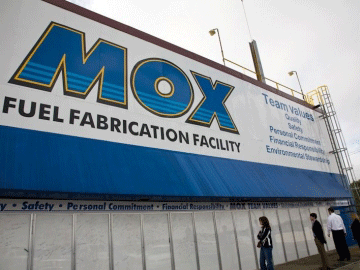 DOE budget seeks money to close MOX http://chronicle.augusta.com/news/2018-02-12/doe-budget-seeks-money-close-mox February 12, 2018, By James Folker, Staff Writer
The Department of Energy’s budget request for fiscal 2019 asks for money to close the Mixed Oxide Fuel Fabrication Facility and says the agency prefers the “dilute and dispose” method to dispose of 34 metric tons of weapons-grade plutonium.
The budget request seeks $1.7 billion — $287 million more than last year — to provide support at Savannah River Site for the Liquid Tank Waste Management Program, including “a significant increase” in the production at the Defense Waste Processing Facility and startup of the Salt Waste Processing Facility, according to a DOE fact sheet released Monday.
The MOX project was born from a 2000 non-proliferation agreement between the U.S. and Russia, which called for the removal of 34 metric tons of plutonium from each nation’s arsenal. The MOX project at SRS would convert the plutonium from retired nuclear weapons into a blend with uranium so it can be used in commercial nuclear reactors
Blow to Russia’s nuclear marketing ambitions – other investors back out of Turkey nuclear build
Bellona 12th Feb 2018, In a major blow to one of Russia’s most ambitious international nuclear
deals, three investors backed out of the Akkuyu Nuclear Power Plant,
leaving Russian state nuclear corporation Rosatom adrift on how to finish
the $20 billion station.
Russian President Vladimir Putin touted progress
on the plant as recently as November during a state visit to the Turkish
capital, and the Kremlin propaganda news network RT pushed the narrative
that the plant’s first reactor would be finished ahead of its scheduled
2023 launch date.
That was all thrown into doubt last week when a Turkish
consortium, representing 49 percent of the funding for the Akkuyu plant’s
construction, backed out of the deal, citing a failure to agree on a number
of project’s “commercial conditions,” Russian and Turkish news
outlets said. Rosatom is now in talks to secure other investors, but the
corporation wont’ say by how long the loss of half the project’s
financing will delay the station’s launch, or by how much the project’s
price tag is likely to increase as a result of the back out.
http://bellona.org/news/nuclear-issues/2018-02-investor-pullout-leaves-rosatom-at-sea-with-its-nuclear-project-in-turkey

UK’s “Central Government Supply Estimates 2017-18” promises a massive future bailout for the nuclear industry

 – excitingly entitled “Central Government Supply Estimates 2017-18” – detailing changes to planned public expenditure since last Autumn’s
Budget 2017. At pages 162-64 you can find the Business, Energy and Industrial Strategy (BEIS) extra expenditure requests and clarification of
perceived liabilities.
These include several covering the privately-owned commercial nuclear industry sector. Below are the sections on nuclear, and
the most common read-out message is how often the liabilities for which the taxpayer is expected to take long term financial responsibility are
described as “unquantifiable.”
That is accurate, but what is omitted is the numbers are – based on accumulated experience to date, likely to be astronomically huge. This worryingly unacceptable situation,- whereby one industry (nuclear) of the electricity generating sector is being promised a massive future bailout from its liabilities- really should be examined in detail by our elected Parliamentarians and peers in several relevant committees and in the Estimates Debate on the floor of the Commons.
http://drdavidlowry.blogspot.co.uk/2018/02/nuclears-unquantifiably-huge-future.html
Yet another loss for uranium mining company Cameco
Uranium miner Cameco Corp. reports $62-million Q4 loss, revenue down, SASKATOON 11 Feb 18, — Cameco Corp. lost $62 million in its latest quarter, an improvement from the year-earlier loss of $144 million…… Revenue in what was its fourth-quarter totalled $809 million compared with $887 million in the year-earlier quarter. http://business.financialpost.com/pmn/business-pmn/uranium-miner-cameco-corp-reports-62-million-q4-loss-revenue-down
Progress in getting compensation for sick Hanford nuclear workers and ex-workers

 Hanford atomic workers get state legislative boost for workers’ comp http://www.peoplesworld.org/article/hanford-atomic-workers-get-state-legislative-boost-for-workers-comp/ February 9, 2018 CST HANFORD, Wash.—This is a good-news story. It involves a persistent union legislative director, a favorable election outcome, and bipartisan and cross-chamber cooperation in the Washington State legislature.
And the beneficiaries are and will be hundreds, if not thousands, of workers exposed to some of the most dangerous materials known to humans.
The workers are present workers and retirees, at the Department of Energy’s nuclear complex in Hanford, Wash. And as a result of all those factors, they’ll be more eligible for workers’ comp.
The story starts in 1942-43, says Nick Bumpaous of Plumbers and Steamfitters Local 598, located near the complex. That’s when the U.S. War Department took over the Hanford area to build the factory complex to make nuclear warheads for U.S. bombs. Hanford, like the whole Manhattan Project for developing atomic weapons, was top secret.
The feds, to their credit, realized Hanford’s workers would be in constant daily contact with uranium, plutonium and other highly radioactive materials. Who knew what would happen to them in later years due to those exposures?
“In the 1940s, the War Department got into a contract with the state legislature to have workers use Washington’s industrial insurance for workers’ comp claims if they got ill from handling the radioactive material,” Bumpaous said in a phone interview. “The feds would reimburse the state for any claims.”
The catch was when sickened workers went to their doctors, the doctors “couldn’t tell what the illnesses were” – because Hanford was secret – “so they couldn’t give you medication,” much less OK workers’ comp claims.
Common diseases among the Hanford workers include various cancers, according to a fact sheet for a later federal workers comp program for federal nuclear workers nationwide. The Steelworkers, who now represent many of those nuke workers, lobbied for and won the federal program. It began in 2001, with a second part added in 2004. But it caps lifetime benefits at $250,000, plus medical expenses.
“But you still put the burden of proof” upon the worker to show his or her toil at Hanford and exposure to the fissile materials there caused those ills, not to mention exposure to other threats, Bumpaous says.
One example: Exposure to diethyl mercury, “a silent odorless, colorless, tasteless stuff that induces neurological diseases and dementia.” In addition, “you have a whole generation of people with reactive airway disease,” he adds.
The doctors couldn’t diagnose the reasons for Hanford ills. The workers became so ill they couldn’t work and had to leave their jobs, “so they’re not getting a paycheck and they had no health insurance.” They had to navigate the bureaucracy “and their claims were denied,” Bumpaous explains. Workers’ comp denials at Hanford were 52 percent above average.
“It’s hard enough to take care of yourself when you’re battling the Department of Energy,” which now runs Hanford “and the state Department of Labor and Industry,” which runs workers’ comp, Bumpaous says.
With the burden of proof on the workers, Bumpaous got into the picture. Two years ago, he read about legislation the Fire Fighters successfully pushed elsewhere, shifting the burden of proof for certain diseases – known to be caused by Fire Fighter exposure to asbestos and other dangers on the job – from the worker to the state.
In short, if a Fire Fighter goes to the doctor with asbestosis, the doctor must presume the worker caught it from on-the-job exposure and is eligible for workers’ comp. Bumpaous wanted to create the same scenario for the Hanford workers. Workers and retirees still must go to the doctors, though.
“These brave workers continue to be exposed to some of the most hazardous substances known to man, including many chemical and radiological hazards as yet unidentified, and the safety measures intended to protect them are inadequate,” wrote David Groves in The Stand, the Washington State Labor Council’s online newspaper, which first reported the legislation.
But the Hanford workers couldn’t get workers comp because they had to “connect specific exposures to their disease — a virtually impossible task given the” top secret “circumstances at Hanford.”
Bumpaous enlisted two lawmakers to push the measure shifting the burden of proof from the workers to the state: State Rep. Larry Haler, R-Richland, and State Sen. Karen Keiser, D-Kent, a longtime pro-worker advocate, who is now state Senate President Pro Tem and chair of the state Senate’s Labor Committee. Haler’s district includes Hanford.
And that’s where the political switch comes in. When Bumpaous, Haler and Keiser first tried to get their bill, HB1723, through, it passed the House, then died in the Senate, which the GOP controlled by one vote. Republican leaders wouldn’t even let it get out of committee.
But earlier this year, Manka Dhingra, a Democratic pro-worker woman with strong union backing, won a special election for an open State Senate seat. Control switched, Keiser took over – and the legislation for the Hanford workers sailed through: 76-22 in the House and 35-14 in the Senate.
“It’s important we take care of workers who suffered due to being exposed to harmful chemicals and processes at Hanford,” Haler said. “Despite all the safety precautions, families and individuals have been devastated by illness and disease. They need help. This will help make that easier,” Haler said after HB1723 headed for Democratic Gov. Jay Inslee’s desk.
“Exposure to heavy metal and radiation has ruined people’s lives,” Keiser told the Senate before passage.
“I cannot think of a more suitable assertion for this Senate to make than putting our partisan differences aside to put people first. We are seeing people dying from dementia, cancer and lung disease who were systematically left out of workers compensation.”
“People went bankrupt paying for cancer treatments. This ordeal has been going on since the 1990s. We have seen a whole generation impacted by this tragedy. That is not right. Our Washington community cares about protecting all workers.”
Inslee is expected to sign the bill. But that’s not the end of the story for Bumpaous. “I want to see everyone get these benefits” nationwide if they worked in nuclear weapons and warhead production, he says. “That way we won’t have this type of stuff in the future.”
International Atomic Energy Agency trying hard to market nuclear power to Indonesia (never mind the earthquakes)
IAEA Director General Visits Indonesia: Highlights Close Cooperation in Using Nuclear Technology,
Desperate to save its failing nuclear business, Toshiba looks to Ukraine
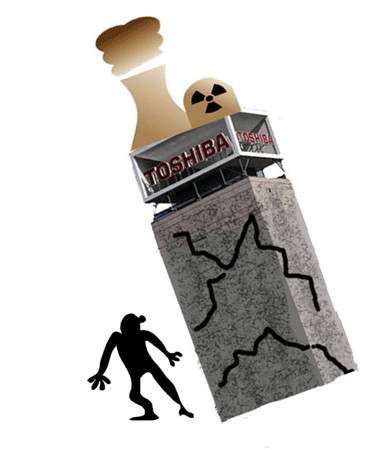 Toshiba seeks deal in Ukraine to revive nuclear power business, Asahi Shimbun, By TOSHIO KAWADA/ Staff Writer, February 8, 2018 Toshiba Corp. is planning another foray into an overseas nuclear-power industry, forced in part by the disastrous consequences of its previous failure abroad, sources said.
The Tokyo-based company has started negotiations with Energoatom, a Ukrainian state-run power company, to supply turbine generators for use in its nuclear power plants. The two companies concluded a memorandum in October 2017.
Toshiba in March 2017 said it was withdrawing from the business of designing and constructing entire nuclear power plants overseas following the collapse of its U.S. nuclear arm, Westinghouse Electric Co.
However, Toshiba judged that it would not suffer such a huge deficit again if it only supplies equipment to nuclear power plants abroad, the sources said.
“There will be little concern that we will suffer a huge loss (from an overseas deal),” a source related to Toshiba said.
Energoatom operates 15 nuclear reactors and is building two others in Ukraine. It plans to replace the generators of old reactors to increase output.
Toshiba wants to win a deal with Energoatom to export the replacement generators and provide maintenance services after they go into operation.
If Toshiba succeeds in the equipment supply business in Ukraine, it will consider looking at other markets abroad, the sources said.
Toshiba is desperate for a steady source of income…….
Toshiba plans to earn steady profits from its nuclear business, believing competition with other companies will not be so fierce, the sources said.
But if this endeavor fails to pan out, Toshiba’s management situation could worsen. http://www.asahi.com/ajw/articles/AJ201802080050.html
Russia postponing new nuclear reactors because of costs

 Nucnet 5th Feb 2018, Russia’s state nuclear energy corporation Rosatom is ready to postpone
the commissioning of two nuclear power units for two years in an effort to
slow down increases in energy prices, the state-owned Tass news agency
said.
said commissioning of Novovoronezh 2-2, planned for January 2019, would be
postponed by a year, and commissioning of Leningrad 2-2, planned for
February 2020, by two years.
a government-regulated fixed power supply agreement with wholesale
consumers, any return on nuclear investment must be at least 10.5%, which
would mean electricity prices for the consumers would increase to meet the
target.
2008 to guarantee returns on investment in generating capacity. The final
wholesale prices are usually higher than the prevailing market price to
compensate costs incurred by the investor during construction. The
agreements include government-regulated price levels for various types of
consumer, dependent on their maximum consumption. Neither Tass nor Rosatom
gave details, although Tass said postponing commissioning of the units will
lead to a reduction in the rate of electricity price growth in 2019 from
12.9% to 11.1%. https://www.nucnet.org/all-the-news/2018/02/05/russia-ready-to-postpone-commissioning-of-two-nuclear-plants-says-official-agency
Britain’s costly gamble with Hinkley point C nuclear project, as the renewables revolution gather speed
there will be no room in this new world of flexible, decentralised generation for large, rigid nuclear reactors. “There are going to be increasingly frequent periods when we have too much power,” says Mr Burke. “But if you are the energy minister, how do you explain to people why you are having to switch off cheap renewables in order to use the much more expensive nuclear power which you have committed to pay for over the next 35 years?”

FT 4th Feb 2018, The UK’s Hinkley Point C has become a critical test of developers’ ability to compete with cheap gas and renewables. Across an expanse of scarred earth the size of 250 football pitches beside the Bristol Channel in south-west England, 3,000 workers are building what will be, by some estimates, the most expensive structure on the planet.
At a cost of almost £20bn, the Hinkley Point C power station in Somerset is the first nuclear plant to be built in the UK since the 1990s. Clusters of cranes and cement silos loom over a warren of earthworks crawling with excavators and
100-tonne dumper trucks. At the centre of the site, foundations are taking shape for two 1.6 gigawatt reactors intended to meet 7 per cent of UK electricity demand, with a target for completion by the end of 2025.
Hinkley is crucial to UK energy security as the country faces the closure of old coal and nuclear plants accounting for about 40 per cent of the country’s reliable electricity generating capacity by 2030. But it also has wider significance as a test of the industry’s ability to compete in a rapidly changing energy landscape. Nuclear power has been under threat
since the meltdown at the Fukushima plant in Japan in 2011 revived safety fears.
But the biggest threat is now economic as the spiralling cost of building new reactors collides with a world of cheap and plentiful gas and renewable power. The UK is now one of the few western countries committed to renewing its ageing reactors. More than 70 per cent of the 448 reactors around the world are in the OECD club of wealthy nations, and more than half of them are at least 30 years old.
Many will reach the end of their operational lives in the next two decades, yet the prospects of replacing
them are uncertain, at best, in countries such as the US, Japan and France, while others including Germany, Switzerland and South Korea are planning to phase out nuclear power altogether. The days of networks dominated by a few large, centralised power stations are drawing to a close, according to many analysts. In their place will come more dispersed sources of renewable generation. Battery storage and digital “smart grid” technology will help smooth out supply and demand, and increase efficiency.
Tom Burke, chairman of E3G, an environmental think-tank, says there will be no room in this new world of flexible, decentralised generation for large, rigid nuclear reactors. “There are going to be increasingly frequent periods when we have too much power,” says Mr Burke. “But if you are the energy minister, how do you explain to people why you are having to switch off cheap renewables in order to use the much more expensive nuclear power which you have committed to pay for over the next 35 years?”
Progress at Hinkley, therefore, is being watched as closely in Beijing as in Paris and London. A repeat of the delays at Olkiluoto and Flamanville could sign the death warrant for western reactor developers, while dealing a setback for
China’s international expansion. Mr Rossi is aware of the high stakes: “We need to make sure that Britain will be happy about the choice it made.” https://www.ft.com/content/8307c266-066b-11e8-9650-9c0ad2d7c5b5
American companies’plans to market nuclear technology to India have come to nothing
 The Hindu 3rd Feb 2018, Watching the Republic Day parade, where 10 ASEAN leaders were chief guests,
it was easy to miss the fact that the dates of their visit also marked the
anniversary of another big visit three years ago: the visit by then U.S.
President Barack Obama, when he announced a “breakthrough” in the
India-U.S. civil nuclear deal, to finally pave the way for a commercial
contract.
“The deal is done,” Sujatha Singh, who was Foreign Secretary
at the time, said as the government issued papers and held briefings
describing the nature of the agreement between India and the U.S. on
supplier liability and tracking requirements, which would enable American
companies to build nuclear power reactors in India.
Today, nearly a decade since the memoranda of understanding were inked, and three years after the
last wrinkles were ironed out, there is no sign yet of any concrete
contract between an American company and the Indian authorities to build a
reactor.
In 2009, both GE-Hitachi and Toshiba-Westinghouse had begun talks
on techno-commercial agreements for six reactors each in India. These
commercial contracts were to be the start of the ‘payoff’ for the U.S.
that had considerably shifted its stand on non-proliferation to give India
the waivers needed, and they were to herald India’s arrival on the global
nuclear power stage in return.
Instead, GE-Hitachi’s plans were shelved after it rejected the Obama-Modi agreement in January 2015, saying GE would
not accept the compromise formula on supplier liability. (While others have
indicated they would accept the liability offer, none of them has put that
on paper.) Toshiba-Westinghouse then carried the baton to actualise the
India-U.S. civil nuclear deal, but ran into a different storm as both
Toshiba and Westinghouse had major financial troubles last year. After a
near-bankruptcy, Toshiba jettisoned Westinghouse for just $4.6 billion to a
Canadian consortium, a deal that is now expected to be cleared by the end
of 2018.
http://www.thehindu.com/opinion/lead/forging-a-new-nuclear-deal/article22637628.ece
1 This Month
26 September – International Day for the Total Elimination of Nuclear Weapons





PLEASE OPPOSE HR 8255 AND S.3639 – bills would accelerate satellite deployment, with no environmental review or safeguards – https://ncstd5li.quorum.us/campaign/169331/
To see nuclear-related stories in greater depth and intensity – go to https://nuclearinformation.wordpress.com
-
Archives
- September 2026 (305)
- August 2026 (330)
- July 2026 (355)
- June 2026 (287)
- May 2026 (306)
- April 2026 (356)
- March 2026 (251)
- February 2026 (267)
- January 2026 (308)
- December 2025 (358)
- November 2025 (359)
- October 2025 (375)
-
Categories
- 1
- 1 NUCLEAR ISSUES
- business and costs
- climate change
- culture and arts
- ENERGY
- environment
- health
- history
- indigenous issues
- Legal
- marketing of nuclear
- media
- opposition to nuclear
- PERSONAL STORIES
- politics
- politics international
- Religion and ethics
- safety
- secrets,lies and civil liberties
- spinbuster
- technology
- Uranium
- wastes
- weapons and war
- Women
- 2 WORLD
- ACTION
- AFRICA
- Atrocities
- AUSTRALIA
- Christina's notes
- Christina's themes
- culture and arts
- Events
- Fuk 2022
- Fuk 2023
- Fukushima 2017
- Fukushima 2018
- fukushima 2019
- Fukushima 2020
- Fukushima 2021
- general
- global warming
- Humour (God we need it)
- Nuclear
- RARE EARTHS
- Reference
- resources – print
- Resources -audiovicual
- Weekly Newsletter
- World
- World Nuclear
- YouTube
-
RSS
Entries RSS
Comments RSS

