Trump tax bill promotes polluting robots – and damages clean energy workers
Polluting robots win big, clean energy workers get screwed in Trump tax bill http://reneweconomy.com.au/polluting-robots-win-big-clean-energy-workers-get-screwed-trump-tax-bill-37122/ By Joe Romm on 7 December 2017
Think Progress Polluting robots of the world, unite! The GOP tax bill is for you.
The rest of us, however, have a lot to lose from GOP tax changes that favor investments in dirty energy over clean — and robots over human workers.
As one MIT economist told Newsweek, “We are creating huge subsidies in our tax code for capital and encouraging employers to use machines instead of labor.” And unless significant changes are made in the GOP plan, those machines will be running on dirty energy.
The good news is that the Senate tax bill doesn’t roll back those renewable energy tax credits.
The bad news is that it contains language that could seriously undermine the investment in renewables by imposing “a new 100 percent tax” on those credits, as Gregory Wetstone, head of the American Council on Renewable Energy, explained in a statement.
“If this bill passes as drafted, major financial institutions would no longer participate in tax equity financing, which is the principal mechanism for monetizing credits,” Wetstone pointed out.
“Almost overnight, you would see a devastating reduction in wind and solar energy investment and development.” Meanwhile, tax subsidies for fossil fuels, many of which are decades old, would continue unchanged–and the Senate bill opens up the Arctic National Wildlife Refuge to drilling.
This type of clean energy financing will reach $12 billion this year, according to Bloomberg New Energy Finance, which examined the impact of this change in detail.
This investment, much of it by multinational finance companies, has helped leveraged some $50 billion a year in U.S. wind and solar projects, creating hundreds of thousands of jobs.
Ironically — or, rather, tragically — harming renewables mostly harms red states. As “The American Prospect” noted, “The states that voted for Trump produce nearly 70 percent of wind energy, while 85 percent of existing wind projects are in GOP-held congressional districts.”
As for longer-term impacts, the GOP plan would cut billions of dollars in incentives for the biggest new source of sustainable high-wage employment in the world — clean energy — just as China and the rest of the world are making massive investments.
What’s unknown at this point is how these and other changes to these tax credits will be dealt with in the final bill, after the House and Senate work out their differences. While the House plan to gut the credits was intentional, it’s not clear that Senators intended to undermine them, so the problem is fixable.
This change would occur just when companies are beginning to automate their factories using robots and advanced computing technology, as corporate tax attorney Robert Kovacev, explained to Huffington Post: “It’s going to accelerate spending, basically, on robots that could displace workers.”
The GOP plan naturally has no tax incentives to encourage businesses to hire more actual workers or to retrain those who lose their job due to automation
Indeed, the Senate bill is so bad that Bloomberg’s editors wrote a piece explaining “Republicans have managed to make a terrible plan worse.” As one example the equipment-expensing provision would take effect immediately, but the Senate only lowers the corporate tax rate to 20 percent (from 35) in 2019.
“This will allow businesses to take deductions on investments while rates are high, then pay a lower rate on the resulting income, creating a perverse incentive to pursue otherwise unprofitable projects,” explains Bloomberg.
So the Senate bill actually encourages companies to replace workers even with unprofitable robots.
Unprofitable polluting robots — quite a legacy for the disastrous GOP tax plan.
Risk of Chernobyl sarcophagus collapsing – radiation danger to workers now sealing it
Vice News 5th Dec 2017, Workers at the Chernobyl Power Plant are now facing some of the highest
radiation levels ever while they put the finishing touches on a new
decontamination structure for the world’s worst nuclear disaster. After
the fallout in 1986, workers at the plant built a sarcophagus to contain
the radiation in just three months.
But it was just a quick fix, designed
without future decontamination in mind. And now, after more than 30 years,
it’s at risk of collapse. Workers are sealing the old structure with a
new one they finished building a year ago, called the New Safe Confinement.
They hope it will hold for the next 100 years.
https://news.vice.com/story/inside-the-clean-up-of-chernobyl-the-worlds-worst-nuclear-disaster
Rick Perry to visit Saudi Arabia – a nation keen to have nuclear reactors AND to highly enrich uranium
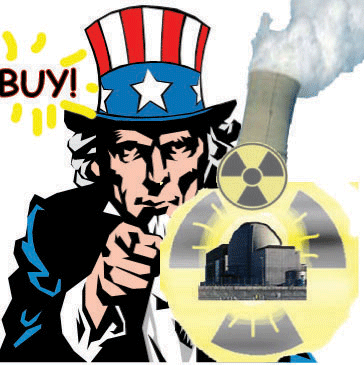
 U.S. Firms Courting Saudi Arabia to Build Nuclear Reactors; Rick Perry to Visit
 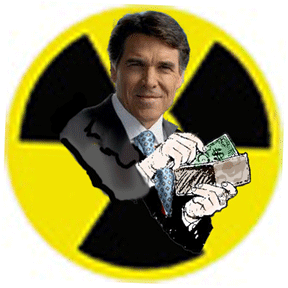 Riyadh, Haaretz, 3 Dec 17, One of the sources also said Riyadh had told Washington it does not want to forfeit the possibility of one day enriching uranium – a process that can have military uses.
USA nuclear industry keen to sell to ANYBODY – pushing for Saudi Arabia sales
U.S. firms push Washington to restart nuclear pact talks with Riyadh: sources https://www.reuters.com/article/us-saudi-nuclear-usa/u-s-firms-push-washington-to-restart-nuclear-pact-talks-with-riyadh-sources-idUSKBN1DV586?feedType=RSS&feedName=worldNews. Reem Shamseddine, Sylvia Westall RIYADH/DUBAI (Reuters) 1 Dec 17, – U.S. firms attracted by Saudi Arabia’s plans to build nuclear reactors are pushing Washington to restart talks with Riyadh on an agreement to help the kingdom develop atomic energy, three industry sources said.
Saudi Arabia has welcomed the lobbying, they said, though it is likely to worry regional rival Iran at a time when tensions are already high in the Middle East.
One of the sources also said Riyadh had told Washington it does not want to forfeit the possibility of one day enriching uranium – a process that can have military uses – though this is a standard condition of U.S. civil nuclear cooperation pacts.
“They want to secure enrichment if down the line they want to do it,” the source, who is in contact with Saudi and U.S. officials, said before U.S. Energy Secretary Rick Perry holds talks in Riyadh early next week.
Another of the industry sources said Saudi Arabia and the United States had already held initial talks about a nuclear cooperation pact.
U.S. officials and Saudi officials responsible for nuclear energy issues declined to comment for this article. The sources did not identify the U.S. firms involved in the lobbying.
Under Article 123 of the U.S. Atomic Energy Act, a peaceful cooperation agreement is required for the transfer of nuclear materials, technology and equipment.
In previous talks, Saudi Arabia has refused to sign up to any agreement with the United States that would deprive the kingdom of the possibility of one day enriching uranium.
Saudi Arabia, the world’s top oil producer, says it wants nuclear power solely for peaceful uses – to produce electricity at home so that it can export more crude. It has not yet acquired nuclear power or enrichment technology.
Riyadh sent a request for information to nuclear reactor suppliers in October in a first step towards opening a multi-billion-dollar tender for two nuclear power reactors, and plans to award the first construction contract in 2018.
Reuters has reported that Westinghouse is in talks with other U.S.-based companies to form a consortium for the bid. A downturn in the U.S. nuclear industry makes business abroad increasingly valuable for American firms.
Reactors need uranium enriched to around 5 percent purity but the same technology in this process can also be used to enrich the heavy metal to a higher, weapons-grade level. This has been at the heart of Western and regional concerns over the nuclear work of Iran, which enriches uranium domestically.
Riyadh’s main reason to leave the door open to enrichment in the future may be political – to ensure the Sunni Muslim kingdom has the same possibility of enriching uranium as Shi‘ite Muslim Iran, industry sources and analysts say.
POTENTIAL PROBLEM FOR WASHINGTON
Saudi Arabia’s position poses a potential problem for the United States, which has strengthened ties with the kingdom under President Donald Trump.
Washington usually requires a country to sign a nuclear cooperation pact – known as a 123 agreement – that forfeits steps in fuel production with potential bomb-making uses.
“Doing less than this would undermine U.S. credibility and risk the increased spread of nuclear weapons capabilities to Saudi Arabia and the region,” said David Albright, a former U.N. weapons inspector and president of the Washington-based Institute for Science and International Security (ISIS).
It is not clear whether Riyadh will raise the issue during Perry’s visit, which one of the industry sources said could include discussion of nuclear export controls.
Under a nuclear deal Iran signed in 2015 with world powers – but which Trump has said he might pull the United States out of – Tehran can enrich uranium to around the level needed for commercial power-generation.
It would be “a huge change of policy” for Washington to allow Saudi Arabia the right to enrich uranium, said Mark Fitzpatrick, executive director of the Americas office at the International Institute for Strategic Studies think tank.
“Applying the ‘golden standard’ of not allowing enrichment or preprocessing (of spent fuel) has held up a 123 agreement with Jordan for many years, and has been a key issue in U.S. nuclear cooperation with South Korea,” said Fitzpatrick, a nuclear policy expert.
The United States is likely to aim for restrictions, non-proliferation analysts say.
These could be based on those included in the 123 agreement Washington signed in 2009 with the United Arab Emirates, which is set to start up its first South Korean-built reactor in 2018 and has ruled out enrichment and reprocessing.
“Perhaps Saudi Arabia is testing the Trump administration and seeing if the administration would be amenable to fewer restrictions in a 123 agreement,” ISIS’s Albright said.
It would be “a huge change of policy” for Washington to allow Saudi Arabia the right to enrich uranium, said Mark Fitzpatrick, executive director of the Americas office at the International Institute for Strategic Studies think tank.
“Applying the ‘golden standard’ of not allowing enrichment or preprocessing (of spent fuel) has held up a 123 agreement with Jordan for many years, and has been a key issue in U.S. nuclear cooperation with South Korea,” said Fitzpatrick, a nuclear policy expert.
The United States is likely to aim for restrictions, non-proliferation analysts say.
These could be based on those included in the 123 agreement Washington signed in 2009 with the United Arab Emirates, which is set to start up its first South Korean-built reactor in 2018 and has ruled out enrichment and reprocessing.
“Perhaps Saudi Arabia is testing the Trump administration and seeing if the administration would be amenable to fewer restrictions in a 123 agreement,” ISIS’s Albright said.
Underground bunkers – a promising marketing opportunity for South Korean and UK businessmen
Bomb shelter boss ‘wants North Korea to launch nuclear attack’ to help sell new ‘high street bunkers’ Mirror UK, 30 Nov 17 British bunker experts have been working alongside a Korean company on making the world’s toughest shelters to prepare for nuclear war A bomb shelter boss ‘wants North Korea to launch a nuclear attack’ to help sell ‘high street bunkers’.

The bunkers have been built to withstand a nuclear attack, by Kim Jong-un are now being sold on Seoul’s high street.
A ‘bunker showroom’ has now been opened in downtown Seoul, in the same shopping area where people are buying clothes and cosmetics. CBS owner Go Wan Hyeok says that demand from ‘petrified’ locals for affordable bunkers led him to set up in the busy retail district of Jangan-Dong – and wants to branch out to Europe and the UK within five years.
He said: “I’m wishing that he presses the button and shoots the bomb!
“I think more people will be selling bunkers on the high street in the next five years but I’m the first in the world. I want to then open up showrooms in Europe and my friends in the UK.”……http://www.mirror.co.uk/news/world-news/bomb-shelter-boss-wants-north-11613699
Looks as if UK nuclear power is coming to the end of the line
 Is This The End Of Nuclear Power In The UK? https://oilprice.com/Alternative-Energy/Nuclear-Power/Is-This-The-End-Of-Nuclear-Power-In-The-UK.html,
First, let’s put the Hinkley Point C nuclear power station in context. The UK government first announced its nuclear power expansion program in 2006. The plan was to build five new nuclear generating stations, producing 16 GWs, to be on-line by 2030. The units planned are at Sizewell, Wylfa, Moorside, Oldbury and Hinkley.
At the time the government cited two concerns with respect to the adequacy of national electric power generation. First, that “security of supply (was) jeopardized” and second, that by 2025 there would be a need to replace aging coal-fired and nuclear power generating plants. The ensuing decade was not kind to the assumptions of UK energy planners.
The price of both renewables and natural gas dropped significantly. License extensions could keep most existing nuclear power stations running. And demand for power has fallen below expectations due to moderating economic trends and the dampening impact of conservation measures.
From a UK power generation perspective, the big winners in recent years have been natural gas and renewables. Coal burn has dropped drastically and nuclear has remained stable.
On a price competition basis, the future looks like a race to the bottom between natural gas and the ever-declining costs of wind and solar technology. On a cost basis, the Hinkley guarantee of £92.50 per MWh looks rather steep compared with the £57.50 recent price for off-shore wind.
We can already hear the harrumphing from the pro nuclear contingent. But this to us is the problem of making commercial nuclear technology the Zelig of the energy world. In a world eager for low carbon, base load capacity, nuclear has attempted to re-brand itself as the low carbon option. But in countries facing stagnant or declining electrical demand, the need for new, non-intermittent base load power generating resources is diminishing as well.
You can find Leonard Hyman’s lastest book ‘Electricity Acts’ on Amazon
And the other low carbon generating resources, renewables, intermittent though they may be, are now much cheaper than new nuclear construction (£57.50 vs £92.50).
At another level, electricity is a commodity. A commodity that we can’t store, but still. And in a commodity business, where the product is wholly undifferentiated, price is the only consideration. Taken in this context, new nuclear is a non-starter.
South Korea looks for a stake in building UK’s Moorside Nuclear Power Station
 Carlisle News and Star 30th Nov 2017, The British and Korean governments have agreed to greater collaboration onnuclear developments, fuelling speculation that a Korean company is about
to invest in West Cumbria’s Moorside power station.
Greg Clark, the secretary of state for business, energy and industrial strategy, and Paik
Un-gyu, South Korean minister of trade, industry and energy, signed a
Memorandum of Understanding on Monday in London. It promises greater
collaboration in both the construction and decommissioning of nuclear power
stations.
The signing appears to have only been reported by World Nuclear
News and Business Korea websites. State-run Korea Electric Power
Corporation (Kepco) has revealed it is in “working-level” talks to buy
a stake in NuGen – which plans to build three new reactions in West
Cumbria to provide seven per cent of the UK’s electricity needs.
Toshiba, NuGen’s current owner, has been exploring a range of options to fund the
project after its then subsidiary Westinghouse Electric – due to supply
three AP1000 reactors to Moorside – filed for Chapter 11 bankruptcy
protection in the US having overpaid by several billion dollars for another
nuclear construction and services business….http://www.newsandstar.co.uk/news/business/International-agreement-fuels-Korean-interest-in-Moorside-2cefe362-b678-4e12-9214-ad75be6a1933-ds
France joins the rush to market nuclear power to Saudi Arabia
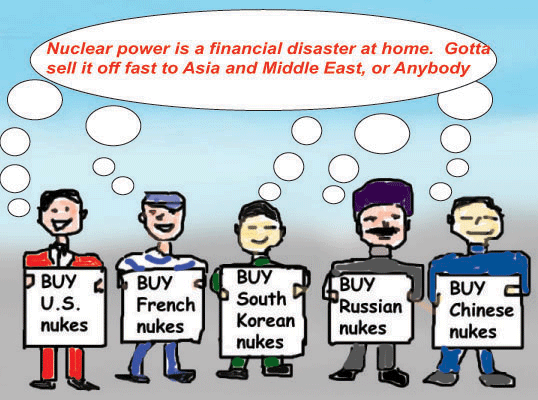 Reuters 29th Nov 2017, French state-controlled utility EDF intends to take part in a tender to
build two nuclear reactors in Saudi Arabia, two sources familiar with the
situation told Reuters.
Saudi Arabia, which wants to reduce domestic oil
consumption, is considering building 17.6 gigawatts of nuclear-fuelled
power generation capacity by 2032 and has sent a request for information to
international suppliers to build two reactors
With answers to the request due by the end 2017 or early 2018, a formal tender could be launched by
mid-2018, but more likely toward the end of 2018 or early 2019, industry
specialists say. https://www.reuters.com/article/saudi-nuclear-edf/update-1-frances-edf-plans-to-bid-in-saudi-arabia-nuclear-tender-sources-idUSL8N1NZ1YN
Earthquake risks making Diablo Canyon nuclear reactors money losers?
Earthquake Risk Keeps Heat on Vulnerable Nuclear Reactors, https://www.commondreams.org/views/2017/11/26/earthquake-risk-keeps-heat-vulnerable-nuclear-reactors A proposal by a California administrative law judge has given safe energy advocates new hope by Harvey Wasserman,
The huge reactors—California’s last—sit on a bluff above the Pacific, west of San Luis Obispo, among a dozen earthquake faults. They operate just 45 miles from the San Andreas. That’s half the distance from the fault that destroyed four reactors in Fukushima, Japan, in 2011. Diablo’s wind-blown emissions could irradiate the Los Angeles megalopolis in less than six hours if an earthquake destroyed the plant.
The death toll could be in the millions, the property damage in the trillions of dollars. The owner of the plant, Pacific Gas & Electric (PG&E), would not be legally liable.
Last year, a deal to shut down Diablo’s two reactors in 2024 and 2025 was struck by the state, PG&E, surrounding communities and some environmental groups. Diablo’s federal licenses expire in those years, and PG&E agreed not to seek renewals. The power, it said, could be replaced with wind turbines and solar panels.
But the $1.7 billion in rate hikes stipulated in the deal still must be approved by California’s Public Utilities Commission (PUC). A proposed decision by administrative law Judge Peter Allen would limit them to less than $200 million.
The PUC must now factor Allen’s decision into how much it allows PG&E to charge. If it honors Allen’s opinion, the company must then decide whether it will continue to operate the reactors, which increasingly look like money losers.
The company’s standing is not exactly sterling. Massive fires that swept through Northern California in October killed at least 43 people, turning some 5,700 structures and whole forests, rural communities and parts of Santa Rosa into smoldering ash (the Trump administration has just omitted from its latest budget any federal aid to the region).
The San Jose Mercury News has speculated that PG&E may have been responsible for the conflagration by failing to maintain power lines that were blown over in a windstorm. Local fire departments were already complaining that trees and underbrush were being sparked by poles and wires PG&E had failed to maintain, though maintenance is required by law.
PG&E now faces a firestorm of lawsuits that could soar well into the billions. Criminal prosecution is also possible.
In 2010, a fire killed eight people and torched an upscale San Bruno neighborhood. The cause was badly maintained gas lines—for which PG&E had been cited repeatedly. Fines exceeded $1.4 billion, but criminal prosecution remains unresolved.
Other costly lapses have plagued PG&E through the years. Some involve Diablo itself, which opened in the mid-1980s amid America’s biggest “No Nukes” civil disobedience campaign, involving thousands of arrests.
Linda Seeley of San Luis Obispo’s Mothers for Peace says the company faces impossible hurdles in dealing with its thousands of tons of radioactive waste. In addition, she notes, “Many very expensive components in the two reactors must be replaced far before the proposed 2024-5 shutdown dates. Our concern is that PG&E may try to sneak through without paying to maintain the reactors even at basic safety levels.”
Michael Peck, a former Nuclear Regulatory Commission in-house inspector at Diablo, has warned that the reactors cannot survive a major earthquake and should close immediately. He has since been transferred to Chattanooga, Tenn.
“Diablo may no longer be profitable,” Seeley has said on my “California Solartopia” show on radio station KPFK. “The cost of wind and solar has dropped so fast it may not pay PG&E to run those plants anymore, even without doing the basic maintenance.”
Because much of Diablo’s aging workforce is retiring or looking elsewhere for job security, PG&E wants subsidies to retain skilled staff to run the place. Judge Allen specifically rejected much of the rate hike designed to meet that crisis.
California’s State Lands Commission is being sued by the World Business Academy, a Santa Barbara think tank, over key leases granted in the 1970s. The commission granted PG&E a waiver on conducting legally required environmental impact statements (gubernatorial candidate Gavin Newsom was among those who voted in favor). Should the business academy win its suit, or should the PUC honor Allen’s decision, and PG&E alter its timetable, those leases might be revisited. Without them, Diablo would almost certainly be forced to shut.
Challenges have also been raised over approval by the California Coastal Commission of Diablo’s cooling system.
Seeley and other activists have asked the public to pressure the PUC, state agencies and politicians like Newsom to shut Diablo sooner rather than later.
“Until they can specify the exact date and time the San Andreas and those other faults will go off,” Seeley said in a recent phone interview, “nobody should feel safe.”
Harvey Wasserman‘s latest book, America at the Brink of Rebirth: The Organic Spiral of US History, will be published in 2016. His Solartopia Green Power & Wellness Show is at www.progressiveradionetwork.com, and he edits www.nukefree.org.
America’s “overkill” with nuclear weapons – but Trump still wants more
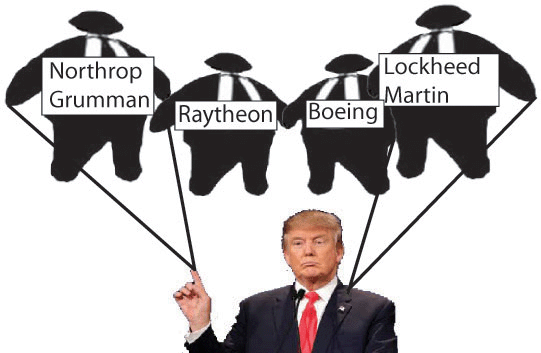 The Sway of the Nuclear Arms Industry Over Donald Trump and Congress Is Terrifying
Without the development of such weapons, that complex simply would not exist in its present form. The Manhattan Project, the vast endeavor that produced the first workable nukes during World War II, was one of the largest government-funded research and manufacturing projects in history. Today’s nuclear warhead complex is still largely built around facilities and locations dating back to that time…….
Eisenhower couldn’t have been more clear-eyed about all of this. He saw the missile gap for the fiction it was or, as he put it, a “useful piece of political demagoguery” for his opponents. “Munitions makers,” he insisted, “are making tremendous efforts towards getting more contracts and in fact seem to be exerting undue influence over the senators.”
The techniques that the arms lobby and its allies in government used more than half a century ago to promote sky-high nuclear weapons spending continue to be wielded to this day. The 21st-century arms complex employs tools of influence that Kennedy and his compatriots would have found familiar indeed—including millions of dollars in campaign contributions that flow to members of Congress and the continual employment of 700 to 1,000 lobbyists to influence them; that’s nearly two arms lobbyists for every member of Congress. Much of this sort of activity remains focused on ensuring that nuclear weapons of all types are amply financed and that the funding for the new generations of the bombers, submarines, and missiles that will deliver them stays on track.
When traditional lobbying methods don’t get the job done, the industry’s argument of last resort is jobs—in particular, jobs in the states and districts of key members of Congress. This process is aided by the fact that nuclear weapons facilities are spread remarkably widely across the country. There are labs in California and New Mexico; a testing and research site in Nevada; a warhead assembly and disassembly plant in Texas; a factory in Kansas City, Missouri, that builds nonnuclear parts for such weapons; and a plant in Oak Ridge, Tennessee, that produces weapon-grade uranium. There are factories or bases for ICBMs, bombers, and ballistic missile submarines in Connecticut, Georgia, Washington State, California, Ohio, Massachusetts, Louisiana, North Dakota, and Wyoming. Such a nuclear geography ensures that a striking number of congressional representatives will automatically favor more spending on nuclear weapons.
In reality, the jobs argument is deeply flawed. As the experts know, virtually any other activity into which such funding flowed would create significantly more jobs than Pentagon spending. A study by economists at the University of Massachusetts, for example, found infrastructure investment would create one and one-half times as many jobs as Pentagon funding and education spending twice as many.
In most cases it hasn’t seemed to matter that the jobs claims for weapons spending are grotesquely exaggerated and better alternatives litter the landscape. The argument remains remarkably potent in states and communities that are particularly dependent on the Pentagon. Perhaps unsurprisingly, members of Congress from such areas are disproportionately represented on the committees that decide how much will be spent on nuclear and conventional weaponry………. http://www.motherjones.com/politics/2017/11/devastation-very-important-nuclear-weapons-industry-donald-trump-1/
Japan Atomic Power in trouble: diverted its decommissioning funds to build new reactors
 Japan Atomic Power in dire straits after diverting funds, Asahi Shimbun, By TSUNEO SASAI/ Staff Writer, November 17, 2017
Japan Atomic Power Co. has diverted so much of its decommissioning funds to build new reactors that it now lacks enough cash to scrap its aging units or even resume operations of existing ones. The problem-plagued company is banking on a decision by the Nuclear Regulation Authority, but even that might not be sufficient to save it financially.
The Ministry of Economy, Trade and Industry requires nuclear power plant operators to accumulate decommissioning funds every year based on their estimated costs to scrap reactors.
The ministry’s guidelines, however, do not prohibit the companies from temporarily using the accumulated money for other purposes.
According to calculations, Japan Atomic Power should have saved around 180 billion yen ($1.6 billion) to decommission its four nuclear reactors. The company declined to give details about how much of decommissioning fund was used for other purposes. However, a person familiar with the situation said the operator “diverted the majority.”
That leaves Japan Atomic Power without the necessary funds to carry out its plans to decommission its one-reactor Tokai nuclear plant in Ibaraki Prefecture, and the No. 1 reactor at its Tsuruga nuclear plant in Fukui Prefecture.
The company’s two other reactors–the reactor at the Tokai No. 2 nuclear plant and the No. 2 reactor at the Tsuruga plant–are off-line. To survive the financial crunch, Japan Atomic Power will soon apply to the NRA to extend the operating life of the idled Tokai No. 2 nuclear plant reactor. That reactor will reach its 40th year of operation in November 2018. Even if the NRA approves the 20-year extension, the company does not have the 174 billion yen needed to improve safety measures at the reactor to bring it online.
An active geological fault line was found running directly beneath the No. 2 reactor building at the Tsuruga nuclear plant, meaning a resumption of reactor operations there is nowhere in sight.
Japan Atomic Power decided to use decommissioning funds to cover costs to build the Tsuruga No. 3 and No. 4 reactors in a bid to curb borrowing from financial institutions, according to several sources.
However, that decision was made before disaster struck at the Fukushima No. 1 nuclear power plant in March 2011.
After the triple meltdown at the Fukushima plant, all reactors in the nation, including those of Japan Atomic Power, were suspended…….. http://www.asahi.com/ajw/articles/AJ201711170054.html
More nuclear reactors in more countries increase proliferation risks
 Bulletin of Atomic Scientists 16th Nov 2017, In an August 2017 report, former Energy Secretary Ernest Moniz argues for federal subsidies to prop up the US nuclear power industry on the novel
grounds that the industry is vital to our national security.
One of his principal conclusions is that to have an effective nonproliferation policy
we need to be selling lots of reactors internationally. The conclusion is
dead wrong but, unfortunately, it’s also influential.
The current energy secretary, Rick Perry, picked up the argument. In October 12 testimony, he
told Congress that “we have to support this industry,” because, among other
things, it is important to the success of our nonproliferation policy.
What kind of reactor exports might this entail? The Energy Department’s acting
assistant secretary for nuclear energy, Edward McGinnis, told an
International Atomic Energy Agency (IAEA) conference in Abu Dhabi on
November 1 that the United States wants “to spur exports of nuclear energy
plants and equipment, including to the conference’s host nation UAE and Saudi Arabia.”
That, after all, is where the export opportunities are—in
the Middle East, Asia, and Africa, among countries taking their first steps
into nuclear energy. Most don’t have the required financial resources and
would need massive loans.
Some, like Saudi Arabia, or perhaps Turkey,
appear to have more on their mind than electricity generation. The trouble
is that power programs based on the most common type of nuclear power
plant, the light water reactor, give a country a large leg up on creating a
nuclear weapons option if that is what it wants. As a result, more nuclear
reactors in more countries increase proliferation risks. Whatever the
advantages of this technology, nonproliferation is not one of them.
https://thebulletin.org/exporting-power-reactors-no-way-fight-proliferation11282
South Carolina Electric & Gas Company (SCE&G) has new proposal for solar and gas generation
SCE&G proposes gas, solar for Summer replacement , WNN, 17 November 2017
South Carolina Electric & Gas Company (SCE&G) has unveiled a proposal that would see some of the capacity that should have been provided by the VC Summer nuclear power plant project replaced with gas and solar generation. The company’s shareholders would absorb the net construction costs of the abandoned nuclear project.
The proposal issued yesterday by the Scana Corporation subsidiary provides about $4.8 billion in benefits to SCE&G customers, and will require approval from South Carolina’s Public Service Commission (PSC).
SCE&G proposes acquiring a 540 MWe gas-fired power plant to replace “more than” 40% of the power that was projected to be provided from the two-unit Summer plant. The $180 million purchase price of the gas-fired plant will be borne by Scana shareholders, who will also forego any shareholder return over the life of the plant. The company said it will also add about 100 MWe of large-scale solar capacity to its system.
Electric rates for SCE&G’s customers – commercial, industrial and residential – will roll back to where they would have been in March 2015, which represents a reduction of about 3.5%. Scana shareholders will absorb the net nuclear construction costs through lower earnings over 50 years, which the company says will account for about $2.9 billion of the total $4.8 billion.
SCE&G owns 55% of the Summer project, with the remainder owned by Santee Cooper…… http://www.world-nuclear-news.org/C-Gas-solar-proposed-by-SCEG-for-Summer-replacement-1711178.html
New report says that South Africa should ditch nuclear plan, to save Eskom from ruin
This comes as an Eskom report seen by Fin24 and EE Publishers shows that the power utility is projecting a R3.55bn loss by the end of its current financial year. It also shows the power utility’s poor governance has left it teetering on the edge of insolvency, with only R1.2bn of liquidity reserves expected to be in hand at the end of the month.
Amidst Eskom’s governance and financial crisis, President Jacob Zuma has repeatedly said that South Africa is committed to developing new nuclear power stations at a pace and scale it can afford. Critics, who believe it could cost over R1trn and that would threaten the country’s fiscal framework policy, want the nuclear policy scrapped altogether.
Now, the new research report, which was published on Thursday by Meridian Economics, shows that Eskom should decommission its older coal-fired power stations and consider curtailing the Kusile construction programme in order to save costs.
These interventions can be achieved without affecting security of supply, it shows.
The study also shows that South Africa does not need a nuclear, coal or gas power procurement or construction programme. Instead, it should accelerate its transition to cleaner, cheaper, and more sustainable renewable energy when further capacity is required.
“Stagnant demand and Eskom’s large power station construction programme has resulted in a growing surplus of expensive generation capacity,” Meridian Economics managing director Dr Grové Steyn said in a statement on Thursday.
“At the same time, the operating costs of Eskom’s coal-fired power stations have consistently increased. This has forced Eskom to implement the highest tariff increases in recorded history, and has led to a growing solvency and – at the time of writing – a liquidity crisis.
“If the system can meet demand over the same period by using alternative resources such as other existing coal stations, wind and solar – but at a lower cost than the cost of electricity from a particular coal-fired power station – it makes economic sense to decommission that station early, or not to complete it.”
A system analysis undertaken by the Council for Scientific and Industrial Research Energy Centre found that new coal and nuclear plants are simply no longer competitive against the falling costs of renewables and associated technologies, the report said.
For the foreseeable future no gas fired power stations are required (peaking gas turbines can run on liquid fuel).
“This means that South Africa does not need a nuclear, coal or gas power procurement or construction programme.”
Eskom shows no commitment to decommission older plants
Despite Eskom’s dire financial circumstances, it nonetheless has not yet committed to decommission any of its older plants, even as they approach the end of their lives and the costs of running the older stations increase, Meridian Economics explained.
“With Eskom’s on-going governance crisis, it appears that government and Eskom are partially paralysed, and could struggle to take the right decisions in the public interest. It is therefore critical that the National Energy Regulator (Nersa) ensures that these issues are investigated and addressed, and that Eskom is only allowed to recover efficient costs in its tariffs,” Meridian Economics said.
“If Eskom’s financial crisis continues to worsen, as we suspect it might, more drastic steps must be considered in light of the systemic risk to the state and the entire economy,” said Steyn.
“If the options of substantial tariff increases and further government bailouts are exhausted, Eskom will have to urgently find other ways to maintain its solvency and avoid a liquidity crisis…….. https://www.fin24.com/Economy/Eskom/to-save-eskom-from-ruin-sa-should-ditch-nuclear-plan-and-cut-coal-power-study-20171116
South Carolina Electric and Gas Co (SCE and G) tries to placate electricity customers after failed nuclear project
SCE&G to cut electricity rates after failed nuclear project http://www.nasdaq.com/article/sceg-to-cut-electricity-rates-after-failed-nuclear-project-20171116-00969 Nov 16 (Reuters) – South Carolina Electric & Gas Co (SCE&G), the main subsidiary of Scana Corp, said it will cut electricity rates to placate customers angered at having to bear the cost of the company’s abandoned V.C. Summer nuclear project.
SCE&G will rollback residential rates to where they would have been in March 2015, resulting in an immediate annual reduction to rates by about $90 million, or 3.5 percent, the company said.
It said there would be $2.9 billion in reduced shareholder earnings over 50 years as they absorb the nuclear construction amortization costs. The company also said it would write off $810 million. “This proposal gives customers additional power generation while also lowering rates for customers,” he said.
SCE&G said it will add a 540-megawatt natural gas-fired power plant to its system, replacing more than 40 percent of the projected power that was to be provided from the V.C. Summer nuclear construction project.
The company also said it will add about 100 megawatts of large-scale solar energy to its system.
V.C. Summer, which was majority-owned by Scana, was ditched in July after estimated costs to build two nuclear reactors spiraled to as much as $24 billion.
Analysts have said the failure of the Summer project and the bankruptcy in March of its designer and contractor, Westinghouse Electric, will likely result in no new nuclear reactors being built in the United States for many years, if ever.
In October, Scana announced the resignation of its chief executive, Kevin Marsh, as the utility company grappled with billions of dollars in cost overruns tied to the abandoned nuclear project.
Summer was one of only two new nuclear power plants under construction in the United States. The other is at Southern Co’s Vogtle plant in Georgia, which is still being built. The two
Vogtle reactors are expected to be completed in 2021 and 2022.
1 This Month

4 May -West Suburban Peace Coalition to discuss Iran war at May Educational Forum
Monday, May 4, 7:00 – 8:00 PM Central Standard Time
Title: : How Trump’s Narrative Tries to Shape the Reality of the War on Iran.
Contact Walt Zlotow, zlotow@hotmail.com 630 442 3045 for further information
14 May – online event From Bombs to Data Centres: the Face of Nuclear Colonialism
To see nuclear-related stories in greater depth and intensity – go to https://nuclearinformation.wordpress.com
-
Archives
- May 2026 (37)
- April 2026 (356)
- March 2026 (251)
- February 2026 (268)
- January 2026 (308)
- December 2025 (358)
- November 2025 (359)
- October 2025 (376)
- September 2025 (257)
- August 2025 (319)
- July 2025 (230)
- June 2025 (348)
-
Categories
- 1
- 1 NUCLEAR ISSUES
- business and costs
- climate change
- culture and arts
- ENERGY
- environment
- health
- history
- indigenous issues
- Legal
- marketing of nuclear
- media
- opposition to nuclear
- PERSONAL STORIES
- politics
- politics international
- Religion and ethics
- safety
- secrets,lies and civil liberties
- spinbuster
- technology
- Uranium
- wastes
- weapons and war
- Women
- 2 WORLD
- ACTION
- AFRICA
- Atrocities
- AUSTRALIA
- Christina's notes
- Christina's themes
- culture and arts
- Events
- Fuk 2022
- Fuk 2023
- Fukushima 2017
- Fukushima 2018
- fukushima 2019
- Fukushima 2020
- Fukushima 2021
- general
- global warming
- Humour (God we need it)
- Nuclear
- RARE EARTHS
- Reference
- resources – print
- Resources -audiovicual
- Weekly Newsletter
- World
- World Nuclear
- YouTube
-
RSS
Entries RSS
Comments RSS
 nuclear-news