Santee Cooper will pay $19 million a year to preserve site of failed S.C. nuclear project, Post and Courier, By Thad Moore tmoore@postandcourier.com, Santee Cooper will preserve the site of South Carolina’s abandoned nuclear project at least temporarily, taking control of the unfinished power plant months after its partner decided to walk away for good.
That’s according to a letter sent Wednesday from Santee Cooper’s board chairman to Gov. Henry McMaster, who had called for the partially built reactors to be maintained.The letter indicates that it will cost Santee Cooper $16 million a year to maintain the reactors and the enormous stockpile of equipment purchased for the project. It’ll cost another $3 million to buy insurance and lease warehouses to store parts………..
Santee Cooper has been under pressure from state lawmakers to keep up the site ever since the project’s majority owner, South Carolina Electric & Gas, decided it was abandoning the site permanently. SCE&G says it can claim a tax write-off worth billionsby letting the reactors rust away.
At the end of last year, Flemish nationalists spoke publicly against the withdrawal of nuclear power endorsed by the Energy Pact project that was designed by the country’s four ministers for energy on the basis of the cost for households and companies. The Plan Office and Professor Johan Albrecht have been asked to evaluate the cost evolution of power in Belgium in the years to come, taking various scenarios into consideration.
The extra cost for households would come to 15 euros plus VAT as of 2025, the planned date for the phasing-out of nuclear power. It includes the producers’ investment in gas power plants, the price of gas necessary for the production of electricity, as well as the federal government’s subsidies for plants. This figure, however, does not take into account the cost of the plants’ dismantlement or the nuclear waste reprocessing, and it only covers the expenses which fall within the federal competence. The support cost for the sustainable, therefore, is not included.
For the companies, the situation will be “slightly more complicated,” according to the minister. Discounts to be discussed with partners of the majority could be granted to companies competing with foreign offers, she indicated.
As with other commodity markets, the uranium market is a curious beast at the best of times ‒ keen to spot a bargain, investors get more and more excited the further the uranium price and company stock prices fall. They’ve had plenty to get excited about in recent years.
These days, the market exhibits multiple levels of weirdness, all stemming from the growing acknowledgment that nuclear power and the uranium industry face a bleak future.
The uranium market has a “subdued outlook” and Cameco’s uranium is now “more valuable in the ground” according to Warwick Grigor from Far East Capital, because the cost of production is higher than the prices currently being offered. Cameco CEO Tim Gitzel agrees, saying in January 2018 that at current prices “our supply is better left in the ground.” So uranium industry executives and market analysts are finally coming around to rallying cry of the anti-uranium movement: Leave it in the ground!
Lizards Revenge, Olympic Dam, 2012.
We’ve also had the odd situation over the past year of nuclear lobbyists arguing repeatedly that the nuclear power industry is in “crisis” and wondering what if anything can be salvaged from “the ashes of today’s dying industry“. Usually such claims come from the anti-nuclear movement ‒ sometimes more in hope that expectation.
And we’ve had the odd situation of industry bodies (such as the US Nuclear Energy Institute) and supporters (such as former US energy secretary Ernest Moniz) openly acknowledging the connections between nuclear power and weapons ‒ connections they have strenuously denied for decades.
Such arguments are now being used in an effort to secure preferential treatment for uranium mining companies in the US. Ur-Energy and Energy Fuels have lodged a petition with the Department of Commerce seeking a mandated requirement for US power utilities purchase a minimum 25% of their requirements from US mines. Uranium is “the backbone of the U.S. nuclear deterrent and fuels ships and submarines in the U.S. Navy”, the companies state.
The arguments might appeal to President Trump and they would dovetail neatly with his silly conspiracy theory about Hillary Clinton threatening national security by allowing the sale of a uranium mining company with US interests to Russia’s Rosatom. But the arguments don’t appear to enjoy any support from the US nuclear weapons complex and they certainly don’t enjoy any support from power utilities. According to market analysts FNArena, the petition lodged by Ur-Energy and Energy Fuels “brought the uranium market to a screaming halt” and US power utilities warned that a quota would force the early shutdown of some nuclear plants.
Another miserable year for the uranium industry
Nuclear power has been stagnant for the past 20 years. Although power reactors account for an overwhelming majority of uranium demand, uranium production ‒ and prices ‒ have been up and down and all over the place.
Uranium mine production increased by 50% from 2007 to 2016. The increase was driven, initially at least, by expectations of the nuclear renaissance that didn’t eventuate. Mine production plus secondary sources (e.g. stockpiles and ex-military material) have consistently exceeded demand ‒ 2017 was the eleventh consecutive year of surplus according to the CEO of uranium company Bannerman Resources.
Stockpiles (inventories) have grown steadily over the past decade to reach enormous levels ‒ enough to keep the entire global reactor fleet operating for around eight years. Supply from mines and secondary sources in recent years has exceeded demand by about 18%.
Those dynamics have put downward pressure on prices. After six years of steady decline, uranium prices were flat in 2017. The spot price as of 1 December 2017 was less than one-third of the pre-Fukushima price and the long-term contract price less than half the pre-Fukushima price.
Countless would-be uranium mining companies have given up, some trying their luck in other areas such as property development or growing dope. Some mines have closed, others have been put into care-and-maintenance, and others have reduced output. But supply has continued to exceed demand ‒ and to exert downward pressure on prices.
Very few mines could operate at a profit at current prices. Some mines are profitable because earlier contracts stipulated higher prices, while many mines are operating at a loss. Many companies have been loathe to close operating mines, or to put them into care-and-maintenance, even if the only other option is operating at a loss. They have been playing chicken, hoping that other companies and mines will fold first and that the resultant loss of production will drive up prices. “We have to recognise that we over-produce, and we are responsible for this fall in the price,” said Areva executive Jacques Peythieu in April 2017.
Current prices would need to more than double to encourage new mines ‒ a long-term contract price of about US$70–$80 is typically cited as being required to encourage the development of new mines.
The patterns outlined above were repeated in 2017. It was another miserable year for the uranium industry. A great year for those of us living in uranium producing countries who don’t want to see new mines open and who look forward to the closure of existing mines. And a great year for the nuclear power industry ‒ in the narrow sense that the plentiful availability of cheap uranium allows the industry to focus on other problems.
Cut-backs announced
The patterns that have prevailed over the past five years or so might be changed by decisions taken by Cameco and Kazatomprom (Kazakhstan) in late 2017 to significantly reduce production. Canada closed McArthur River in Canada in January and plans to keep it closed for around 10 months ‒ it had been producing more uranium than any other mine in the world. Kazakhstan has been producing almost 40% of world supply in recent years and plans to reduce production by 20% from 2018‒2020.
Previous cut-backs in Canada and Kazakhstan have had little or no effect, and so far the late-2017 announcements have only resulted in a small, short-lived upswing in uranium prices. But the cut-backs are significant and their impact might yet be felt.
A late-2017 report by Cantor Fitzgerald equity research argued that the decisions by Cameco and Kazatomprom could result in a “step change” for uranium prices. But Warwick Grigor from Far East Capital was downbeat about Cameco’s announcement. “I don’t see this as a turnaround for the uranium price; at best they will stay where they are, but it doesn’t signal a boom in price,” he said in November 2017.
BHP marketing vice-president Vicky Binns said in December 2017 that uranium markets would remain oversupplied for close to a decade, with downward pressure remaining on uranium prices despite Cameco’s production cuts. She said that demand for uranium could outstrip supply by the late 2020s but that could change if developed nations close their nuclear reactors earlier than expected, or if renewables take a larger than expected market share.
Equally downbeat comments have been made by other industry insiders and analysts in recent years. Former Paladin Energy chief executive John Borshoff said in 2013 that the uranium industry “is definitely in crisis” and “is showing all the symptoms of a mid-term paralysis”. Former World Nuclear Association executive Steve Kidd in May 2014 predicted “a long period of relatively low prices”. Nick Carter from Ux Consulting said in April 2016 that he did not see a supply deficit in the market until “the late 2020s”.
Perhaps a uranium price increase is on the way but it will do little to salvage Australia’s uranium industry. Apart from BHP’s Olympic Dam mine in SA, the only other operating uranium mine in Australia is Beverley Four Mile in SA. At Ranger in the NT, mining has ceased, stockpiles of ore are being processed, and ERA is planning a $500 million project to decommission and rehabilitate the mine site.
Meanwhile, Mirarr Traditional Owners in the NT and their many supporters are celebrating the 20th anniversary of the mass movement that defeated the plan to mine the Jabiluka uranium deposit. South Australians are celebrating the successful campaign to stop the state being turned into the world’s high-level nuclear waste dump. The Aboriginal-led Australian Nuclear Free Alliance recently celebrated 20 years of ‘radioactive resistance’.
And with the cost of a single power reactor climbing to as much as $20 billion, proposals to introduce nuclear power to Australia seem more and more quixotic and are now largely limited to the far right ‒ in particular, Australians Conservatives’ luminary Senator Cory Bernardi and the Minerals Council of Australia.
Even Dr Ziggy Switkowski ‒ who used to be nuclear power’s head cheerleader in Australia and was appointed to lead the Howard government’s review of nuclear power ‒ recently said that “the window for gigawatt-scale nuclear has closed”. He said nuclear power is no longer cheaper than renewables and the levelised cost of electricity is rapidly diverging in favour of renewables.
Dr Jim Green is the national nuclear campaigner with Friends of the Earth Australia and editor of the Nuclear Monitor newsletter produced by the World Information Service on Energy and the Nuclear Information & Resource Service.
Supporters of nuclear power hope that small nuclear reactors, unlike large plants, will be able to compete economically with other sources of electricity. But according to M.V. Ramana, a Professor at the University of British Columbia, this is likely to be a vain hope. In fact, according to Ramana, in the absence of a mass market, they may be even more expensive than large plants.
In October 2017, just after Puerto Rico was battered by Hurricane Maria, US Secretary of Energy Rick Perry asked the audience at a conference on clean energy in Washington, D.C.: “Wouldn’t it make abundant good sense if we had small modular reactors that literally you could put in the back of a C-17, transport to an area like Puerto Rico, push it out the back end, crank it up and plug it in? … It could serve hundreds of thousands”.
As exemplified by Secretary Perry’s remarks, small modular reactors (SMRs) have been suggested as a way to supply electricity for communities that inhabit islands or in other remote locations.
In the past decade, wind and solar energy have become significantly cheaper than nuclear power
More generally, many nuclear advocates have suggested that SMRs can deal with all the problems confronting nuclear power, including unfavorable economics, risk of severe accidents, disposing of radioactive waste and the linkage with weapons proliferation. Of these, the key problem responsible for the present status of nuclear energy has been its inability to compete economically with other sources of electricity. As a result, the share of global electricity generated by nuclear power has dropped from 17.5% in 1996 to 10.5% in 2016 and is expected to continue falling.
Still expensive
The inability of nuclear power to compete economically results from two related problems. The first problem is that building a nuclear reactor requires high levels of capital, well beyond the financial capacity of a typical electricity utility, or a small country. This is less difficult for state- owned entities in large countries like China and India, but it does limit how much nuclear power even they can install.
The second problem is that, largely because of high construction costs, nuclear energy is expensive. Electricity from fossil fuels, such as coal and natural gas, has been cheaper historically ‒ especially when costs of natural gas have been low, and no price is imposed on carbon. But, in the past decade, wind and solar energy, which do not emit carbon dioxide either, have become significantly cheaper than nuclear power. As a result, installed renewables have grown tremendously, in drastic contrast to nuclear energy.
How are SMRs supposed to change this picture? As the name suggests, SMRs produce smaller amounts of electricity compared to currently common nuclear power reactors. A smaller reactor is expected to cost less to build. This allows, in principle, smaller private utilities and countries with smaller GDPs to invest in nuclear power. While this may help deal with the first problem, it actually worsens the second problem because small reactors lose out on economies of scale. Larger reactors are cheaper on a per megawatt basis because their material and work requirements do not scale linearly with generation capacity.
“The problem I have with SMRs is not the technology, it’s not the deployment ‒ it’s that there’s no customers”
SMR proponents argue that they can make up for the lost economies of scale by savings through mass manufacture in factories and resultant learning. But, to achieve such savings, these reactors have to be manufactured by the thousands, even under very optimistic assumptions about rates of learning. Rates of learning in nuclear power plant manufacturing have been extremely low; indeed, in both the United States and France, the two countries with the highest number of nuclear plants, costs rose with construction experience.
Ahead of the market
For high learning rates to be achieved, there must be a standardized reactor built in large quantities. Currently dozens of SMR designs are at various stages of development; it is very unlikely that one, or even a few designs, will be chosen by different countries and private entities, discarding the vast majority of designs that are currently being invested in. All of these unlikely occurrences must materialize if small reactors are to become competitive with large nuclear power plants, which are themselves not competitive.
There is a further hurdle to be overcome before these large numbers of SMRs can be built. For a company to invest in a factory to manufacture reactors, it would have to be confident that there is a market for them. This has not been the case and hence no company has invested large sums of its own money to commercialize SMRs.
An example is the Westinghouse Electric Company, which worked on two SMR designs, and tried to get funding from the US Department of Energy (DOE). When it failed in that effort, Westinghouse stopped working on SMRs and decided to focus its efforts on marketing the AP1000 reactor and the decommissioning business. Explaining this decision, Danny Roderick, then president and CEO of Westinghouse, announced: “The problem I have with SMRs is not the technology, it’s not the deployment ‒ it’s that there’s no customers. … The worst thing to do is get ahead of the market”.
Delayed commercialization
Given this state of affairs, it should not be surprising that no SMR has been commercialized. Timelines have been routinely set back. In 2001, for example, a DOE report on prevalent SMR designs concluded that “the most technically mature small modular reactor (SMR) designs and concepts have the potential to be economical and could be made available for deployment before the end of the decade provided that certain technical and licensing issues are addressed”. Nothing of that sort happened; there is no SMR design available for deployment in the United States so far.
There are simply not enough remote communities, with adequate purchasing capacity, to be able to make it financially viable to manufacture SMRs by the thousands
Similar delays have been experienced in other countries too. In Russia, the first SMR that is expected to be deployed is the KLT-40S, which is based on the design of reactors used in the small fleet of nuclear-powered icebreakers that Russia has operated for decades. This programme, too, has been delayed by more than a decade and the estimated costs have ballooned.
South Korea even licensed an SMR for construction in 2012 but no utility has been interested in constructing one, most likely because of the realization that the reactor is too expensive on a per-unit generating-capacity basis. Even the World Nuclear Association stated: “KAERI planned to build a 90 MWe demonstration plant to operate from 2017, but this is not practical or economic in South Korea” (my emphasis).
Likewise, China is building one twin-reactor high- temperature demonstration SMR and some SMR feasibility studies are underway, but plans for 18 additional SMRs have been “dropped” according to the World Nuclear Association, in part because the estimated cost of generating electricity is significantly higher than the generation cost at standard-sized light-water reactors.
No real market demand
On the demand side, many developing countries claim to be interested in SMRs but few seem to be willing to invest in the construction of one. Although many agreements and memoranda of understanding have been signed, there are still no plans for actual construction. Good examples are the cases of Jordan, Ghana and Indonesia, all of which have been touted as promising markets for SMRs, but none of which are buying one.
Neither nuclear reactor companies, nor any governments that back nuclear power, are willing to spend the hundreds of millions, if not a few billions, of dollars to set up SMRs just so that these small and remote communities will have nuclear electricity
Another potential market that is often proffered as a reason for developing SMRs is small and remote communities. There again, the problem is one of numbers. There are simply not enough remote communities, with adequate purchasing capacity, to be able to make it financially viable to manufacture SMRs by the thousands so as to make them competitive with large reactors, let alone other sources of power. Neither nuclear reactor companies, nor any governments that back nuclear power, are willing to spend the hundreds of millions, if not a few billions, of dollars to set up SMRs just so that these small and remote communities will have nuclear electricity.
Meanwhile, other sources of electricity supply, in particular combinations of renewables and storage technologies such as batteries, are fast becoming cheaper. It is likely that they will become cheap enough to produce reliable and affordable electricity, even for these remote and small communities ‒ never mind larger, grid- connected areas ‒ well before SMRs are deployable, let alone economically competitive.
Editor’s note:
Prof. M. V. Ramana is Simons Chair in Disarmament, Global and Human Security at the Liu Institute for Global Issues, as part of the School of Public Policy and Global Affairs at the University of British Columbia, Vancouver. This article was first published in National University of Singapore Energy Studies Institute Bulletin, Vol.10, Issue 6, Dec. 2017, and is republished here with permission.
Pentagon’s New Nuclear Strategy Is Unsustainable And A Handout To Defense Industry Considering the arsenal we have is extremely costly to maintain not to mention update, expanding it will be fiscally unsustainable in the long run. The Drive, BY TYLER ROGO, WAYFEBRUARY 21, 2018
I had high hopes that the Pentagon’s Nuclear Posture Review would lay out a creative new strategy that would save money when it comes to sustaining and modernizing America’s hideously expensive nuclear arsenal. It ended up doing just the opposite.
Basically an “and the kitchen sink too” document, it not only maintains and modernizes the current nuclear triad, but also expands upon it with calling for new iterations of established delivery systems as well as a developing a whole new one as well. Most controversially it looks to field more “usable” nuclear weapons in some nebulous attempt to deter an enemy’s own use of low-yield tactical nukes during a limited conflict. This is sometimes referred to as “escalate to de-escalate,” but regardless of the tactics involved, really this document represents a handout to defense contractors of monumental proportions and above all else, a unsustainable and highly expensive strategy overall.
Just modernizing the nuclear arsenal we have today was slated to cost roughly $1.5T with inflation over the next 30 years and that is without the new initiatives laid out by the Strategic Posture Review. These include the introduction of low-yield warheads for the D5 Trident submarine-launched ballistic missile, the reintroduction of a nuclear-tipped naval cruise missile, and the development of nuclear-armed hypersonic weapons that will become a whole new medium of delivery in the coming decades. ……….
In the end, substantially increasing the number of America’s nuclear delivery systems and making nuclear weapons “easier to use” is a reckless and extremely costly path to go down, especially without giving up something in return. And the cold hard truth is that $700B defense budgets are notsustainable. As America is forced to confront its reckless spending habits in the years to come, sustaining the nuclear arsenal we already have will become fiscally challenging—doing so with an expanded arsenal will be all but impossible. ……….
So who wins in all this? Defense contractors, and in a huge way. Nuclear weapons contracts are extremely expensive and the secrecy surrounding them helps with limiting public ridicule and even congressional oversight.
But don’t blame the contractors, blame those who are making these decisions. Just going on a nuclear shopping spree while the dollars are many sets the Pentagon up for some tough, if not embarrassing triaging of fiscal priorities down the road. As such, the chances are very high that these initiatives will end up being viewed as highly wasteful and nearsighted in the not so distant future, and even integrating them into existing arms treaties is a whole other issue altogether.
Centrica to cut 4,000 jobs and sell UK nuclear holdings Beleaguered British Gas owner, lost 1.4 million customers last year The Week, UK Feb 22, 2018
Centrica, the owner of British Gas, is cutting 4,000 jobs and sellings its nuclear holdings amid plummeting profits and customer numbers.
The energy supplier says group profits across operations in the UK, Ireland and North America fell by 17% to £1.25bn for the year ended December 2017. ……..
Centrica, which lost a total of 1.4 million customer accounts last year, is also looking to sell its stake in Britain’s nuclear power stations by 2020. The company bought a 20% share in Electricite de France SA’s UK nuclear operations in 2009 as an investment. This stake is to be divested, “subject to ensuring alignment with our partner and being sensitive to Government interests”, Centrica said in a statement. ……http://www.theweek.co.uk/centrica/91834/centrica-to-cut-4000-jobs-and-sell-uk-nuclear-holdings
Japan to resume aid for firms’ nuclear power plant exports, Japan Times, 20 Feb 18 Two government-affiliated bodies plan to resume financial support for Japanese companies’ nuclear power plant exports in fiscal 2018 at the earliest, according to informed sources.
The Japan Bank for International Cooperation and Nippon Export and Investment Insurance effectively suspended the provision of loans and trade insurance for nuclear plant export deals following the March 2011 disaster at the Fukushima No. 1 nuclear plant.
We look back on a mixed year for construction in the nuclear industry with the delivery of further nuclear power plants (NPPs) under threat from both the rise in renewable energy and the global trend for decommissioning in the prolonged aftermath of 2011’s Fukushima disaster.
According to the latest findings of the annual World Nuclear Report, as of January 2018, there are 52 reactors currently under construction worldwide. Four NPPs began the long-term process of construction in 2017 – one each in Bangladesh, China, India and South Korea.
The Chinese project, a pilot fast reactor, was launched on Christmas Day last year at the Xiapu site in Fujian province, but there were no other new NPP projects or construction starts announced in the country. Analysts suggest it’s a sign of a major shift or slowdown in Chinese nuclear policy, following the country’s domination of world nuclear construction for the past decade when it contributed over 60% of all new global sites since 2008.
The sector is experiencing profound structural change. The introduction of renewable energy at scale, thanks to declining costs driven by technological advances, has increased renewable power output at the expense of conventional technologies such as coal and nuclear. Though an operating NPP can provide up to nine times more electricity per installed kilowatt than a photovoltaic plant, the challenge to the industry from renewables is tangible. China’s massive rates of solar capacity deliver over 50GW to its grid. Even when taking into account lower productivity per installed GW from solar, research shows new solar plants in China alone in 2017 will generate significantly more power than all nuclear reactors started up (four) in the same year in the entire world.
Construction delays are common due to a number of factors, including political upheaval (the US embargo caused a 15-year delay to Iran’s first NPP in Bushehr before construction resumed in 1995) and the type of prolonged protest experienced during the delivery of India’s largest NPP. The progress of the Kundankulam NPP (KNPP) was besieged by various activist groups over potential radiation threats and issues related to nuclear waste disposal, with the anti-Kudankulam campaign intensifying following the Fukushima nuclear incident in Japan in 2011.
Decommissioning is also a factor in construction slowdown. Globally, three reactors were permanently closed in 2017. In Germany, Gundremmingen-B was closed in December as part of the country’s nuclear phase-out policy. South Korea and Sweden both shut down their oldest units – Kori-1 and Oskashamn-1. In addition, two more Japanese reactors, Ohi-1 and -2 were officially closed after the operator abandoned plans for restart and lifetime extension.
The past 20 years has seen the industry place more emphasis on sustainability and focus on the potential for extending the operating life of NPPs. It’s often more economical than building a new one, and why many plant operators, particularly in the US, are seeking licence renewals. “It is very important for us as a world community to care how electricity is produced,” reckons Maria Korsnick, President and CEO of the Nuclear Energy Institute (NEI), who offers hope for NPP construction specialists nervous about the rise of renewables. “You can produce electricity of an intermittent nature, like wind and solar, but you are going to also need 24/7 baseload energy supply that is still kind to the environment, and nuclear is just that.”
Utilising guidance from the International Atomic Energy Agency (IAEA – the world’s central intergovernmental forum for scientific and technical co-operation in the nuclear field) the US Nuclear Regulatory Commission (NRC) issues licences for NPPs to operate for up to 40 years with subsequent renewals of up to 20 years. Following a round of previous renewals, around 90% of American plants will soon reach the end of their 60-year term, prompting the NRC to look at the way it handles regulation when reviewing a NPP’s system metals, welds and piping, concrete, electrical cables and reactor pressure vessels. It must also evaluate potential impact on the environment, so speedier processes have been called for. “In the beginning, an NRC review took years to complete,” recalls Korsnick. “Now that the process is better understood, we are just under two years. For subsequent licence renewal, we will probably get the process down to 18 months.”
Small Modular Reactors (SMRs) and other kinds of so-called ‘advanced reactors’ continue to be positioned as a solution to the problems confronting nuclear power and the still costly renewal requirements of monolithic reactors. SMRs are nuclear power reactors with an electrical output below 300MWe and distinguishable from large reactors by modular design, with prefabrication in offsite factories and the potential for multiple reactors to be deployed at the same site to create bigger power plants. Proponents claim they will be faster, cheaper and less risky to build while safer to operate than large nuclear plants.
NuScale has claimed that “once approved, global demand for SMR plants will create thousands of jobs during manufacturing, construction and operation” and “re-establish US global leadership in nuclear technology, paving the way for NRC approval and subsequent deployment of other advanced nuclear technologies”. It predicts “about 5,575GWe of global electricity will come from SMRs by 2035, equivalent to over 1,000 NuScale Power Modules”.
However, Danny Roderick, former president and CEO of (now bankrupt nuclear services market leader) Westinghouse, once countered: “The problem I have with SMRs is not the technology, it’s not the deployment – it’s that there’s no customers… The worst thing to do is get ahead of the market.” Currently there are no operational NPPs in the world that can be considered fully-fledged SMRs. Several countries and companies are at different stages in the development of SMR technologies. NuScale is the frontrunner to deliver a SMR in Idaho with the initial operational date of 2024. Meanwhile, mPower (another previous beneficiary of Department of Energy funding to the tune of $80m per year) has been struggling to advance a similar project mooted in Tennessee which was terminated in March last year. Elsewhere, South Korea’s System-Integrated Modular Advanced Reactor (SMART) is the first land based SMR to receive regulatory approval anywhere in the world. However, SMR’s are often found to be too expensive on a per-unit generating-capacity basis which has led to this project being shelved. The words of incoming South Korean premier President Moon echo the sentiments of many world leaders now exploring other forms of energy creation: “We will scrap the nuclear-centred policies and move toward a nuclear-free era. We will eliminate all plans to build new nuclear plants.”
Sam Friggens is an energy economist with engineering and development consultancy Mott MacDonald, experts in the nuclear sector. He suggests that emerging innovations in renewables, power storage, efficiency and smart technologies, driven by fast manufacturing cycles, are yielding rapid cost reductions and improving performance, which means that by the time SMRs are ready for mass deployment in the 2030s the market may have disappeared.
He adds: “Will SMRs be acceptable to the public? The closest-to-market SMR technologies produce the same waste as current large reactors and will need refuelling every few years. New sites closer to demand may be attractive from an energy system perspective, but perhaps not to residents of the cities in question. Overall the challenges associated with SMR deployment are likely to be of similar magnitude to those faced by carbon capture and storage. At the same time, recent work suggests that if these challenges can be overcome then smaller, flexible nuclear technologies could still play an important role in future energy systems in countries like the UK.” In any case, it appears SMR construction projects would need the support of major government funding to play a role in tomorrow’s electricity generating business.
These are uncertain times for the industry which saw Westinghouse suffer a spectacular fall from grace in 2017. Its owner Toshiba recently agreed to sell off the US nuclear business for $4.6bn. The Japanese conglomerate made the decision after heavy delays to two Westinghouse nuclear projects drove the troubled engineering group to file. On top of the economic fallout and challenging ageing issues, nuclear operators are struggling with low electricity prices and the consistently dropping costs of their main competitors, wind and solar in particular. In countries like the United States, many nuclear power plants have continued to operate only because of massive subsidies. Despite this, the World Nuclear Association notes that, thanks to the planet’s voracious appetite for power, 160 power reactors (with a total gross capacity of some 160,000MWe) are on order or planned, and over 300 more are proposed.
EDF UK profits hit by fall in sterling and nuclear prices https://www.theguardian.com/business/2018/feb/16/edf-uk-profits-hit-by-fall-in-sterling-and-nuclear-prices, Rob Davies, 17 Feb 18 Pound’s decline against euro costs French firm €608m as home energy usage also dropsFrench state-owned energy firm EDF reported falling profits, including a downturn in the UK due to falling prices for nuclear power, improved energy efficiency among its household customers and the slide in the value of sterling since the Brexit vote
Profits in the UK division, which includes EDF Energy, slumped by a third to €1.035 (£920m) as sales dwindled by €579m to €8.68bn, partly because UK customers pay their bills in pounds but the company reports its results in euros.
EDF said the decline of the pound against the euro had cost it €608m.
The company has faced criticism over delays and the cost of its £20bn Hinkley Point C nuclear power plant. However, it has blamed a 12% fall in nuclear energy prices in the UK, where it is the market leader.
Revenues were depressed by lower home energy consumption among customers, with usage falling 1.9% due to “milder weather and rising energy efficiency”.
EDF, which is majority-owned by the French government, reported a 2.2% decline in overall revenues to €69.6bn, with profits down 16% to €13.7bn, excluding the impact of asset sales.
It said group results had declined due to lower prices in almost all of the regions where it operates and an exodus of nearly 1 million customers.
It was also affected by lower nuclear and hydroelectric output in its domestic market, where it is the dominant supplier with more than 85% market share.
It lost 960,000 customers, shaving €341m off profits, blaming the exodus on heightened competition, including in the UK.
Chief executive and chairman Jean-Bernard Levy said the group’s profitability in the face of a “difficult market context” was evidence of EDF’s financial strength, adding that he expects a “rebound” in 2018.
He said the company would launch an “unprecedented” ramp-up of renewable energy this year, as France looks to reduce nuclear’s share of power generation from 75% to 50% by 2025.
Russia and Congo to cooperate in nuclear power, WNN, 14 February 2018 Rosatom and the Ministry of Scientific Research and Technological Innovations of the Republic of Congo have signed a Memorandum of Understanding (MoU) on cooperation in the peaceful uses of nuclear energy.
The document was signed yesterday in Moscow by the Russian state nuclear corporation’s deputy director general for international relations, Nikolay Spassky, and the ambassador extraordinary and plenipotentiary of the Republic of the Congo in Russia, David Maduka.
The document establishes a legal basis for the implementation of bilateral cooperation in a wide range of areas, Rosatom said. These include the development of nuclear infrastructure in the Republic of Congo and programmes aimed at increased awareness of nuclear technologies and their applications…..http://www.world-nuclear-news.org/NP-Russia-and-Congo-to-cooperate-in-nuclear-power-14021801.html
GE Hitachi, Holtec Announce Cooperation to Accelerate Commercialization of SMR-160 Small Modular Reactor, Power Magazine
02/14/2018 GE Hitachi Nuclear Energy (GEH), Global Nuclear Fuel (GNF), Holtec International and SMR Inventec, LLC (SMR, LLC), today announced a collaboration to advance the SMR‐160, a single loop, 160 MWe pressurized light water reactor based on existing light water technologies.In a Memorandum of Understanding, the companies have agreed to enter into a procompetitive collaboration to progress the SMR-160 which SMR, LLC intends to develop, design, license, commercialize, deploy and service globally. The cooperation will initially include nuclear fuel development supported by GNF and control rod drive mechanisms designed by GEH, and may later extend to other areas.
“We are excited to leverage the experience and capabilities of world class nuclear companies like GEH and GNF as we bring our game changing SMR-160 technology to global markets,” said Holtec President and CEO Dr. Kris Singh. “SMR-160 has prioritized safety in its design, to produce a right-sized, passively safe and cost-effective solution for carbon-free energy. This collaboration will ensure the SMR-160 supply chain, to deliver and fabricate critical SMR-160 technologies and components, including at our new Advanced Manufacturing Division in Camden, New Jersey.”……http://www.powermag.com/press-releases/ge-hitachi-holtec-announce-cooperation-to-accelerate-commercialization-of-smr-160-small-modular-reactor/
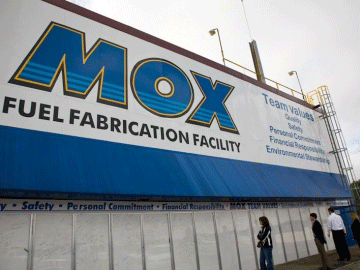
The Department of Energy’s budget request for fiscal 2019 asks for money to close the Mixed Oxide Fuel Fabrication Facility and says the agency prefers the “dilute and dispose” method to dispose of 34 metric tons of weapons-grade plutonium.
“The Budget Request includes $220 million to continue the orderly and safe closure of the Mixed Oxide (MOX) Fuel Fabrication Facility and $59 million to pursue the proven dilute and dispose technology,” Lindsey Geisler, press secretary for the National Nuclear Security Administration, said in a statement. “The administration has proposed termination of the MOX construction project because it is simply unaffordable. We have a proven method called dilute and dispose that is less expensive, has far lower risks, and can be i “The Budget Request includes $220 million to continue the orderly and safe closure of the Mixed Oxide (MOX) Fuel Fabrication Facility and $59 million to pursue the proven dilute and dispose technology,” Lindsey Geisler, press secretary for the National Nuclear Security Administration, said in a statement. “The administration has proposed termination of the MOX construction project because it is simply unaffordable. We have a proven method called dilute and dispose that is less expensive, has far lower risks, and can be implemented decades sooner than the MOX approach.”
The budget request seeks $1.7 billion — $287 million more than last year — to provide support at Savannah River Site for the Liquid Tank Waste Management Program, including “a significant increase” in the production at the Defense Waste Processing Facility and startup of the Salt Waste Processing Facility, according to a DOE fact sheet released Monday.
The MOX project was born from a 2000 non-proliferation agreement between the U.S. and Russia, which called for the removal of 34 metric tons of plutonium from each nation’s arsenal. The MOX project at SRS would convert the plutonium from retired nuclear weapons into a blend with uranium so it can be used in commercial nuclear reactors
Bellona 12th Feb 2018, In a major blow to one of Russia’s most ambitious international nuclear
deals, three investors backed out of the Akkuyu Nuclear Power Plant,
leaving Russian state nuclear corporation Rosatom adrift on how to finish
the $20 billion station.
Russian President Vladimir Putin touted progress
on the plant as recently as November during a state visit to the Turkish
capital, and the Kremlin propaganda news network RT pushed the narrative
that the plant’s first reactor would be finished ahead of its scheduled
2023 launch date.
That was all thrown into doubt last week when a Turkish
consortium, representing 49 percent of the funding for the Akkuyu plant’s
construction, backed out of the deal, citing a failure to agree on a number
of project’s “commercial conditions,” Russian and Turkish news
outlets said. Rosatom is now in talks to secure other investors, but the
corporation wont’ say by how long the loss of half the project’s
financing will delay the station’s launch, or by how much the project’s
price tag is likely to increase as a result of the back out. http://bellona.org/news/nuclear-issues/2018-02-investor-pullout-leaves-rosatom-at-sea-with-its-nuclear-project-in-turkey
– excitingly entitled “Central Government Supply Estimates 2017-18” – detailing changes to planned public expenditure since last Autumn’s
Budget 2017. At pages 162-64 you can find the Business, Energy and Industrial Strategy (BEIS) extra expenditure requests and clarification of
perceived liabilities.
These include several covering the privately-owned commercial nuclear industry sector. Below are the sections on nuclear, and
the most common read-out message is how often the liabilities for which the taxpayer is expected to take long term financial responsibility are
described as “unquantifiable.”
That is accurate, but what is omitted is the numbers are – based on accumulated experience to date, likely to be astronomically huge. This worryingly unacceptable situation,- whereby one industry (nuclear) of the electricity generating sector is being promised a massive future bailout from its liabilities- really should be examined in detail by our elected Parliamentarians and peers in several relevant committees and in the Estimates Debate on the floor of the Commons. http://drdavidlowry.blogspot.co.uk/2018/02/nuclears-unquantifiably-huge-future.html







 nuclear-news