Trump’s nationalisation of the nuclear energy marketplace could cost U.S. consumers up to $17 billion a year
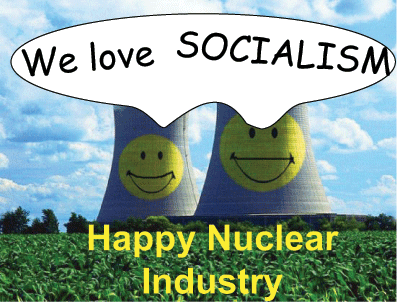 NIRS 6th June 2018 The controversial Trump Administration plan to nationalize the nuclear
energy marketplace could cost U.S. consumers up to $17 billion a year in
artificially high electricity bills, with the prospect of extensive
coal-fired power plant subsidies potentially doubling that figure.
Further, the bailouts of nuclear and coal could trip up America‘s renewables
industry, leaving the U.S. even further behind in the global race for clean
energy technology development and deployment, according to three experts
participating in a news conference today.
Today, the Nuclear Information & Resource Service (NIRS) updated and expanded the nuclear bailout costs
estimated in its November 2016 report that concluded that federal handouts
for nuclear alone could add up to $280 billion to electricity bills by
2030. A bailout of coal-fired power plants would leave ratepayers and
taxpayers holding the bag for even more. NIRS estimates that the current
Trump bailout scheme could cost consumers $8-$17 billion for just the
nuclear element and as much again for coal subsidies.
https://www.nirs.org/press/experts-nuclear-bailout-could-cost-up-to-17-billion-a-year-and-destroy-renewables-industry-in-u-s/
Costly lobbying for nuclear and coal industries, by bankrupt First Energy Solutions
 The Lobbying Bills Attached to FirstEnergy’s Coal and Nuclear Emergency Action https://www.greentechmedia.com/articles/read/firstenergy-coal-and-nuclear-request-lobbying#gs.WUmycd4
The bankrupt business has spent hundreds of thousands of dollars on lobbying so far this year., JUNE 05, 2018
UK Tax-payer to cop huge payments for Wylfa nuclear power project, and costs may still balloon further
 Times 3rd June 2018 ,Ministers will this week reverse decades of opposition to investing taxpayer money in nuclear energy by agreeing to bankroll a £15bn-plus power station in Wales. The government will commit to taking a direct stake in the Wylfa plant on Anglesey, planned by the Japanese industrial giant Hitachi, after more than two years of negotiations.
It is understood the government will also provide the vast bulk of the £9bn debt. State equity will slash the cost of borrowing, but leave the taxpayer exposed if costs balloon or the project overruns. It has, though, helped ministers to
negotiate a strike price — a guaranteed payment for the plant’s electricity — of about £77.50 per megawatt hour. The government was determined to achieve a cheaper price than the £92.50 agreed with EDF, which is building the £20bn Hinkley Point power station in Somerset.
It is understood that this week’s heads of terms agreement with Hitachi will refer to “lessons learnt” from Hinkley. That deal was criticised by the National Audit Office for driving up the cost by piling too much risk on EDF. The deal this week has had to overcome opposition from the Treasury and will be a coup for the business secretary Greg Clark, who sees nuclear power as a key pillar of the government’s industrial strategy. Hitachi is believed to be considering increasing the number of reactors at Wylfa from two to four, with a strike price of less than £70, and to be planning a plant in Gloucestershire. Wylfa’s three shareholders — the UK and Japanese governments and Hitachi — will pump in about £6bn of equity on top of the £9bn debt provided largely by UK taxpayers.
https://www.thetimes.co.uk/article/taxpayer-bankrolls-15bn-nuclear-plant-at-wylfa-in-wales-0p7dnxfhq
Buddhist priest Tomonobu Narita at forefront of movement to withdraw money from banks that support coal, nuclear

Japan’s divestment campaign pits Buddhist priest against banks In the wake of Fukushima, Tomonobu Narita is at the forefront of a movement to withdraw money from banks that back environmentally harmful energy projects.
by Daniel Hurst May.29.2018 NBC News, YOKOHAMA, Japan — Buddhist priest Tomonobu Narita admits he hadn’t thought much about energy policy until the Fukushima nuclear meltdown forced tens of thousands of people to flee their homes in 2011.
Now he’s at the forefront of a budding movement in Japan to withdraw money from banks that provide finance for environmentally harmful energy projects.
The campaign to “divest” from fossil fuels such as coal has gained traction in the United States, Europe and Australia in recent years, but environmental activists are now targeting Japan. They see the country as crucial to the success of international efforts to address climate change.
On top of fossil fuels — which release greenhouse gases into the atmosphere when burned, contributing to global warming — campaigners here are working to oppose nuclear power.
While advocates of nuclear power say it can provide carbon emissions-free energy, critics say the overall dangers are too high.
Most of the country’s nuclear plants remain offline amid safety checks and legal challenges.
Driven by concern about nuclear power, Narita recently shifted some of his temple’s funds to a financial firm that is rated as one of Japan’s 45 “earth-friendly” banks. This means the bank is not known to provide finance for the fossil fuel and nuclear sectors.
Narita told NBC News he planned to explain the decision to his counterparts in other temples, believing that “we need to be more mindful of what we’re blessed with.”
“That small action when combined [with the actions of others] leads to a bigger effect, so I hope for divestment to have that kind of spread in Japan,” he said during an interview at Totsuka Zenryo Temple. ………
Japan’s Mizuho provided an estimated $11.5 billion in loans to the world’s top coal-plant developers from January 2014 to September 2017, according to analysis published by BankTrack, a pro-renewable energy network. That led to Mizuho being assessed as the most prolific lender in that category, followed by another Japanese financial group, MUFG, in second place, while Sumitomo Mitsui Banking Corporation came in at fifth.
These banks have signaled that they are weighing their future lending criteria………
Takejiro Sueyoshi, a former senior banking executive who is now a special adviser to the United Nations Environment Program Finance Initiative, believes it will require strong government leadership for banks to take a more assertive step toward renewables. …….
Some senior government figures, at least, seem to be paying attention. The foreign minister, Taro Kono, recently blasted his country’s lackluster embrace of renewable sources like wind and solar as “lamentable.” ……. https://www.nbcnews.com/news/world/japan-s-divestment-campaign-pits-buddhist-priest-against-banks-n876301
Corporate Socialism: bailing out Three Mile Island Nuclear Power Plant for the third time?
Three Mile Island Documentary: Nuclear Power’s Promise and Peril | Retro Report | The New York Times
We’ve already bailed out Three Mile Island twice. The third time isn’t a charm http://www.pennlive.com/opinion/2018/06/weve_already_bailed_out_three.html By Eric Epstein
It wasn’t that long ago that Pennsylvania policymakers proclaimed that the market is best suited to determine which energy technologies should move Pennsylvania forward.
Remember when nuclear power generators embraced the marketplace and were betrothed to electric deregulation after they received a $9 billion engagement ring?
Now two nuclear corporations, Exelon and FirstEnergy, are suing ratepayers for a divorce.
Hold on to your wallets.
Turns out that a handful of politicians and their donors know what’s best for Pennsylvania ratepayers. Alimony is going to be in the billions.
Welcome to this century’s version of corporate socialism. In September 1974, Three Mile Island Unit 1 became operational.
But it was behind schedule and over budget. Four years later, in December 1978, Three Mile Island Unit 2 came online: three times over budget and five years behind schedule.
No private equity was invested in the construction of TMI. Only cost overruns and delays. TMI was built and paid for by ratepayers. Sticker shock: $1.1 billion.
Then came the bailouts. Bailout No. 1: After 90 days of operation, TMI-2 melted down. Ratepayers once again came to the rescue. Under Gov. Dick Thornburgh’s plan, TMI-2 received $987 million to defuel the melted core from 1981 to 1993.
How did TMI show gratitude? Not only does TMI-2 pay no taxes, but the school district and the county had to return about $1 million in 2005 after the company appealed the tax assessment.
Great partner to the community!
In 1996, the Pennsylvania Legislature passed the Electricity Generation Customer Choice and Competition Act. The law restructured the electricity utility industry, separating the generation of electricity from its distribution and transmission.
Pennsylvanians were free to choose the source of their electricity from any qualifying provider, but ownership and operation of the utility wires remained with regulated monopolies.
Once those customers were free to choose a more affordable source of electricity, the utilities’ expensive nuclear power could not compete in the new retail generation market.
There was one huge problem — utilities were saddled with nuclear power plants that were burdened with enormous debt because of cost overruns. That debt was secured by the wallets of the utilities’ previously captive customers.
Bailout No. 2: TMI-1 was part of the $9 billion deregulation bailout that took consumers a decade to pay off from 1999 to 2009. Keep in mind, these payments were meant to help nuclear power generators transition to competitive markets.
Now they are back for more!
It turns out that TMI is the most uneconomical reactor in the state.
It lost $300 million to $800 million over the last five years despite the deregulation bailout.
If consumers already paid to build the nuclear plants, and then paid off the debt on the nuclear plants, why does TMI need yet another bailout?
What happened to all the money collected from consumers under the Competitive Transition Charge over 10 years?
Bailout No. 3?
If the bailout in New Jersey cost $300 million a year, how much is the bailout going to cost Pennsylvania, which has three times the amount of nuclear capacity? This includes three nuclear facilities with six reactors that continue to clear auction and remain profitable.
Rather than asking for another bailout, TMI should commit to finally cleaning up TMI-2 — a de facto high-level radioactive waste site in the middle of the Susquehanna River — and deploy its 525 employees to decontaminate and decommission TMI-1.
Nuclear power projects drag ratepayers into a quagmire of higher cost electricity
 Construction Delays Boost Cost Of Nuclear Power Plants By Up To 20%, Give Renewables Another Economic Advantage https://cleantechnica.com/2018/06/01/construction-delays-boost-cost-of-nuclear-power-plants-by-up-to-20-give-renewables-another-economic-advantage June 1st, 2018 by Steve Hanley
Researchers from Imperial College London, the Universidade Federal do Rio de Janeiro, and the University of Minho have looked at the difference between the projected cost of nuclear power plants from 2010 to the present and compared them to the actual cost of those projects once completed. They find that, on average, delays in the construction process added about 18% to the budgeted cost of those projects.
At a time when entrenched energy interests are doing everything in their power to convince regulators new nuclear facilities make economic sense, it’s important to know that what the planners say a project will cost is only an hypothesis. What it actually costs will be significantly higher, based on historical data. Which means those comparing the cost of renewables to the cost of nuclear should use the higher number that experience shows to be accurate rather than some pie in the sky projections that are more likely to be dreams than real numbers? The new research has been published recently by the journal Energy Policy.
Lead author Dr. Joana Portugal Pereira of the Center for Environmental Policy at Imperial College London, said: “Nuclear projects are actually becoming more complex to carry out, inducing delays and higher costs. Safety and regulatory considerations play heavily into this, particularly in the wake of the 2011 Fukushima Dai-ichi nuclear accident in Japan.”
When assessing the cost of new nuclear projects, decision makers often use “overnight construction costs,” according to Science Daily. The assumption is that projects will be built on time, usually within five years. However, the “lead-time” — the time between the initiation of the project and its completion — can cause significant extra costs.
The study included nuclear projects in China, India, and the UAE in addition to traditional locations like Europe, the USA, and Japan. Dr. Pereira adds, “If we want to decarbonize our energy system, nuclear may not be the best choice for a primary strategy. Nuclear power is better late than never, but to really address climate change, it would be best if they were not late at all, as technologies like wind and solar rarely are.”
The research should be a warning to those who finance and insure such projects — the projected costs are often little more than vaporware designed to get a project moving forward. The researchers say nuclear projects are more like ‘mega-projects’ — such as large dams — which require more rigorous financial assessments due to their high uncertainty and risk.
Once a new nuclear project gets moving, it takes on a life of its own, dragging ratepayers deeper and deeper into a quagmire of higher cost electricity that may last for 40 years or more. Regulators also need to be aware of this research, as it suggests many of the basic assumptions about the cost of new nuclear facilities are artificial and bear little relation to reality.
The trials and tribulations of France’s Flamanville EPR nuclear reactor

Montel 31st May 2018 French utility EDF will reveal “in the next few days” whether
sub-standard welding identified at France’s first European pressurised
reactor (EPR) in Flamanville will lead to further start-up delays, a
spokeswoman said on Thursday. However, she refused to comment on Montel’s
interview with a senior official of the ASN watchdog’s technical arm –
the IRSN – who said the commissioning of the unit faced further delays
“of at leastseveral months”.
https://www.montel.no/en/story/edf-to-reveal-possible-epr-start-up-delay-in-days/905717
Jeremy Leggett 31st May 2018 French nuclear regulator fears “epidemic” safety-culture collapse at
Flamanville: disaster looms for EDF. Almost 150 more weld failures (beyond
those discovered earlier, as reviewed in the article) mean the nuclear
plant scheduled online in 2012 at a cost of €3.5bn is now delayed to
2020, probably, at a cost of €10.5bn, and counting.
Thierry Charles, deputy director general, Institute for Radiation Protection and Nuclear
Safety (IRSN), the technical arm of the Nuclear Safety Authority (ASN):
“The expected high level of quality was not specified (Editor’s note:
by EDF), the conformity of supplies to the specification could not be
attested”, plus “the qualification of the welding procedures […] ]
does not respect all the rules of art. Charles cites concerns over “other
categories of mechanical equipment” than the pipes of the secondary
circuit. He flags “human and organizational failures” and “lack of
rigor of suppliers”.
He ascribes all this to the “inadequacies of the
monitoring system put in place by EDF” to check the conformity of the
work of its subcontractors and he fears “dysfunction potentially damaging
to safety”. He has invited the ASN to summon EDF to thoroughly review its
organization “to improve the quality of realization of welds and make its
monitoring system more effective”. In a final, potentially lethal, blow
to EDF he argues that “additional controls will be requested on other
circuits of the reactor to verify that there is no epidemic.”
https://jeremyleggett.net/2018/05/31/french-nuclear-regulator-fears-safety-culture-collapse-at-flamanville-disaster-looms-for-edf/
Liberation 31st May 2018 [Machine Translation] The Flamanville EPR is likely to see its start
postponed to 2020. The weld quality problem detected on the EPR reactor
could differ by almost a year from its commissioning. The nuclear policeman
should demand that the work be redone.
A blow for EDF. A month and a half
after the discovery of new quality defects on 150 welds of the main
secondary circuit of the EPR reactor of the Flamanville power station, in
the Channel , EDF is preparing to post a further delay of several months in
the commissioning of what was to be the new flagship of the atom made in
France.
The EPR was due to start no later than early 2019. But according to
a source very familiar with the file questioned by Libération, the start
of the EPR Flamanville could outright “suffer a year late and be postponed
to the end of 2019 or early 2020” ! Severely taxed by the gendarme of the
atom, EDF would indeed be forced to resume one by one “Almost all 150
welds” whose quality is not up to what was expected by the nuclear
policeman for this type of equipment under nuclear pressure.
http://www.liberation.fr/france/2018/05/31/l-epr-de-flamanville-risque-de-voir-son-demarrage-reporte-a-2020_1655448
Minnesota process protect ratepayers from being ripped off by the nuclear industry
Now That Xcel Won’t Get Its Nuclear Bill, What’s Next? Bulletin of the Atomic Scientists JESSICA COLLINGSWORTH, POLICY ANALYST, CLEAN ENERGY | JUNE 1, 2018 Earlier this month the Xcel Nuclear Plant Costs Bill (SF3504/HF3708) passed the Senate but failed to pass through the Minnesota House. The bill created a system of approving nuclear plant repair costs for Xcel Energy that would have circumvented the normal process of the Minnesota Public Utilities Commission (MN PUC) and left ratepayers to shoulder potentially excessive costs of keeping Xcel’s nuclear plants running.
Trying to keep Xcel’s nuclear fleet in the blackXcel’s nuclear fleet is struggling to stay profitable in the face of cheaper alternatives (like renewable energy and natural gas) and looming upkeep costs. Xcel estimates it will need at least $1.4 billion dollars in repairs over the next 17 years for its Monticello and Prairie Island nuclear plants. To provide certainty that Xcel would be able to recover those costs from ratepayers, they introduced legislation that would have allowed the company to get upfront approval from the PUC for its future nuclear expenses instead of approval after those investments have been made (how it works currently). The legislation would have provided certainty for Xcel that they would be able to recover these maintenance costs from ratepayers.
This is a bad deal for ratepayers because the legislation dilutes the PUC’s authority, and attempts to bypass the PUC’s current process for reviewing costs to determine if they’re prudent. That’s why UCS opposed the bill: it was an attempt to avoid the existing regulatory review process and shift financial risk from Xcel’s shareholders to ratepayers. This is not the first legislative attempt to dilute the power of the MN PUC.
Maintaining the current process for approving costs is important
Xcel is due to file their next Integrated Resource Plan (IRP), also known as their 15-year business plan, in February 2019. The IRP process allows for a comparison of electricity options to make sure consumers are getting the most bang for their ratepayer bucks. The IRP process is where Xcel will detail how they plan to generate and supply power to their customers over the next 15 years, including any expected expenses to keep its nuclear plants up and running.
A successful IRP includes evaluation of existing resources, a robust economic analysis of different supply-side and demand-side options under a range of scenarios and assumptions, including future environmental costs and fuel prices, opportunities for stakeholder engagement, adequate reporting requirements, and a robust set of criteria of which to base approval or denial of utility plans to spend ratepayer dollars.
It’s important to keep the current process because it protects ratepayers from excessive charges. By separating out the nuclear plant upkeep costs, we’re not comparing them to other options that would maintain a reliable and affordable energy supply for less cost to ratepayers. The legislation would have pre-approved these costs, meaning any cost overruns due to mismanagement by Xcel would have been automatically passed on to ratepayers. To protect Minnesota consumers, it’s important to keep the robust IRP process and maintain the PUC’s authority to scrutinize Xcel’s expenditures……..https://blog.ucsusa.org/jessica-collingsworth/xcel-nuclear-bill-whats-next
UK wind power – much cheaper than planned Wylfa nuclear power plant
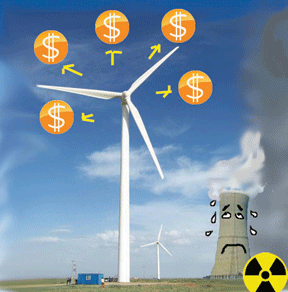
 ‘Cheap’ power at Wylfa nuclear plant blown away by wind, The Times, Emily Gosden, Energy Editor, 2 June 18 The electricity generated by the Wylfa nuclear plant could be about a fifth
cheaper than Hinkley Point’s but is likely to be much more expensive than
power from the latest offshore wind farms. It is understood that a figure
of close to £75 per megawatt-hour is under discussion as the “strike
price” that Hitachi, the Japanese conglomerate developing the Anglesey
plant, would be guaranteed by the government for the electricity it
produces. The difference between the guaranteed price and the wholesale
price — currently £50 per MWh — would be paid for by consumers through
levies on their energy bills.
Ministers are preparing to announce next week
the outline of a deal to fund the proposed Wylfa plant, which could cost in
excess of £15 billion. The twin-reactor plant could generate 2.9 gigawatts
of electricity, enough to power five million homes. It is due to start
generating in the mid 2020s. The government plans to invest directly in
Wylfa, as well as to offer extensive guarantee loans for the project. These
measures are designed to cut the cost of the project and so lower the price
that consumers will have to cover.
Critics of nuclear power are likely to
draw unfavourable comparisons with offshore wind. Two projects in UK waters
were awarded guarantees prices of £57.50 per MWh last year. Some onshore
wind and solar projects are being built without any subsidy.
https://www.thetimes.co.uk/article/cheap-power-at-nuclear-plant-blown-away-by-wind-3bzc2h5qm
The nuclear industry – a few big winners, many big losers
 Left in the wake of this race to nuclear modernity are people harmed and exploited along the way..
Ironically, as nuclear weapon states pursue upgrades to their arsenal, they also insist that countries like North Korea and Iran abandon plans to develop nuclear weapons. The double-standard traps the world in a situation that increase tension and competition between nuclear haves and have-nots.
As world leaders continue to wield nuclear weapons as part of their geopolitical power plays, we should resist automatically accepting the trope that nuclear weapons are custodians of global security.
The Nuclear Industry’s Winners and Losers, The New Republic
As Donald Trump plays chicken with North Korea, it’s worth remembering that this is also a business. Some profit; others suffer. By May 31, 2018 “…. Today, nuclear weapons are having a renaissance, again confronting  news consumers with their duality as harbingers of destruction and champions of national security. …….
The American government’s renewed focus on nuclear weapons raises, again, the question taken up by protesters of the 1960s and 70s: of exactly who these weapons protect. Pomp and patriotism can obscure a more specific cast of characters—some who immensely benefit while others unjustly sufferfrom the nuclear weapons enterprise. ….
Left in the wake of this race to nuclear modernity are people harmed and exploited along the way, grievances that date decades back to the inception of the bomb itself. In stark contrast to the romanticized image of military men and scientists tinkering with the bomb in secret laboratories was dirty, unacknowledged work done by uranium miners starting in the early twentieth century—from the pits of the Congo, Australia, and the indigenous lands of Southwest United States—who dug the Earth in horrible conditions in search for the special ingredient. ………
 …… A quick study of nuclear weapons testing overtime reveal a disturbing pattern: from the heart of the Saharan Desert to the rugged terrain in Kazakhstan, tests were primarily conducted in former colonies or territories of nuclear weapon states, where the land and livelihood of people were neglected for a greater national cause. Today, some former test sites are facing health hazards and environmental catastrophe. Recent declassified information divulged that French nuclear testing in Polynesia caused significant radioactive fallout in the region, which was not publicly disclosed for almost four decades. And in the Marshall Islands, where the United States detonated more than a hundred tests in a span of 15 years, rising tides due to climate change are threatening to flood nuclear waste sites and former testing grounds. To date, nuclear weapon states have yet to fully compensate victims and address this growing environmental damage. All the while, they are allocating big budgets for their nuclear arsenals to protect vital national interests.
Hitachi ‘won’t pay’ for nuclear accidents at proposed Wylfa plant on Anglesey
 Times 30th May 2018 Hitachi ‘won’t pay’ for nuclear accidents at proposed Wylfa plant on Anglesey. Hitachi could seek to absolve itself of financial responsibility for any accidents at its proposed new nuclear power station in north Wales.
The Japanese conglomerate has decided to continue with work developing the planned Wylfa plant on Anglesey after progress in financing talks with the government, which Hitachi is already relying on for a package of loan guarantees, subsidies and potential direct investment to make the project viable.
However, the company wants further concessions to reduce its risks, the Japanese newspaper Nikkei reported. Reports in several Japanese media outlets have claimed that the Wylfa plant could cost as much as three trillion yen, or almost £21 billion — making it even more expensive than Hinkley Point C.
EDF decided to build Hinkley Point only thanks to a 35-year subsidy contract from the government, which locks consumers into paying a fixed price for the power it generates and has been criticised for its high cost.
The Nikkei reported that some of Hitachi’s directors also wanted “safeguards that reduce or eliminate Hitachi’s financial
responsibility for accidents at the plant”. Nuclear operators are already obliged to take out insurance to cover their liabilities in case of an accident. If they are unable to secure insurance from the market, the government is obliged to step in and provide it instead. It is unclear what alternative arrangement or safeguards Hitachi might be seeking.
https://www.thetimes.co.uk/edition/business/hitachi-wont-pay-for-nuclear-accidents-at-proposed-wylfa-plant-on-anglesey-gtm28q0k3
Persisting with the European Pressurized Reactor (EPR) has brought Franc e to a costly nuclear crisis
 Liberation 30th May 2018 [Machine Translation] “The impasse”, how the EPR sank French nuclear.
France 5 broadcasts this Wednesday night “Nuclear, the French impasse”, a documentary against the declining reign of the atom. This film investigates EDF’s crazy gamble: risking its survival on the EPR, a reactor that accumulates trouble.
Will the EPR be the Titanic of French nuclear power? This is the shocking question posed by a film investigated by director Patrick Benquet broadcast tonight on France 5 which points to the “impasse”
in which the “most nuclearized country in the world” has locked up by equipping itself with 58 reactors. the 70s-80s. A fleet of 19 aging plants, which still produces 75% of French electricity, and which EDF wants to keep at all costs by launching a new generation of pressurized water reactor:
the EPR, “the most powerful never built, able to supply electricity to a metropolis like Paris. It must have been the deadly weapon of the nuclear lobby to defend the reign of the atom undermined by the Fukushima disaster and the rise of green energies.
EDF dreamed of exporting it all over the world by selling this “new nuclear” as the best lever against global warming. But things did not go at all as planned. And today EDF is going through a crisis that threatens the very existence of the “public service preferred by the French,” says the documentary.
There are these hidden costs of the atom, put under the carpet for decades, which rise to the surface: the enormous costs of reprocessing radioactive waste, is added the bill of the “great refit”: these works of Hercules designed to extend the lifespan of aging plants from 40 to 50 years. ”
EDF promised cheap electricity, but the real cost of nuclear energy today is in the tens and tens of billions. And ultimately it is the taxpayer who will pay, announces the implacable voice off. Yet, EDF, the nuclear state in the state, will launch the EPR at all costs. By assigning a strategic mission: take over
the old reactors that will gradually retire by 2035.
http://www.liberation.fr/france/2018/05/30/l-impasse-comment-l-epr-a-coule-le-nucleaire-francais_1655363
Tough times for uranium company Cameco – and no improvement in sight
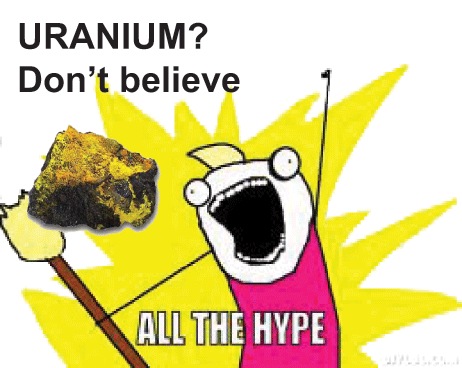 Motley Fool 28th May 2018 , It has been a tough few years for one-time high-flying uranium miner Cameco Corp.. Over the last five years, its value has plummeted by 38% after nuclear power fell into disfavour after the 2011 Fukushima disaster in Japan, which caused the price of uranium to collapse.
Since then, uranium has remained caught in a protracted slump, despite claims by industry insiders and analysts that it is poised to rebound because of a combination of growing demand and emerging supply constraints. Nonetheless, despite these claims, there has been no sign of a sustained rally, and an upturn in the fortunes of the radioactive metal may never occur.
This is because the outlook for uranium is not as bright as claimed, and there is every indication that nuclear power will remain in disfavour. That will continue to weight on Cameco’s market value.
https://www.fool.ca/2018/05/28/despite-an-improved-1st-quarter-2018-the-outlook-for-cameco-corp-remains-poor/
Toshiba walks away from involvement in USA nuclear energy project

 Toshiba exits US nuclear project https://www3.nhk.or.jp/nhkworld/en/news/20180531_37/ 31 May 18 Japanese electronics maker Toshiba is walking away from a nuclear energy project in the US. The firm says it won’t take part in building or operating the nuclear plant.
There are 2 reactors on the drawing board. Toshiba executives say the project is no longer financially viable.
They say an increase in shale production has caused a fall in electricity sales.
They also point to stricter regulations introduced after the 2011 nuclear accident in Fukushima. Toshiba joined the South Texas Project in 2008. Executives were hoping to start operating the reactors around 2016 or 2017.
But the power company that’s heading up the project hasn’t started building them.
Toshiba is cutting its ties to the nuclear power business overseas.
The firm incurred massive losses through its former American nuclear subsidiary, Westinghouse.
Tennessee Valley Authority was overcharged nearly $4.4 million by contractor at Watts Bar Nuclear Power Plant
Contractor at Watts Bar Nuclear Power Plant overcharged TVA nearly $4.4 million http://www.wrcbtv.com/story/38316846/contractor-at-watts-bar-nuclear-power-plant-overcharged-tva-nearly-44-million
TVA spokesman Scott Brooks said the federal utility is pursuing action to collect for the overcharges by the contractor. May 31st 2018, by
The Tennessee Valley Authority was overcharged nearly $4.4 million by a contractor at the Watts Bar Nuclear Power Plant for construction of the Unit 2 reactor from 2013 to 2015, according to an audit released Wednesday.
1 This Month
26 September – International Day for the Total Elimination of Nuclear Weapons





PLEASE OPPOSE HR 8255 AND S.3639 – bills would accelerate satellite deployment, with no environmental review or safeguards – https://ncstd5li.quorum.us/campaign/169331/
To see nuclear-related stories in greater depth and intensity – go to https://nuclearinformation.wordpress.com
-
Archives
- September 2026 (305)
- August 2026 (330)
- July 2026 (355)
- June 2026 (287)
- May 2026 (306)
- April 2026 (356)
- March 2026 (251)
- February 2026 (267)
- January 2026 (308)
- December 2025 (358)
- November 2025 (359)
- October 2025 (375)
-
Categories
- 1
- 1 NUCLEAR ISSUES
- business and costs
- climate change
- culture and arts
- ENERGY
- environment
- health
- history
- indigenous issues
- Legal
- marketing of nuclear
- media
- opposition to nuclear
- PERSONAL STORIES
- politics
- politics international
- Religion and ethics
- safety
- secrets,lies and civil liberties
- spinbuster
- technology
- Uranium
- wastes
- weapons and war
- Women
- 2 WORLD
- ACTION
- AFRICA
- Atrocities
- AUSTRALIA
- Christina's notes
- Christina's themes
- culture and arts
- Events
- Fuk 2022
- Fuk 2023
- Fukushima 2017
- Fukushima 2018
- fukushima 2019
- Fukushima 2020
- Fukushima 2021
- general
- global warming
- Humour (God we need it)
- Nuclear
- RARE EARTHS
- Reference
- resources – print
- Resources -audiovicual
- Weekly Newsletter
- World
- World Nuclear
- YouTube
-
RSS
Entries RSS
Comments RSS

