Trump’s reckless propping up of the nuclear industry pleases its big lobbyists
 Trump has Plenty of Accomplices in his Reckless Energy Policies http://progressive.org/dispatches/trump-has-plenty-of-accomplices-in-his-reckless-energy-polic/, by Harvey Wasserman, May 24, 2018
Some 360,000 Americans now work in the solar industry, more than in nukes and coal combined. In fact, more Americans are now working in California’s solar industry than are digging coal nationwide. And the U.S. wind business now employs more than 100,000 people.
But President Donald Trump wants to change that. He has already slammed the solar industry’s growth by slapping a 30 percent tariff on imported Chinese panels, slowing installations nationwide.
He’s also contemplating using an obscure Korean War-era “emergency” ordinance that would let the government bail out money-losing coal and nuclear plants at the expense of renewables.
The idea was presented to Trump while he dined with a lobbyist from the infamous Akron-based FirstEnergy, whose bad business decisions have hung it with four crumbling, money-losing nuclear power reactors and some eighty obsolete coal burners.
More than half the nation’s ninety-nine licensed commercial reactors are now losing money. FirstEnergy’s Davis-Besse, near Toledo, Ohio; Perry, east of Cleveland, Ohio, and Beaver Valley 1 & 2, outside Pittsburgh, Pennsylvania, are bleeding radioactive red ink. One might expect “free market” corporate executives to cut their losses and let competition determine how our energy will be generated.
But FirstEnergy CEO Chuck Jones (annual salary: $8.7 million) has begged Ohio’s legislature and regulators to slap consumers with billions in higher electric rates. So far he’s failed, which is why he sent his lobbyist to dine with Trump.
Already, governments are doing what they can to prop up the nuclear power and fossil-fuel industries and damage the cause of renewable power.
Three nuclear reactors in Illinois have been granted a $200 million annual handout for the next decade. Pennsylvania and Connecticut may soon get soaked with massive rate hikes to keep reactors running there.
The New Jersey legislature has just approved spending $430 million over the next decade to run three more uneconomical reactors there, two at Salem and one at Hope Creek. Activists including actor Alec Baldwin have urged that state’s new Democratic governor to veto that proposal.
Throughout the United States, owners of even those few reactors that are still making money are poised to scam their way into compliant legislatures to see how much they can grab.
But the biggest nuke scam of all has been rammed through state regulatory agencies by New York’s “liberal” Governor Andrew Cuomo. Cuomo backs the 2021 shutdown of two decrepit reactors at Indian Point, saying they are too close to Manhattan to be considered safe.
But Cuomo wants ratepayers statewide to cough up a staggering $7.6 billion for four upstate reactors whose owners had them slated for decommissioning. To the astonishment of economists, ecologists, business and ratepayer groups, Cuomo’s hand-picked regulators approved the rip-off last year.
Nuclear opponents have gone to court to stop it. They argue that while less than four thousand jobs are tied to the reactors, many thousands more would be created by replacement wind and solar projects.
FirstEnergy’s scam is even more brazen. According to the Nuclear Energy Institute, the average reactor generally employs between four hundred and seven hundred workers. Some workers stay on long after shutdown to deal with issues of decommissioning and waste management.
But along with bailing out its four dying nukes, FirstEnergy wants a staggering $8 billion per year in above-market ratepayer fees for some 80 coal burners.
Rightwing think tanks like Heritage have joined financial and business groups in warning such rate hikes could decimate the area’s economy.
Meanwhile, a bitterly disputed “set-back” law has stopped some $4.2 billion in proposed wind projects along Ohio’s “north coast,” which is flat, windy, well-wired and full of farmers desperate for the projects to begin. But repeal has stalled, with tens of thousands of jobs and billions in income hanging in limbo.
They’ll all disappear if Trump and Energy Secretary Rick Perry approve FirstEnergy’s “emergency” bailout.
Last September, the Trump Administration approved another $3.7 billion in federal loans, on top $8.3 billion approved in the past, to sustain a scandal-ridden nuclear project in Vogtle, Georgia.
More recently, on May 10, Congress passed a new attempt to open the proposed Yucca Mountain waste dump. The plan to store some 70,000 tons of high-level commercial radwaste in an earthquake-riddled dormant volcano is overwhelmingly opposed by Nevadans and had long since been written off. But the measure was approved by a vote of 206 to 179, with ninety-four Democrats and eighty-five Republicans voting against. It now heads to the Senate.
As all of this plays out, tens of thousands of jobs hang in the balance. The nation’s entrenched fossil-nuclear corporate elites are more focused on propping up the industries of the past than embracing the technologies of the future.
Harvey Wasserman’s radio shows appear at prn.fm and KPFK-Pacifica, 90.7FM, Los Angeles. His America at the Brink of Rebirth: The Life & Death Spiral of US History from Deganawidah to the Donald will soon be published at Solartopia.org.
USA nuclear agency up to its old tricks – secretive over-spending on nuclear weapons
 New Documents Raise Questions About Increased Nuclear Spending, A nuke agency is up to its old tricks War is Boring, WIB POLITICS May 22, 2018 Lydia Dennett
There are many reasons to keep certain parts of the U.S. nuclear weapons complex a secret. But fraud, waste, and abuse run rampant when the mystique and awe of nuclear bombs gets in the way of effective oversight. And it is the taxpayer who ends up suffering.
The secrets to creating a nuclear explosion and the materials to do so are kept by the National Nuclear Security Administration, a semi-autonomous agency within the Department of Energy, and it has a $1.2 trillion plan to build new nuclear warheads and facilities over the next 30 years.
But new documents obtained by the Project on Government Oversight discussing the life expectancy of nuclear weapons components show that the uranium cores may have a longer life span than originally thought. This may undermine some justifications for an expansive—and expensive—nuclear modernization plan.
Although much of the documents are redacted, likely to keep safe the most sensitive details of the U.S. nuclear enterprise, the remaining details seem to suggest that initial life-span estimates were too conservative. These initial estimates were partially used as justification for plans to build an expensive new facility and revising plans based on these findings could result in billions of savings for taxpayers.
In light of NNSA’s rhetoric about the aging nuclear arsenal and the desperate need for more money to modernize, POGO endeavored to determine exactly what upgrades were truly needed to support a credible nuclear deterrent. In 2013, we released a report that called for a study into the lifetime of uranium secondaries in order to determine what capacity would be required of a proposed new facility.
Initially, the NNSA had claimed publicly that it needed a “big box” design, a large facility that would replace several different buildings in the complex and that had the capacity to remanufacture 160-200 secondaries per year. But just a few years later the department’s own Stockpile Stewardship and Management Plan stated the need was really only 80.
Given this shift within the department, as well as a litany of design missteps, cost overruns, and poor project oversight, POGO recommended a lifetime study for uranium secondaries and a scaled-down design utilizing existing facilities.
Shortly after POGO released our UPF report, the NNSA formed a “Red Team” to review the design. That review echoed many of POGO’s findings and recommendations including the need for “significant and sustained oversight” as well as immediately scrapping the big box design.
“Design efforts on the current ‘big box,’ single structure UPF concept should be stopped while a comprehensive reevalution of program requirements and applicable design standards is undertaken,” the report stated.
The new documents from the time suggest that a study into the lifetimes of secondaries supported this decision. One of the newly obtained documents is a 2010 peer review analysis conducted by the Los Alamos National Laboratory of the life expectancy study for one nuclear warhead type, the W78. The review committee examined work and analysis done by the “life expectancy team” charged with concluding how long these secondaries will remain effective…………
NNSA’s pattern of exaggerating spending needs
A remarkably similar situation occurred with the agency’s planned plutonium operations replacement facility. The NNSA claimed the proposed Chemistry and Metallurgy Research Replacement – Nuclear Facility needed to be able to manufacture 450 plutonium cores per year. But after a lifetime study found they can last for over 150 years without significantly degrading the number plummeted to less than 80 per year, dramatically decreasing what would be required of the new building.
Congress ultimately canceled the facility when cost overruns and delays made it impossible to continue, and the NNSA is now pursuing a scaled down approach. But there’s no getting around the fact that twice now the NNSA has either obscured facts that would suggest a more limited capacity is all that’s required or has pursued an expensive plan without knowing all the facts beforehand. Either explanation is an unacceptable exploitation of taxpayer dollars.
……… Despite these nearly constant warnings and recommendations for improvement from all the four corners of the nuclear complex world, the NNSA plans to move full steam ahead with their incredibly expensive upgrade plan. A plan that is partially justified by rhetoric suggesting that age has significantly deteriorated parts of the complex.Without an independent study it’s impossible to know if these claims are true. And with NNSA’s track record, Congress would be more than justified in asking questions. Before pouring billions of dollars into this effort, Congress should commission an independent, scientist-led study by the JASON advisory group to ensure NNSA’s future spending plans match up with the overall U.S. national security needs.
This story first appeared at the Project on Government Oversight. https://warisboring.com/new-documents-raise-questions-about-increased-nuclear-spending/
Hitachi’s build of Wylfa nuclear power station delayed – may never happen
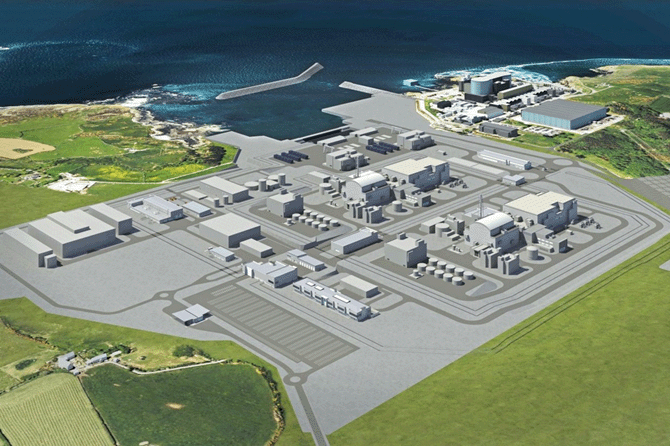
Asahi Shimbun 20th May 2018 [Machine Translation] Hitachi announced plans to delay the goal of starting
nuclear power plans planned in the UK for about two years to 2027. The collection of funds necessary for the project is difficult, and reconsideration of sharing has started between companies that undertake design and construction.
The continuation of the project itself is increasingly uncertain.
In the plan, two nuclear reactors will be built on Anglesey island in the UK. The goal of starting operation has been
announced as “early 20’s”.However, according to officials, the Hitachi side recently proposed a new goal “April 27” to companies and others involved in the plan. It is planned to decide whether to start construction in 2019,
but it seems to be assuming a case where this time is delayed.
https://www.asahi.com/articles/ASL5M4HZ3L5MULFA001.html
Hitachi’s nuclear export transfers risks to both Japanese and British people while companies get profits
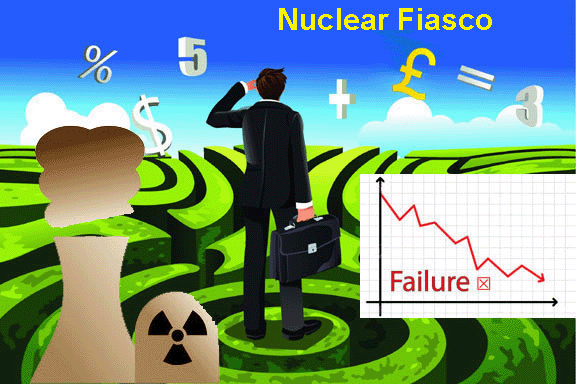 Urgent Joint Statement: Hitachi’s nuclear export transfers risks to both Japanese and British people while companies get profits http://www.foejapan.org/en/energy/doc/180502.html
Hitachi’s Chairman Nakanishi is reportedly going to visit British Prime Minister Teresa May on 3rd May to ask the U.K. government to take a direct stake in Wylfa Newydd nuclear power project in Anglesey, Wales. The report says Hitachi is going to ask not only for direct investment but also an assurance for a power purchase agreement(1). Hitachi’s struggle just shows the risks of the nuclear power project is simply huge.
In February, Mr. Nakanishi already expressed the view that the project would not happen without government commitment and stated “Both UK and Japanese governments understand that the project would not go on without the commitment by the governments”(2). To reduce the risk of the project, the project is said to be insured by Nippon Export and Investment Insurance(NEXI), 100 percent Japanese government owned export credit agency(3).
In addition to huge construction cost, nuclear projects are associated with various risks such as accidents, increased cost for tougher regulations, opposition from local people, radioactive waste management and so on. Risks are too huge to manage. Thus, it is clear that companies should decide to retreat from the project. While transferring risks of the project to people, it is unacceptable that the companies and banks take profits.
Electricity generated from Hinkley Point C nuclear power, which is currently under construction in UK will be purchased at £92.5/MWh, which is approximately twice as expensive as the average market price. National Audit Office of UK warned that this would increase ratepayers burden (4). If UK government gives an assurance for expensive price of electricity to Hitachi, the project will put more burden not only Japanese taxpayers with huge risks, but also British ratepayers with huge costs. For whose sake is this project?
The project site for Wylfa Newydd is surrounded by pristine nature. Colonies of protected bird such as Arctic terns was discovered near the site(5). The National Welsh Coastal Path borders the land bought by Hitachi which is in an area of Otstanding Natural Beauty. The project would put a heavy burden on the social and economic infrastructure on the island rather than benefitting the local economy(6) .
“Don’t pour good money in to the bottomless black hole of nuclear power. This is an old fashioned, dirty, dangerous and extortionately expensive technology. The Fukushima triple explosions and meltdowns has and will continue to cost the people of Japan greatly. There is no end in sight for this continuing tragedy, which means that no new nuclear reactors are going to be built in Japan. It is unacceptable that Japan wish to export this deadly technology to another state in order to keep Japan in the nuclear club.”
TEPCO’s Fukushima Daiichi nuclear accident is not over. Globally the cost of renewable energy decreases dramatically and energy efficiency is also improved. Exporting nuclear power is against that trend. This is morally and economically the wrong direction. Moreover, pouring public money to a handful of private companies without consulting the public or having discussion at a parliament is unacceptable.
Japanese government and companies should seek and promote nuclear phase out and sustainable and democratic energy systems based on thorough reflection on the lessons learned from the nuclear accident. We strongly oppose Hitachi’s Wylfa Newydd project. No money from Japanese and British taxpayers should be used to save this totally outdated and dangerously wasteful project.
1. “Hitachi seeks assurance from UK’s May on shared stake in nuclear project” Nikkei Asia Review, 29th April 2018.
2. ”Committements by both UK and Japanese government necessary fro Hitachi’s nuclear project, says next chair of Keidanren” (In Japanese) Reuters, 13th Feb 2018.
3.“Japanese and UK government to support Hitachi’s nuclear project, loss may result in public financial burden (in Japanese)” Asahi Shimbun, 11th Jan 2018.
4. “Hinkley Point C” National Audit Office, 23th June 2017
5.“Plans for Welsh nuclear power plant delayed by concerns over seabirds” Guardian, 9th Apr 2018.
6.“Wylfa Newydd: Nuclear plant ‘increases homelessness risk’” BBC, 27th Mar 2018.
Contact:
Friends of the Earth Japan
fukakusa@foejapan.org
+81-3-6909-5983
Ayumi Fukakusa
People Against Wylfa B
pawbcymru@gmail.com
Dylan Morgan
Indian and Russian governments getting together to market nuclear power globally
PM Modi, Vladimir Putin May Discuss Energy, Nuclear Issues At ‘No-Agenda’ Summit
With China, reducing the tension on the border was important but with Russia, a trusted all-weather partner, increasing trade ties and stepping up defence and atomic energy cooperation could be on agenda
……. The meltdown of the Iranian nuclear deal after the US unilaterally pulled out of it would come up for sure, especially since India has ‘civilizational links’ with Iran. The patch up happening between North and South Korea over nuclear weapons is also going to be on the table. But closer home, atomic talks related to Kudankulam Nuclear Power Plant are also likely to be part of the summit.
PM Modi is expected to reassert India’s avowed position of complete denuclearisation of these weapons of mass destruction from the world.
Indo-Russian atomic energy cooperation could also be reviewed at the highest level. Reports suggest that India has invested nearly $5 billion in the Russian energy sector. Bilateral civil nuclear co-operation could be very high on the agenda.
……… atomic experts say, discussion on the second site for the Russian Nuclear Park would be on the anvil. In the 2014 Indo-Russian ‘Strategic Vision’ document on nuclear cooperation, the two countries have committed themselves to building in all 16 nuclear reactors in the next two decades. In all, six reactors will come up at Kudankulam and the remaining six at another site.
Today, it seems the next set of six reactors could come up in Andhra Pradesh. It is hoped that later this year in October, at the proposed formal summit, the two countries will announce the allotment of the second nuclear park site to Russia.
……… The Indo-Russian nuclear deal is well worth over Rs. 4,50,000 crores and could be the mother of all deals.
It may be worth noting that as part of the agreement for the Indo-US Civilian Nuclear Deal, India has committed to buy 10,000 MW of reactors from USA and France. But unfortunately, both the French nuclear company Areva and the American atomic giant Westinghouse ran into financial trouble and declared bankruptcy, and the new owners are still taking charge in both the countries. In all possibility, India may not order either French or American reactors for the next three to four years till these ‘new technologies’ are safely operating.
India is getting to partner in these Bangladeshi reactors by providing training to Bangladeshi atomic engineers at Indian reactor sites. The three countries have signed a tripartite nuclear agreement on Rooppur, confirmed Anwar Hussain, Secretary of the Ministry of Science and Technology in Dhaka, who spoke exclusively to NDTV on the sidelines of the 10th edition of the Atomexpo exhibition held at Sochi. At least 3,000 participants from 68 countries presented an upbeat picture of the global nuclear industry at the exhibition. https://www.ndtv.com/india-news/pm-modi-vladimir-putin-may-discuss-energy-nuclear-issues-at-no-agenda-summit-1854710
South Africa’s energy corporation Eskom still dedicated to nuclear power
Eskom continues with front-end nuclear preparation Carin Smith
The business case for nuclear power – Oh – it’s NOT GOOD
 Nuclear industry urged to address business case, 16TH MAY 2018 ,BY: REBECCA CAMPBELL CREAMER MEDIA SENIOR DEPUTY EDITOR Decisions on the future energy mix for South Africa need to be forward looking, not backward looking. So affirmed EE Publishers MD Chris Yelland in his keynote address to the National Nuclear Regulator’s second Nuclear Regulatory Information Conference on Wednesday.
…………”The nuclear sector needs to address the real elephants in the room,” he asserted. “In my view the biggest elephant in the room is not the technology, but the business case.” There is great uncertainty about the future demand for grid electricity. Megaprojects have high costs and risks. Nuclear power plants also have long construction periods and high up-front costs. There are serious financing issues, both with the public and private sectors in South Africa (local institutions were unwilling to invest in nuclear projects). Nuclear power plants had to be run constantly at a high output level for maximum efficiency.
Moreover, a nuclear new build programme would require a 100-year commitment to an energy technology and a specific vendor — in an uncertain world. He observed that nuclear energy was more prone to political interference because of geopolitical factors. At home, the image of the nuclearindustry had been severely damaged by its association, in the public mind, with former President Jacob Zuma and the allegations of large-scale corruption involving him, key members of his administration, and high ranking officials…….http://www.miningweekly.com/article/nuclear-industry-urged-to-address-business-case-not-technology-2018-05-16/rep_id:3650
China marketing nuclear power to Uganda
 China to help Uganda build nuclear power plants, Reuters Staff, 17 May 18 KAMPALA (Reuters) – China will help Uganda build and operate nuclear power plants under a deal signed last week.
Uganda has some uranium deposits and President Yoweri Museveni has said his government was keen to exploit them for potential nuclear energy development.
Eight potential sites have been identified in the country’s central, southwest and northern regions that could potentially host nuclear power plants, the government said on Thursday. It signed a deal with Russia last year to cooperate on nuclear power.
China is already a major investor in Ugandan infrastructure projects and China National Nuclear Corporation (CNNC) signed a memorandum of understanding on May 11 to help Uganda build capacity “in the use of atomic energy for peaceful purposes”, Uganda’s energy ministry said in a statement issued on Thursday……
Co-operation between CNNC and Uganda will involve the development of nuclear power infrastructure including the design, construction and operation of nuclear power plants.
In June last year Uganda signed a similar memorandum of understanding with Russian State Atomic Energy Cooperation (ROSATOM) to facilitate the two countries’ cooperation on nuclear power.
Reporting by Elias Biryabarema; Editing by Susan Fenton https://www.reuters.com/article/us-uganda-energy/china-to-help-uganda-build-nuclear-power-plants-idUSKCN1II219
Russia’s state nuclear corporation Rosatom trying to market nuclear power to Chile, China, Cuba, Finland, Hungary, Iran, Italy, Kazakhstan, Saudi Arabia, Serbia, Spain and Zambia
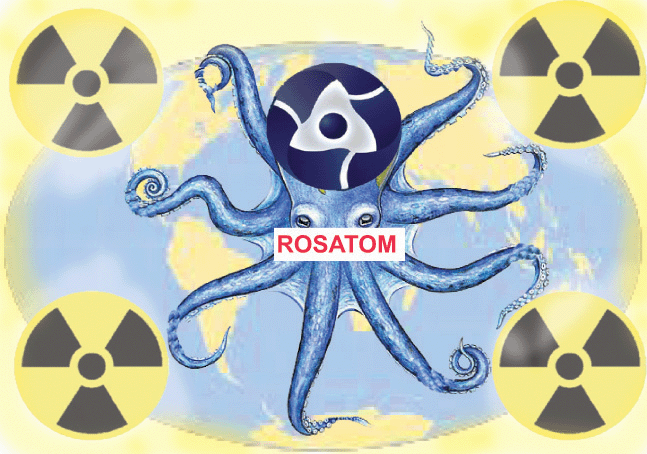 World Nuclear News 16th May 2018 Rosatom, the Russian state nuclear corporation, yesterday signed a series of agreements with overseas companies during the Atomexpo conference and exhibition being held this week in Sochi, Russia. The agreements, with Chile, China, Cuba, Finland, Hungary, Iran, Italy, Kazakhstan, Saudi
Arabia, Serbia, Spain and Zambia, include the engineering and medical
sectors, among others.
http://www.world-nuclear-news.org/C-Rosatom-expands-overseas-links-with-new-agreements-16051801.html
The future is not looking good for uneconomic Small Modular Nuclear Reactors (SMRs)

Small Modular Nuclear Reactors Will Soon Face a Moment of Reckoning, NuScale is bringing small nuclear alive. But will the concept survive? GreenTech Media , MAY 14, 2018
Clean energy investment is headed for beating fossil fuels and nuclear
Renewables Investment Nudges Out Fossil Fuel And Nuclear, Forbes, May 15, 2018, The global clean energy transition is gaining pace as it becomes a mainstream investment option.
The global clean energy transition is gaining pace as it becomes a mainstream investment option. According to the latest research from CERES on progress to a ‘Clean Trillion’ it is also one that far outstripped fossil fuels and nuclear in 2017.
In 2017 the clean energy industry reached a critical turning point. Growth and cost reductions across the sector have far outperformed expectations based on policy frameworks alone. Dramatic reductions in cost, increases in scale, and technology improvements have fundamentally changed the dynamics of the clean energy market. Energy market
dynamics have shifted in favor of clean energy technologies such as wind and solar, which increasingly out-compete new fossil fuel and nuclear power sources.
Within In Sight of the Clean Trillion: Update on an Expanding Landscape of Investor Opportunities, Ceres says that what it calls the ‘Clean Trillion’ – the goal of an additional $1 trillion investment in clean energy per year through 2050 – is increasingly feasible as the market matures.
Bulgaria’s struggle to find the money for building Belene nuclear power project
Reuters 12th May 2018 , Bulgaria’s government will ask parliament to give it the authority to
negotiate with investors to build the Belene nuclear power project on the
Danube River, the prime minister said on Saturday.
The Black Sea state initially canceled the project, estimated to cost about 10 billion euros,
in 2012 after failing to find foreign investors and bowing to U.S. and
European Union pressure to limit the country’s energy dependence on
Russia, which would have supplied some equipment.
The current government of Prime Minister Boyko Borissov, however, is renewing the search for private
investors to build the plant after an arbitration court ruled in 2016 that
Bulgaria must pay more than 600 million euros ($717 million) in
compensation to Russian state nuclear company Rosatom due to the
cancellation.
https://www.reuters.com/article/us-bulgaria-nuclear-belene/bulgarian-government-to-seek-mandate-for-talks-with-investors-over-nuclear-plant-idUSKCN1ID0TE
Former Republican leader joins Trump and USA businesses in promoting the nuclear industry to Saudi Arabia

 A nuclear deal with the Saudis is a good thing, says former GOP leader Eric Cantor
- Saudi Arabia has been in negotiations with the U.S. and other countries for several years in pursuit of a nuclear energy partnership, with the stated aim of diversifying its energy base.
- Riyadh has found a willing partner in the Trump administration, which has signaled far greater support for a deal than its predecessors.
- Months of escalating tensions between the kingdom and its regional arch-rival Iran have raised the stakes for any future nuclear plans.
But what’s made many observers nervous is Riyadh’s refusal to accept a deal that would forbid it from enriching uranium and reprocessing plutonium — the mechanisms necessary not for nuclear energy, but for developing a weapon.
Saudis find support from Trump
Opposition from U.S. lawmakers on both sides of the political aisle has historically impeded the kingdom’s aims — Section 123 of the U.S. Atomic Energy Act of 1954 mandates that Congress review any sharing of nuclear technology with a foreign country.
Now, however, the Saudis have found a friendlier partner in the Trump administration, which has signaled far greater willingness to strike a deal than its predecessors.
A U.S. trade delegation visited the kingdom in April, led by the Washington-based Nuclear Energy Institute (NEI) and in partnership with the U.S. Departments of Commerce, Energy, and State. It brought with it 20 companies from across the U.S. nuclear supply chain, to promote “the strong interest of U.S. industry to partner in Saudi Arabia’s ambitious nuclear energy program,” according to the delegation’s press release.
……..Months of escalating tensions between Iran and its arch-rival Saudi Arabia raise the stakes for any future nuclear plans. In March, Saudi Crown Prince Mohammed bin Salman told CNBC news that if Tehran was to build a nuclear bomb, so would Riyadh.
U.S. lawmakers and non-proliferation experts have expressed their concern over dual-use technology, and Bin Salman’s unpredictable and aggressive foreign policy has not helped his country’s case……https://www.cnbc.com/2018/05/13/former-gop-leader-eric-cantor-supports-nuclear-deal-with-saudi-arabia.html
UK government understating their costs for Wylfa nuclear plant, combined with costs for Hinkley Pt C – over £40 billion
 Dave Toke’s Blog 10th May 2018, A fake price for the faltering proposed Wylfa nuclear plant will obscure
the fact that the project, backed by Hitachi, will be even more expensive than Hinkley C. Negotiators for the Wylfa project are clamouring for the Government to use taxpayers money and a commitment to pay at least some of
the risks of construction cost overruns to massage the price of the deal
 down compared to Hinkley Point C.
If this is done, then the combined support for Hinkley C and Wylfa projects through loan guarantees, equity
support and risk underwriting could rival the size of bill the UK has to pay the EU for Brexit.
But a carefully contrived fake price produced by giving a massive taxpayer funded handout to the project will obscure this terrible consequence. Hinkley Point C (HPC), scheduled to be built by EDF, is now said to cost around £20 billion, almost exactly the same as the cost of the Hitachi-led Wylfa project.
In fact both of these figures do not appear to include interest charges, and so will be underestimates of the
total mount of money needed to be paid out before the plant is even built. But the interesting thing is that whilst the Hinkley C project is 3.2GW, the Wylfa project is smaller, at around 2.9 GW, which actually makes the Hitachi project even more expensive!
http://realfeed-intariffs.blogspot.co.uk/2018/05/hitachis-wylfa-project-is-even-more.html
British government to provide $18.2 billion for Hitachi to build Wylfa nuclear power station
Nikkei Asian Review 11th May 2018 The British government has proposed to arrange all 2 trillion yen ($18.2
billion) in lending that Hitachi says is needed to build a nuclear power
plant in Wales, as the Japanese side seeks to reduce its risk and encourage
the U.K. to put more skin in the game.
London had previously suggested that it guarantee 1 trillion yen in lending, but to get the project moving it
changed its offer to include approaches such as direct financing in order
to reduce Hitachi’s financial exposure.
The plan also calls for a totalinvestment of 900 billion yen, with Hitachi as well as Japanese and British
public-private interests each taking a one-third stake, and guarantees for
corporate loans. The total cost of the plant, to be built on the Isle of
Anglesey, is expected to swell to 3 trillion yen.
Hitachi Chairman Hiroaki Nakanishi met with Prime Minister Theresa May in London last Thursday to
ask for greater backing. The original plan called for the loans to be
provided by private lending institutions from both countries and guaranteed
equally by each government. State funding would come at a lower cost than
borrowing from private institutions and would demonstrate the U.K.’s
increased involvement as a backer of Hitachi’s nuclear power business,
which would ease raising funds and help secure investors.
The offer reflects the U.K.’s strong desire to proceed with the project, since
bankruptcy could place a burden on British taxpayers. The U.K. government
will submit a formal proposal to the Japanese side soon. Hitachi will then
make a final decision on whether to continue with the project at a board
meeting at the end of the month.
Some at Hitachi and in Tokyo have expressed concern about Japanese interests retaining leadership of the
project with two-thirds control. Hitachi and the U.K. are thought to be
discussing ways to prevent Hitachi’s exposure risk from rising, such as by
raising London’s stake or issuing dual class shares. But the British
Parliament is likely to oppose expanding the government’s stake, which
could throw a wrench in the project’s final shareholding structure or
allocation of costs. Hitachi is also requesting that the electricity’s
purchase price be raised, but the U.K. is opposed. It hopes to satisfy
Hitachi by covering all loans and raising its stake in the project.
https://asia.nikkei.com/Business/Business-Deals/London-offers-18bn-in-loans-for-Hitachi-s-UK-nuclear-plant
1 This Month
26 April – Chernobyl: Inside the Meltdown airs on National Geographic on Sunday 26th April from 4pm

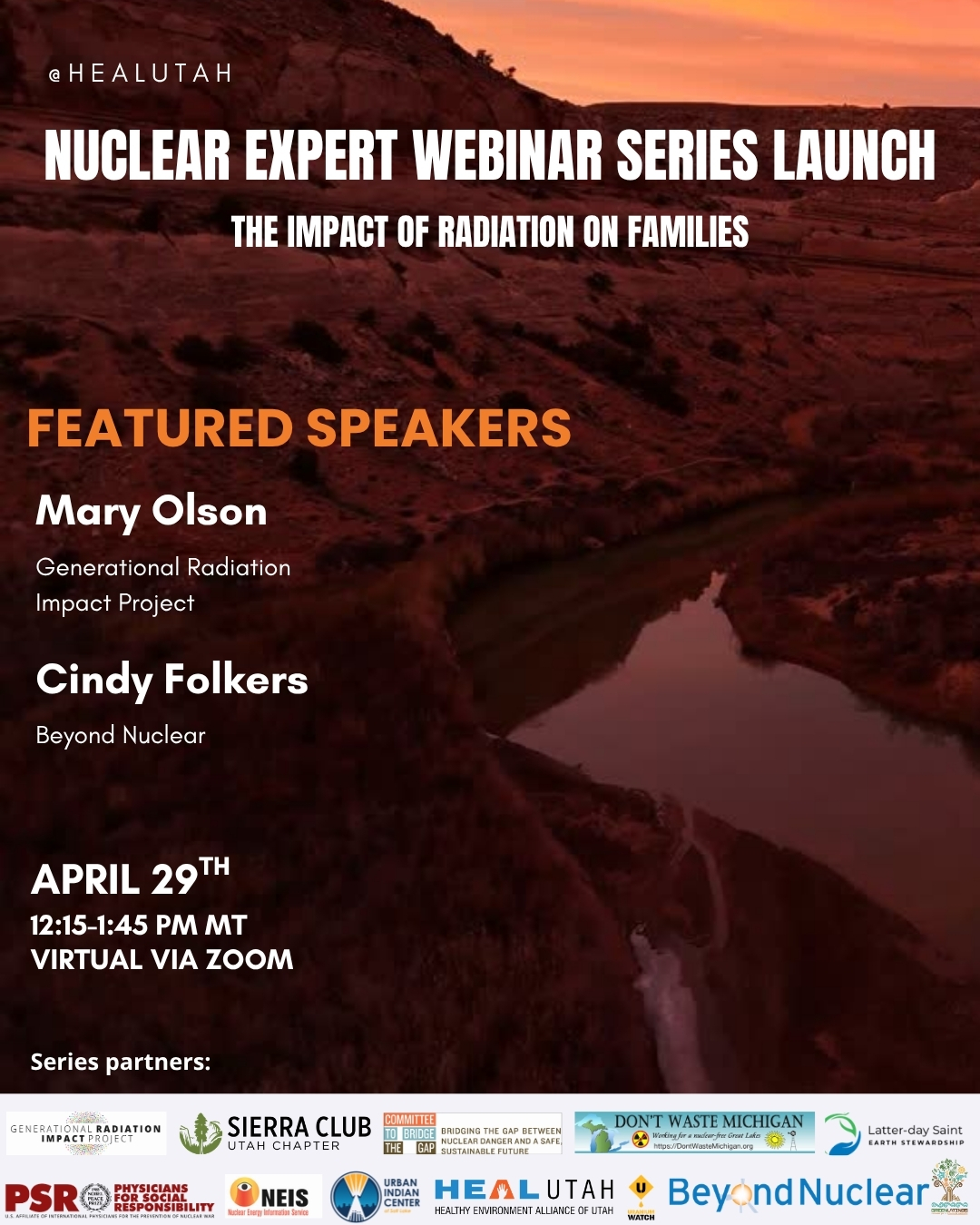
29 April – Nuclear Expert Webinar #1 – Radiation Impacts on Families with Mary Olson and Cindy Folkers
- 12:15 PM MT – 1:45 PM MT
- Location: Virtual – REGISTER TODAY

4 May -West Suburban Peace Coalition to discuss Iran war at May Educational Forum
Monday, May 4, 7:00 – 8:00 PM Central Standard Time
Title: : How Trump’s Narrative Tries to Shape the Reality of the War on Iran.
Contact Walt Zlotow, zlotow@hotmail.com 630 442 3045 for further information
14 May – online event From Bombs to Data Centres: the Face of Nuclear Colonialism

Pine Ridge Uranium is the real threat, not Tehran- Tell Burgum: Stop the Extraction.
Chernobyl: The Lost Tapes – A good documentary on Chernobyl on SBS available On Demand for the next 3 weeks– https://www.sbs.com.au/ondemand/tv-program/chernobyl-the-lost-tapes/2352741955560
To see nuclear-related stories in greater depth and intensity – go to https://nuclearinformation.wordpress.com
-
Archives
- May 2026 (25)
- April 2026 (356)
- March 2026 (251)
- February 2026 (268)
- January 2026 (308)
- December 2025 (358)
- November 2025 (359)
- October 2025 (376)
- September 2025 (257)
- August 2025 (319)
- July 2025 (230)
- June 2025 (348)
-
Categories
- 1
- 1 NUCLEAR ISSUES
- business and costs
- climate change
- culture and arts
- ENERGY
- environment
- health
- history
- indigenous issues
- Legal
- marketing of nuclear
- media
- opposition to nuclear
- PERSONAL STORIES
- politics
- politics international
- Religion and ethics
- safety
- secrets,lies and civil liberties
- spinbuster
- technology
- Uranium
- wastes
- weapons and war
- Women
- 2 WORLD
- ACTION
- AFRICA
- Atrocities
- AUSTRALIA
- Christina's notes
- Christina's themes
- culture and arts
- Events
- Fuk 2022
- Fuk 2023
- Fukushima 2017
- Fukushima 2018
- fukushima 2019
- Fukushima 2020
- Fukushima 2021
- general
- global warming
- Humour (God we need it)
- Nuclear
- RARE EARTHS
- Reference
- resources – print
- Resources -audiovicual
- Weekly Newsletter
- World
- World Nuclear
- YouTube
-
RSS
Entries RSS
Comments RSS
 nuclear-news