China drafting laws to promote marketing of nuclear reactors overseas
 Euro News 22nd Sept 2018 , China will provide more support for its nuclear firms to go overseas and strengthen their position on the international market, according to new
draft legislation submitted to the industry for consultation on Friday.
“The state will encourage and support the positive and orderly
participation of its enterprises in the international market” and promote
the export of nuclear equipment, fuel and services, the draft Atomic Energy
Law says.
China aims to bring its total installed nuclear capacity to 58
gigawatts (GW) by the end of 2020, up from 37 GW at the end of June this
year, but it also has ambitions to dominate the global market and has
created a unified third-generation reactor brand known as the “Hualong One”
to sell overseas. China has already signed a series of preliminary
agreements with countries like Brazil, Argentina, Uganda and Cambodia and
it is also undergoing a technical approval process for the Hualong One in
Britain.
https://www.euronews.com/2018/09/22/china-drafts-new-nuclear-energy-law-focus-on-international-market
Argentina’s nuclear power industry in trouble
FT 24th Sept 2018 , Argentina’s long-established nuclear power industry is facing financial
difficulties as the government seeks to balance the budget. This could
delay important projects, not least as Argentina aims to be a player in
what may well develop into a growing global market for small-scale
reactors. The national industry began much thanks to a German scientist
described by some as a fantasist and a scammer. In the late 1940s, Ronald
Richter convinced Argentina’s President Juan Domingo Perón to underwrite
research, at a secret lab in Patagonia, into building what he called a
Thermotron. After three years and spending about $410m in today’s money,
the project proved a failure that eventually landed Richter in jail for
fraud.
https://www.ft.com/content/d138b4a8-95b4-11e8-95f8-8640db9060a7
America’s last nuclear power project at risk of cancellation

 Last U.S. Nuclear Project Faces `Jeopardy’ as Owners Mull Exit, Bloomberg, By Mark Chediak, Margaret Newkirk, and Ari Natter, September 24, 2018,
-
Costs of Southern’s Vogtle project have doubled to $28 billion
-
orida utility seeking to cancel contract to buy Vogtle powerThe only nuclear power plant under construction in the U.S. is facing stiff headwinds, as two minority owners are mulling whether to pull out of the $28 billion project led by Southern Co.
Vogtle’s primary municipal co-owners, Oglethorpe Power Corp. and Municipal Electric Authority of Georgia, are scheduled to vote Monday whether to move forward with construction on the Vogtle plant in Georgia after Southern’s Georgia Power utility disclosed in August that costs had increased by $2.3 billion.
As the vote looms, a Florida utility is suing to get out of a contract to buy electricity from the plant. Georgia lawmakers, meanwhile, called this week for a price cap on the project.
If one of the major parties decides not to continue, that could put the project in serious jeopardy,” said Kit Konolige, an analyst for Bloomberg Intelligence.
The Vogtle decision comes at a critical time for the U.S. nuclear industry. Existing reactors are struggling to compete with cheap natural gas and renewables, and efforts to build new ones have all but dried up. Cost overruns forced Scana Corp. to abandon a half-built project in South Carolina last year, leaving Southern and its partners as the only companies left building reactors in the U.S……….https://www.bloomberg.com/news/articles/2018-09-21/last-u-s-nuclear-project-faces-jeopardy-as-owners-mull-exit
Cost of Georgia’s Vogtle nuclear power project is becoming a big worry to law-makers
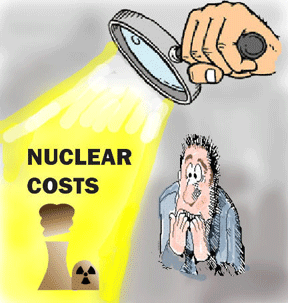 Cost of Georgia nuclear plant draws scrutiny from lawmakers, https://business.financialpost.com/pmn/business-pmn/cost-of-georgia-nuclear-plant-draws-scrutiny-from-lawmakers Financial Post, The Associated Press, Ben Nadler, 21 Sept 18, ATLANTA — A group of ranking Georgia lawmakers is sounding the alarm about cost overruns from construction at a nuclear power plant near Augusta.
The two additional reactors being built at Plant Vogtle, approximately 30 miles (50 kilometres) south of Augusta, are years behind schedule and billions of dollars over budget. The lawmakers said they want a “cost cap” established to protect Georgians from getting gouged on their electricity bills.
In August, the plant’s owners, which include Georgia Power, Oglethorpe Power Corporation and Municipal Electric Authority of Georgia, learned that the plant would require an additional $2.3 billion, bringing the total cost estimate to $27 billion.
That new overage initiated a clause in the ownership agreement where ninety per cent of ownership must agree to move forward. A down vote from any one of those organizations would mean the multibillion-dollar project is abandoned.
Georgia Power’s parent company, Southern Company, pledged that its shareholders would absorb its share of the costs. That leaves Oglethorpe Power and MEAG with a decision: pay up or pull out.
The letter lawmakers sent Wednesday was signed by 20 members of the Georgia General Assembly, including Rep. Terry England, chairman of the House appropriations committee, and Sen. Butch Miller, president pro tempore of the Senate. It said that unlike Georgia Power, the other organizations “don’t have the luxury of shareholders to absorb these additional costs and will have to increase rates even higher.”
They asked the owners to “ensure prior to voting in support of moving forward … that a cost cap is established to protect all Georgia electric ratepayers from this and future overruns.”
But Gov. Nathan Deal took a different stance. A day before the lawmaker’s letter was sent, Deal sent a letter to Oglethorpe Power encouraging completion of the project.
“Given the project’s critical economic impact to the State of Georgia, I strongly encourage (the project’s) co-owners to continue work and complete the construction,” Deal said. “I am counting on the project co-owners to follow through on the commitments you made to the citizens of Georgia, ratepayers and myself.”
The plug was pulled on a similar project in neighbouring South Carolina in July 2017 when the V.C. Summer plant was abandoned after going billions of dollars over.
French court orders EDF to release risk analysis about Hinkley nuclear project. It’s not too late to stop it.

 N2NP 19th Sept 2018 A court in Paris has ordered French utility EDF to
  release a risk analysis
report to the group’s works council (CEE) concerning its Hinkley Point C
nuclear project. The appeals court in Paris said the firm must communicate
the report within a month and must consult the CEE regarding the project
within two months.
In 2016, EDF refused to release all documents required
by the council for it to be able to issue its advice on the project,
triggering CEE’s legal action. The CEE say EDF failure to give elected
representatives of the staff objective, precise and complete information on
the technical and financial issues raised by the Hinkley project meant they
had not been able “to give a reasoned opinion on this project“.
Commenting on the news, Steve Thomas Emeritus Professor of Energy Policy at
Greenwich University and author of ‘Time to Cancel Hinkley?’ said:
“Some senior EDF management and some EDF trade unions have long been
concerned about EDF’s participation in the Hinkley Point C project.
The 3-year old report the EDF Central Works Council (CCE) has won access to
will show that EDF is well aware of these risks. The continuing delays and
cost overruns (more than 3 times over budget and 8 years late) at
Hinkley’s reference plant, Flamanville, significantly worse than when the
report was written, illustrate graphically the scale of the risk.
The Works Council see Hinkley as a financially risky project that will divert EDF’s
scarce finances away from the strategically more important task of
upgrading and life-extending EDF’s fleet of 58 reactors, many of which
are at or near the end of the 40-year design life.”
Stop Hinkley spokesperson, Roy Pumfrey says: “Even the long standing nuclear advocate,
former International Energy Agency boss, Nobuaki Tanaka, says nuclear power
can’t compete with renewables. He says it’s ‘ridiculously
expensive’ and ‘utterly uncompetitive’ Electricity consumers would
almost certainly still be able to make savings if the project were halted
now and the south-west were given the chance to develop sustainable energy
industries. Full construction start is still a year or more away so not too
late to stop it.”
http://www.no2nuclearpower.org.uk/news/campaign-update/paris-court-ruling-on-hinkley-point-c-risks/
“I’ll fight tooth and nail” to salvage Moorside nuclear power project – says NuGen chief
 NuGen chief vows to “fight tooth and nail” to salvage Moorside nuclear power project, News and Star , 21 Sept 18, Tom Samson makes impassioned pledge at the second Cumbria Nuclear Conference The boss of NuGen has vowed to “fight tooth and nail” to salvage the £15 billion Moorside nuclear power station in an impassioned speech to industry leaders gathered in Cumbria.
Tom Samson, chief executive of the company set to develop the plant in West Cumbria, also told around 150 delegates at the second Cumbria Nuclear Conference at Carlisle Racecourse on Friday, that he was fully behind using the Regulated Asset Base (RAB) model to fund the “transformational” project.
In his first public address since NuGen made more than 70 staff redundant because of delays to a deal between current owners Toshiba and prospective buyers Kepco, he warned that the threat of winding up the company was “very real”.
With Toshiba’s exit from NuGen definite, Mr Samson stressed it was crunch time for a project that has the potential to create thousands of jobs in Cumbria and generate around seven per cent of the UK’s energy needs.
“My commitment to Cumbria is that I will fight tooth and nail to find a solution, and indeed a sustainable solution, we can depend upon with real determination to avoid a wind up of NuGen,” he said at the conference, hosted by Carlisle MP John Stevenson. “The deal with Kepco may still come to fruition, but we cannot just wait for them to make a decision. It is essential that this project (Moorside) goes ahead and we therefore have to consider alternative ways forward.”
Kepco is understood to have a deal for NuGen on the table but will not sign on the dotted line until it has undertaken a study in to the risks and profitability of applying RAB model to finance Moorside, which allows government regulators to ensure stable returns and finance through government support.
Delays to the deal led Toshiba to strip Kepco of “preferred bidder” status in August. Toshiba is now understood to be in talks with a number of other investors including Brookfield Asset Management, which bought Westinghouse from Toshiba at the beginning of the year for $4.6 billion.
But Mr Samson expressed his support for deploying the RAB model to finance NuGen, although he was keen to stress no firm decisions had been made on whether it would be used.
“I am convinced that the model which is now being proposed by the Government could provide NuGen with a viable path forward which puts NuGen in control of its own future,” he said……….
A recent report from the NIC recommended delivering just one more nuclear power station after Hinkley Point C – namely the Horizon Nuclear Power project at Wylfa Newydd – before pausing for around 10 years to gather evidence on how competitive renewable energy and battery storage projects are in comparison.
Mr Samson said NuGen was “deeply shocked” at the suggestion, which could further damage efforts to progress Moorside, and accused the NIC of failing to recognise the complexity of new nuclear projects and their vital contribution to providing a stable source of energy……….
The event – organised by John Stevenson MP to encourage greater collaboration in the nuclear sector – was sponsored by WYG, UCLan, NuGen and the Centre of Nuclear Excellence. http://www.newsandstar.co.uk/news/business/NuGen-chief-vows-to-fight-tooth-and-nail-to-salvage-Moorside-nuclear-power-project-df430793-5e25-42dc-b1ea-ff67886b4f06-ds
Engie warns on profit following Belgian nuclear outages
Engie warns on profit following Belgian nuclear outages, Bate Felix
- Engie recurring net seen at low end of forecast
- * Belgian reactor outages extended over concrete problems
- * Shares recover following the profit warning (Adds Engie statement on earnings)
- By Bate Felix PARIS, Sept 21 (Reuters) – French gas and power group Engie warned on Friday that the extended outages at its Belgian nuclear plants would push its 2018 net recurring income to the low end of its 2.45 billion-2.65 billion euros ($2.9 billion-$3.1 billion) forecast range.
It said the longer outages would result in a shortfall of around 250 million euros in core earnings before interest, tax, depreciation and amortisation (EBITDA) and net recurring income……….
It said the longer outages would result in a shortfall of around 250 million euros in core earnings before interest, tax, depreciation and amortisation (EBITDA) and net recurring income.
……..Engie said earlier that following the discovery of problems with the concrete in some of the nuclear plants operated by its Belgian unit Electrabel, it had decided to prolong the outages at its Tihange 2 and 3 reactors.
Tihange 2 will now restart on June 1, 2019 instead of Oct. 31, 2018 while Tihange 3 will restart on March 2, 2019 instead of on Sept. 30, 2018.
Belgium’s nuclear power regulator said this week it had detected concrete degradation in two bunkers adjoining Electrabel reactor buildings……..https://www.reuters.com/article/belgium-nuclearpower/update-1-engie-extends-outages-belgiums-tihange-nuclear-reactors-idUSL8N1W72O4
Scottish peace campaigners pressing big financial institutions to divest from nuclear weapons
 The National 20th Sept 2018 ,PEACE campaigners are urging Scots to force the hand of the country’s biggest institutions in a war against nuclear weapons as a bombshell report
is launched. With data drawn from annual results, official statements and
freedom of information reports, the paper reveals the extent to which major
Scottish bodies help fund the making of nuclear weapons.
Billed as a way to help “eliminate” the big-money devices, the document has been produced by
the Scottish Campaign for Nuclear Disarmament (CND) in conjunction with
similar organisations. It calls on bank customers, students and pension
holders to press major institutions into divesting their funds from
companies involved in the manufacture of nuclear weapons.
These include Royal Bank of Scotland and the Scottish Local Government Pension Scheme
(SLGPS), the largest fund of its kind in the country. It also claims that
success could help sink Trident, arguing: “If we can persuade Scottish
financial institutions to divest from nuclear weapons producers, this will
incentivise those companies to end their involvement with Trident and other
nuclear weapons programmes.”
http://www.thenational.scot/news/16889880.scots-urged-to-put-pressure-on-institutions-funding-nuclear-arms/
Vogtle Nuclear Power plant – last hope of the industry might not be completed: opposition grows

Primary owners of Georgia’s Vogtle power plant are set to vote on the project—already years behind schedule, billions over budget, WSJ, By Russell Gold
California law to protect workers, community and environment, as Diablo nuclear power plant to close
 California Gov. Brown Signs Historic Diablo Canyon Nuclear Plant Bill, https://www.powermag.com/press-releases/california-gov-brown-signs-historic-diablo-canyon-nuclear-plant-bill/Power Magazine, 09/20/2018 SACRAMENTO, CA – California Gov. Jerry Brown today signed into law a bill to protect the environment, workers, and local communities during the closure of California’s last nuclear plant, Diablo Canyon near San Luis Obispo.Senate Bill 1090, which had wide bipartisan support, will help to ensure that the electricity generated by the giant plant is replaced with zero-carbon options led by energy efficiency and renewable energy. The new law also mandates full funding of a $350 million employee retention program and the $85 million community impact mitigation program, which are needed to ensure that the plant is adequately staffed and essential emergency services are provided through the end of the plant’s license period in 2025.
Plant owner Pacific Gas & Electric (PG&E), citizen and environmental groups including NRDC, and labor organizations in June 2016 announced an agreement to close the two reactors by August 2025 and replace their generation with lower-cost, zero-carbon alternatives. Their joint proposal asked the California Public Utilities Commission to authorize the replacement of the electricity being generated by the plant 250 miles south of San Francisco with emissions-free options led by energy efficiency, wind and solar power, and included protections for plant workers and surrounding communities during the transition. When the CPUC rejected much of the historic joint proposal in January, supporters turned to the Legislature.
Following is a statement from Ralph Cavanagh, energy program co-director at the Natural Resources Defense Council:
“Governor Brown made climate history again today when he signed this legislation to specifically authorize that Diablo Canyon’s electricity generation be replaced with carbon-free resources like energy efficiency and wind and solar power. This groundbreaking legislation also ensures that we account for the full impact of the plant’s closure on the workers and surrounding communities.”
US govt plan to improve worker safety at Hanford polluted nuclear site
Washington Attorney General Bob Ferguson told reporters that the agreement represents a major win for hundreds of workers who have been getting sick for years while cleaning up the nation’s nuclear waste at the Hanford Nuclear Reservation in eastern Washington.
“Those workers deserve to be protected,” Ferguson said.
He added that the U.S. Department of Energy did not take the issue seriously and resisted putting protections in place.
“There’s no way to sugar coat this,” Ferguson said.
The Energy Department will for the first time test a new technology that Ferguson called “game-changing” that would protect workers from the vapor exposures.
Under the agreement, the agency will pay $925,000 in fees and costs to the state and Hanford Challenge, a watchdog group that has for decades been warning about worker safety. The agency will also install a new vapor monitoring and alarm system and maintain safety measures that are currently in place, including supplying air and respirators.
The Department of Energy said in an emailed statement that the agreement “acknowledges the extensive actions” that the agency, and its contractor, Washington River Protection Solutions LLC, have taken to protect workers from potential exposure to chemical vapors.
The agency said they continue to “take a very conservative approach to protecting workers from potential exposures to chemical vapors” and that agreement reinforces the ongoing effort.
The state, Hanford Challenge and the pipefitters union Local 598 sued the Energy Department in 2015 and its contractor for tank farms containing nuclear waste, seeking better protection for workers at risk of inhaling vapors or gases that leaked from underground storage tanks.
The agreement puts that federal lawsuit on hold while the Energy Department tests and implements a new system to capture and destroy vapors escaping waste tanks. Ferguson said if the federal agency doesn’t meet its obligations, legal action could resume.
“Hearing and documenting dozens of stories of sick workers was heartbreaking,” said Meredith Crafton, a lawyer representing Hanford Challenge, whose voice broke as she spoke to reporters.
The agreement protects workers in the interim but also creates incentives to find better technology to protect workers in the future, she said.
The 586-square-mile (943-square-kilometer) Hanford nuclear site located along the Columbia River in Eastern Washington state produced up to 70 percent of the plutonium for the U.S. nuclear arsenal since it was established in World War II.
Hanford has 177 underground tanks made of steel that contain more that 54 million gallons (204 million liters) of radioactive and chemical wastes.
Ferguson said studies over the last 20 years, including by the Energy Department and other government agencies, have shown workers falling ill after being exposed to the vapors. They’ve experienced dizziness, nausea and other issues.
Increasing concern among lawmakers over ballooning costs of Vogtle nuclear power plant project
Vogtle’s Escalating Costs Concern Lawmakers, Stakeholders, Power magazine, 09/20/2018 | Sonal Patel, The Vogtle nuclear expansion’s “ever-escalating” cost is concerning several members of Georgia’s General Assembly, according to a letter sent to partners building the much-delayed project.
Twenty lawmakers from both houses of state government—19 Republicans and one Democrat—sent a letter to the board of directors at Georgia Power Co., Oglethorpe Power Co. (OPC), and Municipal Electric Authoity of Georgia (MEAG Power), lamenting continuing cost increases, and their impact on local utility rates, despite a change in project management eight months ago.
The lawmakers urged the utilities to ensure a cost cap is established before the utilities vote in support of moving forward with the project, as required by the amended co-owners agreement, before September 24. Georgia Power holds a 45.7% stake in the two-unit Plant Vogtle expansion, while OPC (30%), MEAG Power (22.7%), and Dalton Utilities (1.6%) hold the remaining shares. MEAG Power could vote as early as today (September 20). A 90% vote for the project is required for the project to continue……….
Legal Complications
As the fate of project grows murky, a legal battle is also brewing that involves the City of Jacksonville, Florida, and JEA, the city’s municipal utility that serves about 458,000 electric customers. The entities on September 11 asked a federal appeals court for a declaratory judgment on a power purchase agreement (PPA) the utility entered into with MEAG in 2008 for power from Vogtle Units 3 and 4, which were originally scheduled for completion in April 2016 and April 2017.
Completion dates have since been extended by five years: Unit 3 is expected to come online in November 2021, and Unit 4 in November 2022. “A new unlimited cost-plus reimbursement agreement was implemented without JEA’s approval in June 2017 after the project’s initial general contractor, Westinghouse, declared bankruptcy. The amended agreement has increased JEA’s liability from $1.4 billion to more than $2.9 billion—an uncapped and rising amount,” the company noted.
MEAG Power on September 11 filed its own lawsuit in the Northern District of Georgia in Atlanta, claiming that the Florida entity became “irreversibly obligated” when the company entered into the PPA to pay its share regardless of “whether or not the project is completed or is operating or operable.”………https://www.powermag.com/vogtles-escalating-costs-concern-lawmakers-stakeholders/?mkt_tok=eyJpIjoiTnpFNFpXUmpZbVJqWWpCbCIsInQiOiJOTXhEekNRSSszWDdKcEd5eWFKWm5YN3JpUjVPQXRWNm9ZVkJLbXNjbzF4M1o0Z2hBOHFRc2pucjBLS29xTVV5QW
The second nuclear industry stillbirth – Small Modular Nuclear Reactors (SMRs)
 SMR – The Second Make-Believe Renaissance – Gordon Edwards, 18 Sept 18 SMR stands for “Small Modular Reactor(s)”. It is the latest effort by an increasingly desperate nuclear industry to create a “Nuclear Renaissance”. Nuclear Renaissance I
French nuclear industry in turmoil, – inadequate welds at Flamanville nuclear reactor
 Le Monde 16th Sept 2018 [Machine Translation] Nuclear: In Flamanville, the welds of the discord.
The manufacturing difficulties of the French EPR have cruelly recalled the pitfalls that threaten the tricolor nuclear industry: an extremely ambitious initial vision and implementation difficulties with heavy consequences.
generators.
As a result, the group has to take back fifty-eight welds, knowing that a single weld represents eight weeks of extra work.
https://www.lemonde.fr/economie/article/2018/09/16/nucleaire-a-flamanville-les-soudures-de-la-discorde_5355892_3234.html
Financiers desert France’s EPR nuclear power plan for UK’s Hinkley Point C project
 Le Monde 16th Sept 2018 [Machine Translation] Can EDF’s finances support such a trajectory? The company’s chief financial officer, Thomas Piquemal, slammed the door in 2015, worried that the UK’s Hinkley Point EPR would weigh heavily on the company. According to him, the need for the nuclear company to finance alone two thirds of the project creates a situation too risky. ”
Who would bet 60% to 70% of its heritage on a technology that we still do not know if it works, while it’s been ten years that we try to build it? “, He launches in front of the deputies in 2016. This is the heart of the problem for EDF: how to finance new reactors? For Hinkley Point, it took considerable resources, even though EDF won a gold contract with the British state: for thirty years, the French group will sell its electricity at a guaranteed rate, twice the current price electricity!
In other words, British consumers will see their bill increase. In fact, most countries that continue to build nuclear power can only do so with a strong commitment from the state and a guaranteed income for private investors.
But the France of 2018 is no longer that of Pierre Messmer and the Commissariat au plan in 1974, when the French nuclear plan was launched. The impossible equation But the atom requires long time. “When we talk about the EPR, we
are talking about an investment over a century. We are in a period in which people want shorter-term returns, even in infrastructure, “says Emmanuel Autier of Bearing Point.
“We are not going to scramble to finance a project that has not yet proved its worth while it is much more profitable and less risky to finance renewable energy,” notes an investment fund manager. Especially since EDF’s current structure, subject to stock market fluctuations, does not encourage long-term commitment. “Finance costs are a
very important part of construction. A listed company can not wear that on its balance sheet in a massive way, “agrees Valérie Faudon, SFEN.
“It will be necessary for the state to play its full role by creating a new regulatory framework,” admits Xavier Ursat. In other words: to sustain the EPR – and make survive EDF – it will be up to the state to guarantee the investments and consumers to bear the burden on their electricity bill.
This is the impossible equation in which EDF is: to survive in its current form, it must.
https://abonnes.lemonde.fr/economie/article/2018/09/16/l-epr-le-cauchemar-d-edf_5355883_3234.html
Les Echos 17th Sept 2018 Nuclear: the amazing schedule for the extension of reactors. The first reactor of the Tricastin plant will stop in June 2019 to start the extension work after 40 years. But ASN will not give its generic opinion on
the subject until the end of 2020.
https://www.lesechos.fr/industrie-services/energie-environnement/0302222113379-nucleaire-letonnant-calendrier-de-la-prolongation-des-reacteurs-2205709.php
1 This Month
26 September – International Day for the Total Elimination of Nuclear Weapons





PLEASE OPPOSE HR 8255 AND S.3639 – bills would accelerate satellite deployment, with no environmental review or safeguards – https://ncstd5li.quorum.us/campaign/169331/
To see nuclear-related stories in greater depth and intensity – go to https://nuclearinformation.wordpress.com
-
Archives
- September 2026 (291)
- August 2026 (330)
- July 2026 (355)
- June 2026 (287)
- May 2026 (306)
- April 2026 (356)
- March 2026 (251)
- February 2026 (267)
- January 2026 (308)
- December 2025 (358)
- November 2025 (359)
- October 2025 (375)
-
Categories
- 1
- 1 NUCLEAR ISSUES
- business and costs
- climate change
- culture and arts
- ENERGY
- environment
- health
- history
- indigenous issues
- Legal
- marketing of nuclear
- media
- opposition to nuclear
- PERSONAL STORIES
- politics
- politics international
- Religion and ethics
- safety
- secrets,lies and civil liberties
- spinbuster
- technology
- Uranium
- wastes
- weapons and war
- Women
- 2 WORLD
- ACTION
- AFRICA
- Atrocities
- AUSTRALIA
- Christina's notes
- Christina's themes
- culture and arts
- Events
- Fuk 2022
- Fuk 2023
- Fukushima 2017
- Fukushima 2018
- fukushima 2019
- Fukushima 2020
- Fukushima 2021
- general
- global warming
- Humour (God we need it)
- Nuclear
- RARE EARTHS
- Reference
- resources – print
- Resources -audiovicual
- Weekly Newsletter
- World
- World Nuclear
- YouTube
-
RSS
Entries RSS
Comments RSS

