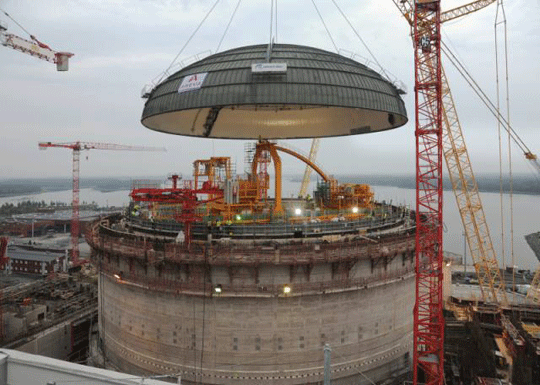
 Nuclear plant delay, YLE 4 Oct 18 Daily Turun Sanomat reports that the start of regular power production at Finland’s biggest nuclear reactor, Olkiluoto 3, may be pushed back yet again.
TVO – the owner of the power plant – said the French-German consortium Areva-Siemens has not been able to complete commissioning tests at the Eurajoki site as planned, the paper says. According to TVO, it is still unclear whether the supplier’s test delays will affect the launch of the plant, which has been scheduled for September 2019.
The project in western Finland has been hit by repeated delays, spiraling costs and legal disputes. The construction of the 1,600 MW reactor began in 2005, and initially it was scheduled to start producing electricity in 2009.
On Tuesday, Finland’s Radiation and Nuclear Safety Authority expressed concerns about the safety culture at energy company Fennovoima, which seeks to build a nuclear power plant in northern Finland. https://yle.fi/uutiset/osasto/news/thursdays_papers_bus_driver_walk-out_nuclear_power_plant_delay_and_finns_in_drug_bust/10438247
October 5, 2018
Posted by Christina Macpherson |
business and costs, Finland |
Leave a comment
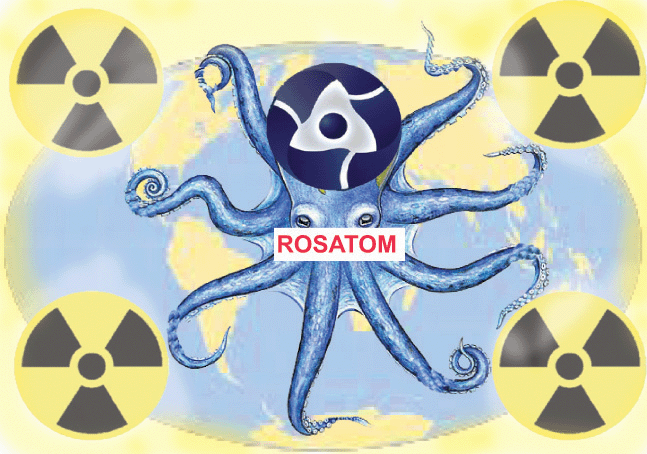
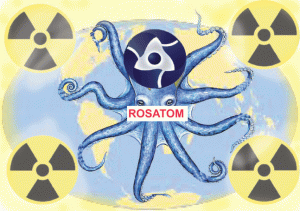 Is the global nuclear industry Russia’s latest power play? , Telegraph UK 4 Oct 18 “…….Amid the financial fallout of the West’s attempts at a new nuclear dawn, Russia is quietly building an army of nuclear reactors across the world in an increasingly important power play for a country that has traditionally been powered by fossil fuels.
Kirill Komarov, the first deputy chief executive of Russia’s Rosatom, is also the head of the World Nuclear Association. It is a fitting role for man helping to lead Russia’s global nuclear expansion.
“We are the ultimate leader in the majority of nuclear sectors,” he says, and it is hard to disagree. “In the last 11 years we have commissioned 13 new nuclear plants, which is probably the biggest number in the world even compared to the increase from our Chinese friends.”………
“We are a unique company in that we have activities in all areas of the nuclear business; starting with mining of natural uranium, enrichment fuel fabrication, developing our own nuclear equipment, the construction of nuclear power plants, the decommissioning, waste management… everything,” says Komarov…..
says Tim Yeo, a former Tory MP and the leader of New Nuclear Watch, an industry-backed lobby group.
“They back this up with helpful vendor financing packages, which the Russian government is ready to support where necessary,”………https://www.telegraph.co.uk/business/2018/10/04/global-nuclear-industry-russias-latest-power-play/
October 5, 2018
Posted by Christina Macpherson |
business and costs, politics international, Russia |
Leave a comment
REFILE-EDF says Meuse river flow could restrict output at Chooz nuclear plant https://af.reuters.com/article/commoditiesNews/idAFL8N1WK4QZ PARIS, Oct 4 (Reuters) – Electricity production at French utility EDF’s Chooz nuclear power plant could be restricted from Oct. 11 due to the forecast flow of the Meuse river, French electricity grid operator RTE, said on Thursday.
Chooz nuclear power plant in the northeast of the country has an installed capacity of 3,000 megawatts. The plant uses water from the river to cool its two reactors.
“Production restrictions are likely to affect EDF’s nuclear generating fleet on Chooz production units starting Thursday October 11,” RTE said. It did not give further details.
Low river levels has forced EDF, which operates France’s 58 nuclear reactors, to curb production at some reactors in recent weeks.
October 5, 2018
Posted by Christina Macpherson |
business and costs, France |
Leave a comment
French nuclear output drops to 41 GW on three unplanned outages, S and P Global Platts,- Andreas Franke –Jonathan Fox – 4 Oct 28
HIGHLIGHTS
1.3 GW Belleville-2 in unplanned shutdown overnight
0.9 GW Gravelines-6 also taken offline overnight
0.9 GW Tricastin-2 restart attempt delayed again
London— French nuclear output fell below 41 GW Wednesday morning, with operator EDF listing three unplanned short-term outages with a combined 3 GW capacity, according to grid operator RTE…
some risks remain, with Platts Analytics noting the ongoing shift in the restart of reactors as a key factor.
The improved nuclear outlook in France is offset by a 2.5 GW shortfall in Belgium this winter and the permanent closure of the 1.3 GW Gundremmingen B reactor in Germany, with combined nuclear output across the CWE region for December seen barely above December 2017 levels, Platts Analytics said in its October report.
–Andreas Franke, andreas.franke@spglobal.com
–Edited by Jonathan Fox, jonathan.fox@spglobal.com https://www.spglobal.com/platts/en/market-insights/latest-news/electric-power/100318-french-nuclear-output-drops-to-41-gw-on-three-unplanned-outages
October 5, 2018
Posted by Christina Macpherson |
business and costs, France |
Leave a comment
Hinkley Point builder feels heat for French reactor failings. EDF has been
rebuked by French safety regulators for failings in the construction of a
prototype reactor in Normandy. Flamanville has been beset by problems and
delays that critics say cast doubt on EDF’s ability to deliver power from
the British plant by 2025, as promised.
The Autorité de Sûreté Nucléaire, the French nuclear regulator, said yesterday that EDF may need
to carry out more repairs than had been estimated initially on faulty
weldings at the French reactor and ordered it to carry out a wider review
of the quality of materials in the project. The watchdog said that it
believed the company had “failed to properly oversee certain activities” at
Flamanville and had failed in its handling of the welding problems when
they were discovered, taking a year and a half to inform the regulator.
Times 4th Oct 2018 , Flamanville originally was due to start up in 2012, but it has been delayed
repeatedly. This summer, EDF said that the start date had slipped again to
early 2020 as it needed to repair “quality deficiencies” in the welding in
part of the plant that carries steam to the turbines.
The costs of the project are estimated at €10.9 billion, more than three times its
original budget. The company has blamed the welding issues on a contractor
that had signed off on the work despite the failings. It said in July that
it needed to redo 53 weldings at Flamanville, but was confident that a
further ten were fit for service.
However, the watchdog said it was not certain that this was the case and that EDF should “start preparing for
possible repair work on the weldings”. It said that the company had
informed it only early last year, despite identifying the issue in July
2015.
This year the British nuclear regulator raised concerns about poor
quality control checks on EDF’s supply chain for Hinkley Point C and said
that improvements had to be made. Kate Blagojevic, head of energy and
climate at Greenpeace, said: “The French nuclear regulator has given a
pretty damning verdict on EDF’s attempt to build the new nuclear power
station at Flamanville . . . Nothing in the latest statement from the
French nuclear regulator could possibly inspire confidence that Hinkley
will be built on time or budget.”
https://www.thetimes.co.uk/article/b8a10964-c745-11e8-a4a5-a34bea2c1d04
October 5, 2018
Posted by Christina Macpherson |
business and costs, UK |
Leave a comment
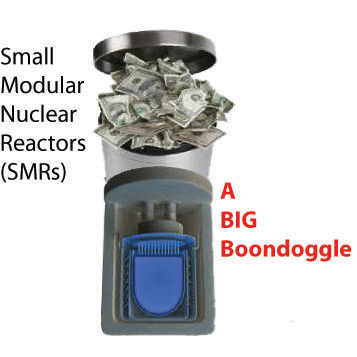
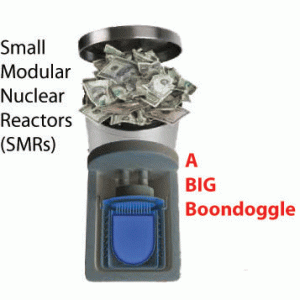 Energy firms demand billions from UK taxpayer for mini reactors Ministers under pressure to fund new generation of small-scale nuclear power stations,Guardian, Adam Vaughan Energy correspondent @adamvaughan_uk, 1 Oct 2018 Backers of mini nuclear power stations have asked for billions of pounds of taxpayers’ money to build their first UK projects, according to an official document.
Advocates for small modular reactors (SMRs) argue they are more affordable and less risky than conventional large-scale nuclear plants, and therefore able to compete with the falling costs of windfarms and solar power.
But the nuclear industry’s claims that the mini plants would be a cheap  option for producing low-carbon power appear to be undermined by the significant sums it has been asking of ministers.
Some firms have been calling for as much as £3.6bn to fund construction costs, according to a government-commissioned report, released under freedom of information rules. Companies also wanted up to £480m of public money to help steer their reactor designs through the regulatory approval process, which is a cost usually paid by nuclear companies.
Ten companies hoping to build the plants requested direct government funding, according to the briefing paper by the Expert Finance Working Group on Small Reactors. While the report named the companies involved in the mini nuclear projects, it did not specify who was asking for
David Lowry, a nuclear policy consultant who obtained the document, said: “SMRs are either old, discredited designs repackaged when companies see governments prepared to throw taxpayers’ subsidies to support them, or are exotic new technologies, with decades of research needed before they reach commercial maturity.”
The working group that drafted the report, and was appointed by the Department for Business, Energy and Industrial Strategy (BEIS), urged the government in August to put in place a framework to help bring the smaller plants to market.
The government has already offered £44m of funding for research and development of one group of SMRs, which typically have a capacity of less than a tenth of the Hinkley Point C nuclear plant being built in Somerset, or enough power for 600,000 homes.
Mini nuclear power stations are unlikely to supply clean energy to Britain’s homes and businesses any time soon. Of more than 30 British, US and Chinese companies that have expressed an interest in building one in the UK, the majority told the working group that their power stations would be ready to deployed in the 2030s.
The companies include UK firms such as Rolls-Royce, Sheffield Forgemasters and Atkins, along with China’s CNNC, US companies NuScale and Westinghouse, and France’s EDF Energy.
The working group found the firms’ cost estimates “varied significantly”, to the degree that some of the companies clearly had a “lack of understanding” of how British nuclear regulation works.
It also noted that some of the companies proposed using “non-standard fuels” rather than the conventional uranium used by today’s nuclear plants, which “may add cost to business models” because of new facilities to produce and later manage the spent fuel.
The firms told the group that the four main barriers they faced were finding and confirming sites, the cost of regulatory approval for their designs, a lack of state funding and unclear policy.
The government is expected to make announcements soon regarding the siting regime and regulatory approvals for SMRs, sources told the Guardian…….. https://www.theguardian.com/environment/2018/sep/30/energy-firms-demand-billions-from-uk-taxpayer-for-mini-reactors
October 1, 2018
Posted by Christina Macpherson |
business and costs, politics, Small Modular Nuclear Reactors, UK |
Leave a comment

TOUCHING FROM A DISTANCE, The workers of Fukushima Daiichi BY ANDREW DECK METROPOLIS JAPAN, SEPTEMBER 28, 2018“………an elaborate operation that also aspires to full decommissioning of Units 1, 2, 3 and 4 by 2050. Now seven years into this proposed timeline, some critics have questioned its feasibility. According to Daisuke Hirose, a TEPCO spokesperson who debriefed Metropolis on the state of decommissioning, there are three major priorities in fulfilling the plan as scheduled.
The most complex is the location and extraction of nuclear fuel debris. Hundreds of tons of melted fuel remain buried deep within Units 1, 2 and 3, the exact locations of which remain unknown. Rubble and fatal radioactivity levels have rendered these parts of the reactor buildings inaccessible to humans, leaving remote-controlled robots the most viable method of investigation. Only minimal fuel debris in Unit 2 has currently been identified and the means of extraction have not been finalized, but Hirose says TEPCO will meet a 2021 benchmark for initial fuel extraction. Alongside the handling of nuclear debris, the plant must confront a rapid accumulation of contaminated water on site, perhaps the most urgent task facing the operation. ……….
Our coach passed the border of the “difficult to return zone,” a government-designated boundary that separates areas of Fukushima deemed habitable from those deemed uninhabitable. Suddenly we were facing the Fukushima “ghost towns” of popular imagination. While Fukushima Daiichi is ground zero, the heart of this disaster is in the abandoned towns of the prefecture: homes and businesses and schools left behind in an instant, hard evidence of the 160,000 residents that were displaced by the disaster. Abandoned vehicles, shattered windows, hollowed-out storefronts, a dilapidated pachinko parlor and seven years of weeds rising from cracks in the cement — they all passed by the coach windows on our approach to Fukushima Daiichi.
We were not the only vehicles on this highway, trucks rumbled past us and cars lined the road. Calling these “ghost towns” is a misnomer: these towns may be uninhabited, but they are not unoccupied. Many of these vehicles belonged to a decontamination project that spans the original 20km exclusion zone and beyond. It is not operated by TEPCO, but rather a web of government agencies and municipalities. Their job, first and foremost, entails the mass removal of dirt, stripping entire towns of topsoil and manually washing down rooftops and other surfaces that were doused in radioactive particles in an effort to clean away radiation. Fields of black refuse sacks, millions of which are filled with contaminated soil, now litter the prefecture without plans for their permanent storage or removal. Regardless of this work’s efficacy, it is an undertaking that requires a massive labor force; Japan’s Ministry of Health, Labour and Welfare reports that more than 46,000 were employed in Fukushima decontamination work in 2016.
The harsh reality is that the disaster has disrupted the industries that once thrived in Fukushima Prefecture — fishing, agriculture and service jobs. Currently, only half of the region’s 1,000 fishermen are going out to sea and they face highly reduced demand. The decontamination industry is one of the few thriving seven years later, but this line of work is not without its risks. In early September, the UN human rights division released a statement warning of possible worker exploitation in the recovery effort, both within the prefectural decontamination projects and on the 1F site. “Workers hired to decontaminate Fukushima reportedly include migrant workers, asylum seekers and people who are homeless,” wrote three UN Special Rapporteurs. “They are often exposed to a myriad of human rights abuses, forced to make the abhorrent choice between their health and income, and their plight is invisible to most consumers and policymakers with the power to change it.” Japan’s Foreign Ministry responded by calling the statement “extremely regrettable.”
There are many people who shoulder the burden of the nuclear disaster: parents sending their children to school with Geiger counters on their backpacks, farmers who have lost their livestock and livelihood, elderly left to care for deserted towns as the young set roots far from Futaba-gun, multi-generation Fukushima lineages that have been forced to abandon their familial homes for prefabricated temporary housing units. Yamamoto carries one small burden of this sweeping tragedy, as do the other workers of Fukushima Daiichi, as do those who labor in irradiated fields without other means of income. They are trying to extinguish a danger that can’t be seen, but its presence is felt in every aspect of their work. At times the job they’ve been assigned feels beyond comprehension, but Fukushima is not a supernatural disaster and Yamamoto is no ghostbuster. This disaster is deeply human, founded in both nature and negligence. “If you think in terms of decades, the long road ahead and the abstractness of it all will crush you,” says Yamamoto. “But just as with any other work, if you split up big projects into smaller pieces, the feeling of accomplishment from each small victory will keep you motivated.” Inside the exclusion zone, we witness the people of Fukushima trying to take their land a few steps closer to normal. https://metropolisjapan.com/workers-of-fukushima-daiichi-power-plant/
|
|
|
September 29, 2018
Posted by Christina Macpherson |
employment, Japan |
Leave a comment
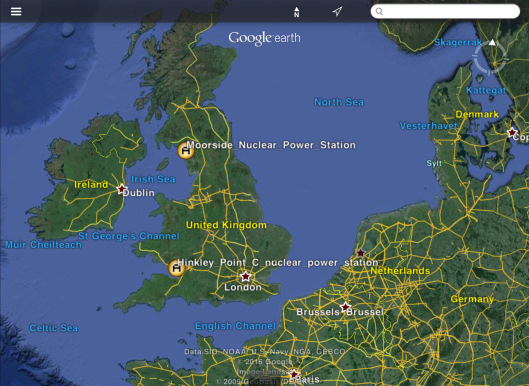
 Moorside on the rocks? NucClear News October 18
Plans for a new nuclear power station in Cumbria are on the verge of collapsing after the Toshiba-owned company – NuGen – laid off 60% of its workforce and embarked on a final effort to sell the project. Toshiba was due to sell the NuGen consortium to South Korean state-owned firm Kecpo in early 2018, as the Japanese firm exits international nuclear projects and looks to recoup some of the £400m it has spent on the Moorside plant.
But Kepco has been delaying a final decision, due in part to the UK government signalling a new approach to financing nuclear power stations. That has forced NuGen to cut 60 of its 100-strong workforce after a six-week consultation with staff. (1)
Unions said the project’s problems showed the need for the government to take a stake in Moorside. Justin Bowden, the GMB national secretary, said: “The looming collapse of this vital energy project has been depressingly predictable for months.” The GMB wants the NDA to be scrapped as it currently exists and a Nuclear Development Agency created to make sure Moorside and the accompanying creation of thousands of new jobs and apprenticeships, goes ahead. (2) The skeleton NuGen team is now focused on clinching a deal with Kepco by the end of the year before Toshiba writes the unit off entirely at the end of March 2019. Success will hinge on whether Kepco buys into a new financing approach for nuclear power plants that the government is exploring, known as the regulated asset base (RAB) model. Officials think it could deliver the government’s nuclear ambitions more cheaply for consumers than alternatives.
The RAB approach involves a regulator – in the case of nuclear power stations most likely to be Ofgem – setting a fixed sum for the costs of the scheme, and a fixed return for the project’s backers. Those returns would be funded by energy bill payers. But the model is likely to be ditched if Jeremy Corbyn comes to power. Alan Whitehead, the shadow energy minister, said: “Using customers’ bills to make a bet that construction of such large and complex projects will not overrun in terms of cost or time is a reckless act.” (3)
The Chief Executive of NuGen said he will “fight tooth and nail” to salvage the £15 billion Moorside nuclear power station in an impassioned speech to industry leaders gathered in Cumbria. He says he is fully behind using the RAB model. (4)
The FT reported that Toshiba had entered talks with Canadian asset manager Brookfield over the potential sale of NuGen. Brookfield bought Westinghouse from Toshiba for $4.6bn in January after the US nuclear business filed for Chapter 11 bankruptcy protection in 2017. (5) But the claims were later rubbished by Toshiba. It added that it was still considering the sale of NuGen to Kepco. (6)
Later NuGen admitted that there are no firm plans to save Moorside. (7)
Workington Labour MP, Sue Hayman, co-chair of the All Party Parliamentary Group on Nuclear Energy, wrote to the Secretary of State for Business, Greg Clark MP, at the end of July, when NuGen announced it was consulting on job losses, calling on him to guarantee Government support for the project and 20,000 future Cumbrian jobs. Mr Clark said in June that he “will consider direct Government investment” in the proposed Wylfa nuclear power station in Wales, but he has refused to make any similar commitment to Cumbria. In a response to Sue’s letter, energy minister Richard Harrington MP said: “The Secretary of State and I understand the potential importance of the Moorside project to the local area. However (…) the proposed sale of NuGen is principally a commercial matter for Toshiba and it would not be appropriate for me to comment on those ongoing negotiations.” Sue Hayman said: “This Tory government could not care less about the Cumbrian economy, the Moorside project, or the 20,000 future jobs it will bring.” (8)
but he has refused to make any similar commitment to Cumbria. In a response to Sue’s letter, energy minister Richard Harrington MP said: “The Secretary of State and I understand the potential importance of the Moorside project to the local area. However (…) the proposed sale of NuGen is principally a commercial matter for Toshiba and it would not be appropriate for me to comment on those ongoing negotiations.” Sue Hayman said: “This Tory government could not care less about the Cumbrian economy, the Moorside project, or the 20,000 future jobs it will bring.” (8) http://www.no2nuclearpower.org.uk/wp/wp-content/uploads/2018/09/NuClearNewsNo111.pdf
September 29, 2018
Posted by Christina Macpherson |
business and costs, politics, UK |
Leave a comment

After wrangling over Georgia nuclear plant, cost concerns remain, By Matt Kempner and Anastaciah Ondieki – The Atlanta Journal-Constitution , September 28, 2018
Not many people can name the plant that their electricity comes from. But in Jefferson, at a gathering sponsored by Jackson EMC, plenty of customers were familiar with the trials and tribulations of expanding Plant Vogtle.
Among the people who gather annually for chicken dinners, gospel music and raffle drawings put on by the electric cooperative, there are worries about the mounting headaches 130 miles away.
Plant Vogtle — the only nuclear power plant under construction in the United States — keeps ending up in the news because of its ever escalating pricetag. And those soaring costs are likely to end up in the monthly bills of customers of Jackson EMC and most other Georgia utilities, which are on the hook to pay for the project.
“I don’t understand why they can’t figure out what it’s going to cost,” said Mike Mize, a retired phone company worker who lives in Commerce and gets power from Jackson EMC. “I want them to hurry up and finish the thing and quit spending money on it.”
But high-stakes events this week suggest that costs will only go higher.
Co-owners of the plant voted Wednesday to continue its expansion, but did little to address the fundamentals of the Vogtle’s troubles.
The owners ditched a proposal for a firm cost cap on the now $27-billion-plus project and avoided addressing calls by state lawmakers to refrain from passing new cost increases along to customers. Meanwhile, electric membership cooperatives and city utilities around the state lost some of their say over whether the project continues in the future.
Georgia Power blasted the idea of a firm cost cap, but agreed to take on a greater share of costs in the event of certain big overruns. The size of the risk shift was limited — if there are $2.1 billion in cost increases, the company would face an extra $180 million penalty, “peanuts in this context,” said one critic.
Georgia Power, the state’s largest utility, was given carte blanche to drop out of the project at its sole discretion.
Morgan Stanley analysts predict a “very good chance” that Vogtle costs could jump more than another $2.1 billion.
“We think there is a significant level of uncertainty around the budget and see a very high likelihood of continued cost overruns,” the analysts wrote.
Add that to the existing pile. Nine years into construction, the Vogtle expansion is billions of dollars over budget, years behind schedule and at least four years away from completion.
Cost projections and assurances from Georgia Power have been consistently wrong.
Then a bankruptcy filing last year by the project’s main contractor, Westinghouse Electric, eliminated a contract that had buffered Vogtle owners from many extra costs. But the costs still continue to rise.
When Georgia Power recently announced $2.3 billion in new increases, it automatically triggered a vote by the co-owners on whether to stick with the project.
Georgia Power, the Municipal Electric Authority of Georgia and Dalton Utilities all gave approval. But Oglethorpe Power, which represents electric membership corporations throughout the state, insisted on a cost cap. It also asked that shareholders of Georgia Power’s parent, Southern Company, eventually cover additional cost increases. (Another Southern subsidiary is overseeing the construction.)
Bitter disagreements among the project’s co-owners bubbled out into the public. It kicked off brinkmanship negotiations over whether and how the project would continue.
The core issue is one that has haunted Vogtle for years: Who should shoulder its ever-ballooning costs?
“We never signed up for a project where we would just be a blank checkbook for Southern Company or anybody else in this project,” said Gary Miller, the chief executive of GreyStone Power Corporation, which serves portions of Fulton, Cobb, Douglas and other counties. “We never said, ‘Build it no matter what the cost.’ ”………
There’s been intense political pressure to continue the work. If the project were to be canceled, its costs likely would end up in customer bills without any energy generation to show for it. Some Jackson EMC members consider that wasteful; others want to stop the bleed. …….https://www.myajc.com/business/after-wrangling-over-georgia-nuclear-plant-cost-concerns-remain/9iGHX9Ugo7QPkli9LoqGbM/
September 29, 2018
Posted by Christina Macpherson |
business and costs, UK |
Leave a comment

 U.S. Makes Shortlist for Saudi Nuclear-Plant Deal, One stumbling block: Negotiations over restrictions meant to prevent spread of weapons. WSJ By Timothy Puko, Sept. 26, 2018
Saudi Arabia has put the U.S. on its shortlist of potential partners competing to build nuclear-power plants in the kingdom, while the two countries negotiate how to do a deal without spreading nuclear weapons, Energy Secretary Rick Perry said.
The kingdom has been hearing offers from several countries, including Russia, South Korea and China, for what could be the biggest new market for nuclear power. Mr. Perry told reporters Wednesday the kingdom recently made a decision that keeps U.S. businesses— foremost Westinghouse… (subscribers only) https://www.wsj.com/articles/u-s-makes-shortlist-for-saudi-nuclear-plant-deal-1538006144
September 28, 2018
Posted by Christina Macpherson |
marketing, Saudi Arabia |
2 Comments
,Fortune, By GRACE DOBUSH , 27 Sept 18, The Alvin W. Vogtle Electric Generating Plant in Georgia, the only nuclear power reactors currently under construction in the U.S., got a last-minute save last night as warring partners agreed to new funding terms.
Southern Co. subsidiary Georgia Power, which owns 45.7% of the project, will shoulder more of the costs past a certain level, and agreed to purchase future tax credits at a discounted cost from co-owners Oglethorpe Power Corp. (30%), the Municipal Electric Authority of Georgia (22.7%) and Dalton Utilities (1.6%).
Costs for the two new nuclear reactors have nearly doubled to more than $27 billion. Partners and politicians are worried the costs will trickle down to rural customers’ electric bills, but the sunk costs of halting construction would also be expensive for consumers.
The existing two reactors at Vogtle have been in operation since the 1980s. The new reactors, now expected to come online in 2021 and 2022, are five years behind schedule and $13 billion over budget. The Vogtle owners have been struggling since the designer and lead construction contractor, Westinghouse Electric Co., filed for bankruptcy in March 2017.
The Department of Energy has paid the project’s owners $5.6 billion of an $8.3 billion loan guarantee for the project. The Trump administration has promised the project another $3.7 billion if construction continues. But if the project were stopped, the DOE would demand an accelerated repayment schedule.
John Sneed, executive director of the DOE Loan Programs Office, had said in a letter to project leaders that his agency acknowledges continuing construction is a “commercial decision” but that the owners must realize Vogtle’s “profound impact on the U.S. nuclear industry.” He added: “The decision each owner makes should be made with an understanding of the ripple effect this project is already having, including job creation and the positive signal of the continued value of commercial nuclear power in our country.”……..http://fortune.com/2018/09/27/vogtle-nuclear-power-plant-construction-deal/
September 28, 2018
Posted by Christina Macpherson |
business and costs, USA |
Leave a comment
A nuclear startup will fold after failing to deliver reactors that run on spent fuel, MIT Technology Review, James Temple, 25 Sept 18 Transatomic Power, an MIT spinout that drew wide attention and millions in funding, is  shutting down almost two years after the firm backtracked on bold claims for its design of a molten-salt reactor.
High hopes: The company, founded in 2011, plans to announce later today that it’s winding down.
Transatomic had claimed its technology could generate electricity 75 times more efficiently than conventional light-water reactors, and run on their spent nuclear fuel. But in a white paper published in late 2016, it backed off the latter claim entirely and revised the 75 times figure to “more than twice,” a development first reported by MIT Technology Review…….
The longer timeline and reduced performance advantage made it harder to raise the necessary additional funding, which was around $15 million. “We weren’t able to scale up the company rapidly enough to build a reactor in a reasonable time frame,” Dewan says.
Transatomic had raised more than $4 million from Founders Fund, Acadia Woods Partners, and others. ……https://www.technologyreview.com/the-download/612193/nuclear-startup-to-fold-after-failing-to-deliver-reactor-that-ran-on-spent-fuel/
September 26, 2018
Posted by Christina Macpherson |
business and costs, technology, USA |
1 Comment
 Japan vows to cut its nuclear hoard but neighbours fear the opposite, By Motoko Rich, 25 Sept 2018 New York Times, “………Pulling the plug would also deprive one of Japan’s poorest regions of an economic lifeline. Over the years, the central government has awarded nearly $3 billion in incentives to the prefecture, where political leaders reliably support Japan’s governing party.
Even inoperative, the plant employs more than 1 in 10 residents in Rokkasho and accounts for more than half the town’s tax revenues.
“It is now indispensable for Rokkasho,” said Kenji Kudo, the fourth generation to run his family’s clothing distribution company, which sells uniforms and protective gear to the plant.
As demand from local squid fishermen disappeared, he added, the plant “rescued our business.” The town has also received more than $555 million in government subsidies for hosting the facility, including funding for a 680-seat concert hall, an international school with just eight students and a new pool and gym complex that opened last year.
There are small reminders that the munificence comes with some risk.
A screen in the lobby of the concert hall reports the radiation level at 32 places around the prefecture, and a sign at a local nursing home warns residents not to use the baths “in case of nuclear disaster.”
Kaoru Sasaki, director of the nursing home, said she doubts the plant will ever operate given concerns about nuclear power around the country. “But we don’t talk about that among friends here,” she said. “It is so important to the community.”
The plant itself is sprawled across nearly 1,000 acres of farmland, surrounded by fields of solar panels and wind turbines.
Some 6,000 workers are installing steel nets to protect it against tornadoes and digging ditches for pipes to carry water from a swamp into its cooling towers. Inside a large control room, workers in turquoise jumpsuits mill about computer consoles, monitoring dormant machinery.
The final piece of the plant to come online will be a facility, now under construction, that will take a mix of plutonium and uranium and turn that into fuel. But no one knows what would happen if the government could not persuade communities to reopen and upgrade more reactors to use this type of fuel.
“Our only plan right now is that we want to start reprocessing in 2021,” said Koji Kosugi, general manager for international cooperation and nonproliferation at Japan Nuclear Fuel.
“But we do not yet know how it will be consumed. This is something that has to be worked out with the utilities and the Japanese government.”
One of the reasons Japan is so wedded to recycling may be that it does not want to confront the politically toxic question of what to do with its nuclear waste, much of which is being stored temporarily in cooling pools on the sites of its nuclear power plants.
Thomas M. Countryman, an Obama administration official who is now chairman of the nonpartisan Arms Control Association in Washington, said the Rokkasho plant is “in a sense a delaying tactic in order to put off the most difficult decision that any country has to face.”
One option, said Tatsujiro Suzuki, a nuclear scientist at Nagasaki University, is to turn Rokkasho itself into a nuclear waste storage facility.
Nuclear plants across Japan have sent waste that cannot be recycled to Rokkasho — steel drums full of ash, contaminated filters, steel pipes and protective clothing.
Huge concrete boxes holding the drums are lined up in vast dugouts on the grounds of the plant, and canisters holding highly radioactive waste are stacked nine deep in a cavernous underground room where only their bright orange lids poke out of the floor.
The government promised that the waste would only be stored here temporarily but never came up with a permanent plan. In Rokkasho, residents are still waiting for the recycling plant.
“If the government had asked the village to only accept waste in the first place,” said the mayor, Mamoru Toda, “I don’t think the village would have accepted it.” https://www.sbs.com.au/news/japan-vows-to-cut-its-nuclear-hoard-but-neighbours-fear-the-opposite
September 26, 2018
Posted by Christina Macpherson |
business and costs, Japan, politics |
Leave a comment
 ATLANTA (AP) — The Latest on budget overruns in construction of a Georgia nuclear power facility U.S.News 24 Sept 18
The nation’s only major nuclear power plant under construction appears to still be alive after the owners voted to push forward despite another multibillion-dollar cost overrun.
But Oglethorpe Power says they’re only willing to move forward with the construction of two new reactors at the Vogtle nuclear power plant near Waynesboro, Georgia if cost-control measures are implemented.
It is unclear how the other utilities that own a stake in the project will respond to the conditions.
The Municipal Electric Authority of Georgia and Georgia Power, the other two primary owners of the project, had previously said they’re willing to move forward.
The project is billions of dollars over budget and years behind schedule.
A similar project in South Carolina died in July 2017 when the V.C. Summer plant was abandoned after going billions of dollars over budget.The board of a Georgia utility has voted to continue the expansion of a nuclear power plant that’s years behind schedule and billons of dollars over budget.
The Municipal Electric Authority of Georgia’s board voted unanimously Monday to continue building two new reactors at the Vogtle nuclear power plant near Waynesboro.
That leaves one co-owner, Oglethorpe Power, left to decide whether to move forward or abandon the project.
A third owner, Georgia Power, already indicated it’s ready to push forward.
The critical votes came after a new $2.3 billion cost increase was recognized, bringing the total estimated cost to $27 billion. That triggered a clause in the ownership agreement where 90 percent of ownership needs to agree to forward.
A down vote from Oglethorpe Power could sink the project. Oglethorpe Power is expected to vote on it later this week…….https://www.usnews.com/news/best-states/georgia/articles/2018-09-24/the-latest-georgia-nuclear-plant-gets-tentative-up-vote
September 26, 2018
Posted by Christina Macpherson |
business and costs, USA |
Leave a comment

 Sunday Times 23rd Sept 2018 , Aldermaston, The consortium that runs Britain’s nuclear weapons factory paid itself
£70m of dividends last year despite huge delays and cost overruns on a key
project. AWE Management paid the dividends to its shareholders — the
giants Serco, Jacobs and Lockheed Martin — which have a long-term
contract to run the Atomic Weapons Establishment (AWE).
AWE, which develops and builds the nuclear warheads that arm the navy’s Trident submarine
fleet, came under fire from the government’s spending watchdog in May.
The National Audit Office said an upgrade to AWE’s warhead assembly
facility in Berkshire was six years late and costs had spiralled from
£734m in 2011 to £1.8bn.
AWE has also been at loggerheads with the
nuclear safety watchdog, which, in July, prosecuted the company over an
incident last year in which an electrician was injured. At a court hearing
last week, AWE admitted failing to ensure the safety of its staff. It is
due to be sentenced in November.
https://www.thetimes.co.uk/edition/business/navy-nuke-maker-awe-pays-70m-dividend-lvthpcwkj
September 26, 2018
Posted by Christina Macpherson |
business and costs, UK, weapons and war |
Leave a comment