UK govt allowing Chinese nuclear technology for Bradwell reactor?

 Times 9th Dec 2018 Something that would once have been unthinkable took another step towards
becoming reality last month just 40 miles east of London on the Essex
coast.
Britain’s nuclear watchdog nudged a Chinese reactor a step closer
to being allowed to operate in the UK, sending it through the “initial
high-level scrutiny” phase. It will eventually be built at
Bradwell-on-Sea. Much tougher hurdles lie ahead, but regulators have so far
been able to find no reason to block China General Nuclear’s HPR1000.
This is the dilemma facing Britain — one that has been thrown into stark
relief by the events of the past week. The arrest of Meng Wanzhou, the
chief financial officer of telecoms giant Huawei, means all that must be
seen through a different lens. The daughter of Huawei’s founder was
arrested in Canada at the behest of the US authorities and faces charges of
fraud and breaching US sanctions on Iran.
However, the tone on Chinese investment in Britain has now changed and recalls the words of Theresa
May’s former adviser Nick Timothy in 2015, when he said the government was
“selling our national security to China”. A deep-seated suspicion of
Huawei at GCHQ has finally surfaced as open hostility, while,
coincidentally, BT is removing Huawei technology from its 4G mobile
network. Yet all this looks remarkably like shutting the stable door after
the horse has bolted. If there was a time to reject Chinese investment, it
was 20 years ago.
Now, with ministers reliant on Chinese cash to fund a
significant slice of our future power needs, do they dare bite the hand
that feeds? Plus, in a post-Brexit world, a trade deal with China is meant
to top the priority list. For all the braggadocio, I suspect there will be
much soothing talk between London and Beijing in the months ahead. Does the
government really think it can put the Chinese dragon back in the bottle?
And can it afford to?
https://www.thetimes.co.uk/article/6cfdbf12-fafc-11e8-9a07-72ebead02362
UK must explain its plans for civil nuclear power security under ‘no deal’ Brexit scenario

Reeves calls for clarity for nuclear in ‘no deal’ Brexit scenario https://utilityweek.co.uk/reeves-calls-clarity-nuclear-no-deal-brexit-scenario/ David Blackman , 7 Dec 18 Rachel Reeves has urged the government to provide greater clarity about its plans for civil nuclear power if the UK leaves the EU without a withdrawal deal.
The chair of the House of Commons Business, Energy and Industrial Strategy committee has written to Richard Harrington, who has responsibility for the nuclear industry in his portfolio as minister for busiUK
In the letter, Reeves acknowledges indications of progress on the civil nuclear relationship between the EU and the UK regarding issues like safeguards and trading arrangements.
The government passed a bill last year outlining plans to create a new safeguarding regime for nuclear material and labour once the UK has to leave its existing arrangements under the Euratom treaty.
The letter seeks more detail on the plans that the government is making to ensure that the civil nuclear sector can continue to function after next March if parliament has been unable to secure a broader separation agreement and whether a side-deal with Euratom is being pursued.
She also quizzes Harrington on whether the UK has received any signals from Euratom about whether it will be possible to maintain the “close association” that the government has said it wanted with the EU-wide nuclear co-operation arrangement.
Reeves also asks whether the government has made any arrangements to overcome possible hitches in the nuclear new build programme if the upcoming migration white paper inhibits the inflow of the migrant labour which has been “essential” for such projects.
Reeves said: “In the event of no deal and no transition period, the ongoing operation of the UK’s nuclear power stations could be put at risk. The government needs to spell out what it is doing to ensure that nuclear power stations continue to function from 29 March 2019 and whether it will seek a separate deal with Euratom in these circumstances.
“The government also needs to be clearer about its plans to facilitate the building of construction of major facilities such as Hinkley Point C if restrictions on migrant labour are introduced in the future.”
China’s push to take over the abandoned Moorside nuclear project
Chinese nuclear giant flags interest in NuGen’s abandoned Cumbria plant, Building, 7 December 2018 China General Nuclear also reveals plans to speed up delivery of nuclear power plant in Essex.China General Nuclear has flagged interest in building on the Moorside site recently vacated by Toshiba subsidiary NuGen as it reveals plans to speed up development of a nuclear power plant in Essex.
China General Nuclear (CGN), who is already developing Hinkley Point C (pictured) with EDF Energy, is carrying out technical assessments with a view to building another plant with the French energy giant in Bradwell, Essex.
Speaking at the Nuclear 2018 conference in London Rob Davies, the UK chief operating officer of CGN, said: “With the demise of NuGen there is a gap in the UK’s nuclear programme; the expected sequence of reactors coming down the line has been interrupted.
“We are confident we can close that gap by bringing Bradwell into operation much sooner.”…….https://www.building.co.uk/news/chinese-nuclear-giant-flags-interest-in-nugens-abandoned-cumbria-plant/5096959.article
UK tax-payers, not the nuclear industry, will pay for the new safeguards regime, post Brexit !
 ENDS Report 3rd Dec 2018 , Government confirms it will fund post-Brexit nuclear regime. The nuclear
industry will not have to fund the creation of a new safeguards regime
after Brexit, the Department for Business, Energy and Industrial Strategy
has confirmed.
https://www.endsreport.com/article/61622/government-confirms-it-will-fund-post-brexit-nuclear-regime
Nuclear companies think that Japan’s nuclear power plans are unrealistic

 50% in nuclear industry: Energy plan for 2030 is ‘unrealistic’ http://www.asahi.com/ajw/articles/AJ201812050032.html, By NORIYOSHI OHTSUKI/ Senior Staff Writer, December 5, 2018 Half of companies in the nuclear industry doubt the government’s goal of having nuclear power account for 20 to 22 percent of Japan’s energy supply by fiscal 2030, according to a survey.The reasons for their skepticism relate mainly to difficulties restarting or building reactors under stricter safety measures taken after the Fukushima nuclear disaster in 2011.
The survey was conducted in June and July by the Japan Atomic Industrial Forum, whose members include electric power companies that operate nuclear plants.
The forum contacted 365 companies in the nuclear industry, such as equipment manufacturers, and received responses from 254, or 70 percent.
According to the results, 50 percent of the companies said the government’s nuclear energy goal for fiscal 2030 is “unachievable,” compared with only 10 percent that said it is “achievable.” Forty percent said the attainability is “unknown.”
An estimated 30 reactors must be operating to reach the target, but the resumption of reactor operations has been slow since all of them were shut down after the triple meltdown at the Fukushima No. 1 nuclear power plant.
“Only nine reactors were restarted in the more than seven years after the accident in Fukushima,” Akio Takahashi, president of the forum and former senior official at Tokyo Electric Power Co., said at a news conference. “I guess respondents think it’s difficult (to achieve the goal) given the current pace (of the restarts).”
Tougher nuclear safety standards were set after the Fukushima disaster, forcing utilities to spend more on upgrading their reactors or keeping aging units operational.
Asked why they thought the government’s nuclear goal was unrealistic, 48 percent of the companies said, “There are no plans in sight to build or replace nuclear reactors.”
Thirty-three percent cited the delays in restarting idle reactors, while 16 percent said, “No progress can be seen in regaining trust from the public.”
Japan to scrap Turkey nuclear project
 Post-Fukushima safety measures doubled costs for Mitsubishi and partners Nikkei Asain Review
The increase was due to heightened safety requirements in the wake of the 2011 meltdown at Japan’s Fukushima Daiichi nuclear power plant. The recent fall in the Turkish lira has also contributed to the cost increases.
The decision to cancel the project, now in final negotiations among the parties, comes as a blow to Japan’s nuclear industry, which is looking for avenues for growth overseas as it becomes increasingly unlikely that a new plant will be built at home post-Fukushima.
The Japanese and Turkish governments agreed in 2013 on the project, with an alliance of Japanese and French businesses centered on Mitsubishi Heavy to build four reactors in the city of Sinop on the Black Sea. Initial plans had construction beginning in 2017, with the first reactor coming online in 2023………
In 2017, global investment toward building new nuclear projects plunged roughly 70% year on year to $9 billion, according to the International Energy Agency. With safety costs rising, nuclear has grown less competitive with other forms of energy.
A number of aging Japanese reactors are set to be decommissioned soon, with Kansai Electric Power planning to scrap the Nos. 1 and 2 reactors at its Oi plant in Fukui prefecture, and Tohoku Electric Power the No. 1 unit at a plant in Miyagi Prefecture’s Onagawa. Meanwhile, new nuclear projects have hit a standstill in the face of deep public wariness. https://asia.nikkei.com/Economy/Japan-to-scrap-Turkey-nuclear-project
What will ratepayers have to pay to resolve fight over failed V.C. Summer nuclear project?

Dominion wants a deal to end the SC nuclear fight. Here’s what it could cost ratepayers. By Andrew Brown abrown@postandcourier.com, Dec 3, 2018 COLUMBIA — For 15 days, South Carolina’s utility regulators reviewed testimony and sorted through mountains of evidence on the failed V.C. Summer nuclear project in order to decide how much S.C. Electric & Gas customers should pay for two unfinished reactors.
But as the high-stakes hearing wrapped up last week, the utility regulators were asked to consider one more thing.
Dominion Energy wanted the commissioners to review a new offer that would allow the Virginia-based energy company to seal its proposed takeover of SCE&G’s parent, SCANA Corp. It was the third plan Dominion pitched to regulators.
- Less than four days later, SCANA announced another deal — this time with several law firms that were suing the company in a class action lawsuit on behalf of SCE&G ratepayers. That legal settlement threw support behind Dominion’s plans in the state Public Service Commission and is contingent upon the regulators giving the utilities what they want.
- With a decision from regulators due by Dec. 21, here’s some explanation of what this dual settlement offer could mean for ratepayers, who have already dumped more than $2 billion into the abandoned nuclear project and who face paying more in the future.
- What does Dominion’s latest offer in the Public Service Commission include?
- The initial plan from Dominion called for the average SCE&G ratepayer to receive a roughly $1,000 refund check but required customers to pay another $3.8 billion for the reactors.
- Dominion has since offered to do away with the refund checks if the utility commissioners don’t like the idea. Instead, the company offered to further reduce how much customers pay for the abandoned reactors moving forward.
- Under the more recent plan, residential and business ratepayers would be required to pay another $2.3 billion for the reactors over the next two decades. ………
- What other plans are the state’s utility regulators considering?
- The Office of Regulatory Staff is sticking to its plan. Customers will still have to pay for the reactors moving forward, due to the 2007 state law that allowed SCE&G to charge customers in advance for the project.
- But under the utility watchdog’s plan, the average residential ratepayers would kick in a little more than $5 per month for the failed project.
- Overall, all SCE&G’s customers will pay back $1.7 billion over the next two decades under that plan, according to the Office of Regulatory Staff. ……..
- What does the new settlement in the class action lawsuit do?
- The press release announcing the pending legal settlement mentioned $2 billion in rate relief for SCE&G customers. But that money was already part of the deal that Dominion put forward in the Public Service Commission.
- In reality, SCANA and the trial attorneys representing SCE&G ratepayers plan to settle the high-stakes case for $115 million, which matches the money set aside in golden parachutes for SCANA executives let go after the Dominion sale, and whatever money can be made from the sale of several SCANA properties, including an office in downtown Charleston.
- ………… https://www.postandcourier.com/business/dominion-wants-a-deal-to-end-the-sc-nuclear-fight/article_93463a28-f3e5-11e8-b9bd-9b4df318cd08.html
Delay in compensation for NUCLEAR LAB EMPLOYEES WITH RADIATION-LINKED CANCERS
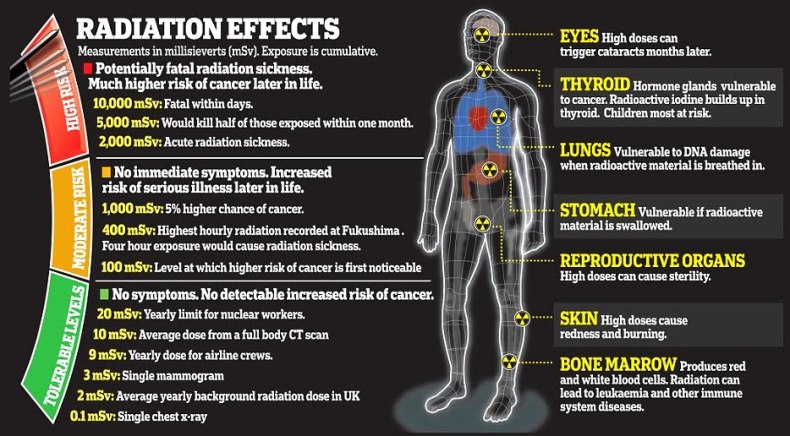
NUCLEAR LAB EMPLOYEES WITH RADIATION-LINKED CANCERS HAVE BEEN FORCED TO WAIT YEARS FOR POTENTIAL BENEFITS At the Los Alamos National Laboratory in New Mexico, workers are still waiting for answers about who is liable for sicknesses they say were caused by radiation from the lab. REBECCA MOSS PACIFIC STANDARD, Nov 30, 2018
Deal to purchase Bellefonte Nuclear Power Plant is off
 By WAFF 48 Digital Staff | November 30, 2018 JACKSON COUNTY, AL (WAFF) – The deal for Tennessee valley Authority to sell the partially completed Bellefonte Nuclear Power Plant in Jackson County has been derailed. Officials with Nuclear Development say they’ve been told by TVA they will not close on the deal.
Nuclear Development was set to purchase the property for over $110 million.
The future of the plant has been in question for decades.
The final date to close on the sale has passed, and TVA informed Nuclear Development late Thursday that the deal was off. An extension was granted by TVA but Nuclear Development officials stated on Friday that TVA would not grant another.
According to TVA, Nuclear Development had not acquired a license to own a nuclear plant.
TVA’s official statement is as follows:
“On Nov. 30, 2018, the parties were unable to complete the sale of the Bellefonte property after Nuclear Development’s lack of progress in meeting its legal obligations related to future ownership of the site. Nuclear Development did not complete the necessary NRC license transfer prior to the closing date as required by the Atomic Energy Act………http://www.waff.com/2018/11/30/deal-purchase-bellefonte-nuclear-power-plant-is-off/
China and USA competing to market technology to Argentina
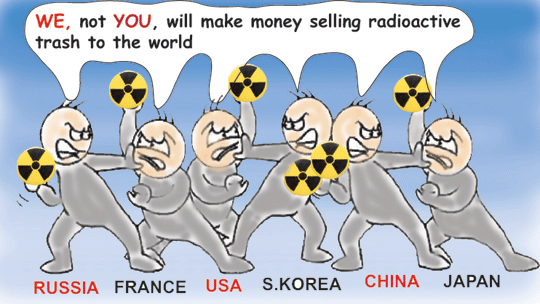
China, vying with U.S. in Latin America, eyes Argentina nuclear deal, Cassandra Garrison, Matt Spetalnick, BUENOS AIRES/WASHINGTON (Reuters) 29 Nov 18 – Argentina and China are aiming to close a deal within days for the construction of the South American nation’s fourth nuclear power plant, a multi-billion dollar project that would cement Beijing’s deepening influence in a key regional U.S. ally.
Argentina hopes to announce an agreement on the Chinese-financed construction of the Atucha III nuclear power plant during Chinese President Xi Jinping’s state visit on Sunday following the summit of leaders of G20 industrialized nations in Buenos Aires, Juan Pablo Tripodi, head of Argentina’s national investment agency, told Reuters in an interview.
The potential deal, reportedly worth up to $8 billion, is emblematic of China’s strengthening of economic, diplomatic and cultural ties with Argentina. It is part of a wider push by Beijing into Latin America that has alarmed the United States, which views the region as its backyard and is suspicious of China’s motives.
………. The negotiations on Chinese financing of the Atucha III nuclear power plant are a key cause for concern for the U.S. government, a senior Trump administration official told Reuters.
Atucha III would be one of the biggest projects financed by China in Argentina, according to the Reuters review of Chinese state funding data…….. https://www.reuters.com/article/us-argentina-china-insight/china-vying-with-u-s-in-latin-america-eyes-argentina-nuclear-deal-idUSKCN1NX0FE
In an 18-Year-Old Program to Help Ill Nuclear Workers, a Petition Has Lingered for 10 Years
A security guard at Los Alamos National Laboratory has been seeking compensation for fellow lab workers who’ve become ill, but the government has repeatedly denied the petition and he’s still waiting for a final answer. by Rebecca Moss, Santa Fe New Mexican Nov. 30 Ten years ago, a Los Alamos National Laboratory security guard named Andrew Evaskovich submitted a petition seeking compensation for fellow nuclear lab workers diagnosed with cancer linked to radiation. The government has repeatedly recommended denying the petition, despite evidence of continuing safety and recordkeeping problems at Los Alamos. And today, Evaskovich is still waiting for an answer. (Read our investigation.)
October 2000: Congress creates a program to compensate nuclear workers who’ve become sick after being exposed to hazardous levels of radiation or toxic chemicals. The law allows groups of workers to petition the government for easier access to compensation if their worksite has not kept adequate worker health records. The process has yet to help workers who started after 1996, when labs had to begin meeting higher safety standards.
2000 to 2004: Government inspectors find continuing worker safety problems at Los Alamos. A top official writes that Los Alamos labs’ “corrective actions have not been effective in preventing the recurrence of the radiological and safety basis violations.”
March 2006: Internal government memos are revealed showing a plan to deny petitions seeking special compensation for workers whose exposure records are missing or were destroyed, as a way to keep the costs down.
January 2008: A government watchdog report finds numerous incidents of “unusually high, unexplained dosage readings for workers” at Los Alamos.
April 2008: Evaskovich files a petition seeking compensation for ill Los Alamos workers employed between 1976 and 2005 who may not have adequate records of radiation exposure, based on his research showing problems with lab safety and recordkeeping.
January 2009: The National Institute for Occupational Safety and Health, or NIOSH, recommends for the first time that Evaskovich’s petition be denied, saying Los Alamos records’ show the lab had a health and safety program and was monitoring workers.
February 2009: A government advisory board disagrees and tells NIOSH to continue studying the petition.
July 2009: Workers are exposed to radioactive arsenic-74 at two areas of the lab, violating radiation safety practices in part because personnel “did not recognize the extremely high beta radiation dose rate associated with the arsenic.” Los Alamos is later fined for the incident.
July 2010: In response to a different petition, the government provides easier access to benefits for workers employed at Los Alamos prior to 1975.
August 2012: NIOSH reverses course and says that workers employed prior to 1996 should be eligible for compensation as a group since they “may have accumulated substantial chronic exposures through intakes of inadequately monitored radionuclides.” It also says it needs to continue studying those who started work in subsequent years.
February 2014: Lab workers improperly pack nuclear waste, which causes a drum to burst at an underground nuclear waste facility in Carlsbad, New Mexico. The accident exposes more than 20 workers to radiation and is one of the costliest nuclear accidents in Department of Energy history.
August 2015: The DOE cites Los Alamos for six violations, with issues going back a decade, including a near-runaway chain reaction.
April 2017: NIOSH once again recommends denying Evaskovich’s petition for Los Alamos workers, saying the stricter rules implemented in 1996 meant the lab didn’t have systemic problems after that.
July 2017: Independent consultants disagree. The lab “did not magically” have the ability to follow the rules in 1996 just because the government said it had to, said one of the consultants who had been hired to provide technical advice to the government’s advisory board.
October 2018: NIOSH again recommends that Evaskovich’s petition be denied, saying it has plenty of documents to estimate workers’ radiation exposure, even if they weren’t individually monitored by the lab.
November 2018: Independent consultants again disagree.
The Department of Energy and NIOSH both say that nuclear sites are safer and have done a better job monitoring workers since the new rules were implemented in 1996. Los Alamos spokesman Kevin Roark said that workers are closely monitored for radiation exposure and that the lab complies with all federal requirements.
Finland’s super-expensive Olkiluoto nuclear project delayed yet again
 World Nuclear News 29th Nov 2018, The start of regular electricity generation at the Olkiluoto 3 (OL3) EPR has been pushed back by a further four months and is now expected to begin
in January 2020, Finnish utility Teollisuuden Voima Oyj (TVO) announced
today.
Last month, the plant’s supplier – the Areva-Siemens consortium –
announced it wanted to update the schedule for completing the unit as
commissioning tests were taking longer than planned. TVO said it has been
informed by the Areva-Siemens consortium that fuel will now be loaded into
the reactor core in June 2019, with grid connection to take place next
October, and the start of regular electricity generation scheduled for
January 2020.
Under the previous schedule provided by the plant supplier in
June this year, fuel loading was expected in January 2019, grid connection
in May and the start of regular electricity production in September.
http://www.world-nuclear-news.org/Articles/New-delay-in-start-up-of-Finnish-EPR
USA Justice Dept now tries to prevent sick nuclear workers from getting compensation
DOJ is wrong to fight state and sickened Hanford workers https://www.yakimaherald.com/opinion/editorial-doj-is-wrong-to-fight-state-and-sickened-hanford/article_9d57b37c-f424-11e8-8cbc-8fdfc885e6c4.html?utm_medium=social&utm_source=twitter&utm_campaign=user-share, The Yakima Herald-Republic Editorial Board , 29 Nov 18
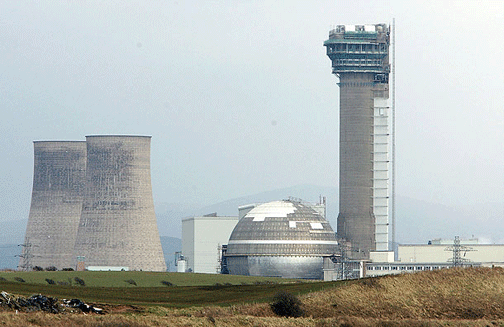
Sellafield – a nuclear misuse of public funds – and Hinkley Point C will be the next

|
There are strong parallels between THORP and the proposed £20bn Hinkley Point C nuclear power plant. Powerful arguments were put forward against the construction of both plants, but the Government and the Nuclear Industry continued to stubbornly pursue these massively expensive and dangerous projects.
Most major projects at Sellafield are still significantly delayed, with expected combined cost overruns of £913 million. The NDA has not systematically reviewed why these projects keep running into difficulties, or analysed properly the constraints it says prevent them from making faster progress. Until this work is completed, the Committee will remain sceptical about the long-term strategy to decommission Sellafield. And despite this Committee’s recommendation nearly five years ago, the Department for Business, Energy & Industrial Strategy has still not decided what to do with the plutonium stockpile currently stored at Sellafield. Given the scale and unique challenges at Sellafield, the NDA must have a firm grip of the work that takes place on the site. This was not the case with the NDA’s recently failed contract to decommission its Magnox sites. PAC Deputy Chair, Sir Geoffrey Clifton-Brown MP said: “The Government’s oversight of the NDA’s performance could and should be much better, The Committee’s findings make yet more dreary reading for the UK taxpayer says Cumbrians The site currently receives some £2bn of public money every year and, over the next 100+ years The PAC report reveals the following: Major projects are expected to cost over £900 million more than originally budgeted and be subjected to delays of over 13 years. The NDA has cancelled three projects since 2012 after spending £586 million of taxpayers’ money on them. Two of the above projects – the silo direct encapsulation project and the box transfer facility were cancelled after the NDA projected a combined cost increase of £2.1 billion and a combined delay of nine years . The NDA’s programme to deal with the plutonium stockpile in the near term is late and its costs are increasing. The concerning discovery last year (NAO report 20.6.18) that some plutonium canisters have been decaying faster than expected is made worse by the fact that the NDA’s project to repackage these canisters is at least two years late and expected to cost over £1.5 billion, £1 billion more than it first expected . The series of contingency arrangements to manage these decaying canisters are shortterm fixes for a long-term problem and BEIS has yet to set out clearly what its strategy is and the associated costs to the taxpayer. BEIS has still not decided between the two plutonium management options available – its long-term storage prior to final disposal as waste in a geological disposal facility (GDF) that has yet to be located or constructed, or its reuse as fuel in new nuclear power stations – but has told the PAC Committee that ‘it is not comfortable with any of the potential options for managing plutonium other than disposing it in the GDF’ (2) Meanwhile the controversial Thermal Oxide Reprocessing Plant (THORP) at Sellafield has started work on processing its final batch of waste fuel after operating for only 24 years. (3) THORP opened in 1994 to reprocess spent fuel from the UK’s newer reactors – like Hinkley Point B – and overseas customers. Reprocessing is a chemical process which separates out plutonium and unused uranium from spent nuclear fuel. There are strong parallels between THORP and the proposed £20bn Hinkley Point C nuclear power plant. Powerful arguments were put forward against the construction of both plants, but the Government and the Nuclear Industry continued to stubbornly pursue these massively expensive and dangerous projects. This Stop Hinkley Campaign briefing asks whether there are any lessons we can learn from the THORP experience to help us to evaluate the merits of continuing to build Hinkley Point C. Currently, the ground-works for Hinkley Point C aren’t even finished so, in theory, it should be straightforward not to go ahead with the project, if it looks like full construction and operation would be a mistake. In fact not going ahead with the plant could save electricity consumers between £27bn and £50bn over the 35 years that the plant would have operated. (4) The construction of THORP was very controversial and was the subject of a Public Inquiry in 1977, which ran for one hundred days. It was argued that the Inquiry would be a way of rationally weighing up all the evidence in order to come up with the correct decision on whether or not to give the plant the go-ahead. However, Professor Brian Wynne has argued that the Inquiry was in fact a charade, meant only to give the impression of rational decision making. (5) At the Inquiry it was argued that THORP would be needed to supply plutonium for a new type of reactor – the Fast Breeder Reactor. Justice Parker, the Inquiry Inspector, concluded that THORP should go ahead and the Government agreed. It was built in the 1980s and switched on in the 1990s. Within a week of THORP starting up, the prototype Fast Reactor at Dounreay in the north of Scotland was shut down – ending the whole UK Fast Breeder programme. (6) By 1992 the original rationale for THORP had all but disappeared before it even opened so the Government decided to commission the consulting firm Touche Ross to examine the financial implications of THORP’s operation or abandonment. It concluded that the economic benefit of operating THORP versus not operating it were £1.81bn for BNFL and £950m for the UK (7). In 1994, after a long and agonised debate, the Government decided to allow the plant to operate and the first waste spent fuel was ‘sheared’ – the outer cladding taken off – as the first step in the reprocessing process, in March of that year (8). Another raison dêtre for THORP was quickly found, with construction work of the Sellafield MOX Plant beginning a few weeks later in April 1994. This was meant to produce plutonium fuel for ordinary reactors rather than Fast Breeders. The Sellafield MOX Plant was expected to generate £400m; instead it cost £2.2 Billion. THORP was originally expected to reprocess 7,000 tonnes of spent fuel in its first ten years of operation. By the time it closes it will probably have reprocessed around 9,300 tonnes of spent fuel. If the plant had been working to its design capacity it should have completed 9,300 tonnes ten years ago in 2008 (9). THORP’s throughput was never reliable, nor to specification The cost of building THORP steadily rose from £300m at the time of the public inquiry in 1977 to £1.8bn on completion in 1992. With the additional cost of associated facilities this figure rose to £2.8bn. The operator at the time – British Nuclear Fuels Ltd (BNFL) received advance payments from its customers of £1.6bn which largely covered the construction costs. The net result, according to BNFL was that over the first ten years the income would not only cover all building operating and future decommissioning costs, but would produce a profit of £500m. One economic analysis in 1993 pointed out that at a projected profit of only £50m per year, the economics of the project looked extremely vulnerable to unforeseen events, and British electricity consumers would be paying £1.7bn more than necessary to have British spent fuel reprocessed at THORP (10). This analysis turned out to be prophetic – there have certainly been plenty of unforeseen events since 1994. With THORP operating around a decade behind schedule, any notional profit originally expected must have long since been completely wiped out. A report for the Government by management consultants Arthur D Little predicted in 2001 that the Sellafield MOX Plant would earn the UK more than £200m in foreign currency by exporting MOX fuel to Japan and several other countries. After the plant opened it was plagued by production problems due to its faulty design and layout. Instead of producing 120 tonnes of MOX a year, it managed less than 14 tonnes in eight years. The plant was closed in August 2011. (11) The plant is thought to have cost British taxpayers about £2.2bn in capital, operating and decommissioning costs since it was built. An internal report concluded that the facility was “not fit for purpose” and its performance over a decade was “very poor”. (12) The economics of THORP and subsequently the Sellafield MOX Plant (SMP) depended on the constructors and operators being able to build and operate the facilities according to the specification. But nuclear facilities being built in the west have suffered from delays and almost always tended to have large cost overruns. Recent ones have ALL suffered horrendous cost overruns – in the USA (4), France (1) and Finland (1). Yet otherwise sensible, financial analysts have, in the past produced reports to justify building facilities at Sellafield and Hinkley which seem to ignore this fact and assume construction and operation will proceed precisely on target. The prospects of avoiding a Sellafield-scale financial disaster with Hinkley Point C do not look good. As Emeritus Professor Steve Thomas has pointed out: “Hinkley Point C would use a technology unproven in operation – the EPR – which has run into appalling problems of cost & time overruns in the 3 projects using it. It would be supplied by Areva NP, which is in financial collapse and might not be saveable and has been found to be falsifying quality control records for safety critical items of equipment for up to 50 years – a bizarre situation.” Time to cancel Hinkley Point C now while the cancellation costs are relatively low. Leaving things any longer risks yet another Sellafield-scale financial disaster. http://www.no2nuclearpower.org.uk/wp/wp-content/uploads/2018/11/NuClearNewsNo113.pdf
|
|
UK customers to pay in advance for Hinkley nuclear power, AND cop the financial risk?
EDF’s EDF seeks to charge customers upfront for UK nuclear plants, Ft.com , 23 Nov 18, Financing scheme modelled on London’s ‘super sewer’ aims to cut cost of power from reactors Jonathan Ford in London NOVEMBER 22, 2018 EDF is pushing a plan to finance nuclear investment in Britain that it claims would cut the cost of power from new reactors to levels competitive with gas and renewable energy. The French state-backed power utility wants to use a technique commonly used in utilities such as water, airports and power distribution. This allows companies to charge customers upfront for new infrastructure. It is being used in the £4.2bn project to build a “super sewer” under London’s river Thames. But the mechanism has never been tried for a project as technically complicated and lengthy as a nuclear power station, which can take a decade to build. This and other challenges mean any gains are not assured.
Why nuclear revival is struggling to take hold EDF’s proposal comes at a time when Britain’s much touted nuclear renaissance is in danger of shorting out. The first deal — which will see the French group and its Chinese partners build a £20bn station at Hinkley Point in Somerset — was struck in 2016 at a guaranteed strike price of £92.50 per megawatt hour (MWh) in 2012 prices, indexed for 35 years and worth about £105 in current terms. Heavily criticised for being excessive, it was at least similar in headline terms to the prices required for renewables, nuclear’s main zero carbon competitor. However, renewable costs have since fallen sharply, with some deals for offshore wind farms being signed for as little as £55-60 per MWh with 15 year contracts. ……….
1 This Month
26 September – International Day for the Total Elimination of Nuclear Weapons





PLEASE OPPOSE HR 8255 AND S.3639 – bills would accelerate satellite deployment, with no environmental review or safeguards – https://ncstd5li.quorum.us/campaign/169331/
To see nuclear-related stories in greater depth and intensity – go to https://nuclearinformation.wordpress.com
-
Archives
- September 2026 (291)
- August 2026 (330)
- July 2026 (355)
- June 2026 (287)
- May 2026 (306)
- April 2026 (356)
- March 2026 (251)
- February 2026 (267)
- January 2026 (308)
- December 2025 (358)
- November 2025 (359)
- October 2025 (375)
-
Categories
- 1
- 1 NUCLEAR ISSUES
- business and costs
- climate change
- culture and arts
- ENERGY
- environment
- health
- history
- indigenous issues
- Legal
- marketing of nuclear
- media
- opposition to nuclear
- PERSONAL STORIES
- politics
- politics international
- Religion and ethics
- safety
- secrets,lies and civil liberties
- spinbuster
- technology
- Uranium
- wastes
- weapons and war
- Women
- 2 WORLD
- ACTION
- AFRICA
- Atrocities
- AUSTRALIA
- Christina's notes
- Christina's themes
- culture and arts
- Events
- Fuk 2022
- Fuk 2023
- Fukushima 2017
- Fukushima 2018
- fukushima 2019
- Fukushima 2020
- Fukushima 2021
- general
- global warming
- Humour (God we need it)
- Nuclear
- RARE EARTHS
- Reference
- resources – print
- Resources -audiovicual
- Weekly Newsletter
- World
- World Nuclear
- YouTube
-
RSS
Entries RSS
Comments RSS

