Rolls Royce, EDF, Centrica – all trying to sell of their money-losing nuclear businesses
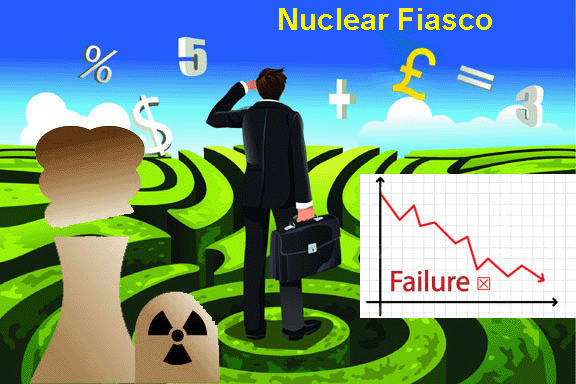 Ian Fairlie 11th Marcvh 2019 UK nuclear going down the pan? Readers will have seen the news that Rolls
Royce is trying to get rid of the main bulk of its civil UK nuclear
business though not Small Modular Reactors, nuclear submarines and Hinkley
Point C involvement.
It has appointed the consultancy firm KPMG to find a
buyer. This follows the earlier revelation that EdF Energy has been doing
the same for at least a year, ie trying to find a buyer for its ageing UK
reactor fleet.
It is unlikely either company will find a buyer, or at least
find one willing to pay a reasonable price . For example, UK energy giant
Centrica[4] has been trying for years to offload its 20% shareholding of
EDF Energy. Back in 2012, after it pulled out of the mooted Hinkley Point C
development (thereby losing £200 million in sunk costs), Centrica
appointed the German investment bank UBS to look for a suitable buyer but
none has ever been found.
The main reason these companies are trying to
offload their nuclear reactor businesses is that they are essentially
unprofitable: the electricity they produce is more expensive than the sales
they generate. And their fuel costs are far more expensive than the
effectively zero fuel costs of electricity from wind and solar.
https://www.ianfairlie.org/news/uk-nuclear-going-down-the-pan/
Misleading inaccuracies in BBC report on Hunterston nuclear reactors
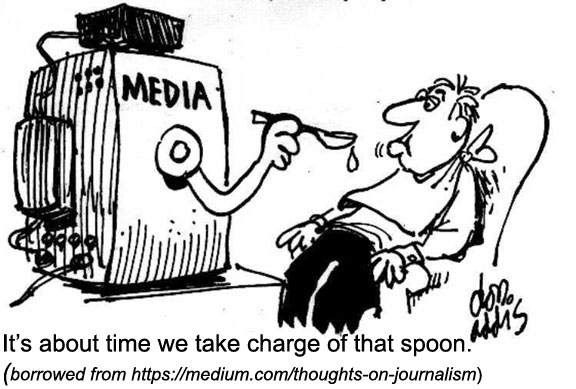 Ianfairlie 8th March 2019 On March 8, the BBC published a news item about cracks in the Hunterston B nuclear reactors. Whilst it is good that the story highlighted reporting of the safety issues surrounding the plant and, in particular, included photographs of the cracked graphite core, we wish to correct several inaccuracies.
The BBC article claims that early decommissioning could cause serious energy supply problems. This is simply not the case and is alarmist nonsense: the reality is that Scotland has, if anything, an oversupply of electricity. Both Hunterston and Torness could be closed without problem to Scotland’s electricity supplies.
The BBC article then states that “Concerns have also been raised about the consequences for local jobs if Hunterston closed early.”As pointed out in our article, few if any jobs would be lost if the reactors Hunterston B were closed permanently: dealing with the immense heat rates from radioactive decay even from closed reactors will guarantee jobs there for the first 2 to 3 years.
After that decommissioning will provide more jobs then when the reactors operated, just as is occurring at the closed reactors at Dounreay. The BBC cites Councillor Tom Marshall as stating: “Most of the large employers round about here have disappeared – and this is one of the last major employers.
So, if it is safe to run most people locally would be happy to see it running.” We obviously share the concerns of local people about deindustrialisation and the appalling effects of the UK Government’s uncivilised austerity programmes in Scotland. But local councillors should\ not be misled by incorrect statements by the nuclear industry. Closing
Hunterston B for good will not lead to large numbers of job losses: the contrary in fact.
Dave Toke’s Blog 8th March 2019
https://realfeed-intariffs.blogspot.com/2019/03/the-real-story-about-stricken.html
A billion dollar bailout for Three Mile Island Nuclear Station?

Bailout bill proposed for Three Mile Island nuclear plant, 21 News, by Jessie McDonough, March 9th 2019 MIDDLETOWN, PA — A 981-million dollar bailout will be proposed next week to keep Three Mile Island Nuclear Plant afloat.
Republican representatives want to amend Pennsylvania’s Alternative Energy Portfolio
MIDDLETOWN, PA — A 981-million dollar bailout will be proposed next week to keep Three Mile Island Nuclear Plant afloat.
Republican representatives want to amend Pennsylvania’s Alternative Energy Portfolio Standard by adding nuclear energy to the plan. Energy providers will have to buy a certain percentage of nuclear which would lead high utility bills for you the consumer.
The proposal would bail out two nuclear energy plants. One of those is Exelon’s Three Mile Island.
Not everyone is on board with the proposal and its’ hefty price tag.
“We are talking almost a billion dollar nuclear bailout and basically it is a tax on consumers. It is going to force energy prices to be higher”, said Commonwealth of Pennsylvania CEO Nathan Benefield.
Some residents in Middletown where the plant is located are also worried about increases in their electric bill……. https://local21news.com/news/local/bailout-bill-proposed-for-three-mile-island-nuclear-plant
Fukushima nuclear workers still facing radiation danger, eight years on.
 Eight years after Fukushima nuclear meltdown, workers still facing radiation risk https://www.peoplesworld.org/article/eight-years-after-fukushima-nuclear-meltdown-workers-still-facing-radiation-risk/ February 22, 2019 eight years since the nuclear meltdown at the Fukushima Daiichi Nuclear Power Plant. The NPP operator, Tokyo Electric Power Company (TEPCO), says that it will soon conduct a probe into the containment vessel of the No. 2 reactor in order to find out the condition of the melted nuclear fuel inside, which means that TEPCO has yet to obtain even such basic information.
TEPCO officials recently said to Akahata that high-risk zones in the Fukushima Daiichi plant have become smaller and that now workers do not need to wear a full-face mask and a protective suit in 96 percent of the plant premises. This is because the level of radioactive materials in the air has decreased as a larger area of the site is now covered with concrete, according to officials. At the crippled nuclear power plant, the number of workers coping with the aftermath of the 2011 nuclear accident, though, is still more than 4,000 per day.
However, the hidden reality regarding contamination risks seems to differ from the impression the utility wanted to create by citing the figure “96 percent.” In a recently published survey of Fukushima workers conducted by TEPCO, of the respondents who are anxious about their exposure to radiation, nearly half feared that their health would be damaged in the future. In another question in the same survey, more than 40 percent were concerned about working at the nuclear power plant.
The most common reason for their concern was that they have no idea how long they need to work at the plant because it is unclear how much work remains to be done. They are also worried about the risk of radiation-induced health damage in the future with no guarantee of a stable income. Without a worker-friendly environment, the decommissioning of the crippled reactors will be extremely time-consuming.
The storage of radiation-contaminated water is another major issue. Around 100-150 tons of polluted water is produced every day at the plant, which means that a 1,000-ton tank is filled up in seven to ten days. Currently, around 1.1 million tons of radioactive water are stored on the plant premises, but under TEPCO’s plan, the maximum planned storage capacity is only 1.37 million tons.
In another survey of residents conducted by municipalities near the Fukushima plant, among the respondents who decided not to go back to their hometowns and who cannot decide whether to do so, many cited worries about the safety of the plant as a reason.
The government of Prime Minister Shinzo Abe, however, is still encouraging Fukushima evacuees to return to their homes, but as the nuclear disaster drags on.
All use of nuclear power will end in Germany by end of 2022
Nuclear “finished” in Germany, plant operators affirm https://www.cleanenergywire.org/news/nuclear-finished-germany-plant-operators-affirm Frankfurter Allgemeine Zeitung 04 Mar 2019, Benjamin Wehrmann
The use of nuclear power in Germany will come to an end by the end of 2022 as planned, operators of the country’s remaining nuclear plants have told the Frankfurter Allgemeine Zeitung in reaction to a survey in which almost half of the respondents said nuclear plants should run longer than coal plants. Energy company EnBW said that the political regulation means that “nuclear energy is finished in Germany,” adding that its two remaining plants would be deconstructed right after they are taken off the grid. Ralf Güldner, head of the German Nuclear Forum, said ending nuclear power while at the same time phasing out coal and struggling to expand the power grid could mean that Germany’s autonomous power supply security becomes threatened. However, Güldner too said the political situation was “very clear.” Plant operator Preussen-Elektra said “we certainly don’t think about any plan B.” According to the article, operators say that they will not have qualified staff anymore to keep nuclear plants running longer than agreed.
In the survey, 49.5 percent of respondents said the planned decommissioning of the last nuclear plant by 2022 and of the last coal plant by 2038 is the right order, while 44.1 percent said closing nuclear plants before coal plants is wrong from a climate perspective.
Russia ready to enter deal to build nuclear power plant in Czech Republic
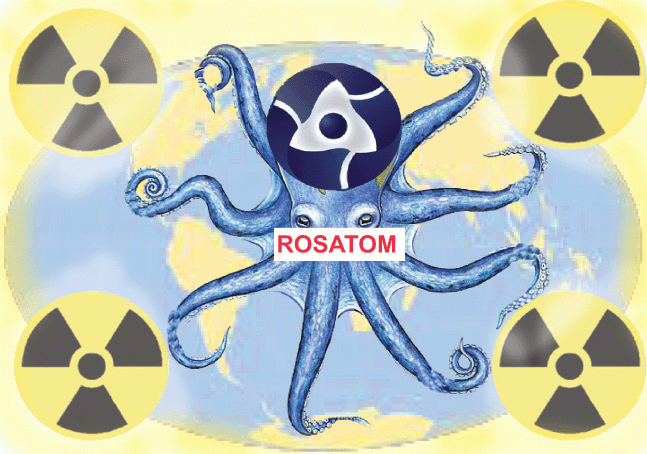 CZECH-RUSSIAN TALKS INCLUDED DISCUSSIONS ON CONSTRUCTION OF NEW NUCLEAR POWER BLOCK, https://www.radio.cz/en/section/news/czech-russian-talks-included-discussions-on-construction-of-new-nuclear-power-block Tom McEnchroe, 06-03-2019
His Czech counterpart Marta Nováková (ANO) said one tender conditions would be that the third nuclear power source remain fully under the administration of the Czech Republic once finished.
The intergovernmental commission also discussed mutual cooperation in supporting small- and medium-sized businesses, mutual exports into third-countries and cooperation within the aircraft industry.
Russia keen to have Bulgaria go into debt to Russia, to implement Belne nuclear station
 Russia Ready To Take Part in Bulgaria’s Belene Nuclear Power Plant, Medvedev Says, Moscow Times
Russia to lease nuclear-powered attack submarine to India for a cool $3 billion
|
India, Russia To Sign $3 Billion Nuclear Sub Deal This Week
India and Russia are set to sign a $3 billion lease agreement for a nuclear-powered attack sub on March 7, according to local media reports. The Diplomat, By Franz-Stefan Gady, March 05, 2019 India and Russia are expected to conclude an intergovernmental agreement for a 10-year lease of a Russian nuclear-powered attack submarine (SSN) this week. The deal, estimated to be worth around $3 billion, will likely be inked on March 7, according to sources cited by The Economic Times. Neither the Indian nor Russian defense ministries, however, have officially confirmed that a signing ceremony will be held in the coming days. |
|
Texas-based Uranium Energy Corporation strongly lobbying Trump administration, and demonising Canadian company Uranium One
The Nuclear Energy Industry Goes MAGA to Win Over Trump
A U.S. uranium company set up shop at CPAC and started spreading Clinton scare stories. The Daily Beast, Lachlan Markay, 03.03.19 A leading U.S. uranium producer is confident that President Donald Trump is going to crack down on its foreign competitors. But in the spirit of not taking any chances, the company rented space at the annual Conservative Political Action Conference, enlisted a top Trumpworld public relations executive, and invoked a well-worn Trump attack line on his 2016 campaign opponent to try to nail down a policy win.
New defects, after a series of problems and delays, in France’s supposed “nuclear flagship” Flamanville
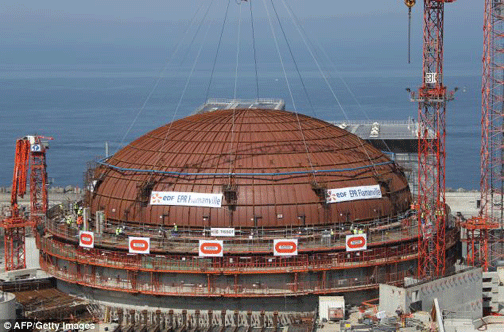 France Info 1st March 2019 Machine Translation] Cracks, failed welds … How the site of the EPR Flamanville has turned into a fiasco to nearly 11 billion euros.
The third generation nuclear reactor, which was to take office in 2012, will finally be operational only in 2020 after the discovery of new defects. Back on those days when the yard slipped. It was to be the flagship of the French nuclear industry, the EPR of Flamanville (Manche) is today its ball.
The construction site of the European Pressurized Reactor (EPR) experienced numerous delays, the last of which occurred on July 25, 2018, after the discovery of poorly made welds. Originally scheduled for 2012, its entry into service is (for the moment) postponed to 2020. And nothing says that the yard will be spared by new counter-time. The Nuclear Safety Authority (ASN) thus pinned EDF on Wednesday (February 27th) for a lack of “traceability” of certain equipment qualification operations on the EPR.
Trump’s son-in-law, Jared Kushner, helping Saudi Crown Prince towards getting nuclear weapons?
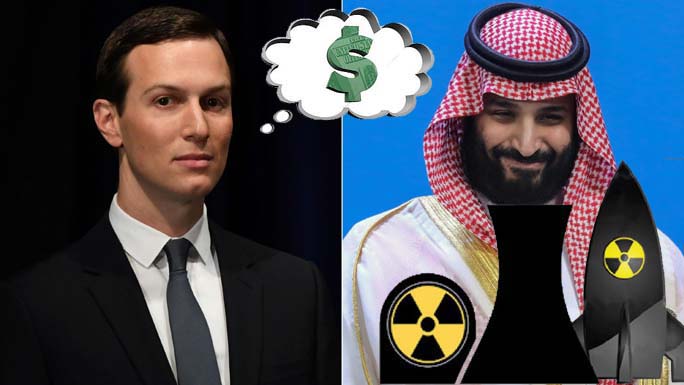
There are too many unanswered questions about the White House’s role in advancing Saudi ambitions. By Nicholas Kristof, March 2, 2019
Jared Kushner slipped quietly into Saudi Arabia this week for a meeting with Crown Prince Mohammed bin Salman, so the question I’m trying to get the White House to answer is this: Did they discuss American help for a Saudi nuclear program?
Of all the harebrained and unscrupulous dealings of the Trump administration in the last two years, one of the most shocking is a Trump plan to sell nuclear reactors to Saudi Arabia that could be used to make nuclear weapons.
Even as President Trump is trying to denuclearize North Korea and Iran, he may be helping to nuclearize Saudi Arabia. This is abominable policy tainted by a gargantuan conflict of interest involving Kushner.
Kushner’s family real estate business had been teetering because of a disastrously overpriced acquisition he made of a particular Manhattan property called 666 Fifth Avenue, but last August a company called Brookfield Asset Management rescued the Kushners by taking a 99-year lease of the troubled property — and paying the whole sum of about $1.1 billion up front.
Alarm bells should go off: Brookfield also owns Westinghouse Electric, the nuclear services business trying to sell reactors to Saudi Arabia.
Saudi swamp, meet American swamp.
It may be conflicts like these, along with even murkier ones, that led American intelligence officials to refuse a top-secret security clearance for Kushner. The Times reported Thursday that Trump overruled them to grant Kushner the clearance.
This nuclear reactor mess began around the time of Trump’s election, when a group of retired U.S. national security officials put together a plan to enrich themselves by selling nuclear power plants to Saudi Arabia. The officials included Michael Flynn, Trump’s national security adviser, and they initially developed a “plan for 40 nuclear power plants” in Saudi Arabia, according to a report from the House Oversight and Reform Committee. The plan is now to start with just a couple of plants.
As recently as Feb. 12, Trump met in the White House with backers of the project and was supportive, Reuters reported.
These are civilian nuclear power plants, and Saudi Arabia claims it wants them for electricity. But the Saudis insist on producing their own nuclear fuel, rather than buying it more cheaply abroad. Producing fuel is a standard way for rogue countries to divert fuel for secret nuclear weapons programs, and the Saudi resistance to safeguards against proliferation bolsters suspicions that the real goal is warheads.
Trump may be vigilant (destructively so) about Iran’s nuclear plants, but in the Saudi case his response seems to be: There’s money to be made! When Israeli Prime Minister Benjamin Netanyahu raised objections to the transfer last year, Axios reported, “Trump and his advisers told Netanyahu that, if the U.S. does not sell the Saudis nuclear reactors, other countries like Russia or France will.”
Trump seems to believe that the Saudis have us over a barrel: If we don’t help them with nuclear technology, someone else will. That misunderstands the U.S.-Saudi relationship. The Saudis depend on us for their security, and the blunt truth is that we hold all the cards in this relationship, not them.
Why on earth would America put Prince Mohammed on a path to acquiring nuclear weapons? He is already arguably the most destabilizing leader in an unstable region, for he has invaded Yemen, kidnapped Lebanon’s prime minister, started a feud with Qatar, and, according to American intelligence officials, ordered the murder of the Washington Post columnist Jamal Khashoggi.
The prince has also imprisoned and brutally tortured women’s rights activists, including one who I’m hoping will win the Nobel Peace Prize, Loujain al-Hathloul. As Representative Brad Sherman, a California Democrat, has noted, “A country that can’t be trusted with a bone saw shouldn’t be trusted with nuclear weapons.”
There’s another element of Trump’s Saudi policy that is simply repulsive: the fawning courtship of a foreign prince who has created in Yemen the world’s worst humanitarian crisis, murdered a journalist and tortured women’s rights activists. The White House genuflections are such that Prince Mohammed had a point when, according to The Intercept, he bragged that he had Kushner in his “pocket.”
No one knows whether Prince Muhammed will manage to succeed his father and become the next king, for there is opposition and the Saudi economic transformation he boasts of is running into difficulties. Trump and Kushner seem to be irresponsibly trying to boost the prince’s prospects, increasing the risk that an unstable hothead will mismanage the kingdom for the next 50 years. Perhaps with nuclear weapons.
Rolls Royce largely getting out of the nuclear industry
 Times 3rd March 2019 Rolls-Royce is selling the vast bulk of its civil nuclear business, dealing a new blow to efforts to rebuild Britain’s atomic power industry. The FTSE 100 engineer has hired consultants from KPMG to find a buyer for the
nuclear division, which could fetch up to £200m.
The move marks the end of an era for the country’s premier engineering company, which has more than 50 years’ expertise in nuclear power but is being slimmed down by chief executive Warren East to focus on jet engines, power generators and defence. The nuclear business makes instruments and controls to monitor radiation and temperature and prevent reactors overheating. Its equipment is installed in more than 200 reactors around the world, and it has a big presence in France, where it works with the state-backed engineering firm Orano , [formerly Areva, which went bankrupt]
Rolls-Royce’s retreat from civil nuclear work reflects the industry’s broader problems. Plans for new power stations in Britain have been left in tatters after the Japanese industrial giants Toshiba and Hitachi withdrew, leaving just Hinkley Point in Somerset under way.
The Japanese exit has triggered an inquiry by the Commons business committee into future investment in energy infrastructure. The sale will not include Rolls-Royce’s work on Hinkley Point, which is ringfenced, the company’s
project to develop small reactors or its nuclear submarine reactor business.
Rolls-Royce has been in talks to install its equipment at a plant in Essex planned by China General Nuclear, to help assuage security concerns. This work is likely to be transferred to the new owner. Sources said the business, which has more than 1,000 staff, was likely to go to a trade buyer. A Chinese deal is unlikely.
https://www.thetimes.co.uk/edition/business/rolls-royce-to-offload-civil-nuclear-unit-zsq59zlmm
U.S. army wants risky small modular nuclear reactors
The Army wants mobile nuclear reactors for FOBs, but some scientists say that’s ‘naive’, Army Times The Army wants to bring back mobile nuclear reactors to power forward bases and is asking industry how to make that happen.
A collection of scientists that closely monitor nuclear issues thinks that the concept is “naive,” dangerous and describes the chances for the current technology to accomplish what the Pentagon wants as “vanishingly small.”
In January, the Pentagon’s Strategic Capabilities Office posted a request for information on the government website fbo.gov asking for information from industry on how companies might provide a less than 40-ton small mobile nuclear reactor design, capable of operating for three years or more and putting out 1 to 10 megawatts of power.
Dubbed “Project Dilithium,” a nod to the fictional dilithium crystal, a fuel source that powered warp drives in the Star Trek films and television series…….
But Edwin Lyman, acting director of the Nuclear Safety Project at the Union of Concerned Scientists, noted that the Army’s own study showed the devices would “not be expected to survive a direct kinetic attack.”
Lyman acknowledges the Army’s need to save fuel, reduce convoys and transports and minimize attacks on those elements of the force. But, he also argues that adding reactors to the battlefield could create more problems than it solves.
In a lengthy response to the program posted on the Bulletin of Atomic Scientists website, Lyman outlines the scientific, safety and policy problems with developing and deploying a small mobile nuclear reactor.
 But he closes with his analysis that the nuclear ambitions of the ground forces are part of a “patient, decade-long effort by nuclear lobbyists” aimed at gaining the interest of both the Pentagon and Congress to be “the savior small nuclear reactor vendors need: deep-pocketed and unbeholden to return-seeking investors.”
He implores defense officials to “pull the plug on this misguided effort.” ……….
The Army Nuclear Power Program, which ran from 1954 to 1977, developed eight small nuclear reactors. Those reactors ranged in power production from 1 to 10 megawatts.
How five of the eight reactors were used:
- The PM-1 reactor was used in Sundance, Wyoming, from 1962 to 1968.
- The PM-2A was used at Camp Century, Greenland, from 1961 to 1964.
- The PM-3A was used at McMurdo Base, Antarctica, from 1962 to 1972.
- The ML-1 was used in developmental testing from 1962 to 1966.
- The MH-1A Panama Canal Zone from 1965 to 1977.
Lyman notes a major failure with one of the original eight designs in 1961 when a core meltdown and explosion of the ML-1 reactor in Idaho killed three operators.
The three deployed to Antarctica, Greenland and Alaska proved “unreliable and expensive to operate,” Lyman wrote.
The idea was resurrected by the National Defense Authorization Act for FY 2014, in which Congress asked for a report on a “small modular reactor” to power forward or remote operating bases.
A Defense Science Board task force then published a detailed report in 2016 outlining the power requirements that could be met with such hardware. Last year, the Army’s deputy chief of staff, G-4, published a 148-page study on the use of mobile nuclear power plants for ground operations, adopting the recommendations of the 2016 Defense Science Board and further advocating, as the board did, that the Army manage ground nuclear reactor programs and pursue existing or near-to-maturity technologies.
Last year’s Army G-4 report outlined a dozen existing locations that officials think could have power provided by the type of mobile reactor they’re seeking:
- Thule, Greenland
- Kwajalein Atoll
- Guantanamo Bay, Cuba
- Diego Garcia
- Guam (for both a naval and Air Force facility on the island)
- Ascension Island
- Fort Buchanan, Puerto Rico
- Bagram Air Base, Afghanistan
- Camp Buehring, Kuwait
- Fort Greely, Alaska
- Lajes Field, Azores……… https://www.armytimes.com/news/your-army/2019/03/01/the-army-wants-mobile-nuclear-reactors-for-fobs-but-some-scientists-say-thats-naive/
Santee Cooper continues search for new owner after failed nuclear project
https://www.counton2.com/news/local-news/berkeley-county-news/santee-cooper-continues-search-for-new-owner-after-failed-nuclear-project/1820291050 MONCKS CORNER, SC – A special legislative committee is looking into what to do with state-owned utility, Santee Cooper.
The company is in billions of dollars in debt because of the failed nuclear reactor project in Fairfield County.
The State newspaper reports that this week the committee authorized co-chairmen State Senator Paul Campbell of Charleston and State Representative Murrell Smith of Sumter to hire an outside consultant.
That hire will eventually evaluate bids to buy Santee Cooper and negotiate with those potential buyers.
Radiation in a crematorium traced back to a human body
It wasn’t enough radiation to be alarming, but it could be a sign of an ongoing problem The Verge By A crematorium in Arizona became contaminated with radiation when workers cremated a man who had received radiation treatments for cancer right before he died, a new study reports. The findings highlight a potential safety gap for crematory workers, who might not know what’s in the body they’re cremating.
In this case, the radiation in the crematorium wasn’t significant enough to be worrying for the crematory worker’s health, according to a study published today in the Journal of the American Medical Association. But the study also found clues that exposure to radioactive compounds from medical treatments may be an ongoing safety risk for crematory workers……..
It’s not an easy problem to fix. Manufacturers provide detailed instructions for handling the drug with patients who are alive, but not for ones that have died, Yu says. “It presents a unique safety challenge.” Detecting radioactive materials is more complicated than running a Geiger counter over the body. And there aren’t any federal regulations for what to do with a radiation-treated body, Yu says, so the laws change from state to state. ……https://www.theverge.com/2019/2/26/18241402/radiation-crematorium-arizona-radiopharmaceuticals-cancer-body-lutetium
1 This Month
26 September – International Day for the Total Elimination of Nuclear Weapons





PLEASE OPPOSE HR 8255 AND S.3639 – bills would accelerate satellite deployment, with no environmental review or safeguards – https://ncstd5li.quorum.us/campaign/169331/
To see nuclear-related stories in greater depth and intensity – go to https://nuclearinformation.wordpress.com
-
Archives
- September 2026 (291)
- August 2026 (330)
- July 2026 (355)
- June 2026 (287)
- May 2026 (306)
- April 2026 (356)
- March 2026 (251)
- February 2026 (267)
- January 2026 (308)
- December 2025 (358)
- November 2025 (359)
- October 2025 (375)
-
Categories
- 1
- 1 NUCLEAR ISSUES
- business and costs
- climate change
- culture and arts
- ENERGY
- environment
- health
- history
- indigenous issues
- Legal
- marketing of nuclear
- media
- opposition to nuclear
- PERSONAL STORIES
- politics
- politics international
- Religion and ethics
- safety
- secrets,lies and civil liberties
- spinbuster
- technology
- Uranium
- wastes
- weapons and war
- Women
- 2 WORLD
- ACTION
- AFRICA
- Atrocities
- AUSTRALIA
- Christina's notes
- Christina's themes
- culture and arts
- Events
- Fuk 2022
- Fuk 2023
- Fukushima 2017
- Fukushima 2018
- fukushima 2019
- Fukushima 2020
- Fukushima 2021
- general
- global warming
- Humour (God we need it)
- Nuclear
- RARE EARTHS
- Reference
- resources – print
- Resources -audiovicual
- Weekly Newsletter
- World
- World Nuclear
- YouTube
-
RSS
Entries RSS
Comments RSS

