Reliability problems at Mississippi’s Grand Gulf nuclear power plant
|
Grand Gulf nuclear power plant troubles ‘happening far too often,’ Mississippi official says, Clarion Ledger
Operators took the southwest Mississippi plant offline last week, citing problems with a turbine bypass valve. Last Wednesday’s outage came to light Tuesday when the federal Nuclear Regulatory Commission announced a special inspection. “The reactor was safely shut down but some equipment issues occurred that the agency wants to better understand,” the agency said in a statement. It’s at least the sixth unplanned decrease in output at the plant in the last 15 months, according to NRC documents. The plant has been running at reduced or zero power output for much of the time since 2016, according to an analysis published earlier this month by E&E News ……. The plant’s troubles come as President Donald Trump continues to support plans to subsidize nuclear power generation for reliability purposes. ……. Beyond questions of safety, the absence of Grand Gulf’s 1,443-megawatt capacity can stress power supplies and may cause higher prices across Mississippi, Arkansas, Louisiana and southeastern Texas, a region that includes not only New Orleans-based Entergy’s utilities, but cooperatives and private utility Cleco of Pineville, Louisiana……. Entergy spent hundreds of millions to increase the plant’s generating capacity in 2012, setting it up to be a cornerstone of low-cost generation in the region for decades, especially after winning a 20-year extension of the plant’s license from the NRC through 2044. But when it’s down, utilities have to buy power from other plants in the MISO region……..https://www.clarionledger.com/story/news/2018/12/19/grand-gulf-nuclear-power-plant-outage-safety-reliability-ms-entergy/2361876002/ |
|
Japan’s nuclear export industry about to get the fatal blow
 Sun setting on Japan’s nuclear export sector http://www.atimes.com/article/sun-
 setting-on-japans-nuclear-export-sector/
Post-Fukushima cost overruns may kill a giant power project in Turkey, and there are few other deals to replace it
The Sinop plant project in Turkey was seen as Japan’s best chance for an industry – battered and bruised after the 2011 tsunami and triple meltdown at Fukushima – to put together a workable export strategy that did not break the bank of potential international customers.
Aside from Sinop, the Japanese industry has only one viable export project still upcoming: Hitachi’s bid to build two reactors on the island of Anglesey in Britain. And even that deal is looking shaky.
Mitsubishi Heavy Industries (MHI) has not pulled the plug yet on its stake in the four-reactor project on Turkey’s Black Sea coast, but a slew of domestic media reports and talk in Tokyo, suggests that, in the face of seemingly ever-rising construction costs to meet new safety standards that have been put in place since the 2011 Fukushima disaster, the company will bail.
Fukushima legacy
When the deal was signed with Ankara in 2013, the ownership profile was: 65% awarded to a consortium made up of MHI, Itochu, France’s Areva, and GDF Suez. The other 35% was covered by Turkey’s electric power utility, Elektrik Uretim.
However, in April, Itochu pulled out of the consortium, citing cost overruns. That left the consortium with 51%, and the remaining 49% owned by the Turkish utility.
Without Mitsubishi the viability of the project is in question, sources say, unless Turkey can find a new partner or is willing to take on the project without its largest foreign partner. The Russians, who are building a nuclear complex on Turkey’s southern Mediterranean coast, might be interested.
According to Kyodo, a thorough cost evaluation was to be completed by the end of this year. Itochu waited for the report to be released before bailing out of the deal. MHI is apparently waiting for the study to be completed before deciding its next move.
When the deal with Mitsubishi was signed in 2013, the estimated cost was $18 billion for four 1,100-megawatt nuclear power plants. But overall costs have soared, passing $42 billion in April – when Itochu withdrew, and is now put at about $44 billion.
Cost increases are nothing new in the nuclear power industry, but have been exacerbated in recent years by expensive adjustments phased in to meet more stringent safety concerns following the earthquake and tsunami that destroyed four units of the Fukushima Daiichi plant. The Sinop cost rises, however, also encompass other problems encountered in construction.
Fukushima, one of the most serious nuclear accidents in history, turned most of Japan against nuclear power. Before March 11, 2011, Japan had 54 nuclear plants. All were shut down after the accident and some are slowly returning to service having passed scrutiny by the regulator. Five are expected to restart within the next five years, and eight will likely be decommissioned. But prospects for the remaining plants are unclear.
Aware that no new nuclear plant may ever be built at home amid the anti-atomic public mood, Japan’s nuclear vendors have turned to overseas exports as the Fukushima accident does not appear to have destroyed the Japanese industry brand in other countries.
Endgame for nuclear exports?
If Mitsubishi does pull out of the huge project in Turkey it will be a blow to Prime Minister Shinzo Abe, who sees international exports of nuclear technology as an important way to boost the economy. On his many trips abroad, he often acts as a salesman for nuclear exports. For example, it was a topic of discussion with Turkish President Recep Erdogan on the sidelines of the G-20 meeting in Argentina.
Details of the conversation were not revealed, but it would be a good bet that they discussed the Sinop project with the threat of Mitsubishi hanging over them, and that Abe sought ways to keep the project viable.
Meanwhile, it is not just MHI that may have doubts about the sector. Japan’s nuclear export industry has suffered plenty of setbacks in the seven years since Fukushima. Questions about the future of the sector hang over all three main players in the sector.
Toshiba, one of Japan’s big-three nuclear constructors, recently pulled out of the nuclear power business overseas after incurring huge losses in the United States.
Toshiba has also suffered something of an administrative meltdown in its quest to win construction contracts in the US. In February it finally unloaded it money-losing American subsidiary, Westinghouse, for $1 billion less than it paid to acquire the company 10 years ago.
If the export program is to remain viable, it may be in Wales, where the British government is seeking to build a two-reactor nuclear power plant on the island of Anglesey. Among those bidding for the project is Japan’s third nuclear constructor, Hitachi, through a subsidiary called Horizon Nuclear.
In the nuclear world, there are constructors – like MHI, Toshiba and Hitachi – and operators, who run the plant after it is completed, and they are not always the same. Japan learned from Korea’s successful bid to build six nuclear plants in the United Arab Emirates that offering to build and also run them – a one-stop service – is key to making sales.
Hitachi is teaming up with the Japan Atomic Power Company, which operates two plants in Japan (although both are currently shut down pending the review by regulators). The plan is to present the British with a package deal.
Now, there are worries that Hitachi might pull out of the British project. Chairman Hiroaka Nakanishi was quoted in the Times of London saying his company was “facing an extreme situation,” and that a final decision on whether to stay with the project or leave it will be made next year.
If Mitsubishi does, as is widely expected, pull out of the huge project in Turkey, the only egg left in Japan’s overseas nuclear export basket will be Wales.
Hitachi having trouble financing new nuclear reactors in Wales – may pull the plug on Wylfa project

Hitachi may freeze British nuclear project due to swelling costs, https://www.japantimes.co.jp/news/2018/12/16/business/corporate-business/hitachi-may-freeze-british-nuclear-project-due-swelling-costs/#.XBawLdIzbGg
KYODO 17 Dec 18, Hitachi Ltd. is considering freezing its plan to build nuclear reactors in Wales after facing difficulties in finding investors to finance the project’s ballooning costs, sources close to the matter said Sunday.
If the Japanese conglomerate freezes the ¥3 trillion Wylfa Newydd plant construction, all of the overseas nuclear projects promoted by the government of Prime Minister Shinzo Abe as part of his growth strategy would have faltered.
Mitsubishi Heavy Industries Ltd. is mulling withdrawing from a nuclear project in Turkey amid swelling safety-related costs following the 2011 Fukushima nuclear accident, while Toshiba Corp. has decided to exit from the nuclear plant business outside Japan after incurring huge losses in the United States.
Hitachi has said it wants to lower its stake in Horizon Nuclear Power Ltd., a wholly owned unit it acquired in 2012 from two German electric utilities to take over the nuclear project, to below 50 percent to limit the impact on the Hitachi group of the construction of two advanced boiling water reactors on the Isle of Anglesey in Wales.
Hitachi is likely to have told the British and Japanese governments of its plan to freeze the project, the sources said. The issue will likely be discussed at the planned meeting between Abe and British Prime Minister Theresa May in January, they said.
The company has been contacting prospective investors in the project, including Japanese utilities, but little progress has been made amid concerns that costs will further swell, they said.
Hitachi also remains at odds with the British government over the purchase price of electricity to be generated by the plant, a key factor in determining the project’s profitability for the company and potential investors.
Given the current turmoil in British politics over May’s proposed deal with the European Union on the United Kingdom’s departure from the bloc, price-setting talks are at a “deadlock,” a senior Hitachi official said.
Cost of Chinese-designed and largely Chinese-owned nuclear reactor for Bradwell UK will probably blow out hugely

 Dave Toke’s Blog 16th Dec 2018 The UK’s Office for Nuclear Regulation (ONR) has requested a long series of safety improvements to the proposed design of the Chinese HPR1000 (‘Hualong’) reactor proposed to be built at Bradwell in Essex. Previous experience suggests this could presage a big increase in costs for the plant which is likely to cost a lot more than similar plant built in China. The HPR100 design Bradwell, UKis based on one being built in China at by China General Nuclear Power Group (CGN). CGN will own around two-thirds of the project, with EDF owning the remaining share.
‘follow up’ point materials must severely question any financial estimates of the plant’s costs that have been based on the plant being built in
China.
https://realfeed-intariffs.blogspot.com/2018/12/office-for-nuclear-reactor-demands.html
Hitachi calling on Britain to further subsidise new nuclear reactors for Wales
 Hitachi to ask UK for further funding as nuclear project stalls https://asia.nikkei.com/Business/Companies/Hitachi-to-ask-UK-for-further-funding-as-nuclear-project-stalls
Company struggles to find other Japanese parties willing to invest TAKAFUMI HOTTA and SHINICHIRO IBUSUKI, Nikkei staff writers, DECEMBER 18, 2018
TOKYO — Hitachi will ask the British government for additional support for a nuclear power project in Wales as it struggles to recruit other Japanese investors amid international headwinds for atomic energy.
The company will consider scrapping the project, worth more than 3 trillion yen ($26.6 billion), should negotiations with London fail to reach a conclusion by January.
Aborting Japan’s last active proposal to build an overseas nuclear power plant would deal a blow to the government’s plan to expand exports of energy-related infrastructure, as similar projects face setbacks around the world.
“It is a fact that it is facing a difficult situation,” Hitachi Chairman Hiroaki Nakanishi said at a news conference Monday. “I told the British government that we are already reaching the limit.”
Nakanishi was speaking in his capacity as chairman of the Japan Business Federation, the nation’s top business lobby, better known as Keidanren. The news conference was held after reports emerged that Hitachi is considering scrapping the project altogether due to the difficulty of securing funding from Japanese companies.
With aid from the British government, Hitachi’s nuclear power segment intends to build two reactors on the Welsh island of Anglesey through British subsidiary Horizon Nuclear Power. It was scheduled to make a decision on the project’s economic feasibility sometime in 2019 but will probably push that decision forward by more than six months as the business environment worsens.
Nuclear power is losing its competitiveness as the price of renewable energy falls. The U.K. government also plans to buy electricity from the Wales plant for lower prices than those charged by other nuclear power facilities.
The Japanese government has promoted overseas nuclear power plant construction as a pillar of its strategy to boost infrastructure exports. Since the 2011 Fukushima disaster, no new reactors have been approved inside Japan. To maintain nuclear expertise and talent, Japan’s public and private sectors have teamed up to sell the technology abroad.
But ground has not broken on any project to date. A Japanese public-private consortium led by Mitsubishi Heavy Industries is planning to scrap a nuclear power plant in Turkey, for instance. Should the nuclear industry lose its legs, it could affect the restating and decommissioning of existing plants.
Hitachi has said it will move forward with the project if it can limit its exposure by reducing its 100% stake in Horizon Nuclear to around 30%. The U.K. has pledged more than 2 trillion yen in loans for the project, with the remaining cost of about 900 billion yen to be split among investments from Hitachi, the British government and business as well as the Japanese government and businesses.
Lining up Japanese investors, however, has proved to be a challenge. Tokyo Electric Power Co. Holdings, also known as Tepco, is reluctant to provide funding. Chubu Electric Power and other Japanese companies probably will follow its lead. Without other investors on the horizon, Hitachi is asking the British to share more of the burden.
Aside from Tepco and Chubu Electric, Hitachi also solicited investments from Japan Atomic Power, the Japan Bank for International Cooperation, the Development Bank of Japan and other parties. But the industrial conglomerate is having trouble gathering the necessary 300 billion yen.
The British government is no position to acquiesce to these demands. Having already pledged around $18 billion in loans, it risks backlash from the public by providing further financial support. Prime Minister Theresa May can ill afford another fight as her government risks collapse over negotiations to leave the European Union.
At a separate news conference held by Hitachi, Toshiaki Higashihara, the company’s president and CEO, did not attempt to downplay the situation. “Hitachi is a private company,” he said, “and there is a limit to how much risk it can take. If the project is not economically rational, it is possible that the project will be halted.”
Higashihara added that the final investment decision will be made by the end of 2019.
Hitachi Executive Vice President and Executive Officer Toshikazu Nishino also spoke, saying the company “has not given up yet,” though it recognizes “the negotiations are not easy.”
Saudi Arabia, the Khashoggi murder case: the nuclear connections with Terra Power, Bill Gates, Breakthrough etc
 US Nuclear Energy Policy & Khashoggi Murder: Appeasement Or Threat? Clean Technica, December 12th, 2018 by Tina Casey “…………..The Nuclear Energy Connection
Either way, that brings us around to the idea that the corporate world needs to step up and press for meaningful action on the Khashoggi case, since the White House is falling down on the job.
In particular, the tech sector is feeling the pressure not only because of its financial ties to Saudi Arabia, but also because of the high profile of its biggest players.
That brings us right back around to the nuclear energy angle, where the US nuclear company TerraPower has been making waves.
TerraPower was formed back in 2006 and crossed the CleanTechnica radar during COP 2015, when it popped up in relation to a newly launched investor umbrella organization called the Breakthrough Energy Coalition.
Breakthrough is a tech incubator with a focus on clean energy and rapid decarbonization, and nuclear energy makes the cut.
As a global organization, Breakthrough can provide TerraPower with a platform for pitching its technology overseas — a key consideration, given the morbid state of demand for new nuclear power plants here in the US.
So far TerraPower has been focusing on foreign markets, particularly China, for its new technology.
If all of this is beginning to ring some bells, that’s where the tech and Silicon Valley connections kick in.
Microsoft’s Bill Gates is financial backer of TerraPower and chairman of its board.
Gates is also the chair of the Breakthrough Coalition’s Breakthrough Energy Ventures, where you’ll find a host of other familiar top-dollar investors with an interest in decarbonization including Jeff Bezos, Richard Branson, Vinod Khosla, and Michael Bloomberg.
Saudi Arabia is represented among Breakthrough members through Prince Alwaleed bin Talal, who is Chairman of Alwaleed Philanthropies and a supporter of Gates’s “giving pledge.”
Saudi Arabia is also represented among the 24 countries (including the EU) that support the Mission Innovation clean energy initiative, which is in turn receives considerable support from Breakthrough, so there’s that.

Not for nothing, but as of last August the Department of Energy has supported a TerraPower molten salt reactor project with $28 million in cost-shared funds.
When Will The Silicon Valley Crickets Stop Chirping And Start Acting?
All this is by way of saying that when it comes to the Saudi government, the Khashoggi murder, and the cash flow, all roads lead back to Silicon Valley and the US tech sector.
The New York Times raised a red flag on Saudi financial ties to Silicon Valley last year. Among other developments since then, Tesla has been ramping up its profile in the country, and Google has expressed interest in building data centers there.
Perhaps it’s not fair for the tech sector to take all the heat, but on the other hand these are the guys who promised to make life better for millions if not billions of people all over the world. More is expected of them than, say, the CEO of a local pest control company.
The Trump family’s financial ties with Saudi Arabia seem to be the driving force behind Trump’s response to the Khashoggi murder, and now it seems those same ties have silenced the US tech sector.
The fact is that the Khashoggi murder is not going away. New details about the murder are emerging on a regular basis, and even Trump’s Republican allies have finally stirred into action.
In the latest development, today the US Senate is reportedly set to debate cutting off US support for the Saudi-lead war in Yemen. The measure has been linked directly to outrage over the country’s role in the Khashoggi killing.
Meanwhile, CleanTechnica is reaching out to TerraPower for comment, so stay tuned for more on that.
Follow me on Twitter. https://cleantechnica.com/2018/12/12/us-nuclear-energy-policy-khashoggi-murder-appeasement-or-threat/
Amazon planning to run a “global brain” for the Pentagon.
To understand the implications of JEDI, we must realize that the information being gathered and sorted will inevitably be used for the targeting and killing of not only opposing government-based military forces, but also nongovernmental individuals and groups who are viewed as political or potential military threats by the US.
The transfer of a massive amount of military information into a privately owned and built cloud, as will happen with the creation of JEDI, raises the possibility that the owner or owners of that cloud will — because of their knowledge of the cloud structure, capabilities and content — become more powerful than military and elected officials.
 “Alexa, Drop a Bomb”: Amazon Wants in on US Warfare, Nick Mottern, Truthout https://truthout.org/articles/alexa-drop-a-bomb-amazon-wants-in-on-us-warfare/December 16, 2018
Amazon is seeking to build a global “brain” for the Pentagon called JEDI, a weapon of unprecedented surveillance and killing power, a profoundly aggressive weapon that should not be allowed to be created.
Founded in 1994 as an online book seller, Amazon is now the world’s largest online retailer, with more than 300 million customers worldwide, and net sales of $178 billion in 2017.
Amazon has built a vast, globally distributed data storage capacity and sophisticated artificial intelligence programs to propel its retail business that it hopes to use to win a $10 billion Pentagon contract to create the aforementioned “brain” that goes by the project name Joint Enterprise Defense Infrastructure, a moniker obviously concocted to yield the Star Wars acronym — JEDI.
As of the October 12, 2018, deadline for submitting proposals for JEDI, Amazon is the betting favorite for the contract, which will go to just one bidder, in spite of protests by competitors, chief among them Microsoft and IBM. The Pentagon appears likely to select a winner for the contract in 2019.
Jedi Powers? Continue reading
Nuclear power is no answer to global heating – even if only because nuclear power is unaffordable
 Want to solve climate problem? Nuclear isn’t the answer https://www.downtoearth.org.in/blog/energy/want-to-solve-climate-problem-nuclear-isn-t-the-answer-62428
Alternatives to nuclear energy, in particular renewable sources of electricity like wind and solar energy, have become drastically cheaper. By M V RamanaL 10 December 2018 “It is nuclear power that will be the main tool to reduce emissions” said Poland’s Minister of Energy, Krzysztof Tchórzewski, in keynote remarks at a meeting during the 24th Conference of Parties to the United Nations Framework Convention on Climate Change (COP 24) being held in Katowice, Poland. There is more than a little irony in that statement.
To start with, Poland, which is invested heavily in coal, has no nuclear power plants; its current plans call for starting nuclear power generation in 2030. That projection has to be taken with more than a pinch of salt. In 2002, even the International Atomic Energy Agency (IAEA), whose official objective is “to accelerate and enlarge the contribution of atomic energy”, concluded that nuclear power in Poland was not viable because of “insufficient economic competitiveness of nuclear plants, availability of cheaper alternatives and the absence of environmental motivation”.
The second irony was that Tchórzewski was speaking at an event organised by an initiative called Nuclear Innovation: Clean Energy Future, that was set up in May 2018 by the country that is withdrawing from the Paris climate accord, the United States of America. The United States, under the Trump administration, has been engaged in the perverse pursuit of various efforts that will result in increased emissions. Such an administration touting nuclear power suggests a basis for scepticism about nuclear energy being a tool to reduce emissions.
The final, and the most important, irony is that nuclear energy is fading in importance globally. The peak in nuclear power’s share of global electricity generation was 17.5 percent in 1996. Since then this fraction has steadily declined, reaching 10.3 percent in 2017. For a variety of reasons, the downward trend is expected to continue.
Although nuclear energy’s share of electricity generation has been continuously declining, expectations for how nuclear energy will fare in the future went up in the first decade of this millennium, thanks to propaganda from nuclear advocates about an impending nuclear renaissance. That supposed resurgence came to a crashing halt after multiple devastating accidents at the Fukushima Daiichi nuclear plant in Japan that started in 2011, which reminded the world about the hazardous technology involved in the generation of nuclear power. Even the IAEA’s average projections for nuclear power for the year 2050 have decreased from 1,002 gigawatts (GW) as laid out in 2010 to 552 GW in its 2018 publication.
This decline reflects the corresponding declines in future projections of nuclear power in many individual countries as exemplified by India and China. In 2010, the secretary of India’s Department of Atomic Energy (DAE) announced a target of 35 GW by 2020. The DAE is nowhere near that target and, as of December 2018, the current capacity is only 6.8 GW. If all the currently under-construction plants are ready in time, the total installed capacity will reach 13.5 GW by 2024-25, a far cry from earlier projections.
In China, the country constructing the largest number of nuclear plants, the official target as of 2010 was 70 GW by 2020, and the expectation was that “reaching 70GW before 2020 will not be a big problem”. That proved not to be the case and China’s current target for 2020 is only 58 GW and it is unlikely to meet that target.
India and China are often considered the poster children for nuclear energy growth—and even there the picture is quite dismal. The outlook in other countries is worse. Operating nuclear capacity in the two countries with the largest deployments of nuclear power plants, the United States and France, is expected to decline.
What is behind this trend? Fukushima is only a minor part of the story. The primary reason is that nuclear power is no longer financially viable. Because they are hugely expensive, it has been known for a while that building new nuclear power plants makes little economic sense. What has changed in the last decade is that it is not just constructing new reactors, but just operating one, even one that is old and has its capital costs paid off, that has ceased to make economic sense.
This is because alternatives to nuclear energy, in particular renewable sources of electricity like wind and solar energy, have become drastically cheaper. In contrast, just about every nuclear plant that was constructed in the last decade has proven more expensive than initially projected.
This economic reality adds to the other well-known problems associated with nuclear energy—the absence of any demonstrated solutions to managing radioactive waste in the long run, the linkage with nuclear weapons, and the potential for catastrophic accidents. The bottom line is that nuclear power cannot be a tool to decrease emissions. If we want to solve the climate problem, we will have to look elsewhere.
PG and E needs $1.6 billion more to decommission Diablo Canyon — and it’ll come from your bill,
PG&E needs $1.6 billion more to decommission Diablo Canyon — and it’ll come from your bill Tribune BY KAYTLYN LESLIE 14 Dec 18 PG&E needs to collect $1.6 billion from ratepayers by 2025 to pay for Diablo Canyon nuclear power plant’s closure, according to new filings with the state.
For a typical residential customer, this would translate to about $1.98 more on your bill, though the exact amount would vary depending on usage.
In its Nuclear Decommissioning Cost Triennial Proceedings, filed on Thursday, the company said it expects the total cost of decommissioning Diablo Canyon to be about $4.8 billion — up from the $3.8 billion it estimated in its last triennial report in 2015. https://www.sanluisobispo.com/news/local/environment/article223058625.html
Global nuclear industry’s confidence is wobbling, as China loses enthusiasm for nuclear power
 China’s losing its taste for nuclear power. MIT Technology Review, Once nuclear’s strongest booster, China is growing wary about its cost and safety. by Peter Fairley,December 12, 2018
Most beautiful wedding photos taken at a nuclear power plant” might just be the strangest competition ever. But by inviting couples to celebrate their nuptials at the Daya Bay plant in Shenzhen and post the pictures online, China General Nuclear Power (CGN), the country’s largest nuclear power operator, got lots of favorable publicity.
A year later, the honeymoon is over.
For years, as other countries have shied away from nuclear power, China has been its strongest advocate. Of the four reactors that started up worldwide in 2017, three were in China and the fourth was built by Beijing-based China National Nuclear Corp. (CNNC) in Pakistan. China’s domestic nuclear generation capacity grew by 24% in the first 10 months of 2018.
The country has the capacity to build 10 to 12 nuclear reactors a year. But though reactors begun several years ago are still coming online, the industry has not broken ground on a new plant in China since late 2016, according to a recent World Nuclear Industry Status Report.
Officially China still sees nuclear power as a must-have. But unofficially, the technology is on a death watch. Experts, including some with links to the government, see China’s nuclear sector succumbing to the same problems affecting the West: the technology is too expensive, and the public doesn’t want it.
The 2011 meltdown at Japan’s Fukushima Daiichi plant shocked Chinese officials and made a strong impression on many Chinese citizens. A government survey in August 2017 found that only 40% of the public supported nuclear power development.
The bigger problem is financial. Reactors built with extra safety features and more robust cooling systems to avoid a Fukushima-like disaster are expensive, while the costs of wind and solar power continue to plummet: they are now 20% cheaper than electricity from new nuclear plants in China, according to Bloomberg New Energy Finance. Moreover, high construction costs make nuclear a risky investment.
And gone are the days when nuclear power was desperately needed to meet China’s soaring demand for electricity. In the early 2000s, power consumption was growing at more than 10% annually as the economy boomed and manufacturing, a heavy user of electricity, expanded rapidly. Over the past few years, as growth has slowed and the economy has diversified, power demand has been growing, on average, at less than 4%.
China’s disenchantment with nuclear power corresponds with an overall decline in nuclear generation elsewhere in the world. Utilities are retiring existing plants and have stopped building new ones. If China, too, gives up on nuclear, it could sound the death knell………
Within days of Fukushima, nuclear reactor construction in China was frozen. When building resumed months later, after a wave of inspections, Beijing insisted that future nuclear power projects adopt more advanced designs with extra safety features.
The damage to public confidence, however, had already been done. In 2013 over a thousand people assembled in Jiangmen, east of Hong Kong, to decry a planned uranium fuel plant. Within days the state-run project was scrapped. In 2016 local officials suspended preliminary work on a site in Lianyungang, in northeastern Jiangsu province, after an uproar caused by revelations that it might host a recycling plant for spent nuclear fuel. In the wake of that protest, China’s State Council amended its draft regulations on nuclear power management, requiring developers to hold public hearings before siting projects…………
Dwindling options
The government has lately said little about nuclear policy. Its official target, last updated in 2016, calls for 58 gigawatts of nuclear generating capacity to be installed by 2020 and for another 30 GW to be under construction. All experts agree China won’t reach its 2020 goal until 2022 or later, and pre-Fukushima projections of 400 GW or more by midcentury now look fanciful. Han says he is betting that after the country builds the 88 GW in its 2020 plan, it will move on to other energy sources. …….
If the Hualong One proves too expensive, China’s lingering nuclear hopes will be pinned to its advanced-reactor program—an effort to develop a new generation of technologies that include high-temperature gas-cooled reactors, designs cooled with sodium metal or salt, and smaller versions of pressurized-water reactors. These various designs are meant to be cheaper to build and operate—and much safer—than conventional reactors.
But so far there is little evidence that any of them will solve nuclear’s problems. A sodium-cooled reactor completed near Beijing in 2011 has had familiar technical glitches such as problems in its coolant systems. And the rising cost of a pair of high-temperature gas-cooled reactors nearing completion at Shandong Province’s Shidao Bay ended plans for a further 18 such reactors at the site.
There’s always the possibility of a breakthrough that would make nuclear safe and cheap enough to compete with renewables and coal. But even China’s nuclear giants are hedging their bets. Both CGN and the state-owned firm funding China’s AP1000 investments rank among the world’s top 10 renewable-power operators……..
Washingtonhelping nuclear workers to get compensation State will defend its law
State will fight feds over Hanford worker compensation, Q13 FOX, , DECEMBER 11, 2018, BY ASSOCIATED PRESS SPOKANE, Wash. (AP) — Officials for the state of Washington said Tuesday they will defend a new law that helps employees of a former nuclear weapons production site win worker compensation claims, after the federal government filed a lawsuit seeking to overturn the law.
Democratic Gov. Jay Inslee criticized the lawsuit as outrageous and “depraved.”
“The people who fought communism shouldn’t have to fight their federal government to get the health care they deserve,” said Inslee, who is weighing a run for the White House in 2020.
The U.S. Department of Justice filed the lawsuit on Monday in federal court for the Eastern District of Washington.
The Washington Legislature last spring passed a law that says some cancers and other illnesses among Hanford Nuclear Reservation workers are assumed to have been caused by chemical or radiological exposures at work, unless that presumption can be rebutted by clear and convincing evidence.
…….The legislation signed into law in March by Inslee was propelled through the Legislature by the concerns of sick Hanford workers frustrated by state denials of their compensation claims…..
Ferguson said he presumed the federal government was worried the new Washington law might spread to other states where federal employees were involved in dangerous work. He predicted the issue would likely be resolved at trial.
“Before this, workers had to prove that whatever illness they had was not caused by something else in their lives,” Ferguson said.
Inslee called it another attempt by the Trump administration to take health care away from people in the state.
“They want to tell workers at Hanford to go hang,” said Inslee, who used to represent the Hanford site in Congress.
Lynne Dodson of the Washington State Labor Council said the federal government should be working to improve worker safety, rather than pursuing this lawsuit.
“Donald Trump and (Energy Secretary) Rick Perry would kick these workers while they are down,” Dodson said. https://q13fox.com/2018/12/11/state-will-fight-feds-over-hanford-worker-compensation/
Russia marketing nuclear technology to Saudi Arabia
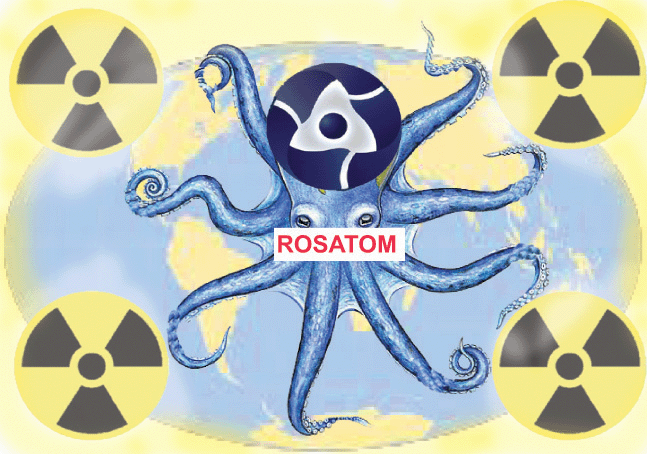
 Riyadh hosts workshop on Russian nuclear technology RIYADH — ROSATOM State Atomic Energy Corporation organized a workshop on Russian nuclear technologies in Riyadh on Dec. 5 for representatives of Saudi companies. The event was held at the Council of Saudi Chambers of Commerce………
Despite President Macron, France’s government report calls new nuclear power uneconomical
 Building new nuclear plants in France uneconomical -environment agency https://af.reuters.com/article/commoditiesNews/idAFL8N1YF5HCGeert De Clercq, DECEMBER 11, 2018
State environment agency contradicts Macron on new nuclear
* New nuclear reactors would be structurally loss-making
* Renewables could account for 85 pct of power mix by 2050.
Building new nuclear reactors in France would not be economical, state environment agency ADEME said in a study on Monday, contradicting the government’s long-term energy strategy as well as state-owned utility EDF’s investment plans.
In a speech last month, President Emmanuel Macron said nuclear energy would remain a promising technology for producing low-cost, low-carbon energy and that EDF’s EPR reactor model should be part of future energy options.
Macron has also asked EDF to draw up a plan for building new reactors with a view to making a decision about nuclear in 2021
Two EPR reactors under construction in France and Finland are years behind schedule and billions of euros over budget.
“The development of an EPR-based nuclear industry would not be competitive,” ADEME said, adding that new nuclear plants would be structurally loss-making. bit.ly/2GlEbcT
Building a single EPR in 2030 would require 4 to 6 billion euros of subsidies, while building a fleet of 15 with a total capacity of 24 gigawatt-hour by 2060 would cost the state 39 billion euros, despite economies of scale that could bring down the EPR costs to 70 euros per megawatt-hour (MWh), ADEME said.
Renewables costs could fall to between 32 and 80 euros/MWh, depending on the technology, by 2060.
But extending the existing fleet too long, while also building new EPRs, would lead to overcapacity, compromising returns on all generation assets, including renewables.
EDF – which generates about 75 percent of French electricity with 58 nuclear reactors – declined to comment.
The ADEME report, which studied energy mix scenarios for 2020-2060, said renewables could account for 85 percent of power generation by 2050 and more than 95 percent by 2060, except if the government pushes through the EPR option anyway.
The gradual increase of renewables capacity could reduce the pre-tax electricity cost for consumers – including generation, grids and storage – to about 90 euros per MWh, compared to nearly 100 euros today, ADEME said.
ADEME director Arnaud Leroy, appointed in February, helped write the energy chapter of Macron’s election programme and was a spokesman for his campaign, but the agency is independent and earlier studies have also contradicted government energy policy.
In 2015, a ADEME study suggesting that France could switch to 100 percent renewable energy by 2050 at a cost similar to sticking with nuclear was barred from publication for months by the government. reut.rs/2RLGKG8 (Reporting by Geert De Clercq; editing by David Evans)
UK govt allowing Chinese nuclear technology for Bradwell reactor?
 Times 9th Dec 2018 Something that would once have been unthinkable took another step towards
becoming reality last month just 40 miles east of London on the Essex
coast.
Britain’s nuclear watchdog nudged a Chinese reactor a step closer
to being allowed to operate in the UK, sending it through the “initial
high-level scrutiny” phase. It will eventually be built at
Bradwell-on-Sea. Much tougher hurdles lie ahead, but regulators have so far
been able to find no reason to block China General Nuclear’s HPR1000.
This is the dilemma facing Britain — one that has been thrown into stark
relief by the events of the past week. The arrest of Meng Wanzhou, the
chief financial officer of telecoms giant Huawei, means all that must be
seen through a different lens. The daughter of Huawei’s founder was
arrested in Canada at the behest of the US authorities and faces charges of
fraud and breaching US sanctions on Iran.
However, the tone on Chinese investment in Britain has now changed and recalls the words of Theresa
May’s former adviser Nick Timothy in 2015, when he said the government was
“selling our national security to China”. A deep-seated suspicion of
Huawei at GCHQ has finally surfaced as open hostility, while,
coincidentally, BT is removing Huawei technology from its 4G mobile
network. Yet all this looks remarkably like shutting the stable door after
the horse has bolted. If there was a time to reject Chinese investment, it
was 20 years ago.
Now, with ministers reliant on Chinese cash to fund a
significant slice of our future power needs, do they dare bite the hand
that feeds? Plus, in a post-Brexit world, a trade deal with China is meant
to top the priority list. For all the braggadocio, I suspect there will be
much soothing talk between London and Beijing in the months ahead. Does the
government really think it can put the Chinese dragon back in the bottle?
And can it afford to?
https://www.thetimes.co.uk/article/6cfdbf12-fafc-11e8-9a07-72ebead02362
UK must explain its plans for civil nuclear power security under ‘no deal’ Brexit scenario

Reeves calls for clarity for nuclear in ‘no deal’ Brexit scenario https://utilityweek.co.uk/reeves-calls-clarity-nuclear-no-deal-brexit-scenario/ David Blackman , 7 Dec 18 Rachel Reeves has urged the government to provide greater clarity about its plans for civil nuclear power if the UK leaves the EU without a withdrawal deal.
The chair of the House of Commons Business, Energy and Industrial Strategy committee has written to Richard Harrington, who has responsibility for the nuclear industry in his portfolio as minister for busiUK
In the letter, Reeves acknowledges indications of progress on the civil nuclear relationship between the EU and the UK regarding issues like safeguards and trading arrangements.
The government passed a bill last year outlining plans to create a new safeguarding regime for nuclear material and labour once the UK has to leave its existing arrangements under the Euratom treaty.
The letter seeks more detail on the plans that the government is making to ensure that the civil nuclear sector can continue to function after next March if parliament has been unable to secure a broader separation agreement and whether a side-deal with Euratom is being pursued.
She also quizzes Harrington on whether the UK has received any signals from Euratom about whether it will be possible to maintain the “close association” that the government has said it wanted with the EU-wide nuclear co-operation arrangement.
Reeves also asks whether the government has made any arrangements to overcome possible hitches in the nuclear new build programme if the upcoming migration white paper inhibits the inflow of the migrant labour which has been “essential” for such projects.
Reeves said: “In the event of no deal and no transition period, the ongoing operation of the UK’s nuclear power stations could be put at risk. The government needs to spell out what it is doing to ensure that nuclear power stations continue to function from 29 March 2019 and whether it will seek a separate deal with Euratom in these circumstances.
“The government also needs to be clearer about its plans to facilitate the building of construction of major facilities such as Hinkley Point C if restrictions on migrant labour are introduced in the future.”
1 This Month

of the week – THE ONENESS of HUMANITY

25 June- THE PUKE ON NUKES
Thursday, June 25, 2026
7pm Central Time (8pm ET, 6pm MT, 5pm PT) UTC – 5
From NRC & DOE Deregulation to Techno-Fascist Billionaires Going Nuclear, Plus a Few Songs from Atomic Cabaret REGISTER
26 June – Radiation Trainwreck at the NRC / Join the Protect Better Campaign – https://us02web.zoom.us/meeting/register/4ZlZ5_qLSHGiLSCg8FF6Bg#/registration

1st July – Webinar Waste of Space: The Environmental Harm of Military and Civil Space Activity st July, 7 pm

Report Launch Online: We are seeing an increasing exploitation of space for military and commercial purposes. This must change.

Protect Sazan Island from the Trump family! https://secure.avaaz.org/campaign/en/protect_sazan_island_from_the_trump_family_loc/?bqFCVab&v=174511&cl=22707147157&_checksum=5e9dde668860e8231c33699735e16a1fbf22ab2cb01da50c999fe8732b9775ef&utm_source=email&utm_medium=blast_email&utm_campaign=174511


Cuba Is Not a Failed State – It Is a Besieged State
PETITION: “Global Appeal to Endorse Palestinian Right of Return of Refugees”
To see nuclear-related stories in greater depth and intensity – go to https://nuclearinformation.wordpress.com
-
Archives
- June 2026 (251)
- May 2026 (306)
- April 2026 (356)
- March 2026 (251)
- February 2026 (268)
- January 2026 (308)
- December 2025 (358)
- November 2025 (359)
- October 2025 (376)
- September 2025 (257)
- August 2025 (319)
- July 2025 (230)
-
Categories
- 1
- 1 NUCLEAR ISSUES
- business and costs
- climate change
- culture and arts
- ENERGY
- environment
- health
- history
- indigenous issues
- Legal
- marketing of nuclear
- media
- opposition to nuclear
- PERSONAL STORIES
- politics
- politics international
- Religion and ethics
- safety
- secrets,lies and civil liberties
- spinbuster
- technology
- Uranium
- wastes
- weapons and war
- Women
- 2 WORLD
- ACTION
- AFRICA
- Atrocities
- AUSTRALIA
- Christina's notes
- Christina's themes
- culture and arts
- Events
- Fuk 2022
- Fuk 2023
- Fukushima 2017
- Fukushima 2018
- fukushima 2019
- Fukushima 2020
- Fukushima 2021
- general
- global warming
- Humour (God we need it)
- Nuclear
- RARE EARTHS
- Reference
- resources – print
- Resources -audiovicual
- Weekly Newsletter
- World
- World Nuclear
- YouTube
-
RSS
Entries RSS
Comments RSS
 nuclear-news