Hitachi to post $2 billion special loss, will suspend UK nuclear power operations
 Hitachi to suspend UK nuclear power ops, post $2 billion special loss https://energy.economictimes.indiatimes.com/news/power/hitachi-to-suspend-uk-nuclear-power-ops-post-2-billion-special-loss/67484807
Hitachi is set to vote on the planned suspension at its board meeting next week, the Nikkei said without citing sources REUTERS | January 11, 2019, TOKYO: Hitachi has decided to suspend its 3 trillion yen ($28 billion) nuclear project in Britain and to post a special loss of about $2 billion for the year ending March, the Nikkei business daily reported on Friday.
Hitachi is set to vote on the planned suspension at its board meetingnext week, the Nikkei said without citing sources.
The loss is expected to be 200 billion to 300 billion yen ($1.9 billion to 2.8 billion), it said.
Hitachi representatives could not be immediately reached for comment
Hitachi looks certain to cancel its plans for a £16bn nuclear power station in Wales
 Hitachi set to cancel plans for £16bn nuclear power station in Wales Guardian, Adam Vaughan@adamvaughan_uk-12 Jan 2019
Move by Japanese firm would be blow to UK plans to replace coal plants and ageing reactors The Japanese conglomerate Hitachi looks certain to cancel its plans for a £16bn nuclear power station in Wales, leaving Britain’s ambitions for a nuclear renaissance in tatters.
An impasse in months-long talks between the company, London and Toyko on financing is expected to result in the flagship project being axed at a Hitachi board meeting next week, according to the Nikkei newspaper.
The company has spent nearly £2bn on the planned Wylfa power station on Anglesey, which would have powered around 5m homes.
Another Japanese giant, Toshiba, scrapped a nuclear plant in Cumbria just two months ago after failing to find a buyer for the ailing project.
Withdrawal by Hitachi would be a major blow to the UK’s plans to replace dirty coal and ageing reactors with new nuclear power plants, and heap pressure on ministers to consider other large-scale alternatives such as offshore windfarms.
It would also mark an end to Japan’s hopes of exporting its nuclear technology around the world.
Hitachi and the UK and Japanese governments have been negotiating over a guaranteed price of power from Wylfa and a potentially £5bn-plus UK public stake in the scheme.
Talks have proved “tricky to find a solution that works for all parties”, industry sources said.
Unions said the prospect of Wylfa being cancelled was extremely worrying and losing two projects in such a short period “should set alarm bells ringing” about the government’s commitment to nuclear………
an insider said: “There has been a serious rift in Hitachi, and the group that said this is too large and risky an investment of Japanese capital have won out. They pointed to the uncertainty created by Brexit to say this was another reason to pull the plug.” ……….
Nuclear critics said a collapse of the scheme was not a disaster but an opportunity for a policy shift. Doug Parr, the chief scientist of Greenpeace UK, said: “We could have locked ourselves into reliance on an obsolete, unaffordable technology, but we’ve been given the chance to think again and make a better decision.”
Sara Medi Jones, the acting secretary general of CND, said: “With offshore wind now cheaper than nuclear it’s clear there is a clean and workable alternative. We just need the political will to make it happen.”
Just one new nuclear power station, EDF Energy’s Hinkley Point C in Somerset, has been given the green light and begun construction. The French company and Chinese firm CGN both want to build more. https://www.theguardian.com/environment/2019/jan/11/hitachi-cancel-plans-nuclear-power-station-angelsey-wales
Iowa Utilities Board OK’s Alliant ending nuclear power purchase: Duane Arnold nuclear plant to shut down
 State board OK’s Alliant ending nuclear power purchase, The Gazette, 11 Jan 19, Alliant Energy’s request for a settlement that will allow the utility to end its purchase of energy from Duane Arnold Energy Center has been approved.
The Iowa Utilities Board’s approval of Alliant’s request to recover a one-time $110 million payment allows the utility to end its purchase of power from the state’s sole nuclear power plant. The plant, based in Palo, is slated to shut down in late 2020 — five years sooner than the current power purchase agreement between NextEra Energy Resources and Alliant Energy.
The Iowa Utilities Board announced the settlement agreement in a Thursday news release.
Duane Arnold, which first began producing power in 1975, is about 9 miles northwest of Cedar Rapids and is one of the larger employers in Linn County. The power plant, at 3277 Daec Road, is owned by Florida-based NextEra Energy Resources……..https://www.thegazette.com/subject/news/business/state-board-approves-alliants-plan-to-close-duane-arnold-in-2020-20181213
Funding deadlock looks set to sink Japan’s last overseas nuclear project.
Nikkei Asian Review 11th Jan 2019 , Hitachi to suspend all work on UK nuclear plant. Funding deadlock looks set to sink Japan’s last overseas nuclear project. Hitachi plans to put a U.K.nuclear power project on hold as negotiations with the British government over funding hit an impasse, all but closing the book on Tokyo’s vision for nuclear infrastructure exports.
board is expected to officially decide next week to suspend all work on the
plant, including design and preparations for construction. Hitachi will
freeze the roughly 300 billion yen ($2.77 billion) in assets held by its
British nuclear business and write down their value, likely booking a loss
of 200 billion yen to 300 billion yen for the fiscal year ending in March.
after the news last month that a Japanese-led consortium including
Mitsubishi Heavy Industries was scrapping a project in Turkey. With the
aversion to nuclear power that took hold after the March 2011 Fukushima
Daiichi disaster showing little sign of abating, prospects look grim for a
sector that the Japanese government had positioned as a pillar of its
infrastructure export drive. Hitachi had taken on the planned construction
of two reactors on the Welsh island of Anglesey after acquiring U.K.-based
Horizon Nuclear Power in 2012. The company is leaving the door open to a
return. The project is “not being abandoned,” a source close to Hitachi
told Nikkei, suggesting the company would keep an eye on the situation and
resume the project if possible.
apparently set to continue, reworking the project to the extent Hitachi
requires will be no easy task. As things stand now, it appears likely that
the company will ultimately be forced to bow out.
https://asia.nikkei.com/Business/Business-Deals/Hitachi-to-suspend-all-work-on-UK-nuclear-plant
Japan, the U.S. and France failing in their efforts to sell nuclear reactors overseas, (or at home)
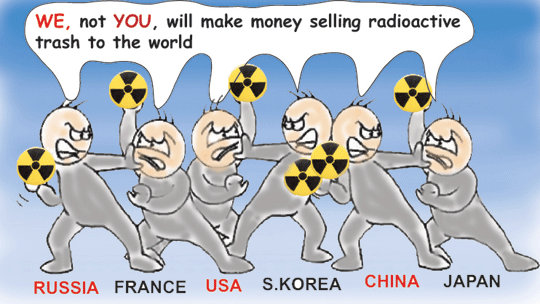 Japan’s Nuclear Export Struggles Narrow the Field of Suppliers, Only a handful of nations now seem capable of building new reactors, with the ability of the U.S. also in doubt. Greentech Media, JANUARY 10, 2019 Japan is struggling to find viable foreign buyers for its reactor technology in an expensive and competitive global nuclear market.
Only half a dozen nations currently have credible nuclear export capabilities. And besides Japan, the true export potential of at least two — the U.S. and France — is in doubt.
A recent report in the Japanese daily Mainichi Shimbun said a government strategy to export nuclear power technology had “run aground amid rising safety costs and deteriorating prospects for project profitability.” Proposed projects in Turkey and the United Kingdom had both hit roadblocks, the Mainichi Shimbun noted……..
Also, and perhaps more importantly, Japanese nuclear vendors are not state-owned like developers from China, Russia and South Korea. That puts Japanese firms at a disadvantage in terms of accessing finance and accepting risk.
These problems are not restricted to Japanese firms, though. They also apply to U.S. vendors.
Struggles in the U.S. nuke sector
While Japanese nuclear is at least enjoying something of a gradual recovery at home, with nine reactors back online after Fukushima and a further 17 looking to restart, in the U.S. the domestic sector is a mess.
This month saw Dominion Energy absorbing Scana Corporation after the latter failed to keep construction of two reactors at the Virgil C. Summer Nuclear Generating Station afloat.
A little over 100 miles away, Georgia state lawmakers have expressed concerns that a couple of new reactors at the Alvin W. Vogtle Electric Generating Plant, which are already half a decade behind schedule, could see further delays.
Six reactors out of a total of 104 have shut down across the U.S. since 2012, according to the Center for Climate and Energy Solutions, and a further 13 are due to close before 2025.
Meanwhile, a 2017 study by the Massachusetts Institute of Technology found two-thirds of U.S. nuclear power capacity could become unprofitable over the next few years.
When publicly owned U.S. nuclear developers do not even have a viable domestic market to play in, it is hard to see how they might compete overseas. There are efforts underway to revive the U.S. nuclear industry, but industry advocates say much more support is needed.
U.S. nuclear export prospects are thus beginning to look a lot like those in Japan — and also those in France, which has been struggling to launch its Evolutionary Power Reactor technology. Like the U.S. and Japan, France seemingly has little appetite to attach state guarantees to nuclear projects abroad……
Nuclear Power Is Economically Obsolete
 https://www.ecowatch.com/nuclear-power-cost-renewables-2625524662.html, By Grant Smith, 9 Jan 19,
Major financial group in Japan bans lending to those developing, making or possessing nuclear weapons
 Resona bans lending to those developing, making or possessing nuclear weapons https://mainichi.jp/english/articles/20190107/p2a/00m/0bu/024000c, January 7, 2019 (Mainichi Japan) TOKYO — Resona Holdings Inc., a major financial group in Japan, has announced a policy of not extending loans to borrowers that are involved in the development, production or possession of nuclear weapons.
The statement, the first of its kind by a major Japanese banking institution, came amid similar moves by an increasing number of European banks and institutional investors following the adoption at the United Nations of the Treaty on the Prohibition of Nuclear Weapons in 2017.
Whether other Japanese corporations will follow Resona’s action is a focus of attention for the future. There were other lenders banning loans for the production of nuclear weapons, but the Resona policy prohibits any loans to such companies even when such transactions are for non-nuclear related purposes.
The new posture was incorporated in a document titled “Efforts toward socially responsible investment and loans,” which was announced in November last year. According to the paper, Resona refuses to lend to those that are associated with the development, production or possession of weapons of mass destruction, such as nuclear, chemical and biological weapons, or inhuman weaponry including antipersonnel mines and cluster munitions.
Entities that can be subject to relevant restrictions or sanctions, or even those with the potential to be hit with such punitive measures, will be rejected as borrowers, the document says.
An official with Resona, which has never lent to companies making nuclear weapons, explained that the banking group decided to introduce the policy “because we thought it important for providers of funds to make such efforts toward a sustainable society.”
According to the Dutch nongovernmental organization PAX, 63 financial institutions had similar lending policies as of October 2017, an increase of nine from the previous year.
A Mainichi Shimbun poll of four Japanese mega banks — Mitsubishi UFJ Financial Group, Sumitomo Mitsui Financial Group, Mizuho Financial Group and Sumitomo Mitsui Trust Holdings — as well as four major life insurance companies — Nippon, Dai-ichi, Meiji Yasuda and Sumitomo — found that all of the eight companies and groups have policies to refrain from lending and investment over inhuman weapons. Yet the entities did not specify the production of nuclear weapons as a condition to disengage from borrowers.
Officials at Sumitomo Mitsui and Mizuho replied that their companies ban loans to be used in the production of nuclear weapons, while a Mitsubishi UFJ official explained that the company is “making careful judgment in each transaction.”
(Japanese original by Satoko Takeshita, Business News Department)
Japan losing hope for having a nuclear export industry
 Japanese gov’t plan to export nuclear power technology floundering, January 4, 2019 (Mainichi Japan) (Japanese original by Takayuki Hakamada and Ryo Yanagisawa, Business News Department) TOKYO — The Japanese government’s strategy to export nuclear power technology has run aground amid rising safety costs and deteriorating prospects for project profitability. While the government has aimed to maintain the country’s nuclear technology and expert resources through construction of atomic reactors abroad amid stalled nuclear plant development at home, its projects with Turkey and Britain have both hit snags.
“The Turkish government is in the midst of evaluating the project. I believe it will respond to us in some way or other,” said Shunichi Miyanaga, president of Mitsubishi Heavy Industries Ltd., in mid-December about a plan to build a nuclear power plant in Sinop, northern Turkey. Miyanaga’s comment suggested that the fate of the project had been left up to the Turkish government.
At the end of July last year, Mitsubishi Heavy told the Turkish government that the cost of the project would total somewhere around 5 trillion yen, more than doubling from the original estimate of roughly 2.1 trillion yen. As the plan envisages recovering the costs through profits from power generation at the nuclear facility, it would not become profitable unless Turkey purchases the generated electricity at a higher price than originally expected. If Turkey does not comply with the increased burden, Japan would withdraw from the plan.
The nuclear plant project was pitched by Prime Minister Shinzo Abe to then Turkish Prime Minister Recep Tayyip Erdogan in 2013. At the time, Abe vowed at a press conference in Ankara, “We will share our experiences and lessons from the (2011) disaster at the nuclear plant (run by the Tokyo Electric Power Co. in Fukushima) with the rest of the world, and will strive to contribute to enhancing the safety of nuclear power generation.”
However, the catastrophe prompted the international community to turn a wary eye toward nuclear power, leaving the costs for safety measures at nuclear plants to swell. The steep fall in the Turkish lira over the past year by more than 30 percent also added to the project’s deteriorating profitability.
Under these circumstances, Tokyo plans to propose to Ankara that it would provide comprehensive energy cooperation in such spheres as coal-fired thermal power generation and liquefied natural gas, in place of the atomic plant project. Because the nuclear power project is based on an agreement struck by both leaders, such a proposal by Tokyo could face a backlash from Ankara, but Japan’s focus is already shifting to how to withdraw from the project without undermining bilateral diplomatic ties with Turkey.
Meanwhile, a nuclear plant construction project undertaken by Hitachi Ltd. on the Isle of Anglesey in central Britain has also run into rough waters, after the project’s costs soared to approximately 3 trillion yen, about 1.5 times the initial estimate.
n May last year, Hitachi Chairman Hiroaki Nakanishi held talks with British Prime Minister Theresa May, where the latter agreed to expand her government’s support for the project. However, British citizens have been wary of the scheme out of concern that it could lead to rising electricity bills should Japan’s request to raise the sale price of electricity be accepted.
As the May administration is suffering from sagging approval ratings amid turmoil over Britain’s exit from the European Union, it is becoming increasingly difficult for London to comply with an increased burden. At home, Japanese companies are also becoming more reluctant to invest in the project out of fears of poor profitability and accident risks. Given the circumstances, Tokyo is also likely to exit the project.
The Abe administration has made the export of nuclear power technology a pillar of its growth strategy, but to little avail thus far. While the government intends to pursue measures to counter China and Russia’s aggressive drive to export nuclear plants by stepping up financial support for partner countries and through other measures, such a strategy may end up bringing more harm than good………..
a senior official of an economy-related government body said, “It is difficult for Japanese manufacturers, which can’t even build nuclear plants in their own country, to win confidence (abroad),” suggesting that the government’s strategy to export nuclear power technology in itself is unreasonable.
https://mainichi.jp/english/articles/20190104/p2a/00m/0bu/030000c
Uncertain future for nuclear engineers
 High-Paying Jobs in Nuclear Power Aren’t Looking So Safe Anymore
A wave of plant closings has workers—even highly trained engineers—on edge, THE WALL STREET JOURNAL, Erin Ailworth, Dec. 28, 2018 “………As large employers, these plants are often economic anchors for the smaller, sometimes rural communities in which they were built. When they disappear, so too can a significant portion of the tax base—a big blow for many. Each plant shuttered equals hundreds of jobs lost; combined, the nine slated to retire employ more than 7,000.
After a plant closes, those employees are left playing musical chairs, hoping to land a spot at another nuclear plant even as that job pool shrinks. Federal labor data for nuclear and other electric power generation shows the number of workers has dropped to about 63,000 in October from roughly 158,000 in 1990. At least 3,000 of those jobs vanished since the start of 2013………
Federal forecasts show that employment among nuclear power reactor operators, who tend to have a high school or equivalent education, is expected to fall by just over 10% from 2016 to 2026. Meanwhile, the Nuclear Energy Institute, a trade association, estimates that of 100,000 nuclear workers—including those with jobs outside power plants—it expects about 23,000 people to retire from or quit the industry over the next five years.
……. The latest nuclear job losses occurred at Oyster Creek, a 49-year-old plant owned by Exelon Corp. in New Jersey, that went offline in September. Next to go will be Entergy Corp.’s Pilgrim nuclear plant in Massachusetts, which is scheduled to shut down in May. Three Mile Island’s shuttering is slated for September 2019.
Christopher Crane, chief executive of Exelon, said his company is doing what it can to absorb workers displaced by Oyster Creek’s retirement, even as it works to avoid further closures by lobbying for policies that recognize nuclear power as a carbon-free resource akin to solar and wind farms.
…….. The last nuclear plant built in the U.S. came into full service in 2016. More recent nuclear projects have had huge cost overruns and delays.
The Trump administration, meanwhile, repeatedly has promised to help the struggling nuclear industry, but so far its efforts haven’t panned out.
Employees at the James A. FitzPatrick nuclear plant in central New York state worry about their future. https://www.wsj.com/articles/high-paying-jobs-in-nuclear-power-arent-looking-so-safe-anymore-11545993000
Japan abandoning ambition to sell nuclear power reactors to Turkey
|
The Japanese government decided to ask for the increased coverage by Turkey as a final condition for constructing the plant. Under the current proposal, the plant is to be built by ATMEA, a joint venture of Japan’s Mitsubishi Heavy Industries Ltd. (MHI) and French nuclear plant maker Framatome, near the Black Sea coastal town of Sinop in northern Turkey. Besides the Turkish project, another plan to export nuclear power reactors to Britain by Hitachi Ltd. also faces difficulties. If both plans fail, a growth drive strategy of the administration of Prime Minister Shinzo Abe will collapse. The Turkish project has its roots in a 2013 joint declaration for cooperation over the construction of nuclear power plants signed by Prime Minister Abe and then Turkish Prime Minister Recep Tayyip Erdogan. Under the original plan, four medium-sized ATMEA1 reactors would be built for the start of operation in 2023……. Meanwhile, Hitachi, which also manufactures nuclear reactors, has acknowledged that it faces difficulties in completing a project to build two nuclear reactors in Britain. Chairman Hiroaki Nakanishi of the company told reporters in December that he informed the British government that the plan was “at a limit” due to a surge in project costs. Both the Turkish and British projects have been pitched directly by Prime Minister Abe, but those once promising plans now appear to be falling apart. (Japanese original by Ryo Yanagisawa and Takayuki Hakamada, Business News Department) However, the total cost estimate conducted in July 2018 by MHI for the project more than doubled from the original projection of some 2.1 trillion yen to around 5 trillion yen. The price hike occurred amid rising safety costs following the 2011 triple core meltdowns that hit the Tokyo Electric Power Co.’s Fukushima Daiichi Nuclear Power Station, as well as the finding of an active fault near the Sinop site. https://mainichi.jp/english/articles/20190104/p2a/00m/0bu/011000c |
|
|
Trump’s done one good thing – stopped the Bill Gates- China “new nuclear power” push

Bill Gates shelves nuclear reactor in China, citing U.S. policy, Axios, Amy Harder, Dec 30
TerraPower, a nuclear-energy company founded by Bill Gates, is unlikely to follow through on building a demonstration reactor in China, due largely to the Trump administration’s crackdown on the country.
Why it matters: This is a blow to America’s attempts to commercialize advanced, smaller scale nuclear technology and, separately, further evidence of soured relations between the U.S. and China under President Trump.
Driving the news: In a year-end blog post covering various topics published Saturday night, Gates said of TerraPower: “We had hoped to build a pilot project in China, but recent policy changes here in the U.S. have made that unlikely.”
Details: The Trump administration, led by the Energy Department, announced in October that it was implementing measures to “prevent China’s illegal diversion of U.S. civil nuclear technology for military or other unauthorized purposes.”
- Those measures have made it nearly impossible for TerraPower’s project to go forward, according to multiple people familiar with the development.
- TerraPower had pursued plans to build a pilot reactor in China because that country has two things America doesn’t — growing electricity demand and a long-term strategic energy plan — a top TerraPower executive told me last year.
- Morning Consult and, separately, an analyst for the think tank International Institute for Strategic Studies, covered the impacts of the October policy change shortly after it occurred, with brief mentions of the likely negative impact on TerraPower………
What’s next: “We may be able to build it [the reactor] in the United States if the funding and regulatory changes that I mentioned earlier happen,” Gates said in his post, although he didn’t specify which funding or regulations.
Meanwhile, the Energy Department just announced it plans to buy some of the power from new advanced reactors being pursued by NuScale, another advanced nuclear company, for here in the United States. https://www.axios.com/bill-gates-nuclear-reactor-china-terrapower-be4c792c-6f76-4723-bf63-d8f9fb527dc1.html
Desperate effort to find a buyer for the Santee Cooper after its nuclear fiasco
 Inside the hurried effort to find a buyer for Santee Cooper, Herald Sun, BY AVERY G. WILKS, DECEMBER 30, 2018 , COLUMBIA, SC
A day before state regulators approved Dominion Energy’s bid to buy SCANA Corp., representatives from at least six firms gathered in a secret meeting in North Charleston to discuss a possible solution to the other half of South Carolina’s $9 billion nuclear construction fiasco.
The gathering revolved around the possible sale of Santee Cooper, the state-owned utility that racked up more than $4 billion in debt before abandoning a joint effort with SCANA to expand a nuclear power plant in Fairfield County.
ICF International — a Virginia-based firm hired by the General Assembly — hosted the invitation-only meeting as part of a hurried, ongoing effort to solicit and study bids from some of the largest names in the utility industry.
There to ask questions about Santee Cooper’s assets and operations — and to scout out the competition — were two dozen legal and financial experts representing Charlotte-based Duke Energy, Florida-based NextEra Energy, Virginia-based Dominion, Greenville-based Pacolet Milliken Enterprises, New York-based LS Power and South Carolina’s electric cooperatives — who together buy three-fifths of Santee Cooper’s electricity.
SCANA’s chapter of the V.C. Summer Nuclear Station debacle is winding down with the Cayce-based company’s impending sale to Dominion. But 17 months after the project’s collapse, the buzz surrounding Santee Cooper’s future is only now ramping up.
This summer, S.C. lawmakers slashed the nuclear-bloated electric rates for customers of SCANA’s electric subsidiary, SCE&G. That $22-a-month rate cut was made permanent by state regulators earlier this month.
Now, the nearly 2 million S.C. residents who get their power from Santee Cooper — either directly or through one of the state’s 20 electric co-ops — are wondering whether they will get a rate cut, too. That will be one of the biggest questions facing the General Assembly when it reconvenes in Columbia in January.
……….. The presentation on Santee Cooper’s assets and operations, and a question-and-answer period were scheduled to last all day. But with each of the bidders hesitant to ask a question that could tip their hands, the event wrapped up about lunchtime instead, sources said.
ICF declined to comment through a public relations agency.
State Rep. Murrell Smith, the Sumter Republican who co-chairs the Legislature’s Santee Cooper sale study committee, told The State in a recent interview he is confident in the timeline set for the process.
ICF told Smith’s committee there would be enough time for “meaningful and thorough bids,” particularly since potential buyers have known for more than a year that Santee Cooper could be on the auction block, he said.
Those bids are due Jan. 14. https://www.heraldsun.com/news/state/south-carolina/article223631625.html
Don’t mistake a short burst in uranium market – the longterm outlook is no good
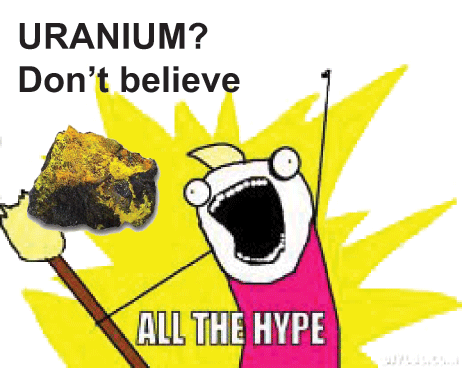 How Poor Is the Long-term Outlook for Cameco Corp. (TSX:CCO)? The Motley Fool Matt Smith | December 27, 2018 “………it is becoming increasingly unpopular. This is primarily due to the dangers it poses during times of catastrophic failure, as demonstrated by the Fukushima incident. There are also concerns over the safe processing and storage of the radioactive waste that it produces.
Bullish analysts point to growing demand for the fuel and rising supply constraints as the reason to be optimistic for uranium and Cameco. This makes the demand side dynamics for uranium appear healthy, pointing to higher consumption which will bolster prices.
However, other nations are moving to reduce their dependence on nuclear power in favour of renewable sources of energy which in recent years have become significantly cheaper to install and operate. The inherent risks associated with nuclear power see France intending to reduce the share of its electricity generated by nuclear by 25% by 2025. Whereas Germany has measures in place to decommission all reactors by 2022 and South Korea intends to undergo a similar process.
According to analysis conducted by asset management firm Lazard, utility scale solar and wind generated electricity is significantly cheaper to produce than nuclear as well as coal and natural gas-fired power generation. This explains why a record level of renewable energy was installed during 2017 and most of that new installed capacity was composed of solar and wind. This points to a sharp deterioration in demand for nuclear power over the long term, particularly given that some of the reactors under construction will replace existing reactors that are to be decommissioned.
No analysis is complete without an understanding of the supply-side of the equation. Recent production cutbacks by Cameco and Kazakhstan’s state-owned producer Kazatomprom triggered uranium’s latest rally and those are likely only to be temporary. Both miners will boost output once uranium prices firm sufficiently to make the operations that they have shuttered economic to operate. Then you have nations such as Namibia, the world’s sixth-largest producer, which is aiming to boost production to benefit financially from uranium before it falls into disuse, becomes a stranded asset and loses its value.
The long-term outlook is poor
While the average spot price during the third quarter 2018 was higher than the equivalent period in 2017 Cameco’s revenue of $488 million was flat year over year. This can be attributed to much of the uranium sold by the miner being priced according to long-term contracts. Cameco, however, reported a significant improvement in its bottom line, announcing adjusted net income of $15 million compared to a $50 million loss a year earlier.
The miner has also secured additional uranium deliveries during the fourth quarter 2018, which along with firmer prices, bodes well for Cameco to report stronger earnings. This will give its stock a short-term lift, but it appears that any lasting recovery may never occur. The reasons for this are simple: there is no sign of the bear market for uranium ending anytime soon. A combination of declining demand over the long-term and the potential for supply to grow significantly all points to uranium never attaining its pre-Fukushima prices. https://www.fool.ca/2018/12/27/how-poor-is-the-long-term-outlook-for-cameco-corp-tsxcco/
McAfee computer virus protection company is in partnership with nuclear corporation AREVA, (now rebranded as ORANO, and rebranded again as FRAMATOME)
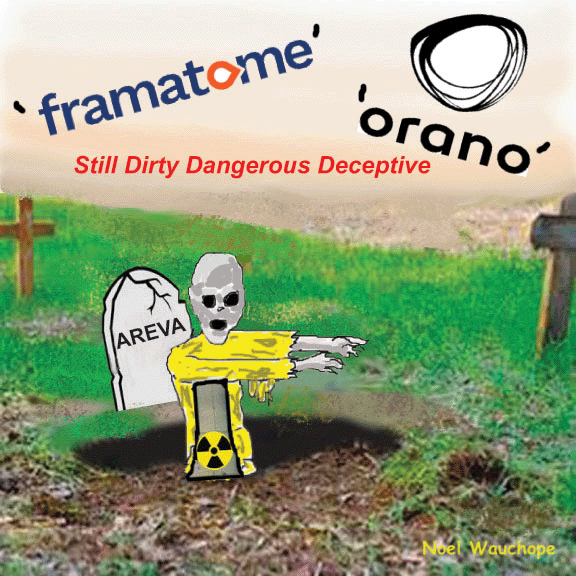 Framatome partners with McAfee to support energy industry cybersecurity 24 May 2018, Framatome signed an agreement with McAfee, the device-to-cloud cybersecurity company, to distribute cybersecurity solutions to energy transmission, distribution and generation facilities worldwide. Together, Framatome and McAfee will work with these facilities to help protect their digital assets and support the reliable production of electricity.
“In a rapidly evolving digital landscape, holistic and robust cybersecurity programs are critical to protecting nuclear energy facilities and electrical power and distribution infrastructure,” said Catherine Cornand, senior executive vice president of Framatome’s Installed Base Business Unit. “This partnership with McAfee will enhance our ability to provide customers with the right combination of cutting-edge technologies and expertise.”…….http://www.framatome.com/EN/businessnews-1331/framatome-partners-with-mcafee-to-support-energy-industry-cybersecurity.html
USA desperate to make money from the nuclear industry – selling radioactive trash clean-up technology
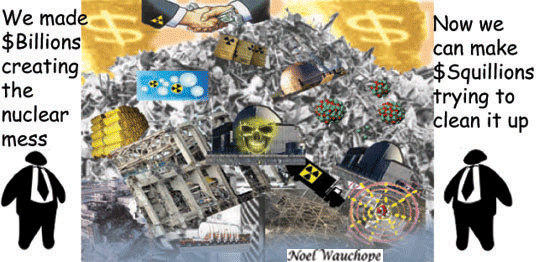
 US to offer ‘black box’ nuclear waste tech to other nations ChannelNews Asia 20 Dec 18
The U.S. Department of Energy’s nuclear security office is developing a project to help other countries handle nuclear waste, an effort to keep the United States competitive against global rivals in disposal technology, according to two sources familiar with the matter.
WASHINGTON: The U.S. Department of Energy’s nuclear security office is developing a project to help other countries handle nuclear waste, an effort to keep the United States competitive against global rivals in disposal technology, according to two sources familiar with the matter.
The push comes as the United States struggles to find a solution for its own mounting nuclear waste inventories amid political opposition to a permanent dump site in Nevada, proposed decades ago, and concerns about the cost and security of recycling the waste back into fuel.
The National Nuclear Security Administration is considering helping other countries by using technologies that could involve techniques such as crushing, heating and sending a current through the waste to reduce its volume, the sources said.
The machinery would be encased in a “black box” the size of a shipping container and sent to other countries with nuclear energy programs, but be owned and operated by the United States, according to the sources, who asked not to be named because of the sensitivity of the matter.
“That way you could address a country’s concerns about spent fuel without transferring ownership of the technology to them,” said one of the sources.
The NNSA confirmed a project to help other countries with nuclear waste is underway but declined to provide details.
We are in the conceptual phase of identifying approaches that could reduce the quantity of spent nuclear fuel without creating proliferation risks – a goal with significant economic and security benefits,” NNSA spokesman Dov Schwartz said.
The effort is being led by NNSA Deputy Administrator for Defense Nuclear Nonproliferation Brent Park, a nuclear physicist and former associate lab director at the Energy Department’s Oak Ridge National Laboratory, appointed by President Donald Trump in April.
The NNSA declined a Reuters request for an interview with Park.
The sources did not name countries to which the service would be marketed, or where the waste would be stored after it is run through the equipment. But they said they were concerned the processes under consideration could increase the risk of dangerous materials reaching militant groups or nations unfriendly to the United States.
Former President Jimmy Carter banned nuclear waste reprocessing in 1977 because it chemically unlocks purer streams of uranium and plutonium, both of which could be used to make nuclear bombs.
The NNSA’s Schwartz said the plans under consideration do not involve reprocessing, but declined to say what technologies could be used.
The sources familiar with the NNSA’s deliberations said there are three basic ways that the physical volume of nuclear waste can be reduced, all of which are costly. At least one of the techniques poses a security threat, they said.
The first, called consolidation, reduces the volume of nuclear waste by taking apart spent fuel assemblies and crunching the waste down to two times smaller than the original volume – an approach that is considered costly but which doesn’t add much security risk.
A second technique involves heating radioactive pellets in spent fuel assemblies. The process, which gives off gases that must be contained, results in a waste product that has more environmental and health risks.
A third approach called pyroprocessing – developed at the Department of Energy’s Argonne National Laboratory – puts spent fuel in liquid metal and runs an electric current through it. That reduces volume, but concentrates plutonium and uranium – making it a potential proliferation risk.
The nuclear community is divided on whether pyroprocessing fits the definition of reprocessing.
The Trump administration has made promoting nuclear technology abroad a high priority, as the United States seeks to retain its edge as a leader in the industry, amid advancements by other nations like Russia, and France – both of which already offer customers services to take care of waste.
U.S. reactor builder Westinghouse, which emerged from bankruptcy in August and is owned by Brookfield Asset Management, hopes to sell nuclear power technology to countries from Saudi Arabia to India, but faces stiff competition from Russia’s state-owned Rosatom.
U.S. Energy Secretary Rick Perry visited Saudi Arabia this month for talks on a nuclear energy deal with the kingdom, despite pushback from lawmakers concerned about the killing of journalist Jamal Khashoggi in the Saudi consulate in Istanbul………… https://www.channelnewsasia.com/news/technology/exclusive–us-to-offer–black-box–nuclear-waste-tech-to-other-nations-11046762
1 This Month

of the week – THE ONENESS of HUMANITY
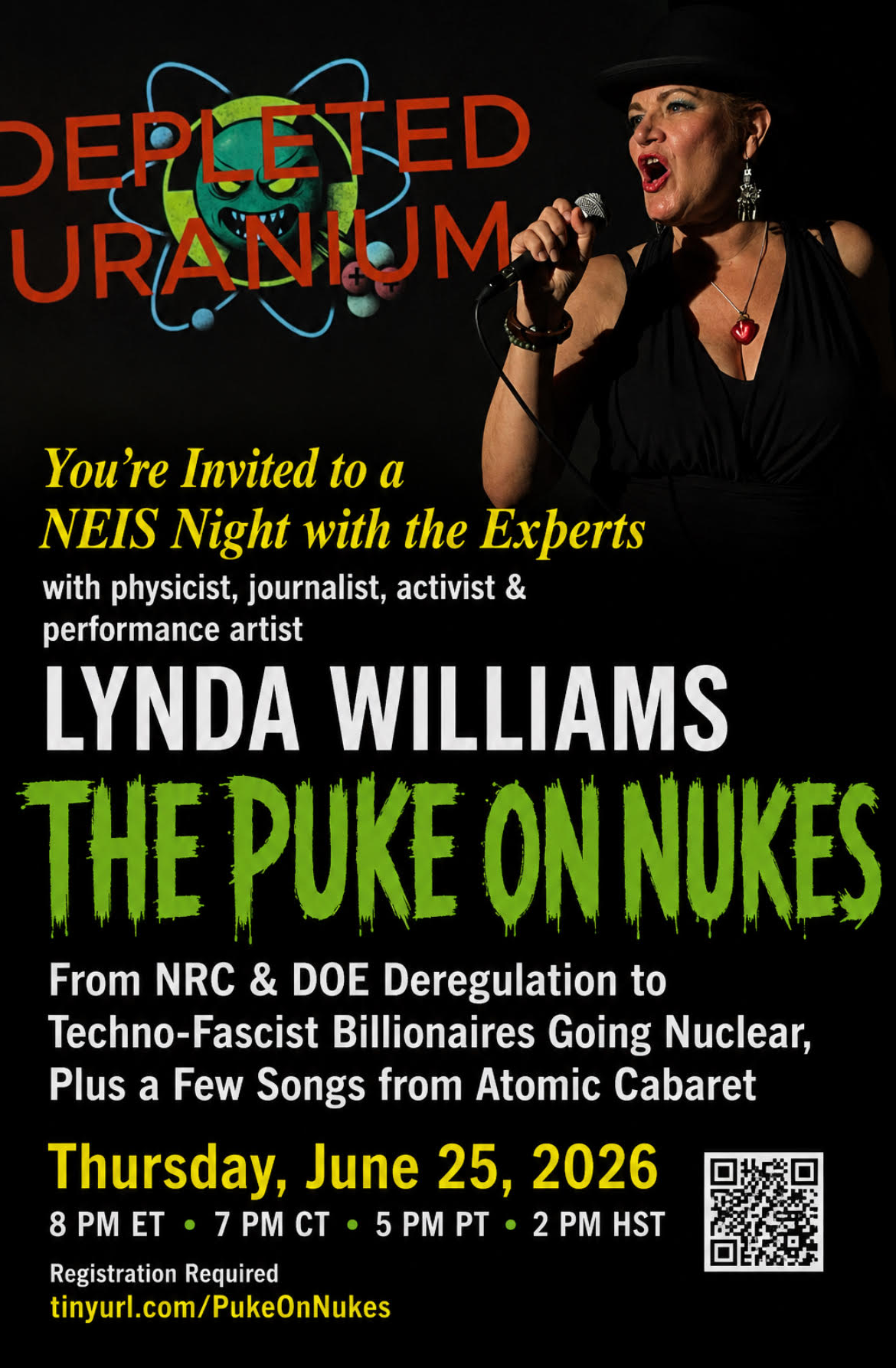
25 June- THE PUKE ON NUKES
Thursday, June 25, 2026
7pm Central Time (8pm ET, 6pm MT, 5pm PT) UTC – 5
From NRC & DOE Deregulation to Techno-Fascist Billionaires Going Nuclear, Plus a Few Songs from Atomic Cabaret REGISTER
26 June – Radiation Trainwreck at the NRC / Join the Protect Better Campaign – https://us02web.zoom.us/meeting/register/4ZlZ5_qLSHGiLSCg8FF6Bg#/registration

1st July – Webinar Waste of Space: The Environmental Harm of Military and Civil Space Activity st July, 7 pm

Report Launch Online: We are seeing an increasing exploitation of space for military and commercial purposes. This must change.

Protect Sazan Island from the Trump family! https://secure.avaaz.org/campaign/en/protect_sazan_island_from_the_trump_family_loc/?bqFCVab&v=174511&cl=22707147157&_checksum=5e9dde668860e8231c33699735e16a1fbf22ab2cb01da50c999fe8732b9775ef&utm_source=email&utm_medium=blast_email&utm_campaign=174511


Cuba Is Not a Failed State – It Is a Besieged State
PETITION: “Global Appeal to Endorse Palestinian Right of Return of Refugees”
To see nuclear-related stories in greater depth and intensity – go to https://nuclearinformation.wordpress.com
-
Archives
- June 2026 (251)
- May 2026 (306)
- April 2026 (356)
- March 2026 (251)
- February 2026 (268)
- January 2026 (308)
- December 2025 (358)
- November 2025 (359)
- October 2025 (376)
- September 2025 (257)
- August 2025 (319)
- July 2025 (230)
-
Categories
- 1
- 1 NUCLEAR ISSUES
- business and costs
- climate change
- culture and arts
- ENERGY
- environment
- health
- history
- indigenous issues
- Legal
- marketing of nuclear
- media
- opposition to nuclear
- PERSONAL STORIES
- politics
- politics international
- Religion and ethics
- safety
- secrets,lies and civil liberties
- spinbuster
- technology
- Uranium
- wastes
- weapons and war
- Women
- 2 WORLD
- ACTION
- AFRICA
- Atrocities
- AUSTRALIA
- Christina's notes
- Christina's themes
- culture and arts
- Events
- Fuk 2022
- Fuk 2023
- Fukushima 2017
- Fukushima 2018
- fukushima 2019
- Fukushima 2020
- Fukushima 2021
- general
- global warming
- Humour (God we need it)
- Nuclear
- RARE EARTHS
- Reference
- resources – print
- Resources -audiovicual
- Weekly Newsletter
- World
- World Nuclear
- YouTube
-
RSS
Entries RSS
Comments RSS
 nuclear-news