Saudi Arabia Receives Offers from 5 Countries to Build 2 Nuclear Reactors 23 January, 2019 Riyadh – Asharq Al-Awsat
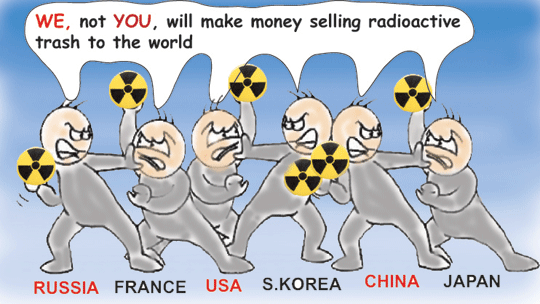
Five countries have submitted their requests for the establishment of two nuclear reactors in Saudi Arabia on the Arabian Gulf coast.
The bid was made after the peaceful Saudi nuclear project met the requirements of the International Atomic Energy Agency (IAEA).
The oil-rich Kingdom launched a tender to define specifications of sites that will host the two reactors, said Chairman of King Abdullah City for Atomic and Renewable Energy (KACARE) Khalid al-Sultan.
He added that KACARE asked the services providers in the US, Russia, France, South Korea and China to present their preliminary offers……. https://aawsat.com/english/home/article/1558606/saudi-arabia-receives-offers-5-countries-build-2-nuclear-reactors
January 24, 2019
Posted by Christina Macpherson |
marketing, Saudi Arabia |
Leave a comment
|
Rolls-Royce in talks to supply Chinese nuclear plant in Essex, CGN hopes involvement of UK engineering group will allay security concerns concerns Jonathan Ford in London, Ft.com, 21 Jan 19
China’s largest state-backed nuclear company is in talks with Rolls-Royce about supplying equipment for the power plant it hopes to build in Essex as it seeks to allay national security concerns about the project. CGN is in discussions with the British engineering group over providing the control systems for the Hualong HPR1000 reactors the Chinese group plans to install at Bradwell on the Essex coast. Regarded as the central nervous system of a nuclear power plant, this technology not only drives the operation of the reactor, but allows it to be safely shut down should problems occur.
Using the British group’s equipment would be a significant concession by CGN. The Chinese group has developed its own control systems which it hopes to export along with its reactor technology. But the move is seen as a necessary sop to ease concerns about Chinese companies building critical national infrastructure in the UK. Britain’s nuclear programme is in disarray following Hitachi’s decision last week to shelve plans for a £20bn power station at Wylfa in Anglesey after financing plans for the scheme unravelled. That came two months after Toshiba pulled out of another project in Cumbria. The latest withdrawal leaves just EDF and CGN as potential bidders for new nuclear projects. The two companies are linked. The French group is building the Hinkley Point station in Somerset with financial backing from CGN.
Theresa May’s government has been less enthusiastic about Chinese investment than her predecessors, and Washington has raised concerns about Beijing taking civilian nuclear technology and transferring it to military uses. Various countries have barred Chinese suppliers from telecoms and energy markets over fears that “backdoors” could give the Chinese government access to data or control over the equipment. …….
Peter Atherton, an industry expert at consultancy Cornwall Energy, said the lack of bidders left the government with a dilemma. “On the one hand they want Chinese nuclear investment in order to provide competition to the French but on the other hand there are very obvious security issues,” he said. “If the government doesn’t trust China to build mobile telecom networks how on earth can they trust them to build nuclear power stations?”
CGN has appointed senior figures from the contracting and nuclear industry to its UK subsidiary. Its British advisory board is chaired by Sir Terry Morgan, the former chairman of Crossrail and the HS2 high speed rail project. He was dismissed from both roles after serious delays and overruns at the state-run Crossrail project. ……… https://www.ft.com/content/4d2f2814-1b41-11e9-9e64-d150b3105d21
|
|
January 22, 2019
Posted by Christina Macpherson |
business and costs, politics, UK |
1 Comment
Britain badly needs a dose of nuclear realism. If it remains a strategic necessity, the UK must find a way to win more bang for its buck, Ft.com , JONATHAN FORD , 21 Jan 19
One thing British politicians have never lacked when making nuclear policy is optimism. When it comes to atomic energy, they leave Dr Pangloss in the shade. Take the last big nuclear programme back in the 1960s, whose purpose was to meet a fifth of the UK’s electricity needs. Rather than using proven (if US made) reactor technology, the government bet instead on a homegrown gas-cooled type. The minister of power, Fred Lee, confidently predicted the experimental design would be a world beater. Britain had “hit the jackpot”, he declared. The UK certainly hit something. But it wasn’t pay dirt. The AGR programme dragged on for more than two decades and was, in the words of the man who commissioned it, Arthur Hawkins of the Central Electricity Generating Board, “a catastrophe that must not be repeated”. ………
Once again, there is plenty of wishful thinking. Indeed, policy has been driven largely by a series of optimistic guesses. These include not just the cost of new reactors, but also the willingness of private capital to fund them without assistance from the state. …….
again there are multiple reactor types. Repurposing often almost untested equipment for UK safety rules means that each starts from scratch with its own prototype, learning as it goes along. Add the need to fund these “first of type” schemes with private capital and it’s not surprising that projects have been falling by the wayside. Toshiba pulled out in November and, last week, Hitachi shelved plans to install its boiling water reactor technology at a promising site in Anglesey, having spent £2bn just getting to the start line.
The result is that a decade in, Britain has just one project under way — at Hinkley Point in Somerset — for which the government has struck an eye-wateringly expensive contract. The owner, EDF of France, is now saying it could do subsequent projects cheaper, because it will have the Hinkley experience to draw on. But given the absence of competition (the only other participant left in is CGN of China, EDF’s partner at Hinkley), the government faces the unpalatable prospect of a series of potentially disadvantageous bilateral deals. The UK originally set a target of about 18GW of electricity coming from nuclear by the 2030s. This has since been reduced to about 12GW. With only Hinkley and an ageing Sizewell B likely to be in operation, just 4.4GW of that target is likely to be met. ……….
Removing complexity (and wishful thinking) doesn’t come without cost. The government would have to acquire the necessary sites and assist bidders to get them to the start line. (Abu Dhabi cut some corners the UK might balk at, such as accepting the supplier’s home country safety accreditation). It means the government acting as owner, committing to fund construction itself rather than going through complex contortions to attract just a sliver of risk-bearing equity. There may not be the political willpower.
Of course, Britain does not have to go ahead with nuclear. It can run the risk of relying on other zero-carbon technologies, such as renewables, and other countries by building interconnectors. It can legislate to change the carbon targets it has set itself. But if nuclear power remains a strategic necessity, the UK needs a realistic programme to meet it. Otherwise the country will end up building vanishingly little new capacity, and doing so only at extortionate cost.
https://www.ft.com/content/5bc23eec-1caa-11e9-b2f7-97e4dbd3580d
January 22, 2019
Posted by Christina Macpherson |
business and costs, politics, UK |
Leave a comment
Plans to sell nuclear plants overseas derailed, Japan Times, 20 Jan 19, With the decision by Hitachi Ltd. to “freeze” its plan to build two nuclear power reactors in the United Kingdom, all of the overseas nuclear power plant projects pursued by Japanese firms — with the backing of the government seeking to promote export of nuclear power technology as a key pillar of its efforts to boost infrastructure sales in overseas markets — have now effectively been derailed.
……… Prime Minister Shinzo Abe has long taken the initiative to promote the overseas sale of Japanese nuclear power plants through top-level diplomacy. However, the nuclear power plant business cannot be a part of the nation’s growth strategy if its business feasibility is in doubt. The government and related industries need to face up to the situation surrounding the nuclear power business — which continues to face difficulties domestically as well — and reassess the way forward.
The Fukushima nuclear disaster, triggered by the March 2011 Great East Japan Earthquake and tsunami, has radically changed the global nuclear power market landscape. The cost of nuclear power, which had been promoted as a relatively inexpensive and “clean” source of energy that does not emit carbon dioxide, spiked as additional safety investments inflated plant expenses.
The cost of Hitachi’s project to build the two reactors in Anglesey, Wales, which began in 2012, has ballooned from the initial estimate of ¥2 trillion to ¥3 trillion. Another project pursued by Mitsubishi Heavy Industries Ltd. to build four reactors in Turkey has also been hampered by the swelling cost — which reportedly shot up from an initially estimated ¥2.1 trillion to ¥5 trillion. Toshiba Corp. has pulled out from the overseas nuclear power business after the huge losses incurred by its subsidiary Westinghouse Electric Co. in its nuclear power plant projects in the United States.
Even with a spike in plant construction costs, the nuclear power business would make economic sense if the expected earnings surpass the investments. But Hitachi reportedly decided to halt the U.K. project after it became clear that even with public support from the British government it could not possibly realize profits………
Behind the government’s drive to promote the sale of nuclear power plants overseas has been the domestic market’s bleak business prospects. While the government and the power industry have pushed for restarting the nation’s nuclear power plants idled in the wake of the Fukushima disaster, once they have cleared the tightened plant safety standards, only nine reactors at five plants have been put back online. The additional costs of safety investments required under the new Nuclear Regulation Authority standards to make the plants more resilient to natural disasters such as earthquakes and tsunami — estimated to range from ¥100 billion to ¥200 billion for each reactor — have prompted power companies to decide to decommission 23 aging reactors so far (including the six at Tepco’s Fukushima No. 1 plant).
As popular opposition in Japan remains strong against reactivating the idled plants, there is no prospect that the construction of new plants will be approved in the foreseeable future. The drive to promote the export of nuclear power plants may have been intended to make up for the loss of demand in the domestic market. But earlier plans for Japanese makers to build plants in Lithuania and Vietnam were canceled, while a civil nuclear cooperation pact signed with India in 2016 — which was aimed at paving the way for Japanese nuclear plant exports to the country — has not resulted in any deal. Along with Hitachi’s decision to halt the U.K. project, Mitsubishi Heavy Industries is reportedly set to abandon its plan in Turkey.
Even without construction of new plants, there will be demand for maintaining Japan’s existing nuclear power plants, and for decommissioning its aging plants. What to do with the spent nuclear fuel and the high-level radioactive wastes from the plants will also be among the challenges that confront Japan’s nuclear power business. There will be plenty of work for the industry, and it will be crucial to develop and maintain the technology and manpower to deal with the tasks. https://www.japantimes.co.jp/opinion/2019/01/20/editorials/plans-sell-nuclear-plants-overseas-derailed/#.XETUVtIzbGg
January 21, 2019
Posted by Christina Macpherson |
business and costs, Japan, politics |
Leave a comment
Hitachi chief’s remarks on nuclear industry spark debate, Japan Times, BY PHILIP BRASOR , 20 Jan 19, On Jan. 1, Hiroaki Nakanishi, chairman of the Japan Business Federation (Keidanren), held press interviews on the outlook of the business community and, at one point, the discussion turned to nuclear energy.
Nakanishi is also the chairman of Hitachi Ltd., a major supplier of nuclear technology, and he said that the commercial possibilities for nuclear energy in Japan, for both “clients,” meaning power companies, and “vendors,” meaning plant manufacturers such as Hitachi, were increasingly limited. If clients can’t make a profit, then neither can vendors, and that will continue to be the case as long as the public is opposed to nuclear energy. The industry can’t force nuclear power on the citizens of a democracy.
Major media were presumably represented at the interviews, but only one outlet, All-Nippon News Network (ANN), reported Nakanishi’s nuclear-related comments. Jan. 1 was a newspaper holiday, which means that no newspapers were published on Jan. 2, but there was still no other mention of his remarks on Jan. 3. On Jan. 5, journalist Hajime Takano commented on this lack of interest to former Prime Minister Yukio Hatoyama on the latter’s web channel for his East Asian Community Institute. The head of Hitachi, a key company in nuclear technology, had said that the business of nuclear energy is impossible without public support. Since nuclear energy is national policy, the ramifications are huge, Takano said, and yet no other major media had covered the remarks or ANN’s report. Were they afraid of upsetting the government?
As Takano pointed out, the Tokyo Shimbun, which as a regional newspaper doesn’t qualify as “major media” and tends to question the government’s nuclear policy, did mention Nakanishi’s remarks on its front page on Jan. 5, suggesting that the Hitachi chairman was no longer aligned with the administration on nuclear energy. Almost eight years after the disaster at the Fukushima No. 1 nuclear power plant, no nuclear plants in eastern Japan have resumed operation and, without an economic rationale for nuclear power, the policy is pointless.
But the Tokyo Shimbun also reported that Nakanishi said Japan does not have the right environment for renewable energy. This qualification seemed to imply that nuclear power was still preferable, but only if the public could be persuaded to accept it. So while part of Nakanishi’s remarks might give the impression that Japan’s nuclear power industry is throwing in the towel, they need to be contextualized within the larger picture of Hitachi’s business.
……… Ever since Japanese nuclear plant expansion ground to a halt after the Fukushima disaster, the government has promoted overseas nuclear development as a growth strategy, with Prime Minister Shinzo Abe as the lead international salesman. However, proposed projects in Vietnam, Taiwan and other places have stalled one after another. The collapse of the British project, which was formally announced Thursday, may be the final nail in the coffin.
In that light, Nakanishi’s new year remarks sound fatalistic, but pundits hear something different. Nikkan Gendai interviewed former trade ministry official Shigeaki Koga, who pointed out that Japan’s nuclear energy players are dependent on the government. Without support, there was no way private power companies or vendors could have made money on nuclear energy. They essentially stuck with it because it was national policy. Nakanishi’s remarks, Koga said, were really veiled threats directed at the government: If you don’t help us financially and legally, then we will have no choice but to get out of the nuclear business. If you want us to continue, he added, it’s your job to convince the public that nuclear energy is worth it………. https://www.japantimes.co.jp/news/2019/01/19/national/media-national/hitachi-chiefs-remarks-nuclear-industry-spark-debate/#.XETXadIzbGg
January 21, 2019
Posted by Christina Macpherson |
business and costs, Japan |
Leave a comment
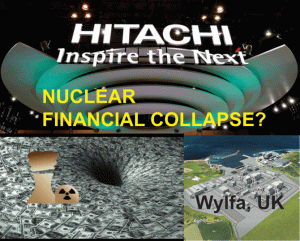 Hitachi to Cease Work on Nuclear Power Plant in North Wales, NYT, Stanley Reed, Jan. 17, 2019, Hitachi said on Thursday that it was suspending work on a 15 billion pound, or $19.3 billion, nuclear power project in North Wales after failing to agree on financial terms with the British and Japanese governments.
“The decision was made from the viewpoint of Hitachi’s economic rationality as a private enterprise,” the company, based in Japan, said.
Ben Russell, a spokesman for Hitachi’s British venture, Horizon Nuclear Power, said that discussions with the governments would continue but that its staff, currently around 300 people, would be cut to “a minimal handful.”
Hitachi will also stop planning work on a second project, in Oldbury, England. The company said it planned to take a write-off of 300 billion yen, or $2.75 billion, on the projects.
The decision by Hitachi is a blow to the British government, which is betting heavily on nuclear installations to help meet the country’s electric power needs in the coming decades.
The big question is whether Hitachi’s move will be a death knell for Britain’s campaign to build nuclear plants, which so far has resulted in only one project under construction.
While there are signs that the government is rethinking its energy policy, it was willing to go a long way toward trying to keep Hitachi on board.
In a statement to Parliament on Thursday, Greg Clark, the secretary of state for business and energy, said the government had been willing to consider providing one-third of the equity financing for the project and to take on all of the construction debt. When Hitachi continued to balk, Mr. Clark said, “I was not prepared to ask the taxpayer to take on a larger share.”
…….For Hitachi, though, the announcement could mark the end of a long and expensive saga. The company acquired the Horizon sites from two German utilities in 2012 for £697 million, or about $900 million, and wound up spending around £2 billion in total on design approvals, staff and other matters. It has been hiring apprentices, who have been training at a technical college on the island and going to Spain and Japan for work experience. At times in recent months more than 100 archaeologists were on the site, excavating and recording ancient structures that the construction would have destroyed.
Hitachi hoped Britain would prove to be an international showcase for its reactor designs. Ultimately, the company lost patience with the high level of spending required to land such a project there.
Hitachi had sought to arrive at a financial arrangement that would attract long-term investors like pension funds to the project and reduce its own exposure. But the offers of support from both the British and the Japanese sides were not enough………https://www.nytimes.com/2019/01/17/business/energy-environment/hitachi-horizon-wales-nuclear-plant.html
January 19, 2019
Posted by Christina Macpherson |
business and costs, politics, UK |
Leave a comment
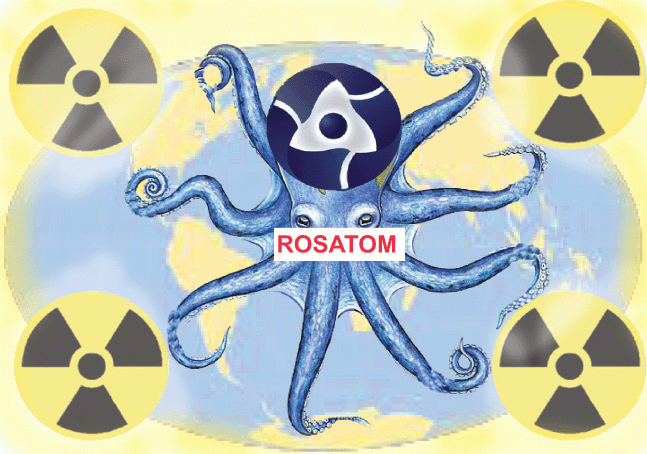
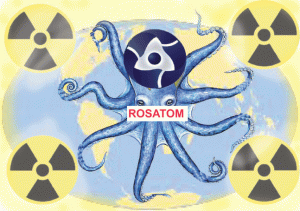 Russia, Serbia sign agreement on nuclear cooperation, Agreement includes construction of center of nuclear science, technology and innovation, Yeni Safak January 18, 2019 Anadolu Agency Russia and Serbia signed a strategic cooperation document for the peaceful use of nuclear energy, Russian State Atomic Energy Corporation Rosatom said on Thursday. Russia, Serbia sign agreement on nuclear cooperation, Agreement includes construction of center of nuclear science, technology and innovation, Yeni Safak January 18, 2019 Anadolu Agency Russia and Serbia signed a strategic cooperation document for the peaceful use of nuclear energy, Russian State Atomic Energy Corporation Rosatom said on Thursday.
The agreement, signed during Russian President Vladimir Putin’s visit to Serbia, includes the construction of a center of nuclear science, technology and innovation, according to the company’s statement.
“In particular, the implementation of the project to build the center of nuclear science, technology and innovation will not only give a powerful impetus to bilateral cooperation between Russia and Serbia in a number of innovative areas, including medicine, industry and agriculture, but will also serve as a platform for cooperation at the level of the entire Central European region,” Likhachev said………
Alexey Likhachev, director general of Rosatom signed the documents on Russia’s behalf, while Nenad Popovich, Serbia’s minister in charge of innovation and technological development, signed them on Serbia’s behalf.
The Russian company has 36 nuclear reactor construction projects in different countries, including Bangladesh, Belarus, China, Egypt, Finland, Hungary, India, Iran and Turkey.
According to the company, its package of foreign orders in 2018 exceeded $130 billion. https://www.yenisafak.com/en/world/russia-serbia-sign-agreement-on-nuclear-cooperation-3472195
|
|
|
January 19, 2019
Posted by Christina Macpherson |
EUROPE, marketing, Russia |
Leave a comment
|
  Dave Toke’s Blog 14th Dec 2019 Dave Toke’s Blog 14th Dec 2019 There’s a bunch of highly misleading statements that the Government is to adopt so-called ‘Regulated Asset Base’ (RAB) financing of nuclear power projects.
Yes, some of the mechanisms that are being proposed are also used in RAB, but the term is being grotesquely distorted to hide the fact that this is a cover for the Government risking very large sums of money to be lent to nuclear power developers.
Put simply, if the nuclear power projects are as expensive as they usually are the electricity consumer will lose an awful lot of money and prices will be jerked upwards. Either that or the
taxpayer takes a hit and funding of public services suffer big time. You can see the cover up printed in the Sunday Times yesterday where, we are told that ‘Ministers are expected to accelerate plans to introduce regulated asset base (RAB) financing, which is popular in the water and infrastructure sectors, for nuclear plants including the Horizon project’.
Under such schemes the developers are allowed to charge consumers in advance for the capital building projects. What Ministers are not emphasising of course, is that in industries such as water the Government does not lend lots of money to the privatised companies. They raise this on private markets. But in the case of nuclear power plants the bulk of the money needed to build them will be borrowed from the Government.
So if the nuclear plant has very big delays and cost overruns (as has happened to ALL nuclear power plant built in the West this century), the Government loses shedloads of money. The Treasury is likely to insist that this gets paid for by adding the (large) sums to electricity consumer bills. RAB has been used to try to finance nuclear power plant in the USA, in the states of Georgia and South Carolina recently.
The result was disaster and the developing company, Westinghouse, went bust. But this was ‘normal’ RAB where the developer takes the risk of cost overruns. But in the proposed UK
nuclear version it will be the electricity consumer who goes bust when the almost inevitable cost-overruns set in!
|
|
January 17, 2019
Posted by Christina Macpherson |
business and costs, politics, secrets,lies and civil liberties, UK |
Leave a comment
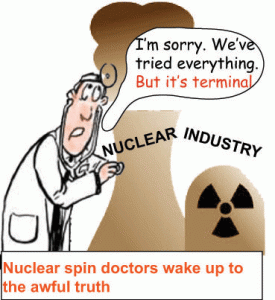 FT 13th Jan 2019 Nick Butler: Who could blame the board of the Japanese company Hitachi if
its members decide at their meeting this week to scrap plans for a new nuclear power station at Wylfa on the North Wales island of Anglesey?
Hitachi has invested more than £840m in the project over the past six years. The technology has passed all the tests set by the UK’s nuclear regulator. But the company has been unable to get the government to put in place the clear and credible financial structure necessary to underpin the investment.
That failure has already led other investors to abandon the new plant planned at Moorside in Cumbria. Talk of scrapping the Wylfa project could be a bargaining tactic on the part of Hitachi but the reality is probably much simpler. Hitachi’s doubts have been well signalled during the
past few months and the company’s purchase of ABB’s power grid business at the end of last year gives it a range of investment choices.
Given Whitehall’s chronic indecision, the company is ready to use its capital elsewhere. Hitachi’s withdrawal would mark the collapse of the energy policy adopted in 2013 by the UK’s coalition government. Facing what were believed to be ever-rising energy prices the policy plumped for new nuclear, promising that 35 gigawatts of new capacity would be on stream by the mid 2030s – more than replacing the first generation of nuclear plants, which would by then have reached the end of their useful lives.
Because the price of gas seemed doomed to keep rising, new nuclear would come to look highly competitive over time as well as reducing dependence on imports. Since then much has changed, and the assumptions which underpinned the old policy now look laughably wrong.
The costs of all forms of energy (apart from nuclear) have fallen dramatically and there is no shortage of supply. Electricity demand is down thanks to efficiency gains and new technology.
The contract for the first new nuclear station being built at Hinkley Point in Somerset, which enjoys a guaranteed index-linked price for 35 years from the moment the plant is commissioned, looks exorbitant. The demise of Wylfa forces the need for a comprehensive review of energy policy.
Since the UK government is too busy preparing for Brexit to focus seriously on any other issue, the review should be conducted independently. Advances in energy technology offer more
possibilities each year. But those options will never be taken up unless the old outdated policy is scrapped and a more realistic approach put in place.
https://www.ft.com/content/7b33e9fa-1648-11e9-9e64-d150b3105d21
January 15, 2019
Posted by Christina Macpherson |
business and costs, politics, UK |
Leave a comment
PG&E ex-CEO gets $2.5 million severance amid wildfire woes
Former PG&E CEO Geisha Williams lands $2.5 million in cash for severance pay despite being in charge during lethal wildfires of 2017 and 2018
January 15, 2019
Posted by Christina Macpherson |
business and costs, USA |
Leave a comment
PG&E to file for bankruptcy due to wildfire lawsuits; shares tank
Utility cites ‘challenges’ from California wildfires, East Bay Times, By LEVI SUMAGAYSAY | lsumagaysay@bayareanewsgroup.com and GEORGE AVALOS | gavalos@bayareanewsgroup.com | Bay Area News Group January 14, 2019 Citing “extraordinary challenges” from the devastating 2017 and 2018 California wildfires, PG&E said Monday that it will file for Chapter 11 bankruptcy protection.
In a filing with the Securities and Exchange Commission, the utility that serves 16 million Californians gave the 15-day notice required by law for filing for bankruptcy, one day after it announced the departure of Chief Executive Geisha Williams. The company’s stock dropped by more than half Monday in response to the early-morning announcement……..
One estimate, from Moody’s Investor Services, puts PG&E’s wildfire liabilities at $15 billion but PG&E said it may face liabilities of $30 billion or more. In its filing Monday, PG&E said it is aware of about 50 complaints from at least 2,000 plaintiffs related to November’s Camp Fire and said it expects more. It also said it knows of about 700 complaints on behalf of at least 3,600 plaintiffs from the 2017 California wildfires. PG&E further stated that if it is found liable for the 2017 and 2018 fires, “punitive damages, fines and penalties could be significant.” ………
San Francisco-based PG&E’s shares plunged 52.4 percent to close at $8.38 on Monday. Since October 2017, when it first became clear that PG&E might be liable for some wildfires, PG&E’s shares have nose-dived by 88 percent……… https://www.eastbaytimes.com/2019/01/14/pge-to-file-for-bankruptcy-shares-tank/
January 15, 2019
Posted by Christina Macpherson |
business and costs, USA |
Leave a comment
 Times 13th Jan 2019
 Ministers will be forced to pioneer a new way of financing nuclear power after Hitachi walked away from a £16bn plant in north Wales. The suspension of the Japanese giant’s Horizon project on Anglesey, expected to be confirmed at a board meeting tomorrow, will force the government to lure investors with a financing method that would pile costs on to consumers, even before a plant has been built.
Ministers are expected to accelerate plans to introduce regulated asset base (RAB) financing, which is popular in the water and infrastructure sectors, for nuclear plants including the Horizon site. Hitachi’s mothballing of its scheme, which could cost about 400 jobs, will be a damaging blow to Britain’s energy policy.
In November, its Japanese counterpart Toshiba scrapped plans to build a nuclear plant at Moorside in Cumbria. Japan’s withdrawal from the UK market will kill the country’s ambitions to sell reactors around the globe.
It leaves Britain dependent on France’s EDF and the Chinese company CGN. Together they are
building the £20bn Hinkley Point power station in Somerset, and CGN has ambitions to build its own reactors on the Essex coast at Bradwell-on-Sea. Industry insiders said state-controlled CGN could swoop on Anglesey if Hitachi puts the project up for sale. Kepco of South Korea would also be interested.
The project’s collapse follows years of negotiations between Tokyo and London. Last summer Britain agreed to split the equity equally with the Japanese government and Hitachi. Ministers were keen to avoid a repeat of the deal struck with EDF, which guarantees at least £92.50 per
megawatt hour for Hinkley Point’s electricity for 35 years. The Horizon deal would have guaranteed about £75 per megawatt hour, falling to the £50s for future reactors on the site.
However, the Japanese government balked at the risk, and tried to pass the equity on to Japanese utility companies. That triggered nervousness at Hitachi, a conglomerate with interests from train manufacturing to power grids. Nuclear power makes up just 4% of its business.
Shares in Hitachi surged almost 9% on Friday amid speculation about Horizon being halted, despite the company having spent more than £2bn on the plans.
EDF is keen to use RAB financing for Sizewell C in Suffolk, its next UK plant. The funding method, which allows investors to earn a set return, has been used for a huge new sewer beneath London and Terminal 5 at Heathrow. However, the pre-funding formula passes some of the risk of cost overruns on to consumers, and their bills rise even before a project has been completed.
https://www.thetimes.co.uk/article/fce4e714-169e-11e9-9e09-701e9f424b2e
January 14, 2019
Posted by Christina Macpherson |
business and costs, politics, UK |
Leave a comment
Senate doesn’t have the votes to sell Santee Cooper after nuclear fiasco, leaders say, BY AVERY G. WILKS, JANUARY 13, 2019 BUT EVEN THE HIGHEST BIDDER MIGHT NOT WIN THE STATE’S APPROVAL TO TAKE OVER THE 85-YEAR-OLD UTILITY.
A proposed sale, which needs the S.C. General Assembly’s approval, seems likely to die in the state Senate, where senators are skeptical that selling Santee Cooper is the best solution to the agency’s nuclear woes.
Senators also say they don’t want a long and complicated debate over Santee Cooper to drown out the General Assembly’s No. 1 priority for 2019: public education reform……https://www.thestate.com/news/politics-government/article224287910.html
January 14, 2019
Posted by Christina Macpherson |
business and costs, USA |
Leave a comment
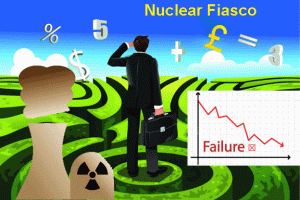 Japan’s nuclear rethink could derail UK energy plans, https://unearthed.greenpeace.org/2019/01/09/japan-uk-nuclear-plans-go-awry/, Doug Parr, 11 Jan 19, Reports in the Japanese press claim Hitachi is set to suspend all work on Wylfa, its nuclear power project in Wales.
Japan’s prime minister Shinzo Abe is in London this week, and it seems likely in his meeting with Theresa May that the Japanese-backed nuclear power plant in Wales will come up.
The Wylfa project, to be built by Hitachi and its subsidiary Horizon, is one of a clutch of planned nuclear power stations which the UK government has heavily prioritised for security of power supply, and meeting the country’s climate obligations.
Late last year another of the 6 major projects, the proposed Moorside plant in Cumbria, was effectively abandoned after Toshiba pulled out. And another has come under fire as questions are raised about security issues flowing from the Chinese builders.
These developments effectively illustrate that UK nuclear power policy is heavily dependent on overseas developers. What is less understood is that there are significant shifts underway in Japan which strongly suggest Hitachi’s projects may too be at risk.
‘Nuclear export superpower’ The most advanced of Horizon’s nuclear plans is a large power station to be built at Wylfa on Anglesey, North Wales.
In fact, with the collapse of Moorside, the Wylfa plant is the only nuclear project that could realistically be built before 2030, in addition to the plant already under construction at Hinkley Point in Somerset.
Japan, however, is reconsidering its nuclear export strategy. Because it keeps going wrong.
Until recently it had 3 companies interested in building nuclear power stations abroad: Toshiba, Mitsubishi and Hitachi.
These companies have experience building nuclear stations at home but since the Fukushima disaster in 2011, they have had to look elsewhere. Seeking to help these giants of Japanese industry to maintain their businesses, Prime Minister Abe reportedly wanted to turn Japan into a “nuclear export superpower”.
Misfires Toshiba pulled out of Moorside last year because it had run up huge losses in building 2 nuclear plants in USA. One, the Summer project in South Carolina, was abandoned altogether despite it being nearly half-built. Toshiba has pulled out not just of Moorside, but of building new nuclear power stations altogether.
Meanwhile, another of Japan’s nuclear groups, Mitsubishi Heavy Industries (MHI), has also been struggling to get its international project off-the-ground. It had one nuclear power station in the offing, at Sinop in Turkey, following an agreement years ago between the two countries’ prime ministers. However it seems clear that MHI is preparing to leave the project amid its “ballooning costs”. This is the only nuclear power station project MHI had an interest in.
The last of the companies involved in Japan’s nuclear export push is Hitachi. It has one active overseas nuclear project in UK at Wylfa, North Wales, and one more speculatively planned at Oldbury in Gloucestershire.
Hitachi, however, are reportedly be thinking of scrapping the project as its costs and risks become unmanageable. Hitachi could be looking at Toshiba’s near-bankruptcy and thinking ‘let’s not go there’. According to their chairman the project was in “an extremely severe situation” as it struggled to attract investors, even though UK government may have promised as much as two thirds of the build cost.
Despite this already generous largesse (on behalf of UK taxpayers, not offered to any other energy projects) Hitachi are intending to come back to UK government and ask for more. It looks like no assessment of the risks by a private funder come back looking good, and the only way nuclear plants can be built is with government stepping into very risky projects that require taxpayers to shoulder the risk.
The aversion from private investors may not only be because of the rising costs, but also that the operating performance of the proposed reactor is pretty poor (albeit partly due to earthquakes). Notably Hitachi continues to be happy to spend many billions of pounds on power grid investments, but not its own nuclear reactor, which it wants UK taxpayers to fund.
Second thoughts Unsurprisingly this tale is making many in Japan have second thoughts.
Major Japanese newspapers have opposed their own taxpayers lending supportto the Wylfa project, even though a home-grown company would be getting the benefits. And during the Xmas break, Japan’s third largest newspaper called for the nuclear export strategy to be abandoned. Another paper attacks the ‘bottomless swamp’ of nuclear funding in UK and remarks upon how few countries seem to be following the UK-style nuclear-focused policy.
Reportedly Japanese government has asked its development banks to fund the ‘nuclear export strategy’, and Wylfa in particular, but they don’t want to. It is quite difficult to see how Hitachi can manage the risks of this project without some home support, and support in Japan is ebbing away.
Few other countries will be stepping into the UK’s nuclear hole. The South Korean company KEPCO – that once might have taken over the Moorside project – is also finding exporting nuclear power tough to export, as ‘shoddy’ construction in a nuclear plant in United Arab Emirates, with attendant delays and extra costs, is showing.
For the UK, which has made a heavy bet on new nuclear to cover for retiring plants and make up a significant share of its decarbonisation targets, news from the other side of the world makes that bet look a dodgy one.
January 12, 2019
Posted by Christina Macpherson |
business and costs, Japan, politics, UK |
Leave a comment










 nuclear-news